The Architect of Order
The ESTJ is one of the more instantly recognizable psychological profiles, precisely because its qualities are so visible in ordinary life. Wherever an organization needs someone to keep it running, wherever a family needs someone to hold the schedule together, wherever a group of people drifting toward chaos needs a single figure to impose coherence, an ESTJ is likely to step forward without being asked twice. This is not an accident of circumstance but an expression of a deep psychological orientation toward the external, observable, and measurable world. The ESTJ trusts what can be seen, tested, and proven far more readily than what can only be felt or imagined, and this trust becomes the foundation for an entire way of engaging with life. Where other temperaments might hesitate before uncertainty, deliberating endlessly over possibilities, the ESTJ tends to move directly into action, treating movement itself as a form of clarity. This is why the type is so often associated with leadership, management, and institutional stability — not because these roles are imposed on them from outside, but because they represent the most natural expression of an inner architecture built around competence, structure, and results.
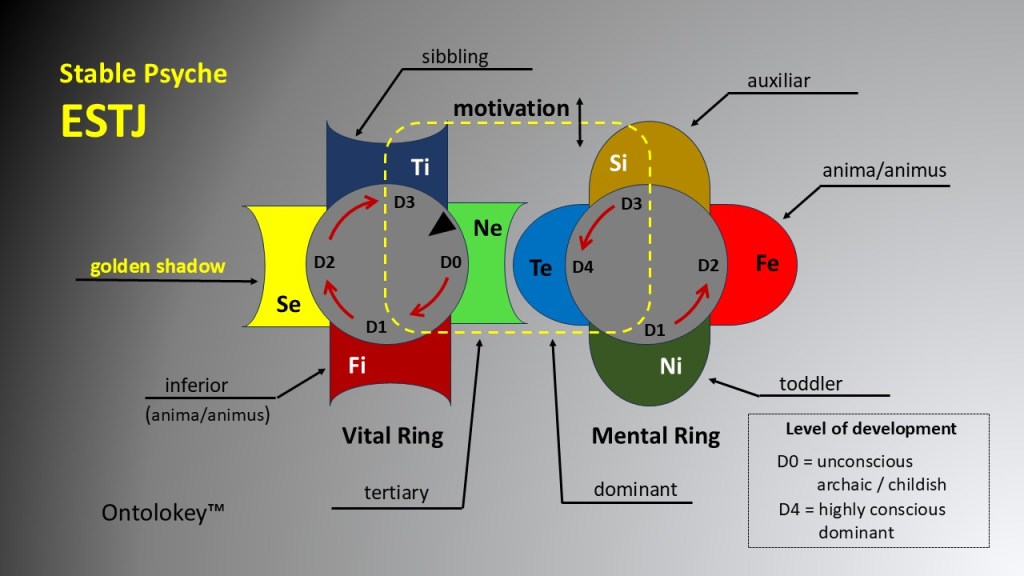
It would be a mistake, however, to treat this profile as a flat or one-dimensional archetype of the disciplined manager, the strict parent, or the no-nonsense executive. Beneath the outwardly practical and sometimes blunt exterior lies a far more layered psychological system, one that includes not only the traits an ESTJ consciously identifies with but also a series of underdeveloped, hidden, and sometimes disowned dimensions of the self. Understanding the ESTJ properly requires looking at both halves of this picture: the conscious strengths that make the type so effective in the world, and the unconscious material that, left unexamined, can quietly distort those very same strengths into something considerably darker. This summary attempts to hold both halves together, moving first through the familiar description of the type’s conscious functioning and then descending into the shadow material that Ontolokey’s longer essays explore in far greater depth.
The Conscious Architecture: Thinking, Memory, and the Public Persona
At the center of the ESTJ’s conscious personality sits a dominant orientation toward organizing the external world according to logic, efficiency, and cause-and-effect reasoning. This is the engine that drives the type’s characteristic decisiveness, their comfort with responsibility, and their tendency to evaluate ideas not by how elegant or interesting they sound but by whether they actually produce results. For the ESTJ, life is fundamentally something to be shaped rather than merely interpreted, and this orientation gives them an unusual immunity to certain forms of wishful thinking that trap other personalities. They notice what functions and what fails with a kind of unsentimental clarity, and they feel a near-moral obligation to fix what is broken rather than simply commenting on it. This same orientation, however, carries within it the seed of a particular rigidity, because a mind so committed to external validity can grow impatient with ambiguity, emotional nuance, or ideas that cannot yet prove their practical worth. When this tendency intensifies without balance, it can slide into micromanagement or a kind of utilitarian bluntness that overlooks the inner lives of the people being managed.
Supporting this outward-facing drive is a quieter, inward-facing function concerned with memory, tradition, and accumulated experience. This is what gives the ESTJ their characteristic loyalty to what has already been tested and proven, their preference for routines that work rather than novelties that merely promise to work, and their deep respect for craftsmanship, quality, and consistency in the physical world around them. It explains why so many ESTJs maintain orderly homes, dependable schedules, and a wardrobe or set of tools chosen for durability rather than trend, and why they often carry sentimental attachments to family rituals and inherited customs even when they rarely speak about it openly. This same function also shapes the social mask the ESTJ tends to present to unfamiliar people, a mask that can look warmer, gentler, and more nurturing than their core decision-making style would suggest, because they have learned that maintaining social harmony is itself a kind of order worth preserving. The cost of this reliance on precedent is a wariness toward genuine innovation, a suspicion of ideas that have not yet earned their keep through repetition and proof, which can make the ESTJ slow to adapt when circumstances genuinely call for something new.
Beneath these two dominant currents runs a far less visible emotional life, one that rarely announces itself in ordinary conversation but that exerts real influence over how the ESTJ experiences connection, belonging, and recognition. Although this type is frequently mistaken for someone who simply lacks emotional depth, the truth is closer to the opposite: emotion runs powerfully beneath the surface, but it has never been given the same deliberate cultivation as their practical faculties, so it tends to surface unpredictably rather than fluently. This is why an ESTJ might suddenly tear up during a toast, laugh with unexpected intensity at a joke, or deliver a surprisingly heartfelt speech at a family occasion, catching even themselves off guard by the depth of feeling involved. It also explains their genuine, if sometimes clumsy, desire to be liked and appreciated, and their strong need for their effort and loyalty to be visibly acknowledged by the people around them. When this emotional current is wounded, particularly through betrayal or disrespect, the pain tends to be suppressed, rationalized, or converted into renewed activity rather than processed directly, which means it can linger far longer beneath the surface than anyone would guess from the ESTJ’s composed exterior.
There is, further, a quieter and more private layer still, concerned not with the approval of others but with an internal sense of what is simply right. This layer rarely speaks in the ESTJ’s everyday vocabulary, and it can feel foreign or even embarrassing to them precisely because it does not respond to logic or results the way their dominant faculties do. Yet it is this layer that produces their capacity for real moral seriousness — the promise that is kept even when keeping it is costly, the quiet protection offered to someone who cannot defend themselves, the deep hurt that follows a betrayal of trust regardless of how rationally the ESTJ tries to explain it away. Because this inner world is so unfamiliar to them, ESTJs often default to fixing rather than comforting when someone close to them is in emotional pain, not out of coldness but because they genuinely do not know another way to help. When this dimension is neglected for too long, it can produce a private sense of guilt, moral inadequacy, or quiet loneliness that the ESTJ rarely admits to anyone, including themselves, precisely because admitting it would seem to contradict the image of strength and self-sufficiency they have built their identity around.
Rounding out the type’s fuller psychological picture are two further currents that remain largely aspirational rather than dominant: a playful curiosity about new ideas and unconventional people, which can surface as an unexpected sense of humor or an interest in hobbies far outside the ESTJ’s usual routine, and a fascination with pure sensory presence — spontaneity, physical vitality, aesthetic pleasure — that the ESTJ often admires in others more than they permit themselves to embody directly. Both of these currents represent genuine untapped potential rather than core identity, and when an ESTJ manages to integrate them even partially, the effect is a noticeably more relaxed, magnetic, and full-bodied version of the same fundamentally disciplined person. Taken together, this constellation of conscious strengths and semi-conscious undercurrents forms a personality capable of enormous constructive contribution to the people and institutions around it — provided the underlying psychological tensions are recognized rather than left to fester unattended.
Where the Shadow Begins
Every one of the strengths described above carries within it a corresponding danger, and the danger rarely takes the form of a simple opposite. A leader does not typically decay into a tyrant by becoming weak or incompetent; instead, the tyrant is often what a leader becomes when their strengths detach from self-awareness and begin operating without any internal check. This is precisely the mechanism through which the ESTJ’s shadow develops. Discipline does not vanish — it hardens into rigidity. Responsibility does not disappear — it evolves into control. Leadership does not collapse — it curdles into domination. None of these transformations happen suddenly or through a single dramatic decision; they unfold gradually, through years of small psychological adjustments that each seem reasonable when considered on their own, until the accumulated pattern has quietly reshaped the person’s entire relationship to the world around them.
The root of this process lies in how thoroughly the ESTJ’s sense of self-worth becomes entangled with effectiveness. Early in life, competence earns praise, reliability earns trust, and results earn respect, and it is entirely natural for a person to begin identifying with the role they perform so consistently and so well. Over time, however, this identification deepens past the point of healthy self-esteem into something closer to psychological dependency. Achievement stops being merely a goal and becomes a source of identity; responsibility stops being merely a duty and becomes proof of personal value; authority stops being merely a practical tool and becomes a confirmation of worth itself. As long as the world continues to reward effort with results, this arrangement feels stable and even admirable. The trouble begins the moment reality stops cooperating — when hard work goes unrecognized, when loyalty is betrayed, when someone less capable is promoted instead, or when authority is challenged by people the ESTJ does not respect. Because their sense of self has become so tightly bound to effectiveness, these experiences do not register merely as disappointments; they register as threats to identity itself, and the resulting wound tends to cut far deeper than an outside observer would expect.
Out of this wound grows one of the defining emotional currents of the ESTJ shadow: resentment. Resentment is a fundamentally different animal from ordinary anger, because anger discharges itself quickly while resentment accumulates silently over time, stored rather than released, remembered rather than forgotten. The ESTJ is especially vulnerable to this pattern precisely because they tend to invest so heavily in effort, sacrifice, and responsibility, which creates a strong implicit expectation that such investment will eventually be reciprocated. When it is not — when credit goes to someone else, when political maneuvering triumphs over merit, when gratitude never arrives — the ESTJ does not simply feel disappointed; they feel a genuine sense of moral violation, as though an unwritten contract between effort and reward has been broken. What makes this dynamic so psychologically dangerous is that the underlying perception is often at least partly accurate. The ESTJ frequently has worked harder, sacrificed more, and possessed greater competence than the people around them, and this kernel of truth makes the resulting resentment feel entirely justified rather than distorted, allowing it to grow largely unchecked. Over time, an internal ledger begins to form in which every sacrifice is recorded, every disappointment carries symbolic weight, and human relationships slowly reorganize themselves around calculations of fairness and reciprocity rather than genuine warmth.
The Turn Toward Power and Control
As resentment accumulates, it tends to intertwine itself with an increasing attraction to power, though the underlying motivation here is rarely a straightforward desire for dominance. Power, for a personality whose psychological security depends so heavily on effectiveness, functions primarily as a kind of insurance against future helplessness — it reduces uncertainty, increases predictability, and allows intention to shape outcome more reliably. In its earliest and healthiest form, this attraction remains entirely reasonable: the ESTJ pursues leadership because leadership allows them to solve real problems, and authority remains a tool serving practical goals rather than a substitute for anything deeper. Under conditions of prolonged frustration or wounded pride, however, this relationship to power begins to shift in a subtler and more troubling direction. Authority stops being merely useful and starts becoming psychologically necessary, control begins protecting self-esteem rather than simply improving outcomes, and disagreement starts to feel less like an intellectual difference of opinion and more like personal opposition that must be managed or neutralized.
What makes this shift especially difficult to detect, both for the ESTJ themselves and for the people around them, is that it typically hides behind a completely sincere sense of moral conviction. Unlike personality types that pursue power in an openly self-interested way, the ESTJ almost always frames their growing need for control in the language of duty, efficiency, or collective welfare, and because they genuinely do possess real competence, this framing often contains enough truth to make it convincing even to themselves. The individual gradually develops an unshakable conviction that they simply know what is best, a belief that starts out reasonably grounded in genuine experience but slowly hardens past the point of legitimate confidence into something closer to psychological infallibility. Once this threshold is crossed, criticism stops being treated as useful information and starts being interpreted as opposition; independent thinkers become troublesome rather than valuable; and the full complexity of other human beings gradually collapses into a simplified internal ledger of loyalty versus disloyalty, usefulness versus obstruction. This same period tends to coincide with a widening gap between how rational the ESTJ believes their decisions to be and how much those decisions are actually being driven by unacknowledged emotional wounds — hurt expressing itself as anger, fear expressing itself as control, humiliation expressing itself as aggression — a paradox in which the personality appears most purely logical precisely at the moments when it is furthest from genuine objectivity.
A closely related development is the slow curdling of admiration for competence into outright contempt for its absence. Throughout their lives, ESTJs typically learn to associate strength, discipline, and self-reliance with both success and psychological survival itself, which means that qualities symbolizing the opposite — dependency, indecision, emotional fragility, helplessness — do not merely register as unappealing in other people but as uncomfortable reminders of a state the ESTJ desperately fears within themselves. In healthy development this discomfort motivates the individual to keep growing stronger while retaining compassion for ordinary human limitation, but under shadow conditions the same discomfort curdles into irritation and then into judgment. Mistakes start to seem unforgivable, emotional needs start to feel burdensome, and the suffering of others is increasingly filtered through a lens of personal responsibility rather than genuine empathy. At its most advanced stage, this pattern produces a kind of psychological blindness in which human worth becomes conditional on performance, compassion is mistaken for indulgence, and the basic recognition that strength and weakness coexist in every person — including the ESTJ themselves — is quietly lost.
The Paranoid Turn and the Architecture of Grievance
Once resentment and the need for control have become sufficiently entrenched, a further and considerably darker development can emerge: a gradual reinterpretation of reality itself as a landscape of hidden threats and betrayals. This is not the theatrical paranoia of popular imagination, built from bizarre or delusional beliefs, but a much quieter and more insidious process rooted in experiences that often contain genuine elements of truth. The ESTJ has, in many cases, actually been betrayed, undermined, or treated unfairly at some point, and the danger is not that these original perceptions are false but that they gradually become generalized into an entire worldview. Neutral actions start to acquire suspicious meaning, ambiguous situations are interpreted negatively by default, criticism stops being received as feedback and starts being read as evidence of opposition, and every interaction is unconsciously scanned for signs of disrespect or disloyalty. This process is intensified by one of the ESTJ’s genuine cognitive strengths — an unusually precise memory for practical, concrete events — which under healthy conditions supports accountability and realism but under shadow conditions becomes a permanent archive of grievances, continually expanding and continually reinforcing an emerging narrative of betrayal.
This narrative performs an important, if ultimately self-defeating, psychological function: it protects the individual’s self-esteem from a far more threatening realization, namely that effort and competence cannot actually guarantee outcomes in an unpredictable world. It is considerably easier, psychologically speaking, to conclude that other people are malicious than to accept that life itself is simply unpredictable, because malice at least implies a coherent explanation while randomness offers none. As this mentality deepens, relationships gradually shift from intimacy toward strategy, with every interaction quietly evaluated according to questions of trust, loyalty, and threat, and the rich individuality of other people compressed into a much simpler framework of ally, competitor, obstacle, or potential traitor. From here it is only a short psychological distance to what might be called the tyrant pattern — not a uniquely evil character type, but rather the pathological exaggeration of otherwise admirable qualities such as discipline, determination, and organizational capacity. What distinguishes a genuine leader from this darker pattern is not the presence or absence of strength but the individual’s relationship to that strength: a genuine leader remains accountable to reality and capable of self-correction, while the shadow-oriented ESTJ begins defending their authority because that authority has become inseparable from their emotional survival, and any threat to it feels indistinguishable from a threat to their very identity.
Perhaps the most unsettling feature of this entire trajectory is that the individual almost never experiences themselves as a villain during any stage of it. On the contrary, they typically continue to see themselves as the last responsible person left standing in an increasingly irresponsible world — a protector of standards, a defender of order, a guardian of competence — and this self-perception frequently contains real elements of truth, since the ESTJ often genuinely does work harder and judge more accurately than those around them. The corruption here does not begin with an obvious falsehood but with the gradual conversion of a legitimate strength into a claim of moral superiority: the belief that one is capable slowly becomes the belief that one is indispensable, which in turn becomes the belief that one alone understands what must be done, until eventually ordinary moral constraints start to seem like unnecessary obstacles standing between the individual and goals they have convinced themselves are too important to compromise. This same blindness tends to seep directly into intimate relationships, where love gradually acquires transactional qualities, affection becomes quietly linked to obedience, and disagreement starts to feel indistinguishable from betrayal — all while the individual remains sincerely convinced that their increasing control is simply an expression of care.
The Addiction to Being Right, and the Refusal to Forgive
A further thread running through the ESTJ shadow concerns the slow transformation of ordinary confidence into something closer to psychological addiction. In its healthy form, confidence develops naturally from repeated experience of sound judgment, and it enables the kind of decisive action that makes the ESTJ so valuable in positions of responsibility. The danger emerges when the ability to be correct stops functioning merely as a useful skill and starts functioning as the entire foundation of self-worth, so that being right no longer simply feels satisfying but becomes psychologically necessary for maintaining a stable sense of identity. Once this shift occurs, disagreement is no longer processed as an ordinary intellectual difference but as a direct threat to the self, and conversations quietly stop functioning as collaborative searches for truth and start functioning as contests to be won. This explains why so many shadow-oriented ESTJs grow more rigid over time despite remaining genuinely intelligent — the obstacle is rarely an inability to understand alternative perspectives, but rather an inability to emotionally tolerate what being wrong would imply about a self-concept built almost entirely on reliability and competence.
Closely related to this dynamic is a profound and often lifelong difficulty with forgiveness. The same precise memory for concrete events that makes the ESTJ so dependable in practical matters becomes, under shadow conditions, a mechanism for keeping old wounds permanently alive, because the injury has by this point become woven into the individual’s very identity and narrative of self. To forgive would mean relinquishing a story that has come to feel central to who they are, surrendering a hard-won source of moral certainty, and acknowledging that an old injury no longer needs to define present reality — and all of this can feel, to the shadow-oriented ESTJ, like a kind of self-erasure rather than a form of freedom. The tragedy of this pattern is self-reinforcing: the longer a grievance is nursed, the more essential it becomes to the individual’s sense of self, and the more essential it becomes, the harder it grows to release, until eventually it is no longer accurate to say the person is holding onto the past — the past has begun holding onto them. A closely related and equally seductive narrative is what might be called the tragic hero complex, in which the ESTJ comes to see their very real sacrifices and burdens as evidence not merely of hard work but of a kind of moral elevation above the people around them, a self-image that offers real comfort in the short term but that ultimately isolates the individual from the mutual, reciprocal relationships that could otherwise ease their burden.
The Path Toward Integration
The deepest danger of the ESTJ shadow is, in the end, neither cruelty nor domination as such, but a fundamental misunderstanding about the nature of strength itself. For most of their lives, ESTJs learn to equate strength with competence — the capacity to remain capable when others falter, disciplined when others drift, and responsible when others retreat — and these qualities genuinely do allow them to build careers, families, and institutions of real and lasting value. Yet every psychological strength eventually meets a limit it cannot overcome through further effort. There are losses that discipline cannot prevent, betrayals that authority cannot undo, and forms of uncertainty that no amount of control can ever fully eliminate, because uncertainty is not a solvable problem but a basic condition of human existence itself. The tragedy of the shadow-oriented ESTJ is that they often spend years, sometimes decades, attempting to resolve fundamentally existential difficulties using methods that only ever worked reliably within the practical world, and the promised relief of each new achievement or position of authority never quite arrives, because the underlying fear was never actually about competence or control in the first place.
The turning point, when it comes, usually arrives through some experience that simple willpower cannot master — failure, loss, aging, or the confrontation with mortality itself — moments in which the fears that had been quietly suppressed beneath years of achievement finally surface and demand to be acknowledged. At this juncture two paths become visible. One leads toward an ever-deepening rigidity, in which the individual doubles down on control, intensifies suspicion, and seeks ever greater authority in a desperate attempt to hold uncertainty at bay, preserving the appearance of strength while gradually impoverishing the inner life beneath it. The other path requires a far more demanding form of courage: the willingness to discover that vulnerability is not the opposite of strength but an essential part of it, that true authority does not depend on domination, that genuine confidence does not require constant validation, and that real competence has nothing to prove through superiority over others. Along this second path, forgiveness stops looking like weakness and starts looking like liberation, because every grievance carried indefinitely becomes another link in a chain binding the present to an old and unhealed wound, and releasing that chain does not mean excusing what happened but simply refusing to let it continue shaping the future. The mature, integrated version of this personality ultimately arrives at a paradoxical but profoundly freeing realization: the strongest individual is not the one who manages to control everything around them, but the one who eventually discovers they no longer need to.
This summary has drawn together only the essential contours of a psychological portrait that Ontolokey explores in considerably greater detail across several independent essays, each examining a different function or dimension of the ESTJ personality — from the mechanics of its dominant thinking style to the specific literary and archetypal expressions of its shadow. Readers who recognize themselves, a colleague, or a family member in these pages, and who want to understand the fuller architecture behind this brief overview — or who are curious about how the other fifteen personality types are mapped within the same three-dimensional framework — are warmly encouraged to visit www.Ontolokey.com, where the complete essays, along with the broader theoretical model behind them, are freely available for further reading.


Leave a comment