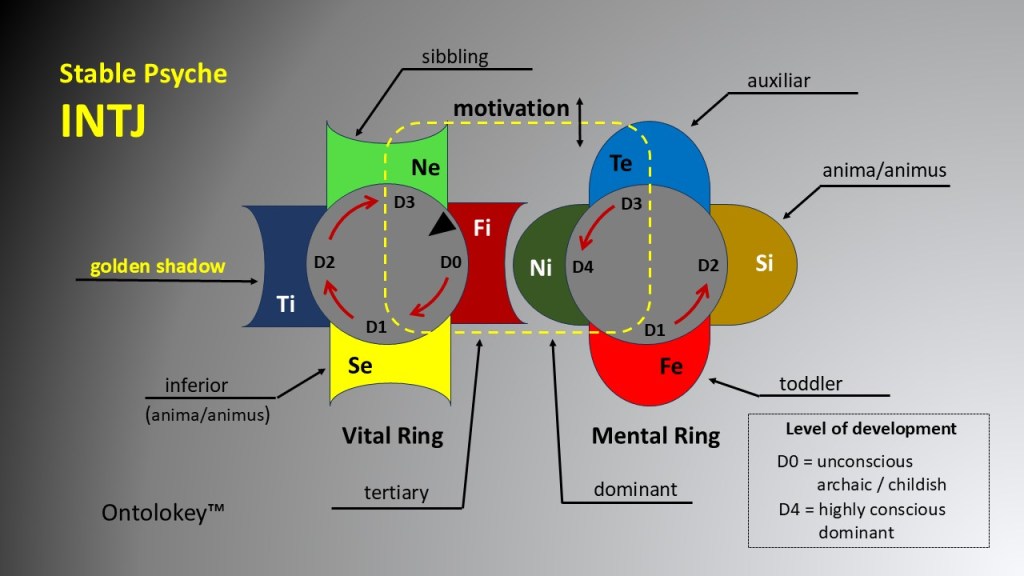
The INTJ personality is one of the most consistently mythologized profiles in the entire landscape of personality theory. Popular descriptions tend to circle around the same handful of adjectives: strategic, independent, visionary, cold, brilliant, distant. These words are not wrong, but they are dangerously incomplete, because they describe only the surface of a psychological architecture that is, in reality, far more layered and far more conflicted than the popular caricature suggests. According to the Ontolokey model, personality is not reducible to four dominant traits but is instead built from eight interacting psychological functions, each occupying a different position of strength, maturity, and unconscious pressure within the individual’s inner life. Understanding the INTJ requires looking at both ends of this structure — the conscious functions that produce the famous “mastermind” reputation, and the unconscious functions that quietly generate the tension, isolation, and internal conflict that so often accompany this type beneath its composed exterior.
The Familiar Portrait: Vision, Structure, and Quiet Control
At the center of the INTJ’s conscious personality sits an intuitive function oriented inward, which Ontolokey describes as the source of the type’s uncanny sense of foresight. This is not mysticism; it is a pattern-recognition capacity so deeply internalized that the future often feels, to the INTJ, less like a set of possibilities and more like a trajectory already in motion. Ontolokey’s material describes how this function allows the INTJ to notice subtle shifts long before others register them, giving rise to a kind of quiet, unspoken advisory role in groups — the person who sees the pothole before anyone else has left the driveway. This foresight is frequently mistaken for pessimism, but the sources are clear that what looks like gloom is closer to preparation: the INTJ trusts what is probable rather than what is merely hoped for, and treats time itself as a resource to be managed with the same seriousness other people reserve for money.
Supporting this inner vision is a second function, oriented outward and organized around logic, structure, and efficiency. Where the inward intuitive function generates the picture of what could be, this outward thinking function is what actually builds it. According to the material, INTJs are rarely dreamers in the passive sense; they are architects who translate insight into workable systems, timelines, and procedures. This is the part of the personality that thrives on autonomy, resents micromanagement, and quietly constructs better methods than the ones handed to them, simply because inefficiency offends something structural in how they process the world. It is also, notably, the function most visible to employers, colleagues, and casual acquaintances, which is precisely why so many outside observers mistake the whole person for nothing more than a competence engine.
Beneath these two dominant forces lies a quieter, more sentimental layer that rarely receives public attention. Ontolokey’s material describes an unexpected attachment to the familiar — favorite chairs, worn books, specific rituals of tea or candlelight — that gives the INTJ’s private world a texture entirely at odds with the stereotype of cold detachment. This function also explains the type’s tendency toward quiet preparedness: the stocked pantry, the “just in case” drawer, the general instinct to secure the material foundations of life so that the mind is free to roam elsewhere. It is not glamorous, and it is rarely discussed, but it gives the INTJ’s inner world an anchor that keeps the more abstract and future-oriented functions from spinning entirely free of the ground.
Where things become more complicated is in the domain of shared emotional life, a domain the sources describe as something closer to foreign terrain than home territory. INTJs are not without feeling — quite the opposite, as later sections make clear — but they are generally uncomfortable navigating the emotional atmospheres that other people move through instinctively. Raised voices, public displays of feeling, and unpredictable emotional turbulence tend to register as something closer to a threat than a normal part of human interaction, and the INTJ’s typical response is containment rather than participation. This containment is very often misread by partners and friends as coldness or judgment, when in fact, according to the material, it usually reflects an anxious uncertainty about what to do with emotional information that resists the kind of orderly processing this type prefers for almost everything else in life.
The Architecture of the Unconscious
Ontolokey’s broader analysis of the INTJ places particular emphasis on what happens at the far end of the functional stack, in the territory the individual is least equipped to consciously manage. The inferior position is occupied by an outward-facing sensory function, concerned with immediate physical experience — texture, taste, spontaneity, the raw immediacy of the present moment. Because this function sits so far from conscious control, it frequently manifests either as blind avoidance, where the INTJ neglects bodily needs and aesthetic surroundings almost entirely, or as occasional bursts of uncharacteristic indulgence under stress, followed swiftly by self-criticism. The material is careful to note that this function is not simply a weakness to be tolerated; it is described as a genuine gateway toward psychological wholeness, since learning to inhabit the present moment without needing to control or predict it is one of the more difficult and valuable developmental tasks this type can undertake.
Nested between the dominant and inferior positions are several functions that Ontolokey treats as developmental way-stations rather than fixed traits. A tertiary function tied to inward, personal values gives the INTJ a private ethical compass that rarely gets voiced aloud but shapes nearly everything the person considers acceptable or unacceptable behavior, both in themselves and in others. Alongside it sits a skeptical, somewhat contrarian relationship with open-ended possibility — the part of the INTJ’s mind that meets a new idea not with excitement but with an immediate scan for weaknesses, flaws, and hidden costs. And deeper still lies what the material calls a golden shadow: a capacity for pure, self-contained logical elegance that the INTJ does not use daily but which, when it surfaces, produces some of the type’s most refined intellectual and even philosophical insight. Taken together, these functions form less a static personality profile than a living, unevenly developed ecosystem, one whose various parts are frequently in tension with one another rather than operating in smooth cooperation.
Where the Portrait Breaks Down: The Shadow Beneath the Mastermind
It is precisely at this point, according to the more recent Ontolokey material devoted specifically to shadow analysis, that the conventional description of the INTJ stops being merely incomplete and starts being genuinely misleading. The problem, as the material frames it, is structural rather than incidental: the very faculties that make this personality so effective are the same faculties that, left unchecked, generate its deepest psychological wounds. The capacity to rise above collective illusion can just as easily isolate a person from ordinary human reality. The independence that protects against manipulation can slowly starve a person of connection. And the devotion to truth that makes the INTJ such a valuable critic of flawed systems can, with enough repetition, turn inward and become a merciless instrument aimed squarely at the self. This is not a minor caveat tacked onto an otherwise glowing profile; it is, according to the source material, the central psychological fact of the type, and understanding it changes the entire picture.
The first and perhaps most foundational layer of this shadow concerns the INTJ’s relationship with feeling itself. Contrary to the popular assumption that this type simply lacks emotional depth, the material insists that the actual problem is one of governance rather than absence: emotional life exists in full, but it is subjected to such intense internal scrutiny before it is permitted conscious expression that it rarely completes its natural course. An emotion arises, and almost immediately an internal tribunal convenes to ask whether it is rational, useful, justified, or safe to acknowledge — and by the time this interrogation concludes, the feeling has often been filtered into something manageable rather than something lived. Over years, this pattern produces a peculiar kind of self-alienation, because a person who habitually intercepts his own emotional responses eventually loses clear access to what he actually values, enjoys, or finds meaningful, and begins instead to substitute abstract principle and inherited obligation for authentic internal conviction. The tragedy the material identifies here is that this substitution frequently feels, from the inside, like strength and clarity, when in fact it represents a slow and largely invisible disconnection from the emotional foundation that gives reasoning its purpose in the first place.
Closely related to this emotional suppression is a second shadow pattern the material calls a fortress of superiority — a defensive structure built not from genuine confidence but from an early and often painful sense of difference. Many INTJs, according to this analysis, recognize from a young age that their attention gravitates toward patterns and long-range implications in a way that sets them apart from peers absorbed in immediate social dynamics, and this early estrangement, if left unprocessed, tends to calcify into a worldview that reframes exclusion as distinction. Rather than experiencing loneliness directly, the individual reinterprets it: other people are not simply different, they are shallow; the individual is not misunderstood, others are simply incapable of understanding. This reframing offers real psychological protection in the short term, but the material argues that it comes at a steep long-term cost, because the very standards used to justify the fortress are frequently applied with equal severity to the self, producing a person who appears outwardly composed while privately measuring himself against ideals no human being could consistently meet.
A third and especially destructive layer of the shadow involves the transformation of ordinary self-discipline into what the material bluntly calls an internal dictatorship. Discipline itself is treated as a genuine virtue throughout the source texts, but the shadow emerges when self-governance stops serving the individual’s life and starts waging war against it. The material draws a sharp and important distinction between insecurity and self-condemnation: an insecure person doubts his abilities, while a self-condemning person doubts his fundamental nature, and the latter is a far more corrosive condition because it cannot be resolved through achievement. INTJs are described as unusually capable of sustaining this kind of internal regime for long stretches of time, partly because their considerable willpower allows outward functioning to continue smoothly even as the emotional foundations beneath it quietly erode — a mismatch that often delays recognition of the problem, both by the individual and by the people around him, until the eventual collapse arrives in the form of burnout, unexplained anger, or a kind of pervasive exhaustion that no amount of rest seems to touch.
The fourth shadow theme the material develops concerns the growing distance many INTJs experience between mind and body, a split that rarely announces itself as a deliberate choice but accumulates gradually through thousands of small decisions to prioritize abstraction over sensation. Instinct, desire, and bodily need come to be treated less as sources of information and more as inconveniences to be managed or overridden, and pleasure itself becomes psychologically suspect whenever it resists justification in terms of productivity or long-term strategy. The material is careful to point out that this is not a permanent or necessary feature of intelligence — instinct is described as one of intelligence’s oldest and most reliable foundations rather than its opposite — but the shadow nonetheless pushes the INTJ toward treating embodiment as something to transcend, with the frequent and ironic consequence that neglected physical and sensory needs eventually reassert themselves in compulsive or disruptive forms precisely because they were never allowed conscious integration.
Perhaps the most philosophically serious of the shadow patterns described in the material is the slow drift toward nihilism that some INTJs experience later in life. Because this type is unusually skilled at pattern recognition, it is also unusually capable of noticing the inconsistencies, hypocrisies, and structural flaws that run through institutions, relationships, and belief systems generally dismissed or overlooked by others. In healthy development, this discernment produces wisdom and appropriately calibrated skepticism. In its shadow form, however, discernment collapses into reductionism, where the recognition that people are flawed slowly hardens into the conviction that flaw is the entirety of what people are. The material links this directly back to the earlier theme of emotional suppression, arguing that because meaning is not a purely intellectual phenomenon but something generated through relationship, commitment, and lived emotional investment, a person who has lost conscious contact with feeling gradually loses access to the very sources from which a sense of meaning would otherwise be drawn — leaving behind an intellectually coherent but existentially hollow worldview that mistakes disillusionment for the final word on reality rather than a difficult but transitional stage on the way toward something deeper.
Bound up with this nihilistic drift is a subtler and more grandiose distortion the material names the fantasy of transcendence through understanding — the unconscious belief that sufficient intelligence and sufficient self-control might elevate a person above the ordinary vulnerabilities that constrain everyone else. This fantasy grows, importantly, not from simple arrogance but from genuine and repeated competence: the INTJ’s forecasts are frequently proven correct, his analyses frequently outperform the assumptions of those around him, and this real track record can slowly and almost imperceptibly curdle into an inflated sense of authority over reality itself. The danger, according to the material, lies in confusing prediction with control — understanding a pattern is not the same as standing outside it, and the individual who forgets this distinction begins treating uncertainty itself as an insult rather than a basic condition of being human, becoming correspondingly less tolerant of ambiguity, contradiction, and the many dimensions of life, such as love or grief, that simply cannot be optimized or fully explained.
This entire constellation of shadow patterns converges, finally, on a form of loneliness that the material describes as one of the most persistent and least acknowledged aspects of the type. The popular assumption that INTJs simply prefer solitude to connection obscures an important distinction the sources draw carefully: chosen solitude, which nourishes and restores, is not the same thing as defensive isolation, which protects against disappointment at the cost of intimacy. Because this type often seeks depth rather than breadth in relationships, and because the shadow tends to attach perfectionistic expectations even to this search, the INTJ can end up rejecting the very imperfect, ordinary connection that constitutes almost all real human intimacy, while continuing to long, often silently, for the profound understanding that never quite arrives on the terms he has unconsciously set for it. The material suggests that competence itself compounds this problem, since highly capable people are frequently perceived as needing less support and are consequently offered less of it, leaving the INTJ respected for what he can do while remaining, in a deeper and more painful sense, unknown for who he actually is.
Taken together, the material argues, all of these patterns point toward a single underlying dynamic rather than a collection of separate flaws: a personality that has gradually turned against itself, in which intelligence becomes self-sabotage, discipline becomes self-punishment, and insight becomes self-condemnation. The source texts are emphatic that the way through this condition is not further conquest but integration — a willingness to listen to emotion without being ruled by it, to inhabit vulnerability without treating it as failure, to reconnect with the body as a source of knowledge rather than an inconvenience, and to accept, gradually, that wholeness is not the same thing as perfection. None of this requires the INTJ to abandon the genuine strengths that make this type so effective in the world; it requires, instead, that those strengths stop being asked to do the impossible work of eliminating the ordinary vulnerabilities that come with simply being human.
What emerges from the full body of Ontolokey’s material, then, is a portrait considerably richer and more difficult than the familiar image of the calm, calculating strategist. The INTJ described here is a person of genuine depth and genuine capability, but also a person whose greatest gifts carry within them the seeds of a very particular kind of suffering — quiet, disciplined, often invisible even to the individual himself, and for that reason all the more important to name honestly. Readers who recognize themselves, even partially, in this description are encouraged to treat that recognition not as a verdict but as an invitation, and to explore the considerably longer and more detailed essays available directly on www.Ontolokey.com, where each of these themes, along with the model’s broader system of functions, tripods, and developmental sliders, is examined in far greater depth than a summary of this length can properly convey.


Leave a comment