Beyond the Mastermind
The INTJ is often presented as the archetype of the strategist: autonomous, intellectually formidable, future-oriented, disciplined, and difficult to influence from the outside. Yet this familiar portrait captures only the visible architecture of the personality, because the deeper INTJ is not simply a person who thinks ahead but a psyche organized around a continuous tension between inner vision, external execution, private values, emotional vulnerability, sensory immediacy, and several less conscious modes of psychological functioning. In the Ontolokey framework, this complexity becomes visible through an eight-function structure represented spatially by the cube, rather than through a flat description of only the most recognizable characteristics. The INTJ therefore becomes psychologically interesting precisely where the stereotype begins to fail: beneath apparent certainty there may be uncertainty, beneath self-control a profound sensitivity to disruption, beneath rationality a private moral world, and beneath independence a rarely acknowledged longing for forms of connection that do not require surrendering autonomy. Ontolokey describes this architecture as dynamic, with the eight functions occupying different psychological positions and interacting through developmental tensions rather than operating as isolated traits.
What makes the INTJ particularly paradoxical is that its greatest strengths can become the mechanisms through which its deepest difficulties are maintained. Introverted Intuition gives the personality its capacity to perceive patterns, anticipate developments, construct long-range visions, and sense trajectories before they become obvious; Extraverted Thinking then translates those perceptions into systems, strategies, procedures, and measurable action. This combination can produce extraordinary clarity and effectiveness, especially when the INTJ is given autonomy and a meaningful objective, because the mind is naturally inclined to reduce complexity into an intelligible architecture and then determine how that architecture can be implemented. Yet the same psychological economy can gradually turn against the person when prediction becomes hypervigilance, efficiency becomes compulsion, independence becomes isolation, and emotional restraint becomes emotional exile. The shadow therefore cannot simply be understood as the opposite of the INTJ’s strengths; it is more accurately understood as what happens when those strengths become so dominant that other dimensions of the personality are forced into the unconscious. Ontolokey’s central contribution to the portrait is precisely this movement from the visible strategist toward the hidden psychological landscape beneath the strategist, where the Anima, Toddler, Inferior, Sibling, Golden Shadow, and other positions reveal tensions that the conventional INTJ image tends to conceal.
The INTJ as a Three-Dimensional Psychological Architecture
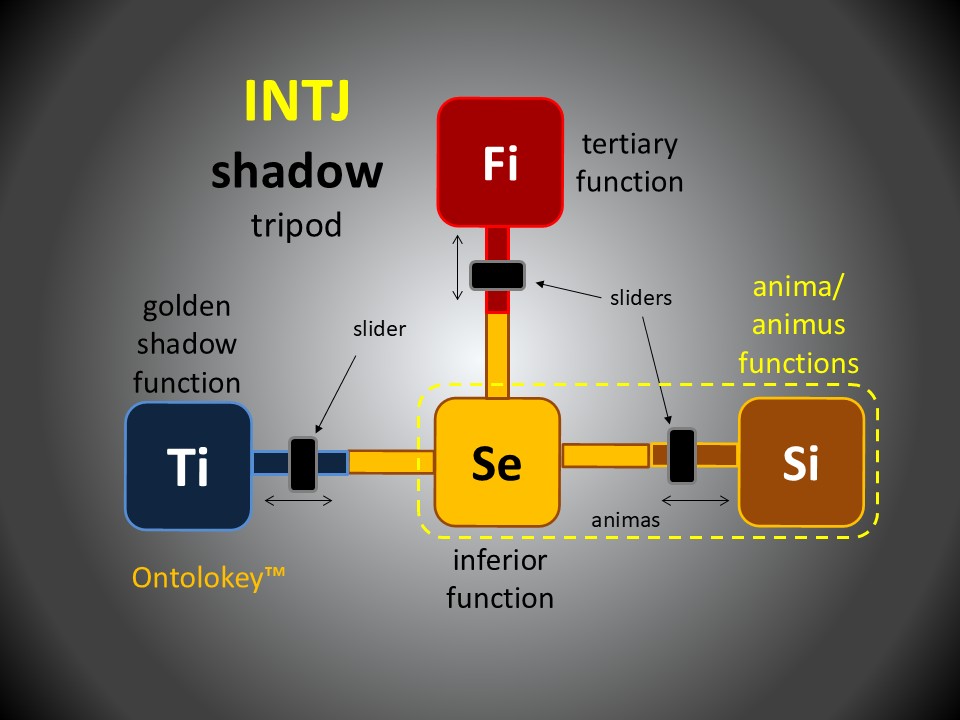
The Ontolokey Cube provides the structural foundation for the essay that follows because it treats the INTJ not as a fixed collection of adjectives but as an interconnected psychological configuration. At its center stands Introverted Intuition (Ni) as the Dominant function, accompanied by Extraverted Thinking (Te) as Auxiliary and Extraverted Intuition (Ne) as the Sibling function; these positions describe the conscious architecture through which the INTJ perceives patterns, constructs strategic systems, and occasionally opens itself toward alternative possibilities. Around this conscious core, however, lie less accessible functions: Extraverted Feeling (Fe) as the Toddler, Extraverted Sensing (Se) as the Inferior, Introverted Sensing (Si) as the Anima, Introverted Feeling (Fi) as the Tertiary or value-bearing inner function, and Introverted Thinking (Ti) as the Golden Shadow. Each position therefore represents more than a cognitive operation: it describes a particular psychological relationship to consciousness, competence, vulnerability, desire, projection, and development.
The cube becomes especially meaningful when these positions are understood as relationships rather than as a sequence of functions. The Ni–Te relationship concerns the translation of inner vision into external structure: insight must become strategy, and strategy must eventually become reality. The Ni–Ne relationship introduces a second tension, because the INTJ’s natural tendency to converge upon a singular interpretation is challenged by the possibility of divergence, alternatives, ambiguity, and intellectual play. The Ni–Fe relationship brings the social and emotional world into direct contact with the INTJ’s private vision, asking whether profound understanding can also become emotionally communicable rather than remaining internally complete but externally inaccessible. Ontolokey explicitly presents these dynamic connections through sliders, suggesting that psychological development is not achieved by maximizing a single function but by learning to regulate and integrate relationships among functions.
The consequence is a portrait of the INTJ that is considerably more human than the conventional image of the detached mastermind. The strategic exterior is real, but it is only one layer of a personality whose inner life can contain nostalgia, private ideals, sensitivity, existential concern, aesthetic appreciation, emotional uncertainty, and an intense desire for intellectual and personal authenticity. The deeper truth is that the INTJ does not simply need to become more effective; effectiveness is already one of its natural languages, and making it stronger can sometimes reinforce the very defenses that prevent psychological integration. The more consequential developmental movement is therefore inward and downward: from prediction toward presence, from control toward trust, from intellectual certainty toward openness, from functional competence toward personal meaning, and eventually from the identification with being the one who understands toward the much more difficult experience of simply being present within what cannot be completely understood. This is where the positive and shadow dimensions of the INTJ cease to be separate topics and become two sides of the same psychological structure.
Further explorations of the INTJ, including the extended analyses of its conscious functions, shadow dynamics, Anima, and developmental architecture, are available through the broader body of material at Ontolokey.com. The following sections will now move through the eight positions of the Ontolokey Cube in greater depth, before turning toward the INTJ’s shadow and the question of psychological integration.
I. Introverted Intuition — The Architecture of Inner Vision
At the center of the INTJ structure stands Introverted Intuition (Ni), and within the Ontolokey model this is not merely the first function in a hierarchy but the psychological center around which the other functions acquire their meaning. Ni operates by moving beneath immediate appearances toward patterns, trajectories, symbolic relationships, and underlying principles, allowing the INTJ to experience reality less as a succession of isolated events than as a process unfolding toward some discernible configuration. The characteristic INTJ experience is therefore often anticipatory: rather than asking only what is happening, the mind instinctively asks what this means, where it is going, what hidden structure connects the apparently unrelated elements, and what the present situation will eventually become. Ontolokey describes this as a form of perception that can produce sudden insight without a consciously retraceable chain of reasoning, because the integration occurs largely beneath the surface before the conclusion reaches awareness. The strength of this orientation lies in its ability to transform complexity into coherence, but its danger lies precisely there as well, because a sufficiently compelling internal model can begin to feel more authoritative than the changing reality it was originally designed to understand.
This gives the INTJ a peculiar relationship with time, because the future is psychologically present long before it becomes objectively present. An INTJ may appear slow, cautious, or detached when in fact the mind is already running simulations of consequences, identifying probable obstacles, comparing trajectories, and waiting for the moment when internal certainty is sufficient for action. What others experience as hesitation can therefore be experienced internally as preparation, while what others perceive as pessimism may actually be a form of anticipatory realism: the tendency to notice what could undermine a plan before becoming emotionally invested in its success. Ontolokey’s description of “constructive pessimism” captures this distinction particularly well, because the INTJ’s concern with failure is often less an attraction to negative outcomes than an attempt to make positive outcomes more robust by accounting for hidden variables. Yet the same mechanism can gradually impoverish experience if every possibility is converted into a prediction and every uncertainty into a problem requiring resolution. When the future becomes too thoroughly conceptualized, spontaneity loses some of its psychological value, and the individual can begin living one step ahead of life rather than actually inhabiting the moment in which life is occurring.
The shadow of Ni therefore does not necessarily consist in having inaccurate intuitions; it can consist in becoming excessively loyal to intuition itself. The INTJ can become so accustomed to discovering structures beneath appearances that ordinary reality begins to seem superficial, inefficient, or intellectually disappointing, while the private model constructed in the mind acquires an almost sovereign status. The deeper shadow text describes this movement as a gradual estrangement in which the individual increasingly evaluates external reality according to whether it corresponds with an internal image rather than allowing reality to challenge that image on its own terms. This is psychologically significant because the very capacity that makes the INTJ independent of collective assumptions can eventually make the person independent of corrective experience as well. A hypothesis that cannot be meaningfully contradicted becomes indistinguishable from conviction, and conviction that no longer tolerates contradiction can quietly transform into rigidity while still feeling internally like clarity.
For a mature INTJ, however, Ni does not have to become a prison of certainty; it can become an instrument of profound orientation. Its highest expression is not simply predicting what will happen but recognizing which patterns matter, which possibilities deserve commitment, and which apparent contradictions contain a deeper synthesis. This is why the INTJ can be extraordinarily valuable in situations where others are overwhelmed by complexity: the mind naturally searches for the invisible organizing principle that makes complexity intelligible. But the mature use of Ni requires an unusual discipline—the discipline to distinguish a powerful interpretation from reality itself, to permit new evidence to modify an elegant model, and to recognize that uncertainty does not necessarily represent intellectual failure. In this sense, psychological maturity does not diminish the INTJ’s vision but makes that vision more permeable, allowing insight to remain deep without becoming dogmatic. The deepest form of Ni is therefore not the conviction that one already knows the future, but the capacity to perceive its emerging structure while remaining sufficiently open to discover that reality is larger than the structure one has perceived.
The Ontolokey Cube becomes particularly useful at this point because Ni cannot be understood adequately in isolation: its psychological consequences depend upon how it interacts with the functions surrounding it. As the dominant function, Ni provides the direction and internal coherence of the INTJ, but it requires other functions to translate vision into action, challenge premature certainty, reconnect abstraction with concrete experience, and eventually bring neglected emotional and relational dimensions back into consciousness. Ontolokey therefore places the INTJ’s other functions around this central orientation rather than treating them as unrelated abilities, creating a three-dimensional image of a psyche in which development means learning to move between different forms of perception and evaluation without losing the coherence of the whole. The INTJ’s central developmental question consequently becomes more profound than “How can I use my intuition better?” because the more important question is whether the visionary center can remain connected to everything it tends naturally to exclude. The next function, Extraverted Thinking (Te), provides the first major answer to that problem by taking the internal vision of Ni and forcing it into the external world of structure, execution, standards, measurable consequences, and reality-testing.
II. Extraverted Thinking — When Vision Becomes Architecture
If Introverted Intuition gives the INTJ an image of where reality is heading, Extraverted Thinking (Te) is the mechanism that attempts to make that vision operational. In the Ontolokey model, Te is therefore not simply “logical thinking” but the outward-facing function through which an internally perceived possibility becomes a system, procedure, objective, schedule, decision, or concrete result. Ni asks what lies beneath the surface and where the trajectory leads; Te asks what must be organized, changed, measured, or executed so that the envisioned outcome can actually exist. This explains why many INTJs are far less interested in possessing an interesting idea than in determining whether the idea can survive contact with reality, because an insight that cannot eventually be translated into structure remains psychologically incomplete. Their characteristic efficiency is consequently not necessarily driven by a love of productivity for its own sake, but by an instinctive desire to eliminate unnecessary friction between intention and outcome. Ontolokey captures this relationship through the Ni–Te slider, presenting it as a dynamic tension between meaning and implementation, vision and execution, rather than as two unrelated abilities.
The mature expression of Te is remarkably constructive because it gives form to what would otherwise remain abstract. An INTJ can take a diffuse problem, identify its essential variables, establish priorities, construct a sequence of operations, and then continue refining the system until the desired result becomes reproducible rather than accidental. This is why the INTJ often performs particularly well when given autonomy, a difficult problem, and sufficient freedom to determine the method independently: the mind is naturally inclined to redesign inefficient processes rather than merely endure them. The Ontolokey portrait emphasizes that such individuals are not necessarily motivated by conventional ambition or status; they can derive considerable satisfaction from building something correctly, eliminating waste, teaching a more effective method, or solving a problem that others have accepted as unnecessarily complicated. Te also explains the characteristic INTJ relationship with time, because deadlines tend to be interpreted as structural parameters rather than emotional threats, allowing the individual to pace effort according to a long-term internal calculation. In its healthiest form, therefore, Te does not make the INTJ controlling; it makes the INTJ architectural, instinctively asking how an intention can be transformed into a coherent external structure.
But every strength becomes psychologically dangerous when it becomes the sole criterion by which reality is evaluated. Te naturally privileges what is demonstrable, effective, organized, measurable, and consequential, and an INTJ can gradually begin to regard whatever cannot be translated into these categories as secondary or even irrelevant. This is where the relationship with Introverted Feeling (Fi) becomes decisive, because Te can determine whether something works without determining whether it is personally meaningful, ethically acceptable, emotionally humane, or consistent with the individual’s deepest convictions. Ontolokey explicitly identifies the danger of overusing Te at the expense of Fi: the person can become increasingly identified with competence, utility, and results while losing contact with the private values that originally gave the project its significance. The irony is profound because an INTJ may become extraordinarily effective at achieving goals whose emotional or ethical meaning has gradually disappeared from consciousness, only to discover later that successful execution has not produced psychological satisfaction. The shadow side of Te is therefore not irrationality but instrumental intelligence detached from inner allegiance—the capacity to solve almost any problem except the question of whether the problem should have been solved in the first place.
This tendency can also shape the INTJ’s relationships, particularly when interpersonal complexity is unconsciously treated as an inefficient system rather than as an irreducibly human domain. When someone expresses distress, the INTJ may instinctively search for causes, variables, options, and solutions, because solving the problem is experienced as the most concrete form of assistance available. Yet emotional experience does not always ask to be optimized; sometimes another person needs recognition before resolution, presence before analysis, or companionship in uncertainty rather than an immediate strategy for escaping it. The resulting misunderstanding can be painful because the INTJ may genuinely be attempting to help while the other person experiences the intervention as emotional distance or implicit criticism. Ontolokey’s description of the INTJ’s difficulty with emotional atmospheres becomes particularly relevant here: Te can provide a highly competent defense against emotional unpredictability, but competence does not automatically create intimacy. The developmental task is consequently not to weaken Te or make it less decisive, but to prevent it from becoming the universal language through which every human situation is interpreted.
The deepest maturity of Te emerges when execution becomes subordinate to a consciously chosen purpose rather than becoming an identity in itself. An integrated INTJ can still be demanding, precise, autonomous, and exceptionally systematic, but the system serves something larger than the system: a vision that has been tested by reality, informed by personal values, and made sufficiently flexible to accommodate the perspectives of other people. In that state, Te ceases to be merely the machinery of achievement and becomes an instrument of stewardship, capable of turning insight into something useful without confusing usefulness with ultimate meaning. The INTJ no longer needs to prove worth through being the most competent person in the room, because competence becomes a tool rather than a psychological defense against vulnerability, uncertainty, or dependence. This distinction is central to the deeper Ontolokey portrait: Ni sees the destination, Te builds the road, but neither function alone can explain why the journey matters. That question leads naturally toward the next position in the cube, Extraverted Intuition (Ne), the sibling function that introduces precisely what the Ni–Te architecture finds most difficult to tolerate: alternative possibilities, ambiguity, divergence, and the possibility that the future may not unfold according to the first compelling vision.
III. Extraverted Intuition — The Sibling Who Opens the Door
If Ni gives the INTJ the capacity to converge upon an underlying pattern, Extraverted Intuition (Ne) introduces the psychological movement in the opposite direction: away from one interpretation and toward a field of alternatives. Ontolokey places Ne in the INTJ’s Sibling position, an especially revealing designation because it suggests neither an enemy nor a subordinate but a psychologically close counterpart capable of both cooperation and friction. Ni tends to reduce multiplicity into an internally coherent trajectory, whereas Ne expands a situation into possibilities, associations, hypotheses, and unexpected connections; one asks where the pattern is leading, while the other asks what else might emerge from it. The Ni–Ne slider therefore represents more than flexibility in a superficial sense: it expresses a fundamental tension between convergence and divergence, certainty and curiosity, depth and breadth. For an INTJ, the ability to access Ne can be liberating because it introduces the possibility that an internally convincing interpretation is not the only legitimate interpretation available.
This is particularly important because the INTJ’s natural confidence in internally constructed models can make alternative perspectives feel less like enriching additions and more like interruptions to an already coherent line of thought. When Ne is sufficiently available, however, alternatives do not necessarily destroy coherence; they can strengthen it by exposing hidden assumptions and revealing possibilities that the original model could not accommodate. The INTJ can suddenly entertain several explanations without immediately deciding which one is correct, allowing intellectual exploration to precede judgment rather than forcing every observation into an established conceptual structure. This capacity can greatly enhance creativity, innovation, scientific or philosophical inquiry, and strategic planning because the person becomes capable of distinguishing between having a vision and being imprisoned by the first version of that vision. Ontolokey consequently describes healthy Ne as a means of loosening the grip of control, supporting exploration and preventing the certainty of Ni from becoming dogmatism. The psychological achievement is not abandoning conviction but acquiring the freedom to temporarily suspend conviction when reality has not yet provided enough information to justify it.
Yet the sibling relationship can also become unstable when Ne is either excessively suppressed or insufficiently integrated. If the INTJ refuses alternative possibilities altogether, the mind can become increasingly narrow despite its apparent intellectual sophistication, because every new piece of information is unconsciously recruited to confirm an already established model. The resulting rigidity may be particularly difficult to recognize precisely because it does not necessarily appear irrational; the person can construct elaborate arguments in defense of a conclusion that was emotionally or intuitively settled long before the argument began. At the opposite extreme, an INTJ who accesses divergent possibilities without retaining Ni’s capacity for synthesis can experience the shadow side of Ne as fragmentation, restlessness, endless reconsideration, or intellectual distraction. Ontolokey therefore does not portray Ne as something the INTJ should simply maximize, because unrestricted possibility can be just as destabilizing as excessive certainty. The developmental task is subtler: Ni should provide depth and direction while Ne keeps that depth permeable to surprise.
This tension becomes especially significant in the INTJ’s relationships and worldview because many interpersonal conflicts arise not from a lack of intelligence but from premature closure. An INTJ may observe another person’s behavior, infer the underlying motive, and then behave according to that interpretation without sufficiently testing whether other explanations are possible. Because Ni often produces conclusions that feel internally complete, the individual may not experience this as prejudice or assumption but simply as accurate perception, which makes correction psychologically difficult. Ne offers an antidote by introducing a deliberate question: What else could be happening here? That question creates psychological space between perception and certainty, allowing the INTJ to recognize that another person’s apparently irrational behavior may contain emotional, historical, situational, or relational dimensions that are invisible from the original vantage point. In this sense, Ne is not merely an intellectual function but a form of epistemic humility, because it reminds the INTJ that understanding reality requires maintaining enough openness for reality to contradict the observer. The sibling therefore protects the visionary from becoming trapped inside the elegance of the vision itself.
At its highest level, the Ni–Ne relationship produces a particularly sophisticated form of intelligence: the ability to hold a coherent long-range vision without confusing coherence with inevitability. The mature INTJ can construct a model, pursue it with determination, and simultaneously retain an internal capacity to revise it when unexpected information appears; such flexibility does not weaken strategic thinking but makes strategy more resilient because it prevents commitment from becoming blindness. Ontolokey’s cube makes this developmental movement visible by treating the relationship between the two intuitive functions as a dynamic slider rather than a static possession of one and absence of the other. The INTJ’s growth therefore involves learning to move deliberately between the two poles: to descend deeply enough into Ni to discover meaning, then step outward through Ne to test whether other realities, interpretations, and futures remain possible. Once this balance is established, the INTJ’s intelligence becomes less about predicting reality perfectly and more about remaining psychologically capable of adapting when reality refuses to behave as predicted.
The next position in the cube exposes a much more vulnerable dimension of the INTJ architecture, because Extraverted Feeling (Fe) is not another intellectual counterpart but the Toddler function, representing a comparatively immature and uncertain relationship with emotional atmosphere, collective feeling, interpersonal harmony, and socially shared values. Where Ne asks the INTJ to tolerate multiple possibilities in thought, Fe asks the far more personally threatening question of whether the individual can enter a shared emotional field without first understanding or controlling it. That distinction is crucial, because the INTJ can often analyze human emotion with considerable sophistication while remaining uncertain about what to do when emotion becomes immediate, reciprocal, and personally involving. The movement from Ne to Fe therefore marks a transition from the relatively safe territory of alternative ideas into the much less controllable territory of human emotional presence.
IV. Extraverted Feeling — The Toddler at the Edge of the Room
Within the Ontolokey Cube, Extraverted Feeling (Fe) occupies one of the most psychologically revealing positions for the INTJ because it represents the Toddler: a function that is present, emotionally significant, and capable of development, yet comparatively inexperienced and vulnerable in its expression. Fe concerns the emotional field between people—the atmosphere of a group, the implicit needs of others, interpersonal harmony, shared emotional meanings, and the capacity to participate in a collective feeling without first reducing it to an intellectual problem. For an INTJ whose conscious architecture is dominated by private pattern recognition and objective structuring, this domain can feel strangely exposed because there is no reliable algorithm for human atmosphere; emotions shift, contradict themselves, resist measurement, and often communicate indirectly. The INTJ may therefore understand people exceptionally well in an analytical sense while remaining uncertain about how to inhabit their emotional world spontaneously. Ontolokey’s designation of Fe as the Toddler captures this asymmetry: the function is not absent or meaningless, but it may emerge with a mixture of innocence, sensitivity, awkwardness, and disproportionate vulnerability precisely because the INTJ has not developed the same confidence in this territory that it possesses in Ni and Te. (ontolokey.com)
The Toddler metaphor becomes especially illuminating when considering the INTJ’s relationship with social belonging. An INTJ may appear profoundly independent, and often genuinely values autonomy, yet independence should not be confused with emotional immunity to acceptance or rejection. Because Fe is less consciously differentiated, social feedback can sometimes affect the INTJ more deeply than the outward presentation suggests, particularly when criticism is experienced not merely as disagreement but as evidence of interpersonal exclusion or misunderstanding. The paradox is that the person may consciously reject the need for approval while unconsciously remaining highly sensitive to whether the surrounding emotional environment is welcoming, hostile, chaotic, or dismissive. This can create a peculiar oscillation between detachment and sudden emotional investment: for long periods the INTJ may appear indifferent to group dynamics, only to discover that a particular interpersonal rupture has acquired far greater psychological significance than anticipated. The problem is not hypocrisy but compartmentalization, because the conscious personality has learned to rely on self-sufficiency while the less developed Fe still carries an ordinary human need to be understood, accepted, and emotionally connected to others.
This also explains why the INTJ can occasionally behave in ways that appear surprisingly unlike the stereotypical image of emotional restraint. When Fe is activated under pressure, the person may become unusually concerned with how others perceive them, may attempt to restore harmony with an intensity disproportionate to the situation, or may suddenly express emotions that have accumulated without sufficient conscious processing. Because the function has not been granted the same deliberate cultivation as Ni or Te, its expression can feel less nuanced and more reactive. The INTJ may consequently alternate between suppressing interpersonal concerns and becoming preoccupied with them, rather than maintaining a stable middle position in which emotional information can simply be acknowledged and integrated. The deeper developmental movement is therefore not toward becoming socially performative or emotionally agreeable, but toward acquiring enough Fe literacy to recognize that interpersonal reality is itself a form of information. A mature INTJ can learn that noticing another person’s emotional state does not require surrendering intellectual independence, just as responding compassionately does not require agreeing with every feeling or abandoning objective judgment.
The shadow danger emerges when Fe remains sufficiently undeveloped that interpersonal emotion is experienced primarily as an intrusion. In such circumstances, the INTJ can retreat further into the apparent safety of Te: if emotional complexity cannot be controlled, then perhaps it can be bypassed through efficiency, boundaries, rational explanation, or withdrawal. This strategy often works in the short term because distance genuinely reduces emotional stimulation, but it can produce a deeper cost by confirming the belief that intimacy is inherently destabilizing and that emotional dependence is therefore something to be avoided. The resulting isolation may then reinforce the original defensive structure, because the person receives fewer opportunities to discover that emotional communication can be predictable enough, respectful enough, and intellectually compatible enough to coexist with autonomy. Ontolokey’s broader shadow perspective is important here because the shadow is not portrayed simply as a collection of undesirable traits; it emerges when neglected functions begin exerting influence from outside conscious control. In that sense, the INTJ’s emotional difficulties are not evidence of an absence of feeling but evidence that feeling has not always been granted a sufficiently conscious place within the personality’s architecture. (ontolokey.com)
The integration of Fe therefore represents one of the INTJ’s quieter forms of psychological maturation. It means learning to distinguish emotional atmosphere from emotional obligation, empathy from agreement, and relational responsiveness from loss of autonomy. The mature INTJ does not need to become highly expressive, socially demonstrative, or constantly available; rather, the person becomes capable of recognizing that other human beings are not variables in a system but subjective worlds whose reactions cannot always be predicted from external facts. This capacity can profoundly improve leadership, friendship, partnership, and intellectual collaboration because it allows the INTJ to communicate truth without unnecessarily turning truth into interpersonal damage. More importantly, Fe can soften the defensive assumption that vulnerability is synonymous with weakness, allowing the INTJ to discover that some forms of emotional openness actually increase rather than diminish personal freedom. Once the Toddler is no longer treated as an embarrassing psychological liability, it can become a source of warmth, social awareness, and genuine participation in human life. The next function, Extraverted Sensing (Se), exposes an even deeper tension because it confronts the INTJ with what may be most difficult for a future-oriented, internally absorbed personality to tolerate: the immediate reality of the present moment itself.
V. Extraverted Sensing — The Reality the INTJ Cannot Think Away
If Ni represents the INTJ’s movement away from immediate appearances toward underlying patterns, Extraverted Sensing (Se) represents the opposite psychological demand: to encounter reality exactly where it is, before interpreting it, predicting it, organizing it, or converting it into a future-oriented model. Ontolokey places Se in the Inferior position, making it the INTJ’s great counterweight and one of the most consequential developmental tensions in the entire cube. Se attends to concrete presence—the body, movement, physical surroundings, sensory detail, immediate opportunity, spontaneous action, aesthetic experience, and the simple fact that something is happening now. For a consciousness naturally inclined to retreat into abstraction and anticipate what comes next, this immediacy can feel almost psychologically primitive, because there is nothing to solve and no future structure to construct; there is simply an environment demanding direct contact. Ontolokey therefore interprets the Ni–Se axis as a fundamental polarity between inward vision and outward presence, suggesting that the very function the INTJ experiences as least natural may also contain an essential corrective to the excesses of its dominant intuition.
The difficulty begins with the INTJ’s tendency to experience the present primarily as information about something else. A landscape can become evidence of an approaching season, a conversation can become evidence of an underlying psychological pattern, and a current event can become another piece in a much larger conceptual structure; the immediate object is continually being translated into meaning, trajectory, or implication. This extraordinary capacity for abstraction can become a liability when the person loses contact with the raw experience from which interpretation originally emerged, because life gradually becomes something observed through a conceptual filter rather than something directly inhabited. Ontolokey describes suppressed Se as a potential blind spot in which bodily needs, sensory surroundings, spontaneity, and immediate experience are neglected, while its more destabilized expression can appear under pressure as compulsive stimulation, impulsive behavior, or an unusual preoccupation with sensory gratification. The apparent contradiction is psychologically coherent: when a function is chronically excluded from conscious life, it does not necessarily disappear but can emerge in less differentiated and less controllable forms. The INTJ may therefore oscillate between excessive abstraction and sudden immersion in sensation rather than developing a calm, conscious relationship with the physical world.
This makes Se particularly important to understanding the INTJ’s relationship with the body. A person whose attention is habitually absorbed by ideas, systems, plans, and anticipated consequences can unconsciously treat the body as an inconvenient vehicle for the mind rather than as an essential dimension of psychological existence. Hunger, fatigue, tension, pleasure, sexuality, movement, environmental beauty, and physical discomfort may be noticed only after they have become sufficiently intense to interrupt cognitive activity. The danger is not simply physical neglect; it is a deeper dissociation in which the individual becomes extraordinarily familiar with internal concepts while remaining surprisingly unfamiliar with the immediate signals through which the organism communicates its needs. Development of Se therefore involves something more radical than becoming “more spontaneous”: it requires learning that sensory information is not inferior to conceptual information and that the present moment does not need to justify itself by contributing to a future objective. Nature, physical exercise, craftsmanship, music, art, travel, food, embodied intimacy, and direct engagement with one’s surroundings can all become psychologically significant because they interrupt the habitual conversion of experience into abstraction. In this sense, Se does not compete with intelligence; it reconnects intelligence with the world in which intelligence must ultimately live.
The shadow expression of inferior Se becomes particularly revealing when the INTJ’s carefully constructed internal order encounters an environment that refuses to cooperate. Unexpected noise, disorder, sensory overload, sudden changes, social improvisation, physical vulnerability, or circumstances requiring immediate reaction can temporarily deprive the person of the psychological distance on which Ni normally depends. Under such conditions, the INTJ may become unusually reactive, controlling, impatient, or impulsive, precisely because the usual strategy of stepping back and constructing an internal model is no longer sufficient. Ontolokey’s deeper shadow perspective makes this important because the problem is not that Se is inherently destructive; rather, the problem arises when the neglected function enters consciousness without having been gradually integrated into the personality. What might otherwise have been healthy spontaneity can then feel like loss of control, while what might have been ordinary sensory enjoyment can become excessive because it has been psychologically starved. The mature solution is consequently neither permanent self-denial nor unrestricted indulgence, but the gradual transformation of sensory immediacy from an unconscious disturbance into a conscious source of information, vitality, pleasure, and reality contact.
There is an especially profound irony in the fact that Se is described within Ontolokey as a gateway to individuation. The INTJ often spends enormous psychological energy attempting to understand reality, anticipate its movement, and construct increasingly accurate models of what lies beneath the surface, yet the final obstacle may be the refusal to encounter reality without first turning it into an object of interpretation. Se introduces a different form of knowing, one that does not begin with explanation but with presence: seeing what is actually there, hearing what is actually being said, noticing what the body is communicating, and allowing an experience to exist before deciding what it means. This does not require the INTJ to abandon Ni; indeed, the deepest integration occurs when Ni and Se begin to correct one another, with intuition giving experience context while sensation prevents intuition from becoming detached from reality. The result is a person who can still think decades ahead without being absent from the afternoon, who can construct elaborate systems without forgetting the physical human beings living inside them, and who can contemplate the future without unconsciously sacrificing the present. The next movement into Introverted Sensing (Si), the Anima position, deepens this paradox further, because if Se teaches the INTJ to inhabit the present, Si confronts the personality with the psychological significance of what has already been lived, remembered, preserved, and emotionally carried forward.
VI. Introverted Sensing — The Anima and the Memory of Being
If Extraverted Sensing confronts the INTJ with the immediacy of the external world, Introverted Sensing (Si) leads into a much more intimate territory: the inner registration of bodily experience, memory, familiarity, continuity, and the subtle emotional residues left by what has already been lived. In the Ontolokey framework, Si occupies the Anima position, and this gives it a significance considerably deeper than that of a merely “inferior” cognitive function. Ontolokey’s extended treatment of the INTJ Anima describes an unfolding developmental process in which Si represents an early, inwardly experienced form of the anima, associated with bodily memory, instinctive resonance, pre-verbal emotion, and forms of experience that are difficult to translate into the INTJ’s preferred conceptual language. This is particularly revealing because the INTJ is commonly imagined as someone who lives almost entirely in the future, whereas the Anima introduces the neglected fact that the psyche also carries an enormous archive of embodied past experience. The INTJ may therefore remember far more emotionally and physically than the conscious personality admits, even when those memories have never been organized into an explicit narrative.
The psychological importance of Si becomes clearer when one distinguishes memory as information from memory as felt continuity. Ni may remember an event because it contributed to an emerging pattern, while Si preserves the atmosphere of having lived through it: the bodily sensation, the familiar texture of a place, the emotional tone of a relationship, the sense of safety or unease associated with a particular environment, and the subtle recognition that something resembles something encountered before. This form of remembering can be profoundly difficult for an INTJ to articulate because it does not necessarily arrive as a logical proposition; it may appear as a visceral attraction, an inexplicable aversion, nostalgia, comfort, or a sense that something is “right” or “wrong” before the conscious mind has determined why. Ontolokey’s description of the early Eve-Anima places precisely this kind of experience at the beginning of the developmental sequence, suggesting that the INTJ’s relationship with the anima begins not with conscious mastery but with an archaic and largely unconscious connection to inner sensation and embodied memory. This gives the INTJ’s emotional life a different texture from the stereotype of pure abstraction: beneath the strategic mind exists a quieter layer of remembered experience that can influence attachment, attraction, aversion, and identity without announcing itself in conceptual language.
As development progresses, Ontolokey describes a second stage, the Helen-Anima, in which the unconscious material represented by the anima can become projected onto another person. The significance of this idea lies less in the literal identity of a particular personality type and more in the psychological mechanism of projection: qualities that the INTJ has not sufficiently developed internally may appear extraordinarily compelling when encountered in another human being. Ontolokey associates this stage with an idealized external counterpart who appears to embody qualities the INTJ experiences as missing—warmth, sensory groundedness, emotional availability, familiarity, and an ability to inhabit life rather than merely conceptualize it. Such projection can make a relationship feel almost metaphysical because the other person seems not merely attractive but psychologically complete, as though they possess a missing part of the self. The danger is that the INTJ may fall in love not only with a person but with an unconscious possibility of wholeness represented by that person, and when the projection eventually encounters ordinary human complexity, disappointment can be experienced as though something sacred has been taken away.
The subsequent Mary-Anima represents a decisive developmental shift because what was previously projected outward begins to be reclaimed inwardly. Ontolokey describes this stage symbolically as the maturation of Si through sufficiently developed Te, with Si becoming capable of giving birth to Extraverted Feeling (Fe)—a metaphor that portrays emotional and relational development as something emerging from the integration of previously unconscious inner experience. Psychologically, this suggests that the INTJ’s development does not require abandoning rationality in favor of emotion; rather, the very discipline of Te can eventually create enough stability for the personality to turn toward experiences that previously seemed too vague, private, or uncontrollable to examine. Memories can then become sources of self-knowledge rather than merely unexplained residues, bodily reactions can become information rather than disturbances, and attachment can become something consciously understood rather than something projected onto an idealized other. The deeper movement is from projection toward ownership: instead of searching externally for someone who embodies the missing psychological dimension, the INTJ gradually begins developing the capacity to carry that dimension internally.
The final movement of the Anima is therefore inseparable from the larger process of individuation described by Ontolokey, because Si ultimately becomes part of a pathway toward a more embodied and psychologically continuous self. The model describes the later Sophia-Anima as associated with the conscious integration of Se, symbolizing the culmination of a journey that moves from unconscious inner sensation through projection and integration toward full presence in the external world. This makes the Anima far more than a “weak function”: it represents a developmental bridge between the INTJ’s highly differentiated conscious identity and dimensions of existence that the conscious identity originally excluded. The irony is that the INTJ’s greatest independence may ultimately require learning to belong to the continuity of its own embodied history—to recognize that memories, sensations, attachments, vulnerabilities, and emotional residues are not distractions from the self but parts of the self that have been waiting to become intelligible. When that recognition occurs, the INTJ no longer has to choose between being rational and being deeply human, because rationality itself becomes capable of making room for forms of experience that cannot be reduced to rational structure.
The Anima consequently reveals one of the most important truths hidden beneath the INTJ stereotype: the person who appears most detached from the past may be carrying an extraordinarily private relationship with it. The past may not be discussed, displayed, or consciously analyzed, yet it can remain encoded in preferences, bodily reactions, idealizations, relational expectations, and an almost instinctive attraction to certain forms of familiarity. The mature INTJ does not need to become nostalgic or tradition-bound in order to integrate Si; rather, the task is to recognize continuity as psychologically meaningful without allowing the past to dictate the future. This creates a new balance with Ni: intuition can envision what has not yet existed, while Si remembers what has already mattered, and together they prevent the personality from becoming either imprisoned by history or severed from it. From here, the Ontolokey architecture moves toward Introverted Feeling (Fi), the Tertiary position, where the question changes from What have I experienced? to the much more intimate question of What do I personally value, and who am I when nobody else is defining the criteria by which my life should be judged?
VII. Introverted Feeling — The Private Sovereignty of Values
Within the Ontolokey Cube, Introverted Feeling (Fi) occupies the Tertiary position, and this placement introduces one of the most misunderstood dimensions of the INTJ personality: the existence of a deeply private evaluative world beneath the visible machinery of logic, strategy, and objective effectiveness. Fi does not primarily ask whether something works, whether it is socially harmonious, or whether it can be justified through an external standard; it asks whether something is internally true, personally meaningful, ethically congruent, and faithful to an individual’s deepest sense of what matters. For the INTJ, this function can remain remarkably concealed because Te provides a much more obvious language for decision-making, allowing the person to explain choices in terms of efficiency, evidence, consistency, or consequences even when an important part of the decision has actually been determined by a private value judgment. The result is a personality that may appear impersonal while being governed by convictions that are, in certain areas, intensely personal. This is one reason the stereotypical image of the INTJ as someone who “doesn’t care what people think” is incomplete: the INTJ may care very deeply about what is right, authentic, principled, or meaningful, but may have little interest in displaying those commitments as emotional declarations.
Fi also explains why an INTJ can react with surprising intensity when something violates an internal principle that has remained largely invisible to other people. Because these values are often not continuously verbalized, outsiders may see only the final reaction and fail to understand the invisible criterion that produced it, while the INTJ may experience the violation as self-evident and therefore struggle to explain why compromise suddenly feels impossible. This can create one of the personality’s most distinctive paradoxes: extraordinary flexibility in methods can coexist with extraordinary inflexibility concerning certain principles. An INTJ may be willing to redesign an entire system if evidence shows that the system is ineffective, yet refuse to alter a personal conviction merely because doing so would be socially convenient or strategically advantageous. In its mature form, Fi provides precisely the internal compass that prevents Te from becoming pure instrumentalism, because it reminds the strategic mind that efficiency is not the same thing as value and that a successful outcome can still be personally or morally empty. In its less integrated form, however, Fi can become so private that the INTJ expects others to intuit values that were never communicated, creating resentment when people fail to recognize boundaries, loyalties, or principles that seemed obvious only from within.
The relationship between Te and Fi is consequently one of the central psychological tensions in the INTJ structure. Te seeks externally demonstrable effectiveness, whereas Fi seeks internally experienced authenticity, and these two criteria can cooperate beautifully when neither attempts to eliminate the other. An INTJ may formulate a powerful personal conviction through Fi and then use Te to determine how that conviction can be implemented effectively in the world, producing the rare combination of principle and competence that allows ideals to become tangible rather than remaining private fantasies. The reverse movement is equally important: Te can expose the consequences and practical limitations of a cherished value, forcing Fi to become more nuanced instead of merely sincere. The mature personality therefore does not ask whether logic or values should dominate, because that question itself creates a false opposition; it asks how external effectiveness and internal integrity can inform one another without either becoming subordinate to the other. This integration is particularly important for the INTJ because the person can otherwise spend years becoming increasingly successful according to external criteria while remaining uncertain whether the life being constructed actually belongs to the person constructing it.
Fi also gives the INTJ a capacity for profound loyalty that can remain almost invisible until circumstances reveal it. Once a person, principle, project, or ideal has been incorporated into the INTJ’s internal value structure, commitment can become remarkably durable, even when the external expression of that commitment is restrained. The INTJ may not constantly reassure others verbally, yet may demonstrate attachment through consistency, protection, problem-solving, reliability, or an unwillingness to abandon something considered genuinely important. This is one reason emotional restraint should not automatically be confused with emotional shallowness; the feeling may be deep precisely because it is not habitually externalized. At the same time, the private character of Fi can create a vulnerability to moral isolation, in which the INTJ becomes convinced that personal integrity requires standing alone against a surrounding environment that appears superficial, irrational, compromised, or morally confused. When this happens, principled independence can gradually transform into self-righteous isolation, particularly if the individual stops allowing other people to challenge the interpretation of what integrity requires. Healthy Fi therefore demands not only fidelity to one’s values but enough humility to examine whether the values have been understood correctly and whether the chosen expression of them actually reflects the principles they are supposed to protect.
The deepest contribution of Fi to INTJ development is therefore interiority without isolation. It gives the personality permission to recognize that not everything important can be justified by external utility, and that a human life cannot ultimately be reduced to optimization, prediction, productivity, or strategic success. Yet Fi also asks the INTJ to take responsibility for making private values conscious rather than allowing them to operate as mysterious sources of attraction and rejection. When the person can articulate what genuinely matters, distinguish authentic conviction from defensive pride, and accept that another person’s values may be different without being incomprehensible, the tertiary function becomes a stabilizing center of identity. The INTJ then gains something that neither Ni nor Te can provide alone: a reason to care about the future beyond the elegance of the future plan itself. This creates the possibility of a more integrated personality in which vision, competence, embodiment, relationship, memory, and values all participate in the construction of a life that is not merely efficient but personally inhabited.
Yet Fi also points toward one of the most intriguing positions in the Ontolokey Cube: Introverted Thinking (Ti), the Golden Shadow. Whereas Fi asks whether something is internally meaningful and ethically authentic, Ti represents an almost seductive alternative form of internal evaluation—one concerned with conceptual precision, structural consistency, definitions, and whether an intellectual system is correct according to its own principles. For an INTJ whose conscious thinking is organized around Te, this shadow function can appear strangely fascinating because it offers a different kind of intellectual authority: not the authority of what works externally, but the authority of a perfectly coherent internal model. The Golden Shadow therefore introduces a final dimension to the INTJ’s intellectual identity, because it represents not merely a weakness but a powerful alternative mode of thought that may become especially attractive when the limitations of Te are experienced. To understand why this function can become both illuminating and dangerous, the essay must now enter the shadow architecture itself, where the INTJ encounters not simply what it lacks, but what it has been psychologically organized to keep at a distance.
VIII. Introverted Thinking — The Golden Shadow
Introverted Thinking (Ti) occupies the Golden Shadow position in the Ontolokey model, and this is one of the most psychologically intriguing placements because it represents a form of intelligence that the INTJ can recognize, admire, and even idealize without necessarily experiencing it as the natural language of the conscious personality. Te evaluates systems primarily through their external effectiveness, coherence in application, measurable consequences, and capacity to produce an intended result, whereas Ti turns inward and asks whether the conceptual structure itself is internally precise, whether its definitions are clean, whether its premises are consistent, and whether the reasoning remains valid independently of practical usefulness. For the INTJ, Ti can therefore resemble a hidden intellectual ideal: the possibility of understanding something so completely that every conceptual relationship becomes internally transparent. Ontolokey’s use of the term Golden Shadow is significant because this function is not simply repressed or rejected; it may be projected onto admired thinkers, intellectual systems, theories, or people who appear to possess an almost uncompromising capacity for conceptual rigor. The shadow can therefore contain genuine psychological gold, but precisely because it is idealized rather than fully integrated, the INTJ’s relationship with it can become ambivalent, seductive, and occasionally destabilizing. (ontolokey.com)
The attraction of Ti becomes strongest when Te encounters a problem that cannot be solved merely by making the external system function more efficiently. An INTJ can construct an extraordinarily effective model and eventually discover that the model contains conceptual assumptions that were never examined because they were simply useful. At that point, Ti introduces an uncomfortable but intellectually liberating question: Is the system actually true, or does it merely work? This distinction matters because practical success can conceal conceptual ambiguity, and an externally functional framework can remain internally inconsistent for a surprisingly long time. The Golden Shadow therefore represents a potential corrective to the INTJ’s confidence in implementation, encouraging a deeper examination of definitions, premises, categories, and the logical architecture underlying conclusions. Yet because Ti is not the INTJ’s conscious evaluative function, this attraction can sometimes become excessive: the individual may begin admiring intellectual purity for its own sake, endlessly refine distinctions that have little practical consequence, or become fascinated with constructing a perfectly self-consistent model that no longer needs contact with empirical reality. The shadow then reverses the original problem: Te can sacrifice conceptual elegance for effectiveness, while unintegrated Ti can sacrifice effectiveness for conceptual elegance.
There is another psychological dimension to the Golden Shadow that concerns projection. The INTJ may encounter a person who appears capable of dissecting ideas with extraordinary precision and experience a mixture of admiration, fascination, irritation, and even inferiority, particularly when that person seems able to identify contradictions in the INTJ’s own carefully constructed reasoning. Because Ti occupies a shadow position, the INTJ may initially experience such individuals as possessing something rare and almost inaccessible, rather than recognizing that the capacity they are witnessing also exists as a potential dimension of their own psyche. Projection can therefore produce both idealization and antagonism: the other person is admired for an ability that the INTJ secretly values, but simultaneously experienced as threatening because that ability exposes weaknesses in the INTJ’s preferred mode of reasoning. Ontolokey’s Golden Shadow concept becomes psychologically useful precisely here because it suggests that what fascinates or irritates us disproportionately in another person can sometimes point toward an underdeveloped capacity within ourselves. Integration means withdrawing the projection and recognizing that conceptual precision does not have to belong exclusively to “other kinds of thinkers”; it can become a supplementary instrument available to the INTJ when circumstances genuinely require it.
The shadow becomes darker when Ti is activated defensively against the limitations of Te. An INTJ who has become frustrated by organizational inefficiency, irrational authority, social conventions, or the superficiality of practical decision-making may retreat into increasingly elaborate internal systems where conceptual consistency becomes a substitute for participation in the imperfect external world. The person can then become convinced that the problem lies entirely in the world’s failure to understand the model, rather than considering that a model must remain accountable to reality, other people, and consequences. In extreme form, this can create an intellectual fortress: every objection can be answered with another distinction, every contradiction absorbed into a more sophisticated theoretical structure, and every practical criticism dismissed as evidence that others lack the conceptual depth required to understand the system. The danger is subtle because the resulting thought can be genuinely intelligent; what makes it psychologically problematic is not its complexity but its increasing immunity to correction. The Golden Shadow has then ceased to be a source of intellectual enrichment and has become an alternative identity—one in which being conceptually invulnerable feels safer than remaining open to the possibility of being wrong.
A more integrated relationship with Ti looks very different. The INTJ can learn to appreciate conceptual precision without requiring every problem to become an abstract intellectual exercise, and can use internal analysis to expose hidden assumptions while allowing Te to determine whether those insights actually improve the functioning of a real system. Ti then becomes a refining instrument rather than a rival identity: it sharpens the architecture that Te builds without demanding that architecture become an autonomous world. This integration is particularly powerful in fields where strategic thinking and conceptual rigor must coexist, because the INTJ can move between practical implementation and theoretical examination without confusing either with absolute truth. More personally, the Golden Shadow teaches an important lesson about intellectual humility: a person does not become more intelligent by making every conclusion harder to challenge, but by developing enough internal precision to recognize exactly where one’s reasoning remains uncertain. The deepest form of Ti integration is therefore not endless analysis but the ability to say, with unusual clarity, “This is what I know, this is why I believe it, and this is where my model may still be wrong.”
At this point the eight-function architecture begins to reveal a larger pattern. Ni and Te constitute the INTJ’s conscious strategic core; Ne introduces alternative possibilities; Fe exposes the need for interpersonal and emotional participation; Se reconnects the person with immediate physical reality; Si opens the archive of embodied memory and continuity; Fi establishes private value and identity; and Ti offers a hidden form of conceptual rigor that can refine the conscious intellect when consciously integrated. The psychological significance of the cube lies precisely in the fact that none of these dimensions exists in isolation: every strength casts a shadow, every neglected capacity contains developmental potential, and every apparent contradiction points toward a larger psychological balance. The INTJ’s deepest development is therefore not a journey toward becoming an exaggerated version of the stereotypical strategist, but a gradual expansion of what the word self is allowed to contain. Before that integration can be understood fully, however, we must turn from the individual functions toward the shadow as a whole, because the INTJ’s darkest patterns emerge not from one neglected function but from the interaction of several unconscious processes operating simultaneously.
The Shadow — When the Strengths Turn Against the Self
The shadow of the INTJ does not begin where intelligence ends; it begins where intelligence becomes the only acceptable way of experiencing reality. This is one of the most important distinctions in the Ontolokey portrait, because the shadow is not simply a collection of undesirable traits waiting somewhere beneath the personality. It develops through exclusion: whatever the conscious identity cannot easily accommodate is pushed away, where it continues to exist with increasing psychological pressure. For the INTJ, the conscious identity is strongly organized around vision, autonomy, competence, coherence, and the ability to understand what lies beneath appearances. Those qualities can become so central that everything which feels immediate, emotional, dependent, bodily, uncertain, or uncontrollable begins to appear inferior or irrelevant. The tragedy is subtle because the person may experience this narrowing not as deterioration but as refinement. He may believe that he is becoming clearer, stronger, more disciplined, and less susceptible to illusion while, in fact, his relationship with reality is becoming progressively narrower. Ontolokey’s treatment of the INTJ’s deepest shadow describes precisely this paradox: the same psychological faculties that permit independence from collective assumptions can, when overidentified with, produce isolation from concrete reality and from parts of the self that have been excluded from consciousness.
The first movement of this shadow is therefore often a retreat into the territory where the INTJ feels most sovereign: the inner model. When circumstances become difficult to understand or control, Ni can intensify its search for the hidden explanation, while Te attempts to impose order upon whatever remains uncertain. Together they can create an extraordinarily convincing psychological fortress. Every contradiction can be interpreted as further evidence that others simply have not understood the deeper structure; every emotional complication can be translated into a problem of communication, incentives, logic, or behavioral pattern; every unexpected event can be absorbed into an increasingly elaborate explanatory system. At its most extreme, this becomes a reversal of the INTJ’s greatest gift: instead of using an internal model to understand reality, reality is judged according to whether it conforms to the model. The Ontolokey material describes this danger as a movement from insight toward estrangement, in which subjective certainty gradually acquires greater authority than lived experience. The individual does not necessarily become irrational in the ordinary sense; rather, rationality itself can become defensive, protecting the psyche from experiences that cannot be neatly predicted, categorized, or controlled.
This is where the neglected functions begin to return with a force that can feel disproportionate to the situation that triggered it. Se, which normally asks the INTJ to encounter what is actually happening in the present, can emerge not as calm presence but as impulsive reaction, compulsive stimulation, sensory excess, or an intense fixation upon external circumstances. Fe, when insufficiently integrated, may transform the normally independent person into someone unexpectedly preoccupied with how he is perceived, whether he is accepted, or whether the emotional atmosphere has turned against him. Fi can become wounded private absolutism when deeply held values are experienced as violated, while Ne can appear as restless proliferation when the established inner vision loses its certainty. Si may pull the psyche toward familiar environments, memories, objects, or emotional states that provide a sense of safety when the future no longer feels intelligible, while Ti can become an increasingly elaborate internal system whose conceptual perfection makes correction difficult. None of these movements is simply “bad”; they are expressions of psychological material that has not been granted enough conscious participation. The danger arises when one of these neglected dimensions suddenly takes control rather than entering into dialogue with the conscious personality.
The deepest shadow therefore appears not as a single dark trait but as a self-reinforcing cycle. The INTJ feels threatened by uncertainty, vulnerability, sensory immediacy, emotional dependence, or the possibility of being wrong; he retreats toward abstraction and competence; the retreat reduces contact with corrective experiences; reduced contact strengthens the internal model; the strengthened model produces greater confidence in withdrawal; and that confidence makes further withdrawal feel justified. Eventually, the person can become extraordinarily perceptive about the world while becoming progressively less permeable to the world. He can diagnose institutions while failing to recognize what fear is doing inside himself, recognize manipulation while becoming subtly controlling through his own standards, demand intellectual honesty while protecting his deepest assumptions from emotional or experiential contradiction. Ontolokey’s shadow essay makes this point particularly sharply by observing that the INTJ’s darkness often develops quietly, through increasing rigidity and emotional deprivation rather than through conspicuous disorder. The more sophisticated the intellect becomes, the more sophisticated the defense can become as well, because almost any uncomfortable experience can be explained away before it is actually felt.
Yet the shadow is also the place where development becomes possible. Integration does not mean abandoning Ni, weakening Te, or turning the INTJ into someone spontaneous, emotionally demonstrative, or socially conventional; it means removing the burden from the conscious functions of having to represent the whole person. A mature INTJ can retain an extraordinary inner vision while admitting that reality sometimes knows something the model does not. He can use Te to build without allowing productivity to determine his worth, use Ne to question without dissolving his direction, allow Fe to register another person’s emotional reality without surrendering autonomy, and permit Se to bring him back into the physical world before abstraction becomes exile. He can allow Si to preserve continuity, Fi to reveal what actually matters, and Ti to refine his concepts without turning them into fortresses. In this sense, the shadow is not the enemy of the INTJ’s strength; it is the price of having mistaken strength for wholeness. The real psychological task is not to become less INTJ, but to become less divided against oneself—to discover that the parts once experienced as inconvenient, irrational, weak, or alien are not intruders in the personality, but unfinished dimensions of it.
The Inner Conflict — Between Control and Surrender
The shadow becomes psychologically decisive when the INTJ discovers that control, however sophisticated, cannot eliminate vulnerability. Much of the conscious INTJ structure is built around anticipating consequences, reducing unnecessary uncertainty, and creating enough internal coherence to act deliberately rather than reactively. This is why the loss of control can feel deeper than an ordinary inconvenience: it threatens not merely a plan but the psychological principle by which the person has learned to remain safe and autonomous. Ontolokey’s portrait repeatedly returns to this tension, particularly in its descriptions of Se, Fe, and the more private dimensions of Fi and Si. The INTJ may be able to tolerate enormous external difficulty when that difficulty can be understood as a problem with structure, but become strangely unsettled when confronted with something that cannot be solved by structure alone: grief, attraction, bodily exhaustion, another person’s unpredictable emotional response, or the realization that an important prediction was simply wrong. The resulting conflict is not between strength and weakness but between two different definitions of reality: reality as something that can be understood and reality as something that must sometimes be experienced before it can be understood.
This distinction explains why the INTJ can sometimes appear paradoxical even to himself. He may be extraordinarily patient with a complex intellectual problem and remarkably impatient with an emotional situation that has no clean solution. He may spend months designing a system while avoiding a single conversation that would expose what he actually feels. He may prepare meticulously for material contingencies while remaining unprepared for the psychological consequences of intimacy, rejection, dependence, or loss. Such contradictions are not necessarily signs of hypocrisy; they emerge because different parts of the personality have developed at different levels of conscious authority. Ni and Te can operate with considerable confidence because they provide recognizable methods: perceive the pattern, identify the objective, construct the solution, execute the plan. The other functions introduce experiences that cannot always be reduced to this sequence. Se says that the body has information of its own; Fe says that relationships possess an emotional reality not reducible to individual intention; Fi says that something can matter even when it cannot be justified instrumentally; Si says that the past survives not only as information but as embodied continuity. The more completely the INTJ accepts these realities, the less he needs to defend himself through intellectual control.
One of the most revealing consequences is the INTJ’s relationship with vulnerability. Vulnerability can initially appear to him as a loss of strategic position because it reveals information that cannot be taken back and gives another person access to something that cannot be controlled. This is particularly significant when the private Fi world is involved, because values and feelings may be far more intense than the outward personality suggests. The INTJ may therefore prefer to demonstrate loyalty through action rather than declaration, concern through problem-solving rather than emotional disclosure, and affection through reliability rather than verbal reassurance. These forms of care are genuine, but they can also become protective substitutes for direct emotional exposure. The Ontolokey description of Fe captures the resulting paradox particularly well: the person may genuinely want meaningful connection while simultaneously experiencing emotional unpredictability as something threatening or difficult to navigate. The shadow begins when protection becomes so successful that nobody—not even the INTJ himself—can easily reach what is being protected.
The same mechanism can operate intellectually. An INTJ who has learned to distrust superficial thinking may gradually begin to distrust anything that does not immediately resemble depth, precision, or coherence. Yet human beings often arrive at truth through ambiguity, contradiction, intuition, relationship, embodied experience, and even temporary confusion. The danger is therefore not simply arrogance, but epistemic self-sealing: the internal system becomes so elegant that experiences which challenge it are classified as inferior before they have been genuinely examined. Here the Golden Shadow of Ti becomes especially significant. The attraction toward conceptual purity can deepen the INTJ’s already powerful need for coherence, making it tempting to prefer an internally flawless explanation over an externally messy reality. Ontolokey’s account of Ti emphasizes this longing for precision and internal elegance, while its broader INTJ portrait shows how easily the pursuit of coherence can become intertwined with independence and resistance to information that does not fit the existing structure. Mature development therefore requires a strange kind of intellectual humility: not abandoning the demand for truth, but becoming willing to discover that truth may occasionally arrive in a form that initially looks inefficient, emotionally inconvenient, contradictory, or impossible to organize.
The deepest transformation occurs when surrender is no longer interpreted as defeat. For the immature shadow, surrender means losing control; for the integrated personality, surrender means relinquishing control over what was never controllable in the first place. The INTJ does not need to stop planning, predicting, analyzing, or building systems; rather, these capacities cease to function as defenses against existence itself. He can plan while remaining available to surprise, analyze while allowing himself to feel, maintain autonomy while permitting genuine dependence, and preserve high standards without demanding that every person or situation conform to his internal architecture. At this stage, the eight functions begin to cease looking like separate psychological compartments and become aspects of one living personality. Ni gives direction without imprisoning the future, Te creates without turning life into a project, Ne questions without scattering, Fe connects without consuming, Se grounds without overwhelming, Si remembers without trapping, Fi values without isolating, and Ti clarifies without constructing an intellectual fortress. What emerges is not a softer INTJ but a more complete one: a person whose greatest strength is no longer the ability to remain untouched by reality, but the ability to remain himself while allowing reality to touch him.
The Fortress of Superiority — When Independence Becomes Isolation
There is a point at which the INTJ’s independence can cease to be freedom and become a psychological fortress. This transformation is especially difficult to recognize because the external appearance may remain impressive: intellectual confidence, self-sufficiency, skepticism toward convention, resistance to social pressure, and an unwillingness to depend unnecessarily upon others. Ontolokey’s deeper shadow analysis suggests that what appears to be superiority can sometimes function as protection against something much more vulnerable—shame, uncertainty, dependency, rejection, or the fear of being overwhelmed by a world that does not behave according to one’s internal logic. The psychological mechanism is subtle because the person does not consciously decide to become superior; rather, loneliness can gradually be translated into the belief that other people are shallow, misunderstanding into the belief that they are incapable of understanding, and disappointment into the conviction that human beings are fundamentally unreliable. A wound is thereby converted into a worldview. What began as self-protection becomes an identity, and the identity then begins to justify the very isolation that created it.
This is one reason the INTJ shadow can be so difficult to confront honestly. The person may possess genuine reasons for distrusting certain people, institutions, conventions, or forms of social behavior; discernment is not the problem. The problem begins when discernment loses its capacity to perceive exceptions, complexity, and contradiction. Cynicism then masquerades as realism because it contains enough truth to remain intellectually defensible. People really can be irrational, institutions really can be corrupt, relationships really can fail, and social rituals really can become empty performances. Yet when these observations become the organizing principle of perception, they cease to function as insights and become psychological armor. The INTJ may increasingly prefer ideas to people because ideas can be examined without demanding reciprocal vulnerability, and systems because systems are more predictable than human beings. Ontolokey describes this movement as a gradual estrangement from the living world: the individual becomes more connected to theories than experience, more comfortable observing human beings than participating in their uncertainty, and increasingly convinced that distance is synonymous with clarity.
The most painful paradox is that this fortress may conceal an unusually strong desire for recognition. The INTJ who insists that he needs nobody may nevertheless long to be understood with a precision that ordinary social interaction rarely provides. The person who rejects emotional dependence may still hunger for a relationship in which he can finally stop translating himself into competence, usefulness, intelligence, or composure. The person who seems indifferent to approval may be deeply affected by the experience of being misunderstood because being understood is not merely social validation; it is confirmation that the private architecture of the self can exist in another person’s awareness without being distorted or rejected. Ontolokey’s analysis connects this contradiction with the deeper tension between hidden shame and intellectual superiority: the more uncertain the individual feels about his own acceptability, the more attractive psychological distance can become. Instead of risking the possibility of discovering that he is unwanted, he can establish beforehand that others are incapable of meeting him. Rejection is then transformed into independence, loneliness into selectivity, and emotional deprivation into evidence of exceptional standards.
But superiority cannot ultimately provide what acceptance provides. It can protect the personality from certain forms of humiliation, but it cannot create intimacy; it can reduce exposure, but it cannot create belonging; it can preserve autonomy, but it cannot answer the human need to be encountered without armor. This is where the INTJ’s private Fi becomes crucial, because the deepest values of the personality cannot remain entirely private without eventually becoming distorted. A value that is never shared becomes a secret standard; a need that is never acknowledged becomes resentment; affection that is never expressed may become disappointment that others “should have known.” The mature INTJ therefore has to learn a form of relational courage that is fundamentally different from intellectual courage. It is the courage to be known before everything has been perfectly formulated, to allow another person to misunderstand something without immediately withdrawing, and to discover that intimacy is not the achievement of perfect communication but the willingness to remain present while imperfect communication takes place. The fortress does not need to be destroyed; it needs a door.
This descent from the fortress is one of the decisive stages of psychological maturity because it changes the meaning of independence itself. Immature independence says, “I do not need you because needing you would make me vulnerable.” Mature independence says, “I can need you without ceasing to be myself.” The distinction is enormous. In the first form, autonomy is maintained through emotional exclusion; in the second, autonomy becomes strong enough to tolerate attachment without experiencing attachment as captivity. The INTJ does not have to abandon solitude, high standards, skepticism, or intellectual sovereignty in order to reach this state. He has to stop using those qualities to prove that he is above ordinary human dependency. Ontolokey’s shadow analysis ultimately points toward acceptance rather than superiority as the way beyond this cycle: the recognition that imperfection, uncertainty, vulnerability, and participation are not failures of psychological development but conditions of being human. Only then does independence become what it was supposed to be from the beginning—not a wall between the self and the world, but the inner freedom to enter the world without disappearing inside it.
The INTJ and the Problem of Being Right
For the INTJ, being right can become much more psychologically significant than simply possessing correct information. Because Ni constructs an internal picture of how events are likely to unfold and Te translates that picture into practical conclusions, correctness can become intertwined with identity itself. To discover that an important judgment was wrong is therefore not always experienced as the ordinary revision of a hypothesis; it can feel like a fracture in the architecture through which the person has been orienting himself. Ontolokey explicitly identifies this tension within the INTJ structure: Ni can build an internal schema to which external reality is expected to conform, while Te gives that schema practical force through systems, objectives, and execution. When this combination is mature, it produces strategic intelligence; when it becomes defensive, it can produce rigidity. The danger is particularly subtle because the INTJ may sincerely believe that he is defending truth when he is actually defending coherence. These are not the same thing. Truth is capable of contradicting the model that seeks to represent it, whereas psychological certainty often becomes attached to the preservation of the model itself.
This distinction explains why the INTJ can sometimes react more strongly to being misunderstood than to being disliked. Dislike is a social judgment and can therefore be dismissed as someone else’s preference, but misunderstanding can appear to falsify the internal structure of reality that the INTJ has carefully constructed. If someone interprets his motives incorrectly, he may feel compelled to explain the logic behind his actions; if someone challenges his conclusions, he may instinctively search for the hidden premise that caused the disagreement; if someone refuses an apparently obvious solution, he may experience frustration because the practical consequences seem unnecessarily clear. The problem begins when explanation becomes compulsion. Instead of allowing another person to inhabit a different perspective, the INTJ may feel driven to make the other person understand why his own perspective is correct. Ontolokey’s description of Ne as the INTJ’s sibling function becomes crucial here because Ne introduces the disruptive question, “What else could it be?” Its psychological value lies precisely in loosening the grip of singular certainty and allowing alternative interpretations to remain alive long enough to be genuinely examined.
There is an even deeper layer beneath this need for correctness: the fear that uncertainty makes one powerless. The INTJ’s characteristic movement toward hidden structures, future implications, and systemic relationships offers a powerful means of reducing that uncertainty. The more accurately the person believes he can perceive what lies beneath appearances, the less dependent he feels upon external guidance. But this strength contains a hidden temptation. If knowledge becomes the primary source of psychological security, then not knowing can begin to feel intolerable, and ignorance can become associated with weakness. The individual may therefore continue analyzing long after analysis has ceased to produce insight, because the act of analysis itself provides distance from the vulnerability of simply not knowing. Ontolokey’s deepest-shadow discussion describes precisely this danger: the intellect can become a defense mechanism, allowing a person to analyze the world with remarkable precision while remaining protected from uncomfortable aspects of his own emotional reality. The most sophisticated defense is not the refusal to think, but the use of thinking to ensure that nothing remains psychologically unexamined in a way that could genuinely disturb the self.
This is why intellectual humility is particularly transformative for the INTJ. Humility here does not mean pretending to know less than one knows, suppressing analytical ability, or accepting weak arguments merely to maintain harmony. It means distinguishing confidence in a method from certainty about a conclusion. The mature INTJ can say, in effect, “This is the strongest model I currently possess, and I am willing to discover where it fails.” Such a position actually strengthens rather than weakens Ni and Te because it allows both functions to remain adaptive instead of becoming instruments of self-protection. Ne can introduce alternative possibilities without being experienced as an enemy, Fe can reveal interpersonal information without being dismissed as irrational, Se can confront the model with immediate reality, Fi can expose values that efficiency cannot measure, Si can remind the person of what experience has already taught the body, and Ti can examine whether the conceptual structure itself remains internally sound. The Ontolokey cube is valuable precisely because it portrays the personality as a dynamic architecture rather than a single dominant faculty operating alone.
Ultimately, the INTJ’s deepest freedom may therefore begin at the moment when being wrong ceases to mean becoming less of oneself. A prediction can fail without intelligence becoming worthless; a strategy can collapse without competence disappearing; an interpretation can be mistaken without the observer becoming foolish. Reality does not humiliate the INTJ by refusing to conform to his model—it gives him the possibility of building a better model. This is perhaps the most mature expression of the INTJ relationship with truth: not the possession of an impregnable explanation, but the willingness to let reality remain sovereign over explanation. The great inner movement is consequently from certainty as protection toward truth as relationship. At that point, the INTJ no longer needs to be the person who already knows what everything means; he can become the person capable of remaining intellectually alive when meaning itself is still unfolding. That is a much deeper form of strength, because it requires neither surrendering intelligence nor worshipping it.
The Hidden Sensitivity — Why the “Cold” INTJ Can Feel So Much
The image of the emotionally detached INTJ becomes increasingly difficult to sustain once the architecture is examined from the inside. What appears externally as coolness can sometimes be the consequence of an unusually private emotional life rather than an absence of feeling. Ontolokey’s description of Fi is especially revealing here: beneath the analytical exterior lies a personal system of values that may be difficult even for the INTJ to articulate, yet can exert enormous influence over choices, loyalties, moral boundaries, and intimate relationships. The person may therefore experience emotions as something too consequential to expose casually. Instead of displaying them spontaneously, he may observe them, interpret them, test them against his principles, and only then decide whether they are safe enough to reveal. This creates a peculiar psychological inversion: the less visible the feeling becomes, the more easily other people assume that it does not exist. Over time, the INTJ may even begin to participate in this misunderstanding, presenting himself as less sensitive than he actually is because emotional privacy has become synonymous with emotional safety.
The difficulty is intensified by the INTJ’s relationship with authenticity. Fi does not merely ask, “What do I feel?” but, at a deeper level, “What is genuinely mine?” This distinction matters because an INTJ can be highly resistant to emotional performances while simultaneously struggling to communicate his own interior reality. He may distrust exaggerated declarations, social rituals of affection, conventional demonstrations of sympathy, or moral positions adopted primarily because they are socially rewarded. Ontolokey portrays this private ethical dimension as one of the places where the INTJ’s apparent rationality conceals a profound concern with sincerity and integrity. Yet the demand for authenticity can become self-defeating when it becomes so absolute that imperfect expression is interpreted as falseness. The INTJ may wait until he can formulate the exact truth before speaking, only to discover that relationships cannot always survive such delays. Human intimacy often requires provisional language: “I do not fully understand what I feel yet, but something important is happening inside me.” For a personality accustomed to understanding before acting, that sentence can be extraordinarily difficult to say.
This hidden sensitivity also helps explain why rejection can have a different psychological meaning for the INTJ than outsiders might expect. A socially expressive person may openly register disappointment and seek reassurance, whereas the INTJ may withdraw, become silent, or retreat into analysis. From the outside, the withdrawal can look like indifference; internally, it may be an attempt to regain control over an experience that has exposed something deeply personal. Ontolokey’s account of Fi describes this tension directly: the INTJ may want to be genuinely seen while simultaneously fearing that his emotional needs are excessive, illegitimate, or vulnerable to misunderstanding. This can produce one of the personality’s most painful contradictions. The person longs for a relationship in which he does not have to explain every layer of himself, yet he may reveal so little that the other person has no opportunity to discover those layers. He wants depth but can unintentionally make depth inaccessible. He wants to be understood without having to perform himself, while forgetting that another person cannot understand what has never been allowed to become visible.
The same sensitivity can appear in the INTJ’s reaction to hypocrisy, manipulation, and betrayal. Such experiences can penetrate more deeply than their outward reaction suggests because they violate both the Fi sense of personal integrity and the Ni expectation that important patterns should remain intelligible. Betrayal is therefore not simply an unpleasant event; it can become a profound contradiction in the INTJ’s internal map of another person. Someone who was believed to possess certain principles suddenly behaves according to another logic, and the mind begins reconstructing the entire history of the relationship in an attempt to discover where the hidden pattern was missed. This is where sensitivity can become obsessive analysis. Instead of allowing grief, anger, or disappointment to exist as experiences in their own right, the INTJ may attempt to solve the betrayal retrospectively. Every conversation becomes evidence, every inconsistency becomes a clue, every forgotten detail becomes potentially significant. The mind searches for the explanation that will make the emotional injury intelligible. Yet sometimes the deepest truth is precisely that another human being cannot be reduced to a perfectly coherent model.
Maturity therefore requires something more demanding than emotional openness: it requires the INTJ to recognize sensitivity as a legitimate source of knowledge. This does not mean treating every feeling as fact, nor abandoning critical judgment in favor of emotional impulse. It means accepting that feelings can contain information about values, boundaries, attachment, grief, desire, and meaning that analytical thought alone cannot generate. The INTJ becomes psychologically stronger when he can distinguish between feeling something and being ruled by it. He can experience hurt without constructing an entire theory of the person who hurt him; he can experience love without needing to predict its outcome; he can admit uncertainty without interpreting uncertainty as weakness. The private emotional world then ceases to be a sealed chamber guarded by intellect and becomes another dimension of consciousness that can participate in the larger architecture. What once looked like emotional vulnerability begins to reveal itself as another form of perception: quieter than Ni, less controllable than Te, but indispensable if the INTJ wants not merely to understand life from a distance, but to inhabit it fully.
The Anima — The Life the INTJ Has Not Yet Learned to Live
If the shadow describes what the INTJ has pushed away, the Anima describes something more intimate: the life toward which the psyche is secretly drawn. Within Ontolokey, the INTJ’s Anima is associated with Introverted Sensing, and the developmental path connected with this structure eventually leads beyond Si toward the conscious integration of Extraverted Sensing and the qualities represented by Fi. Ontolokey describes this progression through the symbolic stages of the Anima, culminating in Sophia, where Se becomes integrated and the INTJ is represented as becoming fully present in the world rather than remaining primarily an observer of it. This is an important development because it changes the meaning of the INTJ’s relationship with reality. The goal is not to replace Ni with Se, nor to exchange abstraction for sensation, but to allow the person who has spent much of life looking beneath reality to finally encounter reality itself without needing to stand outside it. The Anima therefore represents more than an unconscious attraction; she becomes a symbolic invitation toward a form of existence the conscious personality has not yet fully learned to inhabit.
The first expression of this invitation is often found in the INTJ’s fascination with what feels familiar, intimate, timeless, or strangely emotionally charged. Si does not simply preserve factual memories; within the Ontolokey interpretation, it carries an embodied relationship with continuity and the inner impressions left by experience. This can explain why certain places, objects, voices, scents, rituals, or seemingly insignificant details may possess an emotional significance that the INTJ cannot immediately explain through his usual analytical vocabulary. The person who normally thinks in trajectories suddenly finds himself pulled backward into atmosphere, memory, and sensation. He may become fascinated by another person who seems to embody qualities he cannot easily access himself: warmth, groundedness, emotional familiarity, naturalness, sensory presence, or an effortless connection to ordinary life. Ontolokey’s discussion of the Anima explicitly frames such attraction as potentially involving projection, because the psyche may initially experience an undeveloped part of itself through another person. The beloved can therefore become more than a beloved; psychologically, she can become a carrier of the life the INTJ has unconsciously excluded from himself.
This is why certain relationships can affect an INTJ with an intensity that seems disproportionate to the amount of time actually spent together. The attraction may not be based solely on who the other person objectively is. It may also arise from what the other person awakens. Someone who is spontaneous may embody the Se that the INTJ has kept at a distance; someone deeply authentic may activate Fi; someone connected to tradition, memory, family, or bodily continuity may touch the Anima’s Si dimension. The danger is that projection can make the other person appear almost mythological. The INTJ may not simply see another human being with strengths and weaknesses, but an image of psychological completion. The relationship then carries an unconscious burden that no ordinary person can bear: the other is expected to embody the missing half of the self. When reality eventually contradicts the projection, disappointment can be enormous because the person is not merely losing a relationship; he is losing access to a fantasy of wholeness that had been attached to that relationship. Ontolokey’s Anima framework is valuable precisely because it turns this experience inward and asks what the beloved may be carrying on behalf of the psyche.
The developmental movement therefore consists not in possessing the Anima but in reclaiming what has been projected onto her. This is one of the most profound psychological transitions available to the INTJ. Instead of saying, consciously or unconsciously, “This person makes me complete,” the individual gradually discovers, “This person showed me something that already belonged to my own potential.” The distinction changes everything. The beloved is no longer reduced to a psychological symbol, but neither is the psychological meaning of the encounter lost. The INTJ can admire another person’s warmth without deciding that warmth belongs exclusively to them; he can be moved by spontaneity without believing that his own structure is deficient; he can encounter sensory richness without concluding that analytical depth must be abandoned. In this sense, projection becomes a path toward ownership. What was first encountered outside the self can eventually be cultivated within it. Ontolokey describes the Sophia stage precisely in this language of integration: the qualities associated with the inferior and Anima dimensions are no longer merely projected outward but become conscious capacities within the personality.
At the highest level, the Anima journey brings the INTJ into a different relationship with time itself. Ni naturally leans toward what is becoming, while the Anima initially draws consciousness toward what has been felt, remembered, embodied, and preserved. Eventually, however, the developmental movement reaches Se: the immediate present, the body, the environment, the concrete event unfolding now. Ontolokey presents Sophia as the culmination of this movement, with the INTJ becoming capable of full presence rather than remaining perpetually oriented toward what lies behind or ahead of the moment. This gives the INTJ a radically different form of power. He no longer needs to predict the future in order to feel safe within it, because he has become more capable of meeting what actually arrives. He can still anticipate, design, and strategize, but he no longer sacrifices the present to the future. The person who once stood outside life in order to understand it can finally step into it. The untold truth is that the INTJ’s deepest development may not be the perfection of vision at all, but the discovery that a vision of life becomes complete only when the person is willing to live the life he has spent so long trying to understand.
Individuation — Becoming More Than the Type
The final movement of the INTJ’s development is not the perfection of the type but the gradual loosening of identification with it. This distinction is essential because a personality description can become a second-order defense: the person begins by using the type to understand himself, then unconsciously begins using it to justify himself. “I am an INTJ” can become an explanation for withdrawal, emotional reserve, stubbornness, perfectionism, distrust, or an unwillingness to adapt, just as easily as it can describe genuine strengths. Ontolokey’s model points in the opposite direction by treating the eight functions as a dynamic psychological architecture whose tensions can be integrated rather than simply ranked. Its cube places conscious and less conscious functions into relationships, suggesting that psychological development involves bringing previously hidden dimensions into a more conscious relationship with the dominant personality structure. The type is therefore not a prison and not a finished identity. It is a starting configuration from which an individual can move toward greater psychological differentiation.
Individuation, in this sense, does not mean becoming a completely balanced person in whom all eight functions operate with equal strength. Such symmetry would actually erase the distinctive structure that makes the INTJ recognizable in the first place. The deeper achievement is more paradoxical: the INTJ remains profoundly intuitive, strategic, private, and internally directed, yet these qualities cease to monopolize consciousness. Ni can continue to search for hidden meaning without treating every intuition as revelation; Te can continue to build systems without turning efficiency into a moral principle; Fi can remain private without becoming inaccessible; Ti can pursue conceptual elegance without becoming an intellectual refuge. The less conscious functions likewise cease to appear merely as disturbances. Ne can widen the field of possibility, Fe can reveal the interpersonal consequences of action, Se can return attention to immediate reality, and Si can preserve the embodied continuity of experience. Ontolokey’s broader model describes precisely this movement from a contained personality structure toward an unfolding one, where the hidden vertices of the cube become increasingly available to consciousness rather than remaining isolated in the unconscious.
This also changes the meaning of the INTJ’s greatest strength: vision. At an earlier stage, vision means seeing what others do not yet see. At a more mature stage, it also means seeing the limits of one’s own seeing. The first capacity produces strategic insight; the second produces wisdom. The distinction may appear small, but psychologically it is enormous. A person who believes that he sees beneath appearances can become suspicious of appearances themselves, assuming that ordinary perception is superficial while his own interpretation contains the hidden truth. A person who understands the limitations of his perception can remain equally perceptive while becoming more receptive to information that arrives through other channels. Ontolokey’s INTJ architecture makes this possible by refusing to reduce the psyche to Ni and Te alone. The other functions become not distractions from the INTJ’s essential nature but perspectives capable of correcting the distortions that arise when any conscious strength becomes absolute. The deepest form of intelligence is therefore no longer simply pattern recognition. It is the capacity to recognize when the pattern one has recognized may itself be incomplete.
Individuation also transforms the INTJ’s relationship with other people. Earlier in development, relationships may be evaluated primarily according to compatibility, reliability, intellectual depth, shared values, or long-term potential. These are legitimate concerns, but they can encourage the INTJ to approach human beings as systems to be understood before they are encountered as subjects to be experienced. The integrated person gradually discovers that another human being cannot be fully known in advance. A relationship is not a prediction problem whose variables can eventually be solved; it is an unfolding reality in which both people continually change the conditions being observed. This is where the Anima journey toward Se becomes especially significant within Ontolokey. The Sophia stage is described as the culmination of individuation, with Se becoming conscious and integrated so that the INTJ is no longer merely an observer of life but becomes fully present within it. The transformation is therefore not from introversion to extraversion, nor from intellect to emotion, but from distance toward participation.
The mature INTJ consequently begins to inhabit a very different relationship with uncertainty. Uncertainty no longer has to be conquered before life can be lived. It becomes the space in which life actually occurs. This does not mean abandoning foresight or becoming careless; it means understanding that prediction is a tool for orientation, not a substitute for experience. The future can be anticipated without being possessed, relationships can be entered without guarantees, decisions can be made without complete information, and personal convictions can remain firm without becoming immune to revision. Even failure acquires a different meaning because the collapse of a plan no longer automatically threatens the identity of the person who created it. The individual can revise, grieve, learn, and continue without having to convert every disappointment into a theory. In this state, the INTJ’s formidable capacity for structure finally becomes compatible with something structure alone cannot provide: trust in the unfolding of reality.
That is why the deepest Ontolokey image of the INTJ is not the mastermind sitting above the world, but the sovereign who has finally entered it. Ontolokey describes the Sophia stage through precisely this symbolism of becoming “crowned,” moving from observation toward presence and from fragmented function toward greater wholeness. The metaphor is powerful because the crown does not represent domination over reality; it represents reconciliation with it. The INTJ no longer needs to stand outside experience in order to preserve autonomy, nor does he need to dissolve himself into experience in order to feel connected. He can remain distinct while participating, analytical while feeling, strategic while being spontaneous, private while allowing himself to be known. The type remains, but identification becomes lighter. And this may be the most important psychological truth of all: the purpose of understanding the INTJ is not to explain the person so completely that nothing remains mysterious, but to give the person enough language to recognize his own complexity without mistaking the map for the territory.
The Tyranny of Self-Mastery — When Discipline Becomes Self-Aggression
Among the darkest possibilities within the INTJ structure is the transformation of self-discipline into self-domination. Discipline is one of the personality’s most powerful resources: the ability to postpone gratification, maintain concentration, tolerate solitude, and remain committed to a distant objective can create extraordinary freedom. Yet the same capacity can turn inward and become an internal system of commands from which there is no permitted escape. Ontolokey’s deepest-shadow analysis describes this not primarily as insecurity but as self-condemnation: the feeling that something within oneself is fundamentally unacceptable and must therefore be controlled, corrected, or contained. The distinction is psychologically profound because an insecure person asks whether he is capable enough, whereas the self-condemning person asks whether he is acceptable at all. Once the second question becomes dominant, discipline no longer serves development. It becomes a form of permanent surveillance in which every impulse is examined for evidence of weakness, irrationality, dependency, or loss of control.
This internal dictator can be extraordinarily difficult to recognize because it often produces socially rewarded behavior. The INTJ may continue working, achieving, planning, fulfilling obligations, and solving problems long after the emotional foundations supporting those activities have begun to deteriorate. Ontolokey describes the resulting paradox with striking clarity: outward functioning can remain intact while the inner person gradually disappears beneath the demands of the system he has created. The individual may interpret exhaustion as evidence that he needs greater discipline, emotional resistance as evidence that he must become more rational, or dissatisfaction as evidence that his standards are not yet sufficiently high. What should have been a signal becomes another accusation. The personality therefore becomes capable of converting almost every form of suffering into a reason for further self-control. Instead of asking what the suffering is communicating, the person asks how he can become strong enough not to suffer from it.
The deepest problem emerges in the treatment of spontaneity. A spontaneous emotion cannot be commanded into existence or dismissed simply because it is inconvenient; desire does not consult a strategic plan before appearing; grief does not respect productivity schedules; attraction cannot be optimized; exhaustion cannot always be reasoned away. For a personality deeply identified with conscious direction, these experiences can feel like intrusions from an unauthorized part of the self. Ontolokey describes the resulting pattern as a suspicion of the very dimensions of inner life that arise independently of deliberate control: emotion, desire, instinct, mood, vulnerability, and longing. The tragedy is that the person may begin to interpret natural psychological signals as threats. Joy becomes something to question, anger something to suppress, longing something to analyze, grief something to explain, and desire something to justify before it is permitted to exist. Eventually the individual is no longer merely disciplined; he is living under psychological occupation.
Perfectionism then becomes the language through which this occupation is maintained. The INTJ may construct an internal ideal of what a sufficiently developed human being should be: rational but not detached, productive but never exhausted, principled but never rigid, independent but never lonely, emotionally controlled but still connected, intellectually superior without arrogance, physically disciplined without indulgence. Such an ideal is impossible because it demands simultaneous mastery over contradictions that are constitutive of human existence. Yet the impossibility itself can remain invisible because every failure is interpreted individually. One day the person has not worked enough; another day he has been too emotional; another day he has been insufficiently disciplined; another day he has trusted the wrong person. The underlying standard is never questioned. The individual simply concludes that he has not yet become what he ought to be. In this way perfectionism protects itself from correction: the problem is always the person’s insufficient performance rather than the cruelty of the standard.
This explains why self-compassion can be unexpectedly difficult for the INTJ. Compassion may initially appear to threaten accountability because the internal dictator has taught the person that leniency leads inevitably to weakness. But genuine self-compassion is not the abandonment of standards; it is the refusal to confuse human limitation with moral failure. The integrated INTJ can still demand excellence while recognizing that a living organism requires recovery, that emotions require time, that relationships contain ambiguity, and that some experiences cannot be solved through increased effort. He can distinguish between responsibility and punishment. Most importantly, he can allow himself to possess an inner life that does not need to justify its existence through usefulness. Ontolokey’s shadow analysis ultimately points toward this reversal: the problem is not that the INTJ possesses too much discipline, but that discipline has been severed from acceptance and turned against the person it was supposed to liberate.
The deepest form of self-mastery is therefore paradoxically less controlling. It is the ability to remain conscious when something inside cannot be controlled, to remain present when certainty disappears, and to remain compassionate when the self fails to meet its own ideal. The mature INTJ does not abolish standards; he places them within a larger relationship to human reality. He can strive without despising himself when he falls short, correct himself without humiliating himself, and pursue excellence without requiring perfection as the price of self-respect. At that point discipline returns to its proper place: it becomes an instrument of freedom rather than an internal prison. The person is no longer attempting to conquer every spontaneous dimension of himself. He is learning something much more difficult—the art of governing without waging war against the one being governed.
The Untold Truth — The INTJ Was Never Meant to Live Inside the Mind Alone
The deepest truth about the INTJ is not that this personality sees more deeply than others, thinks more strategically, or possesses an unusual capacity for independence. Those descriptions are useful, but they remain descriptions of capacity. The more consequential truth is that the very abilities that make the INTJ powerful can become the mechanisms through which he distances himself from life. Ni can turn experience into interpretation before experience has been fully lived; Te can transform existence into a sequence of objectives; Fi can retreat into a private sanctuary of values; Ti can refine an internal world until it becomes almost impossible for anything external to penetrate it. The shadow then appears not because the INTJ possesses darkness, but because too much of life has been excluded in the name of clarity. Ontolokey’s model is particularly revealing here because it does not reduce the INTJ to his dominant and auxiliary functions. It presents the personality as an eight-function landscape in which conscious strengths and less conscious dimensions continually influence one another. The real developmental question is therefore not how to make the INTJ more intelligent, more productive, or more controlled, but how to prevent intelligence, productivity, and control from becoming substitutes for living.
The irony is that the INTJ often spends much of his life trying to achieve the very thing that his deepest development eventually asks him to relinquish: certainty. He wants to understand before he commits, anticipate before he acts, recognize the pattern before he trusts, establish the structure before he enters it. These tendencies are not defects; they are part of the extraordinary architecture that allows the INTJ to operate independently and to perceive long-range implications that others may overlook. But the future cannot be completely known, people cannot be completely modeled, and the self cannot be completely solved. At some point every sophisticated model reaches the boundary where reality refuses to become an abstraction. A body becomes tired. A person falls in love. Someone leaves. A conviction changes. A carefully constructed future disappears. A relationship reveals something that no analysis anticipated. The mature INTJ does not experience these events as proof that his intelligence has failed. He discovers instead that there are forms of knowledge which only become available through participation. This is the point at which Se, Fe, Fi, Si, Ne, and Ti cease to be peripheral complications and become necessary witnesses to a reality that Ni and Te alone can never exhaust.
This also explains why the INTJ’s apparent coldness can conceal such extraordinary depth of attachment. The person may not express himself continuously because he does not experience every emotion as something that must immediately become public. He may protect what matters by keeping it private, and he may demonstrate loyalty through consistency rather than theatrical declaration. Yet privacy becomes dangerous when it is confused with invulnerability. The INTJ can become so accustomed to carrying his deepest experiences internally that he eventually forgets that intimacy requires some form of external expression. Another person cannot love a psychological interior to which he has never been given access. Nor can the INTJ expect others to infer the full meaning of his silence, restraint, loyalty, disappointment, or affection. The untold emotional truth is therefore not simply that the INTJ feels more than he appears to feel; it is that he may have to learn that being understood requires participation in the imperfect process of being understood. No internal model can perform that task on his behalf.
And perhaps this is why the greatest danger for the INTJ is not failure but successful isolation. Failure can force contact with reality, expose limitations, and compel revision. Isolation can preserve the illusion that the internal system remains sufficient. A person can become increasingly competent while becoming increasingly unreachable, increasingly knowledgeable while increasingly unchallenged, increasingly independent while becoming less capable of receiving what other people offer. Ontolokey’s treatment of the deepest shadow emphasizes this movement toward self-condemnation, superiority, and estrangement, showing how the refusal of vulnerability can eventually turn the strengths of the personality against the person possessing them. The antidote is not social conformity or emotional exhibitionism. It is permeability. The INTJ must remain sufficiently open that another person, an unexpected experience, a bodily sensation, a contradictory fact, or an inconvenient emotion can still alter the internal landscape. Without that permeability, intelligence becomes enclosure. With it, intelligence becomes a living instrument.
The fully developed INTJ therefore does not become less mysterious, less private, less analytical, or less intense. He becomes less defended. This distinction is crucial. He can still prefer solitude without using solitude to avoid intimacy, still value competence without measuring his worth exclusively through achievement, still recognize patterns without assuming that every pattern is destiny, still reject superficiality without despising ordinary human imperfection. He can possess standards without turning them into weapons, values without turning them into walls, independence without turning it into exile, and vision without sacrificing the present to the future. In the language of Ontolokey, development ultimately means bringing the neglected dimensions of the eight-function architecture into conscious relationship rather than allowing them to remain projected, suppressed, or activated only under pressure. The result is not a personality that has escaped its structure, but one that has become capable of inhabiting the entire structure with greater awareness.
The INTJ’s untold truth, then, is almost the opposite of the popular stereotype. He was never meant to become a machine that thinks better than everyone else, a strategist permanently standing outside the emotional chaos of existence, or a solitary architect constructing a perfect future while remaining untouched by the present. His deepest task is to discover that the mind is not the opposite of life, but one of its instruments. Vision must eventually become experience; knowledge must eventually become wisdom; autonomy must eventually become relationship; analysis must eventually become presence. The person who can see ten moves ahead must also learn to see what is happening in front of him now. The person who can understand systems must also tolerate the irreducible mystery of another human being. The person who has spent years mastering himself must eventually discover that some parts of the self are not meant to be mastered, but listened to. Only then does the INTJ cease to be merely the observer of reality and become its participant.
And this is where the title finally reveals its meaning. The untold truth is not that the INTJ is secretly stronger, darker, more intelligent, or more sensitive than the stereotype suggests. The untold truth is that beneath the architecture of mastery there is a human being who wants to experience a life that cannot be completely mastered. The entire journey—from Ni through Te, Ne, Fe, Se, Si, Fi, and Ti, through shadow, projection, self-condemnation, independence, vulnerability, and individuation—leads toward that paradox. The INTJ does not become whole by eliminating contradiction. He becomes whole by developing the capacity to contain it. More detailed psychological explorations of the INTJ and the other personality types can be found on Ontolokey.com, where the function architecture and its developmental dynamics are explored in greater depth. The final achievement is therefore not perfect control over the self, but a self spacious enough to contain both control and surrender, solitude and connection, intellect and feeling, future vision and present reality. At that point the INTJ no longer needs to stand above life in order to understand it. He can finally step into it—and discover that reality was never something he needed to conquer in the first place.
Conclusion — From the Mastermind to the Whole Person
The journey through the INTJ psyche ultimately leads away from the familiar image with which it began. “The Mastermind” is an attractive metaphor because it captures something real: the INTJ’s tendency to perceive underlying patterns, think in long trajectories, organize complexity, and pursue autonomy with unusual determination. But it is also an incomplete metaphor because it describes the person primarily from the outside. It tells us what the INTJ appears capable of doing, not what it can cost him to live exclusively through those capacities. Beneath strategic intelligence there may be a profound sensitivity to incoherence; beneath independence, a fear of dependence; beneath emotional reserve, an intensely private value system; beneath perfectionism, an unforgiving relationship with the self; beneath certainty, a fear of losing orientation; beneath withdrawal, a longing to be understood without having to surrender individuality. Ontolokey’s eight-function architecture makes these contradictions visible because it treats the personality not as a collection of flattering characteristics but as a dynamic psychological landscape in which conscious strengths, unconscious tendencies, projections, and developmental possibilities interact. The INTJ is therefore not simply the person who sees the hidden structure of the world. He is also the person who must eventually become willing to see the hidden structure of himself.
The mature form of this personality is consequently not characterized by the elimination of its darker qualities. It is characterized by a different relationship to them. The capacity for skepticism remains, but skepticism is no longer allowed to become cynicism. The capacity for solitude remains, but solitude no longer has to become isolation. The capacity for discipline remains, but discipline is no longer permitted to become self-punishment. The capacity for analysis remains, but analysis no longer has to protect the person from feeling. The capacity for vision remains, but vision no longer requires escape from the present. This is why integration is fundamentally different from self-improvement in the conventional sense. Self-improvement often asks, “How can I become more effective?” Integration asks a more difficult question: “What parts of myself have I excluded in order to become effective?” The second question reaches beneath performance and into identity. It reveals that psychological wholeness does not come from maximizing the conscious personality, but from establishing a relationship with everything that consciousness previously considered unnecessary.
The eight functions can then be understood as eight different ways of encountering existence. Ni asks what lies beneath the surface and where the pattern is going. Te asks how an intention can become structure and action. Ne asks what else might be possible when the established interpretation becomes too narrow. Fe asks what is happening between people and what the emotional field is communicating. Se asks what is actually present here and now, before interpretation transforms it into something else. Si asks what has been carried through experience, memory, embodiment, and continuity. Fi asks what matters when usefulness, efficiency, and social approval are stripped away. Ti asks whether the conceptual structure itself remains internally coherent. None of these questions is sufficient by itself. The tragedy of psychological imbalance occurs whenever one question attempts to answer all the others. The mature INTJ does not abandon the question of meaning in favor of sensation, or efficiency in favor of feeling, or autonomy in favor of belonging. Instead, he learns that each perspective reveals something the others cannot fully provide.
This is also why the shadow should not be romanticized. There is a temptation, particularly in personality writing, to portray the darker side of the INTJ as evidence of hidden superiority: the misunderstood genius, the ruthless strategist, the emotionally inaccessible visionary who is simply too advanced for ordinary society. Ontolokey’s deeper treatment of the shadow points toward something much more psychologically serious. The shadow is not proof that the INTJ is secretly exceptional; it is evidence of the price paid when parts of the personality are rejected or denied. Self-condemnation, isolation, rigidity, projection, intellectual defensiveness, and emotional disconnection do not make the person more profound. They reveal where development has stopped. The darkness becomes meaningful only when it is understood as information about what consciousness has refused to include. Once that distinction is made, the shadow loses its glamour but gains its usefulness. It becomes neither an enemy to destroy nor a badge to wear, but a source of knowledge about the parts of the self still waiting to be integrated.
The final movement is therefore toward presence. The INTJ begins with an extraordinary relationship to what is not yet here: possibilities, trajectories, consequences, systems, future states, hidden structures. This orientation can produce remarkable achievements, but it can also create the illusion that life is primarily something to be anticipated. The Anima and the movement toward Se within Ontolokey introduce a corrective of enormous significance: existence is not only what will happen, what happened, or what something means. It is also what is happening. The texture of a moment, the sensation of the body, the expression on another person’s face, the sound of a familiar voice, the quiet of an ordinary afternoon, the physical reality of being somewhere rather than merely thinking about it—these are not inferior forms of information. They are dimensions of reality in their own right. The INTJ becomes more complete not when he thinks less, but when thought no longer prevents him from noticing what thought cannot replace.
In the end, the most mature INTJ may look less like the stereotype precisely because the stereotype has become unnecessary. There is no longer a need to prove intelligence through distance, strength through emotional invulnerability, independence through refusal of help, or depth through contempt for the superficial. The person can simply be what he is: private without being closed, demanding without being cruel, rational without being emotionally exiled, visionary without being absent, independent without being alone. He can enter relationships without turning them into strategic calculations, revise his beliefs without experiencing revision as humiliation, and experience his own emotions without immediately converting them into problems to solve. His mind remains a powerful instrument, but it is no longer the ruler of every psychological territory. The person has become larger than the mechanism that once protected him.
And perhaps that is the most honest answer to the question contained in the title INTJ – The Untold Truth. The truth is not that the INTJ possesses some secret superiority hidden beneath an ordinary exterior. The truth is that the apparent mastery is only one layer of a much more complicated human being. Beneath the strategist is the dreamer; beneath the analyst is the value-holder; beneath the independent exterior is the longing for authentic recognition; beneath the controlled surface is a body that remembers, feels, tires, desires, and demands presence; beneath the certainty is a person who, like everyone else, must learn how to live without guarantees. The INTJ’s greatest evolution therefore does not consist in becoming invulnerable to life. It consists in becoming strong enough to remain open to it. When that happens, the architecture of the personality stops functioning as a fortress and becomes what it was always capable of becoming: a structure large enough to contain an entire human being.


Leave a comment