The Visible Personality: A Mind Built for Possibility
At the surface level, the ENTP presents as one of the most mentally agile and restless configurations within this typological system. The defining feature of this personality is a dominant orientation toward possibility rather than toward what already exists. Where many people orient themselves around established structures, known relationships, and observable facts, the ENTP tends to experience the present situation as raw material for reinterpretation. Every object, every institution, every relationship and career path appears to contain hidden alternatives waiting to be discovered, and this orientation is what produces the type’s reputation as an inventor, a visionary, and a relentless generator of ideas. This is not idle daydreaming; the ENTP’s ideas are typically rooted in genuine insight and internal logic, even when they sound outlandish to people who are more anchored in convention. What looks like a flight of fancy to an outside observer is, from the inside, usually experienced as a perfectly coherent and even obvious extension of existing knowledge, simply pushed further than most people are willing to push it.
This forward-scanning, associative mode of cognition explains a great deal about how the ENTP moves through the world on a daily basis. They connect unrelated concepts with unusual speed, they thrive in ambiguity rather than being paralyzed by it, and they experience genuine excitement when a simple idea threatens to explode into an entire framework of new implications. Because this mental engine runs more or less continuously, ENTPs report that a day without some kind of intellectual spark tends to feel wrong, almost like a sign that something is off, whether that be illness, stress, or simple understimulation. This same energy, however, comes with a predictable cost: once the creative or exploratory phase of a project is complete, enthusiasm tends to drop sharply, and attention leaps toward whatever new possibility is calling loudest. This is not laziness in the ordinary sense of the word. It reflects a nervous system that is wired to explore rather than to maintain, and it means that the ENTP’s greatest professional and personal challenge is very often not idea generation but follow-through.
Underneath this outward-facing exploratory drive sits an internal logical structure that the ENTP relies on constantly, even if it rarely gets the same public credit as their imagination does. Before an ENTP can genuinely believe something, it has to make sense internally; external authority or social consensus carries relatively little weight compared to whether an idea clicks together according to their own private reasoning. This is why ENTPs are drawn to debate, not typically to dominate other people but because arguing is quite literally how they think out loud, testing the structural integrity of an idea in real time. It also explains their occasional intolerance for other people’s sloppy reasoning: they may be forgiving of the gaps and inconsistencies in their own grand theories, reasoning that the big picture matters more than the fine print, while remaining unusually sharp-eyed about weak logic coming from someone else. This combination of expansive, fast-moving intuition paired with a private, self-built logical framework is what Ontolokey identifies as the core engine of the type, and when these two capacities are well balanced, the result is a mind capable of both wide-ranging innovation and genuine intellectual rigor.
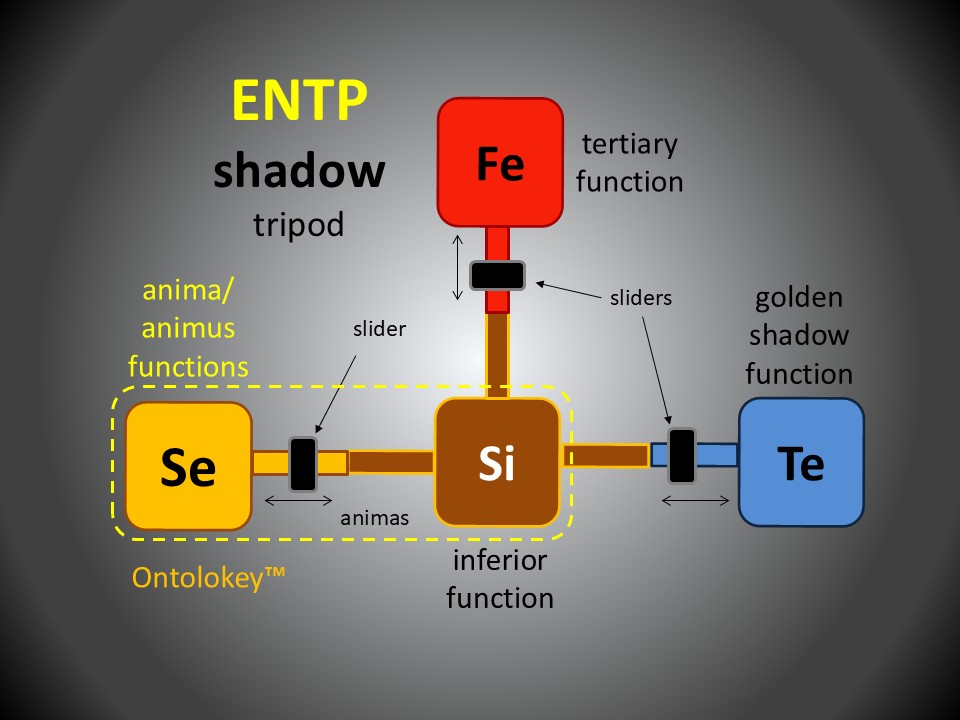
Beneath these two dominant capacities, Ontolokey describes several less conscious layers that shape the ENTP’s behavior in ways the person themselves may not fully register. There is an underused but occasionally startling capacity for sharp, physically present, boundary-testing behavior — a tendency to say the thing others are too polite to say, to provoke a room just to generate real engagement, or to push social conventions simply because they feel arbitrary and confining. There is also a quieter, much more private emotional register, one governed by a set of deeply personal values that the ENTP rarely discusses openly and sometimes struggles even to name for themselves; when this part of them is triggered, whether by injustice, betrayal, or a sense that their integrity has been violated, the ENTP is capable of intense feeling that doesn’t always find a graceful outlet, and may surface instead as sudden withdrawal or unexpectedly sharp reactions that seem out of proportion to observers who only know the type’s more sociable, joking exterior. Finally, there is the ENTP’s well-documented difficulty with ordinary physical maintenance: skipped meals, lost track of time, indifference to routine, and a general sense that the demands of the body are an annoying interruption to the far more interesting demands of the mind. All of this composes the visible and semi-visible personality that most descriptions of the type focus on, and it is a genuinely attractive, often magnetic configuration. But it is only half the picture, and Ontolokey’s more recent material makes the case that the more consequential half of the ENTP story lies beneath this surface, in territory the type itself frequently avoids looking at directly.
Where the Gift Becomes the Trap
The starting point for understanding the ENTP’s shadow side is a simple but often overlooked psychological principle: every significant strength contains, folded inside it, the seed of its own distortion. Human beings rarely suffer primarily because of their weaknesses. Far more often, they suffer because a genuine talent becomes exaggerated, detached from its original context, and gradually transformed into something closer to a compulsion. For the ENTP, this process begins with their signature ability to perceive possibility everywhere they look. This capacity is what makes them innovators, entrepreneurs, and intellectual pioneers, and civilizations genuinely do depend on people who refuse to accept that the present situation represents the final word on what is possible. The difficulty is that a human life cannot actually be lived entirely inside possibility. At some point, possibilities must be converted into choices, choices into commitments, and commitments inevitably require the sacrifice of every alternative path that was not chosen. It is exactly at this threshold — where an open field of potential begins narrowing into a specific, concrete reality — that the ENTP frequently encounters an inner conflict that can remain hidden from them, sometimes for years or even decades.
This conflict manifests as a subtle but persistent anxiety that appears whenever a possibility begins to stabilize into something real. During the early, uncertain phase of a project, a relationship, or an idea, the ENTP typically feels intensely alive, because the future still feels wide open and countless developments still seem possible. As the situation gradually settles — as the unknown becomes known, as maintenance replaces discovery, as practical obligations start to accumulate — something changes. What once felt like expanding freedom starts to feel, almost imperceptibly, like confinement. This is precisely the moment when other people, watching from the outside, often assume the ENTP should finally feel satisfied, since the opportunity they were pursuing has now actually succeeded. Yet the ENTP frequently experiences the opposite reaction: the very moment stability arrives is the moment restlessness begins creeping back in, and curiosity quietly starts drifting toward whatever comes next. This is not fickleness for its own sake. It reflects a psychological structure in which the person has, without quite realizing it, fallen in love not with reality itself but with emergence — with the excitement of something being born rather than with the more demanding, less glamorous experience of something being sustained.
This pattern is made considerably more dangerous by the fact that modern culture tends to reward exactly the behaviors that constitute the shadow. Society celebrates innovation, reinvention, adaptability, and disruptive thinking, which means an ENTP can spend years, sometimes an entire career, receiving genuine external validation for a pattern that is simultaneously undermining their own long-term fulfillment. People notice and admire the brilliant ideas, the rapid insights, and the impressive ability to start over. Far fewer people notice the trail of unfinished projects, half-explored relationships, and neglected responsibilities that tends to accumulate quietly behind that same appearance of freedom. Over time, what looks from the outside like an enviably open and flexible existence can, from the inside, start to feel like fragmentation: talents that remain only partially developed, relationships that remain only partially explored, and a self that keeps moving without ever quite arriving anywhere in particular.
The Addiction to Novelty and the Fear of Finishing
If the first layer of the shadow involves an excessive attachment to possibility in the abstract, the second layer involves something that functions very much like an addiction, even though it rarely gets recognized as one because it looks so much like ordinary intelligence, ambition, and creativity. In its shadow form, novelty stops being simply enjoyable and becomes an emotional necessity: new ideas, new projects, new relationships, and new intellectual territories start functioning as psychological fuel, and their absence produces a genuine and uncomfortable inner emptiness. The crucial distinction here is between curiosity and compulsion. Curiosity is motivated by a real interest in understanding something and is capable of resting once that understanding is reached. Compulsion is motivated by the need for relief from an uncomfortable internal state, and it cannot rest, because the discomfort simply returns the moment stimulation disappears.
This dynamic has a particularly painful effect on completion. Most people assume that achieving a goal should produce satisfaction, but for the ENTP operating from the shadow, achievement frequently carries a hidden disappointment, because the moment a possibility becomes an actuality, it loses the mystery that made it exciting in the first place. The project that once represented adventure now requires maintenance. The theory that once sparked endless exploration now simply sits there, finished, no longer generating new questions. The shadow tends to misread this natural loss of novelty as evidence that something was wrong with the achievement itself — that the project was flawed, the relationship inadequate, the career too limiting — and so attention shifts elsewhere, excitement returns around a new possibility, and the entire cycle repeats. What remains unseen throughout this pattern is that the person was never really attached to the object in question; they were attached to the particular emotional charge generated by that object’s incompleteness.
This same mechanism can become especially corrosive within intimate relationships. Early romantic attraction typically brings the ENTP into a state of genuine fascination, since another human being appears, at that stage, as an unexplored universe full of ambiguity for the imagination to fill in. In healthy development, this fascination gradually gives way to something calmer and deeper: mystery yields to familiarity, excitement deepens into trust, and exploration matures into commitment. The shadow resists precisely this transition, because intimacy requires an entirely different psychological orientation than fascination does. Fascination is sustained by uncertainty and imagination; intimacy is sustained by presence and reality. No real human being can permanently embody every possibility that was originally projected onto them, and no relationship can indefinitely maintain the electric charge of its opening chapter. When this pattern goes unexamined, the ENTP may find themselves quietly searching for stimulation elsewhere, not because love was ever absent, but because novelty has become confused, at an unconscious level, with the very feeling of being alive.
A related and equally significant consequence is the accumulation of what might be called psychological debt. Many ENTPs carry an unusual amount of visible potential from an early age; teachers, colleagues, friends, and partners routinely comment on their intelligence and promise. Potential, however, is only stored energy, and if it remains chronically unexpressed it gradually transforms into frustration rather than fulfillment. Over years, the individual can end up carrying an invisible weight made up of abandoned projects and neglected ambitions, each one functioning as quiet evidence against the self. Rather than confronting this discomfort directly, the shadow typically responds by intensifying the search for new stimulation, since new projects and new ambitions offer temporary relief from unresolved disappointment. The deeper irony is that unfinished possibilities remain, in a strange sense, psychologically safer than finished ones, because as long as something has not yet encountered reality, it can still remain perfect inside the imagination. Reality always introduces compromise and imperfection; fantasy introduces neither, which is precisely why the shadow can develop a quiet, largely unconscious preference for staying unfinished rather than risking the disappointment of completion.
Freedom Turned Against Itself: The Self-Sabotaging Rebel
Few personality configurations value personal autonomy as intensely as this one does, and in its healthy form this produces genuine originality, courage, and a valuable resistance to irrational conformity. The shadow, however, rarely attacks a virtue head-on; instead it exaggerates that virtue until it quietly flips into its opposite. A healthy love of independent thought can gradually mutate into an inability to tolerate structure of any kind, and intellectual skepticism can calcify into reflexive contrarianism. Structure itself, in this shadow state, stops being experienced as a neutral tool and starts being experienced as a threat: rules imply limitation, expectations imply obligation, and systems imply a predictability that feels suffocating to a mind wired for expansion. The result is a kind of automatic resistance that emerges regardless of whether the structure in question is actually reasonable or not, since the underlying issue has stopped being about the merit of any particular rule and has become, instead, an unconscious opposition to limitation as such.
This produces a subtle but important inversion. A person who genuinely believes they are acting freely, by resisting every expectation placed on them, actually becomes remarkably predictable in the process, since every request now generates resistance and every form of order invites some kind of disruption. The rebel, in other words, no longer directs the rebellion; the rebellion begins directing the rebel. This is especially visible in professional contexts, where the same entrepreneurial instincts that allow the ENTP to spot inefficiencies and hidden opportunities can turn, once a venture actually requires administration and coordination, into deep frustration with the very structures needed to sustain what they built. The recurring pattern is one of unconscious self-sabotage: something valuable gets created, and then, once it stabilizes, it gets quietly undermined, not out of malice but because procedures and maintenance feel deadening compared to the excitement of creation.
The same conflict shows up with real force inside close relationships, since commitment inevitably introduces structure, and love is sustained not merely through emotional intensity but through the far less glamorous quality of reliability. This can feel threatening to a shadow-driven ENTP because it introduces obligations that cannot simply be exited without real consequence, producing an unconscious tension between closeness and autonomy in which the deepening of a relationship paradoxically increases, rather than decreases, the fear of being trapped inside it. A particularly destructive expression of this pattern is the romanticization of alternatives: whenever real difficulty appears inside an existing commitment, imagination quietly begins generating competing possibilities elsewhere — a more exciting career, a more alive city, a more compatible partner — and because real life always contains friction while fantasy contains none, the actual commitment loses this comparison every single time, trapping the person in a state of perpetual dissatisfaction that has less to do with the inadequacy of their real life and more to do with imagination being deployed as a weapon against it.
The Emotional Blind Spot
One of the most persistent misconceptions about this type concerns emotional self-awareness. Because ENTPs are typically articulate, socially agile, and genuinely skilled at analyzing human behavior, observers often assume they possess effortless insight into their own inner life. Yet the ability to analyze an emotion intellectually is not the same thing as the ability to actually experience it, and the shadow tends to live precisely in that gap. Thinking, for this type, becomes more than a cognitive tool; it becomes the primary lens through which nearly every experience, including personal suffering, gets filtered before it is even allowed into conscious awareness. This produces genuine strengths, particularly a useful psychological distance during crises that allows the ENTP to remain unusually calm and solution-focused when other people are overwhelmed. But what looks like resilience from the outside can quietly function as avoidance on the inside, since analyzing a feeling can become a substitute for actually feeling it, and emotions, unlike ideas, insist on being lived rather than merely understood.
When emotional discomfort arrives, the shadow instinctively moves upward into abstraction: instead of asking what they are feeling, the ENTP asks why the feeling is occurring; instead of sitting with sadness, they analyze its causes; instead of confronting vulnerability directly, they build elaborate theories about vulnerability in general. This produces a peculiar kind of self-knowledge that is genuinely sophisticated on the level of explanation while remaining oddly disconnected from lived emotional reality — the person can describe their psychological patterns in impressive detail while still struggling, in the moment, to say simply what they feel. This same distancing frequently shows up inside close relationships, where a partner’s expression of pain gets met with an explanation rather than presence, or a partner’s desire for empathy gets met with a proposed solution instead. The intention behind this response is usually genuine care rather than coldness, but the effect can nonetheless feel dismissive to the person on the receiving end, because no argument, however elegant, actually substitutes for emotional presence.
Superiority, Grandiosity, and the Fear of Being Ordinary
A further and more troubling layer of the shadow develops around the ENTP’s relationship to their own intelligence. Because this type frequently discovers early in life that they think differently from those around them — seeing connections others miss, solving problems faster, staying intellectually ahead of conversations — a quiet, largely unconscious equation can begin forming between intelligence and personal worth. What starts as legitimate confidence can slowly harden into an invisible hierarchy in which people are implicitly ranked according to how intellectually stimulating they are, with attention naturally gravitating toward those who provide novelty or challenge and diminishing around those who don’t. This is rarely expressed openly, and it often coexists with a genuinely open-minded, curious social persona, but it subtly shapes which people the ENTP invests real interest in and which people they merely tolerate.
This distortion frequently expresses itself through chronic criticism, since the same mind that generates brilliant connections is equally skilled at spotting flaws, contradictions, and inefficiencies everywhere it looks. Over time, this can produce a consciousness that has become far more practiced at identifying what is wrong than at recognizing what is valuable, resulting in a kind of permanent, low-grade dissatisfaction with people, institutions, and ideas that never quite measure up. What is easy to miss is that this dissatisfaction says at least as much about the observer as it does about the world being observed, and that a mind trained primarily toward critique gradually loses some of its capacity for gratitude and genuine connection. Beneath this pattern there is frequently an unacknowledged insecurity: the louder the unconscious claim to exceptionalism, the more likely it is compensating for a private, haunting awareness of unrealized potential — an awareness of exactly how many projects were abandoned, how many talents remain underdeveloped, and how large the gap has become between what was promised and what has actually been delivered.
This insecurity is closely tied to a compensatory fantasy of future greatness, one made especially convincing by the fact that it usually contains real evidence. The ENTP genuinely is often unusually intelligent and creative, which means the fantasy of a uniquely gifted, destined-for-significance future self finds fertile ground to grow in. The danger is that the imagined future self can become psychologically more important than the actual present self, so that ordinary responsibilities start to feel beneath them, incremental progress starts to feel inadequate, and the present moment itself starts to feel like an obstacle rather than a home. Because imagined achievement produces many of the same emotional rewards as real achievement — excitement, confidence, a temporary sense of having arrived — without requiring any of the corresponding difficulty, this fantasy can become genuinely addictive, and it tends to alternate with periods of disappointment whenever reality inevitably reintroduces resistance and obstacles that the fantasy never had to contend with.
Beneath It All: The Fear of Emptiness and the Weight of Unlived Lives
Underneath most of these individual patterns, Ontolokey’s material identifies a single organizing fear that tends to connect them all: the fear of discovering that there is nothing substantial left once all the movement, stimulation, and future possibility is stripped away. Because the ENTP often experiences identity dynamically, through exploration and reinvention rather than through stable continuity, stillness itself can start to feel quietly dangerous, since it opens the door to self-confrontation and to questions the person has spent years successfully avoiding. This produces a peculiar and specifically ENTP form of psychological suffering: not primarily regret over things that happened, but a diffuse, harder-to-name grief over things that never became real. Every choice necessarily excludes alternatives, and because the imagination keeps those abandoned alternatives alive and idealized long after the actual decision was made, the real, lived life is constantly compared against imagined lives that never had to survive contact with disappointment or difficulty — a comparison the real life can never win.
Over time, this can build into what amounts to a private graveyard of unlived possibilities: the business never started, the book never finished, the relationship never pursued, all of them growing more mythic in memory precisely because they were never tested by reality. Left unexamined, this pattern tends to fragment attention across multiple imagined timelines rather than allowing full investment in the one life actually being lived, and it frequently intensifies as the ENTP approaches midlife and begins to notice, sometimes for the first time, that time itself is not infinitely renewable. The confrontation with mortality and with genuinely closed doors — relationships that ended, opportunities that expired, energy that has shifted — often produces real anxiety in this type, precisely because it directly threatens an identity that has been built around the assumption of endless future reinvention.
Toward Integration
The material Ontolokey publishes on this subject is candid about the fact that understanding these patterns intellectually is not the same as resolving them; insight alone tends to be one of the ENTP’s specialties and one of their favorite ways of avoiding the harder work of actual change. What the shadow work ultimately points toward is not the elimination of curiosity, imagination, or independence, all of which remain genuinely valuable, but a shift in how those qualities relate to reality. Commitment, in this more mature configuration, stops being experienced primarily as a threat and starts being recognized as the actual mechanism through which identity, meaning, and depth become real rather than merely imagined. Structure stops being the enemy of freedom and starts being understood as the vessel through which freedom becomes effective, in much the same way that a river gains power specifically because its banks give the water direction rather than allowing it to disperse. None of this requires the ENTP to become someone fundamentally different. It requires them to let their genuinely extraordinary capacity for possibility finally make contact with the specific, limited, and therefore meaningful life they are actually living.
This summary necessarily compresses a considerably longer and more detailed body of work. Readers who recognize themselves in this description, or who are simply curious to read the fuller original essays on the ENTP’s conscious and shadow functions, as well as the corresponding material Ontolokey has published on the other fifteen personality types, can find the complete texts at www.ontolokey.com.


Leave a comment