The Personality Beneath the Surface
The ISFP is often described through a vocabulary of quiet authenticity, artistic sensitivity, emotional depth, independence, loyalty, and an unusually intimate relationship with the present moment. These descriptions capture something essential, but they can also create a deceptively gentle portrait in which the more difficult dimensions of the personality remain hidden behind the image of the sensitive artist or peaceful individualist. At the center of the ISFP stands Introverted Feeling, or Fi, which organizes experience according to a deeply personal sense of value, integrity, emotional truth, and inner congruence rather than according to external expectations. Extraverted Sensing, or Se, gives this private value system a tangible language: the ISFP does not merely think about life but experiences it through atmosphere, movement, beauty, texture, sound, physical presence, and immediate human behavior. The resulting personality can therefore appear quiet from the outside while possessing an exceptionally active inner evaluative world, in which people, experiences, and choices are continually measured against an internal standard of what feels genuine, meaningful, and morally acceptable.
This combination also explains why the ISFP can be simultaneously receptive and intensely self-protective. Their sensitivity allows them to notice subtle emotional and sensory information that others may overlook, while their private value system makes certain experiences personally significant in ways that are not always easy to communicate. A criticism, rejection, betrayal, or violation of trust may therefore penetrate much more deeply than an observer realizes, particularly when it touches something the ISFP regards as authentic or sacred. The same emotional depth that can produce compassion, loyalty, artistic perception, tenderness, and profound intimacy can, under defensive conditions, develop into withdrawal, resentment, suspicion, rigidity, possessiveness, or an increasingly private world in which the individual feels fundamentally misunderstood. Ontolokey’s treatment of the ISFP is particularly concerned with this transition from conscious strengths into less conscious patterns, portraying the personality not as a fixed collection of traits but as a dynamic arrangement in which different psychological functions occupy different degrees of accessibility, importance, vulnerability, and developmental potential.
The purpose of examining the ISFP in this way is therefore not to replace its familiar positive portrait with a darker stereotype, but to reveal the psychological continuity between the two. The shadow is not presented as something alien that suddenly invades an otherwise harmonious personality; it develops when an existing strength becomes isolated from awareness and begins operating defensively. Emotional depth can become emotional secrecy, authenticity can harden into moral certainty, sensitivity can become hypervigilance, loyalty can become possessiveness, self-protection can become isolation, and idealism can deteriorate into cynicism when reality repeatedly fails to conform to the inner image of how life or relationships ought to feel. Ontolokey gives this tension a spatial form through its cube, placing eight psychological functions into a structure whose relationships are intended to make conscious and less-conscious dimensions of personality visible rather than leaving them as an abstract sequence of labels. To understand the ISFP fully, therefore, one must look simultaneously at the person who creates beauty, protects what they love, and lives according to an inner moral compass, and at the person who may silently accumulate wounds, retreat behind emotional walls, or transform unspoken pain into judgments about the world.
The Ontolokey Cube: Eight Positions, One Psychological Landscape
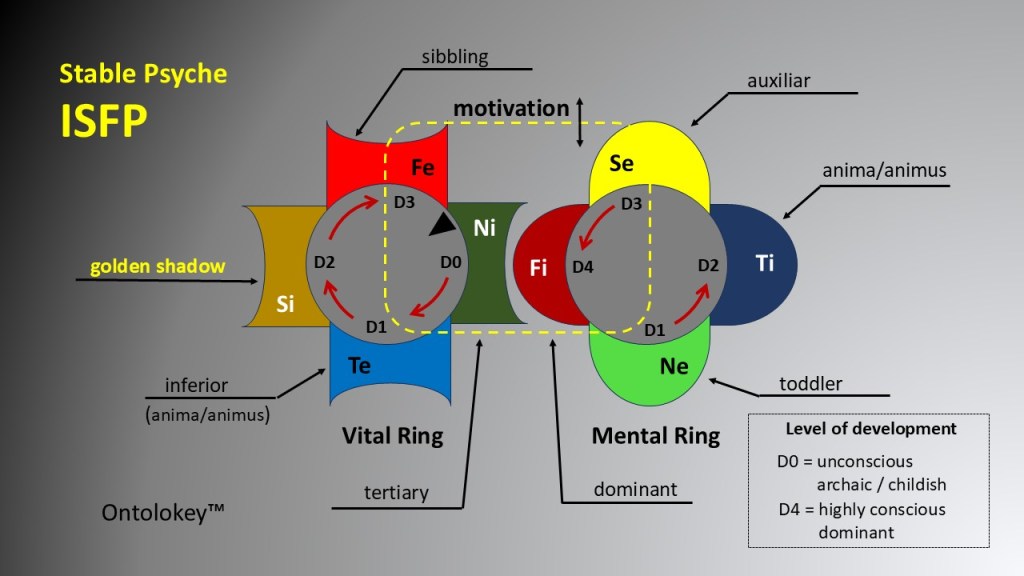
The most useful way to enter the Ontolokey model is to stop imagining the ISFP as a simple four-letter formula and instead regard the personality as a three-dimensional psychological landscape in which different functions have different degrees of proximity, accessibility, and developmental significance. In the Ontolokey presentation, Introverted Feeling (Fi) occupies the central position: it is the psychological core around which the other functions are organized, representing the private system of values, authenticity, emotional discernment, and personal integrity through which the ISFP interprets experience. Fi does not primarily ask what is socially approved or objectively efficient; it asks whether something is inwardly congruent, whether it violates or honours what the person considers deeply meaningful, and whether a relationship, decision, or action feels genuine rather than performed. This explains an important paradox in the ISFP: apparent passivity can coexist with considerable internal firmness, because the individual may be outwardly quiet precisely while making very strong internal judgments about people, situations, and boundaries. Ontolokey describes this centrality in particularly uncompromising terms, emphasizing that the ISFP’s emotional world is not merely a collection of transient feelings but a structure of personal reality in which trust, sincerity, loyalty, and moral consistency can acquire exceptional psychological weight.
Positioned immediately alongside this inner centre is Extraverted Sensing (Se), the function through which the ISFP encounters and shapes the tangible world. If Fi establishes what matters, Se allows the ISFP to experience it concretely: through sight, sound, movement, touch, atmosphere, physical presence, craftsmanship, aesthetics, and immediate action. This is why the familiar image of the ISFP as an artist, craftsperson, designer, nature lover, performer, or person with an unusually refined sense of atmosphere has psychological coherence within the model; Se transforms inner valuation into something that can be seen, touched, built, arranged, tasted, heard, or physically experienced. It also gives the ISFP a distinctive form of observational intelligence, because bodily gestures, facial expressions, spatial arrangements, changes in tone, and other immediate sensory signals can become significant sources of information long before they are converted into explicit verbal analysis. The strength of this position is therefore not simply “living in the moment,” but the capacity to meet reality directly and respond to what is actually happening rather than becoming lost in abstraction, while its vulnerability lies in overstimulation and the need to retreat when the sensory environment becomes chaotic or intrusive.
The next positions reveal why the Ontolokey cube is more nuanced than a conventional four-function description. Extraverted Intuition (Ne) is presented as a relatively immature or exploratory function, described metaphorically as a “Toddler” position, meaning that curiosity about alternative possibilities, unusual perspectives, hypothetical futures, and open-ended interpretations exists but is not naturally as secure as Fi or Se. This gives the ISFP an intriguing psychological contradiction: the person may possess considerable creative imagination while simultaneously becoming uncomfortable when imagination requires abandoning concrete reference points or tolerating too much uncertainty. Extraverted Feeling (Fe) occupies the “Sibling” position and introduces another subtle tension, because it offers access to interpersonal warmth, emotional reciprocity, social harmony, and awareness of collective feeling without replacing the ISFP’s private Fi standard. Consequently, the mature ISFP can become remarkably caring and socially responsive, but is unlikely to experience emotional conformity as a sufficient substitute for authenticity; they may participate in social harmony while internally resisting any demand to manufacture feelings they do not actually possess. In this sense, Ne and Fe broaden the ISFP’s world beyond the private self, but they do so without displacing the central authority of Fi.
The remaining positions become particularly important because they illuminate capacities that are easily misunderstood when the ISFP is viewed only through its conscious strengths. Extraverted Thinking (Te) appears as the inferior “King” position, associated with external structure, efficiency, planning, measurable results, organization, and the ability to impose order upon circumstances; for an ISFP, these demands can initially feel intrusive because they require the private value system to become externally measurable and operational. Yet Te is also one of the most consequential developmental resources in the model: when integrated rather than experienced as an external tyrant, it allows the ISFP to turn values into projects, creativity into sustainable work, convictions into practical action, and personal ideals into something capable of affecting the surrounding world. Introverted Intuition (Ni) is portrayed as a quieter, less consciously controlled source of symbolic insight, pattern recognition, spiritual reflection, and an emerging sense of meaning beyond immediate sensory experience, while Introverted Sensing (Si) functions as a deeper reservoir of bodily memory, familiarity, ritual, continuity, and sensory recollection that can provide grounding and emotional security. Taken together, these positions suggest that the ISFP’s psychological development is not a movement away from sensitivity or feeling, but an expansion of the personality’s ability to give those qualities memory, meaning, structure, foresight, and concrete effectiveness.
The Architecture of the ISFP Shadow
The most revealing aspect of the ISFP is not simply that Fi and Se are strong, but that the other psychological functions remain present as less familiar modes of consciousness and can therefore emerge in distorted, compensatory, aspirational, or unexpectedly powerful forms. Ontolokey explicitly describes the ISFP cube as being weighted toward Fi and Se, while identifying Ti and Ne as inner tensions, Te and Ni as aspirational or stress-related energies, and Fe and Si as lower positions that may be misunderstood, repressed, or unconsciously idealized. This makes the shadow fundamentally different from a collection of “bad traits”: the shadow consists of psychological capacities that belong to the same person but do not normally participate in consciousness with the same ease or authority as Fi and Se. For the ISFP, this creates a particularly important distinction between the authentic self and the defensive self, because the very qualities that make the personality sensitive, principled, perceptive, and aesthetically alive can become rigid when they are used to protect an injured inner world. Fi can cease to be an instrument of authenticity and become a private tribunal that silently judges everyone who violates its standards; Se can cease to be direct contact with reality and become a means of escaping reflection through stimulation, pleasure, activity, or immediate experience. The shadow therefore begins not when the ISFP becomes a fundamentally different kind of person, but when the natural psychological architecture becomes increasingly one-sided and the neglected functions begin compensating for what consciousness refuses to acknowledge.
The first major shadow tension lies in the relationship between Fi and Ti, because both are inwardly oriented judging functions yet ask fundamentally different questions. Fi seeks personal and moral congruence—what feels true, authentic, valuable, or ethically acceptable from within—whereas Ti seeks conceptual precision, internal consistency, and an explanation that remains logically coherent independent of personal preference. For an ISFP under psychological pressure, the distinction can become blurred: a conclusion that feels morally obvious may begin to feel logically self-evident, while a personal reaction may be treated as proof that an interpretation of events must be correct. This is one reason an ISFP can sometimes become extremely difficult to persuade once an issue has entered the territory of personal meaning, because disagreement may no longer register merely as disagreement with an opinion but as evidence that the other person has misunderstood something fundamental about the situation. The healthier expression of Ti would introduce an uncomfortable but valuable question: “Could my emotional certainty be genuine while my interpretation of the facts is nevertheless incomplete?” That question does not invalidate Fi; instead, it protects Fi from becoming absolute by separating the authenticity of a feeling from the objective correctness of every conclusion built upon that feeling. In this sense, the shadow is not overcome by suppressing personal conviction but by developing enough internal differentiation to recognize that sincerity, morality, perception, interpretation, and fact are related psychological dimensions rather than identical ones.
Extraverted Intuition (Ne) introduces a different form of tension because it destabilizes the ISFP’s natural preference for direct experience and personally meaningful perception by multiplying possibilities. Se tends to encounter what is actually present: the concrete situation, the visible detail, the immediate opportunity, the living atmosphere of the moment; Ne instead continually asks what else could be possible, what an event might lead to, how apparently unrelated things could connect, and which alternative interpretation has not yet been considered. For an ISFP, this capacity can be creative and liberating when consciously developed, but it can also feel psychologically unruly because excessive possibility weakens the reassuring clarity of immediate experience. In its immature or defensive form, Ne may therefore appear as scattered speculation, unnecessary suspicion, restless “what if” thinking, or a sudden proliferation of alternative scenarios when the ISFP feels emotionally threatened. A person who normally trusts what they can directly perceive may become surprisingly imaginative in the negative sense: instead of using imagination to create possibilities, they use it to construct explanations for ambiguous behavior, anticipate betrayal, or mentally rehearse futures that have not occurred. The developmental challenge is consequently not to turn the ISFP into an abstract theorist, but to allow possibility to function as a corrective to premature certainty, so that imagination becomes a doorway into flexibility rather than a machine for generating anxiety.
Extraverted Feeling (Fe) reaches an even more intimate layer of the ISFP shadow because it concerns the emotional field between people rather than the private field within the individual. Fi asks whether something is personally authentic and ethically congruent, while Fe is more naturally attentive to shared emotional atmosphere, interpersonal expectations, collective harmony, and the explicit emotional needs of a group. This can create a paradox in which the ISFP genuinely cares about other people yet remains deeply resistant to emotional expectations imposed from outside, particularly when those expectations appear to demand feelings, expressions, or loyalties that the individual does not inwardly share. Under healthy development, Fe can broaden the ISFP’s compassion by teaching them that authenticity does not require emotional isolation and that other people’s emotional realities deserve recognition even when they do not align with one’s own. Under defensive conditions, however, the neglected Fe dimension can emerge indirectly through heightened sensitivity to interpersonal approval, covert resentment about unequal emotional exchanges, or a painful desire to be understood without having to expose the private process through which feelings are formed. This is one of the reasons the ISFP can sometimes appear emotionally transparent and emotionally inaccessible at the same time: their reactions may be visible, their aesthetic expression may be powerful, and their affection may be unmistakable, while the deeper reasoning behind those emotions remains guarded in a psychological territory that few people are permitted to enter.
When the Inner Compass Becomes a Fortress
The most difficult ISFP patterns emerge when the protective power of Fi becomes so closely identified with personal identity that questioning an interpretation begins to feel equivalent to questioning the self. Ontolokey’s deeper treatment of the ISFP emphasizes precisely this darker possibility: the same internal moral sensitivity that enables extraordinary loyalty and compassion can, when wounded, become an almost uncompromising mechanism of emotional self-protection. The ISFP may become exceptionally sensitive to perceived betrayal, manipulation, disrespect, hypocrisy, or emotional intrusion, and because these impressions are experienced internally rather than constructed through explicit argument, they can be difficult to revise through ordinary discussion. The danger is not simply that the ISFP might misjudge another person, but that the judgment can acquire a self-sealing quality: once someone has been categorized as unsafe or morally compromised, subsequent behavior may increasingly be interpreted through that original conclusion. The resulting withdrawal can look calm and controlled from the outside, yet internally it may represent the culmination of intense emotional processing in which trust has been examined, re-examined, and eventually declared irrecoverable. Ontolokey’s account consequently presents the ISFP shadow as capable of moving from sensitivity to suspicion, from discernment to rigidity, and from self-protection to emotional finality.
This becomes particularly significant in relationships because ISFP attachment tends to be selective rather than indiscriminate. When an ISFP decides that someone is trustworthy, affection can become extraordinarily concrete: time is given, practical help is offered, private spaces are opened, sensory experiences are shared, and loyalty is demonstrated through action rather than declarations. Yet the same depth of investment can raise the psychological cost of disappointment, because betrayal is not necessarily experienced as one isolated event but as evidence that the entire relational reality was misread. In such circumstances, the ISFP may not seek an extended confrontation; silence, distance, and disappearance can become the preferred methods of restoring psychological equilibrium. This can be adaptive when genuine boundaries have been violated, but destructive when emotional certainty substitutes for verification and when the individual never permits ambiguity, repair, or competing explanations to enter the picture. The shadow therefore contains a profound paradox: the ISFP’s capacity for loyalty depends upon the ability to distinguish genuine trustworthiness from projection, while its instinct for self-protection can make precisely that distinction harder after significant emotional injury. What begins as the legitimate refusal to tolerate mistreatment can gradually become a generalized expectation of mistreatment, leaving the person safer from certain forms of harm but increasingly isolated from the possibility of corrective experience.
The same mechanism can appear in a different form through Se, because direct sensory awareness can become extraordinarily powerful when it is recruited by a threatened Fi. An ISFP who normally notices subtle shifts in expression, posture, tone, physical proximity, or atmosphere may become almost forensic in observing signs that something is wrong, particularly when trust has already been damaged. This sensitivity can be remarkably accurate in some circumstances, but perception itself does not guarantee interpretation: noticing a change in someone’s voice is an observation, whereas concluding that the change proves hostility, dishonesty, or betrayal is an inference. When Fi supplies the emotional meaning and Se supplies a continuous stream of concrete details, the combination can become extremely convincing from inside the person’s own experience, even when important contextual information remains unavailable. Under pressure, the ISFP can consequently become caught between hyper-attentive observation and increasingly categorical emotional conclusions, scanning the environment for confirmation of an already developing sense that something is unsafe. The positive gift of Se is presence; its shadow appears when presence becomes vigilance and when the immediate sensory world is no longer simply experienced but continuously interrogated for evidence of danger.
There is another, more uncomfortable dimension to this shadow: the ISFP can become capable of considerable force precisely because they normally do not seek confrontation. Ontolokey’s description of Se emphasizes that an individual who is ordinarily quiet, restrained, and observant may respond with surprising decisiveness when someone they love is threatened or a deeply held boundary has been crossed. This is not necessarily aggression in the conventional sense; it can be a sudden transition from tolerance to action, in which accumulated restraint disappears and the individual communicates with unusual directness. The psychological difficulty arises when the threshold for such a transition becomes progressively lower because previous injuries have taught the person to expect danger. A person who has learned that silence protects them may eventually discover that silence has also allowed resentment to accumulate, making the eventual reaction disproportionately intense relative to the immediate trigger. In its mature form, the same energy can become courageous boundary-setting, decisive intervention, and the ability to act when others remain passive; in its shadow form, it can become an emotionally charged final act after a long period in which the other person did not realize how much was being internally recorded.
The deepest lesson of this shadow is therefore not that the ISFP is secretly hostile, vindictive, or unstable, but that unexpressed emotional intensity has consequences. A personality that prefers sincerity to confrontation may postpone difficult conversations because speaking before feelings are fully processed feels unsafe or unfair, yet postponement does not necessarily reduce the emotional charge; sometimes it concentrates it. By the time the ISFP finally speaks, the external event may be only the final element in a much larger internal history containing dozens of observations, memories, disappointments, and interpretations that the other person never knew existed. This creates one of the most important developmental tasks within the ISFP landscape: learning to communicate boundaries while they are still boundaries rather than waiting until they have become verdicts. The mature expression of Fi does not require abandoning judgment or becoming endlessly tolerant; it requires maintaining enough psychological openness to say, in effect, “This matters deeply to me, but my emotional certainty is not automatically identical with complete knowledge of the situation.” That distinction preserves the ISFP’s extraordinary capacity for integrity while preventing integrity from becoming a fortress in which no new evidence, reconciliation, or human complexity is allowed to enter.
The Pressure of the External World: Extraverted Thinking (Te)
If Fi represents the ISFP’s private sense of what is true and Se represents the capacity to encounter reality directly, Extraverted Thinking (Te) introduces an entirely different demand: make it work, make it measurable, make it efficient, and make the result visible. Within the Ontolokey arrangement, Te occupies the inferior position, which gives it a peculiar psychological significance because the ISFP can simultaneously admire and resist everything it represents. The ISFP may deeply respect competence, decisiveness, organization, professional authority, strategic thinking, and the ability to turn an intention into an objectively demonstrable result, while nevertheless experiencing the external world of deadlines, metrics, competition, bureaucracy, hierarchy, and performance evaluation as intrusive or emotionally alien. Ontolokey describes this tension particularly clearly in its discussion of work and external expectations: the ISFP may possess considerable ability while finding self-promotion, negotiation, systematic planning, or the overt measurement of performance uncomfortable. The resulting problem is not an absence of ambition but a conflict between two definitions of success: Fi asks whether something is meaningful and faithful to one’s values, whereas Te asks whether it functions effectively in the external world. Psychological maturity requires the ISFP to discover that these questions do not have to compete, because efficiency can become a servant of values rather than their enemy.
This explains why an ISFP can sometimes appear less capable externally than they actually are. Their strongest qualities may be expressed through craftsmanship, perception, aesthetic judgment, emotional sensitivity, practical improvisation, or painstaking attention to details that matter personally, yet these abilities do not necessarily translate automatically into the language by which institutions measure achievement. An ISFP may produce something exceptionally refined while feeling uncomfortable explaining why it is valuable, negotiating its price, advertising their own competence, or competing for recognition. The psychological tension becomes especially pronounced when external evaluation is blunt: a performance score, sales target, deadline, ranking, productivity metric, or managerial judgment can feel strangely reductive when the person experiences their work primarily through quality, meaning, and personal investment. Yet this vulnerability contains a developmental opportunity because Te teaches the ISFP that something does not become less authentic merely because it is organized, priced, scheduled, measured, or communicated effectively. In fact, the ability to translate inner values into external structures can protect the very things Fi cares about most, allowing the ISFP to establish boundaries, negotiate fairly, complete meaningful projects, and prevent other people from controlling the practical conditions under which their values can exist. Ontolokey therefore presents Te not simply as an uncomfortable weakness but as a capacity that the ISFP can gradually appropriate without surrendering the inner authority of Fi.
The shadow expression of Te becomes particularly visible under prolonged stress, when the ISFP may suddenly attempt to compensate for uncertainty by becoming excessively controlling, categorical, performance-oriented, or focused on demonstrable facts. Instead of the ordinary Fi question, “Does this feel right and remain faithful to what matters?”, the stressed personality can become preoccupied with proving who is correct, who is competent, who has failed, what the measurable evidence says, and why everyone should simply follow the most efficient course of action. Because this mode is less natural to the ISFP, it can lack the flexibility and proportionality that characterize mature Te, producing harsh self-criticism or equally harsh judgments of others. A person who normally dislikes imposing external standards may suddenly impose them upon themselves with extraordinary severity, turning productivity into a measure of worth and mistakes into evidence of personal inadequacy. The irony is that the ISFP may then become trapped in precisely the kind of external value system they normally distrust, desperately trying to prove competence because some part of the personality fears that inner authenticity is insufficient unless it produces visible results. The healthier development of Te is therefore not the acquisition of an impersonal personality but the development of practical authority: the ability to decide, organize, prioritize, negotiate, finish, and act decisively while remaining connected to the values that originally made the effort worthwhile.
At its most integrated level, Te becomes one of the ISFP’s greatest protective resources because it gives external form to what Fi knows internally. The artist can become an entrepreneur without turning art into mere commerce; the compassionate person can establish firm boundaries without becoming cold; the independent individual can create systems that preserve freedom rather than restrict it; and the person who values beauty can learn the practical disciplines required to sustain a beautiful life rather than merely imagining one. This integration also changes the ISFP’s relationship with authority: instead of automatically accepting or rejecting systems according to how they feel, the mature individual can evaluate whether a structure actually serves a legitimate purpose and then use it selectively. The deeper movement is from “I resist because this feels imposed upon me” toward “I will determine which external structures deserve my cooperation because I understand what they accomplish.” Te thereby ceases to be the embodiment of a hostile external world and becomes an instrument through which the ISFP can make inner convictions durable in reality. In the language of the Ontolokey landscape, this is not a replacement of Fi by Te but an expansion of Fi’s ability to act effectively beyond the private world, transforming conviction into consequence without sacrificing authenticity.
Introverted Intuition: The Hidden Meaning Beneath Experience
If Extraverted Sensing gives the ISFP an extraordinary sensitivity to what is immediately present, Introverted Intuition (Ni) introduces the opposite movement: away from the surface of experience and toward the pattern, meaning, and trajectory concealed beneath it. In the Ontolokey account, Ni occupies a tertiary position and therefore does not ordinarily dominate the ISFP’s consciousness, yet it can become increasingly influential as the personality develops. Rather than constructing elaborate forecasts or strategic five-year plans, this form of intuition tends to appear as a quiet recognition that separate experiences belong to a larger pattern, particularly in relationships, creative work, personal transformation, and emotionally significant events. The ISFP may suddenly realize that a recurring type of relationship always produces the same emotional outcome, that a seemingly insignificant encounter altered the direction of their life, or that a particular image, place, piece of music, or memory carries a significance that cannot be reduced to its immediate sensory qualities. Ontolokey describes this as a movement from simply asking what one feels in the present toward asking what those feelings mean across time, giving the ISFP a developing capacity to experience life as a coherent personal narrative rather than merely as a succession of intense moments.
This emerging Ni can profoundly deepen the ISFP’s creativity because it allows sensory experience and personal feeling to become symbolic rather than merely aesthetic. A photograph, melody, landscape, garment, object, or gesture can begin to represent something much larger than itself, and the ISFP may communicate psychological truths through artistic form without first constructing an explicit intellectual theory about them. This helps explain why ISFP creativity can sometimes feel unexpectedly melancholic, intimate, mysterious, or emotionally timeless: Se supplies the concrete image, Fi supplies its personal significance, and Ni gradually discovers the symbolic pattern connecting the two. The same process can also transform suffering into meaning, because experiences that initially appear to be nothing more than loss or disappointment may later become integrated into a larger understanding of identity, attachment, mortality, or personal purpose. Yet this capacity has a shadow counterpart, particularly when Ni becomes entangled with unresolved emotional pain and begins converting isolated experiences into seemingly inevitable narratives about the future. The mature form asks, “What pattern is actually emerging?”, whereas the distressed form may prematurely conclude, “I already know how this will end,” turning intuition into fatalism and making the past appear to dictate the future.
This distinction becomes particularly important after betrayal or repeated disappointment because Ni can give the ISFP’s emotional memory a powerful sense of continuity. One painful relationship may cease to be perceived as one painful relationship and instead become evidence of a larger pattern: people eventually leave, trust eventually becomes dangerous, vulnerability eventually becomes punishment, or good intentions eventually lead to disappointment. Such conclusions can feel extraordinarily convincing because they are not experienced as abstract propositions but as the culmination of emotionally charged observations accumulated over time. Yet the psychological danger lies in the difference between recognizing a genuine pattern and creating one by selecting only experiences that confirm an existing expectation. When Ni becomes subordinated to wounded Fi, its gift for synthesis can therefore become a mechanism for constructing emotionally coherent but unnecessarily pessimistic explanations of reality. The ISFP may retreat not simply because someone hurt them, but because the event appears to confirm an entire philosophy of human relationships that has been forming silently for years. Development requires preserving the capacity for pattern recognition while remaining willing to discover that a pattern may change when the person, circumstances, or choices change.
The mature integration of Ni consequently gives the ISFP something that neither Fi nor Se can provide on its own: perspective across time. Fi knows what matters; Se knows what is happening; Ni begins to understand where those values and experiences are leading. This can produce an unusually personal form of wisdom because it does not require the ISFP to abandon concrete experience or emotional truth in favour of abstraction; instead, it teaches the individual to allow experience to accumulate until meaning emerges from it. The ISFP can begin to recognize that authenticity is not merely the preservation of an immediate feeling but also the construction of a life whose long-term direction remains consistent with deeply held values. At that point, endings become less threatening because not every ending is interpreted as failure, and solitude can become less defensive because reflection is no longer synonymous with withdrawal. Ni thus becomes a bridge between the ISFP’s intensely lived present and an emerging awareness of the person they are becoming, allowing the personality to ask a question that is profoundly different from simple self-expression: not merely “What feels true to me now?”, but “What kind of life is being created by the truths I repeatedly choose?”
Introverted Sensing and the Golden Shadow of Memory
Among the less visible dimensions of the ISFP, Introverted Sensing (Si) occupies a particularly interesting position because it connects the present self with embodied memory, familiarity, repetition, ritual, and the accumulated impressions of previous experience. Ontolokey describes Si as the ISFP’s “golden shadow,” emphasizing its capacity to preserve bodily memories, sensory associations, traditions, and familiar rhythms that can provide a deeper sense of psychological grounding. This is an important complement to Se, because Se is naturally oriented toward what is occurring now, whereas Si quietly preserves what has already been experienced and allows the past to remain present through the body: a particular smell can revive childhood, a familiar room can produce an immediate sense of safety, a repeated ritual can regulate emotional experience, and a physical sensation can carry memories that have never been consciously verbalized. For an ISFP, this dimension may therefore explain why certain places, objects, sounds, foods, gestures, clothing, landscapes, or routines can possess an emotional significance that appears disproportionate to their practical importance. The object is not merely an object, because it has become a container of experience, and the sensory world consequently functions not only as something to perceive but also as something through which personal history remains psychologically alive.
The relationship between Se and Si is particularly revealing because the two functions can appear superficially similar while representing radically different orientations toward experience. Se moves outward toward the immediacy of reality, seeking novelty, direct contact, spontaneous action, and the richness of what is presently available, whereas Si turns inward toward the accumulated imprint of experience and asks what feels familiar, established, embodied, or continuous with what has already been known. This creates a developmental tension within the ISFP: one part of the personality wants to remain open to the living present, while another quietly preserves the emotional and sensory traces of the past. When integrated, these tendencies can produce remarkable groundedness, because the individual is able to experience novelty without losing connection to personal history and can preserve meaningful traditions without becoming imprisoned by them. When the relationship becomes defensive, however, memory can become selective and emotionally charged, causing old disappointments to remain more psychologically present than their external circumstances justify. The past then ceases to function merely as a source of continuity and begins to influence present perception through an embodied expectation of what people, places, and situations are likely to feel like. This provides another route by which the ISFP’s shadow can become self-reinforcing: a new experience is encountered through the present, but interpreted against a deeply stored emotional memory whose influence may remain largely unconscious.
Si also helps illuminate why the ISFP may be more attached to rituals and familiar sensory environments than conventional descriptions of the type sometimes suggest. Ontolokey specifically associates this function with practices such as ritual, mindfulness, yoga, and other embodied forms of repetition through which something psychologically intangible can become physically experienced. Such practices can offer the ISFP a form of regulation that does not require extensive intellectual explanation: repetition establishes continuity, bodily awareness restores presence, and familiar sensory patterns create an environment in which the inner emotional world can settle. This becomes especially significant when the personality is overwhelmed by interpersonal uncertainty, because returning to a familiar physical practice can restore a sense of agency without requiring immediate verbal resolution. The shadow emerges when familiarity becomes confused with safety and novelty becomes confused with threat, because then the very capacity that once provided grounding can reinforce avoidance of experiences that might challenge established emotional conclusions. A mature relationship with Si therefore does not mean retreating into the past, preserving every tradition, or treating memory as unquestionable evidence; it means recognizing the past as a living psychological resource while allowing the present to remain capable of surprising the individual. In that integration, memory ceases to be an archive of old wounds and becomes a source of continuity from which new experience can be approached with greater stability.
The deeper significance of the golden shadow is that it reveals a form of psychological security that the ISFP may possess without fully recognizing its origin. The individual can develop an extraordinary capacity to make environments feel personal, meaningful, embodied, and emotionally inhabited, turning ordinary sensory details into anchors of identity and belonging. This capacity can strengthen creativity because artistic expression frequently depends upon preserving subtle impressions that disappear quickly for other people: the atmosphere of a particular afternoon, the physical quality of a childhood home, the smell associated with a relationship, or the bodily memory of a place where something emotionally decisive occurred. Yet the same sensitivity can preserve pain with remarkable fidelity, particularly when an unresolved experience has become associated with specific sensory cues. Development therefore requires neither rejecting memory nor living inside it, but learning to distinguish between remembering what happened and allowing what happened to determine what is possible now. When Si becomes consciously integrated with Fi and Se, the ISFP gains a more stable psychological relationship with time: Fi protects meaning, Se inhabits the present, and Si preserves continuity, allowing the personality to remain deeply rooted without becoming psychologically imprisoned by its own history.
The Quiet Power of the ISFP: Authenticity, Sensitivity, and Creative Presence
The darker dimensions of the ISFP become psychologically meaningful only when they are considered alongside the considerable strengths from which they emerge. At its healthiest, the ISFP possesses a rare combination of inward moral independence and outward sensory receptivity: Fi provides a deeply personal standard of authenticity, while Se allows the individual to encounter the world with immediacy, precision, and unusual sensitivity to concrete detail. Ontolokey describes this combination as an inner value system supported by direct sensory engagement, creating a personality that does not merely think about what matters but seeks to experience and embody it. This is why ISFP creativity is often more experiential than theoretical: the person may communicate through images, movement, craftsmanship, music, clothing, design, cooking, nature, physical environments, or simply through the particular way they inhabit a moment. Their creativity does not necessarily announce itself as a grand intellectual project, because its psychological source lies closer to the conviction that something should feel right, look right, sound right, or exist in a form that corresponds to an inner sense of beauty and integrity. When this orientation is mature, the ISFP can transform subjective sensitivity into something tangible that other people can encounter, making private values perceptible through concrete reality.
The same combination also gives the ISFP a distinctive form of interpersonal attentiveness. Se allows them to register physical and emotional cues in real time, while Fi supplies an internal sensitivity to whether those cues appear sincere, congruent, compassionate, threatening, or emotionally significant. Ontolokey emphasizes the ISFP’s sensitivity to subtle changes in body language, facial expression, tone, atmosphere, and other sensory signals, describing this as an important part of how the personality experiences interpersonal reality. At its best, this does not become suspicion but presence: the ISFP notices when someone is uncomfortable, recognizes when another person needs space, senses when affection should be expressed through action rather than explanation, and responds without necessarily demanding verbal acknowledgment. Such responsiveness can make the ISFP exceptionally considerate in close relationships because care becomes concrete rather than merely declarative. The danger is that the same perceptiveness can be overinterpreted when wounded, but its healthy expression remains a genuine psychological strength: the capacity to meet another person where they actually are rather than where an abstract social script says they ought to be.
This explains why loyalty is such an important theme in the healthy ISFP personality, although loyalty here should not be reduced to obedience or dependency. Fi makes relationships meaningful through personal significance, while Se makes attachment tangible through presence, practical assistance, shared experiences, and attention to the physical realities of another person’s life. Once trust has been established, the ISFP may express affection with remarkable generosity, sometimes giving time, effort, protection, creativity, or material resources without needing to turn the gesture into a public declaration. Ontolokey’s description of Fi emphasizes precisely this intensity: the ISFP can love deeply, sacrifice for people they care about, and remain committed to personal principles even when those principles are not externally rewarded. The healthy form of this devotion, however, depends upon an equally healthy capacity for boundaries, because genuine loyalty cannot require permanent self-abandonment. When Fi recognizes that love and self-respect are not opposites, the ISFP becomes capable of a particularly mature form of attachment in which compassion does not eliminate discernment and generosity does not require tolerating exploitation.
The ISFP’s relationship with the present moment is another source of psychological vitality. While some personalities naturally move toward abstraction, prediction, categorization, or conceptual systems, the ISFP can derive meaning from the immediate world itself: sunlight entering a room, the texture of a material, the sound of music, the movement of a body, the atmosphere of a particular place, or the simple pleasure of doing something well with one’s hands. Ontolokey’s description of Se emphasizes this direct engagement with physical reality and connects it with aesthetic sensitivity, practical action, creativity, and the ability to respond spontaneously to circumstances. This orientation can become particularly valuable in a culture that frequently rewards anticipation at the expense of presence, because the ISFP reminds itself and others that life is not experienced in the abstract but through actual moments. Its healthiest expression is neither escapism nor hedonism; it is an embodied attentiveness that allows experience to be fully registered before it is converted into explanation. When Fi and Se cooperate rather than compete, the ISFP can therefore create a life in which personal values are not merely believed internally but are physically enacted, aesthetically expressed, and experienced in everyday reality.
The most mature ISFP ultimately moves beyond the stereotype of the quiet artist and becomes something more integrated: a person who can feel deeply, perceive accurately, create concretely, connect selectively, and act decisively without betraying the inner principles that give those actions meaning. The Ontolokey model describes the developmental possibility in similar terms, presenting the less conscious functions not merely as defects but as resources through which intuitive depth, memory, rational clarity, structured action, and broader interpersonal connection can gradually become available. This is important because individuation does not require the ISFP to become less sensitive, less emotional, or less individualistic; it requires those qualities to become sufficiently differentiated that they no longer control the personality unconsciously. The person learns to distinguish intuition from fear, sensitivity from hypervigilance, authenticity from rigidity, solitude from isolation, loyalty from possessiveness, and boundaries from silent punishment. In that development, the ISFP’s greatest strength is no longer simply the preservation of an authentic inner self, but the ability to carry that authentic self into increasingly complex relationships, responsibilities, ambitions, and forms of action. The quiet centre remains Fi, but the psychological landscape surrounding it becomes larger, allowing the ISFP to transform private truth into a life that is both deeply personal and increasingly effective in the world.
The ISFP Under Extreme Pressure: When the Shadow Takes the Wheel
The deepest ISFP shadow is not simply a list of undesirable behaviours but a transformation in the way the personality interprets reality when its ordinary psychological resources no longer provide sufficient security. Ontolokey explicitly frames the cube as a landscape containing both conscious and less-conscious dimensions, with the shadow representing neglected, suppressed, or insufficiently recognized qualities rather than a separate personality hidden inside the individual. For the ISFP, this distinction is essential because the personality’s normal strengths are so closely tied to subjective experience: Fi protects authenticity, Se maintains contact with immediate reality, and the developing functions gradually provide perspective, structure, social awareness, and continuity. Under severe pressure, however, those same strengths can become distorted by fear, accumulated disappointment, or an increasingly narrow interpretation of experience. The ISFP may become less willing to distinguish between what was perceived and what was inferred, between what was felt and what was objectively established, or between a boundary that protects dignity and a wall that prevents intimacy. The resulting shadow state can therefore be psychologically convincing precisely because it is constructed from genuine perceptions and genuine emotions, even though the conclusions drawn from them may become increasingly rigid.
One particularly important pattern concerns the interaction of Fi, Se, and Ni, because these functions can create a powerful closed loop when the individual is emotionally wounded. Fi identifies a personal violation or emotional injury, Se notices concrete details that appear to confirm the significance of the event, and Ni begins connecting those details into a larger story about what the experience supposedly reveals about people, relationships, or the future. Ontolokey specifically notes that poorly integrated Ni can manifest as pessimism, fatalism, emotional withdrawal, and the tendency to interpret events through emotionally charged patterns. What makes this pattern difficult to interrupt is that every stage contains something psychologically legitimate: the feeling is real, the observation may be accurate, and the pattern may contain genuine information, yet the final conclusion can still exceed the evidence available. A disappointed ISFP may therefore arrive at a deeply coherent internal narrative without recognizing how much of that narrative has been constructed through selective attention to experiences that confirm an existing emotional expectation. The result can be a form of private fatalism in which the person does not merely believe that something went wrong but begins to believe that it always goes wrong, that certain kinds of people always behave in certain ways, or that vulnerability inevitably produces the same outcome.
This is also where withdrawal can become more than a simple need for solitude. Healthy introversion allows the ISFP to recover privately, process experience, reconnect with personal values, and return to the world with renewed psychological balance; shadow withdrawal is different because its primary function becomes protection from further emotional exposure. The person may stop explaining themselves because explanation feels pointless, stop asking questions because the answers seem predetermined, and stop offering opportunities for repair because emotional distance feels safer than discovering that trust was misplaced again. Ontolokey’s discussion of the ISFP repeatedly connects this darker pattern with emotional retreat and the difficulty of articulating intuitive or emotional insights that feel profound internally but cannot easily be translated into language. The paradox is that the ISFP may desperately want to be understood while simultaneously making understanding almost impossible, because the most important material remains private until it has already accumulated into a conclusion. This can produce a particularly painful relational dynamic in which other people experience the ISFP as suddenly distant or unreachable, while the ISFP experiences their own withdrawal as the final consequence of a long internal process that has been invisible to everyone else.
At the extreme, the combination of emotional certainty, sensory vigilance, accumulated memory, and intuitive pattern recognition can produce an ISFP who appears remarkably calm while internally maintaining an uncompromising interpretation of another person or situation. This is one of the least obvious aspects of the shadow because the external presentation may contain none of the dramatic signals associated with overt emotional instability. The individual may continue working, creating, behaving politely, and participating in ordinary life while privately having withdrawn emotional investment almost completely. In such a state, silence becomes a form of control over exposure: if nothing is disclosed, nothing further can be used against the person, and if expectations are eliminated, disappointment becomes less threatening. Yet this strategy carries a hidden cost because emotional safety obtained through total self-containment eventually begins to resemble emotional isolation. The same person who once possessed an extraordinary capacity for intimate loyalty can become extraordinarily difficult to reach, not because the capacity for attachment has disappeared, but because the internal threshold for allowing another person close has become exceptionally high.
The shadow therefore reveals something crucial about the ISFP that positive descriptions alone cannot adequately express: sensitivity is not the opposite of strength, but sensitivity without sufficient differentiation can become vulnerable to its own interpretations. The developmental task is not to become emotionally harder, less trusting, or more detached, because that would merely replace one form of imbalance with another. Instead, the ISFP has to learn to preserve the extraordinary fidelity of Fi while allowing Ti to question interpretations, Ne to introduce alternative possibilities, Ni to remain open rather than fatalistic, Te to establish practical boundaries, Fe to recognize the emotional reality of others, and Si to provide continuity without imprisoning the present inside the past. Ontolokey’s cube is valuable within its own conceptual framework precisely because it depicts these capacities as interconnected positions rather than isolated characteristics, allowing the shadow to be understood as part of the same psychological landscape as the personality’s gifts. The mature ISFP does not eliminate the shadow; instead, the individual gradually becomes capable of recognizing when the protective system has taken control, thereby recovering the freedom to choose between withdrawal and dialogue, suspicion and curiosity, emotional certainty and further inquiry, or self-protection and carefully measured vulnerability.
The ISFP and the Problem of Being Misunderstood
One of the recurring themes in the ISFP psychological landscape is the experience of being more internally complex than one’s outward behaviour suggests. The ISFP may appear quiet, relaxed, spontaneous, agreeable, or simply absorbed in whatever is immediately happening, while internally processing questions of loyalty, authenticity, beauty, trust, personal dignity, and emotional meaning with considerable intensity. Ontolokey’s cube is designed precisely to make this hidden architecture visible: rather than reducing the personality to a short sequence of preferred functions, it places eight psychological functions into different structural positions and distinguishes the conscious tripod from the unconscious or shadow tripod. For the ISFP, this spatial approach is especially useful because the outward simplicity of Se can conceal the inward complexity of Fi, while the less familiar functions may become visible only under particular circumstances. A person who knows only the stereotype may therefore mistake silence for indifference, spontaneity for superficiality, kindness for weakness, or withdrawal for lack of emotional investment, when the underlying process can be considerably more complicated. The fundamental problem is that the ISFP often communicates psychological depth indirectly, through behaviour, presence, aesthetic expression, selective disclosure, and concrete acts of care rather than through an ongoing verbal exposition of everything happening internally.
This difference between inner experience and outer expression becomes particularly consequential in conflict. An ISFP may notice a relational problem long before they decide to articulate it, collecting impressions about tone, behaviour, inconsistencies, emotional atmosphere, and the way an interaction makes them feel. Because Fi evaluates these impressions according to an internal standard rather than automatically externalizing them, the person may spend considerable time determining whether the problem is genuinely significant, whether their reaction reflects a personal sensitivity, and whether confronting it would improve the relationship or merely create unnecessary conflict. This can produce a long period of apparent normality during which the other person believes that nothing serious is happening, even though the ISFP is already conducting an extensive internal evaluation. When communication finally occurs, the resulting conclusion may therefore appear sudden to the other person because they are encountering the end product of a process they never witnessed. The healthier solution is not to force the ISFP into constant disclosure, but to develop earlier forms of communication in which uncertainty can be expressed before it hardens into certainty, because doing so allows the personality’s natural discernment to remain flexible rather than turning private processing into an irreversible verdict.
The problem of being misunderstood also concerns the ISFP’s relationship with authenticity. Fi does not necessarily mean that every emotion must be displayed, every opinion must be announced, or every internal reaction must become public knowledge; on the contrary, personal authenticity can include the right to maintain a private inner world and to decide carefully who is allowed access to it. Ontolokey’s description of the ISFP emphasizes this strongly by portraying Fi as a core of personal values and emotional honesty while Se provides the immediate, tangible expression of those values in the world. Consequently, an ISFP may regard excessive explanation as less authentic than simply acting according to what they know matters, particularly when words seem incapable of reproducing the quality of an experience. This can create frustration in environments where verbal assertiveness is treated as evidence of confidence and where people are expected to justify every preference explicitly. The ISFP may know exactly what they will and will not accept without possessing an immediate desire to construct an argument for it, because the psychological basis of the decision lies in an integrated emotional and experiential judgment rather than in a consciously formulated chain of propositions.
Yet this very strength can become problematic when the individual assumes that other people should intuit what has not been communicated. Personal authenticity does not automatically create interpersonal transparency, and a deeply sincere internal experience can remain completely invisible to another person unless it is translated into language or observable boundaries. This is where the less dominant functions become psychologically important, because development requires the ISFP to acquire additional ways of making the inner world accessible without betraying its privacy. Te can help convert values into clear decisions and explicit boundaries; Fe can increase sensitivity to the emotional field shared with other people; Ne can encourage alternative interpretations before a conclusion becomes fixed; and Ni can help distinguish a genuine long-term pattern from an emotionally compelling prediction. Ontolokey’s broader model explicitly treats the eight functions as a dynamic architecture rather than a simple inventory of strengths and weaknesses, with the shadow functions representing neglected or less accessible psychological capacities that can become important for growth. The mature ISFP therefore does not need to become more extroverted, more analytical, or more socially demonstrative simply to be understood; the deeper task is learning how to translate private truth into forms that another person can actually receive, while preserving the inner autonomy that makes that truth meaningful in the first place.
This ultimately leads to one of the most important distinctions in understanding the ISFP: privacy is not the same as secrecy, sensitivity is not the same as fragility, and independence is not the same as emotional detachment. The healthy ISFP can possess a remarkably strong internal centre precisely because they do not require continuous external confirmation of who they are, while their Se allows them to remain engaged with the physical world rather than becoming completely absorbed in introspection. The shadow emerges when privacy becomes concealment, sensitivity becomes hypervigilance, independence becomes isolation, and authenticity becomes a justification for refusing every perspective that challenges the existing self-concept. Ontolokey’s conception of the cube ultimately points toward integration rather than the preservation of such one-sidedness: the personality becomes more complete as previously distant functions acquire conscious relationships with the dominant centre. The “untold truth” of the ISFP is therefore not that there is a dark personality hiding behind a gentle exterior, but that an apparently simple personality can contain a remarkably complex negotiation between feeling, perception, memory, intuition, logic, social connection, and external action—and that its deepest development begins when these dimensions are allowed to communicate rather than remaining divided into the visible self and the hidden self.
Love, Attachment, and the ISFP’s Private World
The ISFP’s relational life becomes particularly revealing when Fi and Se are understood not as isolated functions but as a unified way of encountering intimacy. Fi makes emotional connection intensely personal, selective, and inwardly meaningful, while Se gives affection a concrete form through presence, physical attentiveness, shared experiences, practical gestures, and sensitivity to the atmosphere surrounding another person. The Ontolokey account describes this combination as a personality that does not treat relationships casually: trust is earned gradually, emotional access is selective, and once someone has been admitted into the inner circle, loyalty can become exceptionally deep. This helps explain why the ISFP may prefer a small number of profoundly meaningful relationships to a large social network, because intimacy is not primarily measured by frequency of interaction but by the degree to which another person is experienced as emotionally genuine and safe. The positive side of this pattern is an unusual capacity for tenderness, attentive companionship, quiet generosity, and acceptance of another person’s individuality, while its shadow appears when emotional exclusivity becomes so important that disappointment is experienced not simply as an unfortunate event but as a fundamental violation of the private world the ISFP had entrusted to another person.
Because so much of the ISFP’s emotional processing occurs internally, attachment can also develop through a language that is difficult for outsiders to recognize. An ISFP may communicate devotion through remembering small preferences, noticing subtle changes in mood, creating a comfortable environment, sharing meaningful sensory experiences, offering practical assistance, or simply remaining physically present when someone is suffering. Such behaviour can appear understated because it lacks the theatrical quality associated with overt declarations of affection, yet psychologically it may represent a considerable investment of attention and trust. Ontolokey’s treatment of Fi and Se repeatedly emphasizes precisely this connection between inner feeling and tangible expression: what the ISFP values internally tends to seek embodiment in the physical world. The difficulty arises when the ISFP unconsciously assumes that others will recognize this language without explanation, because a partner or friend may appreciate the gesture while remaining unaware of the depth of meaning attached to it. Mature intimacy therefore requires translation in both directions: the ISFP benefits from learning to verbalize important needs before they become grievances, while the other person must learn that understated behaviour may carry considerably more emotional significance than its appearance suggests.
The ISFP’s vulnerability in love is consequently inseparable from the intensity of its standards for authenticity. A relationship may survive differences in preferences, habits, interests, or temperament relatively easily, but sustained insincerity can be far more damaging because it threatens the principle through which Fi organizes intimacy. Once the ISFP begins to experience another person’s behaviour as manipulative, performative, disloyal, or emotionally false, Se may begin supplying a continuous stream of concrete observations that appear to confirm the judgment, while Ni can gradually organize those observations into a larger narrative about the relationship. The shadow emerges when this process becomes closed to correction, because the individual may stop asking whether a behaviour has another explanation and instead interpret subsequent events through the conclusion already reached. The result can be an apparently sudden emotional disappearance: externally, the ISFP may remain polite and functional, while internally the relationship has already been moved from the category of intimacy into the category of emotional distance. The Ontolokey writings explicitly connect the ISFP’s capacity for profound loyalty with the possibility of equally profound withdrawal after perceived violations of trust, making relational boundaries one of the most important areas in which conscious development can transform an instinctive protective response into deliberate discernment.
The healthiest relational development therefore does not require the ISFP to become less selective or less emotionally intense; it requires greater transparency about the process through which trust is created, damaged, repaired, or withdrawn. The individual can retain the right to say no, to leave harmful relationships, and to protect a private emotional life while also recognizing that another person’s imperfect behaviour does not automatically reveal their entire character or future intentions. Ne can introduce alternative possibilities, Ti can separate emotional conviction from logical certainty, Fe can remind the ISFP that the other person’s emotional experience exists independently of the ISFP’s interpretation, and Te can convert an internal boundary into a clear external statement rather than leaving the other person to infer what has gone wrong. This is precisely the broader developmental movement implied by Ontolokey’s cube, where the less accessible functions are not merely deficiencies but dimensions that can contribute to greater psychological integration. The mature ISFP can consequently love with the same depth while becoming less dependent upon unspoken understanding, because intimacy becomes not only a place where another person is allowed into the private world but also a place where that world can be communicated without being surrendered.
The ISFP at Work: Meaning Before Status
The ISFP’s relationship with work reveals one of the clearest differences between external achievement and internal fulfillment. Because Introverted Feeling (Fi) remains central, work is rarely experienced as psychologically neutral: even when the ISFP does not consciously describe their career in moral or existential terms, they tend to care deeply about whether what they are doing feels personally meaningful, honest, and compatible with their values. Extraverted Sensing (Se) then gives this inner orientation a practical form, favoring situations in which something tangible can be experienced, shaped, repaired, designed, performed, or improved rather than merely discussed in abstraction. This combination can produce remarkable craftsmanship because the ISFP is capable of bringing personal sensitivity into direct contact with concrete reality. Ontolokey’s description of the type emphasizes precisely this connection between Fi and Se, while also presenting Te as an uncomfortable but necessary encounter with systems, performance, structure, and external standards. The result is a person who may care considerably about doing something well while remaining relatively uninterested in the status attached to doing it.
This becomes more complicated when the surrounding environment defines success primarily through competition, hierarchy, measurable performance, or institutional recognition. Extraverted Thinking can feel foreign to the ISFP because it asks questions that do not originate inside the personal value system: What is the objective? What is the most efficient procedure? What result can be demonstrated? Who is responsible? What standard must be met? Under healthy conditions, these questions become useful instruments, allowing the ISFP to transform personal convictions into reliable action rather than leaving them at the level of feeling. Under pressure, however, Te can become disproportionately powerful, producing perfectionism, harsh self-judgment, controlling behavior, or an almost desperate need to prove competence. The person who normally avoids imposing their standards on others may suddenly become rigid when their sense of worth feels threatened by external evaluation. The developmental task is therefore not to become a relentlessly competitive or system-oriented person, but to acquire enough external structure to protect what matters internally. In that sense, Te becomes healthiest when it serves Fi rather than replacing it.
The ISFP can also experience a particular kind of frustration when their contribution is difficult to quantify. Much of what they bring to an environment may exist in qualities that formal evaluation systems struggle to capture: aesthetic judgment, sensitivity to atmosphere, awareness of subtle interpersonal shifts, practical intuition, patience with detail, or the ability to make something feel genuinely human. Because these abilities often operate quietly, the ISFP may underestimate their own value until they encounter an environment in which their particular perception is suddenly indispensable. The shadow appears when this invisibility is interpreted as personal insignificance, leading either to withdrawal or to a compensatory attempt to demonstrate worth through external achievement. A more integrated position allows the ISFP to recognize that recognition and meaning are separate dimensions: being unseen does not automatically make an activity meaningless, just as being admired does not automatically make it worthwhile. The deeper form of professional maturity therefore consists in learning when external standards genuinely improve the work and when they merely threaten to replace the inner reason for doing it.
There is also an important connection between the ISFP’s vocational life and the broader question of autonomy. Because authenticity matters so strongly, environments that demand constant emotional performance, ideological conformity, or rigid self-presentation can become psychologically exhausting even when they offer security or prestige. This does not mean that every ISFP requires complete independence or should reject conventional institutions; rather, it suggests that the quality of the relationship between personal values and external structure matters enormously. The mature ISFP gradually learns to negotiate with systems instead of either submitting to them completely or rejecting them reflexively. They can become organized without becoming mechanical, ambitious without becoming status-driven, and disciplined without sacrificing individuality. What begins as an apparent conflict between Fi and Te can therefore become a productive partnership: inner conviction determines what deserves commitment, while external structure determines how that commitment can actually be realized. In this form, work becomes neither an escape from the self nor a test of personal worth, but one of the places where the self becomes visible through action.
Creativity, Beauty, and the Moral Imagination
Creativity in the ISFP is often misunderstood when it is reduced to artistic talent or aesthetic preference. Within the Ontolokey framework, the deeper connection is between Fi and Se: Fi supplies the private sense of significance, while Se gives that significance a sensory and tangible form. Beauty therefore becomes more than decoration; it can become a way of communicating something that ordinary language cannot easily carry. A particular color, texture, composition, gesture, melody, room, garment, photograph, or physical object may express an emotional truth before the ISFP has consciously formulated that truth. Ontolokey explicitly associates this combination with aesthetic sensitivity, atmosphere, craftsmanship, and the capacity to bring inner values into the physical world. This helps explain why an ISFP may sometimes create something that feels deeply personal without being able to provide a precise intellectual explanation for every choice. The meaning may have been experienced first and understood only later.
This is also where Introverted Intuition (Ni) can deepen the ISFP’s creative life. Se sees what is actually present: the face, the landscape, the movement, the sound, the physical detail; Ni gradually asks what these things might signify and whether they belong to a larger pattern. In a mature form, the two functions can create a distinctive kind of symbolic realism in which concrete experience carries psychological meaning. A photograph can become a meditation on loss, a room can embody a relationship, a piece of music can preserve an emotional period of life, or an ordinary object can become charged with personal significance. Ontolokey describes Ni in the ISFP as a quieter source of symbolism, emotional foresight, existential reflection, and the sense that experiences form a meaningful trajectory. The creative act then becomes neither pure self-expression nor detached aesthetic experimentation; it becomes a meeting point between immediate perception and the deeper story the individual senses underneath it.
Yet the same sensitivity that makes beauty meaningful can make imperfection unusually difficult to tolerate. When Fi becomes strongly attached to an internal ideal and Se notices every discrepancy between that ideal and physical reality, the ISFP can become trapped in refinement: the lighting is wrong, the atmosphere is wrong, the object does not feel right, the gesture lacks sincerity, the finished work does not express what was originally imagined. What looks from outside like meticulous taste may therefore contain an emotional struggle over authenticity. The danger is not simply perfectionism in the conventional sense, but the belief that the external form must become sufficiently pure before the inner experience can be considered valid. This can turn creativity into avoidance, because unfinished work remains protected from the vulnerability of being seen. Integration requires a different relationship to imperfection: Se learns to allow reality to remain reality, while Fi learns that authenticity does not require perfect representation.
At its deepest level, the ISFP’s creativity can therefore be understood as a form of moral imagination. Fi asks what matters, Se discovers how that significance exists in lived reality, and Ni can reveal what the experience might mean beyond the immediate moment. This combination allows the ISFP to communicate values without necessarily preaching them, often through atmosphere, gesture, craftsmanship, or presence rather than argument. The shadow emerges when the private meaning becomes so absolute that other interpretations are experienced as invalidating, or when aesthetic sensitivity becomes a substitute for confronting uncomfortable realities. But when the functions cooperate, beauty becomes neither escape nor ornament: it becomes a way of paying attention to life. The ISFP’s characteristic creative power lies precisely there, in the ability to notice that what is tangible can carry what is invisible, and that an apparently ordinary moment can become meaningful when it is perceived with sufficient depth.
From Map to Landscape: What the Cube Adds to the ISFP
The most important contribution of the Ontolokey cube to the ISFP portrait is not that it gives the personality more labels, but that it changes the way those labels are imagined. A conventional function stack can easily be read as a hierarchy in which some functions are “good” and others are defective, with development understood as strengthening the weak areas until the personality becomes more balanced. Ontolokey instead presents the eight functions as a spatial psychological landscape, placing them at different positions around a three-dimensional structure that can be turned and viewed from different perspectives. In this model, the ISFP is not merely a Fi–Se type with several secondary functions attached beneath it; the entire eight-function architecture exists simultaneously, with different functions occupying different psychological roles and degrees of accessibility. The Ontolokey framework explicitly describes the cube as a three-dimensional representation of the eight Jungian functions, intended to make their relationships and hidden potentials more visually intelligible. The metaphor is important because it changes the psychological question from “Which function am I?” to “How does my whole inner landscape relate to itself?”
For the ISFP, that landscape begins with Fi and Se, but it does not end there. Fi occupies the central position of personal valuation, authenticity, emotional integrity, and the private sense of what is right, while Se connects that inner orientation directly with physical reality through perception, action, aesthetics, movement, and immediate responsiveness. Ontolokey describes Ti as an Anima/Animus position, representing the quieter demand for internal logical clarity, while Ne occupies the Toddler position, where possibilities can be intriguing but also destabilizing when uncertainty becomes excessive. Te represents the demanding encounter with external organization, efficiency, measurable results, and objective standards; Ni introduces symbolic meaning and long-range pattern recognition; Fe concerns the interpersonal field of shared emotion and social harmony; and Si represents a more distant relationship with familiarity, continuity, memory, and established patterns. What matters psychologically is that none of these positions is simply absent. Each represents a different way the psyche can respond to experience, whether consciously available, uncomfortable, idealized, defensive, or only gradually integrated.
This is where the cube becomes particularly useful for understanding the shadow. A shadow function is not simply a weakness in the ordinary sense, because weakness implies something that ought to be corrected and brought up to the level of the dominant function. Ontolokey instead allows the neglected function to remain different from the conscious center while still acknowledging its psychological significance. The ISFP does not need to become an Te-dominated person in order to develop a healthier relationship with structure, nor does the person need to replace Fi with Fe in order to participate meaningfully in groups. Development occurs when the individual can approach these less familiar modes without allowing them to overthrow the existing personality architecture. The cube therefore becomes a metaphor for psychological movement: one can rotate the structure and suddenly see a function that was previously hidden from view, not because it has just appeared, but because a different perspective has made its relationship to the whole more visible. Ontolokey’s broader descriptions similarly emphasize the cube as a dynamic structure in which opposing and hidden potentials become more intelligible when the model is viewed spatially rather than as a flat sequence.
Seen this way, the ISFP’s psychological development is not a journey away from Fi and Se but a journey into greater relationship with everything surrounding them. Fi becomes less defensive when it no longer has to protect itself from every external standard; Se becomes richer when immediate perception can be informed by reflection and long-term meaning; Ti can provide clarity without turning feeling into a courtroom; Ne can introduce possibility without producing unnecessary catastrophe; Te can create structure without becoming domination; Ni can deepen experience without turning uncertainty into fatalism; Fe can open private values into shared human connection; and Si can transform memory into continuity rather than confinement. The goal is therefore not symmetry for its own sake, because psychological wholeness does not mean that all functions become equally strong or equally conscious. It means that the person becomes increasingly capable of allowing different psychological perspectives to participate without being possessed by them. The ISFP remains unmistakably an ISFP, but the personality becomes less imprisoned by its own habitual center of gravity. That is the deeper promise of the cube: not to erase the architecture of personality, but to make its entire landscape inhabitable.
The Untold Truth: Strength and Shadow Are the Same Architecture
The deepest insight of the ISFP personality may be that its strengths and its shadows are not separate structures. They are different expressions of the same psychological architecture. The sensitivity that allows an ISFP to perceive beauty can, under strain, become hypersensitivity; the loyalty that makes relationships meaningful can become suspicion when trust is damaged; the commitment to authenticity can become rigidity when every disagreement feels like a violation of the self; the capacity to live intensely in the present can become avoidance when reflection becomes painful. Ontolokey’s model makes this continuity especially visible because it does not treat the less-developed functions as meaningless defects. Fi and Se form the conscious center, while the other functions represent additional ways of relating to logic, possibility, structure, meaning, social emotion, and continuity. The shadow therefore does not arrive from somewhere outside the personality. It emerges when an existing strength becomes isolated from the rest of the psychological system and is forced to carry more responsibility than it can bear.
This explains why the ISFP shadow can be so difficult for other people to recognize. From the outside, the same behavior may look completely different depending on what is happening internally. Independence may be genuine self-respect, or it may be a defense against vulnerability; silence may represent emotional maturity, or it may conceal resentment; strong boundaries may protect authentic values, or they may prevent any possibility of reconciliation; aesthetic perfection may reflect extraordinary craftsmanship, or it may protect the person from the exposure of unfinished work. The external behavior alone cannot reveal which psychological process is operating. This is why the shadow should not be reduced to a list of undesirable ISFP traits. The same Fi that gives the personality moral seriousness can also make it difficult to accept that one’s interpretation is incomplete; the same Se that creates presence and responsiveness can keep attention locked onto what is immediately felt; and the same Ni that gives experience symbolic depth can, under pressure, construct a dark narrative in which painful events appear to confirm an inevitable pattern. Ontolokey specifically describes this interaction between conscious strengths and less-integrated functions, rather than treating each function as an isolated trait.
The most important consequence is that psychological growth cannot consist simply of becoming “less ISFP.” Trying to eliminate sensitivity, privacy, strong values, aesthetic awareness, or emotional intensity would not produce greater maturity; it would merely produce alienation from the personality’s natural center. Development instead means increasing the number of psychological options available when the familiar response no longer works. When Fi is hurt, the mature ISFP can eventually move toward Ti and ask not only, “How do I feel about this?” but also, “What exactly happened, and what evidence supports my interpretation?” When Se becomes overwhelmed, Ne can introduce alternative possibilities instead of allowing one frightening interpretation to become reality. When Te appears under pressure, it can provide practical structure without turning the self into a performance project. When Ni becomes dark and fatalistic, Se can return attention to what is actually happening rather than what the mind predicts will happen. The neglected functions therefore become forms of psychological counterweight: they do not replace the center, but they prevent the center from becoming a closed system.
This is ultimately what makes the ISFP shadow psychologically interesting rather than merely dark. The shadow contains precisely what the conscious personality needs when its habitual strategy reaches its limits. Ti offers distance where Fi may become emotionally fused with a judgment; Ne offers openness where Se may become trapped in certainty about the present; Te offers structure where personal values alone cannot organize reality; Ni offers meaning where immediate experience feels fragmented; Fe offers shared emotional space where privacy has become isolation; and Si offers continuity where constant adaptation has become exhausting. Even the apparently uncomfortable functions therefore contain something valuable. Ontolokey’s broader conception of the cube treats personality as an architecture in which what is less conscious is not simply absent, but remains part of the larger landscape of the person. The point of integration is not to flatten those differences, but to make more of the landscape accessible.
The untold truth of the ISFP is therefore not that there is a dark personality hiding beneath a gentle one. It is that the gentle and the dark are generated by the same depth of feeling, the same intensity of perception, the same need for authenticity, and the same desire for an experience that feels genuinely real. The person who can love with extraordinary sincerity can also be wounded with extraordinary sincerity; the person who notices beauty can also notice rejection; the person who values freedom can fear dependence; the person who protects inner truth can become frightened of perspectives that threaten it. None of these contradictions invalidates the personality. They reveal its complexity. The mature ISFP does not become someone without a shadow, but someone capable of recognizing when the shadow has begun speaking through their strengths. At that point, authenticity becomes more than “being true to how I feel in this moment”: it becomes the willingness to examine the self honestly enough to discover whether the feeling itself is protecting a deeper truth.
Becoming Whole Without Becoming Someone Else
The final truth of the ISFP is that psychological maturity does not require abandoning the qualities that make the personality distinctive. The sensitivity of Fi, the immediacy of Se, the search for meaning through Ni, and the quiet attraction toward beauty, authenticity, and lived experience are not problems to be corrected. They are the foundation from which development begins. What changes is the degree to which these qualities remain enclosed within a defensive inner world. A mature ISFP can still be private without becoming inaccessible, principled without becoming rigid, sensitive without becoming fragile, and independent without turning every form of dependence into a threat. Ontolokey’s deeper purpose is precisely to make this movement visible: the eight functions are not isolated traits but parts of a larger psychological architecture whose less-conscious regions can gradually become available to awareness. Development therefore does not mean becoming someone else; it means becoming capable of inhabiting more completely the person one already is.
The most important shift occurs when authenticity stops meaning simple loyalty to one’s immediate feelings and begins to include the courage to examine those feelings. Fi becomes more mature when it can say, “This is deeply important to me, but I may still be interpreting it incorrectly.” Se becomes more mature when presence does not merely provide escape from difficult reflection but becomes a way of encountering reality exactly as it is. Ti can introduce necessary distance and precision; Ne can prevent one frightening possibility from becoming an unquestioned certainty; Te can transform values into concrete action; Ni can give experience a wider horizon without turning patterns into fatalistic predictions; Fe can make private emotional truth shareable; and Si can allow memory and familiarity to become sources of continuity rather than prisons of nostalgia. These functions do not have to become equal in strength. Their value lies in the alternative perspectives they make possible. The ISFP becomes psychologically freer when no single perspective is required to explain everything.
This is particularly important for the shadow because the shadow often feels convincing precisely when it is emotionally coherent. A wounded ISFP may possess a powerful internal explanation for why someone cannot be trusted, why a relationship has failed, why the future will repeat the past, or why withdrawing is the only honest response. Such conclusions can contain genuine insight, which makes them difficult to question. But insight and certainty are not identical. The developmental movement is therefore from private certainty toward psychological curiosity: What else could be true? What part of this reaction belongs to the present, and what part belongs to an older wound? What evidence would change my interpretation? What am I protecting? What am I afraid would happen if I remained open? Questions of this kind do not weaken Fi; they protect it from becoming a closed system. They allow authenticity to include self-examination, which is a considerably deeper form of honesty than simply defending whatever one happens to feel.
The ISFP’s deepest strength may ultimately be its capacity to make inner truth tangible. The personality can perceive what is beautiful, meaningful, sincere, human, or emotionally significant and give it form through action, relationship, craftsmanship, art, presence, or ordinary acts of care. But the shadow teaches an equally important lesson: what feels deeply true inside the individual is not automatically the whole truth of reality. Wholeness emerges when the private world remains connected to everything outside it. The Ontolokey cube is useful as an image of this process because turning the structure changes what can be seen without changing the structure itself; what was hidden becomes visible from another angle. In that sense, the ISFP’s journey is not away from the self but around the self, gradually discovering dimensions that were always present but not equally conscious. The result is not a personality stripped of contradiction, but a person capable of carrying contradiction without being divided by it.
That is the untold truth of the ISFP: the shadow is not the opposite of the beautiful, sensitive, authentic person others may see. It is the unfinished side of that same person. The capacity to feel deeply can create both compassion and woundedness; the need for authenticity can produce both integrity and defensiveness; the love of experience can produce both presence and avoidance; the perception of meaning can produce both wisdom and fatalism. Psychological growth does not erase these tensions. It teaches the individual how to hold them consciously. The ISFP who reaches that point does not become less emotional, less artistic, less private, or less individualistic. They become less governed by unconscious reactions and more capable of choosing how their qualities are expressed. For readers who want to explore the architecture in greater detail, the longer ISFP analyses and the wider body of material on the Ontolokey website provide a broader landscape in which these individual functions, positions, and developmental tensions can be examined further. The final movement is therefore not from weakness to strength, but from unconsciousness to awareness—from protecting the self at all costs to becoming sufficiently whole that the self no longer needs to live behind a fortress.


Leave a comment