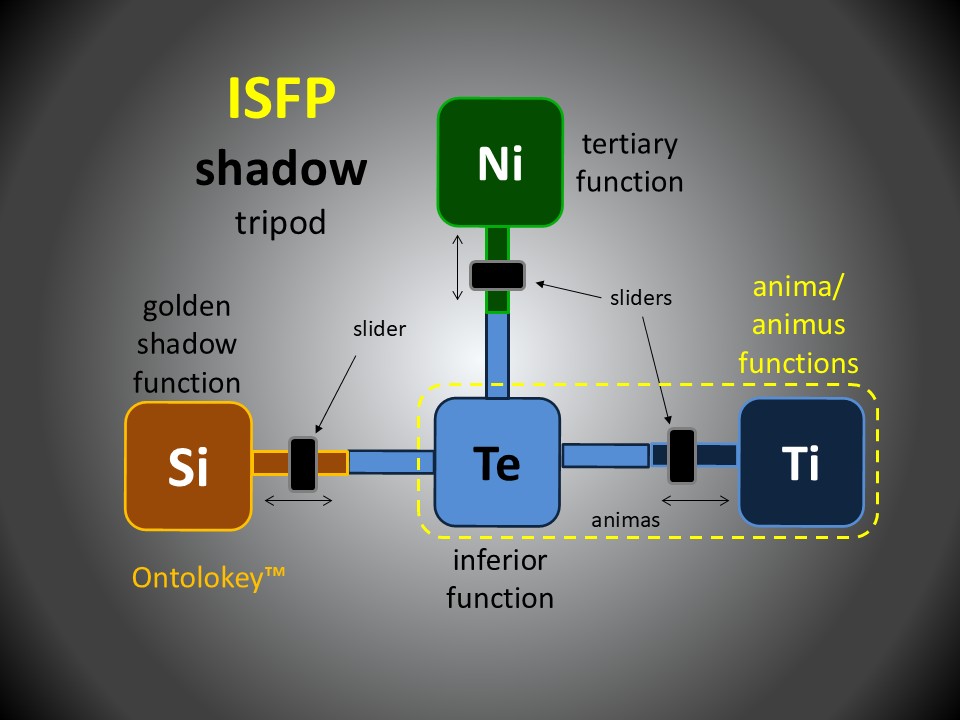
This summary is based on material published by Ontolokey and is intended as a psychologically oriented interpretation of the ISFP personality, with particular attention to the less flattering and less consciously accessible aspects of the type. It should be understood as a personality framework rather than as a clinical diagnosis or as an empirically established description of every person who identifies with this type. Ontolokey presents the ISFP as a personality organized around a deeply internal system of values, a strong sensitivity to immediate sensory experience, and a relatively private emotional life, while also describing less developed capacities for abstraction, external organization, and detached analysis. The shadow-oriented material goes further by examining how precisely these strengths can become distorted when they operate defensively or without sufficient self-awareness. The central psychological proposition is therefore not that the ISFP is secretly a negative or manipulative person, but that admirable qualities such as authenticity, sensitivity, loyalty, compassion, and integrity can develop pathological-looking expressions when they become rigid, wounded, or disconnected from reality testing. In that sense, the shadow is not an alien personality hiding underneath the surface; it is the personality’s own strengths becoming defensive and increasingly unconscious.
At the centre of the conventional ISFP description lies an unusually private and internally governed value system. The person tends to evaluate experiences according to what feels personally authentic, morally acceptable, emotionally sincere, or fundamentally wrong, rather than relying primarily on external expectations or social consensus. This can create a quiet but powerful form of integrity because the individual does not necessarily need recognition in order to remain faithful to an inner conviction. An ISFP may therefore appear flexible, modest, or easygoing while simultaneously possessing surprisingly firm boundaries concerning loyalty, honesty, dignity, and interpersonal conduct. Their morality is often experienced more as an immediate emotional recognition than as an abstract philosophical system, which explains why they may struggle to explain precisely why something feels wrong while remaining deeply convinced that it is wrong. Ontolokey describes this internal value orientation as the central psychological core from which much of the rest of the personality develops.
This internal orientation is closely connected with an exceptionally strong awareness of the concrete world. ISFPs are portrayed as people who experience their surroundings through colour, sound, texture, movement, atmosphere, bodily sensation, and subtle interpersonal cues, often noticing details that more abstractly oriented individuals overlook. Their intelligence may therefore reveal itself through perception and action rather than through elaborate verbal explanation, and they frequently learn more effectively by experiencing, practising, creating, repairing, shaping, or directly engaging with something than by remaining exclusively within theoretical discussion. This helps explain the familiar association between the type and artistic or aesthetic sensitivity, although reducing ISFPs to artists would be misleading because the same perceptual ability can appear in cooking, craftsmanship, design, nature, physical activities, practical problem-solving, or simply an unusually refined awareness of atmosphere. The physical environment can become psychologically significant because disorder, noise, intrusion, or sensory overstimulation may interfere with the inner equilibrium that the person is attempting to maintain. At their best, this orientation produces presence, practical responsiveness, understated creativity, and an ability to turn private values into something tangible in the external world.
The combination of deep private feeling and immediate sensory awareness also creates an important interpersonal quality: the ISFP can be far more perceptive than their quiet manner initially suggests. They may notice inconsistencies between what somebody says and what their body communicates, detect shifts in tone or posture, and register subtle changes in emotional atmosphere without consciously analysing them step by step. This does not necessarily mean that their interpretations are always correct, because perception and interpretation are different psychological processes, but it does mean that they often possess a powerful sensitivity to interpersonal incongruence. In healthy development, this can become empathy, tact, aesthetic intelligence, and an ability to respond appropriately to people who are distressed without overwhelming them with excessive verbal intervention. In stressful circumstances, however, the same sensitivity can become hypervigilance, particularly when previous experiences have taught the person that apparently harmless situations can conceal rejection, betrayal, humiliation, or manipulation. The very instrument that makes the ISFP perceptive can therefore become the instrument through which the person continually searches the environment for signs of emotional danger.
One of the most important tensions in the personality concerns the relationship between emotional conviction and intellectual explanation. The ISFP may know with considerable certainty that something feels wrong while finding it much harder to translate that certainty into a coherent analytical argument. Ontolokey describes a quieter analytical capacity that can become especially visible when the individual attempts to justify, organise, or rationally defend an emotional judgment, sometimes producing over-explanation, circular reasoning, or frustration because the original experience was richer than the available conceptual language. This does not imply low intelligence, irrationality, or an inability to think critically; rather, it suggests that the person’s first access to meaning is often experiential and evaluative rather than detached and conceptual. The danger begins when the individual assumes that because an emotion is intense, it must also be an objectively accurate interpretation of external reality. Psychological maturity therefore requires learning to preserve emotional information without automatically treating emotional certainty as factual certainty.
The shadow begins to become visible when emotional privacy turns into emotional secrecy. An ISFP may initially withdraw because speaking about a wound feels exposing, unnecessary, or likely to produce further misunderstanding, and silence can indeed be a legitimate form of self-protection when someone has been hurt. The problem arises when silence becomes the standard substitute for communication, because unexpressed disappointment does not disappear simply because it is never verbalised. Instead, grievances can accumulate internally, where they become increasingly intertwined with memory, identity, and judgments about another person’s character. The other person may notice only a change in warmth, availability, tone, or trust, while the ISFP may simultaneously feel frustrated that the other person has failed to understand the reason for the withdrawal. A circular interpersonal pattern can consequently develop in which feeling misunderstood produces withdrawal, withdrawal produces confusion, confusion produces distance, and that distance is then interpreted as proof that the original feeling of being misunderstood was correct.
This is where one of the more uncomfortable aspects of the shadow deserves to be confronted honestly: sensitivity does not automatically make a person harmless. A highly sensitive individual can become highly influential precisely because they are capable of detecting emotional vulnerabilities, changes in atmosphere, and the psychological reactions of others. In the mature form, this capacity supports compassion and relational intelligence, but in a wounded form it can become a subtle method of controlling interpersonal environments without consciously intending to control anyone. Withdrawal, emotional coldness, withheld affection, visible disappointment, or a sudden reduction in warmth can communicate displeasure without a single explicit demand being made. The person may sincerely experience themselves as merely protecting their boundaries, yet other people can still begin modifying their behaviour in order to avoid triggering another withdrawal. Ontolokey’s shadow analysis is particularly direct on this point: interpersonal pressure does not require overt aggression, threats, or domination, because emotional withholding can shape a relationship just as powerfully when everyone involved is reluctant to name what is happening.
The moral dimension of the ISFP makes this shadow especially complex because the person may experience their judgments as deeply authentic rather than authoritarian. If someone violates a core value, the reaction can feel less like an ordinary disagreement and more like the recognition of a profound moral fact about the other person’s character. This can make forgiveness difficult when trust has been broken, because the injury is not experienced simply as an unpleasant event but as evidence that the person has revealed something essential about themselves. The healthy version of this capacity is admirable: it protects the individual from tolerating abuse, dishonesty, hypocrisy, or repeated violations of personal boundaries merely for the sake of social harmony. The unhealthy version emerges when subjective moral certainty becomes immune to correction, when contradictory evidence is discounted, or when another person’s different perspective is interpreted as evidence of inferior character rather than as evidence that human beings can experience the same situation differently. Ontolokey therefore identifies a crucial distinction between integrity and rigidity: integrity remains capable of self-examination, whereas rigidity increasingly experiences disagreement as an attack upon the self.
Another important shadow process involves suspicion and projection. When emotional injuries accumulate without being sufficiently examined, the mind naturally searches for patterns that explain them, and a person who has repeatedly experienced betrayal may become increasingly prepared to detect hidden motives before there is adequate evidence for them. The danger is not that every suspicion is false, because people genuinely can be deceptive or hostile, but that unresolved resentment can distort the threshold at which ambiguous behaviour becomes interpreted as threatening. A neutral remark may sound critical, ordinary distance may appear like rejection, and another person’s independent interests may be interpreted as evidence of disloyalty. Ontolokey describes this process in terms of projection: psychological material that has not been consciously recognised within oneself may increasingly be experienced as something located in other people. The resulting worldview can become self-confirming, because the individual expects hostility, interprets ambiguous situations accordingly, reacts defensively, and then encounters the predictable social consequences of that defensiveness as apparent confirmation that other people really were hostile.
The tension between intimacy and self-protection is particularly powerful in close relationships. The stereotypical ISFP is often described as loyal, affectionate, deeply devoted, and capable of profound emotional connection, yet Ontolokey’s shadow analysis argues that precisely this longing for closeness can create vulnerability to possessiveness, jealousy, fear of abandonment, and covert emotional pressure when the relationship becomes psychologically overloaded. The person may want absolute emotional security while simultaneously fearing the exposure required to create genuine intimacy, producing an oscillation between intense closeness and sudden withdrawal. When abandonment is interpreted as a statement about personal worth, ordinary relationship difficulties can acquire an existential significance that is disproportionate to the actual event. The partner may then experience contradictory signals: the ISFP seeks reassurance and closeness but becomes suspicious of dependence, wants loyalty but may fear vulnerability, and desires emotional transparency while withholding their own most painful feelings. Ontolokey’s mature solution is not emotional detachment but the recognition that love cannot eliminate vulnerability and that another person cannot be transformed into a permanent solution for one’s unresolved inner wounds.
A particularly difficult manifestation of the shadow is the possibility of identifying with suffering itself. Because emotional experiences may be remembered with unusual intensity, painful events can become more than memories; they can become organising stories about who one is and what the world is like. The person may understand themselves through narratives of betrayal, sacrifice, loyalty, rejection, endurance, or having been insufficiently appreciated by others, and these narratives can contain genuine truth while nevertheless becoming psychologically restrictive. Suffering becomes dangerous when it ceases to be something that happened and gradually becomes something around which identity is organised. In such a state, letting go of resentment can feel strangely threatening because resentment preserves the moral meaning of the injury and keeps the past psychologically alive. The individual may unconsciously remain loyal to their own pain because abandoning the pain seems to risk abandoning the significance of what was done to them. Ontolokey calls attention to this possibility of victimhood and martyrdom becoming disguised forms of identity, particularly when self-sacrifice is continuously interpreted as evidence of moral worth.
The same mechanism can eventually lead to cynicism. When ideals concerning love, authenticity, loyalty, beauty, or human goodness repeatedly collide with disappointment, a person may protect themselves by lowering their expectations and convincing themselves that the ideals were naïve in the first place. This defence can initially feel intelligent because it contains partial truths: people really are inconsistent, relationships really do fail, institutions can be corrupt, and apparently noble motives can sometimes conceal selfish interests. The problem is the movement from recognising these facts to absolutising them, because once every ideal is interpreted as disguised hypocrisy, the capacity to experience meaning itself begins to collapse. Ontolokey describes an extreme trajectory in which the personality can become emotionally numb, cynical, and eventually nihilistic, not because the person never cared but because they cared so intensely that repeated disappointment became intolerable. The resulting detachment may provide temporary protection from pain, yet it also blocks joy, creativity, intimacy, wonder, and the sense of meaning that originally gave the personality its vitality.
This makes the ISFP shadow fundamentally different from a simple list of negative traits. Emotional depth can become emotional secrecy, but the solution is not to become emotionally shallow; integrity can become moral rigidity, but the solution is not to abandon one’s values; sensitivity can become suspicion, but the solution is not to stop noticing subtle interpersonal signals. The developmental task is instead to introduce a second level of awareness into the original psychological process, so that the individual can ask not only what they feel but also what might be producing that feeling, what evidence supports their interpretation, what alternative explanations exist, and what part of their response belongs to the present rather than to accumulated experiences from the past. This distinction between emotional information and emotional verdict is essential because feelings contain valuable psychological data without necessarily constituting objective proof. A mature ISFP therefore does not have to betray authenticity in order to become more flexible; rather, authenticity becomes deeper when the individual becomes honest enough to examine even the motives and interpretations that feel most sacred.
The weaker relationship with external structure represents another area in which development can be transformative. Planning, measurable goals, efficiency, delegation, financial organisation, long-term strategy, and systematic execution may initially feel alien or oppressive when compared with the ISFP’s preference for immediate experience and personally meaningful action. Yet external structure can become an instrument rather than an enemy when it is consciously placed in service of the individual’s values. A creative person who learns budgeting can protect their independence; someone devoted to relationships can learn to communicate boundaries before resentment accumulates; an idealistic person can learn project management so that their values produce actual results rather than remaining private convictions. Ontolokey’s developmental model consequently emphasises the integration of less comfortable capacities rather than the replacement of the original personality. The mature form is not a person who becomes cold, calculating, or relentlessly productive, but someone capable of giving their inner values sufficient structure to make those values effective in the external world.
The capacity for openness to possibilities also deserves attention because it can exist in two sharply different forms. Under favourable conditions, the ISFP can display a surprisingly playful imagination, experiment with unfamiliar ideas, discover new aesthetic directions, and reinterpret familiar experiences in creative ways, particularly when they feel emotionally secure enough to explore without needing immediate certainty. Under stress, however, uncertainty can become threatening, and the same openness can deteriorate into excessive anticipation of possible problems, catastrophic thinking, indecision, or an almost continuous background expectation that something will go wrong. The person may then retreat toward familiar environments, trusted people, established routines, and concrete realities because these provide a sense of psychological ground. Development does not require forcing oneself into endless novelty, but it does require learning that uncertainty is not synonymous with danger and that imagination can be used to generate possibilities rather than merely threats. When this distinction becomes conscious, curiosity can gradually replace defensive anticipation, and the individual’s natural creativity gains a larger psychological field in which to operate.
Ultimately, the deepest ISFP shadow is not cruelty, weakness, emotionality, or introversion, but the possibility that an exceptionally rich inner emotional world becomes so protected that it stops allowing reality to challenge it. The personality can become trapped in a closed loop in which personal feelings are treated as unquestionable evidence, withdrawal replaces communication, resentment becomes moral certainty, suspicion becomes perception, and self-protection gradually becomes isolation. The tragedy of this pattern is that the qualities being defended are precisely the qualities that make the personality capable of extraordinary devotion, sensitivity, creativity, loyalty, and authentic connection. Ontolokey’s central insight is therefore psychologically useful even when treated as a typological rather than clinical model: the shadow is created when strengths operate without sufficient consciousness, and genuine growth requires neither self-rejection nor sentimental self-acceptance, but radical honesty about both sides of one’s own psychology.
A mature ISFP does not need to become less emotional, less sensitive, less loyal, or less authentic in order to become psychologically stronger. The more demanding task is to become capable of holding two truths simultaneously: one’s feelings matter deeply, and one’s feelings can still be mistaken; one’s boundaries are legitimate, and other people are not obligated to intuit them without communication; one’s perception of hypocrisy may be accurate, and one’s own behaviour may nevertheless contain unconscious motives; one’s suffering may have been real, and continuing to organise one’s identity around that suffering may still become destructive. This form of self-reflection transforms the central qualities of the personality rather than suppressing them, because sensitivity becomes discernment, loyalty becomes freely chosen devotion, authenticity becomes self-awareness, and moral conviction becomes principled but revisable judgment. The ultimate developmental movement is therefore from emotional certainty toward conscious emotional truth, where feeling remains central but is no longer protected from examination. In this sense, the shadow becomes not an enemy to be destroyed but a psychological map showing where the personality’s greatest gifts are most vulnerable to distortion.
This summary has been created from material published by Ontolokey, particularly its three extensive discussions of the ISFP personality and its shadow side. Readers who want a substantially more detailed treatment of the psychological architecture, developmental dynamics, shadow processes, and relationships between the different personality patterns are encouraged to consult the original articles and the wider material available on the Ontolokey homepage. The longer texts go considerably deeper into the distinctions between the conscious and less conscious aspects of the personality and provide a broader framework for comparing ISFP characteristics with those of other personality types. It is worth reading them not as definitive psychological diagnoses but as interpretive material for self-observation, because personality descriptions become most useful when they stimulate examination rather than provide a convenient excuse for behaviour.
The most constructive conclusion is consequently neither flattering nor condemning. The ISFP can be understood as a personality with an unusually intimate relationship to values, sensation, emotional authenticity, beauty, loyalty, and lived experience, but these same qualities can become rigid, secretive, suspicious, possessive, self-sacrificial, or cynical when psychological wounds remain unexamined. The decisive question is not whether an ISFP possesses these shadow tendencies, because every human personality contains defensive patterns, but whether the individual can recognise them before they become an invisible system governing relationships and interpretations. The mature direction is toward greater reality testing, explicit communication, tolerance of ambiguity, acceptance of imperfection, and the ability to distinguish genuine moral boundaries from defensive reactions to old wounds. When that development occurs, the shadow does not need to disappear; instead, it becomes integrated, and the emotional intensity that once created isolation can become the foundation for unusually deep empathy, creativity, courage, and intimacy. That is ultimately the more truthful picture of the ISFP: neither the harmless sensitive artist of a flattering stereotype nor the secretly manipulative figure of an excessively dark portrait, but a psychologically complex person whose greatest gifts and greatest vulnerabilities grow from remarkably similar roots.


Leave a comment