Beyond the Stereotype: The ESFP and the Psychology of Direct Experience
The ESFP is often described through highly visible qualities: charismatic, spontaneous, sociable, adventurous, expressive, pleasure-loving, and intensely engaged with whatever is happening in the present. These descriptions capture an important part of the personality, but they can obscure the psychological structure beneath the surface, particularly because the same qualities that make the ESFP vivid and adaptive can become defensive patterns when they are driven by unconscious needs. In the Ontolokey framework, the ESFP is fundamentally organized around Extraverted Sensing (Se), which places direct contact with reality, immediate perception, action, physical experience, and responsiveness at the center of consciousness. The ESFP does not merely prefer to observe life from a distance; experience itself becomes a primary route to knowledge, meaning, stimulation, and self-discovery. The psychological question therefore extends far beyond whether an ESFP is outgoing or spontaneous: it concerns what happens when an extraordinary capacity for experiencing reality becomes either an expression of freedom or a means of avoiding the realities within oneself.
This distinction is essential because the ESFP’s shadow does not begin with obviously destructive behavior; it begins much earlier, when engagement with the external world gradually becomes a substitute for engagement with the inner world. Healthy Se can make the ESFP exceptionally perceptive, adaptable, courageous, practically intelligent, and capable of responding to circumstances while others are still deliberating, but the same orientation can become compulsive when stillness, uncertainty, vulnerability, or introspection become increasingly difficult to tolerate. In that state, activity can function as psychological regulation: stimulation relieves tension, novelty interrupts dissatisfaction, social interaction protects against isolation, achievement restores self-esteem, and intense relationships temporarily silence uncomfortable questions. Ontolokey’s discussion of the ESFP shadow describes this danger in particularly direct terms, portraying the deeper problem not as simply “impulsiveness” but as the possibility that experience itself becomes an escape from self-confrontation. The untold truth of the ESFP, therefore, is not that the type is secretly negative beneath a charming exterior, but that its greatest psychological strength contains its own characteristic vulnerability: the ability to immerse oneself completely in life can become so powerful that one forgets to ask who is living it, why, and toward what end.
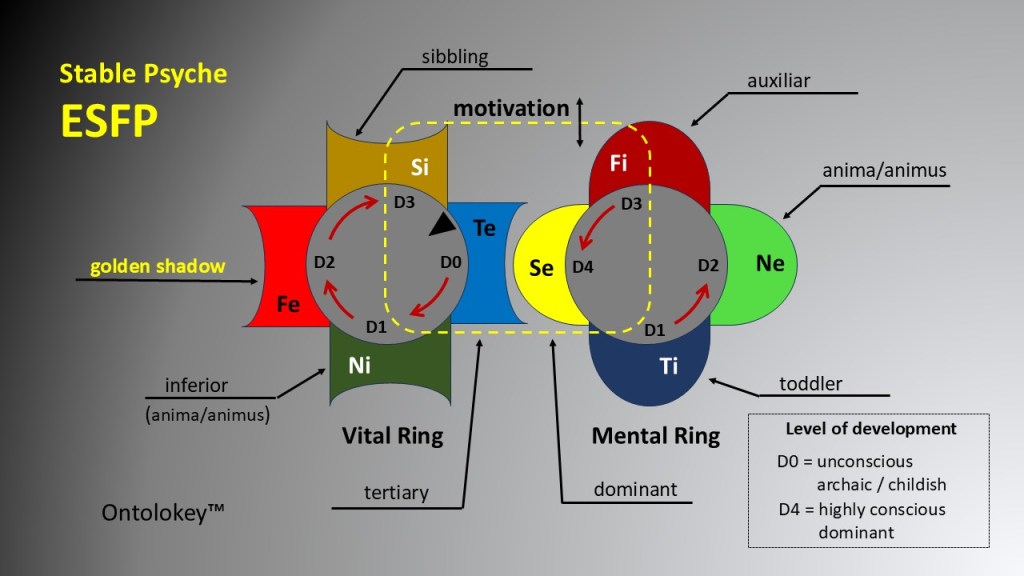
This essay will therefore examine the ESFP as a complete psychological landscape rather than as a collection of familiar personality traits, following the eight-function Ontolokey architecture and paying particular attention to the meaning of each position: Se as Dominant, Fi as Auxiliary, Si as Sibling, Ti as Toddler, Ni as Inferior, Ne as Anima/Animus, Te as Tertiary/Blind Spot, and Fe as Golden Shadow. The purpose is to understand how these positions interact, where the ESFP’s considerable strengths originate, and why the same psychological configuration can under certain circumstances give rise to impulsivity, possessiveness, excessive stimulation-seeking, pride, control, relational intensity, or an inability to tolerate inner emptiness. The darker material is not intended as condemnation, because shadow characteristics are meaningful precisely when they reveal the unconscious compensation behind otherwise valuable qualities. The ESFP’s developmental challenge is ultimately not to become less alive, less spontaneous, or less passionate, but to become sufficiently inwardly conscious that experience remains an expression of life rather than a defense against it. Readers wishing to explore these dynamics in greater depth can find the broader personality analyses, the ESFP-specific Ontolokey material, and corresponding explorations of other personality types on Ontolokey.com.
Se Dominant: The Gift—and the Trap—of Living in the Present
At the center of the ESFP psyche stands Extraverted Sensing (Se), the Dominant function and the primary mode through which reality becomes psychologically accessible. Se is not simply a taste for excitement, parties, travel, physical pleasure, or novelty; at its deepest level, it represents an unusually immediate relationship with the external world, in which perception and action remain closely connected. The ESFP tends to notice what is actually happening rather than becoming excessively absorbed in what might happen, and this gives the personality an instinctive responsiveness that can be remarkably effective in unpredictable circumstances. Changes in atmosphere, body language, opportunities, practical obstacles, aesthetic details, interpersonal tension, and the physical environment can be registered rapidly, often before they have been consciously formulated into words. This is one reason ESFPs can appear extraordinarily “alive” to other people: they are not merely thinking about the moment but participating in it, continuously receiving information from reality and adjusting themselves accordingly. Ontolokey consequently places Se at the center of the ESFP architecture, because the function represents far more than sensory enjoyment; it describes a fundamental psychological confidence in direct contact with life.
This orientation can produce some of the ESFP’s most admirable characteristics. When Se operates freely and consciously, it creates adaptability without excessive hesitation, practical courage without unnecessary abstraction, and a capacity to transform possibilities into actual experiences. The ESFP can often improvise when circumstances change, recognize opportunities while they are still emerging, and bring an unusual amount of energy into whatever environment they inhabit. This can make the type compelling in situations involving performance, entrepreneurship, crisis response, interpersonal engagement, sport, creative expression, hospitality, leadership through action, or any circumstance in which responsiveness matters more than rigid prediction. Se also gives the ESFP a potentially sophisticated relationship with physical and aesthetic reality: colors, sounds, movement, appearance, atmosphere, sexuality, food, architecture, fashion, nature, and bodily experience may all become meaningful channels through which the person encounters life. The positive ESFP therefore does not necessarily pursue stimulation merely because it is stimulating; rather, there can be a genuine ability to extract richness from reality that other personalities might overlook. The world is experienced not as an abstract backdrop but as something immediate, concrete, changeable, and full of possibilities that become visible precisely because the ESFP is willing to enter the situation rather than merely analyze it.
Yet Se also establishes the first and perhaps most important vulnerability of the ESFP: when direct engagement becomes a psychological necessity rather than a freely chosen expression of vitality. The same person who is wonderfully spontaneous can become chronically restless when nothing is happening, and the same capacity for living intensely can turn into a need for increasingly strong experiences whenever ordinary life no longer provides sufficient emotional stimulation. This is where the distinction between healthy spontaneity and psychological avoidance becomes crucial. If action follows perception because something genuinely deserves to be experienced, Se expresses freedom; if action is repeatedly used to prevent reflection, loneliness, boredom, grief, insecurity, or existential uncertainty from becoming conscious, Se begins functioning defensively. The ESFP may then remain extraordinarily busy while becoming progressively less connected to the reasons behind the busyness, moving from one person, project, pleasure, conflict, achievement, or experience to the next without recognizing that the constant movement itself has acquired a regulatory function. Ontolokey’s treatment of the ESFP shadow places considerable emphasis on precisely this danger: the present moment can become not merely a place of vitality but a refuge from the psychological material that becomes visible when external stimulation finally stops.
The deeper shadow of Se therefore has little to do with the simplistic idea that ESFPs are inherently reckless or incapable of seriousness. Its more subtle form is avoidance through immediacy: whenever an internal problem cannot be solved by doing something, the temptation may be to find something else to do. This can create an impressive exterior of resilience because the ESFP continues functioning, socializing, performing, helping, pursuing, creating, and adapting, while an unresolved emotional reality remains untouched underneath the activity. Over time, this pattern can produce a peculiar contradiction in which the person is surrounded by experiences yet increasingly uncertain about what those experiences actually mean. The ESFP may discover that stimulation produces temporary relief but not lasting resolution, and that a life filled with intensity can still contain periods of profound emptiness when the external world becomes quiet. The developmental task is therefore not to weaken Se, because Se is precisely what gives the ESFP much of its vitality, but to liberate it from the requirement that something must always be happening. When the ESFP becomes capable of remaining present even when there is nothing exciting to pursue, Se reaches a more mature expression: the person no longer consumes experience to escape themselves, but enters experience precisely because they are sufficiently at home within themselves to encounter it freely.
Fi Auxiliary: The Inner Self Behind the Visible ESFP
If Se explains the ESFP’s visible relationship with the world, Introverted Feeling (Fi) explains the private interior that gives that relationship personal meaning. As the Auxiliary function in the Ontolokey architecture, Fi does not compete with Se so much as humanize and individualize it: experience is not valuable merely because it is intense, beautiful, exciting, or socially rewarding, but because it resonates with something the ESFP personally considers meaningful, authentic, loyal, beautiful, just, or worth protecting. This is why the ESFP stereotype of the carefree entertainer can be profoundly misleading, because behind the outward spontaneity there can exist a remarkably serious inner value system that is not necessarily displayed publicly. Fi evaluates experience from the inside, asking whether something is genuinely consistent with the self rather than whether it conforms to an external standard or receives universal approval. An ESFP may therefore be extremely flexible about circumstances while being surprisingly uncompromising about certain personal principles, relationships, boundaries, and questions of sincerity. The apparent contradiction between adaptability and stubbornness becomes understandable once Se and Fi are viewed together: the ESFP can adapt rapidly to changing circumstances while remaining deeply attached to what feels personally true.
This combination can produce one of the ESFP’s most attractive psychological qualities: authentic warmth. Because Fi places considerable importance on personal sincerity, the ESFP can become exceptionally attentive to individual people rather than relating to them merely as members of a social category. Affection can be expressed concretely through presence, generosity, protection, shared experiences, physical closeness, encouragement, or simply the willingness to show up when someone matters. The ESFP’s emotional intelligence is therefore often more personal than theoretical; instead of constructing elaborate explanations of another person’s psychology, the individual may instinctively register what this particular person needs in this particular moment and respond through direct engagement. At its healthiest, this creates a personality capable of making others feel seen without necessarily demanding that they become someone else. Fi also gives the ESFP a potentially powerful resistance to artificiality, because hypocrisy, emotional manipulation, false intimacy, and violations of personal integrity can be experienced as profoundly disturbing. The same sensitivity can make the ESFP fiercely loyal to people and causes that have earned genuine emotional investment, transforming the apparently spontaneous personality into someone capable of remarkable devotion when the inner value system has been engaged.
But Fi also creates a vulnerability that becomes increasingly important as the analysis moves toward the shadow. Because personal values are experienced internally, they can become difficult to communicate with precision, especially when the ESFP is emotionally activated. The person may know with considerable certainty that something feels wrong without being able to articulate exactly why, and this can produce frustration when other people demand a detached explanation for what is fundamentally experienced as an internal moral or emotional violation. Under stress, the distinction between “this violates my values” and “this person is objectively wrong” can become blurred, particularly when the situation involves rejection, betrayal, humiliation, or perceived disrespect. The ESFP can then become unexpectedly rigid despite normally being highly adaptable, because changing an external circumstance is relatively easy whereas compromising an emotionally significant value can feel like compromising the self itself. This is also where interpersonal conflicts can become more intense than outsiders expect: an ESFP may recover quickly from ordinary disagreement but react very strongly when disagreement is interpreted as evidence of disloyalty, insincerity, contempt, or a failure to recognize the person’s genuine intentions.
The shadow potential becomes particularly pronounced when Fi and Se reinforce one another in an unhealthy loop. Se supplies vivid experiences and immediate emotional impressions, while Fi assigns those experiences highly personal significance; together they can create a powerful subjective reality that feels unquestionably authentic precisely because it has been both intensely experienced and deeply felt. The problem arises when authenticity is mistaken for infallibility, because an emotion can be completely genuine without its interpretation being completely accurate. An ESFP who feels betrayed may genuinely feel betrayed, but that does not automatically establish the other person’s intention; similarly, feeling rejected does not necessarily mean that another person intended rejection, and feeling morally offended does not by itself explain every dimension of the situation. Psychological maturity therefore requires Fi to preserve its integrity while becoming capable of separating emotional truth from factual certainty. When that distinction becomes possible, Fi ceases to be merely the guardian of personal identity and becomes something deeper: an internal moral compass that can remain compassionate, self-respecting, and authentic without turning every powerful personal experience into an absolute judgment about reality.
Si Sibling: The Past That the ESFP Does Not Simply Leave Behind
In the Ontolokey configuration, Introverted Sensing (Si) occupies the Sibling position, creating an important and often overlooked relationship with the ESFP’s dominant Se. At first glance, Se and Si may appear to point in opposite directions: Se reaches toward the immediate external environment, while Si turns attention toward internalized impressions of what has already been experienced, including bodily states, familiar patterns, remembered circumstances, and accumulated personal reference points. Yet the Sibling position is significant precisely because Si is not foreign to the ESFP; it represents a nearby psychological capacity that can support the dominant function when circumstances require greater continuity and consolidation. The ESFP can therefore possess an unusually rich memory for concrete experiences, particularly experiences connected to people, places, sensory impressions, emotionally significant moments, and events that have left a strong personal imprint. What may look from the outside like an individual who is perpetually moving toward the next experience can coexist with a surprisingly vivid inner archive of previous experiences. Si gives the ESFP access to that archive, allowing the present to be informed by what the body and psyche have already learned rather than treating every situation as entirely new.
The relationship between Se and Si becomes particularly revealing when the ESFP encounters repetition. Se naturally detects what has changed and responds to the current configuration of circumstances, whereas Si recognizes what remains familiar and compares present experience against an internal store of previous impressions. In healthy functioning, these perspectives complement one another: Se prevents Si from becoming trapped in outdated familiarity, while Si prevents Se from assuming that novelty is automatically superior to experience that has already proved meaningful or safe. This can give the mature ESFP a sophisticated form of practical memory in which past experience is not worshipped but consulted. Relationships, habits, environments, physical limits, previous mistakes, successful strategies, and even subtle bodily signals can become sources of information that quietly influence present decisions. The ESFP may consequently develop an instinctive understanding of what feels right or wrong in a concrete situation without necessarily articulating the accumulated history that produced that judgment. Si, in this sense, becomes a stabilizing sibling to Se: it helps the personality remain responsive to the present without becoming disconnected from the continuity of its own experience.
The less mature expression of this relationship appears when the ESFP becomes caught between novelty and familiarity rather than integrating them. Se can encourage constant movement, experimentation, and reinvention, while Si can preserve emotionally charged memories with enough intensity that the past remains psychologically active long after the external situation has changed. An ESFP may therefore simultaneously resist routine and become deeply nostalgic, seek new relationships while remaining emotionally attached to old ones, or pursue new environments while carrying an unusually detailed internal memory of places and experiences that once felt significant. When disappointment or emotional injury occurs, Si can also preserve the sensory and experiential imprint of that event, meaning that certain environments, dates, smells, songs, objects, or interpersonal situations may reactivate memories with considerable immediacy. This does not mean that the ESFP is inherently unable to let go; rather, it illustrates that a personality oriented toward experience can retain experience very deeply. Psychological maturity requires allowing the past to become information rather than imprisonment, so that memory can enrich present perception without dictating it.
The Sibling position also provides an important corrective to the common caricature of the ESFP as someone who lives exclusively for the moment. A person can be strongly oriented toward present experience while still possessing substantial continuity with the past, and the Ontolokey placement of Si helps explain precisely this apparent contradiction. The ESFP does not have to choose between living intensely now and remembering what came before; instead, the developmental opportunity is to let remembered experience refine present perception. When Si is integrated, past mistakes become practical wisdom rather than shame, successful experiences become reliable reference points rather than nostalgia, and bodily memory becomes a source of self-knowledge rather than something ignored until it becomes impossible to overlook. This integration also protects Se from one of its characteristic excesses: the assumption that every new impulse deserves immediate enactment simply because it is new. The mature ESFP can remain spontaneous while quietly carrying the accumulated knowledge of everything already lived, producing a form of presence that is not naïve immediacy but experienced immediacy—a capacity to meet the present fully without forgetting what life has already taught.
Ti Toddler: The Developing Capacity for Inner Precision
In the Ontolokey model, Introverted Thinking (Ti) occupies the Toddler position, a placement that is psychologically different from both the Dominant and Auxiliary functions and therefore deserves more nuance than simply calling Ti a “weakness.” Ti is concerned with internal logical consistency: it wants to understand how something works, whether its elements fit together coherently, which assumptions are valid, and where contradictions have entered a chain of reasoning. For an ESFP, whose consciousness is naturally drawn toward concrete reality and whose judgments are strongly informed by personal values, this kind of detached internal analysis can initially feel less natural than direct perception or subjective evaluation. Yet the Toddler position implies developmental potential rather than permanent incapacity, and Ti can gradually become an increasingly useful psychological instrument precisely because it allows the ESFP to examine ideas without immediately needing them to produce an experience or conform to a personal feeling. The resulting capacity is especially valuable when the ESFP encounters complicated interpersonal situations, misleading appearances, contradictory information, or decisions in which emotional conviction alone does not provide sufficient clarity. (ontolokey.com)
The Toddler metaphor is particularly appropriate because Ti may develop through curiosity and experimentation rather than through an immediate desire for intellectual mastery. An ESFP can become deeply interested in understanding something when the subject connects with a real problem, a practical challenge, an intriguing mechanism, or an experience that has captured their attention. The person may then move surprisingly far into analysis, asking how a system works and discovering inconsistencies that were previously invisible, but the motivation often remains connected to something concrete rather than existing solely for abstraction. This gives Ti a potentially playful quality: the ESFP may enjoy taking apart an argument, testing a theory, understanding a mechanism, or discovering why something works precisely because the investigation itself becomes an experience. As this function develops, however, the psychological benefit becomes more profound because Ti introduces a capacity that can interrupt the immediate alliance between Se and Fi. Instead of automatically concluding that something is true because it was directly perceived and personally felt, the ESFP gains another question: does the reasoning actually hold together?
This question can become uncomfortable because analytical examination sometimes threatens conclusions that have already acquired emotional significance. When Fi has invested strongly in a person, principle, or interpretation, Ti may discover contradictions that the ESFP would rather not examine; similarly, when Se has produced an intense first-hand impression, Ti may point out that perception is not necessarily identical to explanation. The resulting tension can produce defensiveness, impatience with excessive intellectualization, or an instinctive dismissal of arguments that feel disconnected from lived reality. In more reactive states, the ESFP may also use isolated pieces of logic as weapons in an emotionally charged conflict, producing an appearance of analytical certainty without undertaking the slower work of genuinely testing assumptions. This is where Ti’s developmental task becomes important: its purpose is not to provide ammunition for winning arguments, but to cultivate the humility required to discover when one’s own interpretation contains a contradiction. Properly developed, Ti allows the ESFP to say, in effect, “I experienced this, and I feel this, but I still need to determine what follows logically from those facts,” thereby separating experience, interpretation, and conclusion.
The shadow potential of undeveloped Ti is therefore less about intellectual inability than about epistemic overconfidence—the tendency to mistake immediacy for complete understanding. Se can perceive an event with extraordinary accuracy while still misunderstanding its cause, and Fi can identify a genuine emotional response while still misinterpreting another person’s motives. Ti offers a mechanism for slowing that process down and examining the structure between observation and conclusion. When the function remains underdeveloped, the ESFP can instead become particularly vulnerable to arguments that are emotionally compelling, socially persuasive, or supported by vivid personal experience, because these forms of information align more naturally with the dominant psychological system. When Ti matures, the ESFP gains something far more valuable than abstract intellectual sophistication: the ability to challenge their own certainty without experiencing self-questioning as self-betrayal. That capacity can profoundly strengthen both Se and Fi, because perception becomes more discriminating and personal values become less dependent upon interpretations that have never been adequately examined.
Ni Inferior: The Future That Cannot Be Touched
Among the eight positions in the Ontolokey architecture, Introverted Intuition (Ni) occupies the Inferior position of the ESFP, and this placement brings the personality into contact with one of its deepest developmental tensions. Ni is concerned with what lies beneath immediately observable events: emerging patterns, long-term trajectories, hidden meanings, symbolic connections, and the direction toward which circumstances appear to be moving. The ESFP’s dominant Se naturally trusts direct contact with reality, while Ni asks for something much less tangible—the ability to step away from immediate experience and allow an internal sense of direction to develop without requiring immediate proof. This can be uncomfortable because the ESFP is often at its strongest when something can be perceived, tested, experienced, or acted upon, whereas Ni frequently operates through impressions that are initially difficult to explain or verify. The result is not an absence of foresight, ambition, or imagination, but a more specific difficulty: remaining psychologically comfortable when the most important question cannot yet be answered through direct experience. (ontolokey.com)
The Inferior position can therefore create an unusual relationship with the future. An ESFP may be remarkably capable of responding to what is happening today while feeling considerably less secure about what today’s events mean within a much longer trajectory. Immediate problems can often be addressed through action, experimentation, social intelligence, and practical adaptation, but long-term uncertainty cannot always be conquered by doing more. At such moments, the underdeveloped Ni function can emerge through sudden preoccupation with destiny, irreversible consequences, hidden motives, or the possibility that everything is moving toward an outcome the ESFP cannot control. The mind may begin constructing a single overarching interpretation from incomplete evidence, particularly when anxiety has already reduced the individual’s tolerance for ambiguity. This is one reason inferior intuition can sometimes feel disproportionately powerful: because it is not routinely differentiated and consciously integrated, its appearances may be experienced less as tentative possibilities and more as emotionally charged revelations. The mature alternative is not to distrust intuition altogether, but to learn to hold intuitive impressions provisionally, allowing them to inform perception without allowing them to become unquestionable predictions.
The tension between Se and Ni also reveals why the ESFP can alternate between intense present-focus and sudden future anxiety. When life is flowing well, Se provides continuous information and the ESFP can respond to one concrete situation after another, often without needing to construct an elaborate long-range theory of existence. But when the external environment becomes uncertain, when an important relationship changes, when a major life transition approaches, or when action can no longer resolve the problem, the absence of a well-developed Ni perspective can become increasingly noticeable. The person may then attempt to compensate by seeking certainty through external signs, repeatedly analyzing what events “must mean,” or becoming fixated on one feared future scenario. Such episodes can be particularly distressing because they reverse the ESFP’s usual psychological advantage: instead of mastering reality through direct engagement, the individual becomes trapped in an internal landscape where there is no immediate action capable of producing certainty. Development therefore involves learning a new psychological tolerance—the capacity to let the future remain partially unknowable without interpreting uncertainty itself as danger.
Ni also represents the possibility of a much deeper form of ESFP maturity. When developed consciously, it does not ask the ESFP to abandon Se or become permanently contemplative; instead, it adds temporal depth to an already powerful awareness of the present. Experience can begin to be understood not merely as something that happens but as something that accumulates, forms patterns, and contributes to a direction. This can transform the ESFP’s relationship with choices, relationships, work, creativity, and personal development because immediate gratification is no longer the only meaningful measure of an experience. The person can begin asking what repeated behavior is creating, what kind of life current decisions are gradually constructing, and whether the direction of one’s life corresponds with the values articulated through Fi. In that sense, Ni becomes an essential counterweight to the shadow of Se: it helps prevent the present from becoming an endless succession of disconnected experiences. The mature ESFP does not cease to love the moment; rather, the moment acquires context, trajectory, and meaning, allowing the extraordinary vitality of Se to participate consciously in the construction of a future rather than merely escaping uncertainty about it.
Ne Anima/Animus: The Unfamiliar World of Possibility
In the Ontolokey architecture, Extraverted Intuition (Ne) occupies the Anima/Animus position, placing the function in a psychologically intriguing relationship with the ESFP’s dominant Se. Whereas Se immerses itself in what is concretely present, Ne moves laterally through possibilities, associations, hypothetical alternatives, and developments that have not yet become tangible. For the ESFP, this can be both fascinating and destabilizing because Ne opens a world in which reality is no longer defined solely by what is immediately observable. A person whose natural strength lies in recognizing what is happening can encounter a very different psychological experience when confronted with what could happen, particularly when multiple possibilities remain open simultaneously. The Anima/Animus position therefore represents more than another underused cognitive function; it can symbolize an unfamiliar psychological quality that nevertheless carries considerable attraction, curiosity, and emotional significance. The ESFP may encounter Ne most vividly through people who think expansively, generate unconventional possibilities, connect seemingly unrelated ideas, or constantly imagine alternatives to established reality, sometimes finding these qualities exhilarating precisely because they provide access to a dimension of consciousness that Se does not naturally prioritize.
This attraction can become particularly significant in relationships. The ESFP may be drawn toward people whose imagination, intellectual openness, eccentricity, or ability to envision radically different futures seems liberating, because such individuals can embody possibilities that the ESFP does not habitually generate alone. Yet attraction to an unfamiliar function can also involve projection: qualities that appear fascinating in another person may represent psychological capacities that the ESFP has not sufficiently developed internally. This can produce admiration, fascination, idealization, or occasionally frustration when the imagined possibilities of another person fail to become concrete. The tension is understandable because Se wants experience to become real, while Ne is comfortable allowing an idea to remain an idea long enough to discover where it might lead. The developmental opportunity lies in learning from this openness without losing discrimination, so that the ESFP can entertain alternatives without becoming detached from reality and can appreciate imagination without demanding that every possibility immediately become an action. Ne therefore has the potential to broaden Se rather than compete with it, teaching the ESFP that reality is not diminished by considering alternatives to the first interpretation of it.
The shadow difficulty appears when possibility becomes either intoxicating or threatening. Because Ne is less familiar to the ESFP’s conscious psychological style, an abundance of alternatives can sometimes feel like loss of orientation rather than intellectual freedom; instead of clarifying reality, possibilities multiply until decisive action becomes difficult. At the opposite extreme, the ESFP may become excessively attached to a single concrete interpretation and reject alternative explanations simply because they are not immediately verifiable. This creates an important developmental tension between openness and discernment: healthy Ne does not require believing every possibility, just as healthy Se does not require dismissing every possibility that cannot yet be demonstrated. The integrated ESFP can therefore become more flexible at the level of interpretation while remaining decisive at the level of action, a combination that is considerably more powerful than either rigid certainty or endless speculation. In this form, the Anima/Animus function enriches the ESFP’s psychological world by allowing imagination to become a source of expansion rather than an escape from reality, and by demonstrating that being grounded in the present does not require remaining confined to the immediately visible.
Te Tertiary / Blind Spot: Effectiveness Without Becoming Its Slave
Te represents a very different kind of intelligence from the one the ESFP naturally inhabits. Where Se asks what is happening now and Fi asks what feels personally true or meaningful, Te is concerned with what works, what produces a result, and how reality can be organized toward a concrete objective. In the Ontolokey architecture, Te is described as Tertiary / Blind Spot, which captures an important tension: the ESFP can absolutely become practical, decisive, organized, and results-oriented, yet impersonal efficiency is not necessarily the psychological lens through which they instinctively understand the world. They may use Te effectively when a situation demands it, particularly when there is a visible goal, but they are less naturally inclined to turn life itself into a system of measurements, procedures, priorities, and optimization. This can create an interesting paradox in the ESFP: someone who appears extraordinarily competent in real-world situations may nevertheless resist the abstract machinery of efficiency behind those situations.
The healthy development of Te allows the ESFP to transform personal values into tangible consequences. Fi may tell them that something matters deeply, while Se gives them the ability to act on that conviction in the physical world; Te can provide the structure that makes those actions sustainable rather than merely spontaneous. Without this development, however, the ESFP can sometimes rely too heavily on improvisation, personal judgment, or immediate circumstances, assuming that determination and adaptability will compensate for insufficient planning. This often works surprisingly well until the environment becomes complex enough that enthusiasm alone cannot carry the situation. The shadow appears when objective feedback becomes uncomfortable: numbers, deadlines, procedures, performance standards, or external criticism may suddenly feel unnecessarily cold or restrictive. Conversely, under pressure the ESFP may overcorrect, becoming unusually controlling, productivity-focused, or dismissive of anything that appears inefficient. In both directions, the underlying problem is the same: Te has not yet become an integrated instrument, but something the personality either resists or reaches for defensively.
Mature Te does not require the ESFP to become rigid, bureaucratic, or obsessed with productivity. Its deeper value lies in learning that effectiveness and authenticity do not have to oppose each other. An ESFP can ask not only, “Do I care about this?” but also, “What would actually make this work?” That second question can be transformative because it forces intention to encounter reality, including limitations, resources, consequences, and time. Te therefore becomes most constructive when it serves Se and Fi rather than replacing them: Se keeps the ESFP responsive to what is actually happening, Fi ensures that action remains personally meaningful, and Te helps turn both into something coherent and effective. The mature ESFP does not measure their worth by productivity; instead, they acquire enough objective structure to ensure that what matters to them does not remain merely an impulse, an emotion, or a good intention.
Fe Golden Shadow: The Unclaimed Social Mirror
Fe, Extraverted Feeling, occupies a particularly revealing position in the ESFP architecture because Ontolokey places it in the Golden Shadow. Fe is concerned with the emotional atmosphere shared between people: collective mood, interpersonal harmony, social expectations, and the feelings that circulate through a group rather than belonging exclusively to one individual. This is different from the ESFP’s Fi, which evaluates experience through an internal and personal value system. An ESFP can therefore be highly socially perceptive without automatically thinking in Fe terms; they may notice what people are feeling because Se is acutely attentive to the environment, while Fi interprets those observations according to personal meaning and authenticity. The Golden Shadow becomes interesting precisely because Fe can appear deeply attractive from the outside. The ESFP may admire people who effortlessly unite a group, create emotional consensus, or seem naturally attuned to what everyone needs, while simultaneously feeling that such social coordination can compromise individual sincerity.
Because the Golden Shadow contains qualities that can be idealized or projected, Fe may emerge most visibly through relationships with people who seem exceptionally socially harmonious or emotionally inclusive. The ESFP may sometimes place extraordinary value on such individuals, regarding them as possessing a kind of social wisdom that they themselves cannot fully access. Yet projection can move in the opposite direction as well: collective expectations may suddenly feel intrusive, artificial, or manipulative when they conflict with personal values. This can create tension between “What is true for me?” and “What keeps everyone together?” The ESFP’s shadow is not simply an inability to care about other people; quite the opposite, because many ESFPs care intensely about the immediate emotional experience of those around them. The difficulty lies in distinguishing genuine interpersonal sensitivity from the pressure to regulate the emotional field of an entire group, especially when belonging, approval, or rejection becomes emotionally charged.
The integration of Fe therefore does not mean abandoning Fi or becoming permanently responsible for everyone else’s emotions. It means developing a more conscious awareness that relationships exist within emotional systems larger than the individual self. A mature ESFP can recognize when personal authenticity is essential and when another person’s emotional reality deserves consideration even if it does not correspond to their own experience. They can participate in group harmony without automatically treating harmony as proof that something is right, and they can tolerate disagreement without experiencing it as the destruction of connection. In this sense, the Golden Shadow becomes less threatening when it is no longer idealized as a mysterious social gift possessed by other people. Fe can become a perspective the ESFP deliberately consults: not a replacement for personal feeling, but a wider mirror that reveals how individual actions affect the emotional landscape shared with others.
The ESFP Shadow: When Vitality Becomes Avoidance
The most important shadow dynamic of the ESFP begins with the same quality that makes the personality so alive: an extraordinary orientation toward immediate experience. Se gives the ESFP the ability to enter life directly, Fi gives those experiences personal meaning, and together they can produce a person who seems remarkably present, expressive, responsive, and difficult to intimidate. But the same configuration can become defensive when experience is used not to encounter reality, but to escape from it. Activity can then become a form of emotional regulation: going somewhere, doing something, meeting someone, changing the atmosphere, seeking stimulation, creating a new experience, or turning an uncomfortable moment into something more exciting. The problem is not enjoyment itself. The problem begins when stillness becomes psychologically threatening because stillness removes the distractions that normally keep unresolved feelings outside conscious attention. An ESFP can therefore look intensely alive while, internally, being profoundly unwilling to stop and ask what the constant movement is protecting them from.
This is where the ESFP stereotype becomes misleading. The person who appears carefree may actually be carrying a considerable amount of emotional information beneath the surface, especially because Fi can make experiences deeply personal even when they are outwardly expressed through humor, enthusiasm, social energy, or action. A disappointment may not simply be disappointing; it can become evidence about loyalty, rejection, worth, betrayal, or whether a relationship was ever genuine. When such interpretations accumulate without being processed, Se can provide an immediate escape route: change the situation rather than remain inside it. The ESFP may seek another person, another activity, another environment, or another emotional intensity before the original experience has had time to settle into understanding. In this state, spontaneity ceases to be freedom and becomes avoidance disguised as freedom. The personality is still moving, but movement is no longer necessarily an expression of vitality; sometimes it is a way of outrunning vulnerability.
The deeper shadow emerges when this pattern becomes self-reinforcing. The ESFP experiences discomfort, seeks stimulation or emotional engagement, temporarily feels better, and therefore learns that movement works. Over time, however, what has been avoided remains psychologically active, and the need for another distraction returns. This can create an unstable relationship with solitude, boredom, routine, or delayed gratification, particularly when those states offer no immediate emotional reward. Inferior Ni can intensify the cycle during periods of stress, because once action stops producing relief, attention may suddenly turn toward feared future consequences, hidden meanings, or catastrophic interpretations of where everything is heading. The result can be a striking oscillation: first an insistence on living only in the present, followed by an overwhelming fixation on the future. Psychological growth requires breaking this cycle without destroying the ESFP’s natural vitality. The goal is not to become less alive, but to become sufficiently inwardly secure that being still no longer feels like disappearing.
The Relational Shadow: Loyalty, Intensity, and the Fear of Betrayal
The ESFP’s relational shadow becomes especially visible where Fi and Se meet. Fi can make relationships intensely personal, while Se makes the relationship tangible through presence, attention, shared experiences, physical closeness, and immediate responsiveness. When an ESFP cares about someone, caring may therefore become something they do, not merely something they feel. They show up, create experiences, defend the people they love, and often expect emotional reality to be demonstrated through behavior. This can produce extraordinary warmth and loyalty, but it can also make inconsistency particularly difficult to tolerate. If someone’s actions contradict what the ESFP believed the relationship represented, the injury may reach far beyond the immediate event. What was experienced as disappointment can become a question of authenticity: Were you ever sincere with me? Did I misread everything? Was the connection real? The shadow begins when the emotional significance of betrayal becomes so strong that nuance disappears and the relationship is judged entirely through the intensity of the wound.
In this state, loyalty can become possessiveness, emotional investment can become emotional dependency, and sensitivity to interpersonal signals can become hypervigilance. Because Se notices concrete changes in behavior, tone, facial expression, proximity, and attention, an ESFP may detect relational shifts very quickly; Fi then assigns those observations personal meaning. The combination can be powerful, but it can also create a dangerous feedback loop when uncertainty is interpreted before it is clarified. A delayed message, changed tone, new friendship, or reduced enthusiasm may become evidence of rejection long before the facts justify such a conclusion. The ESFP may respond directly, emotionally, or impulsively, sometimes attempting to force clarity because ambiguity itself feels intolerable. Yet relationships inevitably contain periods of uncertainty, distance, conflicting needs, and imperfect communication. Psychological maturity therefore requires learning that emotional perception is valuable without being infallible, and that protecting oneself from betrayal does not require treating every uncomfortable signal as proof that betrayal has already occurred.
The healthier expression of this relational intensity is not emotional detachment but differentiation: the capacity to remain deeply connected without losing the distinction between another person’s behavior and one’s own worth. An integrated ESFP can say, in effect, “This hurts me deeply, but I do not yet know exactly what it means,” and that small psychological pause creates enormous freedom. It allows Fi to remain authentic without becoming absolute, while Se can continue observing what is actually happening rather than reacting to an imagined conclusion. This also changes the meaning of loyalty itself. Loyalty no longer requires unconditional tolerance, constant proximity, or emotional fusion; it can include boundaries, honest confrontation, forgiveness when appropriate, and the ability to leave when a relationship genuinely becomes destructive. The mature ESFP does not become less passionate about people. Instead, passion becomes less dependent on certainty, possession, or continuous reassurance, allowing intimacy to become a meeting between two autonomous people rather than a permanent test of whether love is still real.
The ESFP Under Pressure: Stimulation, Validation, and Emotional Escape
Under pressure, the ESFP’s relationship with stimulation can become considerably more complicated. The natural Se preference for engagement with the immediate world can turn into a relentless search for something that changes the internal state: more activity, more people, more intensity, more novelty, more attention, or simply something that prevents the mind from becoming quiet. This does not necessarily look dramatic from the outside. It can appear as constant socializing, spontaneous plans, excessive entertainment, compulsive distraction, or an almost reflexive need to “do something” whenever an uncomfortable emotion appears. What makes the pattern psychologically significant is not the behavior itself but its function. If stimulation is chosen because life is genuinely interesting, it is an expression of vitality; if it is required because silence brings unwanted thoughts and feelings to the surface, it becomes a defense. The same outward behavior can therefore represent either psychological freedom or psychological avoidance, depending on what the person is trying not to experience.
Validation can become part of the same mechanism. Because the ESFP is often highly responsive to the interpersonal environment, positive feedback can provide immediate emotional confirmation that they are connected, appreciated, attractive, entertaining, valued, or wanted. There is nothing inherently unhealthy about enjoying recognition, but the shadow emerges when external response becomes a substitute for internal stability. Then the absence of attention can feel disproportionately meaningful, and ordinary fluctuations in other people’s interest may be interpreted as evidence of personal inadequacy. The ESFP may unconsciously begin performing not simply to express themselves, but to regulate their sense of worth through the reactions of others. This is particularly difficult when Fi is involved, because external rejection can penetrate deeply into the private sense of identity. The person may respond by becoming more visible, more entertaining, more socially active, or more emotionally expressive, attempting to restore externally what has become unstable internally.
The way out is not to reject pleasure, sociability, attractiveness, or recognition, because these can be legitimate and deeply meaningful dimensions of an ESFP’s life. The crucial development is the ability to tolerate an experience without immediately changing it. Boredom can be endured without being conquered, loneliness can be felt without immediately being filled, uncertainty can remain unresolved without demanding an instant answer, and disappointment can exist without requiring a compensating success. This capacity for psychological stillness gradually changes the role of Se: instead of functioning as an escape hatch from inner experience, it becomes a genuine instrument of contact with reality. The ESFP can then pursue excitement because it is wanted rather than because it is needed to feel okay. That distinction is subtle from the outside but profound internally. It marks the transition from “I need life to make me feel alive” toward “I am alive enough to experience life without needing every moment to rescue me from myself.”
The Fear Behind the Need for Experience
Beneath the ESFP’s attraction to experience there can be a less visible psychological fear: the fear that life might become emotionally empty, repetitive, irrelevant, or disconnected from the self. Se naturally turns attention toward what is happening now, but in the shadow this immediacy can acquire an almost existential quality. If something is happening, the ESFP feels engaged with life; if nothing is happening, uncomfortable questions may become louder. What am I feeling when nobody is around? What remains when there is no excitement to respond to? What happens when the people I love change, leave, or stop reflecting me back to myself? These questions touch the territory of Ni, the Inferior function, because they concern continuity, direction, meaning, and the future rather than immediate experience. The ESFP may therefore resist them until circumstances make resistance impossible. When that happens, the previously avoided future can arrive psychologically all at once, carrying fears that feel far larger than the situation itself.
This is one reason why an ESFP can sometimes move between remarkable confidence and surprising uncertainty. In the present moment, there may be an almost instinctive trust in the ability to handle whatever appears. But the moment experience becomes impossible to control—when a relationship changes, an opportunity disappears, circumstances become unpredictable, or a major decision has consequences extending years into the future—the usual Se strategy of responding to what is immediately in front of them becomes insufficient. The mind may then attempt to compensate by constructing a definitive story about what everything means and where it is heading. Inferior Ni can become less a quiet perception of long-term patterns and more a demand for certainty. Instead of patiently allowing the future to reveal itself, the ESFP may become preoccupied with one feared possibility, interpreting present events through it until the possibility begins to feel like a fact. What was previously avoided through action is now avoided through premature certainty.
The deeper developmental task is to discover that the future does not have to be emotionally solved before it can be lived. Ni becomes healthier when it is allowed to provide perspective rather than prophecy. The ESFP can learn to recognize patterns without assuming that every pattern determines an inevitable outcome, and can make long-term decisions without sacrificing the immediacy that gives their personality its vitality. This creates a different relationship with time: the past becomes something from which Si can learn, the present becomes the domain in which Se can act, and the future becomes a direction that can be approached without demanding absolute certainty. In that integration, experience no longer has to function as proof that life is meaningful. Meaning can survive quiet periods, uncertainty, aging, endings, and change. The ESFP discovers something that the stereotype rarely acknowledges: being fully alive does not mean constantly intensifying experience. Sometimes it means remaining present when experience becomes ordinary, painful, or unknowable—and trusting that life remains real even then.
The ESFP and the Problem of Stillness
Stillness is one of the most revealing psychological tests for the ESFP because it removes many of the external conditions through which the personality naturally engages with life. When there is no immediate problem to solve, no social atmosphere to read, no experience to create, and no sensory novelty demanding attention, the mind is left with itself. For a psychologically integrated ESFP, this can become a valuable space for reflection, emotional digestion, and renewed contact with personal values. For an ESFP caught in a defensive pattern, however, stillness may feel strangely empty or even threatening. The instinct can be to fill the space immediately rather than discover what the space contains. This is not simply a preference for being active; it can become a difficulty with allowing internal processes to unfold without intervention. The person may know how to make life happen but not always how to let an experience finish happening inside them.
This distinction becomes particularly important because some emotions cannot be solved through action. Grief, uncertainty, disappointment, shame, loneliness, and existential doubt often require psychological digestion rather than immediate correction. The ESFP may be extraordinarily effective when something concrete needs to be done, yet become frustrated when the necessary task is simply to remain with an experience that has no immediate solution. There can be a temptation to convert emotional pain into movement: go somewhere, meet someone, change something, start something new, make a joke, create a new memory, or find another source of intensity. Sometimes these are healthy responses, but when they occur before the original emotion has been acknowledged, they can postpone rather than resolve the underlying process. The danger is subtle because the person may genuinely feel better afterward. What remains hidden is that relief is not necessarily the same thing as integration.
Learning stillness therefore does not mean turning the ESFP into a withdrawn or contemplative personality. It means expanding the range of experiences that can be tolerated without immediately being transformed. An ESFP who can sit with boredom without panicking, sadness without performing, uncertainty without demanding an answer, and solitude without interpreting it as rejection becomes considerably less dependent on external intensity for psychological stability. Se remains dominant, but its relationship to inner life changes: instead of constantly pulling attention outward, it becomes capable of returning to the present moment with greater depth. Fi can then process feelings without needing immediate confirmation from other people, while Ni can gradually contribute a sense of continuity and direction rather than appearing only as an anxiety-producing force. Stillness becomes not the opposite of vitality, but one of the conditions that makes vitality sustainable. The ESFP no longer needs to escape ordinary moments in order to feel alive; ordinary moments themselves become capable of carrying psychological meaning.
The ESFP’s Hidden Contradiction: Freedom and Self-Control
One of the central contradictions in the ESFP personality is that the desire for freedom can eventually create a need for discipline. Se naturally resists unnecessary restriction because immediate reality is best understood through direct engagement, experimentation, and responsiveness. Fi reinforces this independence by giving the ESFP a strong sense that life should be personally meaningful rather than dictated by external expectations. Yet complete spontaneity has consequences. Without enough structure, the person can become dependent on mood, opportunity, stimulation, or the availability of other people, while believing that this dependence is simply freedom. The paradox is that genuine freedom requires the ability to act intentionally even when immediate motivation is absent. This is where the less familiar functions become psychologically important: Ti can introduce precision, Te can introduce practical structure, Si can provide continuity, and Ni can provide a longer temporal horizon. None of these capacities needs to dominate the personality. They simply prevent freedom from collapsing into reactivity.
The shadow appears when structure is experienced as an attack on identity. An ESFP who equates spontaneity with authenticity may unconsciously interpret planning as artificial, routine as lifeless, or delayed gratification as a betrayal of the present self. Yet refusing structure does not eliminate limitation; it merely transfers control to circumstances. The schedule of other people, the consequences of unfinished commitments, financial realities, physical limits, or the unpredictable availability of opportunities can eventually determine what becomes possible. In that sense, excessive spontaneity can paradoxically make the ESFP less free, because choices become increasingly shaped by whatever is happening around them. The mature position is not rigid self-management but selective structure: enough organization to protect what matters, enough discipline to follow through on meaningful commitments, and enough flexibility to remain responsive when reality changes. Structure becomes a servant of freedom rather than its enemy.
This integration is particularly important because the ESFP’s strengths are unusually dependent on access to real-world engagement. When life becomes disorganized, emotional energy can be consumed by consequences that could have been prevented through relatively simple forms of planning. The personality then has less freedom to experience, create, connect, and explore because it is constantly repairing avoidable problems. Developing practical discipline therefore does not diminish the ESFP’s natural spontaneity; it protects it. A person who can manage commitments, tolerate temporary boredom, think through consequences, and postpone immediate gratification has greater freedom to pursue meaningful experience without constantly paying for it afterward. The deepest form of ESFP maturity is consequently not the rejection of structure but the realization that self-control and aliveness are not opposites. Freedom becomes more authentic when it is chosen consciously rather than produced automatically by the refusal to be constrained.
The ESFP Shadow in Identity: When Authenticity Becomes a Prison
The ESFP’s commitment to authenticity can become one of its greatest strengths and, under certain conditions, one of its most subtle traps. Fi gives personal experience an intimate authority: what feels deeply true, meaningful, beautiful, unjust, or emotionally significant matters profoundly because it belongs to the individual’s inner world. This can protect the ESFP from becoming excessively dependent on convention or social expectation, allowing them to live with remarkable individuality. Yet authenticity can become rigid when every strong feeling is interpreted as a revelation of the self that must be defended. The distinction between “this is how I genuinely feel” and “therefore this feeling tells me exactly what is true” can gradually disappear. Once that happens, changing one’s mind may feel like betraying oneself, admitting uncertainty may feel like weakness, and accepting another perspective may feel like surrendering personal integrity. The very principle that once liberated the personality can then become an identity structure that makes psychological change unnecessarily difficult.
This becomes especially important when the ESFP encounters experiences that contradict their established self-image. A person who sees themselves as loyal may struggle intensely with evidence that they acted selfishly; someone who sees themselves as independent may resist recognizing their need for reassurance; someone who identifies as spontaneous may find it difficult to admit that impulsivity has produced consequences they can no longer dismiss. Fi can make such contradictions personally painful because the issue is not merely behavioral but connected to identity. Se may initially respond by changing the external circumstances rather than examining the internal contradiction, while Ti can become useful precisely because it offers another way of questioning conclusions without requiring the person to abandon their values. Psychological growth therefore asks the ESFP to become capable of saying, “This feeling is real, but it may not be the whole truth about me.” That sentence creates room for development without requiring emotional self-betrayal.
The mature form of authenticity is consequently more flexible than the stereotype suggests. Authenticity does not mean remaining identical to who one was yesterday; it means being honest enough to acknowledge when experience has changed one’s understanding. The ESFP can remain deeply loyal to personal values while revising interpretations, apologizing after mistakes, changing relationships, developing unfamiliar abilities, and admitting that another person may perceive something they cannot yet see. In this form, Fi becomes a stable center rather than a defensive fortress. Se can explore without needing every experience to confirm an existing identity, Si can incorporate lessons from the past, Ti can challenge inconsistencies, Te can translate intentions into responsible action, and Ni can allow the self to evolve across time. The untold truth is that authenticity reaches its highest form not when the ESFP protects a fixed image of who they are, but when they become secure enough to discover that the self is capable of changing without becoming false.
Integration: From Immediate Experience to Psychological Wholeness
The mature ESFP does not need to become less spontaneous, less emotional, less social, or less passionate in order to become psychologically deeper. The task is integration rather than replacement. Se remains the dominant way of meeting reality, but it no longer has to carry the entire burden of keeping life meaningful; Fi can provide an inner center without turning every feeling into an unquestionable verdict; Si can preserve experience as wisdom rather than nostalgia; and Ti can introduce the ability to examine assumptions with greater precision. Ni gradually becomes less threatening as the ESFP learns to tolerate an uncertain future without filling it with catastrophic certainty, while Ne can offer alternative possibilities without dissolving practical realism. Te can provide enough structure to make intentions effective, and Fe can widen awareness from personal authenticity toward the emotional field shared with other people. None of these developments requires abandoning the personality’s natural center. They allow the center to become more spacious.
The deepest transformation therefore concerns the relationship between experience and identity. An immature pattern may unconsciously say, “If I am experiencing something intensely, it must define what is true about me and my life.” Integration introduces a different possibility: experience can be fully felt without being allowed to dictate the entire interpretation of reality. Pleasure can be enjoyed without becoming an escape, pain can be acknowledged without becoming an identity, relationships can be valued without becoming proof of personal worth, and uncertainty can exist without immediately demanding resolution. This gives the ESFP something that constant stimulation cannot provide: psychological continuity. The person remains recognizably alive and responsive, but no longer needs every moment to be exciting, every relationship to be reassuring, or every decision to feel immediately right. The capacity to remain present through changing internal states becomes a form of strength that is quieter than charisma but considerably more durable.
Ultimately, the ESFP’s shadow is not the opposite of its light; it is often the same psychological energy pushed beyond its healthy function. Presence can become avoidance, authenticity can become rigidity, loyalty can become attachment, spontaneity can become impulsivity, social energy can become validation-seeking, and confidence in the present can become anxiety about the future when the present can no longer provide control. The developmental answer is not suppression but consciousness. The ESFP becomes more whole by learning when to act, when to feel, when to remember, when to question, when to plan, when to imagine, and when simply to remain still. In that sense, the untold truth of the ESFP is not that there is a hidden personality underneath the visible one. It is that the visible vitality becomes profoundly different once it no longer has to defend itself against the inner world. The person can finally experience life not as an escape from themselves, but as an expression of a self that has learned to remain present even in silence.
The ESFP Beyond the Stereotype
The popular image of the ESFP often stops at the surface: energetic, spontaneous, sociable, entertaining, sensual, adventurous, and eager to experience life. Those qualities can certainly describe the outward expression of Se and help explain why ESFPs are frequently perceived as immediately engaging people. But a psychological portrait becomes more interesting when it asks what happens underneath those visible characteristics. The ESFP is not simply someone who “lives in the moment.” They are someone whose primary way of relating to reality is through direct encounter, while their auxiliary Fi continually evaluates those encounters according to personal meaning and emotional authenticity. This creates a personality capable of remarkable warmth and courage, but also of deep private reactions that may not be obvious to observers. The same person who appears relaxed can be highly sensitive to rejection, hypocrisy, betrayal, or the loss of something personally meaningful. The external spontaneity can therefore coexist with an inner world that is considerably more serious than the stereotype suggests.
This complexity also explains why ESFP development cannot be reduced to becoming more disciplined or more introspective. Their natural gifts are not problems to be corrected. Their responsiveness, practical awareness, emotional immediacy, ability to create atmosphere, and willingness to participate directly in life can become exceptional strengths when they are supported by psychological differentiation. The real challenge is knowing when a strength has crossed into defense. Adventure becomes avoidance when experience is needed to suppress inner discomfort; emotional authenticity becomes rigidity when feelings are treated as unquestionable facts; loyalty becomes unhealthy attachment when connection must constantly prove itself; and spontaneity becomes impulsivity when immediate desire consistently overrides longer consequences. The distinction is not visible in the behavior alone. It depends on the psychological function the behavior serves, which is why the ESFP shadow can remain hidden even from the ESFP themselves.
Seen from this perspective, the ESFP is neither the carefree entertainer nor the secretly troubled person sometimes imagined as the “opposite” of the stereotype. The personality contains both vitality and vulnerability, immediacy and depth, freedom and a need for structure, personal conviction and a developing relationship with perspectives that do not come naturally. Ontolokey’s eight-function architecture offers a language for exploring these tensions by looking beyond the dominant and auxiliary functions toward the less conscious positions: Sibling, Toddler, Inferior, Anima/Animus, Tertiary/Blind Spot, and Golden Shadow. The value of such a map lies in what it makes psychologically visible: not only what the ESFP does well, but what can become distorted when development stops at the most comfortable parts of the personality. The untold truth is therefore not that the ESFP has a dark personality hidden beneath the surface. It is that the brightest qualities become most powerful when the person becomes conscious of what those qualities are sometimes protecting them from.
The Final Truth: What the ESFP Is Really Learning
The deepest developmental lesson for the ESFP may be that life does not have to be constantly intensified in order to be fully lived. Se gives the personality an extraordinary capacity to notice what is real, immediate, physical, and alive, while Fi gives those experiences personal significance. Together, they can produce a person who brings energy into environments that might otherwise feel flat or disconnected. But psychological maturity begins when the ESFP realizes that intensity and depth are not the same thing. A powerful experience can be meaningful, but a quiet experience can be meaningful too; a passionate relationship can be genuine, but distance can also reveal truth; an immediate impulse can contain valuable information, but it does not automatically deserve obedience. The more securely the ESFP inhabits their own inner world, the less they need external experience to confirm that they are alive, valuable, loved, or authentic. Experience can then return to its proper place: something to encounter deeply, rather than something constantly required to escape what lies within.
What makes the ESFP psychologically compelling is precisely this tension between immediacy and development. They begin with an unusual capacity to meet the world directly, but life eventually asks questions that cannot be answered through immediacy alone. What remains when circumstances change? What does a relationship mean when affection becomes difficult? Which values survive disappointment? Which desires deserve to be followed, and which are simply reactions to the moment? What kind of future is being created through today’s choices? These questions bring the quieter functions into the psychological landscape and force the personality to develop capacities that may initially feel unfamiliar. The result is not a rejection of Se but its maturation. Presence becomes deeper because it is informed by memory, reflection, perspective, structure, and awareness of consequences. The ESFP does not stop living intensely; they become less dependent on intensity to know what matters.
The final movement is therefore inward without becoming withdrawn. The mature ESFP can remain playful without being evasive, emotional without being ruled by emotion, spontaneous without being chaotic, socially vibrant without being dependent on approval, and fiercely authentic without becoming closed to correction. They can experience boredom without immediately fleeing it, conflict without immediately resolving it, solitude without interpreting it as abandonment, and uncertainty without inventing certainty simply to feel safe. Most importantly, they can allow themselves to change. That may be the greatest protection against the shadow: not a perfectly controlled personality, but a self capable of recognizing its own defenses and returning to consciousness when they appear. The ESFP does not need to become someone else. The developmental journey is to become sufficiently whole that the extraordinary instinct to experience life is no longer used to run away from the parts of life that cannot be experienced through excitement alone. The world remains the ESFP’s arena—but it no longer has to be their escape.
Further Reading: Exploring the Ontolokey Landscape
The ESFP is only one point within a much larger psychological landscape. Ontolokey presents personality through a three-dimensional model in which the eight functions are not treated merely as a linear hierarchy, but as different positions within a dynamic psychological architecture. Its broader material explores the same principles across the sixteen Jungian personality types, including the conscious functions as well as the less familiar territories of the Anima/Animus, Toddler, Sibling, Inferior, Tertiary, Blind Spot, and Golden Shadow. For readers who want to go deeper into the ESFP specifically, the dedicated texts on the ESFP’s personality structure and deepest shadow provide further exploration of themes touched upon here, particularly the relationship between direct experience, desire, loyalty, validation, existential anxiety, and psychological maturity. The wider collection also contains psychological essays on other types, making it possible to compare how different function architectures create different strengths, tensions, defenses, and developmental paths.
For further exploration, readers can visit Ontolokey´s homepage, where additional essays and psychological perspectives on the different personality types are available. The most fruitful way to approach these texts is as invitations to self-observation: not as rigid definitions of who a person must be, but as maps through which recurring patterns can become more visible. The deeper purpose of such exploration is ultimately the same one that runs through the ESFP journey described here—moving beyond the surface of personality and becoming increasingly conscious of the relationship between what comes naturally, what remains difficult, and what still has the potential to develop.


Leave a comment