The Visible Personality: An Inner Citadel Built on Coherence
At the surface level, the INTP presents as one of the most self-contained and intellectually autonomous configurations within this typological system. The engine at the center of the personality is not the collection of facts or the exercise of authority over others but a private, internal compass of logic that continuously asks whether something makes sense, whether it is internally consistent, and whether it is genuinely fair. For the INTP, truth and fairness are not separate concerns; when something feels unjust, it registers not merely as an emotional wrong but as a logical inconsistency, which is why so many people of this type gravitate toward questions of ethics, social structure, and the design of better systems. They tend to build elaborate mental frameworks of how things should work, frameworks that can sound idealistic or even utopian but are never arbitrary, because every element has been tested, refined, and reconstructed against their own internal standard rather than borrowed wholesale from authority or tradition. This deep reliance on personal judgment can make them appear stubborn or aloof to people who expect deference to consensus, but it stems from a genuine need for their conclusions to survive rigorous internal scrutiny before they are allowed to count as beliefs at all.
Working alongside this internal logic is an outward-facing intuitive function that scans the world for patterns, connections, and unrealized potential, and it is this pairing that produces the INTP’s signature curiosity and their tendency to leap unpredictably from one idea to another. This function does not simply register what already exists; it asks what could exist instead, which is why so many INTPs turn out to be natural theorists, futurists, or inventors in the broadest sense of those words, imagining alternative systems of justice, economics, or human behavior as a kind of open-source sandbox for the mind. This intuitive reach also explains a subtler social gift: because the INTP tends to believe that most human limitations are environmental rather than inherent, they often become quiet advocates for equal opportunity, not out of performative virtue but because they genuinely suspect that most people could rise further than circumstances currently allow them to. The risk built into this expansive, associative thinking is that it can drift into overthinking or into idealism that has lost contact with the practical constraints of politics, economics, or ordinary human stubbornness, producing visionary systems that look elegant on paper and collapse the moment they meet messy reality.
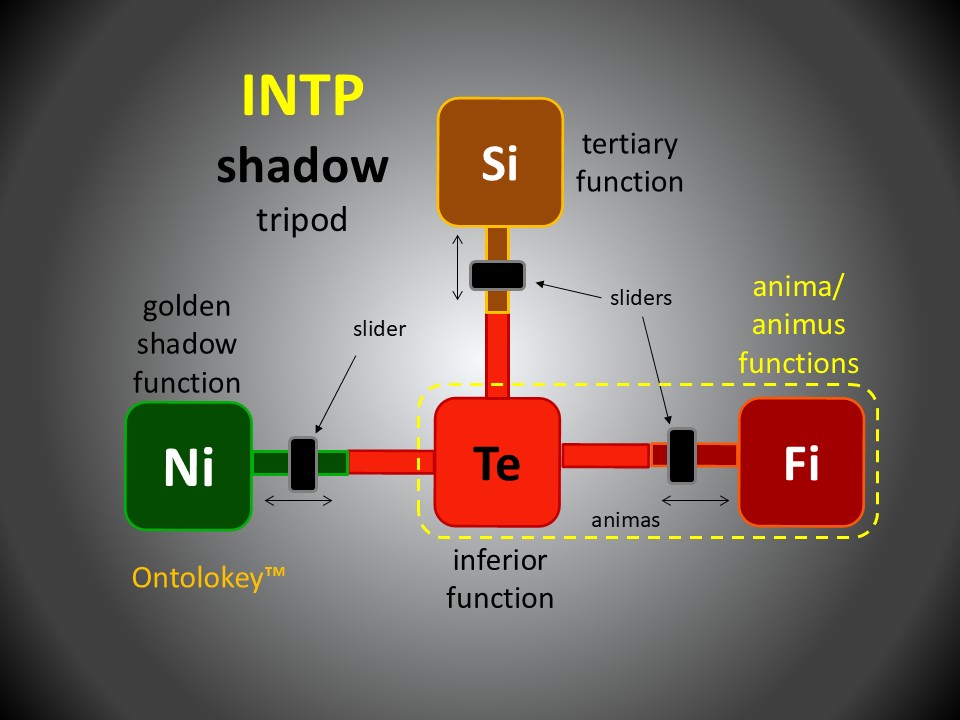
Beneath these two dominant capacities, Ontolokey describes a quieter emotional register that rarely surfaces directly but nonetheless functions as the INTP’s moral backbone. This private layer of values does not announce itself the way it might in more emotionally expressive types; an INTP is far more likely to say that something is “unjust” than to say that it “hurts,” even when the two statements describe exactly the same internal experience. This function makes the INTP quietly loyal to both ideas and people, expressed less through verbal warmth than through remembered details, thoughtful actions, and a steady, if understated, presence in the lives of those they care about. There is also, running beneath the surface, a discomfort with the sheer volume of ordinary sensory and physical demands that daily life makes on a person: crowded rooms, sudden confrontations, cluttered environments, and unattended bodily needs all tend to register as an intrusion on a mind that would rather be somewhere quieter. And finally, there is a genuine if often buried desire to connect emotionally with others, a desire complicated by an equally genuine unfamiliarity with the social rituals through which most people build and maintain that connection. Taken together, this is a personality built for depth, coherence, and independent thought — genuinely impressive on its own terms, but, as the more recent Ontolokey material makes clear, only half of the real story.
The Central Danger: Trusting the Model More Than Reality
The deepest shadow of the INTP does not begin with an obvious character flaw. It begins with the same quality that makes the type so intellectually formidable in the first place: the tendency to trust an internally constructed model of reality more deeply than reality itself. For the INTP, thinking is not simply an activity performed alongside living; it becomes an environment in its own right. Where most people navigate life primarily among objects, obligations, and relationships, the INTP increasingly comes to live among conceptual structures, and within that inner universe coherence becomes the supreme value, pursued not for social approval or material gain but because contradiction itself produces a kind of psychological discomfort that is difficult to tolerate. This produces remarkable intellectual independence, but it carries a hidden cost: the more compelling and well-ordered the inner world becomes, the more the external world starts to look crude, irrational, and disappointing by comparison, and the gap between theoretical understanding and lived participation begins to widen without the person ever quite noticing it happening.
What makes this shadow especially dangerous is how quietly it develops. Unlike personalities whose difficulties erupt visibly through impulsive behavior, the INTP’s shadow tends to hide behind books, projects, and endless analysis, so that the person can appear entirely productive and thoughtful while a slow psychological withdrawal takes place beneath the surface. Relationships gradually become secondary to ideas, direct experience becomes secondary to interpretation, and action becomes secondary to preparation, until the individual exists one step removed from life itself, filtering reality through increasingly elaborate conceptual frameworks that create an illusion of mastery while actually reducing genuine contact with the world. This is closely tied to something frequently misread by outside observers: the calm, detached surface of the INTP is often mistaken for emotional immunity, when in fact it usually conceals a persistent undercurrent of anxiety about uncertainty, responsibility, and irreversible consequences. Because this mind naturally perceives complexity everywhere, even simple decisions rarely feel simple, since every choice opens onto a network of possibilities and every commitment forecloses countless others, which can leave the person suspended in a perpetual state of anticipation rather than genuinely moving through life.
This produces one of the most painful paradoxes described in Ontolokey’s material: the very mind that seeks freedom ends up building itself a prison. Most people imagine freedom as the absence of constraint, but for the INTP freedom frequently comes to mean the preservation of possibilities, and possibilities preserved indefinitely eventually curdle into unrealized potential. A career gets postponed because other careers remain conceivable; a relationship stays undefined because alternative futures cannot yet be ruled out; a creative project stays unfinished because a theoretically perfect version remains just out of reach. Years can pass while enormous psychological energy goes not into living but into maintaining optionality, and what looks from the outside like admirable independence can slowly harden, from the inside, into something closer to paralysis.
The Tyranny of Endless Analysis
A closely related shadow pattern involves the transformation of thought itself from a tool of understanding into an instrument of avoidance. Healthy analysis clarifies reality and enables action; the shadow version of analysis delays action indefinitely, and from the outside the two processes can look nearly identical, since both involve reflection and intellectual engagement. The difference is entirely a matter of function rather than form. Few personalities are as vulnerable to this trap as the INTP, precisely because their analytical apparatus is so sophisticated: where other people encounter uncertainty and eventually act despite incomplete information, the INTP encounters uncertainty and immediately perceives additional variables, additional hidden assumptions, additional alternative interpretations, so that what began as intellectual rigor gradually becomes an inability to move at all. The underlying issue is not perfectionism in the ordinary sense of wanting flawless execution; it is a hunger for epistemological certainty, a desire to know that the chosen path rests on a sufficiently accurate model of reality before committing to it. Since reality rarely offers that kind of certainty, the search for it never actually concludes, and thinking, instead of reducing uncertainty, becomes a ritual for managing the anxiety that uncertainty produces.
This pattern shows up with particular force around questions of identity and creative work. Many INTPs spend years trying to determine exactly who they are before committing fully to any direction in life, searching for the perfect intellectual framework that will finally reveal their authentic vocation or deepest purpose, when in fact identity tends to emerge through participation rather than through reflection alone. In the creative domain specifically, this produces what might be called a private library of unrealized brilliance: unwritten books, unfinished theories, abandoned inventions, and dormant ambitions, all protected from disappointment by the simple fact that they were never finished and therefore never had the chance to reveal their flaws. Beneath this pattern lies a fear rarely acknowledged directly, the fear of discovering the actual limits of one’s own potential, since an ability that remains untested can still be imagined as unlimited, while an ability that has been tested reveals both strengths and weaknesses. Over time this creates a particularly corrosive form of regret, one that differs from ordinary regret over mistakes actually made. The INTP is far more likely to be haunted by unlived lives than by concrete failures, by the relationship never pursued or the project never completed, and this kind of regret is unusually persistent precisely because it never reaches closure — an actual failure can eventually be processed and integrated, but an unlived possibility remains eternally unfinished, replayed by the imagination indefinitely.
Anxiety, Catastrophic Imagination, and the Hidden Fear Structure
The same imaginative capacity that generates innovation in the healthy INTP can, in its shadow form, generate an almost constant undercurrent of anticipatory fear. Because this mind naturally links every event to larger systems and traces every action forward into its consequences, a mind capable of imagining multiple futures is equally capable of imagining multiple disasters, and the anxiety that results rarely centers on immediate, concrete dangers. Instead it fixes on hypothetical futures and unseen variables — outcomes that may never occur but that nonetheless carry real psychological weight simply because the mind is capable of generating them. This is a subtly different kind of fear than the more familiar fear of an obvious, present threat, because a concrete danger can be confronted directly while a hypothetical one exists permanently in a realm where certainty can never quite be reached, so that every answer produces new questions and every reassurance proves only temporary. Over time this can produce a persistent state of vigilance that often goes unrecognized precisely because it hides behind behavior that looks entirely rational: extensive research reads as thoroughness, extended preparation reads as responsibility, reluctance to commit reads as prudence. Each of these qualities has genuine value, yet they can equally well function as a defense against uncertainty, offering temporary relief that inevitably gives way to the next round of unresolved questions.
This dynamic frequently intensifies within close relationships, which may come as a surprise given the type’s reputation for emotional restraint. Many INTPs form remarkably deep attachments, but once that emotional investment develops, the imagination immediately begins generating potential threats to it — misunderstandings, future conflicts, subtle forms of incompatibility — so that even a stable, secure relationship can become the site of significant private anxiety. The same mechanism turns inward through relentless self-examination, in which introspection stops promoting growth and starts functioning as an endless investigation into perceived inadequacies, examining every mistake, reviewing every interaction, scrutinizing every emotional reaction with a kind of microscopic intensity that rarely resolves into anything conclusive. What outsiders read as composure is frequently, on the inside, an entire hidden universe of unresolved simulations running in parallel with whatever conversation is actually happening, and over months and years this constant, largely invisible mental labor produces a particular kind of fatigue — not physical exhaustion, but the exhaustion of carrying an entire landscape of hypothetical realities within consciousness at all times.
Emotional Repression and the Fear of Human Dependency
Perhaps no dimension of the INTP shadow is more persistently misunderstood than its relationship to emotion, because the composed, reserved exterior is so often mistaken for an absence of emotional depth rather than what it actually is: a profound asymmetry between emotional intensity and emotional visibility. Many INTPs discover early in life that intellectual competence offers a form of psychological safety that emotional life simply does not, since logic is predictable and coherent while human beings are inconsistent, and relationships carry the risk of withdrawal, betrayal, or disappointment. Over time the mind becomes both sanctuary and fortress, and what begins as a healthy appreciation for reason can slowly evolve into a genuine, if unconscious, distrust of emotional dependence itself. This does not eliminate emotional need; it merely displaces it, since feelings that are continually analyzed rather than directly experienced do not disappear, they simply migrate into less visible regions of the psyche, where they continue to influence behavior, relationships, and self-concept indirectly and often unrecognizably.
This produces what might be called hidden vulnerability: the INTP frequently appears far less emotionally affected by an event than is actually the case, so that criticism which seems to bounce off harmlessly at the time may reverberate internally for months, and rejection that appears to be dismissed intellectually may create real and lasting private suffering. Because these reactions are processed internally rather than expressed, both observers and the individual themselves can badly underestimate their intensity, and emotional pain tends to surface instead as withdrawal, cynicism, obsessive analysis, or an increasing retreat into intellectual pursuits. Underlying much of this is a fear that is rarely about people themselves but about needing people — since needing another person introduces real vulnerability, and the deeper the attachment grows, the greater the potential pain of losing it, which can lead the INTP to unconsciously limit emotional investment even in relationships they genuinely value. The resulting inner conflict is a painful one: a real longing for deep, authentic connection sits alongside an equally real instinct toward self-protection, producing relationships characterized by hesitation, ambivalence, and a kind of guarded warmth that can be difficult for partners to read correctly. Left unaddressed over years, this pattern tends to produce a distinctive and corrosive form of loneliness — not simple social isolation, since many INTPs maintain functioning relationships, but the deeper experience of feeling fundamentally unknown, in which other people interact comfortably with the intellectual persona while the more vulnerable self remains carefully guarded behind it.
Bitterness, Cynicism, and the Slide Toward Intellectual Nihilism
Where disappointment accumulates without adequate psychological integration, the shadowed INTP frequently develops a particular defense against it: the gradual withdrawal of belief itself. This differs meaningfully from ordinary disillusionment because of the idealism it displaces. Many INTPs begin life with an unusually strong, if often unspoken, conviction that understanding possesses intrinsic value, that intelligence and honesty ought to be rewarded, and that a clearly enough understood problem can, in principle, be solved. Reality repeatedly fails to honor this expectation: institutions remain irrational, organizations reward politics over competence, and public discourse frequently favors simplicity over accuracy, and for a mind this deeply invested in coherence, the accumulation of such disappointments can feel less like an ordinary setback and more like an existential betrayal. Cynicism often emerges at this point as a form of protection, and it is worth distinguishing carefully from genuine skepticism: skepticism remains open to evidence, while cynicism assumes disappointment in advance, offering the seductive comfort that failure, once expected, can no longer really wound. The cost of this protection is a gradual and largely invisible narrowing of attention toward flaws, contradictions, and failures, at the expense of noticing courage, integrity, or resilience, until the picture of reality the person is working from has been subtly but significantly distorted.
Left to develop further, this cynicism can deepen into genuine bitterness, distinguished from its milder cousin by an added emotional charge — a sense that life itself has broken some implicit contract, that effort was supposed to produce reward and did not, that integrity was supposed to guarantee fairness and did not. What is easy to miss, both for outside observers and for the INTP themselves, is that bitterness of this kind is really disappointed idealism wearing a different coat; the person who now dismisses human potential entirely may once have believed in it more deeply than most, and the sharp edge of the critique is, in a very real sense, the leftover shape of a hope that has not been properly mourned. At its most extreme, this pattern can evolve into what Ontolokey terms intellectual nihilism, a state distinct from ordinary despair in that despair still longs for meaning even while failing to find it, whereas nihilism represents an actual withdrawal of investment, in which values come to seem arbitrary and commitments start to look naïve. This is a particularly persuasive trap for an analytically gifted mind, because intelligence is extremely good at deconstructing meaning and considerably less good at generating it, and a person who has spent years sharpening the tools of critique can eventually find that those same tools, turned inward without limit, are capable of dismantling the very foundations they would need in order to keep participating in life at all.
Isolation and the Collapse into the Inner Labyrinth
A further consequence of this general trajectory is a gradual retreat into solitude that starts out healthy and can end up corrosive. In moderation, the INTP’s preference for time alone represents one of the genuine strengths of the personality, since solitude fosters independent thought and offers fertile ground for creativity and self-discovery. The danger appears when this tendency, repeatedly reinforced by disappointing or exhausting social encounters, hardens into chronic isolation, so that the inner world stops being a place of reflection and starts functioning instead as a substitute for reality altogether. This shift is made more likely by a particular kind of loneliness the INTP often experiences at a structural level, not merely feeling misunderstood in this or that specific situation but suspecting that the entire architecture of their inner life is largely inaccessible to the people around them, which over time makes genuine self-disclosure feel inefficient and gradually reduces it. The mind continues to develop, but it develops within an increasingly closed system, refining beliefs without sufficient outside challenge and processing emotional patterns without the corrective feedback that only real relationships can provide, so that intellectual sophistication keeps expanding even as fulfillment quietly stalls.
Ontolokey describes the resulting state as an inner labyrinth rather than a sanctuary, the crucial difference being that a sanctuary preserves a sense of orientation while a labyrinth generates endless complexity without any clear way through it. Thought, deprived of the stabilizing influence of lived experience, increasingly feeds on itself: questions generate further questions, doubts multiply, and every conclusion reveals new exceptions, producing a strange and specifically INTP form of exhaustion in which the mind remains intensely active while the actual, lived life grows steadily narrower. Left unaddressed, this pattern can quietly persist for decades, producing an adult who possesses extraordinary unexpressed insight — unwritten books, unpublished ideas, undeveloped relationships — while looking back to discover that the isolation which once felt like protection also foreclosed most of the experiences that would have generated genuine meaning.
The Inferior Emotional Function: Shame and Sudden Eruptions
Beneath all of this lies what Ontolokey identifies as the single most consequential and least understood layer of the INTP shadow: a genuine asymmetry in emotional development, in which certain aspects of feeling remain sophisticated while others remain comparatively unconscious and poorly integrated. This is not a matter of possessing weaker emotions than other personality types; it is a matter of delayed access to them. Many INTPs do not know, in real time, what they are feeling — an event occurs, an intellectual response follows immediately, and only days or weeks later does the actual emotional significance surface, by which point the original circumstances may have already changed, making direct expression considerably harder than it would have been in the moment. This delay produces frequent misunderstandings in relationships, since other people generally expect emotional responses to arrive in real time, and the apparent detachment an INTP displays during conflict is very often misleading — the impact may be substantial even when conscious access to it remains incomplete.
Underneath this delayed emotional access sits something Ontolokey describes as a persistent undercurrent of shame, distinct from guilt in that it concerns identity rather than specific actions. Many INTPs unconsciously absorb the belief that needing reassurance, affection, or emotional support reflects a kind of weakness, since intellectual competence has become so bound up with self-sufficiency that emotional dependency starts to feel like its opposite. Ordinary human needs consequently generate internal conflict: the person feels not only lonely but ashamed of the loneliness itself, not only in need of connection but embarrassed by that need. Because this shame rarely gets voiced directly, it tends to surface instead through disguise — vulnerability recast as irony, longing concealed beneath detachment, rejection reframed as simple indifference — while the underlying discomfort continues operating quietly in the background. Emotions suppressed this consistently do not remain inert; they accumulate pressure over months or years, and because the INTP generally prides themselves on rational self-control, this accumulation can go unnoticed for a remarkably long time, right up until the moment the psychological system can no longer contain it. What follows is often a genuinely disorienting emotional eruption, disproportionate to whatever minor event triggered it, in which observers conclude the person has suddenly and inexplicably changed, when in reality the emotional material was simply there all along, finally overflowing a container that had held it for far too long.
Obsession, Perfectionism, and the Search for Absolute Certainty
Threading through nearly every pattern already described is a single underlying demand: the wish to eliminate uncertainty before committing to action, belief, or attachment. This tendency rarely looks pathological on its surface, since careful thinking, thorough preparation, and intellectual rigor are all genuinely admirable qualities and are usually rewarded socially. The trouble begins when the pursuit of understanding quietly transforms into an attempt to escape the basic uncertainty that is simply built into existence. Because the INTP instinctively moves toward comprehension before action, and because deeper investigation into almost any subject tends to reveal more complexity rather than less, expanding knowledge can paradoxically produce expanding hesitation rather than growing confidence — the more thoroughly a question gets explored, the more nuance and exception it reveals, so that certainty becomes harder to reach exactly when the person has worked hardest to reach it. Over time this dynamic tends to evolve into something closer to obsessive cognition, in which the same questions get revisited again and again, not because new information keeps arriving but because complete reassurance remains permanently out of reach, and decisions already made continue to be silently re-litigated long after the fact.
This same demand for certainty frequently reshapes the INTP’s relationship with responsibility itself, since the fear at work here is less a fear of choosing wrongly than a fear of choosing irreversibly — every commitment forecloses alternatives, and because this mind perceives so many alternatives simultaneously, every choice carries the psychological weight of everything given up in order to make it. Perfectionism compounds the difficulty, though in a form that looks different from the more familiar perfectionism centered on flawless performance; the INTP’s version is more conceptual, aimed at perfect understanding or perfect coherence rather than perfect execution, which is why it can produce endless refinement rather than obviously meticulous behavior — a project stays unfinished because a better version remains conceivable, a belief stays provisional because absolute certainty never quite arrives. One of the more corrosive long-term effects of this pattern is a gradual erosion of self-trust, since confidence in practical judgment is normally built through repeated engagement with imperfect, uncertain reality, and a person who continually postpones action until sufficient certainty exists deprives themselves of exactly the experiences that would otherwise have built that confidence.
The Dark Relationship with Intellectual Superiority
A further and less frequently discussed layer of the shadow involves the INTP’s relationship to power, expressed not through conventional ambition or dominance but through a quieter, more internalized form of intellectual elitism. Because competence in reasoning has so often proven reliable across this type’s life experience, confidence in one’s own judgment can gradually shift from something the person possesses into something closer to what they are, so that criticism of an idea starts to feel like a personal attack rather than a difference of perspective. This shift is dangerous precisely because it tends to develop invisibly; overt boastfulness feels intellectually unsophisticated to most INTPs, so superiority rarely announces itself directly and instead expresses itself through a quiet, largely unspoken sorting of other people by their apparent intellectual rigor, with genuine warmth and patience reserved mainly for those who clear that bar. What is easy to overlook is that this pattern frequently originates in real disappointment rather than simple arrogance — repeated exposure to poor decisions, groupthink, and intellectual dishonesty naturally generates frustration, and the danger comes when that frustration hardens into a general worldview in which irrationality is treated as humanity’s defining trait rather than merely one recurring feature of it.
What makes this particular shadow distinctive is that it frequently coexists with, rather than replaces, genuine self-doubt, since both the felt superiority and the felt inadequacy tend to spring from the same source: an identity too closely bound up with intellect. If intelligence becomes the primary foundation of self-worth, then every comparison with another person acquires outsized emotional stakes, and the individual can find themselves oscillating between quiet contempt for others and relentless private doubt about their own competence, without ever quite settling into stable self-acceptance either way. At its most defended, this pattern uses intellectual superiority to create distance from emotional risk — if other people are viewed primarily as less informed or less rational, then their opinions of the INTP matter less, rejection stings less, and loneliness becomes easier to explain away as the natural cost of being different. The price paid for this protection, however, is considerable: intimacy, humility, and genuine connection all become harder to access, and the mind ends up elevated above the crowd while growing steadily more isolated from the very humanity it was originally trying to understand.
The Existential Dimension: Meaning, Mortality, and the Abyss
For many INTPs, existential questions are not occasional philosophical curiosities but recurring psychological realities, since the same cognitive architecture that drives the type toward abstraction and analysis naturally extends itself toward the largest questions a mind can ask — what constitutes meaning, whether purpose is discovered or merely constructed, what remains once every comforting assumption has been examined and found wanting. Most people rely on functional narratives that let them navigate daily life without constantly interrogating first principles, but the INTP often finds such narratives insufficient, following every explanation down toward the next unresolved question until beliefs that once felt solid begin to dissolve under sustained analysis. This can produce a uniquely difficult kind of existential crisis, one that arrives not through emotional upheaval or personal loss but through cognition itself — the individual essentially thinks their way into the abyss, dismantling inherited certainties faster than new foundations can be built to replace them.
The encounter with mortality intensifies this dynamic considerably, since death represents a limit that no amount of analysis can remove or fully comprehend, and for a mind built around understanding, confronting something that fundamentally resists being understood can feel destabilizing in a very particular way. What underlies this fear is often not mortality as such but the deeper suspicion of meaninglessness that mortality seems to threaten, since every belief system reveals limitations under sufficiently close examination, and the INTP can begin to wonder whether meaning itself is simply a comforting illusion built to shield consciousness from uncertainty it cannot otherwise tolerate. And yet, as Ontolokey’s material argues, the path through this crisis does not run through greater certainty but through a change in what certainty is expected to provide: meaning, it turns out, does not require absolute proof, since love, loyalty, courage, and creativity have never depended on being logically demonstrated in order to be genuinely significant within a life. The healthiest resolution available to the INTP is not to solve existence intellectually but to commit to it anyway, allowing meaning to be created and embodied through participation rather than waiting to be discovered through analysis alone — a shift that does not remove the uncertainty but changes its function, so that mortality intensifies value rather than erasing it, and impermanence becomes a reason to engage fully rather than an argument for standing apart.
Toward Integration
None of this shadow material is presented, in Ontolokey’s own framing, as an indictment of the INTP personality; it is offered instead as an honest account of where this particular configuration of gifts tends to distort itself when it loses contact with emotion, embodiment, and other people. The path toward integration does not require the INTP to become less intelligent, less independent, or less committed to internal coherence, all of which remain genuine strengths worth preserving. What it requires is a shift in the relationship between thought and life, so that analysis becomes preparation for engagement rather than a substitute for it, so that emotional need is recognized as a feature of being human rather than a defect to be hidden, and so that certainty is no longer treated as a precondition for commitment. None of this happens through additional thinking alone. It happens through the willingness to risk, to attach, to act before every variable has been accounted for, and to trust that meaning is built through participation rather than secured in advance through analysis.
This summary necessarily compresses a considerably longer and more detailed body of work. Readers who recognize themselves in this description, or who are simply curious to read the fuller original essays on the INTP’s conscious and shadow functions, as well as the corresponding material Ontolokey has published on the other fifteen personality types, can find the complete texts at www.ontolokey.com.


Leave a comment