The Basic Architecture: A Mind Built Around Possibility
At the center of the ENFP personality lies an almost instinctive orientation toward what could be rather than what already is. This is not simply a preference for novelty or a restless personality quirk; it is the organizing principle around which the entire psyche is built. Such individuals scan the world constantly for patterns, connections, hidden opportunities, and unexplored angles, and they do this with a fluency that often looks uncanny to people who process reality more linearly. They pick up on the emotional undercurrents of a room, the unspoken intentions behind a conversation, the subtle shift in a relationship long before anyone names it out loud. This gives them a natural advantage in creative work, entrepreneurship, counseling, performance, and any field where the ability to imagine alternatives matters more than the ability to follow an established procedure. It also means that they are rarely satisfied with the well-trodden path; if a conventional route exists, the ENFP is often tempted to find the unconventional one instead, not out of contrariness but because the unconventional route is simply more interesting to their mind.
Beneath this outward-facing curiosity sits a much quieter and more private function: an internal, deeply personal system of values that operates almost like a moral compass no one else can see. While the ENFP’s public persona is often vibrant, playful, and even provocative, their inner emotional world is guarded, nuanced, and evaluated according to standards that are entirely their own. They do not need external rules to know what feels right or wrong to them, and once something crosses that internal line, no amount of social pressure will move them back across it. This combination — outward exploration paired with inward moral seriousness — is what makes the ENFP simultaneously easy to underestimate and difficult to truly know. People often assume they have understood an ENFP after a few enthusiastic conversations, only to discover, much later, that the emotional depths underneath were never actually shared. Vulnerability, for this personality, is something offered carefully, and usually only to those who have already proven themselves trustworthy through time rather than through charm.
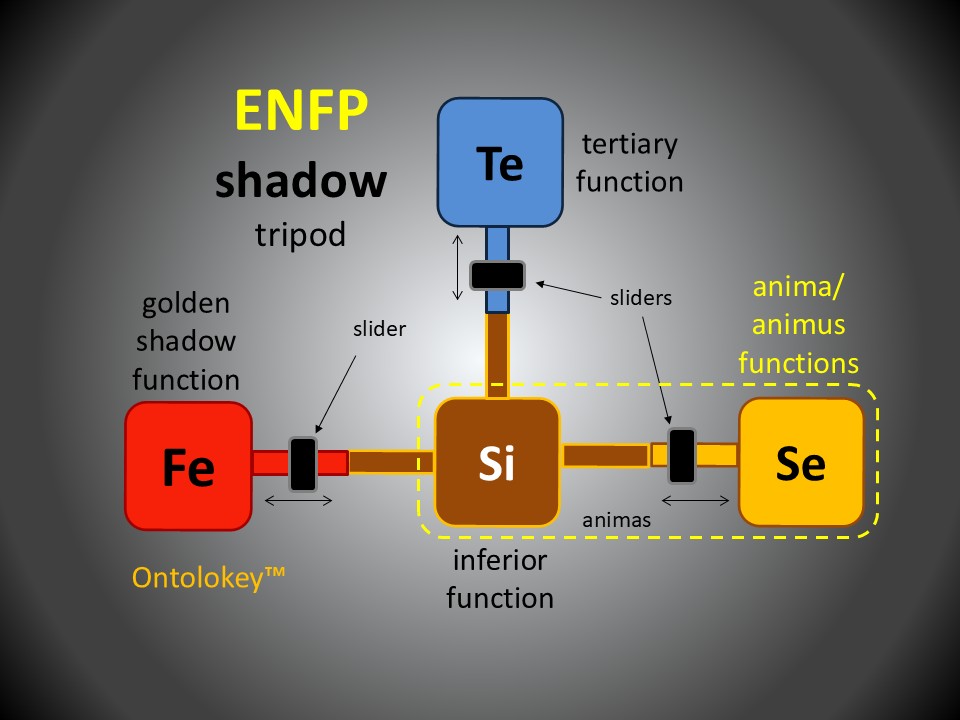
The remaining functions of the personality fill out this picture in ways that are less immediately visible but no less important. There is a pull toward direct, sensory, in-the-moment experience that the ENFP finds both thrilling and faintly destabilizing, a fascination with physical presence, bold action, and immediate gratification that can show up as spontaneous risk-taking or an attraction to people who seem grounded, confident, and slightly dangerous. There is also a clumsier, more playful capacity for logical analysis that rarely produces tidy, structured arguments but instead pokes at ideas from unexpected angles, chases tangents, and occasionally produces genuine insight buried inside a meandering explanation. Further back still lies an underdeveloped capacity for routine, physical self-care, and grounded continuity — the ENFP’s Achilles’ heel when it comes to diet, sleep, paperwork, and the thousand small maintenance tasks that keep a life running smoothly. And running quietly through all of it is an admiration, sometimes bordering on envy, for people who can read a room emotionally and unify it effortlessly, a talent the ENFP secretly wishes came as naturally to them as it seems to come to others.
The Cost of Living for What Could Be
It is precisely this extraordinary capacity for imagining possibility that gives rise to the ENFP’s deepest psychological vulnerability, and understanding this connection is essential to understanding the shadow side of the personality as a whole. When someone is naturally drawn to what could exist rather than what currently exists, reality itself begins to feel provisional, unfinished, merely a placeholder for something better that has not yet arrived. This is not a character flaw so much as a structural consequence of how attention and meaning are organized inside this particular psyche. The imagination becomes more emotionally rewarding than implementation, the dream becomes more vivid than the achievement, and the future begins to feel more alive than the present moment actually being lived. Over time, without anyone noticing the shift happening, the individual can find themselves living not in their actual life but in a perpetual state of anticipating a better one just around the corner. The promise of tomorrow quietly eclipses the substance of today, and this becomes one of the most persistent and least visible sources of dissatisfaction in the ENFP’s inner world.
This same dynamic extends into the way identity itself gets constructed. Where many people build a stable sense of self through repetition, consistency, and long engagement with particular roles, the ENFP tends to organize identity around the question of who they might yet become rather than who they already are. On the surface this produces remarkable adaptability, a genuine capacity for growth and reinvention that many other personalities lack. Underneath it, however, this same orientation can produce a chronic and largely invisible dissatisfaction, because no achievement ever feels quite complete once it has been reached — another possibility simply appears on the horizon, demanding attention, and the cycle begins again. What looks from the outside like ambition or restless creativity can, internally, be something closer to an inability to rest inside one’s own existence, a low-grade hunger that never quite finds anything substantial enough to satisfy it. This is why many ENFPs, even ones who are objectively accomplished by any external measure, continue to carry a nagging sense that the real life, the one that actually matters, has somehow not yet begun.
Connected to this is a pattern that shows up with striking consistency across relationships, careers, and creative projects alike: a tendency to fall in love with beginnings far more easily than with completions. The initiation phase of anything new is saturated with possibility, discovery, and emotional intensity, and this is exactly the psychological territory where the ENFP feels most alive. The middle phase of any project or relationship, the part that requires endurance, patience, and the willingness to tolerate boredom, is considerably less rewarding to this personality, and the final phase — implementation, maintenance, follow-through — can feel almost like a kind of death by comparison. As a result, many ENFPs accumulate an inventory of unfinished manuscripts, half-built businesses, abandoned creative projects, and relationships that began with extraordinary passion but quietly dissolved once the ordinary demands of daily life set in. This is rarely interpreted correctly by the person experiencing it. It tends to be blamed on bad timing, incompatible partners, or the wrong career choice, when the underlying pattern is actually a recurring difficulty in tolerating the transition from possibility into reality, a transition that every meaningful accomplishment eventually requires.
The Narcissism of Potential
One of the more subtle and frequently misunderstood dimensions of the ENFP shadow involves what might be described as an unconscious attachment to unrealized potential rather than to actual accomplishment. This does not resemble ordinary vanity or grandiosity, and most ENFPs would sincerely and accurately reject any suggestion that they are self-centered, because they genuinely do experience themselves as empathetic, caring, and deeply attentive to the people around them. The dynamic operates instead at a much quieter level, where the imagined future self — the writer they could become, the entrepreneur they could build, the extraordinary life they could someday create — gradually acquires more emotional weight than the actual, present-day self living an ordinary existence. This happens because potential, unlike reality, cannot be disproven or criticized. An unfinished novel remains beyond judgment in a way a published one never can; an idea for a business remains flawless in a way an actual business, with its inevitable setbacks and compromises, never will. The unrealized self therefore enjoys a strange kind of psychological immunity, and over time, self-worth can quietly migrate away from what has actually been built and toward what might someday be built instead.
The danger in this pattern lies in how easily it disguises itself as humility or as healthy ambition, since a person can be sincerely modest about their present accomplishments while still harboring, somewhere beneath conscious awareness, a powerful sense that something extraordinary is destined to emerge from them eventually. These two beliefs are not contradictory; they tend to reinforce one another, because the more distant and idealized the imagined future self becomes, the more inadequate any ordinary present achievement inevitably looks by comparison. This is precisely why so many gifted, articulate, insightful ENFPs can speak passionately and convincingly about future projects and transformations for years while comparatively little actually changes in their day-to-day lives. The problem is rarely a lack of talent or ambition. It is that imagining success has become emotionally satisfying enough, in itself, to partially substitute for the much harder and often humbling work required to actually achieve it.
This same dynamic frequently bleeds into how ENFPs relate to other people, since their genuine gift for perceiving hidden potential in others can quietly shift from something generous into something subtly possessive. Instead of loving people as they currently are, the individual can become emotionally attached to who those people might become, treating relationships as ongoing developmental projects rather than as encounters with actual, limited, imperfect human beings. When the other person fails to evolve according to this unspoken internal vision, a sense of disappointment or quiet betrayal can arise even though no promise was ever explicitly broken, because what has actually been disappointed is not a real expectation but an imagined future that the other person never agreed to fulfill. Recognizing this pattern is often one of the more uncomfortable pieces of self-knowledge an ENFP can arrive at, precisely because it sits so close to their genuine capacity for compassion and encouragement, making it easy to mistake the shadow expression of the trait for the trait itself.
Emotional Intensity, Romantic Obsession, and the Hunger for Aliveness
Emotional intensity plays an unusually central role in how meaning gets constructed inside the ENFP psyche, functioning almost like a signal that tells the individual an experience matters. Where other personalities might derive their sense of significance from stability, duty, or achievement, the ENFP tends to measure importance by how emotionally vivid an experience feels, which creates a genuine vulnerability because intensity and psychological truth are simply not the same thing. An experience can feel overwhelming and still be quietly harmful; something genuinely beneficial can feel boring, repetitive, or emotionally flat in the moment it is happening. When intensity becomes the primary criterion by which decisions get made, life gradually starts organizing itself around the pursuit of emotional stimulation rather than around genuine long-term development, and the individual can find themselves, often without realizing it, chasing feelings rather than pursuing anything more substantial.
This tendency becomes especially visible in romantic relationships, where the ENFP’s remarkable capacity for idealization can produce extraordinary intimacy and devotion, but can also tip into something closer to obsession. In the early stages of connection, the beloved becomes a carrier of far more than themselves; they become a symbol of hope, transformation, adventure, and future happiness, and the resulting emotional intensity can feel so overwhelming that it becomes nearly impossible to interpret it as anything other than fate or destiny. Yet this intensity often says more about the unconscious needs of the person feeling it than about the actual compatibility of the relationship itself, and what looks like perfect chemistry can sometimes be, at least in part, a projection of unlived possibility onto another person who never asked to carry that weight. Because the ENFP perceives potential so vividly, they can also remain emotionally invested in relationships that are clearly unworkable for far longer than most people would tolerate, not because they cannot see the problems but because as long as possibility remains alive, letting go feels almost unbearable. This is one of the more painful and least discussed patterns within the ENFP shadow: a grief, after a relationship ends, that extends well beyond the loss of an actual person and into the loss of an entire imagined future that quietly collapses alongside it.
The Fear of Ordinary Life
Perhaps the most counterintuitive dimension of this shadow is the way many ENFPs unconsciously resist precisely the stability, security, and contentment they consciously say they want. This rarely takes the form of an explicit thought; very few people wake up and consciously decide they are afraid of happiness. Instead, it shows up indirectly, through a persistent restlessness that emerges just as things are going well, through minor imperfections that suddenly seem magnified, through hypothetical alternatives that become increasingly attractive the moment a relationship or career starts to feel genuinely settled. The underlying mechanism is that success converts possibility into reality, and reality, by its nature, comes with limits — a stable relationship requires maintenance rather than constant discovery, a successful project requires refinement rather than fresh inspiration, and both of these transitions can generate an anxiety that gets misread as evidence that something is wrong with the situation itself rather than as a natural response to narrowing possibility. The consequence is a pattern in which genuinely good circumstances get quietly sabotaged or abandoned, not because they have failed, but because they have stopped feeling infinite.
Underneath this fear often lies a related belief that a meaningful life must also be an exceptional one, an assumption that makes ordinary routines, everyday responsibilities, and quiet, undramatic contentment feel spiritually unsatisfying by comparison. Yet most durable achievements, deep relationships, and forms of mastery are actually built through sustained, repetitive, unglamorous effort rather than through dramatic breakthroughs, and this is a truth the ENFP often has to learn the hard way, usually after watching several promising situations dissolve at the exact moment they stopped being new. The mature version of this personality eventually discovers that the ordinary is not the opposite of the extraordinary but the very ground on which the extraordinary becomes possible in the first place — that great love is built through ordinary conversations repeated over years, and great work is built through ordinary effort applied consistently, long after the initial excitement of the idea has faded into something quieter and more demanding.
Influence, Seduction, and the Temptation of Control
Because ENFPs are unusually skilled at reading emotional undercurrents and recognizing hidden potential in the people around them, they also carry a considerable and often underestimated power to influence others — not through domination or explicit manipulation, but through emotional connection, encouragement, and the simple experience of being deeply seen. Most people go through life feeling somewhat overlooked, and when an ENFP directs focused, genuine attention toward someone, recognizing strengths and possibilities that person has never had reflected back to them before, the emotional impact can be profound and lasting. This is, in itself, a genuine gift, but it becomes a shadow the moment it starts being unconsciously used to generate admiration, dependency, or a sense of being needed, since self-worth can quietly migrate toward the emotional responses one is able to evoke in others rather than resting on something more internally stable. The individual rarely experiences this as manipulation because no explicit deception has occurred; instead, emotional realities are subtly shaped, hope is allowed to persist in ambiguous situations, and definition is avoided precisely because definition would introduce the kind of limitation this personality instinctively resists.
There is also, paradoxically, a hidden capacity for rigidity and control buried beneath the ENFP’s usual flexibility, one that tends to surface only under significant and prolonged stress. The same person who normally embraces ambiguity, dislikes rigid rules, and resists excessive planning can, when overwhelmed by uncertainty or repeated disappointment, swing sharply in the opposite direction — becoming unexpectedly perfectionistic, critical, obsessed with details, and intolerant of the very unpredictability they usually thrive on. This shift often confuses both the individual and the people around them, because it looks so unlike their usual personality, yet it makes a certain psychological sense: when the usual strategies of intuition and inspiration stop providing reliable guidance, the mind searches for stability elsewhere, and control becomes a substitute for the trust that has temporarily broken down. This pattern tends to resolve not through willpower but through the slow rebuilding of that underlying trust, and through learning to treat structure and discipline as allies rather than as threats to freedom.
The Existential Core of the Shadow
Beneath all of these individual patterns lies a single existential vulnerability that runs through the entire ENFP structure: because this personality’s sense of meaning is so tightly bound up with vitality, novelty, and emotional aliveness, it is unusually exposed to a particular kind of despair when those sources of meaning stop functioning. This is not ordinary sadness. It tends to arrive as a creeping sense that nothing feels significant anymore — that activities which once excited them now feel hollow, that new possibilities no longer generate the anticipation they used to, that the imagination itself, normally the ENFP’s greatest psychological resource, has gone quiet. Because so much of their inner stability has historically depended on the future feeling emotionally charged and full of promise, the collapse of that promise can be genuinely disorienting, sometimes producing a kind of existential crisis that goes well beyond ordinary disappointment with circumstances. What eventually resolves this crisis, for those who move through it rather than around it, is not a new dream or a fresh burst of inspiration but something quieter: the discovery that meaning does not have to be constantly felt in order to be real, and that a life can be genuinely worthwhile even during the long, undramatic stretches when nothing feels particularly extraordinary at all.
Toward Integration
None of what has been described here should be read as a verdict against the ENFP personality, and it is worth being explicit about that, since psychological honesty is not the same thing as condemnation. Every one of these shadow patterns is simply the underside of a genuine gift — the same capacity for imagining possibility that fuels creativity and innovation is what also makes reality feel provisional; the same emotional depth that allows profound love and empathy is what also makes emotional intensity so easy to mistake for truth; the same sensitivity to other people’s potential that makes the ENFP a natural encourager is what also creates the risk of relating to an imagined future version of someone rather than to the person actually standing in front of them. The task, as Ontolokey frames it, is not to eliminate these tendencies but to integrate them — to bring the same energy currently spent chasing possibility into the harder and quieter work of inhabiting reality, so that imagination becomes a source of inspiration for a life actually being lived rather than a substitute for living it. Readers who recognize themselves in this description, or who want to explore the underlying eight-function model in far greater depth, including how it applies to their own type or to the people close to them, will find the fuller versions of this material, along with analyses of every other personality structure, on www.ontolokey.com.


Leave a comment