The Personality Behind the Social Mirror
The ENFJ is often encountered first as a presence rather than as a collection of traits: emotionally perceptive, socially responsive, purposeful, persuasive, and unusually attentive to the psychological atmosphere surrounding other people. Within the Ontolokey framework, this outward orientation is anchored in Extraverted Feeling (Fe), the dominant function through which the ENFJ evaluates interpersonal dynamics, shared values, emotional congruence, and the degree of harmony within a social environment. Fe is therefore not simply “being emotional” or “being nice”; it is an evaluative mode of consciousness that continuously registers what is happening between people and instinctively searches for ways to organize that relational field. This gives the ENFJ a distinctive capacity to encourage, coordinate, teach, mediate, motivate, and give collective experience a sense of direction. Ontolokey describes Fe as the “camera” of the ENFJ’s psychological tripod, suggesting that much of the personality’s conscious experience is oriented through what can be perceived, shaped, and communicated within the interpersonal world.
Yet the same psychological sensitivity that can make an ENFJ extraordinarily effective in human relationships can also become the beginning of a much more complicated inner story. When interpersonal awareness becomes the primary source of orientation, the boundary between understanding others and defining oneself through others can gradually become blurred. The Ontolokey account of the ENFJ’s shadow describes precisely this danger: the person may become so accustomed to receiving identity through emotional feedback, usefulness, recognition, and relational significance that the authentic self becomes difficult to distinguish from the socially reflected self. The resulting personality can remain genuinely caring while simultaneously becoming dependent upon being needed; generosity can coexist with an unconscious demand for appreciation, and leadership can coexist with an unrecognized desire for influence. In this sense, the ENFJ’s deepest psychological tension is not simply between good and bad qualities, but between two legitimate human needs: the desire to belong and contribute, and the equally important need to possess an identity that does not disappear when nobody is watching, approving, admiring, or asking for help.
The Ontolokey model is particularly useful for exploring this tension because it does not present the ENFJ merely as a hierarchy of four preferred functions. It places eight psychological functions at the eight vertices of a three-dimensional cube, transforming functional relationships into a spatial landscape in which conscious strengths, vulnerable areas, shadow processes, and less-recognized potentials can be contemplated as parts of one psychological system. In the underlying conception, Ontolokey seeks to make the architecture of the eight-function model experientially visible: instead of merely listing functions, the cube allows one to consider which functions are adjacent, opposed, complementary, conscious, less conscious, difficult to access, or unconsciously attractive. For the ENFJ, this produces a particularly revealing psychological landscape because the central movement of the personality is not simply from Fe to Ni, but from external emotional attunement toward an increasingly differentiated relationship with inner values, embodied reality, analytical thought, effectiveness, immediate experience, and divergent possibility. The following exploration therefore treats the ENFJ as a dynamic psychological structure whose strengths and shadows are inseparable from one another: the very capacities that allow this personality to inspire, nurture, lead, and transform others can, when overidentified with, become the mechanisms through which self-neglect, dependency, resentment, control, and loss of authenticity emerge.
The Eightfold Architecture of the ENFJ
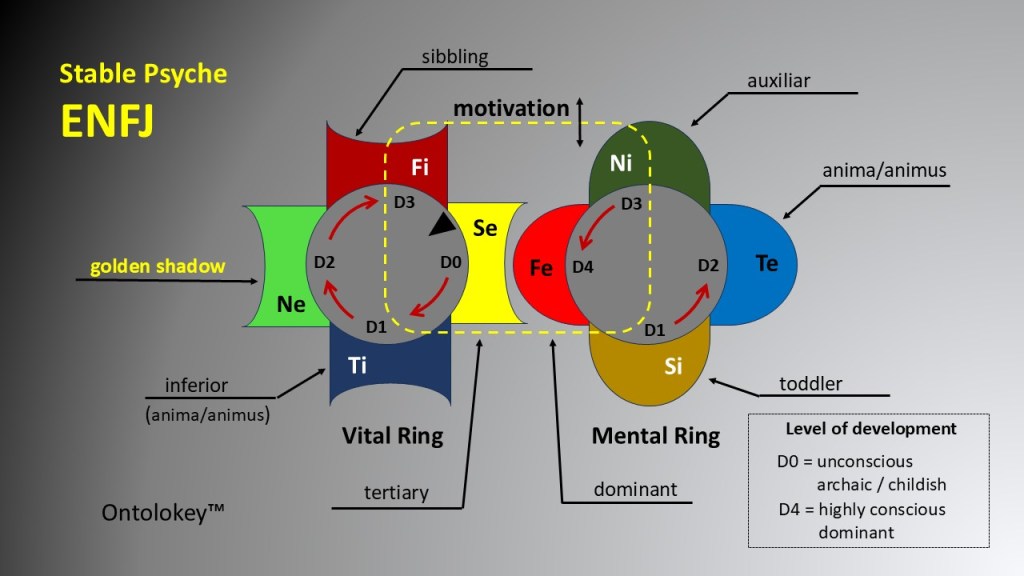
To understand the ENFJ through Ontolokey, it is necessary to move beyond the familiar description of four preferred functions and instead regard the personality as an eight-function psychological landscape. The model places the functions at the corners of a three-dimensional cube, with the conscious configuration forming what Ontolokey describes as a functional tripod and the remaining functions constituting increasingly unconscious dimensions of the same psyche. This is important because an ENFJ is not simply “Fe with some Ni”: the conscious personality is continuously surrounded by psychological capacities that may be neglected, projected, idealized, activated under pressure, or gradually integrated through development. The cube therefore gives the ENFJ a spatial metaphor for something that is otherwise difficult to conceptualize: psychological wholeness does not mean strengthening the functions one already prefers, but establishing a more conscious relationship with the functions that initially feel foreign, uncomfortable, primitive, threatening, or strangely attractive. In the ENFJ configuration, this produces a progression from Fe–Ni–Fi–Si in the consciously accessible landscape toward Ti–Te–Se–Ne as progressively less familiar or shadowed modes of perception and judgment.
At the center of this architecture stands Extraverted Feeling (Fe), the dominant function and, in Ontolokey’s metaphor, the camera of the psychological tripod. Fe does not merely experience emotion; it evaluates the interpersonal field according to relational and collective criteria, continuously registering whether people are connected or alienated, whether a situation feels harmonious or discordant, and whether the emotional atmosphere supports or obstructs what the group is attempting to accomplish. This explains why healthy ENFJs can possess an unusual ability to make other people feel psychologically visible: their attention naturally moves toward the relational space between individuals rather than remaining confined to private subjective experience. Yet the same orientation creates a profound vulnerability because the ENFJ can gradually become so skilled at reading the emotional environment that the environment begins to determine the self. The distinction between empathy and adaptation therefore becomes psychologically decisive; empathy allows the ENFJ to perceive another person without abandoning the self, whereas excessive Fe can make the self continuously reorganize itself according to what the surrounding emotional system appears to require.
The second major position is Introverted Intuition (Ni), the auxiliary function that gives the ENFJ’s social intelligence a direction beyond immediate interpersonal response. Ni withdraws from the multiplicity of the present situation and searches for underlying patterns, developmental trajectories, symbolic meaning, and a coherent future toward which events appear to be moving. In psychological terms, this is what can transform the ENFJ from a responsive caretaker into a visionary: instead of merely asking what people need now, the personality begins asking what these people, relationships, institutions, or communities could become. Ni consequently supplies the ENFJ with a sense of mission, often allowing interpersonal compassion to become attached to a larger narrative of transformation, education, healing, leadership, spirituality, social contribution, or human development. Its danger lies in the same place as its strength, because a compelling internal vision can become so convincing that the ENFJ begins interpreting other people according to the future they believe those people should embody rather than the person actually standing before them. Fe then supplies the emotional influence and Ni supplies the destination, creating an exceptionally powerful combination that can inspire genuine development but can also, when unconscious, turn guidance into direction and direction into control.
The third position, Introverted Feeling (Fi), is perhaps one of the most psychologically important dimensions of the ENFJ because it represents an inner source of value that cannot be obtained from the social environment. Fi asks a radically different question from Fe: not what is emotionally appropriate for the group, but what is personally and internally true for me. Within the Ontolokey configuration, Fi stands adjacent to Fe, symbolizing an intimate relationship between external emotional evaluation and internal emotional valuation, yet the two can pull the personality in opposite directions when they become differentiated. The ENFJ who remains excessively identified with Fe may know precisely what everyone else feels while remaining uncertain about what they themselves genuinely want, resent, reject, desire, or value; Fi consequently becomes the psychological faculty capable of restoring the missing interior boundary. Its development allows the ENFJ to discover that authenticity sometimes requires disappointing people, refusing a request, withholding emotional labor, abandoning a socially admired role, or acknowledging an unpopular personal truth. This is not a rejection of Fe but its maturation, because the ENFJ becomes capable of participating in relationships without requiring those relationships to define the legitimacy of the self.
The fourth position, Introverted Sensing (Si), is described by Ontolokey as the ENFJ’s “toddler” function, and this metaphor captures something psychologically distinctive: Si represents a relatively vulnerable relationship with bodily continuity, accumulated experience, routine, familiarity, physical maintenance, and the concrete traces of the past. An ENFJ can be extraordinarily attentive to another person’s emotional state while remaining surprisingly inattentive to hunger, fatigue, bodily tension, sleep, repetitive practical obligations, or the simple need to stop and recover. The psychological irony is that the personality may possess enormous energy for sustaining other people while treating its own organism as an inconvenient vehicle that should continue functioning regardless of its condition. Si therefore introduces a form of humility that the visionary and relational dimensions of ENFJ consciousness can easily overlook: human beings are embodied creatures, and no mission can indefinitely compensate for neglected physical reality. When Si becomes more integrated, routine ceases to feel like imprisonment and begins to function as psychological infrastructure, allowing the ENFJ to transform inspiration into sustainable practice rather than repeatedly burning through personal resources in pursuit of emotionally meaningful goals.
The fifth position, Introverted Thinking (Ti), occupies the inferior position and consequently represents one of the ENFJ’s most demanding developmental thresholds. Ti seeks internal logical consistency, conceptual precision, analytical independence, and conclusions that remain valid even when they conflict with the emotional consensus surrounding them. For an Fe-dominant personality, this can initially feel almost antagonistic because Ti introduces a question that social intelligence cannot answer: Does this actually make sense, regardless of whether people like it, approve of it, or emotionally agree with it? Under healthy development, Ti gives the ENFJ an internal architecture capable of testing convictions rather than merely communicating them, distinguishing emotional truth from logical validity, and separating persuasive narratives from structurally sound reasoning. Under stress, however, inferior Ti may appear in a distorted form as harsh criticism, pedantic argumentation, intellectual defensiveness, or an abrupt need to prove that one is right. Its mature integration is therefore not about turning the ENFJ into a detached analyst; it is about allowing the relational leader to develop an inner standard of thought that does not depend upon applause, consensus, or emotional resonance.
The remaining three positions deepen the picture because they reveal capacities that can initially appear psychologically foreign to the ENFJ. Extraverted Thinking (Te), positioned by Ontolokey within the anima/animus dimension, represents measurable effectiveness, external organization, execution, objective structure, and the capacity to translate intention into observable results; when integrated, it enables the ENFJ to supplement empathy and vision with operational competence rather than relying upon interpersonal enthusiasm to carry a project forward. Extraverted Sensing (Se) introduces immediate sensory reality, spontaneous action, physical presence, pleasure, risk, and engagement with what is actually happening rather than what should happen according to an internal vision; its conscious development can make the ENFJ more embodied, spontaneous, charismatic, and capable of enjoying reality without constantly assigning it a larger meaning. Finally, Extraverted Intuition (Ne) occupies the golden-shadow position, representing divergent possibility, experimentation, novelty, improvisation, and the willingness to entertain several potential interpretations instead of converging prematurely upon one overarching Ni narrative. These three functions matter because they challenge the ENFJ’s natural tendency to organize life around emotional purpose and coherent direction: Te asks whether the vision works, Se asks whether the person is actually present, and Ne asks whether the supposedly correct vision is only one possibility among many.
Taken together, the cube portrays an ENFJ whose psychological development is fundamentally an integration of opposites rather than an accumulation of socially desirable traits. Fe without Fi can become self-erasure; Ni without Ne can become over-certainty; vision without Se can become disembodied idealism; compassion without Ti can become insufficiently discriminating; generosity without Si can become self-neglect; and leadership without Te can become dependent upon personal charisma rather than durable structures. Conversely, the shadow functions do not exist merely to create problems: they contain precisely the psychological capacities that can correct the distortions produced by over-identification with the conscious personality. The ENFJ becomes psychologically deeper not by becoming less caring, less visionary, or less relational, but by becoming sufficiently internally differentiated that caring no longer requires self-abandonment, vision no longer requires control, and leadership no longer requires being needed. In that sense, the Ontolokey cube can be read as a developmental map from social reflection toward psychological integration, in which the ultimate task is not to escape the ENFJ’s defining gifts but to prevent those gifts from becoming the only permissible way of being.
The Gift and the Trap of Emotional Intelligence
The ENFJ’s most visible strength is the capacity to perceive people not merely as isolated individuals but as participants in an emotional system. This sensitivity can make the ENFJ unusually effective wherever human beings must be understood, coordinated, encouraged, or moved toward a common purpose. Fe allows the personality to notice subtle changes in tone, inclusion, enthusiasm, hesitation, conflict, and emotional reciprocity, while Ni transforms these observations into a broader interpretation of where a person or group is heading. The result can be an extraordinary form of interpersonal intelligence in which the ENFJ senses not only what people are feeling but also what might help them become more coherent, motivated, or connected. This combination explains why ENFJs may gravitate naturally toward teaching, mentoring, leadership, counseling, advocacy, organizational development, community building, or any environment in which psychological insight can be converted into meaningful human action. The positive expression of this configuration is therefore considerably deeper than conventional descriptions of the “charismatic people person”: at its best, the ENFJ possesses the capacity to recognize latent potential in others and create relational conditions in which that potential can become visible.
This ability to recognize potential is closely connected to the ENFJ’s relationship with Ni, because the ENFJ rarely experiences people exclusively in terms of who they are at the present moment. Ni tends to perceive developmental trajectories, hidden patterns, and possible futures, so the ENFJ can intuitively sense a discrepancy between somebody’s current behavior and the person they might eventually become. This can be profoundly affirming when it is used with humility, because many people experience the ENFJ as someone who sees possibilities in them that they themselves have temporarily forgotten. The ENFJ can therefore become a catalyst: not necessarily by solving another person’s problems, but by giving language, emotional confidence, and direction to an emerging possibility. Yet the psychological danger is inseparable from the gift, because perceiving potential can quietly become projecting potential. The ENFJ may begin relating to the person they believe someone could become rather than respecting the person’s actual pace, limitations, preferences, or right to choose a different future. The distinction is subtle but essential: genuine encouragement enlarges another person’s freedom, whereas unconscious projection can make another person feel that they are failing to become the version of themselves that the ENFJ has already imagined.
The shadow becomes particularly significant when the ENFJ’s emotional intelligence turns into an implicit claim to psychological authority. Because the personality is often skilled at recognizing emotional patterns, it can become tempting to assume that recognizing a pattern also grants the right to intervene in it. Ontolokey’s treatment of the ENFJ shadow emphasizes that emotional influence can become a form of power precisely because it does not look like conventional power; the ENFJ may shape morale, redirect conversations, alter group dynamics, inspire commitment, or persuade someone toward a particular interpretation while experiencing the entire process primarily as care. This does not mean that ENFJ influence is inherently manipulative, nor does it invalidate genuine compassion, but it highlights a psychologically important question: Can the ENFJ tolerate another person making a decision that the ENFJ sincerely believes is wrong? Mature influence requires an affirmative answer. The ENFJ’s development therefore involves learning to distinguish I can see something that may help you from because I can see it, you should accept it, since the second position quietly transforms empathy into authority.
This distinction becomes especially important in intimate relationships, where the ENFJ’s natural desire to invest deeply in another person can become entangled with the need to remain emotionally significant. Ontolokey’s shadow analysis describes a pattern in which helping, supporting, rescuing, guiding, and inspiring can gradually become connected to self-worth, producing the unconscious equation that one is valuable because one is needed. When this occurs, generosity may remain completely sincere while simultaneously carrying an unspoken psychological expectation: because I have given so much, our relationship should confirm how important I am to you. The resulting resentment can be particularly confusing because the ENFJ may not consciously perceive any transaction at all; they experience themselves as having given freely, while the unconscious mind has nevertheless registered every sacrifice, disappointment, and moment of insufficient recognition. The psychological correction is not emotional detachment but conscious reciprocity: the ability to give without secretly converting generosity into a claim upon another person’s loyalty, dependence, gratitude, or emotional centrality.
At its healthiest, therefore, the ENFJ does not become less influential but becomes less dependent upon influence. This is a crucial distinction because attempting to suppress the personality’s natural capacity for emotional leadership would create another form of distortion, just as dangerous as excessive identification with it. Fe is a genuine strength when it creates connection without requiring submission, while Ni is a genuine strength when it provides direction without turning possibility into destiny; Fi contributes authenticity by forcing the ENFJ to ask what remains true when nobody else agrees, and Ti contributes discrimination by demanding that emotionally compelling interpretations also withstand internal examination. Si, meanwhile, reminds the personality that psychological greatness cannot compensate indefinitely for neglected bodily reality, while Se and Te can gradually ground inspiration in concrete action rather than perpetual emotional mobilization. The mature ENFJ can consequently become something more stable than the indispensable helper or charismatic guide: a person who can care without possessing, influence without controlling, lead without needing followers, and love without requiring another person’s dependence as proof of love. Ontolokey’s shadow perspective makes this developmental movement especially significant because it suggests that the ENFJ’s deepest psychological work is not the destruction of the shadow but the conscious recognition of the motives that have been hidden behind its most admirable qualities.
When Care Becomes Control
The ENFJ’s shadow becomes most psychologically consequential when the capacity to understand another person gradually becomes confused with the right to determine what that person should do. The Ontolokey shadow text describes this as a hidden relationship between compassion and power: the ENFJ can possess a genuine desire to help while simultaneously deriving psychological significance from the ability to influence another person’s development. This distinction matters because influence itself is not inherently destructive; every mentor, parent, teacher, leader, therapist, or friend influences the people around them, and the ENFJ’s ability to mobilize emotional energy can be one of its most constructive gifts. The difficulty begins when influence ceases to be a means of supporting another person and becomes evidence that the ENFJ is important, effective, morally significant, or indispensable. At that point, the other person’s autonomy can become psychologically threatening precisely because independence removes the mirror through which the ENFJ has been experiencing their own value.
This dynamic can be especially difficult for the ENFJ to recognize because it rarely feels like domination from the inside. The personality may experience its interventions as concern, responsibility, protection, encouragement, or moral commitment, particularly when Ni has generated a compelling conviction about what would ultimately benefit another person. Yet the crucial psychological question is not whether the ENFJ genuinely cares, because genuine care and unconscious control can coexist within the same action; the more revealing question is what happens when the other person refuses the offered guidance. The Ontolokey shadow analysis identifies resistance as a revealing moment because rejection of advice can expose whether the ENFJ was attached primarily to another person’s wellbeing or also to being the person capable of producing that wellbeing. If disappointment becomes disproportionately intense, if disagreement feels like ingratitude, or if another person’s autonomy is interpreted as evidence that they do not understand what is good for them, the psychological center has quietly shifted from care toward influence. The mature ENFJ must therefore develop the capacity to tolerate an outcome that contradicts their insight while remaining emotionally connected to the person who chose it.
This becomes even more complex when moral conviction enters the picture, because ENFJs can experience their interpersonal vision as part of a larger ethical or developmental purpose. Fe can make collective wellbeing deeply significant, while Ni can organize that concern into an internally coherent interpretation of what ought to change and why. This combination can produce extraordinary forms of leadership when conviction remains accompanied by humility, because the ENFJ is capable of translating abstract ideals into emotionally meaningful action and persuading people to participate in something larger than themselves. The shadow emerges when disagreement is no longer experienced as a legitimate difference in perspective but as evidence that another person is uninformed, resistant, immature, selfish, or morally mistaken. Ontolokey describes this as one of the ways power can become concealed beneath idealism: the individual may no longer experience themselves as exercising control because they sincerely believe they are defending what is right. The psychological safeguard is not moral indifference but the ability to preserve a distinction between I believe this is right and therefore I am entitled to make you accept it.
The ENFJ’s developmental challenge consequently involves learning to separate impact from identity. A person can influence another without owning the outcome, offer guidance without requiring obedience, perceive a pattern without possessing the definitive interpretation, and love someone while accepting that their life ultimately belongs to them. This is where the apparently contradictory functions of the Ontolokey cube become psychologically valuable: Fi reminds the ENFJ that every individual possesses an interior value structure that cannot be reduced to collective expectations, while Ti introduces the discipline of examining whether an emotionally compelling interpretation is logically warranted; Se returns attention to what is concretely occurring rather than what ought to occur, and Ne opens alternative possibilities when Ni has become too certain about the future. These shadow dimensions do not weaken Fe but place boundaries around its power, making emotional intelligence more ethical because it becomes less dependent upon controlling the emotional field. The integrated ENFJ can still be persuasive, charismatic, morally serious, and deeply invested in human development, but the relationship changes fundamentally because the person no longer needs another human being to become a particular version of themselves in order to validate the ENFJ’s own vision.
There is also a more intimate consequence of this transformation, because relinquishing control requires the ENFJ to confront the possibility of being loved without being indispensable. The Ontolokey shadow analysis connects the need for influence with a deeper fear of losing significance, suggesting that the pursuit of psychological centrality can sometimes conceal an anxiety about abandonment and worth. If the ENFJ has unconsciously learned that closeness is secured by usefulness, then another person’s independence can feel less like ordinary maturation and more like a withdrawal of love, even when the two events are objectively different. Psychological maturity therefore requires an unusually difficult form of trust: trusting that a relationship can survive equality, that affection does not require dependency, and that one can remain valuable even when one is no longer solving, teaching, rescuing, inspiring, or emotionally regulating another person. This is one of the deepest forms of freedom available to the ENFJ, because once love no longer has to prove its existence through usefulness, the personality can finally give from choice rather than necessity and allow other people to remain fully autonomous without experiencing their autonomy as rejection.
The Social Mirror and the Problem of Authenticity
The deepest ENFJ conflict described by Ontolokey is therefore not simply the tension between empathy and manipulation, but the more fundamental tension between social reflection and inner identity. The ENFJ can become exceptionally skilled at understanding what a situation requires emotionally, yet that very skill can gradually replace the more difficult question of what the self actually wants, values, refuses, or experiences when no interpersonal role is being demanded. Ontolokey describes this process as a “social mirror” in which approval, emotional response, usefulness, and recognition become increasingly important sources of self-definition, until the reflected self begins to feel indistinguishable from the authentic self. This is psychologically significant because adaptation is not inherently false: the capacity to adjust oneself to others is one of the ENFJ’s genuine strengths, and social intelligence necessarily involves some degree of adaptation. The danger begins only when adaptation becomes so successful that the individual can no longer distinguish between choosing to adapt and having no idea who they would be without adapting.
This explains why an ENFJ may sometimes appear remarkably self-aware while remaining surprisingly uncertain about their own deepest motivations. Emotional expressiveness is not identical to self-knowledge, and the ability to articulate another person’s emotional state does not automatically imply the ability to recognize one’s own unconscious motives. Ontolokey’s shadow analysis makes this distinction unusually explicit, suggesting that the ENFJ can become an expert in interpreting the emotional dynamics of everyone around them while directing comparatively little of that perceptive intensity inward. Fe naturally points attention outward toward relationships, while Ni can transform that outward information into a sophisticated internal interpretation; together, these functions can produce profound psychological insight into others without necessarily producing equivalent intimacy with the self. The paradox is therefore that the ENFJ may know exactly why another person behaves as they do while having difficulty answering the deceptively simple question, What do I actually feel when I am not responding to somebody else?
The neglected answer to that question is where Fi, the sibling function in the Ontolokey configuration, becomes indispensable. Fi represents personal emotional truth, individual values, inner ethical conviction, and the capacity to experience something as meaningful independently of collective approval. Ontolokey explicitly describes Fi as an often-suppressed moral core whose development helps the ENFJ distinguish genuine personal meaning from social expectation and establish boundaries without requiring external permission. This means that Fi development may initially feel strangely uncomfortable because it asks the ENFJ to tolerate experiences that Fe instinctively wants to resolve: disapproval, misunderstanding, emotional asymmetry, interpersonal tension, and the possibility that another person may simply not agree. Yet precisely this discomfort can become transformative, because authenticity requires the capacity to remain psychologically intact when the social mirror stops reflecting the desired image. The mature ENFJ does not abandon relational awareness; instead, Fe becomes an instrument of connection rather than the authority that determines whether the self is allowed to exist.
The problem becomes particularly visible when the ENFJ’s virtues themselves become mechanisms of psychological defense. Being helpful, compassionate, inspiring, responsible, morally engaged, emotionally available, and socially perceptive are all potentially authentic qualities, but they can also become identities that protect the individual from encountering less flattering or less socially rewarded aspects of the psyche. Ontolokey’s shadow essay describes how anger, selfishness, resentment, envy, the desire for power, the wish to withdraw, and the urge to stop caring can become relegated to the unconscious precisely because they conflict with the ENFJ’s preferred self-image. The consequence is not that these impulses necessarily become dominant, but that they lose the possibility of being consciously negotiated; what cannot be acknowledged directly must eventually find another route into behavior. An ENFJ who believes they must always be generous may therefore struggle to recognize ordinary selfish needs until those needs return as resentment, while someone who identifies intensely with harmony may have difficulty admitting anger until it emerges indirectly through withdrawal, moral criticism, emotional pressure, or sudden relational rupture.
This is why resentment can be such an important psychological signal within the ENFJ structure. Ontolokey portrays resentment as a kind of unconscious accounting system that develops when a person repeatedly gives beyond what they genuinely wish to give while simultaneously maintaining the conscious belief that their giving is unconditional. The ENFJ may volunteer for responsibilities, provide emotional support, solve problems, maintain relationships, anticipate needs, and absorb other people’s difficulties without explicitly communicating the limits of what they can sustainably provide. Because the sacrifice was never consciously negotiated, the recipient may have no idea that an emotional debt is accumulating; yet the ENFJ’s unconscious may gradually begin keeping score. Eventually the person feels unseen or unappreciated, even though the deeper problem is not necessarily that others have failed to appreciate them, but that the ENFJ has silently exchanged excessive giving for an expectation of recognition. Fi offers the corrective by allowing the ENFJ to identify a need before it becomes resentment: “I do not want to do this,” “I need something in return,” “I need rest,” or “I want to be cared for too” become legitimate psychological statements rather than evidence of selfishness.
The same principle applies to intimate relationships, where the ENFJ’s extraordinary capacity for devotion can become both a profound strength and a source of vulnerability. Healthy devotion allows two autonomous people to participate deeply in one another’s lives while preserving the freedom of each individual to develop independently; shadowed devotion can instead make emotional centrality feel necessary for security. Ontolokey describes the distinction with particular force: love is oriented toward the flourishing of the other person, whereas dependency seeks to preserve the psychological security created by being needed. For the ENFJ, this distinction can become painfully visible when a partner, friend, child, colleague, or former relationship begins to thrive without them occupying the central role they once held. If the ENFJ experiences another person’s independence as rejection, ingratitude, or emotional abandonment, the situation may reveal that the relationship had become partially organized around the ENFJ’s function as helper, guide, protector, or emotional anchor. The developmental task is not to care less, but to become capable of loving someone whose autonomy no longer confirms the ENFJ’s indispensability.
Ultimately, the question “Who are you when nobody needs you?” captures the existential center of this shadow dynamic. Ontolokey presents that question not as a condemnation of the ENFJ but as a doorway into genuine psychological freedom, because a person who can tolerate their own existence without continuous interpersonal usefulness can finally choose relationships rather than unconsciously requiring them. The significance of this question extends beyond relationships: it concerns what remains when the audience disappears, when the leadership role ends, when praise becomes unavailable, when nobody asks for advice, when no crisis needs to be solved, and when there is no emotionally meaningful problem waiting for the ENFJ to organize. In that psychological silence, Fi can begin to answer what Fe could never answer on its own: What matters to me when nobody is rewarding me for caring? That answer is not the destruction of the ENFJ personality but its individuation, because the person who can finally exist without the mirror becomes capable of looking into the mirror again without mistaking the reflection for the self.
The Inferior Function: Ti and the Crisis of Inner Certainty
Among the eight positions of the ENFJ cube, Introverted Thinking (Ti) occupies a particularly consequential place because it represents the inferior function, the psychological position in which the ENFJ’s need for relational coherence encounters the demand for internal coherence. Fe asks whether something is emotionally and ethically appropriate within a human context, whereas Ti asks whether the underlying proposition is structurally consistent, conceptually precise, and logically defensible regardless of interpersonal approval. Ontolokey therefore describes Ti as the “architect in the shadows,” a capacity that may remain comparatively undeveloped but becomes increasingly important for individuation because it gives the ENFJ an internal standard that is not dependent upon the emotional response of other people. The significance of this function is easy to underestimate because ENFJs can be highly intelligent, articulate, strategic, and intellectually curious without necessarily living from Ti as a primary evaluative process. The developmental question is not whether an ENFJ can reason, but whether they can allow reasoning to contradict emotional consensus without experiencing that contradiction as a threat to relationship, identity, or moral coherence.
When Ti is insufficiently integrated, the ENFJ can become vulnerable to a particular form of psychological overconfidence in which emotional conviction is mistaken for logical certainty. Because Fe is exceptionally sensitive to interpersonal meaning and Ni seeks overarching patterns, an internally coherent narrative can become emotionally compelling long before it has been adequately tested against alternative explanations. The ENFJ may understand why somebody behaves a certain way, why a relationship is deteriorating, why an organization is failing, or why a particular course of action would supposedly benefit everyone, and the very sophistication of the interpretation can make it difficult to recognize where observation ends and inference begins. Ti introduces an uncomfortable interruption into this process by asking the ENFJ to separate facts from interpretations, premises from conclusions, emotional plausibility from logical necessity, and personal conviction from demonstrable structure. Ontolokey specifically associates the inferior expression of Ti with periods in which the ENFJ may become unusually critical, rigid, or intellectually insecure, while its integrated expression allows the personality to assess ideas more independently of social approval.
This also explains why criticism can have a distinctive psychological effect on the ENFJ. When a person’s conscious orientation is strongly organized around interpersonal harmony and positive human impact, criticism may initially register not merely as information about an argument or behavior but as information about the relationship itself. The mature Ti function creates an internal buffer between “you disagree with my reasoning” and “you reject me or what I represent,” allowing disagreement to remain cognitively productive rather than becoming emotionally existential. Without that differentiation, the ENFJ may oscillate between two extremes: accommodating the criticism too quickly in order to restore harmony, or defending the original position with disproportionate intensity because conceding it would feel like losing psychological authority. The second reaction can be particularly surprising because it may emerge from a personality ordinarily associated with warmth and flexibility; however, the inferior function often becomes most visible precisely when the dominant mode is threatened. The resulting intellectual rigidity is therefore not necessarily evidence of a fundamentally rigid personality but can represent an overcompensating attempt to secure an inner structure that has not yet become sufficiently stable.
Ti becomes even more important when the ENFJ confronts the shadow dynamics described earlier because it provides a means of examining motives without immediately moralizing them. An ENFJ who discovers resentment, envy, possessiveness, ambition, anger, or a desire for recognition may instinctively attempt to decide whether these experiences are “good” or “bad,” but that approach can simply reproduce the same moralized self-image that allowed the shadow to remain unconscious. Ti permits a more neutral investigation: What conditions produced this reaction? What assumption is operating beneath it? What expectation was never communicated? What evidence supports my interpretation, and what evidence contradicts it? Such questions do not diminish the emotional reality of the experience; they make it more intelligible. The ENFJ thereby begins developing a psychological relationship with the self that resembles the relationship they naturally establish with other people: curiosity replaces immediate judgment, and internal contradictions become objects of investigation rather than threats that must be resolved through a socially acceptable identity.
There is consequently a profound relationship between Ti and authenticity. Fi tells the ENFJ what feels internally true and personally meaningful, while Ti helps determine whether the explanations constructed around those feelings actually hold together. The two functions correct different forms of distortion: Fi protects the person from becoming completely defined by collective expectations, while Ti protects them from becoming completely defined by an emotionally persuasive story about themselves or others. This becomes especially important for an ENFJ because Ni can produce powerful narratives of destiny, development, and meaning, while Fe can provide those narratives with enormous emotional force. Without Ti, the ENFJ may therefore become deeply convinced by a story because the story is psychologically elegant and emotionally resonant; with Ti, the personality learns to ask whether elegance has been mistaken for truth. Ontolokey’s broader vision of the cube is precisely that the less familiar functions should eventually receive “a seat at the table,” allowing the ENFJ to move from a predominantly relational intelligence toward a more differentiated form of psychological wholeness.
The mature integration of Ti does not turn the ENFJ into an emotionally detached person, nor does it require abandoning Fe in favor of abstract rationality. Its deeper function is to liberate the ENFJ from the belief that emotional agreement is necessary for truth. A person can remain compassionate while concluding that another person’s argument is incorrect; they can preserve a relationship while refusing to endorse a particular interpretation; they can acknowledge someone’s pain without accepting every explanation that accompanies that pain. This is a major developmental achievement because it allows the ENFJ to become less vulnerable to emotional pressure, including pressure generated unintentionally by their own extraordinary sensitivity to other people. Fe then becomes more powerful rather than less powerful, because it is no longer required to manufacture agreement in order to maintain psychological equilibrium. The ENFJ can listen deeply, disagree clearly, revise their own conclusions when evidence warrants it, and remain connected throughout the process.
In its most mature expression, Ti therefore gives the ENFJ something that social intelligence alone cannot provide: an inner intellectual spine. The personality no longer needs every insight to be validated through interpersonal resonance, every conviction to be shared, or every disagreement to be repaired immediately. This does not eliminate uncertainty; rather, it makes uncertainty psychologically tolerable because the ENFJ has developed the capacity to examine rather than immediately resolve it. The charismatic guide becomes a more rigorous thinker, the compassionate counselor becomes a more discriminating interpreter, and the visionary leader becomes capable of questioning the assumptions underlying the vision itself. Within the Ontolokey landscape, Ti consequently represents not the opposite of the ENFJ’s humanity but one of the functions that can prevent humanity from becoming unexamined certainty.
The Shadow Functions: Te, Se, and Ne
The three functions that lie furthest from the ENFJ’s habitual center—Extraverted Thinking (Te), Extraverted Sensing (Se), and Extraverted Intuition (Ne)—are especially revealing because they represent modes of consciousness that can feel simultaneously unfamiliar and strangely compelling. In the Ontolokey cube, these functions do not simply constitute a collection of weaknesses waiting to be corrected; they represent alternative ways of engaging reality that challenge the ENFJ’s tendency to organize experience around interpersonal meaning and a coherent vision of development. Te asks whether something is objectively effective and operationally sound, Se asks what is concretely happening here and now, while Ne asks what other possibilities might exist beyond the interpretation already established. Each therefore introduces a destabilizing question into the ENFJ’s preferred psychological order, and this destabilization is precisely what makes these functions developmentally valuable. The mature ENFJ does not need to become a Te, Se, or Ne type in order to benefit from them, but must gradually become capable of allowing their perspectives to interrupt the automatic authority of Fe and Ni.
Te is particularly important because it confronts the ENFJ with the difference between emotional effectiveness and structural effectiveness. An ENFJ may be extraordinarily capable of motivating people, generating enthusiasm, resolving interpersonal tensions, and creating a shared sense of purpose, yet none of these qualities automatically guarantees that the underlying system actually works. Te introduces measurable outcomes, procedures, efficiency, accountability, resource management, prioritization, and the willingness to ask whether good intentions have produced concrete results. This can initially feel uncomfortable because Te is comparatively indifferent to whether a decision feels emotionally elegant; its concern is whether the decision functions in the external world. When integrated, however, Te gives the ENFJ an important corrective to the tendency to compensate for organizational weaknesses through personal effort and charisma, because the personality begins constructing systems that work without requiring the ENFJ to personally hold everything together. Leadership thereby becomes less dependent upon emotional centrality and more capable of becoming institutional, sustainable, and transferable.
The shadow expression of Te can be considerably more dramatic because the ENFJ may experience its sudden emergence as a temporary liberation from the emotional complexity that normally dominates consciousness. Under sufficient pressure, the person who ordinarily negotiates, empathizes, contextualizes, and searches for consensus may abruptly become commanding, categorical, efficiency-oriented, and impatient with what appears to be unnecessary emotional discussion. The problem is not that decisiveness or efficiency are inherently unhealthy; indeed, the ability to act decisively can be one of the ENFJ’s most useful developmental achievements. The danger arises when Te is used defensively to escape emotional ambiguity, producing a temporary psychological state in which people are reduced to tasks, obstacles, resources, or measurable outcomes because this makes a complicated interpersonal reality easier to control. In that form, the ENFJ may discover that the very interpersonal sensitivity that normally constitutes a strength has been temporarily suspended, leaving behind a strangely unfamiliar version of the personality that can be more forceful, transactional, and uncompromising than either the ENFJ or the people around them expected.
Se presents a different challenge because it asks the ENFJ to stop interpreting reality and simply encounter it. Ni naturally moves toward meaning, trajectory, symbolism, and what an experience signifies within a larger pattern, whereas Se is concerned with immediacy: what is visible, tangible, embodied, sensory, and actually occurring in the present moment. This distinction has profound psychological implications for an ENFJ because a life organized around purpose can become so future-oriented that the present is experienced primarily as material for a future state. The person may constantly anticipate what a relationship could become, what a project could achieve, what another individual could develop into, or what a situation means for a larger mission, while overlooking the simple reality that exists before interpretation begins. Se interrupts this tendency by returning attention to the body, the environment, spontaneous experience, physical pleasure, concrete action, and the unpredictable richness of the immediate moment.
The integration of Se can consequently produce an ENFJ who is not merely more spontaneous but more embodied. Instead of experiencing the body as something that must continue functioning while psychological work takes place, the person begins treating physical experience as information in its own right: fatigue becomes meaningful, tension becomes meaningful, pleasure becomes meaningful, sensory attraction becomes meaningful, and the ordinary details of an environment become psychologically significant without needing to serve a larger purpose. This connects directly with the vulnerable Si position discussed earlier, because an ENFJ who learns to inhabit the present through Se may become less dependent upon abstract future orientation and less likely to ignore immediate bodily signals until exhaustion forces recognition. Se also introduces an important form of humility because reality cannot always be predicted from a psychological model; sometimes the person, relationship, or situation is simply different from what Ni anticipated. The ability to say this is what is actually happening before deciding what it means can therefore become one of the ENFJ’s most powerful forms of psychological grounding.
Ne, meanwhile, challenges the ENFJ at the level of possibility itself. Ni tends toward convergence: it searches through complexity for the underlying pattern and gradually forms a coherent vision of where things are heading, whereas Ne expands outward toward multiple possibilities, alternative interpretations, unexpected associations, and paths that have not yet been selected. For an ENFJ, this can be liberating because the personality may otherwise become deeply invested in one emotionally meaningful interpretation of a person, relationship, institution, or future. Ne introduces productive uncertainty by asking what else might be true, what alternative explanation has been overlooked, and what possibility could emerge if the existing framework were abandoned. Ontolokey’s placement of Ne within the ENFJ’s “golden shadow” is especially suggestive because it implies that the personality may unconsciously admire, envy, or occasionally imitate precisely the qualities represented by this function: freedom from premature closure, intellectual playfulness, unconventional thinking, and the ability to generate possibilities without immediately deciding which one must become reality.
The psychological significance of these three functions becomes clearest when they are viewed together. Te asks the ENFJ to make the vision work; Se asks the ENFJ to experience the present; Ne asks the ENFJ to question whether the vision is the only possible one. Together, they loosen the psychological grip of an overly coherent identity and introduce forms of consciousness that are less concerned with preserving the ENFJ’s established narrative. This is particularly important for the shadow because unconscious psychological material often becomes powerful precisely when consciousness refuses to admit that another perspective has value. A person who identifies completely with empathy may repress aggression, a person who identifies completely with purpose may repress spontaneity, and a person who identifies completely with interpersonal wisdom may repress uncertainty. The shadow functions create a route through which these disowned capacities can return consciously rather than erupting in distorted forms.
The fully developed ENFJ therefore becomes considerably more complex than the conventional image of the charismatic empath or inspirational leader. Fe remains the relational center, Ni remains the source of vision, Fi protects personal authenticity, Si deepens continuity with embodied experience, and Ti strengthens intellectual independence, while Te, Se, and Ne increasingly become available as conscious tools rather than merely unconscious or destabilizing forces. The result is not a personality that has lost its defining warmth but one that has acquired structural depth: it can care without absorbing, envision without imposing, organize without dominating, act without overthinking, remain present without abandoning purpose, and entertain alternatives without losing direction. The Ontolokey cube thus becomes psychologically meaningful precisely because it prevents the ENFJ from being reduced to its most socially recognizable characteristics; it reveals a personality whose apparent simplicity—warmth, leadership, empathy, idealism—rests upon a much more complicated internal architecture, including capacities that must be consciously encountered if the personality is to become genuinely whole.
From Persona to Integration: The Developmental Task of the ENFJ
The psychological development of the ENFJ begins where identification with the social persona ends, but this does not mean abandoning the qualities that made the persona successful in the first place. The Ontolokey framework presents the shadow not as an enemy to be defeated but as material that must become conscious, and this distinction is essential because the ENFJ’s warmth, charisma, generosity, moral concern, and capacity for influence are not themselves the problem. The difficulty arises when these qualities become compulsory identities rather than freely chosen expressions of the self. Ontolokey’s shadow analysis describes the central movement as a transition from the “reflected self” toward an identity that exists independently of approval, usefulness, and emotional centrality. The developmental question therefore becomes less How can the ENFJ become a better person? and more Can the ENFJ remain psychologically whole when they are not performing the role through which they have learned to be valuable? This shift is crucial because excessive self-improvement can itself become another form of performance, allowing the personality to construct an even more sophisticated idealized identity instead of confronting the ordinary, contradictory, imperfect self beneath it.
The first movement toward integration is therefore a radical redefinition of self-worth. If the ENFJ unconsciously equates value with usefulness, then every relationship becomes potentially evaluative: people who need the ENFJ confirm worth, while people who become independent can unintentionally threaten it. Ontolokey describes this mechanism as an unconscious equation between existence and usefulness, in which helping gradually changes from an expression of freedom into a mechanism for stabilizing identity. Integration begins when the ENFJ learns to experience usefulness as something they do, rather than something they are. This distinction sounds simple but is psychologically profound because it permits the personality to experience rest, failure, rejection, solitude, and ordinary insignificance without interpreting them as evidence of personal worthlessness. The ENFJ can then help because help is appropriate rather than because being helpful is necessary for psychological survival, and relationships can become reciprocal encounters rather than environments in which the personality unconsciously earns the right to belong.
This transformation inevitably brings Fi into a more central developmental role. Fi asks the ENFJ to discover what remains personally meaningful when collective approval disappears, which means developing the ability to recognize private preferences, personal boundaries, individual convictions, and emotional truths that may not be socially convenient. In the Ontolokey configuration, Fi is not simply an inferior version of Fe; it represents a qualitatively different relationship with value, one in which the individual must learn to experience meaning from within rather than continuously reading it from the interpersonal environment. This can initially produce discomfort because the ENFJ may discover that authenticity sometimes creates disharmony, and that saying no can be more truthful than saying yes in order to preserve emotional equilibrium. Yet precisely here the personality begins to acquire an internal center that cannot be negotiated away whenever someone becomes disappointed. The integrated ENFJ can consequently remain deeply relational without becoming relationally defined, which is perhaps the most important psychological distinction between healthy adaptation and self-abandonment.
The second developmental movement concerns autonomy within intimacy. Ontolokey’s shadow analysis observes that the ENFJ can become psychologically attached to being central within another person’s life, particularly when being needed has become intertwined with feeling valuable. Integration requires the painful recognition that genuine love does not guarantee emotional centrality and that another person’s increasing independence is not necessarily evidence of declining affection. A mature ENFJ can therefore support another person’s development even when that development reduces the ENFJ’s own role, because the other person’s flourishing has ceased to function as proof of the ENFJ’s importance. This is a profound reversal of the unconscious logic of dependency: instead of I matter because you need me, the mature position becomes I matter, and therefore I am free to let you become fully yourself. Such autonomy does not make relationships colder; it makes them more equal, because both people are permitted to exist as complete psychological subjects rather than one person becoming the guide and the other the guided.
Ti then contributes another form of freedom by teaching the ENFJ to separate emotional truth from explanatory certainty. The personality may correctly perceive that someone is suffering while being mistaken about why they are suffering; it may accurately sense relational tension while misunderstanding its cause; it may possess a powerful vision for a group while overlooking evidence that the vision itself requires revision. The Ontolokey lens places Ti in a psychologically important position precisely because the ENFJ needs an internal mechanism capable of challenging interpretations that feel compelling through Fe and Ni. Mature Ti therefore does not suppress compassion but introduces intellectual humility into compassion: I may understand something important, but I may not understand everything. This simple admission protects the ENFJ against one of the most seductive forms of psychological inflation—the assumption that emotional sensitivity necessarily produces superior insight into other people.
The integration of Te, Se, and Ne extends this development beyond the inner world and changes how the ENFJ engages reality. Te teaches the personality that good intentions require effective structures, so leadership becomes less dependent upon personal charisma and more capable of producing systems that function independently of the leader; Se teaches presence, embodiment, and responsiveness to what is actually occurring instead of what the ENFJ believes ought to be occurring; Ne introduces alternatives whenever Ni has become excessively certain that it has already discovered the underlying pattern. The Ontolokey cube is valuable here because it presents these less familiar functions as dimensions of the same personality rather than foreign characteristics belonging to entirely different people. Their integration therefore expands the ENFJ’s behavioral repertoire without requiring a rejection of the dominant Fe–Ni configuration. The personality becomes capable of moving from What does everyone need? to What is actually happening?, from What could this become? to What works?, and from I see where this is going to What other possibilities have I not considered?
The ultimate developmental achievement is consequently not balance in the simplistic sense of using every function equally, but the establishment of psychological freedom between the functions. Fe can care without demanding agreement; Ni can envision without insisting upon destiny; Fi can value without becoming isolated; Si can preserve without becoming rigid; Ti can analyze without becoming cold; Te can execute without becoming authoritarian; Se can experience without becoming impulsive; and Ne can explore without dissolving direction. The functions begin to operate less like competing identities and more like perspectives available to consciousness according to the demands of reality. In this sense, the Ontolokey cube becomes a landscape of psychological differentiation: the ENFJ does not have to leave its natural center, but it must become capable of looking beyond that center. The result is not a diminished ENFJ but a more internally sovereign one, capable of retaining its extraordinary relational gifts without allowing those gifts to become the prison in which its identity is confined.
The Untold Truth: The ENFJ Beyond the Idealized Self
The most uncomfortable truth about the ENFJ is that the personality’s greatest virtues can become its most sophisticated defenses. Compassion can conceal a fear of being unnecessary, leadership can conceal a fear of insignificance, emotional intelligence can conceal an avoidance of one’s own emotions, and idealism can conceal difficulty accepting reality when reality refuses to conform to the ideal. None of these possibilities invalidates the sincerity of the ENFJ’s care; rather, they reveal how psychologically complex genuine care can become when it is intertwined with identity. The Ontolokey model is particularly useful here because its eight-function architecture prevents the ENFJ from being reduced to the socially attractive surface of Fe and Ni, instead presenting the personality as a system in which every strength casts a corresponding shadow and every neglected function contains a potential corrective. The “untold truth” is therefore not that the ENFJ is secretly manipulative, dependent, controlling, or emotionally unstable, but that even the most admirable expression of the personality can become distorted when it is unconsciously required to maintain a particular image of the self. Psychological maturity begins when the ENFJ can recognize this possibility without turning it into another reason to judge or perfect themselves.
The healthy ENFJ is consequently not someone who has eliminated the shadow but someone who has developed enough inner differentiation to recognize when the shadow is speaking. They can notice the impulse to rescue without automatically rescuing, recognize resentment before it becomes accusation, acknowledge the desire for recognition without disguising it as selfless concern, and experience anger without immediately converting it into moral judgment. They can admit that sometimes they want to be admired, sometimes they want to win, sometimes they do not want to help, sometimes another person’s independence hurts, and sometimes their celebrated ability to understand people produces interpretations that are simply wrong. Such admissions are psychologically liberating because they end the requirement to maintain a perfectly benevolent self-image, allowing the personality to become more honest precisely by becoming less idealized. The shadow then loses much of its destructive potential because it no longer has to operate covertly through passive resentment, emotional pressure, over-functioning, moral superiority, or sudden withdrawal. What was previously projected outward can increasingly be recognized as part of the ENFJ’s own psychological landscape.
This integration also changes the meaning of leadership. The immature form of ENFJ leadership may unconsciously depend upon being the person who sees, understands, organizes, inspires, repairs, or saves, whereas the mature form creates conditions in which other people increasingly develop their own capacity to see, understand, organize, and act. That difference is enormous because the first form creates dependency even when dependency was never consciously intended, while the second form creates autonomy and distributes psychological authority. Te contributes structure, Ti contributes critical examination, Fi protects individual integrity, Se restores contact with immediate reality, Si reminds the personality of continuity and limitation, and Ne prevents the vision from becoming an unquestionable destiny. In this sense, the ENFJ’s development is not a movement away from leadership but from personal centrality toward generative leadership: the mature ENFJ does not need to remain the center of the system because the system itself has become capable of functioning, developing, and renewing itself.
The same transformation occurs in love. The idealized ENFJ may unconsciously define intimacy through emotional intensity, mutual transparency, constant availability, shared purpose, and the experience of being profoundly needed, whereas the integrated ENFJ gradually discovers that intimacy also requires separateness. Another person is not an unfinished project, a psychological extension, or a confirmation of the ENFJ’s ability to love; they are an autonomous consciousness whose choices may remain incomprehensible even after years of closeness. This can be deeply challenging for a personality whose Fe–Ni combination naturally seeks emotional coherence and developmental meaning, because human beings often refuse to become coherent according to another person’s interpretation. Mature love therefore requires the ENFJ to tolerate unresolved differences, allow another person to make mistakes, resist the impulse to optimize the relationship continuously, and accept that being deeply connected does not mean being psychologically fused. The paradox is that relinquishing control can produce a more profound intimacy, because the relationship is no longer maintained through unconscious obligation but through two people repeatedly choosing one another while remaining capable of existing independently.
There is also a quieter form of maturity that receives less attention because it produces no obvious social achievement: the ENFJ learning to do nothing. To sit without solving, to listen without advising, to experience an emotion without immediately translating it into action, to rest without earning the rest through exhaustion, and to allow an ordinary day to remain ordinary can be profoundly countercultural for a personality organized around purpose and interpersonal engagement. Se and Si become particularly important here because they return consciousness to embodiment and continuity, while Fi permits the ENFJ to ask whether an activity is genuinely desired rather than merely socially meaningful. The person gradually discovers that existence does not have to justify itself through usefulness, impact, emotional depth, or personal development. There can be value in experience that produces nothing, relationships that accomplish nothing, solitude that teaches nothing, and pleasure that serves no larger mission. For an ENFJ, this may be one of the most radical forms of psychological freedom because it dismantles the hidden assumption that every moment must contribute to becoming a better, more useful, more connected, or more purposeful human being.
Seen from this perspective, the Ontolokey cube is ultimately less a classification device than a map of psychological permission. Each function represents a different way of being available to consciousness, and each becomes potentially problematic when either excessively identified with or chronically excluded from awareness. The ENFJ’s conscious center remains Fe–Ni, with Fi and Si providing adjacent dimensions of inner value and continuity, while Ti, Te, Se, and Ne progressively challenge the assumptions embedded in that center. Ontolokey’s broader presentation of the cube emphasizes this spatial and relational quality: the functions are not merely a linear list but a landscape in which psychological development can be understood through tensions, oppositions, proximities, and neglected capacities. The ENFJ becomes psychologically richer not by abandoning the center but by becoming capable of leaving it and returning consciously, rather than remaining trapped there by habit.
The final paradox is that the ENFJ may become most genuinely themselves only after relinquishing the need to constantly demonstrate what an ENFJ is supposed to be. They do not have to be endlessly warm, endlessly available, endlessly optimistic, endlessly insightful, endlessly socially competent, or endlessly capable of carrying other people’s emotional burdens. They can be contradictory, private, tired, uncertain, selfish, analytical, playful, angry, sensual, detached, or simply ordinary without becoming less authentic. The eight-function landscape makes room for precisely this complexity because psychological wholeness is larger than the conscious persona through which a person is most easily recognized. The deepest ENFJ development therefore leads neither toward saintliness nor toward cynicism, but toward self-possession: the ability to care without disappearing, influence without controlling, envision without imposing, give without secretly keeping score, and belong without surrendering the inner authority to define who one is. That is the untold truth of the ENFJ—not that the light is false, but that the light becomes genuinely trustworthy only when the person is no longer afraid to acknowledge the darkness surrounding it.
Conclusion: Becoming More Than the Role
The deepest ENFJ development is not about becoming less caring, less visionary, or less socially engaged; it is about becoming free enough to use those qualities without being possessed by them. In the Ontolokey framework, the eight functions form a psychological landscape rather than a fixed hierarchy, and the ENFJ becomes more whole as previously neglected territories become accessible. Fe can remain the great relational instrument without becoming the sole source of identity, while Ni can continue to provide vision without turning every intuition into destiny. Fi can protect the private truth of the individual, Si can restore contact with the body and the ordinary rhythms of life, and Ti can introduce the quiet discipline of questioning whether something is actually coherent. The shadow functions add another dimension: Te teaches effectiveness, Se teaches presence, and Ne teaches openness to possibilities that have not yet been organized into a meaningful story. In this sense, integration does not erase the ENFJ personality; it gives the personality room to breathe.
What makes the ENFJ particularly fascinating is therefore also what makes the type psychologically demanding: the same capacity that allows an ENFJ to understand a room can make it difficult to discover who they are outside that room. The same vision that gives life direction can become a projection of what life ought to become, and the same instinct to help can quietly turn into a need to remain necessary. The untold truth is not that there is some hidden, darker ENFJ waiting behind the charming exterior, but that every strength becomes distorted when it is forced to carry the entire burden of identity. Ontolokey’s value as a psychological map lies precisely in making those tensions visible: the ENFJ is not only Fe, not only Ni, not only the charismatic helper or visionary leader, but a multidimensional configuration whose less familiar functions contain both vulnerability and unrealized freedom.
The final question, then, is not whether the ENFJ will continue to influence people, lead groups, recognize emotional undercurrents, or imagine a better future. Those capacities belong naturally to the architecture described by the model. The more important question is whether the ENFJ can remain connected to others without needing to be indispensable, remain committed without becoming controlling, remain idealistic without escaping the present, and remain generous without secretly keeping score. Psychological maturity arrives when care becomes a choice rather than a compulsion, when solitude no longer feels like irrelevance, and when disagreement no longer threatens the sense of self. At that point, the ENFJ does not lose the social mirror; they simply stop confusing the reflection with the person standing in front of it. The result is a form of leadership that does not require emotional possession, a form of love that leaves other people free, and a form of identity that can survive even when nobody is asking the ENFJ to save, guide, inspire, or understand them.
For readers who want to continue beyond this essay, Ontolokey provides substantially more detailed material on the ENFJ architecture, including the eight-function analysis, the shadow dynamics, and the broader three-dimensional cube model. Its stated approach is to represent the sixteen Jungian personality configurations through a rotating cube, using the relationships among functions to explore psychological development rather than treating a type as a simple list of traits. The ENFJ-specific material can therefore be read alongside Ontolokey’s essays on other personality configurations, allowing the same landscape to be viewed from different psychological starting points. The invitation is ultimately the same one that runs through the entire ENFJ story: not to escape the personality one has, but to become less imprisoned by it. The ENFJ at full depth is not merely the person who understands others; it is the person who has gradually learned to understand themselves without needing everyone else to confirm who they are.


Leave a comment