Few personality descriptions in contemporary typological literature provoke as much admiration, and as much misunderstanding, as the one built around the ENFJ. On the surface, this is the personality most readily associated with warmth, charisma, and an almost gravitational pull toward other human beings. People of this type are frequently described as natural leaders, gifted communicators, and tireless advocates for the emotional wellbeing of everyone around them. They seem to know, often before anyone else does, what a room needs in order to feel unified, what a friend needs in order to feel understood, and what a cause needs in order to gather momentum. Yet beneath this remarkable surface lies a far more complicated architecture, one that involves dependency, unacknowledged power, existential fear, and a long, difficult road toward genuine selfhood. A responsible psychological account of this type cannot stop at the pleasant description. It must also walk into the shadow, because it is precisely there that the deepest truths about this personality tend to live.
The Functional Foundation: How the ENFJ Engages the World
At the center of the ENFJ’s conscious personality sits a function oriented toward the emotional life of groups and relationships. This leading function does not merely register feelings passively; it actively organizes them, almost the way a conductor organizes the individual instruments of an orchestra into a coherent piece of music. Individuals with this dominant orientation become remarkably attuned to the emotional undercurrents of any environment they enter. They notice tension before it surfaces, they sense enthusiasm before it is spoken aloud, and they often become, without ever seeking the position formally, the emotional center of families, friendship circles, workplaces, and larger communities. This is not simply empathy in the passive sense of feeling what others feel. It is a more active capacity to shape collective emotional states, to lift a discouraged group, to calm an anxious one, or to rally people around a shared purpose. When this capacity operates in a healthy and conscious way, it produces some of the most effective counselors, teachers, mediators, and public figures a community can have. When it operates unconsciously, however, the same capacity can slide into subtle emotional pressure, quiet guilt-inducing tactics, or a kind of relational choreography in which other people are gently steered without ever realizing it.
Supporting this outward-facing emotional intelligence is a second, quieter function oriented toward the future and toward abstract pattern recognition. This auxiliary capacity gives the ENFJ a sense of vision that goes beyond the immediate social moment. While the dominant function is busy reading the room, this second function is busy reading the era, the trajectory, the underlying story that current events seem to be part of. It is what allows this personality type to feel, often with startling conviction, that they are meant for something larger than ordinary social participation. They frequently experience their lives as mission-driven rather than merely occupation-driven, and their emotional investments in people or causes tend to be laced with a sense of destiny. This combination of relational sensitivity and future-oriented vision explains why so many individuals of this type gravitate toward roles involving leadership, education, healing professions, or social advocacy. They are not simply comfortable around people; they feel called to guide people somewhere.
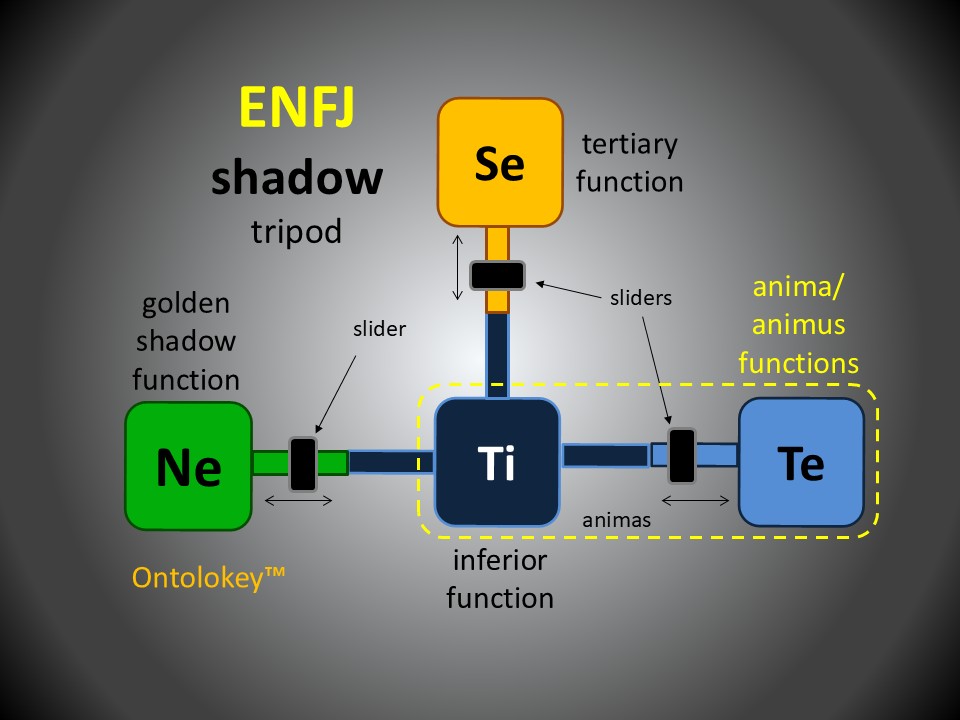
Beneath these two conscious strengths, however, lies a very different terrain, one that receives far less attention in popular descriptions but that carries enormous psychological weight. The function concerned with private, internally generated emotional truth tends to operate quietly in the background, frequently overshadowed by the louder, more socially rewarded outward emotional function. This creates a persistent and often invisible tension: the ENFJ is extraordinarily good at knowing what a group feels, but frequently far less certain about what they themselves feel when no one else’s reaction is available as a reference point. Alongside this sits an underdeveloped relationship with routine, physical grounding, and bodily self-care, which tends to be neglected in favor of larger causes and emotional projects. Further back still, in what could be called the more inferior layers of the psychological structure, sit capacities for detached, impersonal logical analysis and for raw, immediate sensory engagement with the physical world. Both of these are often experienced as foreign territory, admired from a distance in others but awkward and uncomfortable when the ENFJ attempts to inhabit them directly. And finally, tucked away as something like a hidden or golden potential, lies a more playful, exploratory, divergent way of generating ideas, one that the type often suppresses in favor of a single clear vision but that, when allowed to surface, becomes a genuine source of creative renewal.
The Seduction of the Social Mirror
Understanding these functions matters because they explain not only the strengths of this personality but also the mechanism through which its deepest psychological difficulties tend to form. The developmental story of many ENFJs begins early, often in childhood, when the individual discovers that relationships are not simply one important part of life but the primary lens through which reality itself becomes intelligible. Other people stop being merely companions and start becoming mirrors, instruments through which the growing personality learns who it is. Approval, disappointment, gratitude, and emotional resonance from others begin to carry enormous psychological weight, far beyond what such reactions carry for many other people. This is not inherently pathological; it produces, in fact, precisely the interpersonal talents for which this type becomes known and admired. Teachers appreciate the responsiveness. Friends trust the sensitivity. Communities reward the capacity to unify and inspire. The trouble is that a personality built primarily around interpretation of external feedback can begin to substitute that feedback for genuine self-knowledge, until the internal question quietly shifts from “what do I actually feel” to “how am I currently being perceived.” This shift is subtle enough that it can remain unnoticed for years, even decades, precisely because it produces such socially celebrated results.
The consequence of this substitution is a peculiar and often hidden fragility beneath an outwardly confident personality. Worth becomes tied to emotional impact, identity becomes tied to social response, and meaning becomes tied to recognition from others. The individual may continue to appear generous, compassionate, and altruistic, and in most cases genuinely is all of these things, while simultaneously depending on the very act of giving to stabilize an otherwise uncertain sense of self. Care that flows from genuine inner abundance and care that flows from unconscious psychological necessity can look identical from the outside, yet they leave the person in profoundly different internal states. When helping others becomes something the personality requires rather than something it freely offers, relationships risk becoming subtle mechanisms for regulating self-esteem rather than encounters between two equally autonomous people. This is the first movement of the shadow, quiet and largely invisible, in which the authentic self begins to be gradually replaced by a self built almost entirely out of reflected approval.
The False Self and the Addiction to Being Needed
Out of this early substitution grows a second, closely related pattern: the discovery, usually unconscious, that being needed by others creates a powerful and immediate sense of psychological security. Over time this discovery hardens into something like an equation, in which existence itself becomes tethered to usefulness. The individual does not merely enjoy helping people; helping becomes the primary mechanism through which a fragile identity is kept intact. This produces what depth psychology has long referred to as a false self, a carefully constructed persona built to secure love, approval, and belonging, reinforced in this particular type by genuine and considerable social success. The ENFJ becomes skilled, sometimes extraordinarily skilled, at sensing and meeting the emotional needs of others, and because these skills are real rather than fabricated, the false self can feel entirely authentic from the inside even as it slowly crowds out spontaneous, self-originating experience.
One of the clearest warning signs that this false self has taken hold is the slow accumulation of resentment. Whenever a person repeatedly gives more than they genuinely wish to give, an unconscious accounting system tends to develop beneath the surface, even while the conscious mind insists that everything offered was freely chosen. Sacrifices accumulate silently, disappointments are quietly logged, and eventually the individual begins to feel unappreciated, overlooked, or exploited by people who, in many cases, never explicitly asked for the extent of devotion they received. This dynamic becomes especially significant in intimate relationships, where profound emotional generosity can shade into a subtler form of dependency, in which the partner’s independence starts to feel quietly threatening rather than simply healthy. Perhaps nothing exposes this pattern more sharply than rejection, particularly the discovery that someone the ENFJ has deeply invested in simply does not need them in return. Such moments frequently produce a pain disproportionate to the objective event, because what is actually being grieved is not only the relationship but the collapse of a role around which so much identity had been organized. The eventual, hard-won insight that begins to dissolve this pattern is deceptively simple to state and remarkably difficult to internalize: personal worth exists prior to usefulness, and being loved for one’s function is not the same as being loved for one’s existence.
The Hidden Will to Power Behind Compassion
A further, still less comfortable layer of the shadow emerges once the personality begins to examine its relationship with influence itself. The ENFJ does not merely perceive the emotional atmosphere of a group; in many cases they can actively alter it, elevating morale, redirecting collective energy, generating loyalty, or shifting how a room perceives a given situation. This capacity is, in itself, morally neutral, but because it operates through emotion rather than through more visible and socially recognized forms of authority, it frequently escapes scrutiny, both from others and from the individual who wields it. In its immature form, this influence becomes quietly entangled with self-worth. The person begins to need evidence that their presence matters, proof that they can shape outcomes through interpersonal engagement, and gradually the people around them risk being experienced less as autonomous individuals and more as projects requiring guidance. Nothing exposes this dynamic more clearly than resistance: when advice is welcomed, the ENFJ experiences themselves as caring and constructive, but when a partner, friend, or group declines their direction, the resulting irritation or disproportionate hurt often signals that something more than concern for the other person’s wellbeing has been wounded.
This tendency becomes particularly dangerous when it fuses with genuine moral conviction, since few psychological positions grant greater unquestioned authority than the sense of representing not merely a personal opinion but a higher ethical truth. Disagreement then begins to feel like ignorance or moral failure on the part of the other person rather than a legitimate difference of perspective, and power becomes almost impossible to detect precisely because it is cloaked in idealism rather than domination. History offers abundant examples of individuals convinced they were saving others while in fact overriding their autonomy, and the psychological mechanism at work in smaller, more intimate settings is remarkably similar. The mature resolution of this layer of the shadow does not require the ENFJ to abandon influence altogether, since influence is simply the capacity to affect reality and is not inherently corrupt. What is required instead is the far more demanding task of learning to help without needing dependency, to guide without needing obedience, and to inspire without needing followers, so that influence becomes an ethical tool rather than an unconscious source of validation.
The Terror of Emotional Irrelevance
Beneath the pursuit of influence lies something older and considerably more vulnerable: a fear that if the ENFJ ceases to be emotionally significant to others, they may cease, in some meaningful psychological sense, to exist at all. Because identity for this type develops so heavily through relational participation, the loss of relational significance can feel less like an ordinary disappointment and more like a genuine threat to the continuity of the self. This fear rarely announces itself directly, since it would be humiliating for a personality organized around strength and care to admit to such vulnerability. Instead it hides behind more socially acceptable concerns: distress when messages go unanswered, when invitations stop arriving, when appreciation quietly diminishes, or when a role that once conferred meaning simply disappears. Major life transitions, such as retirement, children leaving home, the end of relationships, or the natural evolution of communities beyond their original organizers, often trigger this fear with particular force, because they strip away the external structures that had previously supplied a reliable sense of relevance.
The tragedy embedded in this dynamic is that the harder a person searches for guaranteed significance, the more elusive genuine meaning tends to become, since authentic meaning cannot be secured through psychological effort alone. Every relationship risks becoming, in this state, a kind of referendum on personal worth, every silence becomes suspicious, and every small rejection becomes catastrophic, producing a state of chronic vigilance that eventually exhausts both the individual and the people around them. The path beyond this fear requires a genuine separation of existence from significance, an internal recognition that human worth does not depend on visibility, admiration, or being remembered, however much these things may enrich a life once they are no longer treated as its foundation. Only when this distinction becomes real rather than merely intellectual does the ENFJ begin acting from freedom rather than from a compensatory need to remain indispensable.
Repressed Rage Beneath the Mask of Compassion
It is a common and understandable mistake to assume that a personality this oriented toward warmth and harmony must have a limited relationship with anger. The opposite is frequently closer to the truth. Because early adaptation teaches the young ENFJ that warmth secures connection while anger threatens it, aggressive feelings are rarely eliminated but are instead transformed into more socially acceptable substitutes: frustration becomes concern, resentment becomes disappointment, hostility becomes moral disapproval, and irritation becomes an excess of helpfulness. Over years of small, seemingly insignificant acts of self-suppression, this creates what might be described as an emotional debt, a reservoir of unacknowledged anger that continues to exist even while the person maintains, often sincerely, a self-image built around patience and generosity. Because this anger has been denied a direct outlet, it frequently escapes through indirect channels instead, appearing as sarcasm, subtle guilt-inducing behavior, passive withdrawal, or moral criticism disguised as concern. What looks from the outside like manipulation is, in a great many cases, better understood as emotional illiteracy regarding needs the individual has never been permitted to name directly.
When this accumulated pressure eventually exceeds the personality’s capacity for containment, the resulting eruptions can seem wildly disproportionate to whatever immediate event triggered them, precisely because they are expressing years of unaddressed grievance rather than responding solely to the present moment. Observers are often shocked by the sudden appearance of a version of the person that seems entirely inconsistent with the patient, understanding figure they thought they knew, though in reality both versions have coexisted all along. The path toward integration here does not involve eliminating anger, which would only deepen the underlying problem, but rather reclaiming it as legitimate psychological information: anger reveals where boundaries have been crossed and where the self has been neglected, and a person incapable of accessing it eventually becomes incapable of sustaining authentic boundaries at all. Learning that compassion and anger are not opposites, and that genuine care sometimes requires the courage to disappoint others, marks a decisive turning point in this particular strand of the shadow’s resolution.
Identity Diffusion and the Collapse of the Persona
As these layers accumulate, many ENFJs eventually arrive at a considerably more disorienting crisis, one that extends beyond specific behaviors or emotions and reaches into the structure of identity itself. Because so much of the personality has been organized around accurately reading and meeting external expectations, a moment often arrives, frequently triggered by loss, betrayal, or an unavoidable period of solitude, in which the individual begins to wonder whether the person who made so many of life’s major decisions was ever fully authentic to begin with. This is a considerably more unsettling experience than ordinary self-doubt, because it does not merely question particular choices but questions the reliability of the self that made them. The social persona, built up over years through genuinely effective adaptation, begins to be mistaken for the entirety of the personality, so that the teacher, the leader, the caretaker, or the mentor gradually becomes indistinguishable from the self underneath. When circumstances eventually force the relinquishing of these roles, whatever lies beneath them can no longer remain hidden.
The collapse of this persona is rarely experienced initially as liberation; far more often it feels like disintegration, accompanied by a strange sensation of meeting oneself as a stranger for the first time. Yet this collapse, however painful, tends to represent one of the most important developmental opportunities available to this type, because it is only through the dismantling of an overly narrow self-image that a more honest and complex identity can begin to form. The individual gradually discovers that they can be simultaneously compassionate and self-interested, generous and occasionally selfish, loving and legitimately angry, idealistic and drawn to influence, without any of these apparent contradictions invalidating the others. Authenticity, understood in this deeper sense, does not mean moral perfection or unwavering consistency; it means no longer needing to hide from oneself, and allowing genuinely contradictory truths to coexist within a single, more spacious sense of identity.
The Abyss Within, and the Possibility of Integration
Beneath even this identity crisis lies what may be described as the deepest layer of the ENFJ’s shadow: a confrontation with inner emptiness that has nothing to do with sadness or ordinary loneliness and everything to do with the sudden absence of external structures that had, for years, generated a sense of meaning. This encounter tends to arrive during periods when old sources of validation stop working, when achievements accumulate without producing fulfillment, or when relationships persist without their former emotional vitality. It represents a genuinely existential confrontation rather than a purely psychological one, since it forces the recognition that no amount of admiration, connection, or contribution can, by itself, permanently resolve deeper questions of worth and meaning. Paradoxically, it is precisely this encounter with apparent emptiness that opens the possibility of a more grounded, less externally dependent form of identity, one capable of tolerating solitude, ambiguity, and the eventual disappearance of every social role without experiencing these as a form of annihilation.
What emerges on the far side of this long process is not a flawless human being but a considerably more honest one. The integrated ENFJ retains the same fundamental gifts of warmth, vision, and relational intelligence, but these gifts are no longer secretly enlisted in the service of securing an uncertain identity. Truth becomes easier to speak, even when it complicates a cherished self-image. Anger becomes a legitimate and timely signal rather than a decades-long accumulation waiting to erupt. Influence becomes a tool offered freely rather than a hidden source of psychological validation. Solitude becomes survivable, even fertile, rather than something to be perpetually outrun through activity and relational engagement. And love, perhaps most importantly, becomes less burdened by hidden contracts, offered from genuine abundance rather than unconscious need. This is, in the end, the deeper promise contained within the shadow material Ontolokey has developed around this type: that a serious, unflinching engagement with one’s own darkness does not diminish the capacity for connection and compassion that defines the ENFJ at their best, but rather makes that capacity, for the first time, entirely one’s own.
This summary was compiled from content published by Ontolokey, and represents only a condensed introduction to a much larger body of material. Readers interested in the full functional analysis of the ENFJ, in the complete shadow essay from which much of this overview is drawn, or in explorations of the other fifteen personality types within this framework, are encouraged to visit www.ontolokey.com for the far more detailed original texts.


Leave a comment