The Personality Behind Inner Truth
The INFP is often described through words such as idealistic, sensitive, imaginative, compassionate, creative, and deeply committed to authenticity. These descriptions are not wrong, but they capture primarily the visible surface of a psychological structure whose deeper tensions are considerably more complicated. At the center of the INFP stands Introverted Feeling, Fi, not merely as an emotional preference but as an inwardly experienced criterion of personal truth: the persistent question of whether something feels authentic, morally congruent, meaningful, and genuinely one’s own. Extraverted Intuition, Ne, expands this private moral world into a field of possibilities, interpretations, symbols, alternative futures, and imaginative connections, giving the INFP the capacity to see what could exist beyond what presently exists. In the Ontolokey framework, the personality therefore begins with a distinctive tension between inner truth and outer possibility, between the need to remain faithful to something deeply personal and the simultaneous awareness that reality could always be different. This combination can produce extraordinary creativity, empathy, originality, and moral courage, but it can also create the psychological conditions for idealization, withdrawal, self-criticism, unrealized potential, and a painful distance between the life imagined internally and the life actually lived.
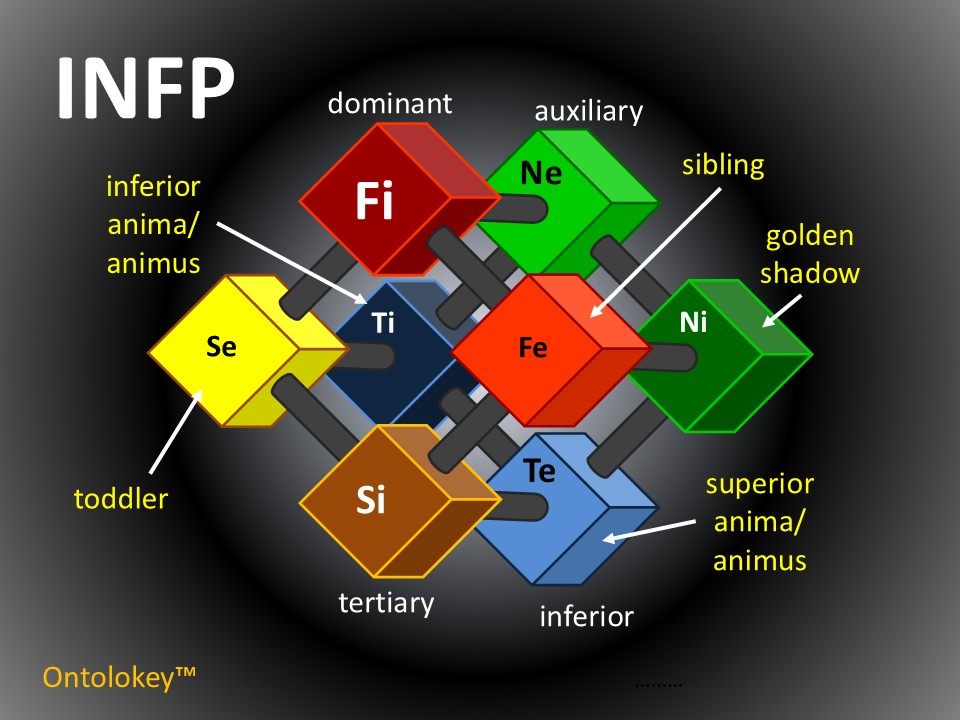
The deeper purpose of examining the INFP is therefore not to romanticize sensitivity or to expose some supposedly hidden defect beneath an attractive personality profile. The more interesting question is what happens when the very qualities that make the INFP psychologically distinctive become defensive strategies: when authenticity becomes an internal tribunal, idealism becomes intolerance of reality, empathy becomes self-abandonment, imagination becomes refuge, and moral seriousness becomes a source of chronic guilt. Ontolokey approaches this problem by transforming the eight-function architecture into a three-dimensional psychological landscape in which the functions occupy qualitatively different positions rather than existing merely as a linear list of strengths and weaknesses. For the INFP, these positions are Fi as Dominant, Ne as Auxiliary, Fe as Sibling, Se as Toddler, Ti as Anima, Ni as Golden Shadow, Si as Tertiary/Blindspot, and Te as Inferior; each represents a different relationship between conscious identity, psychological development, vulnerability, aspiration, and less-conscious potential. The resulting picture is more demanding than the familiar image of the gentle dreamer, because it suggests that the INFP’s greatest psychological challenges are often generated not by a lack of depth, but by the difficulty of bringing that depth into direct relationship with reality, action, boundaries, embodiment, and other people.
The Ontolokey Cube: Eight Functions, Eight Psychological Positions
The Ontolokey approach becomes particularly significant for the INFP when the personality is no longer regarded as a simple sequence of four preferred functions, but as a psychological landscape in which eight functions occupy different structural positions. The underlying idea of this approach is that a psychological function cannot be understood solely by asking whether it is “strong” or “weak”; its meaning also depends upon the role it plays within the total architecture of the personality, its degree of conscious accessibility, the psychological tasks associated with it, and the tensions it creates with the other functions. Ontolokey draws upon the tradition of functional personality models in which the psyche can be represented through eight positions, and its cube gives these relationships a spatial form, turning an abstract functional arrangement into what can be experienced as a psychological landscape. For the INFP, this landscape is organized around Fi – Dominant, Ne – Auxiliary, Fe – Sibling, Se – Toddler, Ti – Anima, Ni – Golden Shadow, Si – Tertiary/Blindspot, and Te – Inferior, and these names are not interchangeable labels but indications of fundamentally different relationships between consciousness, vulnerability, development, attraction, and psychological compensation.
The Dominant Fi, or Introverted Feeling, represents the psychological center around which the INFP organizes personal meaning, identity, conscience, authenticity, and value. Fi does not simply mean “having strong feelings,” nor does it imply emotional expressiveness; rather, it describes an inward process through which experience is measured against an intensely personal sense of what is true, meaningful, right, wrong, beautiful, acceptable, or intolerable. This is why an INFP can appear remarkably flexible about ordinary matters while becoming unexpectedly immovable when something touches a core value, because the important boundary may exist internally long before it becomes visible externally. The dominant position means that Fi is not merely a skill the INFP possesses but the psychological standpoint from which much of experience is interpreted, giving the personality its characteristic concern with authenticity and inner congruence. In its mature expression, this produces moral independence, compassion, nuanced emotional understanding, loyalty to deeply held principles, and an unusual capacity to recognize the individuality of other people without immediately reducing them to social categories. Yet the same structure can become burdensome when the internal value system turns from a compass into a court of judgment, because the person begins not merely asking whether an action is consistent with personal values but whether the entire self is sufficiently pure, authentic, meaningful, or worthy. This is precisely where the positive and shadow expressions of Fi become inseparable: the capacity to live according to inner truth can become the tendency to judge oneself mercilessly whenever reality fails to embody an imagined ideal.
The Auxiliary Ne, or Extraverted Intuition, provides the necessary outward movement of the INFP psyche by opening the inner value system toward possibilities, associations, interpretations, alternative futures, and connections that are not immediately obvious. If Fi asks, “What is true for me?” Ne asks, “What else might be possible?” and this interaction explains much of the INFP’s imaginative richness: values are not merely preserved internally but continually connected to stories, ideas, people, symbolic meanings, creative possibilities, and alternative ways of living. Ne can therefore make the INFP unusually receptive to nuance and ambiguity, because reality is rarely experienced as a closed set of facts; instead, almost every situation can become the beginning of another interpretation or another possible future. Yet this same capacity contains one of the central mechanisms of the INFP shadow, because possibilities can multiply much faster than they can be embodied. When Ne continually generates alternatives while Fi evaluates each one for authenticity and significance, commitment can become psychologically expensive: choosing one possibility necessarily means abandoning many others, while acting upon an imperfect possibility exposes the person to the possibility that reality will disappoint the ideal that existed internally. Ontolokey’s description of the INFP shadow repeatedly returns to this separation between possibility and realization, describing the danger of becoming increasingly rich inwardly while becoming increasingly inactive outwardly. The mature relationship between Fi and Ne therefore does not require the INFP to dream less, but to allow imagination to become a generator of lived experience rather than a substitute for it.
Fe as Sibling and Se as Toddler: The Outer World as Relationship and Exposure
The Sibling Fe, or Extraverted Feeling, occupies a particularly revealing position in the INFP landscape because it represents a capacity that is both recognizable and psychologically complicated: the ability to read, influence, and participate in the emotional atmosphere shared with other people. Whereas Fi asks whether something corresponds to an internally held value, Fe is oriented toward what is happening between people—the emotional field, the implicit expectations, the needs of the group, and the degree of interpersonal harmony. In the Sibling position, this capacity can feel familiar enough to be accessible, yet it does not constitute the INFP’s natural center of gravity; consequently, an INFP may be exceptionally compassionate and perceptive toward another person while remaining uncomfortable with the social machinery through which collective emotional life is organized. This helps explain a paradox often associated with the type: the INFP may care profoundly about people but still feel alienated from social environments, particularly when belonging appears to require the suppression or modification of personal convictions. The mature expression of Fe therefore does not require abandoning Fi, but learning that interpersonal reality has its own legitimacy and that another person’s emotional experience cannot always be reduced to whether it agrees with one’s private moral framework. In this sense, Fe as Sibling can become an important bridge between the INFP’s inner world and the shared world, because it teaches that authenticity does not necessarily mean emotional isolation and that genuine individuality can coexist with reciprocal participation in relationships.
The Toddler Se, or Extraverted Sensing, exposes a very different vulnerability because it concerns direct contact with the immediate physical world: action, sensory intensity, concrete circumstances, bodily presence, competition, environmental demands, and the ability to respond to what is actually happening rather than to what it might mean. For an INFP whose attention naturally moves toward inner values and imagined possibilities, immediate reality can sometimes feel crude, intrusive, excessively demanding, or strangely uninteresting compared with the richness of the psychological world. Se in the Toddler position consequently describes a relatively young relationship with direct experience: it can appear playful, spontaneous, aesthetically receptive, adventurous, or intensely present, but it can also become impulsive when the INFP has been disconnected from physical reality for too long. The problem is not that the INFP lacks sensory experience, but that sustained attention to concrete circumstances may compete with the internal processes that normally provide meaning and orientation. This becomes particularly important when idealism has created a large discrepancy between what life is supposed to feel like and what life actually requires in the present moment, because Se can either return the person to reality through embodied experience or emerge abruptly as a compensatory hunger for stimulation, novelty, indulgence, or immediate escape. A healthier Se therefore does not transform the INFP into a fundamentally different personality; rather, it gives inner values and imaginative possibilities a physical environment in which they can actually be experienced, tested, created, and lived.
This relationship between Fi, Fe, and Se also reveals why the INFP’s interpersonal difficulties cannot simply be described as shyness or introversion. The deeper issue can be a conflict between two forms of psychological legitimacy: the legitimacy of the inner self and the legitimacy of the shared situation. An INFP may possess extraordinary sensitivity toward another person’s suffering while simultaneously resisting demands for conformity, and this can produce a distinctive form of selective intimacy in which emotional depth is welcomed but social obligation is experienced as invasive. When this tension becomes defensive, the person may retreat into an internal world where values are perfectly coherent, relationships can be imagined without their ordinary compromises, and possibilities remain uncontaminated by the disappointments of actual interaction. Yet such withdrawal can eventually intensify the very alienation it was intended to protect against, because relationships cannot be sustained exclusively through private understanding; they require presence, communication, concrete action, and tolerance for the fact that other people will inevitably misunderstand, disappoint, challenge, and change us. The developmental task represented by these positions is therefore not to choose between authenticity and connection, but to discover whether authenticity can survive contact with another person without turning into isolation. The INFP at its healthiest becomes capable of carrying an intensely personal inner truth into shared reality without demanding that either the self or the relationship cease to be imperfect.
Ti as Anima: The Seduction of Impersonal Certainty
The Anima Ti, or Introverted Thinking, occupies a psychologically different territory because it represents an attraction toward a form of understanding that is less concerned with personal meaning and more concerned with internal coherence, conceptual precision, classification, and logical structure. For the INFP, Ti can therefore possess an almost fascinating quality: it promises a way of understanding reality that appears independent of emotional identification, personal preference, or moral investment. This can become particularly attractive when Fi has become exhausted by the burden of deciding what is meaningful or morally right, because Ti seems to offer temporary relief through the simpler question of whether something makes sense. The Anima position can consequently produce a strong fascination with systems, philosophy, psychology, metaphysics, conceptual analysis, or intricate intellectual frameworks, especially when these provide the feeling that an otherwise confusing inner experience can finally be explained. Yet the attraction itself can become problematic when the INFP begins to seek intellectual certainty as a substitute for psychological resolution, because a perfectly coherent explanation does not necessarily resolve an emotional conflict or produce an actionable decision. The shadow expression of Ti can therefore involve overanalysis, intellectualization, endlessly refining distinctions, or constructing increasingly elaborate explanations around problems that ultimately require acceptance, emotional integration, interpersonal communication, or concrete action rather than another layer of theory.
The psychological significance of the Anima becomes clearer when considered alongside the INFP’s dominant Fi and auxiliary Ne. Fi searches for subjective authenticity, while Ne continuously generates alternative interpretations, and Ti can appear to promise an escape from the instability produced by both: if the world can be reduced to a sufficiently elegant conceptual structure, perhaps uncertainty itself can be mastered. This temptation is particularly powerful for an introspective personality because thinking can take place privately and indefinitely, without exposing the person to the vulnerability of acting in the external world. The INFP may therefore become extraordinarily sophisticated at explaining why something happened, what it means, how different perspectives relate to one another, and what theoretical principles might account for the situation, while still postponing the uncomfortable question of what must actually be done. In its healthier form, however, Ti becomes a valuable internal instrument rather than a psychological refuge, allowing the INFP to distinguish intuition from assumption, emotional conviction from factual inference, and genuine insight from an explanation that merely feels profound. The developmental movement is consequently not from feeling toward thinking as though one must replace the other, but toward a more differentiated psyche in which personal truth can tolerate logical examination without experiencing examination as betrayal. When this integration occurs, the INFP’s intellectual life can become remarkably powerful because analysis is no longer being used to escape feeling; it becomes a method for giving feeling greater clarity and preventing sincerity from becoming self-deception.
Ni as Golden Shadow: The Unseen Image of What Could Become
The Golden Shadow Ni, or Introverted Intuition, represents one of the most intriguing positions in the INFP architecture because it points toward a form of psychological perception that may feel both strangely familiar and strangely distant. Whereas Ne expands outward into multiple possibilities, associations, interpretations, and potential trajectories, Ni tends toward convergence: it searches for the underlying pattern, the hidden direction, the symbolic essence, or the singular meaning toward which disparate experiences appear to be moving. For the INFP, this can function as an image of a more concentrated form of intuition, one that does not merely ask what might happen but gradually senses what everything may ultimately mean. The designation Golden Shadow suggests that this less-conscious function can carry a particularly alluring quality because it may represent something the conscious personality deeply admires but does not consistently inhabit. An INFP may therefore idealize people who seem unusually focused, visionary, strategically perceptive, or capable of seeing through complexity to a central pattern, while simultaneously feeling that such clarity is somehow inaccessible to the self. Yet Ni can also emerge under pressure as a sudden conviction that a situation has a hidden meaning or inevitable trajectory, particularly when Ne’s many possibilities become psychologically overwhelming and the mind desperately seeks one definitive interpretation. The developmental potential lies in allowing Ni to provide depth and synthesis without allowing it to turn ambiguity into destiny, because the ability to perceive a pattern is valuable precisely when it remains open to correction by reality.
The relationship between Ne and Golden Shadow Ni is therefore central to understanding one of the INFP’s less visible struggles: the tension between infinite possibility and the longing for ultimate meaning. Ne can keep the future open almost indefinitely, but human life eventually demands choices, and choices create consequences that cannot be intellectually reversed by imagining alternatives. At certain points the INFP may become tired of possibility itself and begin longing for the one path, one relationship, one vocation, one interpretation, or one existential purpose that would finally make everything cohere. This longing can produce periods of intense idealization in which a person, project, or imagined future becomes invested with extraordinary symbolic significance, because Ni supplies the sense that disparate experiences are converging toward something larger. The danger is that the symbolic image can become more compelling than the actual evidence, allowing the individual to remain loyal to a future that exists primarily in interpretation rather than in lived reality. Integrated Ni offers something subtler and more useful: the ability to recognize long-term patterns and underlying themes while retaining enough humility to distinguish a meaningful intuition from a story the psyche desperately wants to be true. In that integration, the INFP does not have to abandon imagination or idealism; instead, imagination becomes capable of acquiring direction, while idealism becomes capable of surviving the corrective pressure of reality.
Si as Tertiary Blindspot: The Problem of What Is Already There
The tertiary Si, or Introverted Sensing, carries the designation Blindspot in the Ontolokey formulation supplied for the INFP, and this position illuminates a subtle difficulty that is easily overlooked because it concerns something so ordinary that the INFP may not recognize its psychological importance. Si is concerned with continuity, accumulated experience, familiarity, bodily signals, established routines, concrete reference points, and the preservation of what has already been learned through repeated contact with reality. The INFP, however, can become so absorbed in what something means and what it might become that the immediate evidence of what has already happened receives insufficient attention. This does not mean that INFPs have poor memories or cannot appreciate familiar environments; rather, the blindspot concerns the tendency to undervalue the stabilizing information contained in repetition, precedent, maintenance, and ordinary physical continuity. A person can understand an experience emotionally and imaginatively while still failing to notice that the same pattern has occurred five times before, that the body has been signaling exhaustion for weeks, or that a seemingly new dilemma is actually an old dilemma wearing a different narrative costume. In this sense, Si represents the psychological wisdom of the already-lived, and the INFP’s difficulty with it can arise precisely because the personality is naturally drawn toward inner significance and unrealized possibility rather than toward the quiet accumulation of evidence that everyday life provides.
This blindspot becomes particularly consequential when idealism encounters disappointment. An INFP may remember an experience not simply as something that happened but as a psychologically meaningful event, and the emotional interpretation of that event can sometimes overshadow the mundane factual record surrounding it. The danger is that memory becomes organized around meaning rather than recurrence: a relationship is remembered through its emotional intensity, a failed project through what it symbolized, or a period of life through the ideal it represented, while the repetitive behavioral details that might reveal why the outcome occurred remain less salient. Si, when integrated, introduces a different discipline by asking the person to observe what actually repeats, what the body consistently tolerates or rejects, which habits reliably produce certain consequences, and what previous experience has already taught. This can be especially valuable for an INFP because Ne can continuously generate compelling explanations for why the next attempt might be different, while Si quietly supplies the uncomfortable counterquestion of whether the evidence supports that hope. The mature use of this function is therefore not rigid conventionalism or attachment to the past, but a willingness to let accumulated experience constrain imagination when the evidence demands it. Without that corrective, idealism can repeatedly reinvent itself after disappointment, preserving the belief that the next possibility will finally be different because the previous failure is interpreted as an exception rather than as information.
The Si blindspot also has a distinctly embodied dimension because the INFP can sometimes inhabit psychological experience more intensely than physical experience. Long periods of reflection, creative absorption, emotional processing, or imaginative activity can make the boundaries between mental and bodily needs surprisingly easy to neglect, particularly when concrete maintenance feels insignificant compared with whatever inner question currently commands attention. Sleep, nutrition, repetitive responsibilities, physical surroundings, financial routines, administrative obligations, and other forms of mundane continuity may consequently become psychologically invisible until their neglect produces an unavoidable consequence. What initially looks like spontaneity or freedom can then become a cycle in which reality repeatedly interrupts inner life with practical problems that could have been prevented through simple consistency. Integrated Si offers the INFP an antidote that is almost deceptively ordinary: remembering, maintaining, repeating, recording, noticing, and caring for what already exists before searching for what comes next. This matters psychologically because a meaningful life cannot be built exclusively from peak experiences, revelations, ideals, or imagined futures; it is also constructed from thousands of apparently insignificant acts that create continuity between one day and the next. The INFP’s development therefore includes learning that attending to the ordinary does not diminish the extraordinary, but gives it a stable place in which it can exist.
Te as Inferior: The Painful Encounter with Reality
The inferior Te, or Extraverted Thinking, represents perhaps the most consequential tension in the INFP personality because it concerns the external organization of reality: objectives, measurable results, efficiency, prioritization, implementation, deadlines, procedures, resource allocation, and the translation of intentions into observable outcomes. For a person whose psychological center is Fi, external standards can easily feel secondary to internal legitimacy; something may be deeply meaningful even when it is inefficient, difficult to measure, commercially unsuccessful, or invisible to others. Ne can reinforce this orientation by continually generating new possibilities before the previous one has been sufficiently developed, while the Si blindspot may make sustained maintenance and repetition less psychologically salient. Te therefore confronts the INFP with precisely the domain in which good intentions are insufficient: the world does not automatically reward sincerity, creativity, sensitivity, or potential, and meaningful ideas become part of reality only when someone organizes the necessary conditions for their existence. This is one reason the INFP can experience practical demands with disproportionate psychological intensity, particularly when deadlines, competition, bureaucracy, money, hierarchy, or performance metrics appear to threaten the integrity of what matters personally. The challenge is not simply learning to “be more productive,” because productivity without meaning can feel empty to Fi; the deeper developmental task is discovering that structure can serve values rather than destroy them.
When Te is underdeveloped, its pressure can produce two apparently opposite reactions: avoidance and overcompensation. In avoidance, practical problems are postponed because attending to them feels emotionally draining, reductive, or disconnected from the inner purpose that makes effort worthwhile; the person may continue refining intentions while concrete obligations accumulate around them. In overcompensation, particularly under prolonged stress, the suppressed Te function can emerge with unusual force, producing an abrupt preoccupation with efficiency, correctness, measurable achievement, categorization, or the perceived incompetence of others, followed by exhaustion or self-reproach when this mode cannot be sustained. The psychological problem in both cases is the same: Te has not yet become an integrated instrument of Fi, so it is experienced either as an external demand imposed upon the self or as an emergency mechanism deployed against disorder. A mature INFP does not need to become relentlessly competitive or emotionally detached in order to develop Te; instead, practical structure can be reframed as an expression of care for what Fi considers important. A writer who establishes a schedule is protecting the work from remaining merely imagined, a person who organizes finances is protecting future autonomy, and someone who learns to make decisions efficiently is reducing the amount of psychological energy consumed by perpetual deliberation. Te becomes healthier when it ceases to ask the INFP to become someone else and begins to help the existing personality make its inner commitments materially real.
The deepest difficulty with inferior Te is therefore not incompetence but exposure. Concrete execution creates evidence, and evidence can contradict the idealized image that Fi and Ne have protected internally. An imagined vocation can remain perfect until it is attempted; a creative project can remain extraordinary until other people encounter it; a moral intention can remain pure until circumstances force competing values into an actual decision. Action removes the protective ambiguity of possibility and replaces it with consequences that can be observed, measured, criticized, improved, or rejected. For an INFP who has unconsciously associated authenticity with preserving the integrity of the inner world, this can feel threatening because external failure may be experienced not merely as “this attempt did not work” but as “perhaps what I believed about myself was not true.” Developing Te therefore requires a psychologically significant separation between self-worth and outcome: the ability to let reality provide feedback without allowing every correction to become a verdict on identity. Once that separation becomes possible, the inferior function can gradually become one of the INFP’s most liberating capacities, because action no longer has to prove the value of the self; it simply becomes the mechanism through which values are tested, refined, implemented, and brought into contact with the world.
The Untold Burden of Idealism
The shadow of the INFP begins to reveal itself most clearly when idealism ceases to function as a source of direction and becomes an implicit standard against which ordinary existence is continually found inadequate. The Ontolokey description of the INFP emphasizes a recurring separation between inner possibility and lived reality, in which the internal world can become richer, more coherent, and more emotionally satisfying than the external world that is supposed to embody it. This distinction is crucial because the resulting suffering does not necessarily arise from obvious external deprivation; it can emerge from the comparison between what actually exists and what the individual can vividly imagine existing. An INFP may therefore experience disappointment not simply because life has gone badly, but because even a reasonably good reality seems pale beside the psychological version of life that could have existed. The imagined conversation is more profound than the conversation that actually occurred, the imagined relationship more intimate than the relationship that survived ordinary misunderstandings, and the imagined creative work more complete than anything that can be produced under real-world limitations. Ontolokey describes the resulting danger as a gradual replacement of lived reality by possibility, where reflection becomes safer than participation and unrealized potential begins to acquire a psychological existence of its own.
This is where the celebrated INFP quality of idealism can become psychologically ambivalent. Idealism gives the personality the capacity to perceive possibilities that others may overlook, to imagine humane alternatives, to remain sensitive to injustice, and to preserve an inner sense of meaning when circumstances appear spiritually impoverished. Yet the same sensitivity can establish standards that reality cannot satisfy because reality is inherently compromised by limitation, ambiguity, conflicting needs, imperfect communication, and finite time. The INFP may consequently begin to experience ordinary compromise as a betrayal of something essential rather than as an unavoidable condition of human existence. This can produce a peculiar form of dissatisfaction in which the person does not necessarily want more possessions, status, recognition, or conventional success, but wants life itself to become more internally congruent with the image carried within. The difficulty is that no external circumstance can permanently solve a discrepancy created by comparing an imperfect life with an ideal that has never been subjected to the friction of embodiment. The psychological task is therefore not to extinguish the ideal, but to change its function: the ideal must become a direction for living rather than a courtroom in which the actual self is perpetually found guilty.
The same mechanism can turn inward and produce one of the most painful characteristics of the INFP shadow: excessive self-monitoring. Because Fi is concerned with inner congruence and Ne can generate numerous alternative interpretations of one’s own motives and behavior, the individual can become trapped in a recursive process of evaluating not only what was done but why it was done, whether the motive was sufficiently pure, whether the behavior accurately represented the self, and whether the evaluation itself was honest. Reflection then stops functioning as a means of understanding and becomes a continuous system of psychological surveillance. Ontolokey describes this as an internal tribunal in which the INFP may judge not only actions but the distance between the actual self and an imagined ideal self, creating a form of guilt that concerns unrealized potential as much as genuine wrongdoing. This distinction is psychologically important because ordinary guilt can point toward a specific correction, whereas existential self-reproach has no natural endpoint: there is always another possibility that could have been pursued, another person who could have been helped, another creative work that could have been completed, or another version of the self that might have been more authentic. The result can be a paradox in which a person who extends remarkable compassion toward the weaknesses of others becomes extraordinarily unforgiving toward the weaknesses of the self.
The deepest danger, therefore, is not that the INFP feels too much, but that feeling and reflection become detached from the corrective influence of lived experience. The individual may understand courage intellectually while avoiding the situations in which courage would actually be required, understand intimacy while remaining protected within imagined relationships, or understand creativity while keeping the creative work permanently inside the realm of potential. Ontolokey’s formulation is particularly severe on this point: potential that never becomes embodied can gradually become a source of psychological suffering because every unrealized possibility remains available as an implicit comparison with the life that was actually lived. The result is a personality that can become extraordinarily rich inwardly while becoming increasingly cautious outwardly, not because it lacks desire, but because action destroys the protective perfection of possibility. Once something is spoken, created, chosen, or committed to, it can fail; while it remains imagined, it can remain limitless. The untold truth of INFP idealism is consequently that the same imagination capable of revealing a more humane world can also become the most elegant hiding place from the imperfect world in which that vision would have to be tested.
Alienation, Withdrawal, and the Private Fortress
The INFP’s withdrawal is often misunderstood because it can look externally like simple introversion, reserve, or a preference for solitude, while internally it may be a much more elaborate psychological process of protecting an intensely private value system from perceived distortion. When the surrounding world repeatedly appears superficial, coercive, emotionally careless, excessively competitive, or indifferent to meanings that feel self-evidently important, retreat can become more than rest: it can become a way of preserving the integrity of the self. The inner world then acquires the qualities of a private fortress in which values remain coherent, imagination remains unconstrained, and relationships can be experienced at a level of depth that ordinary social interaction does not always provide. This tendency is consistent with the broader functional architecture described by Ontolokey, which treats personality not simply as a collection of traits but as an interconnected arrangement of conscious and less-conscious modes of processing, including functions that can become shadow-like or difficult to integrate. The danger begins when protection becomes isolation, because the world outside the fortress is then encountered increasingly through anticipation, memory, interpretation, and imagined possibilities rather than through the corrective complexity of direct participation. The person may remain convinced that others cannot truly understand them, while simultaneously becoming less available to the very experiences through which genuine mutual understanding could develop.
This creates one of the most painful paradoxes of the INFP personality: the longing for profound connection can coexist with behavioral patterns that make such connection extraordinarily difficult to sustain. The INFP may desire someone who can perceive the unspoken layers beneath words, respect individuality without demanding conformity, understand emotional contradictions, and tolerate vulnerability without trivializing it, yet real relationships inevitably involve ordinary misunderstandings, incompatible needs, imperfect timing, practical obligations, and moments in which neither person possesses the right words. If the internal image of intimacy is significantly more coherent than actual intimacy, then reality can repeatedly appear disappointing even when the relationship itself is fundamentally meaningful. Ne intensifies this problem because every actual relationship can be compared with countless possible relationships, while Fi evaluates the emotional and moral authenticity of the comparison. The resulting pattern can involve idealization followed by disappointment, emotional retreat followed by longing, and renewed idealization of a future relationship that will supposedly avoid the limitations of the previous one. The cycle becomes especially destructive when withdrawal is interpreted as evidence of discernment rather than recognized as a defense against vulnerability, because then the person can experience increasing isolation while believing that the isolation proves the rarity of people capable of meeting them at the necessary depth.
There is also a subtler form of alienation in which the INFP becomes estranged not merely from other people but from ordinary participation in life itself. Activities that others experience as routine components of existence can appear strangely empty when they are disconnected from a personally meaningful narrative, and this can make the practical world feel like an endless sequence of tasks imposed upon a consciousness that wants to understand something deeper. The individual may consequently become highly selective about where energy is invested, resisting environments that seem meaningless while waiting for a vocation, relationship, project, or insight that feels sufficiently authentic to justify wholehearted commitment. That selectivity can protect the person from living according to values that genuinely violate the self, but it can also become a sophisticated mechanism for postponement, because almost any imperfect opportunity can be rejected on the grounds that it does not represent the life one is truly meant to live. The result is particularly painful when years pass and the person discovers that refusing an imperfect reality has not automatically produced the ideal reality that was imagined in its place. The more integrated alternative is not indiscriminate conformity, but the recognition that meaning is frequently created through sustained participation rather than discovered fully formed beforehand, and that an imperfect relationship, imperfect vocation, or imperfect creative project may become meaningful precisely because one has remained present long enough to shape it.
The Positive Core: Empathy, Creativity, and Moral Independence
The shadow of the INFP should not obscure the fact that the same psychological architecture can produce qualities of considerable depth and human value. Dominant Fi gives the personality an unusually intimate relationship with subjective experience, making it possible to recognize distinctions between emotions, motives, values, and personal boundaries that can remain invisible within more externally oriented modes of judgment. This inward differentiation can support genuine empathy because the INFP does not necessarily need another person to behave or think like them in order to recognize that the other person possesses an inner reality that deserves to be respected. Auxiliary Ne then expands this capacity beyond identification with what already exists, allowing the individual to imagine alternatives, reinterpret fixed assumptions, connect apparently unrelated ideas, and perceive possibilities within people and situations that others may have dismissed prematurely. The combination can produce a distinctive form of creativity in which imagination is not merely decorative but connected to questions of meaning, identity, ethics, human potential, and emotional truth. When developed well, the INFP can therefore bring something rare to relationships and creative work: the ability to remain attentive to what is psychologically particular while simultaneously imagining what that particularity might become.
This same structure can generate a powerful form of moral independence. Because Fi does not require the immediate confirmation of a group before recognizing something as personally significant, the INFP can maintain convictions even when those convictions are inconvenient, unpopular, or difficult to communicate within conventional social structures. This does not automatically make every INFP conviction correct, but it can provide the psychological capacity to resist social pressure when conformity would violate deeply held principles. The INFP can consequently become an advocate, artist, writer, counselor, researcher, designer, teacher, or simply a deeply principled individual whose contribution consists in refusing to treat the existing order as the only possible order. Ne strengthens this capacity by preventing values from becoming completely rigid: it allows the individual to ask whether the current interpretation is the only interpretation and whether apparently opposing perspectives might contain information worth integrating. The resulting psychological ideal is not moral certainty but moral seriousness combined with imaginative openness, a combination that can allow the INFP to hold convictions without necessarily becoming intellectually closed. At its best, the personality does not merely ask whether something works but also whether it is worth wanting, what kind of human consequences it produces, and whether the people affected by it are being treated as ends rather than abstractions.
The creative potential of the INFP is equally connected to the tension between inner truth and outer possibility. Creative work can provide an unusually natural bridge between Fi and Ne, because it allows something privately experienced to acquire an external form without requiring the creator to abandon the personal meaning that generated it. Literature, music, visual art, philosophy, design, storytelling, and other symbolic forms can become vehicles through which the INFP translates experiences that might otherwise remain difficult to communicate directly. This translation process is important psychologically because it converts private intensity into something that can be encountered, interpreted, criticized, and shared by other people. Here the inferior Te eventually becomes relevant in a constructive sense: inspiration alone produces possibilities, but craft, revision, organization, persistence, and completion transform those possibilities into an actual work. The INFP’s creative maturation therefore involves learning to tolerate the distance between the inner vision and its imperfect external expression, because no medium can reproduce an internal experience without distortion. The finished work does not have to be identical to the imagined ideal in order to be authentic; its value can emerge precisely from the courageous act of allowing something internal to become concrete enough that reality and other human beings can respond to it.
When Sensitivity Becomes Strength
Sensitivity is often treated as though it were a single psychological characteristic, but in the INFP it can involve several distinct capacities operating simultaneously: emotional differentiation through Fi, contextual and symbolic perception through Ne, interpersonal receptivity through Fe, and a strong awareness of whether experience corresponds to an internal sense of authenticity. When these capacities are integrated, sensitivity does not necessarily make the INFP fragile; it can make the person unusually perceptive about subtle discrepancies between what people say and what they appear to mean, between social expectations and personal values, and between an external situation and the psychological experience it produces. Such sensitivity can be especially valuable in environments where ambiguity matters, because the INFP may notice emotional or ethical dimensions that are easily overlooked when attention is restricted to efficiency or measurable outcomes. Yet sensitivity becomes psychologically costly when every perception is treated as equally significant, because an individual who notices many layers of experience can also become overwhelmed by the sheer number of meanings competing for attention. Mature sensitivity therefore requires discrimination: learning which signals deserve sustained attention, which belong to other people rather than to oneself, and which are transient emotional reactions rather than enduring truths. The development of boundaries is consequently not a rejection of empathy but one of its necessary conditions, because without boundaries the capacity to perceive other people’s inner worlds can gradually become a tendency to carry experiences that were never one’s responsibility to carry.
The Sibling Fe position is especially relevant here because it gives the INFP access to a relational sensitivity that can complement the private orientation of Fi. An INFP may be capable of recognizing another person’s emotional needs without necessarily wanting to become governed by the collective emotional atmosphere, and this distinction can allow for a particularly individualized form of compassion. Rather than treating kindness as automatic agreement, the mature INFP can learn to remain connected while disagreeing, to acknowledge another person’s feelings without accepting every interpretation attached to those feelings, and to care without assuming responsibility for regulating everyone’s emotional state. This is a significant developmental achievement because the shadow side of empathy is not only exhaustion but also covert resentment: when a person repeatedly sacrifices personal boundaries in order to preserve harmony, the resulting frustration may eventually be directed toward the very people they attempted to protect. Healthy Fe therefore supports a more reciprocal model of relationship in which emotional consideration moves in both directions, while Fi maintains the right to remain internally distinct. The combination allows the INFP to become neither emotionally detached nor emotionally engulfed, but capable of participating in relationships where closeness does not require psychological fusion.
Sensitivity can also become a source of resilience when it is accompanied by the willingness to experience rather than merely interpret emotion. One of the INFP’s recurrent temptations is to transform every difficult experience into a question of meaning, identity, or existential significance, and although this can generate insight, it can also keep emotional pain circulating indefinitely within the mind. Se as Toddler offers a corrective precisely because direct sensory experience can interrupt excessive abstraction: walking, creating, listening to music, engaging with nature, cooking, physical movement, making something with one’s hands, or simply attending carefully to the present environment can reconnect psychological life with the body. This does not solve every emotional problem, but it can prevent the mind from turning experience into an endlessly self-referential narrative. In that sense, embodiment becomes an underappreciated component of INFP maturity because a person cannot remain psychologically healthy by interpreting life while remaining permanently absent from it. The strongest form of INFP sensitivity is therefore not endless receptivity but grounded receptivity: the ability to feel deeply without drowning in what is felt, to perceive complexity without making every complexity a crisis, and to preserve an inner world without allowing that inner world to become a substitute for inhabiting the physical and relational world outside it.
The Inferior Te Trap: Potential Without Execution
One of the most persistent difficulties in the INFP personality emerges when extraordinary potential becomes psychologically more important than measurable realization. Fi can generate a powerful sense that something matters, while Ne can generate numerous ways in which that meaningful thing might be expressed, but neither function by itself guarantees completion. The person can therefore possess an impressive internal catalogue of projects, vocations, books, artistic concepts, philosophical ideas, relationship possibilities, and imagined versions of the future without establishing the external structures necessary to bring them into existence. This is where inferior Te becomes more than a technical function in a personality model: it represents the uncomfortable transition from intention to implementation. Te asks what the objective actually is, what resources are available, what sequence of actions is required, what has been accomplished, what remains unfinished, and what evidence demonstrates that an idea works. For an INFP, those questions can initially feel almost offensively reductionistic because they appear to translate something meaningful into metrics and procedures, yet the refusal to engage them can quietly transform freedom into stagnation. The untold problem is therefore not lack of ability but the possibility of living for years in the psychological possession of unrealized ability, where potential remains emotionally satisfying precisely because it has never been subjected to the limitations that accompany execution.
This dynamic can become especially severe because Ne makes postponement intellectually easy. Whenever one possibility becomes difficult, another possibility can be generated that appears more authentic, more suitable, more exciting, or more aligned with the self, allowing the mind to reinterpret abandonment as discovery. A project that requires discipline can be replaced by the idea of a better project; a difficult conversation can be postponed while imagining a more natural conversation that will somehow occur later; a career decision can remain unresolved because every option reveals another possible life that has not yet been explored. The psychological danger is that the person can become addicted not to achievement but to possibility itself, because possibility preserves freedom while commitment introduces limitation. Every genuine choice closes doors, and for a personality highly sensitive to unrealized alternatives, closing doors can feel like a violation of one’s own potential. Yet a human life necessarily becomes concrete through exclusions: time spent doing one thing cannot simultaneously be spent doing another, and an identity eventually emerges from repeated behavior rather than from everything one might theoretically become. The mature INFP must therefore discover that commitment is not necessarily the enemy of freedom; in many cases, commitment is the mechanism through which an abstract value finally acquires a form capable of changing reality.
The healthier development of Te begins when external structure is detached from the idea of external validation. An INFP does not have to become obsessed with status, productivity, competition, or conventional achievement in order to benefit from planning and execution; Te can instead become the practical servant of Fi. If a person values writing, Te creates a routine in which writing actually occurs; if a person values independence, Te organizes finances and responsibilities in a way that protects it; if a person values helping others, Te turns compassion into a sustainable practice rather than an indefinite intention. This is one of the most important distinctions between meaningful productivity and productivity pursued for its own sake: the former asks structure to serve a value, whereas the latter can gradually make measurable performance the value itself. The INFP’s developmental challenge is therefore to tolerate the temporary discomfort of becoming concrete without surrendering the inner reason for becoming concrete in the first place. Once action is understood as an extension of authenticity rather than its enemy, execution ceases to be a betrayal of the inner world and becomes its proof of life. The idea no longer needs to remain perfect inside the mind, because it has entered the only environment in which it can evolve, encounter resistance, acquire form, and produce consequences: reality.
Relationships: Intimacy, Idealization, and Boundaries
In intimate relationships, the INFP’s greatest strength and greatest vulnerability can arise from the same source: the conviction that genuine connection must involve access to something deeper than social performance. Fi makes emotional authenticity central, while Ne allows the INFP to imagine the inner world of another person with remarkable richness, filling gaps in communication with possible motives, histories, fears, hopes, and unrealized potential. This can create an experience of intimacy that feels unusually profound, because the INFP is often responding not only to the person who is present but also to the person they sense that individual could become. Such perception can make the INFP deeply accepting and loyal, particularly when they recognize vulnerability or goodness that others have overlooked. But it can also produce idealization, in which the imagined psychological depth of a relationship becomes partially detached from the evidence provided by the relationship itself. The person may fall in love not only with who someone is but with the meaning the relationship appears to contain, and when reality inevitably introduces contradiction, disappointment can feel disproportionately severe because it destroys an internal narrative as well as an interpersonal expectation. The psychological maturity of the INFP therefore depends partly upon learning to distinguish empathy from projection: understanding another person deeply requires allowing them to remain partly unknown, contradictory, and autonomous rather than unconsciously completing them according to an internally compelling image.
The same distinction becomes essential when the INFP encounters relationships that are emotionally demanding or exploitative. High Fi can create strong personal loyalty, and the INFP may remain committed to someone because abandoning the relationship feels morally wrong even when the relationship has become psychologically destructive. Ne can intensify this tendency by continually generating explanations for another person’s behavior and imagining circumstances under which the relationship might become what it was meant to be. The ability to perceive complexity can then become a liability because almost any harmful behavior can be contextualized, explained, forgiven, or interpreted as evidence of an underlying wound that deserves compassion. Meanwhile, Fe as Sibling can make the preservation of interpersonal harmony psychologically attractive even when it conflicts with personal boundaries, creating the possibility that the INFP will suppress anger until resentment accumulates beneath an outward appearance of tolerance. Healthy boundaries require a different form of compassion, one in which understanding why someone behaves destructively does not automatically create an obligation to remain available to them. The INFP’s empathy becomes stronger rather than weaker when it is accompanied by the capacity to say no, because compassion without boundaries can become self-erasure, whereas compassion with boundaries recognizes the humanity of both participants.
There is also a quieter relational difficulty associated with the INFP’s sensitivity to authenticity: ordinary imperfection can be interpreted as evidence that something essential is missing. Real intimacy is repetitive, mundane, inconvenient, and occasionally disappointing; it involves negotiating schedules, finances, household responsibilities, conflicting preferences, fatigue, misunderstandings, and periods in which neither person feels particularly inspired or emotionally articulate. For an INFP who expects intimacy to remain connected to a profound sense of meaning, these ordinary conditions can initially seem like evidence that the relationship has lost its soul. Yet precisely here, the distinction between romantic intensity and enduring intimacy becomes important. A relationship becomes psychologically deep not because it permanently reproduces an ideal emotional atmosphere, but because two imperfect individuals gradually learn how to remain truthful, responsive, and respectful when the atmosphere is no longer ideal. The INFP who learns this distinction becomes capable of a more durable form of love, one that does not require another person to embody an imagined soulmate archetype or to validate the entirety of the inner world. Intimacy then becomes less about finally finding someone who understands everything and more about building a relationship in which both people can safely remain unfinished, misunderstood at times, and nevertheless willing to continue the work of understanding.
The INFP Under Pressure: When the Shadow Takes Over
The INFP’s shadow becomes most visible when the ordinary balance between inner values, imaginative possibility, and external reality begins to collapse under sustained pressure. Under relatively healthy conditions, Fi–Ne can form a productive circuit in which values generate meaningful possibilities and possibilities provide new ways to express those values, while the less-preferred functions gradually contribute relational awareness, embodiment, synthesis, continuity, and execution. Under prolonged stress, however, the same functions can become increasingly polarized: Fi turns inward toward self-judgment, Ne multiplies interpretations and escape routes, Si fails to provide sufficient grounding, and inferior Te becomes associated with the frightening demands of measurable reality. The individual may then retreat further into thought precisely when action would be most corrective, creating a feedback loop in which unfinished responsibilities generate anxiety, anxiety generates more reflection, reflection generates more possibilities, and possibilities make commitment even harder. Ontolokey’s treatment of the INFP is particularly concerned with this movement from inner truth toward alienation, because the private world that originally protected authenticity can gradually become a closed system in which the individual is primarily accountable to internal interpretations rather than to the reciprocal feedback of life.
One particularly difficult manifestation occurs when the INFP becomes convinced that the world has fundamentally failed to understand what matters. Such a conclusion may arise from genuine experiences of rejection, betrayal, social incompatibility, creative frustration, or moral disappointment, and it should not be reduced to mere oversensitivity. The psychological problem begins when individual experiences are transformed into a comprehensive explanatory system in which misunderstanding becomes expected, isolation becomes evidence of depth, and compromise becomes evidence of corruption. At that point, Fi can cease to function primarily as a source of authentic values and become a mechanism for defending identity against contradiction, while Ne supplies an almost unlimited number of interpretations that confirm why withdrawal is justified. The person may become increasingly articulate about the failures of other people and increasingly uncertain about how to participate constructively with them, because analysis of the external world has replaced experimentation within it. This can create a particularly sophisticated form of avoidance: the INFP does not necessarily flee from reality because reality is unbearable, but because an internal interpretation of reality has become sufficiently complete that further participation appears unnecessary or pointless. The antidote is not forced sociability or unquestioning conformity, but renewed contact with experiences capable of producing information that the internal model cannot generate by itself.
Under acute stress, inferior Te can also become disproportionately prominent, producing an unfamiliar preoccupation with control, measurable competence, efficiency, correctness, or the failures of other people. The normally nuanced INFP may temporarily become unusually categorical, impatient, demanding, or focused on external evidence, especially when accumulated responsibilities create the feeling that inner reflection has become a luxury the situation can no longer afford. This state can be confusing because it may initially feel like a long-overdue discovery of decisiveness: finally, something is being done rather than endlessly contemplated. Yet when Te is operating defensively rather than in integration with Fi, the resulting behavior may lack the flexibility and contextual sensitivity that characterize the INFP at its best, leading to harsh self-assessment or abrupt judgments of others. After the pressure subsides, the person may retreat again and experience shame about having behaved in a manner that felt alien to the usual self. A more mature relationship with Te develops when the INFP learns to use structure before crisis makes structure unavoidable: defining priorities, accepting measurable feedback, completing limited tasks, and distinguishing practical failure from personal failure. In that form, Te is no longer the emergency authority that arrives when everything has become unmanageable, but a quiet executive capacity that protects the inner life from the consequences of perpetual postponement.
From Inner Truth to Lived Truth
The central developmental movement of the INFP can therefore be understood as a gradual transition from possessing an inner truth to embodying one. In the earlier stages of psychological development, Fi can provide an extraordinarily powerful sense of what feels authentic, while Ne keeps the future open by generating possibilities through which that authenticity might be expressed. But an inner conviction remains psychologically incomplete until it enters the domain of behavior, relationship, consequence, and time. This is where the less-conscious positions of the Ontolokey landscape become developmental rather than merely descriptive: Fe as Sibling teaches reciprocity, Se as Toddler teaches presence, Ti as Anima teaches conceptual discrimination, Ni as Golden Shadow teaches synthesis and direction, Si as Tertiary/Blindspot teaches continuity and respect for accumulated experience, and Te as Inferior teaches implementation. None of these functions needs to replace Fi, because the point of development is not to dismantle the personality’s center but to prevent that center from becoming isolated from the rest of psychological life. The mature INFP does not become less idealistic; rather, idealism is subjected to enough contact with reality that it becomes capable of producing durable action instead of merely generating dissatisfaction with what already exists. The movement is consequently from authenticity as an internal feeling toward authenticity as a pattern of living.
This transformation requires the INFP to accept a psychologically difficult fact: reality is not obligated to preserve the purity of an intention. Every attempt to translate an internal value into external form introduces compromise, ambiguity, resistance, and unintended consequences, and these do not necessarily invalidate the original value. A compassionate person will sometimes make the wrong decision, a creative person will produce mediocre work, an ethical person will encounter conflicting obligations, and an idealistic person will discover that two deeply held values cannot always be perfectly reconciled. The temptation is to interpret such experiences as evidence that one has somehow failed to remain authentic, but a more mature Fi can recognize that authenticity is not the absence of contradiction. It is the willingness to remain honestly engaged with contradiction without inventing a more flattering story about oneself. This is where the INFP’s capacity for self-reflection can become genuinely transformative: instead of asking endlessly, “Am I being true to myself?”, the individual gradually learns to ask, “What does being true to myself require me to do here, given what I now know?” The second question is more demanding because it cannot be answered entirely in the imagination; it requires choice, action, feedback, revision, and sometimes the humility to admit that one’s previous understanding was incomplete.
The integration of the eight positions ultimately changes the meaning of the INFP’s famous inner world. Fi remains the source of personal value, Ne remains the opening toward possibility, and the less-conscious functions increasingly become collaborators rather than threats: Fe makes inner truth relational, Se makes it embodied, Ti makes it examinable, Ni gives it direction, Si gives it continuity, and Te gives it form. The resulting personality is not necessarily louder, more conventional, more productive, or less sensitive than before; it is simply less divided between what it knows inwardly and what it is willing to enact outwardly. The INFP no longer needs the world to become perfectly meaningful before participating in it, because meaning can be created through participation itself. Nor does the person need to abandon ideals in order to tolerate imperfection, because an ideal can function as a horizon rather than as a weapon directed against the present self. This may be the deepest “untold truth” of the type: the INFP’s psychological freedom does not ultimately come from finding a world pure enough to match the inner vision, but from developing the courage and practical capacity to bring fragments of that vision into an inherently imperfect world.
The Mature INFP: Integration Without Self-Betrayal
Psychological maturity for the INFP does not consist in becoming less emotional, less idealistic, less imaginative, or more conventionally successful; it consists in becoming sufficiently integrated that these qualities no longer have to defend themselves against reality. The mature Fi Dominant can hold deeply personal values without requiring everyone else to recognize them as universal truths, while Ne Auxiliary can explore possibilities without turning every alternative into an excuse to postpone commitment. Fe Sibling allows the person to recognize that relationships involve reciprocal emotional realities, Se Toddler makes direct experience less threatening and more accessible, and Ti Anima permits personal convictions to be examined without automatically experiencing examination as invalidation. Ni Golden Shadow can provide the capacity to synthesize experience into a coherent direction, while Si Tertiary/Blindspot teaches respect for repetition, continuity, bodily information, and lessons already purchased through experience; finally, Te Inferior can transform values into plans, decisions, structures, and completed outcomes. The integrated INFP therefore does not escape the contradictions built into the personality but develops the capacity to hold them simultaneously, allowing sensitivity without helplessness, idealism without denial, introspection without isolation, and authenticity without perpetual self-surveillance. The psychological landscape becomes healthier not because one position disappears, but because the entire landscape becomes inhabitable.
This integration also changes the INFP’s relationship with suffering. The mature individual does not need to interpret every painful experience as evidence that something is fundamentally wrong with the self or with the world, because pain can be recognized as information without being elevated into an existential verdict. Disappointment can mean that an expectation was unrealistic, but it can also mean that a boundary was crossed; loneliness can reveal a need for connection, but it can also reveal the necessity of changing one’s environment; failure can expose insufficient preparation rather than insufficient worth. Such distinctions are essential for Fi because personal meaning becomes psychologically healthier when it remains capable of revision in response to evidence. The INFP can then retain the extraordinary ability to take human experience seriously without making every experience sacred, permanent, or definitive. This is perhaps the point at which sensitivity becomes genuine strength: the individual remains open enough to be affected by life while becoming resilient enough not to be defined by every emotional impact. Inner truth ceases to mean “whatever I feel most intensely must be true” and becomes something more disciplined—the continuing willingness to examine whether one’s perceptions, values, actions, and relationships remain honestly aligned.
The final stage of this development is therefore not the abandonment of the inner world but its opening. The INFP does not need to choose between the private realm of meaning and the external realm of action, because a meaningful life requires both: values without action remain intentions, while action without values can become mechanical. The Ontolokey Cube can be read, in this context, as a landscape of relationships among these different psychological possibilities, showing why the INFP’s greatest gifts and greatest difficulties can emerge from precisely the same underlying architecture. The deepest potential of the type lies in bringing something inwardly experienced into a form that another human being can encounter—through love, art, thought, ethical action, craftsmanship, or simply the way one chooses to live. When that happens, the INFP’s idealism is no longer merely a private refuge from an imperfect world; it becomes a force capable of entering that world and changing a small part of it. The “untold truth” is consequently not that the INFP is secretly broken beneath the romantic image of the idealist, but that the personality’s real challenge is far more demanding and far more hopeful: to stop protecting the inner truth so completely that it never gets the opportunity to become lived truth.
Further Reading on the Ontolokey INFP Landscape
For readers who recognize themselves in this psychological landscape and want to explore its individual positions in greater depth, the extended INFP analyses on Ontolokey.com provide considerably more detailed discussions of the relationship between idealism, alienation, inner truth, possibility, shadow dynamics, and the eight-function structure. The two longer treatments of the INFP examine different dimensions of this architecture and can be read alongside the dedicated explanation of the INFP through the Ontolokey Cube, where the functions are situated within their respective psychological positions rather than treated simply as a conventional hierarchy. Readers interested in the broader origins and conceptual development of Ontolokey can also consult the accompanying account of how the framework approaches the idea of transforming a psychological “map” into a more experiential “landscape.”


Leave a comment