The Mind That Lives in Possibility
The ENTP is one of the most visibly dynamic personality configurations in the Ontolokey framework because its psychological center is Extraverted Intuition (Ne): an orientation toward possibilities, connections, alternatives, emerging patterns, and unrealized potential. The ENTP does not naturally experience reality as a finished arrangement of facts and rules; instead, the existing world tends to appear as something provisional, open to reinterpretation, modification, contradiction, and invention. Ontolokey describes this Ne-dominant mind as continuously scanning its environment for what could be, linking apparently unrelated ideas and transforming ordinary observations into new conceptual possibilities. This explains the characteristic ENTP attraction to complexity, ambiguity, intellectual experimentation, debate, innovation, and situations in which there is no predetermined solution. The ENTP can therefore be extraordinarily stimulating to other people, because conversation with this personality often becomes an expanding field of associations in which an apparently simple subject suddenly reveals several unexpected dimensions. Yet the same psychological openness that makes the ENTP inventive also creates the central tension of the type: a mind that can continually discover another possibility may find it psychologically difficult to accept that some possibilities must eventually be abandoned in order for one possibility to become real.
This tension becomes clearer when Introverted Thinking (Ti) is considered alongside Ne. Ti functions as the ENTP’s internal engineer, requiring ideas to possess structural coherence rather than merely novelty or persuasive appeal; the ENTP therefore does not simply generate alternatives but continually tests, dismantles, reframes, and reconstructs them according to an internally developed logic. This combination of Ne and Ti explains why argument can be pleasurable for the ENTP even when there is no personal hostility involved: debate becomes a laboratory in which assumptions are stress-tested, contradictions exposed, and conceptual systems rebuilt from the inside. Ontolokey emphasizes that ENTPs may reject an externally accepted explanation until they understand its internal mechanism for themselves, while simultaneously being capable of revising their own mental models when new information exposes a weakness in them. At its healthiest, this produces intellectual independence, adaptability, originality, and an unusual willingness to question conclusions that other people regard as settled. At its darker extreme, however, the same capacity can turn every certainty into something that must be challenged, every commitment into something that can be reconsidered, and every emotional problem into something that can be analyzed rather than experienced.
Beyond the Stereotype
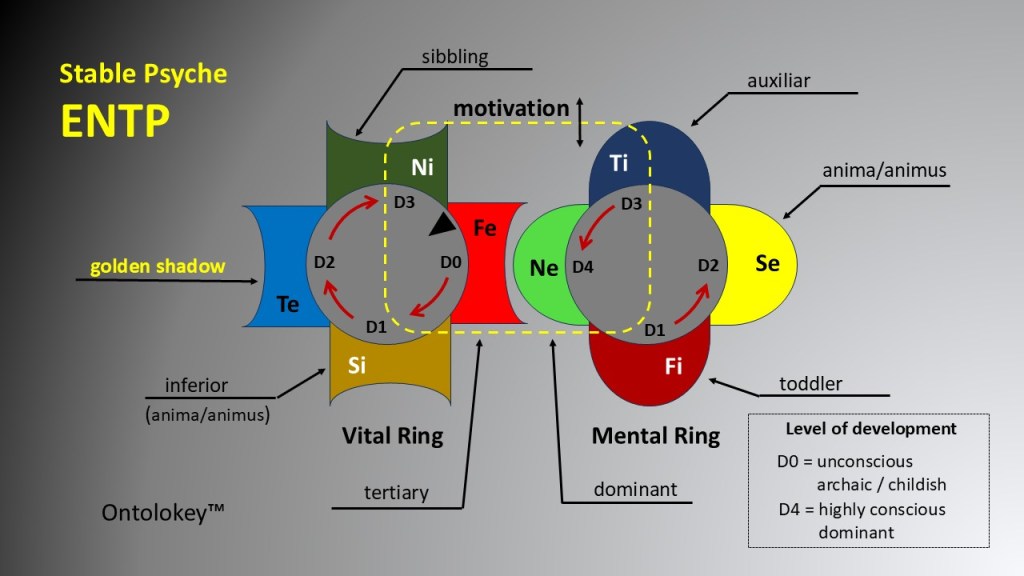
The familiar portrait of the ENTP as the witty debater, rebellious thinker, entrepreneur, provocateur, or endlessly creative idea generator captures something genuine, but it describes mainly the visible surface of a much more complicated psychological structure. Ontolokey’s eight-function architecture places Ne and Ti at the conscious core, while the remaining functions introduce qualitatively different and sometimes uncomfortable dimensions of the personality: Se as Anima, Fi as Toddler, Ni as Sibling, Te as Golden Shadow, Si as Inferior, and Fe as Tertiary. This arrangement is important because the ENTP’s difficulties cannot be understood simply as an excess of intelligence, curiosity, or independence; they emerge from tensions between different ways of experiencing reality, particularly when the dominant Ne–Ti orientation encounters emotional vulnerability, physical limitation, personal values, continuity, social expectations, or the demand to turn an idea into a concrete result. The result can be a person who appears exceptionally confident intellectually while being surprisingly uncertain about deeply personal feelings, who can read and influence a social environment while simultaneously crossing interpersonal boundaries, and who can envision an extraordinary future while neglecting the mundane conditions required to reach it. The untold truth of the ENTP, therefore, is not that the type secretly lacks the qualities for which it is admired, but that its greatest strengths can become mechanisms of avoidance when they are used to escape the very dimensions of life that Ne and Ti cannot solve by themselves.
The Ontolokey Cube: Eight Functions, Eight Psychological Positions
To understand the ENTP beyond the familiar stereotype, the eight positions of the Ontolokey Cube are essential because they describe not simply eight functions but eight different relationships to psychological energy. Ontolokey derives these positions from the eight-function structure of Socionics Model A and gives each position a distinct psychological meaning: Dominant, Auxiliary, Anima, Toddler, Sibling, Golden Shadow, Inferior, and Tertiary. The distinction matters because the same cognitive function can have radically different psychological significance depending on where it appears in the structure; a function can be consciously strong, relatively accessible, desired but underdeveloped, vulnerable, demonstrative, or operating largely outside ordinary awareness. In the ENTP configuration, the sequence is Ne–Ti–Se–Fi–Ni–Te–Si–Fe, corresponding respectively to Dominant, Auxiliary, Anima, Toddler, Sibling, Golden Shadow, Inferior, and Tertiary. This creates a psychological landscape in which the ENTP’s most natural capacities are surrounded by precisely those dimensions that can be easiest to overlook: bodily immediacy, personal feeling, continuity, social-emotional expression, and the disciplined transformation of possibilities into external results.
Ne — The Dominant: The Expansion of Reality
Extraverted Intuition (Ne) is the ENTP’s Dominant function and therefore represents the most natural and consciously available way in which the personality encounters reality. Ne perceives possibilities rather than merely objects, relationships rather than isolated facts, and potential transformations rather than fixed states; it constantly asks what something might become, what else it could mean, what hidden connection might exist, or what would happen if an established assumption were reversed. This gives the ENTP an unusual capacity to move laterally through an intellectual landscape, connecting concepts that other people may experience as belonging to entirely different domains. Ontolokey’s description of the ENTP emphasizes precisely this expansive quality, portraying Ne as the function through which novelty, experimentation, curiosity, and alternative possibilities become almost instinctive modes of perception. The psychological danger is that an environment permanently perceived as open-ended can make limitation feel psychologically unnatural, because every commitment necessarily closes possibilities while every new possibility restores the intoxicating sense of freedom. The mature ENTP therefore does not need to suppress Ne but must learn to distinguish between the productive discovery of possibilities and the compulsive generation of alternatives that prevents any one possibility from becoming sufficiently real.
Ti — The Auxiliary: The Inner Architecture of Thought
Introverted Thinking (Ti) occupies the Auxiliary position and gives the ENTP’s expansive intuition an internal system of analysis, classification, and logical coherence. Where Ne multiplies possibilities, Ti examines their structure: it asks whether an idea actually follows from its premises, whether a contradiction has been overlooked, whether a concept has been defined precisely enough, and whether an apparently persuasive explanation survives closer examination. This combination explains why ENTP curiosity is often more rigorous than the stereotype of the spontaneous “idea person” suggests; the ENTP may generate a dozen hypotheses in rapid succession, but Ti wants to understand the mechanism underneath them. Ontolokey’s Model-A interpretation places the Auxiliary within the conscious Ego structure alongside the Dominant, meaning that Ti is not simply an occasional intellectual accessory but a major component of the ENTP’s ordinary psychological operation. At its best, this creates intellectual flexibility without intellectual gullibility: the ENTP can abandon an idea without experiencing that abandonment as personal defeat because the underlying loyalty is to internal coherence rather than to a particular conclusion. At its worst, however, Ti can become an exceptionally sophisticated defense mechanism, allowing the ENTP to transform virtually any uncomfortable emotional reality into an interesting conceptual problem and thereby remain intellectually engaged while psychologically avoiding what is actually being felt.
Se — The Anima: The Forbidden Attraction to Immediate Reality
Extraverted Sensing (Se) occupies the ENTP’s Anima position, and this is one of the most revealing elements of the Ontolokey architecture because it introduces a psychological attraction toward something the ENTP’s dominant mode does not naturally prioritize: immediate presence, physical force, sensory intensity, decisiveness, confrontation, risk, and direct engagement with the environment. The Anima is not simply another weak function; within the Ontolokey model it belongs to the shadow tripod, where functions can represent less consciously integrated dimensions of the psyche that nevertheless exert a powerful psychological pull. For an ENTP, Se can therefore appear in idealized or projected form through fascination with people who seem exceptionally grounded, physically confident, decisive, fearless, sensual, or capable of imposing themselves upon circumstances without endlessly analyzing alternatives. The ENTP may admire precisely the quality that can simultaneously feel psychologically alien: the ability to stop considering what might happen and simply act upon what is happening now. This can produce both attraction and irritation, because Se represents an answer to a problem Ne continually creates—how to move from possibility into immediate reality—and the ENTP may oscillate between fascination with decisive action and the instinctive urge to reopen the field of possibilities once a decision has been made.
Fi — The Toddler: The Vulnerable Core of Personal Value
Introverted Feeling (Fi) occupies the Toddler position, a placement that gives the ENTP’s relationship with personal values and intimate emotional boundaries an unusually vulnerable character. Fi concerns individual values, personal authenticity, emotional allegiance, the distinction between what is personally acceptable and unacceptable, and the private emotional significance of relationships; these are precisely the areas that can become difficult when the mind is accustomed to approaching experience primarily through possibilities and conceptual analysis. The Toddler designation is significant because it does not mean that Fi is unimportant—it means that this function can appear psychologically young, sensitive, reactive, or difficult to regulate consciously. Within the Ontolokey/Socionics mapping, the Toddler corresponds to the fourth function, the vulnerable or PoLR position, making Fi a particularly sensitive point in the ENTP structure. An ENTP may therefore be remarkably sophisticated when discussing ethics while becoming unexpectedly uncomfortable when the issue shifts from abstract morality to the question of “What do I personally feel, value, owe, or refuse?” This distinction can become especially consequential in intimate relationships, where intellectual understanding cannot substitute for emotional loyalty, personal boundaries, or the willingness to acknowledge that something matters simply because it matters to the individual.
Ni — The Sibling: The Quiet Counterweight to Possibility
Introverted Intuition (Ni) occupies the Sibling position and provides one of the most important counterweights to the ENTP’s dominant Ne. Whereas Ne expands the field of possibilities, Ni condenses experience into trajectories, underlying meanings, emerging directions, and an increasingly focused sense of where events may be heading. This makes Ni psychologically fascinating for the ENTP because it is intuitive in a way that feels familiar, yet its movement is almost opposite to the habitual Ne impulse: instead of asking “What else could this become?”, Ni increasingly asks “What is this ultimately becoming?” Ontolokey places the Sibling in the vital part of the functional architecture, associated with the fifth position of Model A, and therefore gives it a different developmental quality from both the conscious Ego functions and the more vulnerable shadow positions. For an ENTP, Ni can become particularly important after prolonged exploration, because the mind eventually needs to recognize which possibilities possess genuine significance rather than merely novelty. In psychological maturity, Ni does not destroy Ne’s freedom; it gives that freedom a trajectory, allowing the ENTP to move from endless branching toward a deeper perception of what deserves sustained attention.
Te — The Golden Shadow: The Power to Make Things Real
Extraverted Thinking (Te) occupies the Golden Shadow, arguably one of the most intriguing positions for the ENTP because it represents a potentially powerful capacity that does not necessarily operate as part of the personality’s ordinary conscious identity. Te is concerned with external effectiveness, measurable results, organization, efficiency, implementation, and the practical deployment of resources; it asks not merely whether an idea is interesting or logically coherent, but whether it actually works in the external world. Ontolokey identifies the Golden Shadow with the sixth position, the Socionics Suggestive function, and places it within the unconscious but potentially highly desirable part of the structure. For the ENTP, this creates an important psychological paradox: the person may produce extraordinary ideas yet simultaneously feel a deep fascination with people or environments capable of translating ideas into functioning systems. Te represents the bridge between conceptual possibility and external consequence, and its absence from the conscious core can contribute to the familiar ENTP pattern of generating more projects than are ultimately completed. Development does not require the ENTP to become rigidly procedural; rather, the deeper challenge is learning that execution is not the enemy of creativity, because without some capacity for implementation, possibility remains permanently hypothetical.
Si — The Inferior: The Reality of Continuity
Introverted Sensing (Si) occupies the Inferior position, placing the ENTP in a particularly difficult relationship with continuity, bodily awareness, routine, familiarity, accumulated experience, and the subtle maintenance of everyday life. Si is concerned with the internal registration of sensory experience over time: how the body feels, what has worked before, what conditions create comfort or discomfort, how small changes accumulate, and how stability can be preserved through consistent attention. Ontolokey maps the Inferior position to the seventh function in Model A, which belongs to the vital rather than the conscious Ego structure. For an ENTP, this can mean that the ordinary maintenance of life feels less psychologically rewarding than intellectual exploration, particularly when routine appears to compete with novelty; the person may easily become absorbed in ideas while overlooking sleep, nutrition, physical limits, familiar obligations, or the gradual consequences of neglected habits. The shadow consequence is not simply disorganization but a deeper difficulty accepting that life consists partly of repetition, because repetition is precisely what allows possibilities to mature into experience. Si therefore confronts the ENTP with an uncomfortable truth: not everything valuable announces itself through novelty, and some of the most important forms of development occur quietly through consistency.
Fe — The Tertiary: The Social Stage and the Power of Emotional Atmosphere
Extraverted Feeling (Fe) occupies the Tertiary position and therefore contributes a socially expressive dimension that is often far more visible in ENTPs than their reputation for detached rationality would suggest. Fe is concerned with emotional atmosphere, collective expression, interpersonal energy, enthusiasm, humor, shared excitement, and the ability to influence or respond to the emotional tone of a group. The Tertiary position corresponds to the eighth function in the Ontolokey mapping and to the Demonstrative function in Model A, meaning that it can be displayed quite readily even though it does not occupy the same conscious developmental priority as Ne and Ti. This helps explain why ENTPs can be exceptionally entertaining, charismatic, provocative, socially agile, and capable of making an intellectual environment feel alive; their emotional expressiveness does not necessarily contradict their analytical nature but can operate alongside it as a powerful social instrument. Yet Fe can also become performative when it is used primarily to stimulate, provoke, charm, or control the atmosphere rather than to establish genuine emotional reciprocity. The mature expression of Fe therefore involves more than being socially engaging: it requires recognizing that other people’s emotional realities are not merely material for conversation, humor, persuasion, or intellectual experimentation but experiences that deserve to be encountered with genuine presence.
Taken together, these eight positions reveal why the ENTP cannot adequately be described by the conventional four-letter stereotype alone. Ne expands, Ti analyzes, Se embodies, Fi personalizes, Ni converges, Te implements, Si stabilizes, and Fe animates the social field, yet none of these functions operates in isolation; each derives part of its psychological meaning from its position in the larger architecture. Ontolokey explicitly presents the Cube as a spatial representation of these relationships, with the Ego, Super-Ego, Super-Id, and Id blocks corresponding to different forms of conscious accessibility, obligation, desire, and unconscious strength. For the ENTP, this means that the shadow cannot simply be equated with “bad behavior,” because several shadow functions contain capacities the personality genuinely needs: Se can teach presence, Fi can establish personal authenticity, Si can create continuity, and Te can turn invention into external effectiveness. The central developmental problem is therefore not to eliminate the shadow but to stop allowing the dominant Ne–Ti identity to monopolize the definition of what intelligence, freedom, and competence are allowed to mean. Once these other dimensions become psychologically available, the ENTP does not become less inventive; the personality gains the ability to embody, value, focus, execute, sustain, and emotionally inhabit what it has previously been able only to imagine.
When the Gift Becomes a Defense
The ENTP’s shadow does not begin where intelligence ends; it begins where intelligence becomes the preferred way of avoiding everything that cannot be solved intellectually. Ne and Ti are extraordinarily effective at creating distance from uncertainty because almost any experience can be converted into a question, a theory, a paradox, an alternative interpretation, or a problem to be dissected. When this mechanism is healthy, it produces curiosity and psychological flexibility; when it becomes defensive, the ENTP can remain mentally active while becoming emotionally absent from their own experience. Ontolokey’s ENTP portrait repeatedly returns to this tension: the same person who can generate an extraordinary number of perspectives may become restless when confronted with repetition, emotional ambiguity, or situations in which there is no intellectually satisfying solution. The danger is subtle because the defense does not look like withdrawal in the conventional sense; the ENTP may become more talkative, more analytical, more humorous, more provocative, and more intellectually energetic precisely when something inside them has become difficult to tolerate. The result is a distinctive form of avoidance in which the person does not flee from experience by becoming passive, but by generating so much mental activity that direct contact with the underlying experience becomes almost impossible.
This becomes particularly important in the ENTP’s relationship with Fi as the Toddler function, because personal feeling is not easily subordinated to the rules of intellectual experimentation. Ontolokey describes Fi as a quiet and highly private value system that can become difficult for the ENTP to recognize when emotional experience becomes intense; rejection, betrayal, injustice, or perceived disloyalty can affect the ENTP profoundly even when the person appears outwardly detached or amused. The contradiction is that the ENTP may be capable of analyzing another person’s emotional motives with remarkable sophistication while having considerably less clarity about the simple personal statement, “This hurt me,” “This matters to me,” or “I cannot accept this.” Because admitting such statements creates vulnerability, humor and intellectualization can become protective strategies, allowing the ENTP to convert emotional exposure into something controllable. In its more destructive form, this can produce sudden sarcasm, withdrawal, disproportionate reactions, or unexpected cruelty after a long period in which the person appeared completely unaffected. What observers experience as inconsistency may therefore represent an accumulation of unprocessed personal feeling: the ENTP has not necessarily felt less than others, but may have had fewer conscious tools for recognizing and communicating what was being felt before the emotional pressure became impossible to contain.
The Se Anima adds another layer to this shadow because it can transform vulnerability into a struggle for immediate control. Ontolokey describes Se in the ENTP as a capacity for boldness, provocation, theatricality, boundary-testing, and sudden physical or interpersonal intensity; when integrated, it can provide commanding presence and courageous engagement, while under pressure it can emerge as impulsiveness, sharp sarcasm, invasive behavior, or an attempt to dominate the immediate situation. This is psychologically significant because an ENTP who feels emotionally cornered may experience direct action as preferable to the helplessness of remaining inside an unresolved emotional state. Instead of saying “I feel exposed,” the person may challenge, provoke, escalate, joke aggressively, make a scene, or force the situation into a form in which they once again feel psychologically mobile. Se consequently becomes part of a paradoxical defense: the ENTP who is ordinarily defined by mental freedom can become unusually forceful when that freedom feels threatened. The deeper problem is not assertiveness itself, because assertiveness can be entirely healthy, but the unconscious substitution of intensity for vulnerability—using movement, confrontation, performance, or provocation to regain control over an emotional reality that cannot be controlled through force.
The Addiction to Novelty
One of the most recognizable ENTP shadow patterns emerges from the relationship between Ne and completion. Ontolokey describes the ENTP as someone whose energy naturally rises during exploration and can decline sharply once a project becomes repetitive, predictable, or technically closed. This creates an uncomfortable distinction between capacity and sustained engagement: an ENTP may possess more than enough intelligence to finish something while nevertheless experiencing the psychological act of finishing as disproportionately unrewarding. The temptation is then to interpret departure as evidence that the project was never meaningful, when sometimes the real explanation is simpler—the project has stopped producing novelty. Over time, this can create a pattern of serial beginnings: ideas become identities, possibilities become temporary obsessions, enthusiasm becomes commitment, and commitment quietly expires when the psychological horizon stops expanding. The danger is not merely unfinished work but the gradual development of a self-image built around potential, because potential remains psychologically pristine whereas completed reality inevitably contains imperfections, compromises, limitations, and evidence of what the person actually chose.
This is where the ENTP can become trapped by one of its most seductive internal narratives: “There is always something better.” Because Ne is exceptionally good at generating alternatives, dissatisfaction can always find an intellectually respectable justification. A new career could be more exciting, another relationship could be more stimulating, another city could provide greater freedom, another project could have greater impact, another intellectual field could offer deeper discovery; there is almost always a plausible alternative waiting outside the current commitment. Ontolokey explicitly notes the ENTP’s tendency to leave when novelty disappears and describes the resulting movement not simply as laziness but as the consequence of a psychological drive toward exploration. Yet the mature psychological question is whether the next possibility is genuinely superior or merely newer. This distinction becomes crucial because novelty produces immediate psychological energy, whereas mastery often requires tolerating periods in which nothing feels particularly exciting; without learning this distinction, the ENTP can spend years repeatedly approaching the threshold of meaningful achievement and then abandoning the path precisely when the deeper rewards of competence, mastery, intimacy, and long-term creation are beginning to emerge.
The paradox becomes even sharper because ENTPs are often genuinely capable of achieving extraordinary things when inspiration, complexity, and autonomy converge. Their problem is therefore not necessarily insufficient motivation but the uneven distribution of motivation: intense bursts of energy can create impressive beginnings, while maintenance receives far less psychological reinforcement. Ontolokey’s description of Te as the Golden Shadow captures precisely this missing dimension, portraying external execution, systems, deadlines, efficiency, and completion as capacities the ENTP may simultaneously resist and secretly recognize as necessary. This creates a peculiar form of admiration in which the ENTP can criticize procedural or highly organized people while privately recognizing that such people possess something the ENTP’s imagination alone cannot provide. The psychological integration of Te therefore does not require the ENTP to become bureaucratic or suppress spontaneity; it requires learning that implementation is the second half of creativity. An idea becomes psychologically significant not merely because it was conceived brilliantly, but because someone remains present through the tedious, repetitive, imperfect stages necessary to give that idea an independent existence in the world.
The Emotional Blind Spot: Why the ENTP Can Understand Everything Except What Hurts
The ENTP’s relationship with emotion is more complicated than the stereotype of the detached rationalist suggests, because Fi as Toddler and Fe as Tertiary create two very different channels through which emotional life enters the personality. Fi represents the private, individual dimension of feeling: personal loyalty, inner values, emotional boundaries, authenticity, and the subjective significance of an experience, while Fe concerns the shared emotional field of a group—the atmosphere, excitement, humor, enthusiasm, tension, and interpersonal energy that can be expressed outwardly. Ontolokey’s description of Fi emphasizes that ENTPs can experience rejection, betrayal, injustice, and emotional injury intensely while having difficulty identifying or articulating those feelings in real time; instead, they may intellectualize, joke, withdraw, or become unexpectedly sharp. This creates one of the more misunderstood features of the type: the ENTP may appear emotionally fearless precisely because the most vulnerable material has been moved out of direct awareness and converted into cognition or performance. The resulting person can discuss the psychology of attachment while being unable to say that they are afraid of losing someone, can construct sophisticated theories about betrayal while refusing to acknowledge that they personally feel betrayed, and can dissect another person’s motives while remaining uncertain about their own emotional position.
The Fe Tertiary position creates a striking contrast because the ENTP can nevertheless become highly expressive and socially magnetic. Ontolokey describes Fe as the function through which the ENTP turns ideas into social energy, provoking reactions, generating enthusiasm, entertaining an audience, reading the emotional flow of a group, and sometimes deliberately disrupting an atmosphere in order to make people engage. This is why emotional expressiveness should not be confused with emotional intimacy in the ENTP: a person may be exceptionally good at creating excitement in a room while remaining remarkably uncomfortable with quiet, private emotional disclosure. Public emotional intensity can actually be easier than private vulnerability because performance preserves movement, whereas intimacy requires stillness; the former allows the ENTP to influence the emotional field, while the latter requires surrendering control over how one is perceived. Consequently, an ENTP may make an entire group laugh during a period of personal distress and may even become more entertaining when emotionally uncomfortable, because humor restores psychological distance while simultaneously giving the person control over the atmosphere. This is one reason the ENTP’s charm can sometimes conceal rather than reveal their emotional condition: the more uncomfortable the inner experience becomes, the more energetically the external personality may perform.
The darker expression appears when Fe and Se combine under emotional pressure, because the need for engagement can become a need to control the immediate interpersonal environment. Ontolokey describes Se in the ENTP as capable of boldness, provocative behavior, boundary testing, theatricality, and, when emotionally cornered, sharp sarcasm or performative cruelty; Fe can then provide an audience, while Se provides the intensity with which that audience is confronted. The resulting behavior can be particularly confusing to people close to an ENTP because it may seem disproportionate to the original event: what began as hurt can become mockery, what began as insecurity can become provocation, and what began as a desire for reassurance can become an apparent attempt to dominate the interaction. Psychologically, however, the underlying process can be understood as an effort to replace emotional helplessness with immediate agency; if the ENTP cannot comfortably tolerate “I am vulnerable to what you think or feel about me,” they may unconsciously move toward “I will determine what happens next.” This does not excuse harmful conduct, and it does not mean every provocative ENTP is secretly wounded, but it explains why the shadow expression can become most intense precisely in situations involving intimacy, rejection, humiliation, or perceived loss of control.
The ENTP and the Problem of Being Seen
The need to be understood is another paradoxical element of the ENTP personality. Ontolokey’s description of Ne notes that ENTPs do not merely generate ideas for themselves; they often want co-creators, people who recognize the significance of their vision and participate in the expansion of it. This creates a form of recognition hunger that can be difficult for the ENTP to acknowledge because it conflicts with the self-image of radical intellectual independence: the person may insist that they do not care what others think while becoming unusually energized when someone understands their ideas, shares their enthusiasm, or recognizes something distinctive about them. The contradiction is not necessarily hypocrisy; it reflects the difference between independence of thought and indifference to connection. An ENTP may fiercely resist being controlled while simultaneously longing to encounter someone capable of meeting them intellectually, emotionally, and imaginatively without attempting to reduce or constrain them. This is why dismissal can hurt more deeply than ordinary disagreement: disagreement stimulates Ti and Ne, whereas dismissal can communicate something far more personal—your inner world is not worth engaging with.
The shadow emerges when this need for recognition becomes entangled with the ENTP’s ability to generate stimulation. If intellectual brilliance, humor, provocation, and social energy repeatedly produce attention, the personality can gradually learn to use stimulation as a substitute for intimacy. Being interesting becomes safer than being vulnerable because interestingness can be controlled: one can produce an idea, make a joke, provoke an argument, or tell a fascinating story and immediately observe the reaction. Intimacy is different because the person cannot fully control what another human being will discover once the performance stops. The ENTP may therefore become highly skilled at making people want more of them while remaining less practiced at allowing another person to encounter the parts of them that do not perform. This distinction becomes particularly important in close relationships, where the ability to maintain fascination is not equivalent to the ability to maintain emotional continuity; a relationship can remain intellectually exciting while becoming emotionally evasive, because novelty keeps the connection alive without necessarily allowing deeper vulnerability to develop.
There is consequently a difficult question beneath the ENTP’s social charisma: Does the person want to be admired for being exceptional, or known as an ordinary human being who happens to possess exceptional qualities? The distinction is psychologically important because admiration creates distance while genuine intimacy reduces it. If the ENTP unconsciously organizes relationships around being fascinating, brilliant, unpredictable, funny, or indispensable, then ordinary moments can become threatening precisely because they offer no stage on which exceptionalism can perform. Yet long-term intimacy inevitably contains boredom, repetition, misunderstanding, mundane responsibilities, physical vulnerability, and periods in which neither person is particularly impressive. The ENTP’s development therefore requires discovering that being deeply known does not mean maintaining perpetual psychological novelty; it means allowing continuity to exist alongside stimulation. That is where the Inferior Si begins to become psychologically relevant, because the same capacity that appears mundane in the ENTP’s conscious hierarchy—continuity, routine, bodily presence, familiarity, and simple repeated care—may ultimately provide the stable environment in which the more dramatic dimensions of the personality can become sustainable rather than compulsive.
The Deepest Shadow: When Freedom Becomes Escape
The deepest ENTP shadow emerges when the desire for freedom ceases to mean genuine autonomy and begins to mean freedom from consequences. Ne is naturally attracted to the open horizon, but a human life cannot remain permanently open: every meaningful relationship creates obligations, every serious project creates limitations, every decision excludes alternatives, and every identity eventually acquires commitments that cannot simply be reconsidered whenever something more stimulating appears. The ENTP can therefore encounter a peculiar existential temptation: to preserve the feeling of unlimited possibility by refusing to become fully accountable to any particular reality. The person may keep options open not because every option is genuinely valuable, but because closing an option creates the psychological experience of loss. In its most developed form, this becomes one of the central shadow dynamics of the type: possibility is no longer being used to create freedom; freedom is being used to avoid the consequences of choosing.
This is particularly important because the ENTP can construct extraordinarily persuasive intellectual explanations for such avoidance. Ti can provide a coherent argument for why a particular commitment is premature, why another interpretation remains possible, why circumstances have changed, why the original plan no longer makes sense, or why an apparently obvious obligation contains hidden contradictions. Many of these arguments may even be objectively reasonable, which makes the pattern difficult to recognize from the outside. The psychological question, however, is not whether the explanation is logically defensible but whether logic is being used to clarify reality or to preserve psychological escape routes. An ENTP can therefore become trapped in a sophisticated form of rationalization in which every door remains theoretically open while none is entered deeply enough to become a home. This is one of the most uncomfortable possibilities contained within the Ontolokey shadow portrait: the personality may possess an extraordinary capacity to understand why something should be changed while using that same capacity to avoid discovering what would happen if it simply stayed.
The Tyranny of the Unlived Life
Every personality organized around possibility eventually encounters the psychological burden of unrealized potential. For the ENTP, this burden can be particularly intense because the person may be unusually conscious of alternative lives: different careers, different relationships, different intellectual paths, different projects, different identities, and different futures that could theoretically have been pursued. The imagination does not merely generate possibilities for the future; it can also reconstruct the past as a branching tree of roads not taken. An ordinary regret may therefore become an elaborate counterfactual universe in the ENTP mind, complete with explanations of what might have happened under different circumstances. This capacity is intellectually fascinating but psychologically dangerous when it prevents acceptance of the actual life that exists. At some point, the question is no longer “What could I have done?” but “What am I prepared to do with the life that is actually here?”
The shadow of Ne can consequently produce a strange form of dissatisfaction in which reality is judged against possibilities that have never had to survive contact with reality. The imagined career has no tedious bureaucracy, the imagined relationship has no accumulated misunderstandings, the imagined project has no technical failures, and the imagined version of oneself has never had to confront fatigue, limitation, compromise, or consequences. Possibility is therefore structurally unfair to reality: it can remain perfect precisely because it has never been lived. The ENTP’s developmental challenge is to recognize that an unrealized possibility cannot automatically be considered superior to an imperfect reality, because only reality contains the conditions under which something can mature. Potential is seductive because it is unconstrained; achievement is difficult because it is constrained. The movement from one to the other requires accepting that every meaningful creation becomes less perfect the moment it becomes real, yet also infinitely more substantial because it finally exists outside the imagination.
The Shadow of Intellectual Superiority
Another danger appears when intellectual independence becomes confused with intellectual superiority. Because the ENTP can rapidly identify contradictions, weaknesses, alternative explanations, and hidden assumptions, the person may genuinely notice flaws that others overlook. Over time, however, this ability can create an unconscious hierarchy in which questioning becomes associated with intelligence and accepting becomes associated with naïveté. The ENTP may then begin challenging positions not because the challenge is necessary but because the act of challenging reinforces a particular identity: I am the person who sees what everyone else misses. This is where the healthy Ti impulse toward precision can become entangled with ego, and where Ne’s capacity to produce alternatives can become a mechanism for destabilizing other people’s certainty merely to demonstrate intellectual freedom. Ontolokey’s discussion of the ENTP shadow is particularly relevant here because it portrays the darker personality not as someone who simply lacks empathy or morality, but as someone whose strongest cognitive capacities can become weapons when they are disconnected from emotional self-awareness and personal responsibility.
The most sophisticated form of this shadow does not look arrogant in the conventional sense because it can disguise itself as skepticism, irony, curiosity, or intellectual honesty. The ENTP may insist that they are merely asking questions while repeatedly placing other people in a defensive position, or claim to be exploring possibilities while selectively generating alternatives that undermine someone else’s position. In relationships, this can become exhausting because every emotional statement can be turned into an argument, every boundary can become a philosophical proposition, and every request can become an invitation to debate. The person on the receiving end may eventually discover that they are not being heard but analyzed, and that the ENTP’s apparent openness to every perspective does not necessarily mean openness to emotional accountability. The corrective is not to stop questioning; it is to develop the capacity to recognize that being able to dismantle an argument does not establish the right to dismantle a person, and that intellectual freedom becomes psychologically mature only when it coexists with restraint.
What the Shadow Is Asking For
The shadow ultimately asks the ENTP to develop precisely the capacities that the dominant personality is most likely to undervalue: continuity, personal value, embodiment, emotional vulnerability, focused direction, and disciplined implementation. The Inferior Si asks whether the person can remain present when nothing novel is happening; Toddler Fi asks whether the person can recognize personal feelings and boundaries without converting them immediately into theory; Anima Se asks whether the person can inhabit the present moment with courage instead of endlessly reopening possibilities; Sibling Ni asks whether possibility can eventually converge into a meaningful direction; and Golden Shadow Te asks whether an idea can survive the transition from intellectual excitement to sustained execution. These are not demands to become a different personality, but challenges to the assumption that the ENTP’s preferred mode of functioning is sufficient for every human problem. The Ontolokey Cube becomes particularly meaningful at this point because its architecture portrays psychological development not as abandoning the dominant functions but as establishing a more conscious relationship with the functions surrounding them. The ENTP does not become less Ne by developing Si, less Ti by developing Fi, or less inventive by developing Te; instead, the personality gains the ability to determine when possibility is needed and when reality requires something else.
The deepest truth may therefore be that the ENTP’s greatest enemy is not boredom, conformity, emotionality, routine, or commitment in themselves, but the unconscious belief that freedom requires permanent escape from them. A mature ENTP can remain intellectually restless without being existentially restless, can challenge assumptions without needing to destroy every structure, can enjoy novelty without requiring constant reinvention, and can maintain independence without turning intimacy into a threat. The person learns that commitment does not necessarily eliminate possibility; sometimes commitment creates the depth in which possibility can finally unfold. This is the point at which the shadow stops functioning merely as an opposing force and becomes a source of psychological integration: Si gives Ne continuity, Fi gives Ti humanity, Se gives imagination embodiment, Ni gives possibility direction, Te gives ideas consequence, and Fe gives intellectual brilliance a social and emotional context. The ENTP then retains the freedom to explore while acquiring something far more difficult than freedom—the ability to remain.
The Constructive ENTP: When Possibility Becomes Creation
The same psychological architecture that can drive the ENTP toward distraction, avoidance, or endless counterfactual thinking can also make this personality extraordinarily creative when it is consciously directed. The ENTP’s most visible gift is not simply intelligence, and certainly not the ability to win an argument; it is the capacity to perceive relationships between things that other people have learned to keep separate. Ne continually scans the environment for openings, contradictions, emerging patterns, alternative interpretations, and combinations that have not yet been tried. Ti then gives these possibilities a second stage of development, asking whether an idea actually makes sense, whether its assumptions hold together, and whether the apparent solution survives closer examination. This combination explains why ENTPs are so often associated with innovation, improvisation, conceptual problem-solving, and intellectual curiosity. Contemporary descriptions of the type similarly emphasize original thinking under pressure, adaptability, curiosity, and the ability to reframe problems in real time.
Yet creativity in the mature ENTP is different from the mere production of ideas. An immature expression of Ne can generate possibilities almost compulsively, as though every new thought were valuable simply because it is new; a mature expression begins to distinguish between possibility and significance. This is where the relationship between Ne and Ti becomes crucial, because Ti can serve not as a machine for endlessly dismantling everything but as a mechanism for discovering which possibilities deserve sustained attention. The mature ENTP does not lose the ability to see ten alternatives; instead, they become capable of recognizing when one alternative contains enough truth, usefulness, beauty, or transformative potential to justify commitment. That distinction is psychologically profound because it transforms creativity from stimulation into creation. Ontolokey’s broader model is built around precisely this idea of moving beyond a flat description of personality toward a dynamic architecture in which different functions can become conscious and integrated rather than remaining isolated tendencies.
This also explains why the ENTP can be remarkably effective in environments where the problem itself has not yet been clearly defined. Give an ENTP a finished procedure and ask for repetition, and much of the natural energy may disappear; give the same person a confusing situation containing competing variables, incomplete information, conflicting assumptions, and no obvious solution, and the mind can become intensely alive. The ENTP may notice an overlooked connection, question an assumption everyone else has accepted, introduce an unexpected analogy, or reverse the direction of the problem altogether. Their adaptability is not merely social flexibility but cognitive mobility: the capacity to abandon one model quickly when another explains more of the available information. This can make the ENTP an energizing presence in groups, particularly when a discussion has become rigid or when everyone has unconsciously agreed to solve the wrong problem. The constructive ENTP therefore does not merely generate disruption for its own sake; they use disruption to reopen thought.
There is also a form of intellectual courage associated with the healthy ENTP that deserves to be distinguished from contrarianism. The ENTP may be willing to question a consensus precisely because consensus itself does not constitute evidence, but the mature version of this tendency remains willing to discover that the consensus was correct. That distinction separates genuine inquiry from the egoic need to be the person who sees what everyone else misses. The shadow version of intellectual independence says, I must be different because being different proves that I am thinking independently; the mature version says, I will investigate the assumption, even if the investigation ultimately confirms it. This is where Ti can become an instrument of humility rather than superiority, because rigorous thinking eventually turns its questions back toward the thinker. The ENTP’s greatest intellectual strength may therefore be not the ability to produce an unusual answer, but the willingness to keep examining the structure of the question itself.
The social dimension of this creativity is equally important. With Fe in the tertiary position, the ENTP can become highly responsive to the atmosphere of a room, the reactions of an audience, and the emotional energy generated through interaction, even when private emotional experience remains more difficult to identify directly. This contributes to the familiar ENTP qualities of wit, verbal agility, playfulness, persuasion, and an ability to make abstract ideas socially engaging. In its healthier form, Fe allows the ENTP to understand that an idea does not exist only inside the mind of the person who conceived it; ideas live through communication, relationships, collaboration, and the reactions they produce in other people. Se, occupying the Anima position in the Ontolokey architecture, can similarly draw the ENTP toward direct experience, immediacy, sensory reality, and the concrete world that exists before it is turned into an interpretation. These functions can therefore become bridges between possibility and reality: Ne imagines what could exist, Ti examines it, Fe communicates it, Se encounters it, and eventually Te can help turn it into something that actually exists. The very functions that appear peripheral to the ENTP’s conscious identity can therefore become essential to transforming mental possibility into lived experience.
The deepest development of the ENTP is not the suppression of their restless mind but the discovery that restlessness and commitment do not have to be enemies. The person who can generate possibilities without being enslaved by them, challenge assumptions without needing to humiliate them, improvise without becoming chaotic, and pursue novelty without abandoning continuity has crossed an important psychological threshold. At that point, the ENTP’s characteristic freedom becomes more substantial because it is no longer defined merely by the absence of restrictions. It becomes the freedom to choose, to remain, to build, to revise, and sometimes even to finish something after the initial excitement has disappeared. The mind remains open, but openness is no longer an excuse for permanent postponement. Possibility becomes the beginning of creation rather than the substitute for it.
The ENTP in Relationships: When Stimulation Is Not Intimacy
The ENTP can be an unusually compelling person to have a relationship with because connection often begins through the mind. Conversation becomes an arena of discovery: ideas are exchanged, assumptions are challenged, jokes create unexpected intimacy, and the relationship itself can feel like a living experiment in which two people continually discover new dimensions of one another. The ENTP may show affection by asking questions, introducing possibilities, solving problems, sharing discoveries, teasing, debating, or inviting another person into an expanding world of interests. This can make relationships feel alive rather than static, and it helps explain why intellectual compatibility can matter so strongly to this personality. Standard descriptions of ENTP emphasize verbal energy, conceptual curiosity, adaptability, and the ability to read other people, while broader type guidance notes that personality differences can influence communication and conflict without determining whether a relationship will succeed.
But the same quality that makes the ENTP stimulating can create one of its most subtle relational problems: stimulation can become a substitute for intimacy. A relationship can contain endless conversation without ever reaching the vulnerable territory underneath the conversation, because there is always another subject to explore and another interpretation to examine. The ENTP may know what a partner thinks about politics, philosophy, relationships, culture, technology, human nature, and a hundred other subjects while remaining strangely uncertain about what that person actually needs from them emotionally. More uncomfortable still, the ENTP can do the same thing to themselves, translating personal pain into an intellectual problem before allowing it to become an experience that must simply be felt. Fi in the Toddler position becomes important here because private value and emotional vulnerability cannot always be solved through Ti; there are moments when the question is not whether an emotion is logically justified but whether the person is willing to admit that it matters.
This becomes particularly complicated when the ENTP is confronted with emotional repetition. Intellectual novelty is naturally attractive, but relationships depend upon forms of repetition that are not inherently exciting: checking in, remembering details, repairing misunderstandings, keeping promises, returning to difficult conversations, tolerating another person’s moods, and remaining present after the dramatic moment has passed. These are precisely the situations in which the inferior Si position becomes psychologically meaningful, because continuity requires attention to what has already happened rather than constant movement toward what might happen next. The immature ENTP may interpret repetition as stagnation, while the mature ENTP gradually discovers that repetition can also be the mechanism through which trust becomes real. A person does not experience commitment primarily through declarations about freedom or affection; they experience it through accumulated evidence that the other person remains there. This is why relational maturity may demand something particularly difficult from the ENTP: learning to recognize that consistency is not the enemy of freedom but one of the conditions under which genuine intimacy can exist.
The tertiary Fe function adds another layer because the ENTP may be highly sensitive to the social atmosphere while still struggling with the deeper meaning of private emotion. They may know when a conversation has become uncomfortable, sense when someone is losing interest, understand how to make a room laugh, or instinctively adjust their presentation according to the people around them. At its healthiest, this is a genuine relational gift: the ENTP can make people feel intellectually awakened, included, energized, and free to explore ideas without excessive judgment. At its shadow edge, however, Fe can turn connection into performance, especially when being interesting becomes psychologically linked with being valued. The ENTP may unconsciously keep the relationship alive through wit, intensity, provocation, or constant stimulation because silence feels like the disappearance of significance. The deeper developmental question is therefore not simply whether the ENTP can connect with people, but whether they can remain connected when they are no longer entertaining, impressive, provocative, useful, or intellectually fascinating.
There is another relational paradox hidden here. The ENTP may strongly resist being controlled while simultaneously wanting to be deeply understood, and these two desires can collide when intimacy begins to require emotional accountability. Being known means becoming more predictable to another person; it means that one’s patterns become visible, that contradictions can no longer be disguised as complexity, and that promises acquire consequences. The ENTP who has unconsciously equated freedom with keeping every door open may experience this as a threat, even when the relationship itself is not restrictive. Yet genuine closeness does not require the destruction of individuality. It asks something more demanding: that two autonomous people voluntarily create a shared reality and then take responsibility for maintaining it. In that sense, the mature ENTP’s relational task is not to become less independent, but to discover that choosing another person repeatedly can itself be an expression of freedom rather than its surrender.
The most mature ENTP therefore learns to bring the whole architecture into relationship rather than allowing Ne and Ti to dominate every interaction. Ne keeps the relationship curious and alive; Ti encourages honest examination rather than sentimental denial; Se brings attention back to the actual person in front of them instead of the imagined person they could become; Fi asks whether the connection is personally meaningful rather than merely stimulating; Ni helps recognize deeper patterns beneath the constant stream of possibilities; Te supports concrete action when something needs to change; Si remembers what has been promised and what has mattered before; and Fe allows the emotional atmosphere between people to become something consciously cared for. None of these functions needs to replace the ENTP’s natural personality. Together, they transform the relationship from an endless exchange of possibilities into a shared life in which possibilities can actually become experiences. That may be one of the clearest signs of ENTP maturity: not losing the need for intellectual freedom, but becoming capable of loving without requiring love to remain perpetually new.
The ENTP at Work: From Ideas to Consequences
The professional ENTP often becomes most recognizable when there is something unfinished, unclear, inefficient, or conceptually stagnant in the environment. A conventional system may be experienced less as a fixed structure than as a collection of assumptions waiting to be examined, which makes the ENTP naturally inclined toward experimentation, redesign, and alternative approaches. Official descriptions of the type similarly emphasize resourcefulness with new and challenging problems, conceptual possibility-generation, strategic analysis, adaptability, and a tendency to become bored with routine. This can make the ENTP especially energized by situations in which the rules are not yet settled and where intellectual flexibility is more valuable than mechanical consistency. The difficulty begins when the ENTP mistakes the ability to identify what could be improved for the responsibility to improve everything. Once every system becomes an invitation to intervene, the person can spend enormous energy redesigning structures that were functioning adequately simply because the possibility of redesign is intellectually satisfying.
The mature ENTP therefore has to develop a distinction between interesting problems and important problems. Ne can make almost anything interesting because almost anything contains an unexplored angle, contradiction, hidden assumption, or alternative possibility. Ti can then produce an impressive intellectual justification for pursuing that possibility, which means that the ENTP may be capable of explaining exactly why a new direction is fascinating without having answered the more practical question of whether it deserves priority. This is where the Golden Shadow of Te becomes significant within the Ontolokey framework. Te represents a different relationship with thought: not merely understanding whether something makes sense, but asking what must be organized, measured, decided, delegated, or executed so that an intention becomes an external result. For the ENTP, this can feel less intrinsically rewarding than discovery because execution closes possibilities. Yet every meaningful creation eventually reaches the point where another idea cannot substitute for a completed action. The ENTP’s professional development therefore involves learning that implementation is not the enemy of creativity; it is the stage at which creativity becomes consequential.
This distinction also changes the way leadership can develop. The stereotypical ENTP leader is often imagined as the charismatic provocateur who enters a stagnant organization, questions everything, generates ten new strategies, and leaves everyone energized but exhausted. There can certainly be value in that role, especially when a group has become trapped inside assumptions that nobody is willing to challenge. But sustainable leadership requires more than intellectual activation. It requires remembering what has already been agreed upon, understanding which commitments remain active, noticing who is affected by decisions, creating enough structure for other people to work effectively, and accepting that not every member of a team wants to live inside perpetual experimentation. The Myers-Briggs framework itself emphasizes that type differences can become either sources of growth or conflict in professional relationships and that people can stretch beyond their natural preferences when circumstances require it. For the ENTP, this means that leadership maturity may involve becoming less dependent on personal improvisation and more capable of building conditions in which other people can contribute their own strengths.
There is an especially revealing tension between the ENTP’s relationship with competence and the ENTP’s relationship with routine. Competence is often deeply attractive because it represents mastery, and Ti can become absorbed in understanding systems at increasingly sophisticated levels. Routine, however, may feel like the point at which understanding has already been achieved and nothing conceptually new remains to discover. This can create a strange cycle in which the ENTP becomes extremely capable at solving difficult problems but inconsistent at maintaining the ordinary systems that prevent those problems from returning. The inferior Si position exposes this contradiction because continuity is built from details that are individually unimpressive: documentation, maintenance, follow-up, repetition, schedules, records, established procedures, and accumulated experience. None of these activities needs to be psychologically glamorous to be essential. The shadow lesson is therefore uncomfortable but useful: the ability to solve a crisis does not automatically compensate for the inability to maintain the conditions that make crises less frequent.
The same pattern can appear in entrepreneurship, creative work, research, strategy, or any environment in which novelty is rewarded. The ENTP may be extraordinarily good at the beginning of a project because beginnings contain maximum possibility and minimum obligation. Every direction remains available, the conceptual landscape is open, and the identity of the final product has not yet constrained the imagination. Later, as the project acquires specifications, deadlines, stakeholders, limitations, and accumulated decisions, the psychological experience changes. Ne may begin searching for a more exciting project while Ti discovers increasingly sophisticated reasons why the new direction would actually be better. This is precisely where the shadow can disguise itself as insight. Sometimes changing direction really is intelligent; sometimes it is simply the mind’s most elegant way of escaping the less exciting phase of making something real. The mature ENTP learns to ask not only, “Is there a better possibility?” but also, “What would happen if I stayed with this possibility long enough to discover what it can become?”
There is, finally, a deeper professional lesson hidden underneath all of this: the ENTP does not necessarily need a career that maximizes novelty, but a life in which novelty serves a meaningful purpose. Constant stimulation can eventually become another form of confinement when the individual becomes dependent upon external complexity to feel psychologically alive. A mature ENTP can enter a stable field, remain committed to a long-term project, develop expertise, and still preserve the freedom of mind that makes the type distinctive. The difference is that novelty becomes something they generate rather than something they must continually chase. They can look at an established system and ask how it might evolve without needing to destroy it; they can accept a useful structure without surrendering their independence; and they can finish a project without concluding that finishing means the death of possibility. At that point, the ENTP’s greatest professional strength is no longer simply seeing what could be different. It is becoming someone capable of carrying a possibility across the difficult distance between imagination and reality.
The ENTP and the Fear of Finality
One of the least obvious tensions in the ENTP psyche is that possibility can become psychologically valuable in its own right. As long as something remains unfinished, the ENTP can imagine that it might become extraordinary; as long as a decision remains open, every future remains available; as long as an identity remains flexible, no single definition has the power to imprison it. This is one reason the ordinary description of ENTP as adaptable, novelty-seeking, flexible, and resistant to routine captures something important, but does not necessarily reveal the emotional meaning underneath it. The Ontolokey architecture gives this pattern a deeper interpretation because the dominant Ne tendency toward expansion is accompanied by an inferior Si relationship with continuity and an unusually vulnerable Fi relationship with private value. The issue is therefore not simply that the ENTP dislikes being told what to do. At a deeper level, finality can feel like the closing of psychological doors, and some ENTPs may unconsciously preserve possibility because choosing one reality means accepting that other imagined realities will remain unreal.
This is where the difference between freedom and avoidance becomes crucial. Freedom means having the capacity to choose among possibilities; avoidance means keeping possibilities unresolved so that the consequences of choosing never have to be experienced. From the outside, the two can look almost identical because both may involve independence, flexibility, experimentation, and resistance to conventional expectations. Internally, however, they are completely different experiences. The free ENTP can say, “I have considered the alternatives, and I am choosing this one,” while the avoidant ENTP remains fascinated by the alternatives precisely because committing to one would expose the limitations of the chosen path. Every commitment creates a boundary around reality, and boundaries are difficult for a consciousness organized around expansion. Yet without boundaries, potential never becomes history. Without history, there is little continuity from which identity can deepen. The challenge is therefore not to eliminate the ENTP’s openness but to make openness compatible with the courage to let certain doors close.
This is also why the mature ENTP may discover an unexpected relationship with grief. Every serious choice contains a small death of alternatives: the career not pursued, the city not moved to, the relationship not entered, the project not started, the version of oneself that will never be lived. A personality that naturally sees many possible lives can experience this more vividly because the alternatives do not remain abstract; Ne can make them psychologically imaginable. The shadow response is to keep generating new possibilities whenever one possibility begins to demand mourning, thereby replacing grief with stimulation. The healthier response is to recognize that losing alternatives is not evidence that the decision was wrong. It is part of what makes a decision real. The ENTP who learns this can become surprisingly grounded without becoming conventional, because the mind no longer needs to preserve every possibility in order to feel free. Freedom becomes the ability to consciously accept limitation rather than the perpetual avoidance of it.
The relationship between Ni and Ne becomes especially interesting here. Within the Ontolokey model, Ni occupies the Sibling position, and this gives the ENTP a quieter relationship with convergence, underlying direction, and the possibility that many observations may ultimately point toward one deeper pattern. Ne asks what else could be true; Ni asks what all of this is becoming. These questions can coexist, but they pull consciousness in different directions. When the ENTP is caught in perpetual expansion, every answer immediately generates another question, while Ni can become an almost uncomfortable reminder that beneath the possibilities there may be a pattern that cannot be escaped through further brainstorming. Sometimes the problem is not a lack of options but an unwillingness to recognize which option has already acquired psychological gravity. Development therefore includes learning to tolerate the moment when exploration gives way to interpretation, and interpretation gives way to direction.
There is a corresponding lesson in the relationship between the Toddler Fi and the Golden Shadow Te. Fi asks a deeply personal question: What actually matters to me when nobody is watching? Te asks a radically practical one: What am I going to do about it? For an ENTP, both questions can be more difficult than generating another theory. Private values may feel less objective than intellectual arguments, while implementation can feel restrictive compared with conceptual freedom. Yet a life cannot be built from interesting possibilities alone. Eventually, something has to matter enough to deserve sacrifice, and something has to matter enough to deserve disciplined action. This is where psychological maturity becomes less about acquiring another skill and more about becoming willing to be claimed by one’s own values. The ENTP does not need to become rigid, sentimental, or excessively conventional; the deeper task is simply to discover that a chosen direction can become an expression of individuality rather than a betrayal of it.
The final paradox is that the ENTP may spend years trying to protect freedom from commitment only to discover that commitment is one of the things that makes freedom meaningful. A person who refuses every limitation does not necessarily possess more freedom; they may simply possess fewer concrete realities in which that freedom can express itself. The mature ENTP can choose a person, a project, a field of study, a craft, a place, or a cause and still remain intellectually alive because the commitment itself becomes an environment for further discovery. The world does not become smaller merely because one path has been chosen; it becomes deeper. This is perhaps the most important transformation in the ENTP’s development: possibility ceases to be something that must always be protected from reality and becomes something that can be entrusted to reality. When that happens, the ENTP does not lose the open horizon that defines the type. Instead, the horizon finally has a landscape beneath it.
The ENTP and the Seduction of Being Right
There is a particular pleasure in discovering that an apparently solid idea contains a contradiction, and the ENTP can become exceptionally sensitive to that pleasure. Ne finds the opening, Ti enters the structure, and suddenly what appeared to be obvious is no longer obvious at all. This is one reason ENTPs are often described as quick thinkers, intellectually curious, playful, and willing to challenge assumptions; conventional descriptions of the type also associate them with questioning the status quo and exploring opposing viewpoints. Yet there is a psychological difference between questioning an idea because the truth matters and questioning an idea because the act of questioning has become part of one’s identity. Once being perceptive becomes a source of self-worth, disagreement can acquire an emotional significance that has little to do with the subject being discussed. The ENTP may then begin to experience agreement as intellectually disappointing and opposition as psychologically stimulating, even when the opposition itself no longer produces anything useful.
This is where the shadow of Ti becomes especially subtle, because Ti is not inherently aggressive, arrogant, or destructive; its natural function is to seek internal coherence. The problem emerges when coherence becomes confused with superiority, when the ability to expose flaws in another person’s reasoning begins to feel like evidence that the person themselves is somehow beneath the analysis. A logical inconsistency can be real without making the person who expressed it unintelligent, dishonest, or worthless, yet the ENTP’s rapid movement from proposition to counterargument can sometimes compress those distinctions. Contemporary descriptions of ENTP also acknowledge this danger, noting that relentless debate can strain relationships when people feel that their emotions or perspectives are being dismissed simply because they cannot survive a particular form of logical scrutiny. The deeper lesson is not that ENTPs should stop arguing, because argument can be one of their most creative forms of interaction, but that they must become capable of separating the pleasure of intellectual friction from the need to establish personal dominance.
The distinction becomes even more important because ENTP debate is often exploratory rather than purely adversarial. An ENTP may argue a position they do not actually hold because they want to understand its internal structure, discover its strongest version, or see what happens when an assumption is pushed beyond its normal limits. That capacity can be intellectually generous because it allows the ENTP to inhabit multiple perspectives without immediately identifying with them. But to someone who does not share that style of thinking, the experience can be confusing or even destabilizing: what the ENTP experiences as play, the other person may experience as rejection; what feels like curiosity may feel like provocation; what feels like an invitation to think more deeply may feel like an attempt to win. This is why maturity cannot be measured by how many arguments an ENTP can win. It is measured partly by whether the ENTP can recognize when an exchange has ceased to be intellectually productive and can leave the argument without experiencing that withdrawal as defeat.
There is another layer beneath this: the ENTP may sometimes use intellectual control to compensate for emotional uncertainty. When a conversation enters territory where the ENTP cannot easily identify what they feel, Ti provides a familiar structure. Feelings can be analyzed, motives can be questioned, contradictions can be identified, and alternative explanations can be generated. The problem is that an emotional experience does not disappear merely because its interpretation remains unresolved. Fi in the Toddler position can be particularly relevant here because private values and personal vulnerability may not become clearer through endless external analysis; sometimes they become clearer only when the person is willing to say, without turning the statement into a theory, this hurt me, this matters to me, I am afraid of losing this, or I wanted to be understood. For an ENTP, such statements can feel strangely exposed precisely because they cannot be defended in the same way an argument can. There is no clever counterexample that makes vulnerability unnecessary.
The Golden Shadow of Te adds yet another dimension to the question of being right. Ti can demonstrate why a system does not work, but Te eventually asks what should replace it and what concrete result will prove that the replacement works better. This distinction can expose a particularly sophisticated form of avoidance: endless criticism without construction. It is possible to become extraordinarily good at diagnosing the flaws in other people’s plans while remaining comparatively vague about what one would actually build under real constraints. The ENTP’s intelligence then becomes asymmetrical, optimized for opening systems rather than sustaining them. But once Te is consciously integrated, criticism becomes more demanding because it creates an obligation to produce something better, not merely something different. The mature ENTP therefore learns that dismantling is only half of intellectual freedom; the other half is accepting responsibility for what enters the space after the old structure has been removed.
This is also why humility for the ENTP does not mean becoming less confident in thought. It means becoming less dependent upon intellectual victory as proof of identity. The strongest thinker in the room does not necessarily need to demonstrate that fact every time a disagreement appears, and the person who can see an error does not automatically have a duty to expose it publicly. Sometimes the more intelligent response is to ask another question, sometimes it is to allow an imperfect idea to develop, and sometimes it is to recognize that the disagreement is about values rather than logic and therefore cannot be settled by producing one more argument. This does not weaken the ENTP’s mind; it gives the mind greater range. The ability to choose when to challenge, when to explore, when to persuade, when to listen, and when to let something remain unresolved is a more advanced form of the same flexibility that made the ENTP intellectually restless in the first place. The goal is not to tame the debater, but to make the debater conscious of what the debate is actually serving.
The ENTP and the Search for Something That Feels Real
Behind the ENTP’s attraction to ideas lies a more personal question that is easy to overlook: What makes a life feel real? For a personality oriented toward possibility, reality can sometimes seem almost disappointingly narrow compared with imagination. The mind can move from one subject to another, one future to another, one interpretation to another, while ordinary existence remains stubbornly concrete: the same room, the same people, the same responsibilities, the same unresolved conversation. The official MBTI description of ENTP emphasizes conceptual possibilities, strategic analysis, resourcefulness with difficult problems, adaptability, and boredom with routine, which captures the outward pattern but does not by itself explain the existential tension underneath it. In the Ontolokey architecture, that tension becomes particularly interesting because the dominant Ne continually expands the field of possibility while the inferior Si represents an altogether different relationship with continuity, memory, repetition, and the accumulated weight of lived experience. The ENTP can therefore spend a great deal of time asking what life could become before asking what the life already being lived is trying to teach.
This is where the ENTP can encounter an uncomfortable distinction between intensity and meaning. Intensity is easy to recognize because it produces movement: a new idea, an argument, a new person, a new project, a sudden insight, an unexpected opportunity, a night that becomes memorable because nothing went according to plan. Meaning is quieter and often develops through accumulation. It appears when something is returned to repeatedly, when knowledge becomes mastery, when affection survives ordinary days, when an unfinished question is carried long enough to transform the person asking it, and when an apparently small commitment acquires significance because it has been honored for years. The ENTP may naturally gravitate toward intensity because intensity resembles possibility: both open the mind and disrupt the predictable. But the deeper psychological challenge is learning that meaning does not necessarily announce itself through excitement. Sometimes meaning is precisely what remains after excitement has disappeared, and this makes the inferior Si position more than a problem to overcome; it becomes a doorway into a different experience of time.
The same issue appears in the ENTP’s relationship with memory. Si does not simply represent an interest in schedules, details, or conventional routine; within the architecture being explored here, it also points toward the psychological importance of what has already happened. For the ENTP, the past can easily become material for reinterpretation rather than something that deserves preservation in its own right. An old relationship becomes a lesson, a failure becomes data, an embarrassing event becomes a story, and a painful experience becomes an explanation of why something happened. There is enormous intelligence in this ability to transform experience into understanding, but there is also a danger: if everything becomes an interpretation, the emotional reality of what happened can disappear beneath the interpretation. Sometimes the past does not need to be reinvented into a useful theory. Sometimes it needs to be remembered accurately, allowed to retain its emotional weight, and integrated into the continuity of the person who lived it.
This helps explain why the ENTP’s development can involve an unexpected movement from abstraction toward embodiment. Se, the Anima position in the Ontolokey sequence, represents direct contact with the immediate world: what is happening now, what the senses are receiving, what the body is experiencing, and what exists before it is converted into an idea. For an ENTP, this can be both attractive and unsettling because direct experience cannot always be paused for analysis. A sunset does not become more beautiful because it has been conceptually explained; a meal is not experienced through its ingredients alone; physical presence cannot always be replaced by a description of what the presence means. The shadow can use ideas to remain one step removed from experience, while development asks the ENTP to enter experience before interpreting it. This does not require abandoning thought. It requires allowing reality to arrive first and allowing the explanation to come second.
There is also a profound relationship between embodiment and emotional honesty. When a person lives primarily in the realm of possibilities, emotional signals can be translated into narratives so quickly that their original force becomes difficult to recognize. Anxiety becomes an interesting question about the future; sadness becomes an analysis of circumstances; attraction becomes a theory of compatibility; disappointment becomes a critique of expectations. These interpretations may all contain truth, but they can also function as distance. Fi in the Toddler position becomes relevant because personal value is not always accessible through detached explanation. There are moments when the ENTP must encounter an emotion as personally meaningful before deciding what it means. The sentence “I know why I feel this way” is not necessarily equivalent to “I have allowed myself to feel this.” That difference may be one of the quietest but most important distinctions in the ENTP’s psychological development.
The mature ENTP eventually discovers that reality is not the opposite of possibility. Reality is the medium in which possibility becomes something more than imagination. An idea that remains forever hypothetical can retain perfect potential precisely because nothing has tested it, contradicted it, limited it, or forced it to change. Lived reality does something more valuable: it gives an idea consequences. A relationship reveals what one’s theories about intimacy survive contact with another person; a career reveals which ambitions can withstand repetition; a creative project reveals which ideas still matter after the excitement of invention has faded; a long-term commitment reveals which values remain meaningful when they become inconvenient. This is why the deepest form of ENTP maturity is not becoming less imaginative but becoming willing to let imagination encounter resistance. The world becomes psychologically real when the ENTP stops asking only what could happen and begins participating fully in what is actually happening.
And perhaps this is the point at which the ENTP’s apparent contradiction becomes its greatest strength. The same mind that can see a hundred possible futures can eventually learn to inhabit one present moment without feeling that all the others have been lost. The same person who can dismantle an entire system can learn to preserve what deserves preservation. The same personality that instinctively searches for the next horizon can discover depth in staying long enough to understand the landscape already beneath its feet. This does not make the ENTP less ENTP; it makes the original gifts more complete. Possibility becomes imagination rather than escape, skepticism becomes discernment rather than superiority, freedom becomes conscious choice rather than avoidance, and curiosity becomes a way of entering reality more deeply rather than continually leaving it.
The ENTP Who Learns to Stay
There comes a point in ENTP development where the central question changes. Earlier, the question may have been, What is possible? Then it becomes, Which possibility is worth pursuing? Later still, the more difficult question emerges: What am I willing to remain faithful to after the excitement of possibility has passed? This progression matters because the familiar ENTP strengths—curiosity, conceptual agility, resourcefulness, adaptability, and the ability to generate alternatives—can become self-defeating when they are never joined by continuity. Even mainstream descriptions of the type repeatedly return to this tension, describing ENTPs as quick, ingenious, stimulating, resourceful, and highly capable of generating conceptual possibilities while also noting their difficulty with routine, sustained focus, and implementation. The deeper developmental task is therefore not to replace the ENTP’s natural movement with stability, but to develop a second capacity alongside it: the ability to stay present when staying no longer produces immediate stimulation.
To stay is psychologically different from being unable to leave. This distinction is essential because the mature ENTP should not become trapped by relationships, careers, projects, beliefs, or environments merely for the sake of appearing consistent. There are circumstances in which leaving is exactly the honest thing to do, and the ENTP’s instinct for alternatives can be valuable because it makes resignation to an unhealthy situation less likely. The problem begins when leaving becomes the automatic response to the first experience of limitation, boredom, disappointment, criticism, or emotional vulnerability. If every loss of excitement is interpreted as evidence that something is wrong, then no substantial reality receives enough time to reveal its deeper dimensions. A relationship becomes interesting only while it is uncertain, a project only while it is being invented, an intellectual pursuit only while there are unanswered questions, and a personal goal only while success remains hypothetical. Staying requires discovering that the disappearance of novelty does not necessarily mean the disappearance of meaning.
This is where the ENTP’s famous flexibility can mature into something much more powerful than constant adaptability. Flexibility at its most superficial means being able to change direction quickly; flexibility at a deeper level means being able to remain psychologically alive even when the external direction does not change. The first is easy for Ne because another possibility is always available. The second requires development because it asks the ENTP to generate novelty internally rather than constantly obtaining it from new circumstances. A long-term project can become richer precisely because the person knows it intimately enough to perceive subtleties that were invisible at the beginning. A long relationship can become more interesting because familiarity creates access to layers of another person that novelty alone cannot reveal. A field of study can become intellectually expansive after years of sustained attention because expertise does not necessarily reduce complexity; it often exposes deeper complexity. The ENTP who learns this no longer needs to escape the familiar in order to experience discovery, because discovery can occur within continuity itself.
This transformation also changes the meaning of boredom. For the immature ENTP, boredom can function almost like an emergency signal: something must change immediately because the internal energy has dropped. But boredom can have different psychological causes, and not all of them require external change. Sometimes boredom indicates that a situation genuinely has nothing more to offer; sometimes it indicates that the initial challenge has been mastered; sometimes it appears because the person has become emotionally disengaged; and sometimes it emerges precisely when deeper work is about to begin. The fourth possibility is particularly important. Once the obvious stimulation has been exhausted, the mind encounters a choice between abandoning the subject and moving beneath the obvious. The mature ENTP can learn to recognize that threshold and ask whether the absence of novelty is actually an invitation to develop depth. This is one way the inferior Si position can cease to represent merely an unwanted attachment to routine and instead become a teacher of endurance, memory, refinement, and accumulated understanding.
There is also something profoundly liberating about no longer needing every experience to confirm one’s identity as an unconventional person. The ENTP can become attached to being the one who questions, improvises, rebels, sees alternatives, or refuses to conform, and that identity can become surprisingly rigid precisely because it is built around opposition to rigidity. A person can become trapped by the need to remain unpredictable. The shadow appears when independence becomes performance: if everyone expects me to change direction, I must change direction; if everyone accepts an idea, I must question it; if something becomes conventional, I must distance myself from it. Genuine independence is quieter because it does not require constant differentiation. The ENTP who is truly free can sometimes agree, sometimes conform to a useful structure, sometimes repeat a proven method, and sometimes choose the conventional path without experiencing any of these actions as a betrayal of individuality. Freedom no longer means being impossible to categorize; it means being able to act according to conscious priorities rather than according to the need to preserve a particular image of oneself.
This is perhaps where the eight-function architecture reaches its most human meaning. Ne does not have to disappear for Si to matter, Ti does not have to surrender for Fi to speak, Fe does not have to become dominant for emotional awareness to deepen, and Te does not have to replace spontaneity for action to become disciplined. The functions can begin to form a larger psychological ecology in which each corrects the excesses of the others. Ne asks what else is possible, Ti asks whether it makes sense, Se asks what is actually happening, Fi asks whether it matters personally, Ni asks where the pattern is leading, Te asks what can be done, Si asks what must be remembered and maintained, and Fe asks what is happening between people. The mature ENTP is not the person who finally becomes perfectly balanced; such perfection would contradict the very dynamism that defines the type. Maturity is instead the increasing ability to hear more than one of these voices before acting, so that freedom is no longer driven by impulse and intelligence is no longer separated from consequence.
The ENTP who learns to stay therefore does not become less adventurous. In many ways, the opposite happens. The world becomes larger because the person is no longer forced to keep changing environments in order to experience possibility. They can go deeper into a subject instead of merely moving to the next one, deeper into a relationship instead of replacing uncertainty with novelty, deeper into themselves instead of turning every uncomfortable emotion into an intellectual problem. Their curiosity becomes less frantic and more deliberate, their humor less defensive, their skepticism less reflexive, and their independence less dependent upon opposition. The mind remains fast, but it no longer needs to outrun experience. Possibility remains abundant, but reality is no longer treated as an obstacle to it. And somewhere in that transition, the ENTP begins to discover that staying is not the opposite of freedom—it is one of the ways freedom finally becomes real.
The ENTP’s Final Integration: From Possibility to Presence
The deepest development of the ENTP is not a final victory over the shadow, because the shadow does not disappear simply because it has been understood. Integration means something more demanding: the person becomes increasingly capable of recognizing when a natural strength has crossed its psychological boundary and turned into a defense. Curiosity can become avoidance, skepticism can become superiority, independence can become isolation, adaptability can become instability, humor can become emotional deflection, and intellectual analysis can become a way of remaining safely outside one’s own experience. The Ontolokey approach itself frames shadow material not as something that must simply be eliminated, but as an opportunity to recognize unexplored dimensions of the self and bring them into greater consciousness. This is important because the ENTP does not become mature by becoming less ENTP. The goal is not to suppress Ne, weaken Ti, or turn an expansive personality into a rigidly organized one; it is to allow the entire psychological architecture to participate in a life that Ne and Ti alone cannot fully construct.
At the beginning of the developmental journey, the ENTP may experience the world primarily as an enormous field of possibilities. Everything connects to something else, every assumption can be questioned, every problem can be reframed, and almost every established structure seems to contain an alternative version waiting to be discovered. This capacity is one of the type’s greatest gifts, but it also creates the temptation to believe that possibility itself is the highest form of freedom. The mature ENTP discovers something more complicated: a possibility becomes meaningful only when it enters relationship with reality. Se asks the person to encounter what is actually happening rather than merely what could be happening; Fi asks what genuinely matters beneath intellectual performance; Ni asks what larger direction may be emerging from the multitude of possibilities; Te asks what can actually be built; Si asks what deserves to be remembered, maintained, and carried forward; and Fe asks what is happening within the human field created between people. The result is not a personality that has become balanced in some static sense, but a personality whose freedom has acquired depth.
This is why the ENTP’s shadow can ultimately become one of its greatest teachers. The fear of boredom teaches the value of depth. The attraction to novelty teaches the importance of discernment. The tendency to debate teaches humility. The avoidance of emotional vulnerability teaches the difference between explaining a feeling and experiencing it. The attraction to unlimited alternatives teaches the necessity of choosing. The difficulty with routine teaches that continuity is not synonymous with imprisonment. The tendency to intellectualize teaches that understanding is not the same as participation. None of these lessons requires the ENTP to reject the characteristics that made the difficulties possible in the first place. On the contrary, the mature form of each strength remains recognizable: curiosity becomes depth, skepticism becomes discernment, independence becomes autonomy, adaptability becomes resilience, humor becomes connection, and intellectual freedom becomes the ability to think without needing to escape reality.
There is also an important difference between self-knowledge and self-identification. An ENTP can become fascinated by personality systems and then accidentally turn the description into another identity to perform. The label becomes an explanation for behavior rather than an invitation to investigate it. “I am an ENTP, therefore I get bored,” “I am an ENTP, therefore I debate,” or “I am an ENTP, therefore I cannot handle routine” can become psychologically convenient because each statement converts a tendency into a destiny. But the more useful question is always what happens inside the tendency. What does the boredom protect? What does the debate provide? What does the avoidance of routine prevent the person from confronting? What does constant novelty make unnecessary to feel? The value of an architectural model such as Ontolokey lies precisely in giving these questions more dimensions, allowing the individual to look beyond the obvious personality description toward recurring internal tensions and the less familiar functions that may carry developmental information. The personality type becomes a map of inquiry rather than a sentence handed down about the person.
The mature ENTP also begins to understand that being understood is not the same as being admired. This distinction can transform relationships, work, creativity, and self-image. Admiration often rewards the visible strengths: wit, originality, intelligence, spontaneity, confidence, unconventionality, verbal brilliance, and the ability to make other people see something differently. Being understood requires something more vulnerable because it means allowing another person to encounter the parts that are not entertaining or impressive. It means admitting confusion without immediately turning it into analysis, admitting hurt without disguising it as irony, admitting attachment without pretending to be indifferent, and acknowledging failure without instantly converting it into a lesson. Fe can help the ENTP understand the emotional field around them, but Fi reminds them that there is also an inner territory that cannot be outsourced to social feedback. The person eventually discovers that genuine intimacy does not depend upon remaining fascinating every minute. It depends upon becoming real enough that fascination is no longer required.
The same transformation takes place in relation to achievement. An immature relationship with achievement asks, What can I prove? A more developed relationship asks, What am I building? The first is easily fed by novelty because every new accomplishment becomes evidence of possibility. The second requires continuity because building means accepting repetition, limitation, revision, maintenance, and responsibility. Te in the Golden Shadow becomes particularly meaningful here because it represents a form of external effectiveness that the ENTP may initially experience as less natural than conceptual exploration. Yet the integration of Te does not mean becoming obsessed with productivity or turning life into a system of measurable outputs. It means accepting that ideas have consequences and that consequences eventually require action. The ENTP who learns this can retain a playful and exploratory mind while becoming considerably more reliable in the external world. The question is no longer whether an idea is brilliant enough to deserve attention, but whether it deserves the effort required to give it a life.
And perhaps the most profound change occurs in the ENTP’s relationship with time. Ne naturally experiences the future as spacious because it contains alternatives, while Si carries a very different message: the past accumulates, choices leave traces, and a life becomes a life through continuity. For someone who instinctively experiences reality as expandable, the awareness of time can initially feel restrictive. Every choice eliminates other choices; every year closes certain possibilities; every relationship changes; every body ages; every opportunity has a window. Yet this limitation is precisely what gives experience weight. If everything remained endlessly available, nothing would have to matter urgently. Mortality, limitation, and irreversible choice are not merely enemies of freedom. They are the conditions that make commitment meaningful. The ENTP eventually discovers that a finite life does not diminish possibility; it gives possibility significance because there is finally something at stake.
This is where the eight positions can be understood not as a hierarchy of better and worse functions, but as different psychological demands placed upon the same human being. Ne may ask for expansion, Ti for understanding, Se for embodiment, Fi for authenticity, Ni for direction, Te for realization, Si for continuity, and Fe for relationship. The ENTP’s conscious identity may naturally gravitate toward the first two, but a complete life cannot be lived entirely there. A human being eventually has a body that must be inhabited, values that must be honored, consequences that must be accepted, memories that must be carried, people who must be responded to, and choices that must become concrete. Development therefore means allowing the less familiar dimensions of the personality to become sources of information rather than sources of resistance. What once felt like an interruption of the ENTP’s natural flow can become precisely what gives that flow direction.
The deepest truth about the ENTP, then, may be that the personality is not fundamentally about rebellion, debate, cleverness, novelty, or even intelligence. Those are visible expressions of something deeper: an intense relationship with possibility. The ENTP sees that reality does not have to remain as it is, and this perception can become a source of extraordinary creativity or extraordinary restlessness depending on how consciously it is held. When unconscious, possibility becomes escape; when integrated, it becomes creation. When unconscious, skepticism becomes distance; when integrated, it becomes intellectual honesty. When unconscious, freedom means refusing to be contained; when integrated, freedom means choosing one’s commitments without losing the ability to think independently within them.
That is why the final stage of ENTP development is not the conquest of the shadow. It is a reconciliation with reality. The ENTP learns that not every closed door is a prison, not every routine is stagnation, not every disagreement requires a winner, not every emotion requires an explanation, and not every new possibility deserves pursuit. They learn that a life can remain intellectually open while becoming emotionally rooted, that commitment can coexist with independence, and that depth can coexist with novelty. The mind does not become smaller when it stops running from one possibility to another. It becomes more capable of discovering what a single possibility contains when given enough time to unfold.
The ENTP who reaches this point has not lost the restless spark that made the personality distinctive. The spark has simply stopped consuming everything around it. Curiosity becomes a way of entering the world rather than avoiding it. Intelligence becomes a means of understanding rather than a defense against vulnerability. Humor becomes connection rather than camouflage. Freedom becomes responsibility without becoming obedience. And possibility finally becomes what it was always capable of being: not an escape from reality, but a way of seeing more deeply into it.
For readers who want to explore this architecture further, the broader Ontolokey material provides additional descriptions of the personality types and their shadow dynamics, including the ENTP-specific material discussed throughout this essay. The site’s type descriptions present the cube as a framework for examining recurring patterns, unconscious dynamics, and the movement toward greater psychological integration. The deeper ENTP texts can therefore be approached as invitations to continue the examination begun here: not as fixed verdicts about what an ENTP must be, but as material for asking better questions about possibility, identity, relationships, avoidance, creativity, and the difficult process of becoming more conscious of one’s own patterns.
The untold truth of the ENTP is ultimately not that there is something secretly wrong beneath the charm, intelligence, humor, or creativity. It is that every one of those gifts contains a choice. The ability to see possibilities can become an inability to choose; the ability to question can become an inability to trust; the ability to remain independent can become an inability to belong; the ability to understand can become an inability to feel; and the ability to move freely can become an inability to remain. But the same architecture can move in the opposite direction. Possibility can become vision, questioning can become wisdom, independence can become authentic autonomy, understanding can become compassion, and freedom can become the courage to choose a life and inhabit it fully. The deepest ENTP development therefore does not ask the personality to become something else. It asks the ENTP to become conscious enough to decide what their extraordinary mind is actually for.
A Final Word: The Truth Is in the Tension
The ENTP is often described through its visible qualities: quick intelligence, curiosity, humor, adaptability, originality, independence, and an almost instinctive attraction to what lies beyond the obvious. Those qualities are real, but they are only the surface of a much more complicated psychological structure. Beneath them lies a continuous tension between expansion and continuity, possibility and commitment, analysis and feeling, freedom and attachment, stimulation and depth. The shadow emerges whenever one side attempts to eliminate the other. Ne becomes escape when possibility must always defeat permanence; Ti becomes defense when understanding is used to avoid vulnerability; Se becomes excess when immediate experience is pursued compulsively; Fi becomes difficult when personal feeling remains unacknowledged; Ni can be neglected when convergence feels restrictive; Te can remain unrealized when execution threatens freedom; Si can be resisted when continuity feels like confinement; and Fe can become performance when connection is sought primarily through social stimulation. The Ontolokey model gives these tensions a spatial and developmental language, presenting personality as a larger configuration of functions rather than a simple list of traits.
The untold truth, therefore, is not that the ENTP secretly hides a completely different personality beneath the familiar one. The deeper truth is that the familiar ENTP qualities themselves contain their own shadows. Curiosity can become restlessness because the mind that sees infinite possibilities can struggle to accept the limitations of one actual life. Independence can become isolation because the refusal to be controlled can gradually become a refusal to be needed. Humor can become armor because it can transform vulnerability into something entertaining before anyone has the opportunity to touch it. Intelligence can become distance because the person who can explain everything may begin believing that explanation is equivalent to emotional integration. Even rebellion can become another form of conformity when the individual becomes dependent upon always being different. The psychological journey is therefore not about destroying these tendencies but discovering when they are serving life and when they are protecting the personality from something it does not yet want to encounter.
The most developed ENTP is consequently not the person who has stopped changing, questioning, exploring, or imagining. It is the person who has acquired the freedom to remain without feeling trapped, to commit without feeling conquered, to feel without immediately explaining, to listen without preparing a counterargument, and to complete something without interpreting completion as the death of possibility. Such a person can still enter a room and immediately notice ten unexplored directions, but they no longer need to pursue all ten. They can challenge an idea without needing to defeat the person who holds it, and they can encounter an emotion without turning it immediately into an intellectual exercise. They can recognize the attraction of novelty while also understanding the strange richness of repetition. They can remain intellectually unpredictable while becoming personally trustworthy. In this sense, maturity does not make the ENTP less dynamic; it gives that dynamism somewhere to go.
Perhaps this is why the shadow deserves to be taken seriously without being treated as an enemy. What the ENTP rejects may contain exactly what the conscious personality needs in order to become more complete. The functions that initially appear less natural can carry forms of knowledge that Ne and Ti cannot generate by themselves. Continuity can teach the value of time; embodiment can teach the value of presence; personal feeling can teach the value of inner truth; convergence can teach the value of direction; execution can teach the value of consequence; and emotional relatedness can teach the value of belonging. Ontolokey’s broader presentation explicitly treats these less conscious functions as part of a developmental architecture in which the shadow is not merely something dark to suppress, but something that can reveal neglected capacities and contribute to individuation.
The ENTP’s greatest question may therefore be surprisingly simple: What will you do with everything you can see? Seeing possibilities is only the beginning. Understanding them is another beginning. Questioning them is another. Imagining a different future is another. But eventually the mind has to enter the world it has spent so much time imagining. Someone has to choose. Someone has to stay. Someone has to build. Someone has to remember. Someone has to say what hurts. Someone has to admit what matters. Someone has to allow an idea to become imperfectly real rather than eternally perfect inside the imagination. That is where the ENTP’s intellectual freedom becomes something larger than cleverness: it becomes the freedom to participate fully in life.
Readers who want to go deeper can continue with the detailed ENTP material on Ontolokey.com, particularly its discussions of the ENTP’s shadow and the wider eight-function architecture. The site currently presents the Ontolokey Cube as a three-dimensional way of exploring the eight Jungian psychological functions and their relationships, and its type-description section contains further long-form material on personality and shadow dynamics.


Leave a comment