The Mind That Builds Its Own World
The INTP is often described through familiar images: the detached thinker, the abstract problem-solver, the quiet intellectual who prefers ideas to conventions and understanding to conformity. Such descriptions capture something real, but they remain incomplete because they tend to portray the INTP primarily through its visible strengths—intellectual independence, analytical precision, curiosity, originality, and an almost instinctive resistance to accepting an explanation merely because it has been socially or institutionally established. In the Ontolokey perspective, however, the INTP is not simply a “thinking type”; it is a dynamic psychological structure in which different modes of perception, judgment, emotion, action, memory, and intuition occupy different positions and exert different kinds of pressure on one another. The central experience is therefore not merely that of thinking a great deal, but of inhabiting an internal architecture in which coherence can become both a source of extraordinary freedom and, under certain conditions, a sophisticated form of retreat from reality.
At the center of this architecture stands Introverted Thinking (Ti), the function through which the INTP seeks internal coherence rather than external confirmation. The fundamental question is not simply whether something is accepted, useful, conventional, or emotionally reassuring, but whether it makes sense within a logically consistent internal model; this gives the INTP its characteristic tendency to dissect assumptions, reconstruct concepts, identify contradictions, and continue questioning long after others consider a subject sufficiently understood. Extraverted Intuition (Ne) then opens this internal system toward possibility, generating alternative interpretations, unexpected connections, hypothetical futures, and new conceptual routes, so that the INTP is rarely confined to one explanation when several possibilities remain intellectually viable. Ontolokey consequently presents the healthy INTP as an adaptive architect of ideas rather than as a rigid rationalist: Ti provides the structural discipline, while Ne continually introduces new material that may force the structure to be revised.
Yet precisely here begins the paradox that gives the INTP its psychological depth. The same capacity that enables the person to detect possibilities invisible to others can make commitment difficult; the same intellectual independence that protects against conformity can gradually become isolation; the same desire for accurate understanding that produces exceptional insight can become endless analysis when certainty is unconsciously treated as a prerequisite for action. The shadow text on the INTP develops this idea into a more existential formulation: the danger is not simply that the INTP thinks too much, but that thinking can become an environment in which reality is continuously interpreted without being fully entered, leaving ideas safer than relationships, possibilities safer than decisions, and theoretical mastery safer than the vulnerability of direct experience. In this state, intellectual sophistication does not disappear—it may actually increase—while participation in life quietly diminishes, producing the striking contradiction of a person who can understand increasingly more about existence while simultaneously becoming less willing to expose themselves to the uncertainty through which existence is actually lived.
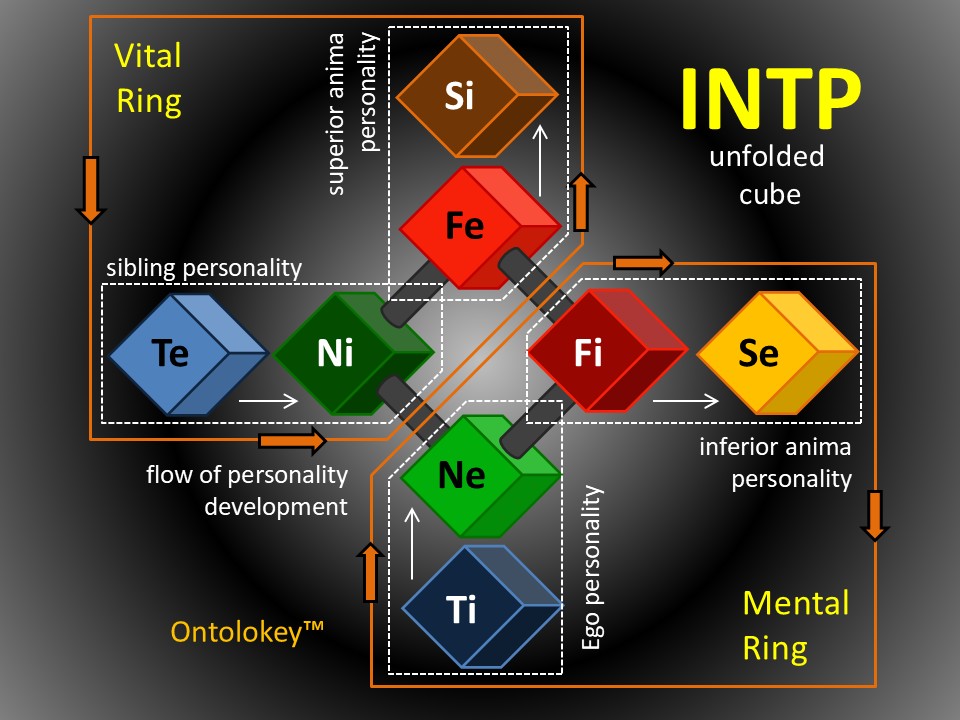
The Ontolokey Cube provides a particularly useful language for examining this contradiction because it places eight psychological functions at eight interconnected positions, rather than treating the INTP as a flat list of four preferred functions. In the model described by Ontolokey, the functions form a spatial system whose relationships matter as much as the individual functions themselves: Ti is connected with Te, Ne, and Se; Te represents the outward execution and structuring of what Ti understands, Ne expands the field of possibilities, and Se connects the abstract thinker with immediate sensory reality. Beyond this more conscious functional landscape lie Fe, Fi, Si, and Ni, which Ontolokey interprets through archetypal and developmental language: Extraverted Feeling as the King or Queen, Introverted Feeling as the anima, Introverted Sensing as a quieter stabilizing function, and Introverted Intuition as the golden shadow. The resulting picture is therefore not one of a personality possessing four functions and lacking the others, but of a whole psychological landscape in which neglected, uncomfortable, unconscious, or unusually powerful functions can become decisive for development.
This is especially important when examining the INTP’s shadow, because the shadow is not simply a collection of “bad traits.” The darker side often develops directly from the same psychological mechanisms that make the personality remarkable in the first place. Analytical depth can become intellectualization; independence can become defensive self-sufficiency; skepticism can become cynicism; imagination can become catastrophic simulation; sensitivity to contradiction can become intolerance toward the irrationality of human beings; and the preservation of possibilities can become paralysis through non-commitment. At the same time, the less conscious functions contain precisely those capacities that can restore balance: sensory presence can bring the thinker back into the body and the present moment, feeling can transform abstract principles into human connection, memory can provide continuity rather than endless reinvention, and intuition can allow meaning to emerge without requiring every insight to be reduced immediately to a chain of explicit reasoning. Ontolokey’s deeper proposition is therefore that the INTP becomes more whole not by perfecting Ti indefinitely, but by learning to inhabit the entire psychological landscape represented by the Cube.
The following examination will therefore move from the INTP’s familiar strengths into the less comfortable territory beneath them, while following the functional architecture of the Ontolokey model. The central question will not be whether the INTP is “good” or “bad,” intelligent or socially awkward, emotional or unemotional, but what happens psychologically when each function is developed, neglected, overused, or pushed into the shadow. Particular attention will be given to the tension between understanding and living, because this is where many of the type’s apparently unrelated difficulties converge: indecision, withdrawal, perfectionistic analysis, hidden emotionality, difficulty with ordinary social expectations, anxiety about uncertainty, unfinished creative potential, and the longing for a form of connection in which the INTP can be understood without having to abandon intellectual authenticity. Read in this way, the INTP’s untold truth is not that there is something secretly wrong beneath the brilliance, but that brilliance itself can become defensive when it is asked to protect the person from everything that cannot be controlled, explained, predicted, or intellectually mastered.
The Inner Architect: Introverted Thinking (Ti) as the INTP’s Psychological Core
The psychological center of the INTP is Introverted Thinking (Ti), and understanding Ti is essential because almost everything else in the personality develops in relation to its demand for internal coherence. In the Ontolokey Cube, Ti occupies the Dominant position, corresponding to the first position of Socionics Model A: it is the function the INTP consciously trusts most, uses most naturally, and experiences as an almost self-evident way of approaching reality. Ti does not primarily ask whether an idea is popular, useful, emotionally reassuring, or institutionally accepted; it asks whether the underlying structure is internally consistent and whether the elements of a system genuinely belong together. This produces the characteristic INTP impulse to take concepts apart, examine their assumptions, distinguish apparently similar ideas, locate contradictions, and reconstruct the whole in a form that feels intellectually clean. Ontolokey consequently describes Ti as the INTP’s “analytical backbone,” the central problem-solving lens through which complexity becomes something that can be investigated rather than merely endured.
At its healthiest, this function gives the INTP an unusual capacity for intellectual independence because external consensus has relatively little authority when it conflicts with what the person has independently understood. An INTP may accept a conventional explanation, but typically wants to know why it is true, what assumptions sustain it, under which circumstances it ceases to be true, and whether a more economical explanation is possible. This is why INTP curiosity often appears less like the accumulation of information and more like the construction of an internal model: individual facts become valuable when they can be integrated into a coherent architecture. The result can be exceptional conceptual precision, especially in fields where abstract relationships, systems, principles, or hidden mechanisms matter more than social convention. Yet the strength contains its own psychological trap, because Ti can become so invested in achieving conceptual clarity that uncertainty begins to feel personally intolerable, even though intellectual inquiry depends upon the willingness to remain uncertain for extended periods. The INTP may therefore continue refining an explanation long after refinement has ceased to produce meaningful insight, not because the subject objectively requires it, but because the mind has learned to experience understanding as its safest form of psychological control.
This distinction becomes crucial when considering the INTP’s shadow. A strong Ti does not automatically produce wisdom; it produces the capacity to analyze, and that capacity can be placed in the service of almost any psychological motive. An INTP who feels threatened, misunderstood, ashamed, or emotionally exposed may unconsciously transform an emotional problem into an intellectual problem because intellectual problems are easier to manipulate: they have definitions, premises, variables, contradictions, and potentially solvable structures. Instead of asking, “Why does this hurt me?” the mind may ask whether the other person’s argument is logically valid; instead of acknowledging loneliness, it may formulate a theory about human attachment; instead of admitting fear of failure, it may endlessly optimize the conditions under which action would supposedly become rational. This is one of the less visible forms of the INTP shadow because it can look like intelligence from the outside while functioning internally as avoidance. The mind has not stopped working—it has become extraordinarily productive precisely where productivity protects the person from direct psychological exposure.
The deepest danger is therefore not that the INTP becomes irrational, but that rationality becomes a defense against experience. When Ti is integrated with the rest of the personality, it allows the individual to distinguish truth from assumption without demanding that every human experience first be converted into a theory; when it becomes defensive, it can establish an inner citadel in which nothing has to be accepted until it has been completely understood. The problem is that life rarely provides such conditions: relationships involve ambiguity, decisions require incomplete information, bodies impose limits, emotions emerge before explanations, and meaningful opportunities frequently disappear while someone is still determining whether they can be justified. In this sense, the INTP’s greatest intellectual strength can quietly become a mechanism for postponement, allowing the person to remain perpetually “almost ready” while preserving the comforting belief that one more insight, one more piece of information, or one more conceptual refinement will eventually eliminate uncertainty. The shadow does not therefore oppose Ti from the outside; it can emerge through Ti itself, when the pursuit of truth becomes inseparable from the need to remain protected from everything that cannot be made intellectually safe.
A mature Ti ultimately has to learn a paradox that is difficult for the INTP precisely because it cannot be solved through analysis alone: clarity and certainty are not the same thing. Genuine intellectual strength allows a person to recognize when the available evidence is insufficient, when competing interpretations remain viable, and when a decision must be made without the luxury of complete conceptual closure. This does not diminish the INTP’s analytical nature; rather, it gives analysis a more sophisticated purpose, because the goal becomes discovering the limits of what can presently be known rather than forcing reality to provide an answer simply because the mind demands one. Ontolokey’s eight-function architecture is particularly relevant here because Ti is only one vertex of a larger psychological system, and the other functions represent forms of information that Ti cannot replace: Ne opens possibilities, Se confronts immediate reality, Fe encounters interpersonal atmosphere, Si preserves embodied continuity, Te translates reasoning into external effectiveness, Fi touches personal value, and Ni allows deeper convergence and meaning. The INTP becomes psychologically stronger not by weakening Ti, but by allowing Ti to relinquish its fantasy of being sufficient for everything.
The Architecture of Possibility: Extraverted Intuition (Ne)
If Introverted Thinking provides the INTP with an internal architecture, Extraverted Intuition (Ne) is the force that continually opens windows in its walls. In the Ontolokey model, Ne is the INTP’s Auxiliary function, and it represents the personality’s most natural bridge between the private world of internal reasoning and the multiplicity of the external world. Ne searches for possibilities, relationships, alternative interpretations, emerging patterns, and conceptual connections that have not yet been made explicit; it is therefore responsible for much of the INTP’s intellectual flexibility and creative unpredictability. Where Ti asks whether an idea is internally coherent, Ne asks what else that idea might imply, what other explanations could exist, and what seemingly unrelated phenomena might actually belong to the same underlying pattern. This interaction creates one of the INTP’s most distinctive strengths: the ability to move simultaneously vertically and horizontally through an idea, penetrating deeply into its structure while also expanding outward into an almost limitless network of possible associations. Ontolokey accordingly portrays the INTP not as a rigid logician but as an “adaptive architect,” someone capable of dismantling an established model when a new possibility reveals that the previous structure was incomplete.
This combination of Ti and Ne explains why INTP curiosity can appear almost inexhaustible when a subject genuinely captures the imagination. A question rarely remains a question in isolation; it becomes the entrance to a network of further questions, and each answer may generate several additional avenues of investigation. A technical problem can become a philosophical problem, which becomes a question about human behavior, which becomes a historical comparison, which then produces an entirely different hypothesis about the original problem. This is not necessarily a lack of discipline, as it is sometimes interpreted from the outside, but a form of associative exploration in which the mind gains energy from discovering relationships that were previously invisible. The positive expression of Ne gives the INTP intellectual openness, originality, inventiveness, humor, and an unusual tolerance for unconventional ideas, because an idea does not have to be immediately practical or socially acceptable to deserve examination. At its best, this function protects Ti from becoming dogmatic: whenever the internal model becomes too confident in its own completeness, Ne introduces another possibility that forces the model to remain alive.
Yet Ne also contributes directly to one of the INTP’s most familiar difficulties: the inability to close a conceptual process once it has become sufficiently interesting. The same mind that can generate an extraordinary range of possibilities can become trapped by the awareness that another possibility always exists. Every conclusion appears provisional because another interpretation might invalidate it; every career direction can be compared with another; every relationship can be examined against hypothetical alternatives; every decision can be reopened because some unknown variable remains outside the model. The result is a psychological tension between intellectual freedom and existential commitment. Ne wants the doors to remain open because openness preserves possibility, whereas life repeatedly demands that some doors be closed in order for anything concrete to happen. This is one reason why the INTP can possess remarkable creative potential while simultaneously struggling with completion: beginning is psychologically expansive, whereas finishing converts a field of possibilities into one actual outcome and therefore exposes the person to the consequences of choosing.
The shadow of Ne consequently appears not only as distraction but as possibility addiction. The INTP may become attached to the state in which everything remains conceivable because that state protects the imagination from the limitations of reality. A finished project can be judged; an unfinished project can remain brilliant in potential. A chosen career excludes countless alternatives; an unchosen career can remain perfect in imagination. A relationship that becomes concrete introduces needs, obligations, misunderstandings, and vulnerability; an imagined relationship can remain entirely coherent because nothing has yet happened to contradict it. Here the psychological problem is not that the INTP has too many ideas, but that ideas can become a way of preserving freedom from consequence. The person may unconsciously prefer the possibility of life to life itself, because possibility contains no irreversible failure. Ontolokey’s shadow perspective is particularly relevant here because the movement toward psychological wholeness requires the INTP to recognize that an unlimited number of possibilities is not the same as an unlimited life; at some point, existence requires embodiment, selection, commitment, and the willingness to discover what a chosen path actually becomes.
The mature relationship between Ti and Ne therefore involves a subtle reversal: the purpose of possibility is not to prevent commitment, but to make commitment more conscious. Ne can generate alternatives without insisting that all alternatives remain permanently available, while Ti can evaluate those alternatives without demanding absolute certainty before a decision is made. Together they can produce a person capable of exploring widely and choosing deliberately, rather than someone who either commits prematurely or remains indefinitely suspended in analysis. This is also where the INTP’s creativity becomes most powerful, because genuine creation requires both divergence and convergence: the imagination must generate what does not yet exist, but judgment must eventually give one possibility enough form to become real. The psychological task is therefore not to suppress Ne’s endless curiosity, but to teach it that limitation can itself become creative. A boundary can transform an idea into a work, a decision can transform potential into experience, and a commitment can reveal dimensions of reality that could never have been discovered from the safety of perpetual possibility.
From Internal Logic to External Logic: Te as the Sibling Function
Within the Ontolokey Cube, Extraverted Thinking (Te) occupies the Sibling position of the INTP, corresponding to Slot 5, the Mobilizing function in Socionics Model A, rather than the Tertiary position. This distinction is psychologically significant because the Sibling is not simply a weaker version of the dominant function; it is its natural counterpart, operating on the same cognitive dimension but with the opposite orientation. Ti and Te are therefore closely related forms of thinking, yet they pursue different criteria: Ti seeks internal coherence, conceptual precision, and structural consistency, whereas Te turns toward externally observable effectiveness, organization, evidence, productivity, and implementation. Ontolokey describes the Sibling function as a non-dominant but intrinsically connected counterpart to the dominant function, meaning that Te is not alien to the INTP but represents a neighboring form of thinking that can become increasingly important when the person needs to translate internal understanding into external results.
This Sibling relationship explains why the INTP can often understand the principles of efficiency without naturally organizing life around them. Te is psychologically close enough to Ti that an INTP can recognize its logic almost immediately, yet its outward orientation introduces a criterion that Ti alone does not necessarily prioritize: whether an idea actually produces an observable result. A Ti-dominant mind may spend enormous effort refining a conceptual model because the structure itself is intellectually satisfying, whereas Te asks whether the model can now be applied, tested, communicated, measured, or converted into something operational. The difference can be subtle but consequential, because an INTP may possess an exceptionally sophisticated understanding of a subject while allowing comparatively ordinary practical obstacles—deadlines, administration, sequencing, execution, prioritization—to remain unresolved. Te therefore becomes particularly valuable when the INTP realizes that external reality cannot always be persuaded to wait until the internal model has reached its theoretically perfect form.
The Mobilizing/Sibling character of Te also gives it a distinctive motivational quality. Because it is not the INTP’s dominant mode, the person may not spontaneously trust external metrics or conventional productivity systems as ultimate authorities, yet successful engagement with Te can feel energizing precisely because it demonstrates that thought can acquire tangible force. An idea that remains inside the mind can be endlessly modified, but once it is built, tested, published, programmed, demonstrated, or otherwise implemented, it begins generating new information that the thinker could not have obtained through contemplation alone. Te therefore has a developmental relationship with Ti rather than an adversarial one: Ti supplies the conceptual integrity, while Te exposes that conceptual integrity to the friction of reality. Ontolokey’s description of the Sibling as a complementary counterpoint is particularly appropriate here, because the INTP does not need to replace internal logic with external efficiency; it needs to allow the two forms of thinking to challenge and refine one another.
The shadow difficulty arises when the INTP experiences Te not as a useful counterpart but as an implicit judgment about personal adequacy. External environments frequently reward visible completion rather than invisible understanding, and this can create a painful discrepancy for a personality whose strongest work may initially occur almost entirely inside the mind. The INTP may know exactly how a system works while struggling to maintain the mundane structures required to make that knowledge productive, and repeated encounters with this discrepancy can produce either withdrawal or overcompensation. In withdrawal, the person retreats toward increasingly elaborate conceptual work because thinking remains an area of competence and psychological safety; in overcompensation, Te may suddenly become harsh, impatient, excessively outcome-focused, or preoccupied with proving competence through measurable accomplishment. Neither extreme represents genuine integration, because in both cases Te has ceased to function as a sibling to Ti and has instead become either an avoided demand or a weapon with which the self is judged.
The mature expression of Te is therefore neither relentless productivity nor submission to external standards, but the recognition that implementation is another form of inquiry. When the INTP puts an idea into the world, reality becomes a source of information: practical failure can expose assumptions that pure reasoning overlooked, while practical success can reveal which parts of the internal model were genuinely useful. This makes Te especially important for overcoming one of the INTP’s deepest shadow patterns, the tendency to postpone participation until understanding feels sufficiently complete. The Sibling does not ask Ti to surrender its demand for truth; it asks Ti to accept that some truths become visible only after an idea encounters consequences. In that sense, Te becomes one of the INTP’s quiet developmental allies, helping the thinker move from “I understand this” toward the more demanding condition of “I can make what I understand exist in reality.”
The Vulnerable Edge of Reality: Extraverted Sensing (Se)
If Te represents the INTP’s capacity to move internal logic toward external effectiveness, Extraverted Sensing (Se) occupies a far more vulnerable position in the Ontolokey architecture. In the INTP configuration, Se is the Toddler function, corresponding to Slot 4, the Position of Least Resistance or PoLR in Socionics Model A. This position is psychologically important because Se represents precisely the kind of immediate, concrete, forceful engagement with reality that an INTP can find difficult to access comfortably: acting decisively in the present, asserting physical or interpersonal boundaries, responding spontaneously to external pressure, and dealing directly with situations that cannot be solved by further abstraction. The INTP naturally prefers to understand the structure of a situation before committing itself to it, whereas Se demands a willingness to encounter the situation as it is and respond to its immediate demands. Ontolokey consequently associates the INTP’s Se position with vulnerability around physical immediacy, confrontation, spontaneity, and real-world action, making it one of the most revealing points at which the internal citadel can collide with reality.
The psychological difficulty is not necessarily an inability to perceive the physical world; an INTP can be highly observant and may possess considerable technical or sensory competence in areas that genuinely interest them. The deeper issue concerns the psychological demand to act before the situation has been intellectually domesticated. Se does not primarily ask what something means, what it could become, or how it fits into a larger conceptual structure; it confronts what is physically present and asks what can be done about it now. This can feel crude or premature to a mind accustomed to identifying hidden variables, because immediate action inevitably excludes some possibilities and creates irreversible consequences. A confrontation, for example, cannot be treated indefinitely as a theoretical question about interpersonal dynamics; at some point someone must speak, establish a boundary, tolerate another person’s reaction, and remain present while the consequences unfold. For the INTP, this can produce an uncomfortable experience of being forced out of the position of observer and into the position of participant, precisely where analytical distance provides much less protection.
This vulnerability helps explain why the INTP may oscillate between avoidance and sudden intensity when confronted with situations requiring direct assertion. Under ordinary conditions, the person may prefer negotiation, explanation, withdrawal, humor, intellectual reframing, or simply waiting for circumstances to resolve themselves. Such strategies are not inherently passive; they can reflect a genuine preference for reducing unnecessary conflict and finding a solution that does not require force. Yet when pressure accumulates beyond a certain threshold, the neglected Se dimension may emerge abruptly, producing a form of directness that feels disproportionate even to the INTP themselves. What has been avoided for weeks or months can suddenly be confronted with unusual bluntness, physical urgency, or an uncompromising insistence that the situation change immediately. The problem is not assertiveness itself—healthy assertiveness is essential—but the lack of gradual access to it: when a function remains psychologically uncomfortable, it can be easier to suppress it until circumstances force its appearance than to integrate it into ordinary conscious behavior.
The shadow becomes particularly significant when the INTP begins to interpret physical reality as an intrusion upon intellectual autonomy. Bodies become inconvenient because they require sleep, movement, nutrition, sexuality, health, environment, and sensory participation; practical circumstances become frustrating because they impose deadlines and limitations that cannot be reasoned away; other people become difficult when they demand immediate responses rather than carefully considered explanations. The more the individual retreats into abstraction, the more these realities can appear as obstacles to the “real” work of thinking, even though they are inseparable from the life of the thinker. Ontolokey’s description of the Toddler function captures this developmental vulnerability: Se is not simply something the INTP lacks, but an area in which a more childlike, awkward, defensive, or inexperienced relationship with reality can emerge. The resulting shadow is therefore not merely social awkwardness; it is the deeper temptation to treat embodiment, immediacy, confrontation, and limitation as interruptions to psychological life rather than as components of life itself.
The integration of Se begins when the INTP learns that presence does not require the abandonment of thought. Being physically present in a conversation, responding to an immediate situation, setting a boundary, finishing a concrete task, or simply experiencing the environment without analyzing it does not diminish intellectual depth; instead, it supplies the mind with direct information that abstraction alone cannot provide. This is especially important because the INTP’s deepest shadow, according to Ontolokey, develops when thought becomes a substitute for participation and the individual gradually exists “one step removed from life itself.” Se offers the opposite movement: not toward impulsivity, aggression, or constant stimulation, but toward contact. It reminds the INTP that reality does not always need to be interpreted before it can be encountered, that some situations become comprehensible only through participation, and that the ability to remain present while something is uncertain may be more psychologically mature than constructing an ever more sophisticated theory about what might happen next.
The Hidden Emotional Center: Extraverted Feeling (Fe) and the INTP’s Relationship with Other People
Among the INTP’s eight functional positions, Extraverted Feeling (Fe) occupies the Inferior position, while Ontolokey associates this position with the conscious desire for social harmony and emotional expression that remains comparatively underdeveloped. This is an important distinction because the stereotype of the INTP as simply “emotionless” misses the psychological contradiction involved: the INTP may be less comfortable expressing emotion publicly while simultaneously possessing a genuine and sometimes profound need to belong, to be accepted, and to experience interpersonal harmony. Ontolokey’s functional mapping places Fe in Slot 7, alongside the INTP’s Dominant Ti, Auxiliary Ne, Anima Fi, Toddler Se, Sibling Te, Golden Shadow Ni, and Tertiary Si, making Fe part of the less conscious side of the functional architecture rather than something absent from the personality. This helps explain why social interaction can sometimes feel strangely disproportionate for the INTP: ordinary interpersonal situations may seem insignificant while the emotional consequences of rejection, misunderstanding, exclusion, or interpersonal conflict can eventually become much more powerful than the individual consciously expected.
The inferior position also clarifies why an INTP can simultaneously appear emotionally detached and surprisingly sensitive to interpersonal atmosphere. Ti naturally evaluates the structural validity of an argument, while Fe evaluates the emotional field between people: whether someone feels included, whether a relationship is harmonious, whether an interaction is becoming hostile, and how emotional expression affects the surrounding group. These are not interchangeable forms of judgment, and the INTP may instinctively trust the former while remaining uncertain about the latter. Consequently, the person can be extremely perceptive about conceptual inconsistencies yet become confused when confronted with an emotional situation that has no obvious logical solution, particularly when another person expects spontaneous empathy rather than analysis. The difficulty can produce a defensive habit of translating emotion into concepts: instead of simply experiencing another person’s anger, sadness, affection, or disappointment, the INTP may begin asking why the person feels that way, whether the reaction is justified, what caused it, and whether the emotional response is logically proportionate. Such analysis can be genuinely compassionate, but it can also create distance precisely when another human being is asking for presence rather than explanation.
The shadow expression of inferior Fe becomes particularly complicated because social acceptance can become more important precisely when the INTP consciously claims not to care about it. Intellectual independence offers a powerful psychological defense against conformity: if external approval is regarded as irrelevant, rejection can theoretically be rendered harmless. Yet the human need for connection does not disappear simply because the conscious personality distrusts social expectations, and the suppressed need can therefore return in indirect forms. An INTP may become unusually concerned about how they are perceived after a period of isolation, become intensely self-conscious after an interpersonal misunderstanding, or suddenly seek reassurance that they have not violated an unspoken social boundary. In more stressed states, Fe may emerge as emotional overexpression, exaggerated attempts to restore harmony, unusual sensitivity to criticism, or an almost desperate desire to be understood by others. Ontolokey’s formulation that inferior Fe “craves social harmony and emotional expression but lies buried and underdeveloped” captures this tension: the issue is not an absence of feeling, but the difficulty of regulating and expressing interpersonal feeling with the same confidence that Ti brings to intellectual judgment.
This also reveals why the INTP’s relationship with people can become one of the deepest sources of the personality’s shadow. The intellect can create an extraordinary private world in which the person feels autonomous, but human relationships cannot be reduced to private systems because they continually introduce another consciousness that cannot be completely predicted. A person can analyze a conversation afterward, reconstruct every statement, identify the probable motivations of everyone involved, and formulate a sophisticated theory of what happened, yet none of this guarantees that the next encounter will feel safe or predictable. The INTP may consequently retreat into solitude not because solitude is inherently pathological, but because solitude provides a degree of cognitive control that relationships cannot provide. When that retreat becomes habitual, however, it can create a self-reinforcing cycle: limited interpersonal experience makes emotional situations feel more unfamiliar, unfamiliarity increases analytical distance, analytical distance reduces spontaneous connection, and reduced connection strengthens the conviction that other people are difficult to understand. The shadow therefore becomes self-protective rather than openly hostile—the person does not necessarily reject humanity, but gradually constructs a life in which humanity has fewer opportunities to reach them.
Healthy Fe integration does not require the INTP to become socially extroverted, emotionally demonstrative, or perpetually concerned with pleasing others. Its deeper purpose is to develop the ability to recognize interpersonal reality without experiencing it as a threat to intellectual autonomy. This means learning that empathy does not require agreement, emotional expression does not require irrationality, and social participation does not require surrendering one’s individuality. The mature INTP can remain skeptical, independent, analytical, and private while becoming increasingly capable of telling another person, in substance, “I understand what you are experiencing, even when I do not share your interpretation.” That capacity is psychologically transformative because it breaks the false opposition between reason and relationship: Ti can continue asking whether something is true while Fe learns to ask what the truth is doing between people. When these perspectives begin to cooperate, the INTP no longer needs to choose between the safety of intellectual isolation and the vulnerability of human connection, because connection itself becomes another domain in which curiosity, precision, and genuine understanding can operate.
The Unspoken Value System: Introverted Feeling (Fi) as the Anima
Among the least visible dimensions of the INTP psyche is Introverted Feeling (Fi), which Ontolokey places in Slot 3, the Anima position. This position is particularly revealing because Fi represents a form of evaluation that is fundamentally different from the INTP’s dominant Ti: Ti seeks internal logical coherence, while Fi seeks inner value, personal authenticity, emotional congruence, and an intimate sense of what is personally right or wrong. The INTP can therefore spend enormous amounts of energy determining whether something is logically defensible while remaining less practiced at asking whether it is personally meaningful or emotionally true. Ontolokey describes the Anima as a shadowed and emerging dimension of identity, and in the INTP this makes Fi less a conventional “feeling function” than a hidden psychological question: What do I actually value when no theory, social expectation, or intellectual justification can answer for me?
This distinction is crucial because the INTP is often mistakenly portrayed as someone without strong values simply because those values may not be displayed through conventional emotional language. In reality, an INTP can possess extremely firm internal convictions while being reluctant to expose them, particularly when those convictions cannot be translated into an objective argument. The person may defend intellectual freedom, honesty, autonomy, fairness, individual dignity, or authenticity with extraordinary intensity, yet become uncomfortable when asked to explain why these principles matter personally rather than logically. Fi operates precisely in that territory, where the individual must encounter the fact that some commitments are not conclusions reached through deduction but expressions of identity and value. The difficulty is that Ti can interrogate almost anything, including the foundations of one’s own convictions, and this can create a peculiar distance from personal feeling: the INTP may understand every side of an ethical question so thoroughly that the experience of having a position becomes strangely difficult. What begins as intellectual fairness can therefore become a subtle refusal to acknowledge personal preference, because choosing one value over another means accepting that the self cannot always remain an impartial observer.
The Anima becomes especially significant in intimate relationships because Fi concerns personal emotional boundaries and the singular meaning of individual bonds. An INTP may be perfectly capable of discussing relationships in abstract terms—attachment, compatibility, communication patterns, psychological dynamics—while finding it considerably harder to state directly, “This person matters to me,” “This hurt me,” “I need this,” or “I cannot accept that.” Such statements expose the individual to a form of vulnerability that logical explanation cannot neutralize, because they reveal something that belongs specifically to the self. Consequently, the INTP may sometimes communicate affection indirectly through attention, intellectual engagement, problem-solving, sharing discoveries, or offering access to a private inner world, while assuming that the meaning of these actions should be self-evident. When the other person does not interpret them correctly, the INTP may feel profoundly misunderstood without necessarily possessing the emotional vocabulary to explain what was actually being communicated. The hidden tragedy is that the person can be deeply loyal and emotionally invested while appearing detached precisely because the most personal layer of feeling has been placed behind the strongest protective layer of cognition.
The shadow side of Fi can also manifest through suppressed resentment and moral absolutism. When personal values are insufficiently acknowledged, the INTP may tolerate situations that violate those values for an unusually long time because the mind continues trying to understand, contextualize, or rationalize the other person’s behavior. Eventually, however, the accumulated discrepancy between what the person intellectually tolerates and what they emotionally cannot accept may become enormous. At that point the reaction can appear unexpectedly categorical: someone is suddenly experienced as fundamentally untrustworthy, a relationship is abruptly terminated, or a previously tolerated behavior becomes an unforgivable violation. This does not mean that the INTP is secretly irrational; rather, the neglected Fi dimension may have been registering a personal boundary long before the conscious personality admitted that the boundary existed. Ontolokey’s Anima concept is useful here because it frames Fi as an emerging part of identity rather than merely a defective emotional capacity: the developmental task is to recognize personal values earlier, before they have to emerge through accumulated hurt, withdrawal, or an apparently sudden moral judgment.
The integration of Fi ultimately asks the INTP to accept a truth that Ti finds difficult to formalize: a life cannot be built entirely from propositions that are objectively defensible. At some point, the person must decide what deserves loyalty, what kind of relationship is worth preserving, which principles are non-negotiable, what forms of behavior violate personal integrity, and what kind of existence feels genuinely one’s own. These decisions cannot always be proven in the same manner as a mathematical proposition, because personal meaning is not reducible to logical necessity. Far from weakening the INTP’s rationality, developing Fi can actually make the intellect more honest: once the person acknowledges their own values, analysis no longer has to disguise preference as neutrality. Ti can then investigate reality without pretending that the investigator has no personal stake in what is discovered, while Fi can provide the answer to a question that pure analysis can never supply on its own—not merely “Is this coherent?”, but “Is this the life I actually want to live?” The Anima therefore represents one of the INTP’s most important paths toward psychological integration: not becoming more emotional for its own sake, but becoming sufficiently acquainted with the private value system beneath the intellect that thought and identity no longer have to live in separate rooms.
The Quiet Anchor: Introverted Sensing (Si) and the Forgotten Continuity of Experience
Introverted Sensing (Si) occupies the Tertiary position in the INTP configuration, and Ontolokey associates it with a quieter, more playful, and frequently neglected dimension of the personality. Whereas Ne continually opens the mind toward novelty, alternatives, and unexplored possibilities, Si turns attention toward what has already been experienced: bodily states, familiar environments, personal memories, established routines, sensory impressions, and the subtle continuity that connects present experience with the past. For an INTP, this orientation can initially feel restrictive because repetition appears less intellectually stimulating than discovery, while routines can seem like unnecessary structures imposed upon an otherwise open-ended existence. Yet Si performs a function that the highly abstract INTP can easily underestimate: it preserves the connection between thought and embodiment, reminding the individual that psychological life unfolds through an actual body, within an actual history, rather than exclusively inside an abstract conceptual universe. Ontolokey therefore describes Si not merely as routine or memory, but as a potential source of comfort, bodily awareness, nostalgia, stability, and emotional continuity.
The neglected nature of Si can become particularly consequential when the INTP’s intellectual life becomes excessively expansive. Ne continually generates new questions and possibilities, while Ti continually evaluates them, and this combination can produce an almost self-sustaining mental activity in which the individual loses awareness of ordinary physical rhythms. Hours disappear while reading, researching, programming, thinking, or following an unexpected chain of ideas; meals, sleep, exercise, household responsibilities, and other bodily requirements can become secondary because they do not appear intellectually urgent. Ontolokey explicitly identifies this danger by connecting neglected Si with losing track of time, health, and daily obligations, suggesting that the problem is not simply poor organization but a gradual dissociation between the mind and the organism that carries it. The INTP can consequently become extraordinarily attentive to abstract complexity while remaining surprisingly inattentive to simple signals from the body, even though those signals often contain information that no conceptual model can substitute for. In this sense, Si represents a psychological invitation to rediscover the fact that stability is not necessarily stagnation and that repetition can sometimes be the condition that allows deeper forms of creativity to survive.
There is also a more intimate dimension to Si because memory is not merely the storage of information; it can provide a felt continuity of identity. An INTP may spend so much time reconstructing concepts and imagining possible futures that the personal past becomes less emotionally integrated than intellectually catalogued. Experiences can be remembered as facts without being fully inhabited as parts of the self: what happened is known, but what it meant to the person may remain comparatively distant. Si can gradually restore this continuity by reconnecting present experience with accumulated sensory and emotional associations—the atmosphere of a particular place, the rhythm of a familiar routine, the physical sensation associated with a memory, or the quiet comfort of something known intimately over time. Ontolokey’s description of Si as capable of strengthening emotional connection through shared memory and rhythm is especially important here because it reveals how a function that initially appears mundane can become relationally meaningful. For the INTP, intimacy does not necessarily require dramatic emotional disclosure; sometimes it develops through the repeated experience of being physically and psychologically present with another person until familiarity itself becomes a form of trust.
The shadow of neglected Si emerges when the INTP becomes increasingly detached from continuity and increasingly dependent upon novelty to maintain psychological stimulation. New ideas provide immediate cognitive energy, but a life built exclusively around novelty can become fragmented because nothing is given sufficient time to acquire depth through repetition. The individual may repeatedly reinvent projects, interests, environments, relationships, or personal goals, interpreting each new beginning as an opportunity for greater authenticity while unconsciously avoiding the slower process through which commitment transforms an activity into a lived history. This can intensify the shadow described by Ontolokey: the person becomes increasingly sophisticated in imagining possible lives while becoming less rooted in the actual life already being lived. Si offers an antidote not by demanding conformity or routine for its own sake, but by making the INTP aware that depth requires duration. Some knowledge only becomes wisdom through repeated experience, some relationships only become intimate through shared history, and some forms of self-understanding emerge only after a person has remained somewhere long enough to discover what cannot be perceived during the excitement of constant possibility.
The mature integration of Si therefore represents a surprisingly profound development for the INTP because it transforms the relationship with ordinary life. A meal can become an experience rather than an interruption, a familiar place can become a source of psychological grounding rather than boredom, physical maintenance can become an expression of respect for the self rather than an obligation imposed by biology, and personal memories can become evidence of continuity rather than merely archived information. This does not require abandoning Ne’s curiosity or Ti’s analytical independence; instead, Si gives those capacities a stable human context in which they can operate without consuming the entire personality. The INTP begins to recognize that a meaningful existence is not composed exclusively of breakthroughs, discoveries, and conceptual revelations, but also of repeated mornings, familiar faces, embodied sensations, remembered experiences, and small patterns of life that acquire significance precisely because they recur. In that integration, the thinker discovers something the purely abstract mind can easily overlook: sometimes the deepest form of understanding is not discovering something new, but finally becoming fully present to something that has been there all along.
The Golden Shadow: Introverted Intuition (Ni) and the Meaning Beneath the Model
At the opposite pole from the INTP’s conscious analytical activity lies Introverted Intuition (Ni), which Ontolokey places in the Golden Shadow position. This is one of the most intriguing positions in the entire Cube because the Golden Shadow is not simply a weak or defective function; it represents a capacity that can appear strangely profound, almost uncanny, precisely because it operates outside the personality’s ordinary conscious method. Whereas Ne expands reality into multiple possibilities, Ni moves in the opposite direction by condensing experience toward underlying significance, convergence, trajectory, and a singular interpretation of where things are ultimately heading. For an INTP accustomed to keeping alternatives open, Ni can therefore feel simultaneously attractive and unsettling: it offers the possibility of reaching a deeper synthesis, yet doing so requires accepting that not every possibility deserves to remain alive indefinitely. Ontolokey’s description of Ni as the INTP’s Golden Shadow accordingly suggests a hidden potential for visionary insight, strategic foresight, and recognition of an emerging pattern that transcends the endless branching normally associated with Ne.
The psychological distinction between Ne and Ni is especially important because the two can superficially resemble one another: both can be abstract, imaginative, future-oriented, and interested in patterns that are not immediately visible. Their internal movements, however, are different. Ne multiplies possibilities; Ni compresses them, seeking the underlying direction that makes the apparent multiplicity intelligible. For the INTP, whose dominant Ti can already create highly elaborate conceptual systems, the development of Ni can produce moments in which analysis suddenly gives way to synthesis: after examining countless variables, the mind begins to perceive the trajectory connecting them rather than continuing to catalogue alternatives. This can result in a form of insight that feels less like constructing an argument and more like recognizing something that has gradually become inevitable. Yet precisely because Ni is not the INTP’s preferred mode, trusting such convergence may initially feel dangerous; the individual may immediately begin dissecting the insight, generating counterexamples and reopening alternatives until the original perception loses its force. The Golden Shadow can therefore contain an ability the INTP both desires and distrusts—the ability to know where a pattern is going without first possessing a complete explicit explanation for every step.
This tension becomes particularly relevant to the INTP’s deepest shadow because endless possibility can become a sophisticated method of avoiding existential commitment. Ne can always produce another interpretation, another future, another explanation, another route; Ni introduces the uncomfortable possibility that beneath all those alternatives there may actually be a direction that deserves recognition. The INTP may sense that a particular relationship is ending, that a project has reached its natural conclusion, that a particular field of inquiry is becoming central to their life, or that years of seemingly unrelated interests are converging toward one coherent purpose. Yet acknowledging such convergence creates psychological consequences because a singular trajectory implies selection, and selection implies the loss of alternatives. The person may therefore use Ti and Ne to dismantle the emerging insight: perhaps the evidence is insufficient, perhaps another explanation exists, perhaps the pattern is merely confirmation bias, perhaps the future remains completely open. Such skepticism can be intellectually legitimate, but when employed reflexively it becomes another defense against the vulnerability of recognizing that life sometimes acquires direction before the intellect can prove precisely why.
Ontolokey’s concept of the Golden Shadow is particularly valuable here because it suggests that the unconscious opposite can contain qualities the conscious personality secretly admires. An INTP may be fascinated by people who possess an almost effortless sense of direction, who can identify the central issue within overwhelming complexity, or who seem capable of committing themselves to a long-term vision without endlessly reopening every assumption. The attraction may partly reflect an unrecognized psychological complementarity: what appears externally as another person’s certainty can symbolize an undeveloped capacity within the INTP to move from analysis toward synthesis. This does not mean that the INTP should imitate an Ni-dominant personality or suppress the natural openness of Ne; rather, the task is to recognize that perpetual openness has limits and that some insights become meaningful only when they are allowed to organize experience over time. The Golden Shadow can therefore function as a source of psychological development because it introduces direction into possibility, allowing the INTP to recognize when an intellectual exploration has ceased to be merely an exploration and has begun to reveal something about the life the individual is actually being called to construct.
The mature relationship with Ni ultimately changes the INTP’s understanding of intuition itself. Intuition no longer has to mean an endless production of speculative alternatives; it can also mean the gradual recognition of what all the alternatives have been pointing toward. This is where the INTP’s analytical and intuitive capacities can reach a deeper synthesis: Ti examines the structure, Ne explores the field, and Ni begins to perceive the trajectory emerging from that field, while the less conscious functions gradually bring the insight into values, relationships, embodiment, and practical existence. Such integration can be profoundly liberating because the individual no longer needs to preserve every possibility in order to remain intellectually free; freedom becomes the capacity to choose a direction while knowing that alternative possibilities existed. The INTP can then move beyond the endless question, “What else could this be?” toward the equally important question, “Given everything I now understand, what does this most likely mean?” That transition—from multiplication toward meaning, from conceptual possibility toward existential direction—is one of the quietest but most consequential movements in the INTP’s psychological development.
The Sovereign Shadow: Extraverted Feeling (Fe) and the Need to Belong
There is a deeper layer to the INTP’s relationship with feeling that becomes visible when Extraverted Feeling (Fe) is examined not only as the Inferior function, but also through the archetypal position assigned to it within Ontolokey’s broader Cube architecture. Fe represents the external emotional field: the capacity to perceive, shape, and participate in the emotional atmosphere between people, to recognize collective needs, establish interpersonal cohesion, and express warmth in ways that are immediately legible to others. For an INTP, this territory can feel simultaneously foreign and strangely important because the dominant orientation toward internal logic creates psychological distance from precisely those interpersonal processes that depend upon spontaneous emotional reciprocity. The person may understand intellectually that relationships require emotional participation while remaining uncertain about how to perform that participation without feeling artificial or exposed. Ontolokey’s Cube is useful here because it does not reduce Fe to a simple deficiency; rather, its position in the INTP’s architecture reveals a latent dimension of the personality that becomes increasingly important when the individual moves beyond the protected territory of solitary cognition and encounters the irreducibly interpersonal nature of existence.
The INTP’s difficulty with Fe is often misunderstood because emotional reserve is not equivalent to emotional absence. An INTP may experience strong affection, loyalty, compassion, embarrassment, grief, admiration, or longing while having considerable difficulty translating those experiences into socially expected forms of expression. The person may show care by solving problems, sharing information, remembering an obscure detail, providing an intellectually stimulating conversation, or giving someone access to thoughts that are normally kept private. Yet other people may not automatically recognize these behaviors as emotional communication because they are expressed through the INTP’s native language of cognition rather than through conventional emotional signaling. This can create a painful asymmetry in which the INTP feels that they are giving considerably more emotionally than others realize, while the other person experiences the INTP as distant or insufficiently responsive. The resulting misunderstanding can reinforce withdrawal: the INTP concludes that emotional communication is unreliable, while others conclude that the INTP simply does not care, even though both interpretations may be substantially wrong.
The shadow becomes darker when the unmet need for connection is denied for too long. Because the INTP often derives psychological security from autonomy, admitting a need for other people can feel like surrendering a carefully protected independence, and the person may therefore rationalize loneliness as preference. Solitude is genuinely valuable to this personality, but there is an important difference between chosen solitude and defensive isolation: the former restores the individual, while the latter protects the individual from the risks of being known. When isolation becomes defensive, the INTP can construct increasingly sophisticated explanations for why ordinary social life is superficial, irrational, inefficient, or exhausting, and some of those observations may even be accurate. The problem is that accurate criticism can become the intellectual justification for avoiding something the person actually needs, allowing a genuine psychological vulnerability to hide behind apparently objective conclusions about human behavior. The deepest shadow is consequently not hatred of people but the possibility of becoming so accustomed to observing human connection from the outside that participation begins to feel more threatening than loneliness.
This becomes particularly painful because Fe is concerned with recognition, and recognition is one of the few things Ti cannot manufacture internally. An INTP can independently determine that their reasoning is sound, but cannot independently create the interpersonal experience of being understood by another consciousness. They can analyze their own personality, reconstruct the origins of their behavior, and formulate increasingly precise descriptions of their emotional patterns, but none of those activities provides the same psychological experience as being genuinely seen and accepted by another person. This creates one of the central paradoxes of the INTP: the person may spend enormous effort trying to understand people while simultaneously making it difficult for people to understand them. The intellectual self is relatively accessible because it can be explained, but the vulnerable self is often protected by layers of abstraction, irony, understatement, and self-containment. When someone finally penetrates those layers, the experience can be extraordinarily meaningful precisely because it reaches a part of the personality that ordinary social interaction rarely touches.
Healthy Fe development therefore does not mean becoming agreeable, emotionally demonstrative, or dependent upon external approval. It means acquiring the ability to participate consciously in the emotional reality that already exists between people. The INTP can learn to express appreciation before it becomes necessary, to acknowledge another person’s emotional experience without immediately analyzing it, to communicate affection directly rather than assuming that its behavioral expression will be obvious, and to tolerate the discomfort of being emotionally visible without retreating into intellectualization. These capacities do not weaken Ti; they give Ti a human context in which its insights can become relational rather than merely analytical. When the INTP learns that emotional communication is not a betrayal of rationality, another possibility opens: relationships can become environments of inquiry in which the objective is not to solve another person but to encounter them. The resulting maturity is not measured by how emotionally expressive the INTP becomes, but by whether the individual can remain intellectually autonomous without needing emotional distance to maintain that autonomy.
The Shadow Is Not the Opposite of the Self
The deepest mistake one can make when thinking about the INTP is to imagine the shadow as a collection of traits that contradict the personality and therefore need to be eliminated. Within the Ontolokey framework, the shadow is more intimate than that: it consists of psychological capacities that belong to the same person but occupy different positions in the architecture of consciousness. The INTP’s eight functions therefore do not form a simple scale from “strong” to “weak”; they describe different relationships to awareness, competence, vulnerability, desire, and psychological development. Ti stands at Slot 1 as Dominant, Ne at Slot 2 as Auxiliary, Fi at Slot 3 as Anima, Se at Slot 4 as Toddler, Te at Slot 5 as Sibling, Ni at Slot 6 as Golden Shadow, Fe at Slot 7 as Inferior, and Si at Slot 8 as Tertiary. The significance of these positions is that each function asks something different of the INTP: Ti provides internal coherence, Ne opens possibilities, Fi confronts personal value, Se confronts immediate reality, Te confronts external effectiveness, Ni introduces singular direction, Fe confronts belonging and emotional reciprocity, while Si reconnects the mind with continuity, embodiment, and lived experience. The psychological drama of the INTP therefore emerges not because some functions are missing, but because the conscious personality naturally gives certain forms of knowing more authority than others.
This becomes especially important when the INTP is under prolonged psychological pressure, because the functions that ordinarily remain peripheral can begin to appear in distorted or compensatory forms. A person who normally trusts Ti may become excessively certain that every problem can be solved through further analysis, while Ne can transform openness into endless branching, producing more possibilities precisely when a decision is required. Fe may become painfully sensitive to rejection or social misunderstanding, Fi may emerge as a private sense of moral injury that the person cannot easily articulate, and Se may appear through abrupt attempts to force immediate action after long periods of detachment from the physical world. None of these experiences necessarily means that the INTP has suddenly “become” another personality; rather, they reveal tensions already contained within the architecture. Ontolokey’s cube is useful here because it treats the psychological system spatially, allowing these functions to be understood as interconnected positions rather than isolated characteristics. The shadow consequently becomes less mysterious once it is understood as the psyche demanding participation from regions that conscious identity has neglected. What initially feels like psychological disruption may therefore contain information about an unmet developmental need.
For the INTP, perhaps the most uncomfortable realization is that intelligence itself can become a defense against psychological experience. Ti can explain almost anything without necessarily allowing the person to feel it, Ne can generate endless interpretations without requiring commitment to any one of them, and intellectual independence can become so deeply associated with identity that dependence, vulnerability, or emotional uncertainty begin to feel like threats to the self. This is where the shadow becomes psychologically serious: not because the INTP possesses hidden darkness, but because the very mechanisms that make the personality capable can also become mechanisms of avoidance. A mind trained to question assumptions can eventually question every emotional impulse until nothing remains sufficiently certain to act upon; a mind capable of seeing many possibilities can eventually use possibility itself as an escape from consequence. The Ontolokey model’s deeper implication is that development cannot consist merely in strengthening the dominant functions. The INTP becomes psychologically larger when the functions that disturb the preferred self-image are allowed to contribute their information, so that analysis can encounter value, possibility can encounter direction, independence can encounter relationship, and thought can finally become something lived rather than merely understood.
The Paradox of the INTP: Freedom Without Escape
The INTP’s deepest psychological conflict can be understood as a paradox between freedom and participation. The personality wants freedom from premature conclusions, imposed meanings, social expectations, emotional coercion, and practical obligations that have not yet been intellectually justified. Ti protects this freedom by demanding internal coherence, while Ne protects it by keeping the field of possibilities open. Yet a human life cannot remain indefinitely in a state of pure possibility. Eventually something has to become real: a relationship has to be entered, a decision has to be made, a body has to be inhabited, a value has to be defended, a project has to be completed, or a direction has to be chosen. This is precisely where the INTP’s less consciously preferred functions become psychologically significant. Ontolokey places Se in the Toddler position, Te as the Sibling, Ni as the Golden Shadow, Fe as the Inferior, and Si as the Tertiary, creating a structure in which the INTP repeatedly encounters forms of experience that cannot simply be reduced to internal analysis. The central developmental problem is therefore not how to become less intellectual, but how to prevent intellectual freedom from becoming a sophisticated form of non-participation.
This distinction explains why some INTPs can possess extraordinary conceptual depth while simultaneously feeling strangely disconnected from the consequences of their own thinking. Understanding something is not the same as committing oneself to it, and seeing the structure of a problem does not automatically produce the willingness to enter the problem personally. Ne can keep the future open, Ti can keep questioning the premises, and the combination can produce a remarkable resistance to psychological closure. At its best, this allows the INTP to remain intellectually honest where others settle too quickly; at its worst, it creates an almost invisible escape mechanism in which every conclusion can be reopened before it becomes binding. Even personal identity can become an object of endless analysis: Why am I this way? What explains this reaction? What other interpretation is possible? The questions may be genuine, but they can also postpone the more dangerous question: What will I actually do with what I now understand? In this sense, the INTP’s shadow is not merely emotional or social. It is existential, because the mind can become so good at observing life that observation itself begins to substitute for participation.
The corrective does not require abandoning ambiguity or forcing the INTP into a more conventional personality. Rather, it involves recognizing that uncertainty and commitment are not opposites. A mature INTP can preserve intellectual openness while still allowing a provisional commitment to organize action; can question a belief while remaining loyal to a person; can recognize alternative possibilities without treating every possibility as equally deserving of pursuit. This is where the less familiar functions begin to acquire their developmental meaning. Te, as Sibling in Slot 5, can translate internal understanding into externally testable effectiveness; Ni, as Golden Shadow in Slot 6, can allow many possibilities to converge toward a meaningful direction; Fe, as Inferior in Slot 7, confronts the relational reality that one’s inner world exists within a field of other people; and Si, as Tertiary in Slot 8, reconnects abstraction with continuity, comfort, embodiment, and accumulated experience. None of these functions needs to replace Ti. Their psychological value lies precisely in preventing Ti from becoming sovereign over every dimension of existence. The mature INTP does not become less free by allowing reality, relationship, value, direction, and embodiment to matter; instead, freedom becomes deeper because it is no longer defined merely as the absence of constraint, but as the capacity to choose a relationship with reality without losing the ability to think independently.
When Intelligence Becomes Armor
There is a particular form of defensiveness that can develop in an INTP without looking defensive at all. It does not necessarily appear as aggression, denial, stubbornness, or visible resistance; it can appear as analysis. When something becomes emotionally threatening, the INTP may instinctively move upward into abstraction, turning an immediate psychological experience into an intellectual object that can be examined from a safe distance. Instead of simply feeling rejected, the person may begin investigating the mechanisms of rejection; instead of admitting that someone matters deeply, they may analyze attachment, interpersonal dynamics, expectations, and possible explanations for their own reaction. This capacity is one of the great strengths of the INTP because it can transform confusion into understanding, but it also contains a subtle danger: understanding can become a substitute for exposure. The more sophisticated the analysis becomes, the easier it can be to mistake conceptual clarity for emotional resolution. The person may know why something hurts while remaining almost completely untouched by the fact that it hurts. In this sense, the INTP’s shadow is not necessarily a hidden collection of irrational impulses; it can be the realization that the mind has become so effective at explaining experience that it has learned how to remain outside experience while appearing to understand it completely.
The problem becomes especially visible in intimate relationships, where psychological reality cannot be controlled through conceptual precision. Another person does not arrive as a philosophical proposition whose variables can be isolated and whose contradictions can be solved. They arrive with moods, needs, ambiguities, insecurities, expectations, memories, and forms of emotional communication that may not be internally consistent. For an INTP, this can be profoundly destabilizing because Ti naturally seeks distinctions and coherence while Fe, positioned in the Inferior role within the Ontolokey Cube, confronts the person with the interpersonal field itself: the atmosphere between people, the desire to be recognized, the emotional consequences of one’s behavior, and the uncomfortable fact that another person’s subjective reality cannot simply be reasoned away. The INTP may therefore oscillate between intense desire for authentic connection and retreat into self-sufficiency when connection becomes emotionally demanding. What appears externally as detachment can sometimes conceal the opposite: a person who cares enough about interpersonal consequences to become afraid of mishandling them. The resulting withdrawal is then not necessarily evidence of indifference, but an attempt to regain psychological control when the relational world becomes too difficult to map.
This is one reason the development of the INTP cannot be reduced to becoming more socially expressive or emotionally demonstrative. The deeper task is to develop the capacity to remain psychologically present when there is no elegant explanation available. Fe does not ask Ti to surrender its standards of truth; it asks the INTP to recognize that human relationships contain another category of truth, one that is partly revealed through participation rather than analysis. Likewise, Fi as Anima confronts the question of personal value at a level that cannot always be derived from an impersonal logical system, while Se as Toddler confronts immediate reality without allowing the mind to postpone everything until it has been completely understood. These positions make the shadow less like an enemy and more like a collection of neglected witnesses. Each one carries information that the dominant consciousness is poorly equipped to generate by itself. The psychological movement toward maturity therefore begins when the INTP can say, in effect, I understand this intellectually, and that understanding matters—but understanding is not the final stage of knowing. At that point intelligence ceases to function primarily as armor and becomes something more demanding: a way of entering reality with greater awareness rather than a way of remaining protected from it.
The Loneliness Behind Independence
Independence is one of the most recognizable qualities of the INTP, but its psychological meaning is more complicated than simply preferring to be alone. For the INTP, independence can become part of the definition of the self: I think for myself, I reach my own conclusions, I do not need the group to tell me what is true. This orientation protects intellectual integrity and allows the person to resist conformity with unusual consistency. Yet the same structure can gradually become self-sealing. If dependence is unconsciously associated with weakness, social approval with compromise, and emotional disclosure with loss of autonomy, then isolation can begin to feel not merely comfortable but morally or intellectually justified. The person may tell themselves that they are alone because other people are superficial, demanding, irrational, or incapable of understanding them, when a more uncomfortable possibility is that sustained closeness requires forms of participation they have learned to avoid. Ontolokey’s treatment of the INTP shadow is particularly relevant here because it places interpersonal feeling in a vulnerable position rather than treating sociality as simply absent from the type. Fe, as Inferior, represents precisely the territory in which the INTP can simultaneously desire connection and feel uncertain about how to inhabit it. The result can be a distinctive form of loneliness: not the loneliness of having nobody around, but the loneliness of remaining fundamentally untranslated even in the presence of others.
This loneliness can become self-reinforcing because the INTP often has a strong capacity to function without immediate interpersonal reinforcement. Ti provides an internal reference point, Ne supplies stimulation through ideas, and intellectual curiosity can generate an almost inexhaustible private world. Unlike a person who depends heavily on external affirmation to maintain psychological momentum, the INTP may be able to spend enormous amounts of time thinking, researching, constructing theories, exploring interests, or following questions that nobody else understands or even knows exist. This is genuine autonomy, but autonomy becomes psychologically costly when it eliminates the need to be known. There is an important difference between not needing constant company and becoming incapable of allowing another person to matter. The first can be a healthy expression of temperament; the second can become a defense against vulnerability. In the latter case, the INTP may unconsciously create relationships in which intimacy remains permanently conditional: people are welcome as long as they do not demand too much emotional exposure, impose too many expectations, or disturb the internal freedom of the individual. Such a life can preserve extraordinary independence while quietly depriving the person of something independence alone cannot provide—the experience of being encountered deeply by another human being and remaining oneself afterward.
The shadow therefore becomes particularly important when the INTP begins to recognize that isolation is not always the same thing as freedom. The developmental movement is not toward constant sociability, emotional performance, or dependence on other people’s approval; it is toward voluntary connection, in which closeness becomes a choice rather than a threat. Fe’s position as Inferior can make interpersonal belonging feel disproportionately significant precisely because it is not the domain in which the INTP naturally feels most competent, while Fi as Anima introduces an even more private question: What do I actually value in the people I allow close to me, and what kind of person do I become in relation to them? These questions cannot be solved entirely through Ti because they concern lived significance rather than structural consistency. The INTP’s deepest form of independence may therefore emerge paradoxically through relationship: not the independence of needing nobody, but the independence of being capable of attachment without surrendering one’s center. Once that distinction becomes conscious, solitude can return to its proper place. It becomes a source of restoration, thought, and discovery rather than an invisible fortress protecting the individual from the uncertainty of being genuinely known.
The Fear Beneath the Need to Understand
For the INTP, the need to understand is rarely a superficial intellectual preference. It can become one of the central organizing principles of identity, because understanding provides something psychologically precious: distance from confusion. When reality becomes comprehensible, it becomes less threatening; when contradictions can be mapped, they become less overwhelming; when assumptions can be exposed, the individual regains a sense of internal sovereignty. This is one reason the INTP can pursue a question long after everyone else has stopped caring about it. The objective is not necessarily achievement or recognition, but the satisfaction of making the structure of something intelligible. Yet precisely because understanding provides psychological security, the inability to understand can become unusually difficult to tolerate. The shadow begins when the desire for truth quietly transforms into a need for cognitive control. At that point, the INTP may no longer be asking only, “What is true?” but unconsciously, “What explanation will allow me to feel that I have this under control?” The distinction is subtle because both questions sound intellectually legitimate, but psychologically they lead in very different directions.
This becomes particularly significant when the subject is the self. External systems can often be examined from a distance, but one’s own motives resist such clean separation. Human beings frequently contain contradictory desires: wanting closeness and independence, certainty and freedom, recognition and anonymity, stability and novelty. For an INTP, these contradictions can become irresistible objects of analysis. The person may construct increasingly elaborate explanations for why they behave as they do, perhaps drawing connections across childhood, relationships, temperament, values, fears, and cognitive patterns. Such introspection can be extraordinarily revealing, but it can also create another layer of distance between the person and the experience being examined. The individual begins to know an enormous amount about themselves without necessarily allowing themselves to encounter themselves directly. This is where the shadow can become particularly sophisticated: self-analysis itself becomes a defense. The person is constantly looking inward, yet remains strangely difficult to reach. Ontolokey’s recent writing on the INTP shadow describes this broader danger in terms of intellectual depth becoming disconnected from emotion, embodiment, and human relatedness, emphasizing that the problem is not intelligence itself but what happens when intelligence becomes a substitute for participation in life.
The deeper freedom comes when the INTP discovers that not every uncertainty requires resolution before life can proceed. Some questions are meant to remain partially open because their answers emerge through living rather than preceding it. A relationship cannot be completely understood before it is entered; a value cannot always be intellectually proven before it is lived; a direction cannot always be logically demonstrated before it is chosen. Even one’s own future self cannot be fully modeled in advance because experience changes the very person doing the modeling. This does not invalidate Ti. On the contrary, it gives Ti a more mature task: not eliminating uncertainty, but distinguishing uncertainty that requires investigation from uncertainty that belongs inherently to being human. The INTP then begins to understand something that pure analysis cannot teach by itself—that reality does not become less real because it remains unresolved. The mind does not lose its freedom when it accepts limits to its knowledge. It gains another kind of freedom: the ability to move forward without demanding that existence first become completely intelligible.
The INTP and the Problem of Meaning
The INTP can spend years pursuing truth without ever asking, with sufficient seriousness, what the truth is for. This is not because the personality lacks depth or existential curiosity; quite the opposite. The problem is that Ti can become so absorbed in the structure of reality that the question of significance appears secondary, almost embarrassingly subjective. If a proposition is coherent, accurate, and internally consistent, why should it need to provide meaning as well? Yet eventually the distinction between truth and meaning becomes impossible to ignore. A person can understand how something works and still not know whether it matters. They can identify the mechanism behind a relationship and still not know whether they want the relationship. They can understand the probable consequences of a decision and still be unable to determine which consequence they are willing to live with. This is where the INTP’s less conscious functions reveal another dimension of the personality: knowledge describes the structure of reality, but value and direction determine how a human being inhabits that reality. In the Ontolokey Cube, Fi as Anima and Ni as Golden Shadow are especially important to this movement because they introduce questions that cannot be reduced to Ti’s preferred language of impersonal coherence.
Fi brings the INTP toward the intimate territory of personal significance. It asks not merely whether an idea is logically defensible, but whether something feels fundamentally right, wrong, authentic, alien, intimate, or violating in relation to the individual’s inner values. This can be uncomfortable precisely because values do not always behave like propositions. They can be deeply felt before they can be clearly articulated, and the INTP may distrust anything that cannot immediately be justified in a conceptual framework. Consequently, an INTP may sometimes remain in a situation long after something inside them has already recognized that it is no longer right, simply because they cannot produce a sufficiently rigorous argument for leaving. The reverse can also happen: they may intellectually dismantle something they once cared about because they cannot reconcile its emotional complexity with their current model. Fi as Anima makes this tension especially personal. It represents a vulnerable encounter with the fact that the individual is not only an observer of systems but also a person with loyalties, attachments, aversions, boundaries, and private commitments. The more fully this dimension is integrated, the less the INTP needs to treat subjectivity as an inferior form of knowledge. Personal meaning does not have to compete with objective analysis; it answers a different question.
Ni, occupying the Golden Shadow position, introduces an equally important shift by bringing the many possible futures generated through Ne toward convergence and direction. Ne can ask what could happen, while Ni becomes concerned with what a pattern is ultimately moving toward, what underlying trajectory is emerging, and what meaning might unify apparently disconnected events. For the INTP, this can be a strangely foreign form of knowing because it asks the mind to tolerate a different relationship with uncertainty. Instead of multiplying possibilities indefinitely, Ni allows possibilities to narrow into a singular sense of direction. That narrowing can feel restrictive to a personality deeply attached to intellectual freedom, yet without some form of convergence, possibility remains sterile. The mature INTP therefore does not abandon Ne’s openness or Ti’s rigor; rather, meaning begins to emerge from the interaction between them. Possibility supplies the alternatives, analysis distinguishes what is coherent, Fi asks what is worth caring about, and Ni begins to sense what deserves to become a direction. At this point, the INTP’s intellectual life can acquire a different gravity. Knowledge is no longer pursued merely because understanding is satisfying. It becomes a means through which the individual discovers what deserves to be built, protected, experienced, or lived.
The Body the Mind Forgot
One of the less obvious dimensions of the INTP shadow is the relationship between consciousness and the physical body. An INTP can become so thoroughly identified with thought that bodily experience begins to function almost like background noise: something that occasionally interrupts the real activity of the mind. Hunger, fatigue, tension, sensory overload, physical discomfort, and the need for rest may be noticed only after they have become impossible to ignore. This does not mean that every INTP is physically inattentive, but within the Ontolokey architecture, Si and Se occupy positions that make embodiment psychologically significant in different ways. Se, as Toddler, confronts the immediate world of action, force, boundaries, presence, and tangible reality; Si, as Tertiary, relates to continuity, bodily condition, comfort, familiarity, and accumulated sensory experience. For a personality whose conscious identity is built primarily around conceptual activity, both can feel strangely secondary to what happens inside the mind. The danger is that abstraction begins to create the illusion that the body is merely a vehicle carrying the intellect around. Eventually, however, the body imposes its own reality, and no amount of conceptual sophistication can negotiate indefinitely with exhaustion, neglected needs, or accumulated tension.
This disconnect can also affect the INTP’s relationship with time. The mind naturally moves toward possibilities, hypotheses, systems, and questions that are not confined to the present moment, while the body exists only in concrete moments that cannot be skipped. An INTP may spend hours immersed in a problem and experience the passage of time almost as an abstraction, only to discover that the physical world has continued moving without permission: the room has become uncomfortable, the day has disappeared, food has been forgotten, sleep has been postponed, or a simple task has remained unfinished. Si’s Tertiary position gives the INTP a potentially stabilizing relationship with continuity, but that relationship may be easy to overlook because continuity is not nearly as stimulating as novelty. The familiar can seem intellectually uninteresting precisely because it does not demand interpretation. Yet repetition is where a human life actually accumulates. Sleep, meals, movement, personal rituals, familiar environments, maintenance, and ordinary sensory pleasures may appear trivial beside an intricate intellectual question, but they form the physical continuity within which every intellectual question exists. Without that continuity, the mind becomes increasingly detached from the conditions that allow it to function.
Se introduces an even sharper challenge because it concerns the reality of now rather than the world as conceptual possibility. Its Toddler position can make direct engagement with immediate circumstances feel either unnecessarily forceful or strangely intimidating, especially when the situation demands decisive action rather than further interpretation. Yet there are moments when reality does not ask to be understood before it is acted upon. A boundary has to be established, a difficult conversation has to happen, a decision has to be made, an object has to be repaired, a journey has to begin, or a physical situation has to be dealt with immediately. The developmental movement is therefore not toward turning the INTP into a permanently action-oriented person. It is toward restoring the legitimacy of direct contact with reality. When embodiment becomes integrated, the INTP discovers that physical presence is not the enemy of thought but one of its foundations. The body provides information that cannot be generated through abstraction alone: tension can reveal resistance before language does, fatigue can reveal limits before logic acknowledges them, and repeated experience can reveal patterns that theoretical analysis could never fully anticipate. The mind becomes more powerful when it stops treating the body as an interruption and begins treating it as another source of knowledge.
Relationship, Intimacy, and Emotional Reciprocity
The INTP’s relationship with intimacy is more complex than the stereotype of the detached intellectual suggests, because the desire for closeness can coexist with a powerful need to preserve psychological autonomy. The person may genuinely want to be understood at an unusually deep level, yet become uncomfortable when another person begins to make emotional claims upon them that cannot be answered through reasoning. Intimacy introduces a form of reciprocity that is fundamentally different from intellectual exchange: another person does not merely want to know what the INTP thinks, but wants to know what they feel, what they need, what they fear, what they value, and whether the relationship itself matters to them. Fe, described by Ontolokey as the Inferior function of the INTP, therefore occupies an especially revealing position. Ontolokey characterizes Fe as a buried desire for social harmony and emotional expression, while the broader Cube places it within the unconscious side of the personality rather than treating it as something absent. The INTP may consequently experience an unusual tension in which emotional connection is deeply attractive precisely because it is not an area in which they instinctively feel sovereign. What is desired can simultaneously be what makes the person feel least in control.
This tension can produce a characteristic pattern of approach and retreat. When intimacy remains intellectual, the INTP may feel remarkably comfortable: ideas can be exchanged without demanding that either person expose the entire emotional structure underneath them. But as the relationship becomes more personal, the individual may begin to experience expectations that cannot be satisfied merely by explaining intentions. A partner may want reassurance rather than analysis, presence rather than solutions, acknowledgment rather than clarification. The INTP can understand these requests intellectually and still find them surprisingly difficult to enact spontaneously. In the shadow, this can produce two opposite distortions: emotional withdrawal when closeness feels overwhelming, or sudden overinvestment in the relationship when the need for belonging becomes impossible to suppress. Neither extreme represents the whole person. Fe’s developmental significance lies precisely in learning that emotional reciprocity does not require surrendering individuality. The INTP does not have to become socially expansive or continuously expressive; they have to become capable of recognizing that another person’s emotional reality is not an irrational intrusion into their inner world. It is another reality with which a relationship must reckon.
Fi deepens this problem from the opposite direction. As Anima, it represents a highly personal dimension of value, authenticity, and emotional truth that cannot simply be derived from what the surrounding group expects. Ontolokey explicitly distinguishes the Anima/Animus from the Inferior function, treating the Anima as part of a broader unconscious developmental structure rather than simply equating it with the inferior function. For the INTP, this means that intimacy eventually confronts two different questions at once: Can I participate emotionally with another person? and What do I personally value within this relationship? The first draws the individual toward Fe and shared emotional reality; the second draws them toward Fi and inner authenticity. Mature intimacy requires both. Without Fe, the INTP can become so internally self-contained that the other person feels excluded; without Fi, they can adapt intellectually to a relationship while remaining unclear about whether their deepest self actually consents to it. The most integrated form of INTP intimacy therefore does not resemble emotional fusion. It resembles two autonomous minds becoming sufficiently permeable to influence one another without either losing its center. That is a much more demanding form of closeness, but also a much more genuine one.
The INTP Under Pressure: When the Shadow Takes Over
Under ordinary circumstances, the INTP can maintain a remarkable degree of psychological distance from immediate pressures. They can step back, analyze the structure of a problem, identify hidden assumptions, generate alternative explanations, and postpone judgment until they feel that the situation has been sufficiently understood. Under sustained pressure, however, this distance can become harder to maintain, and the very functions that normally provide intellectual freedom can begin to operate defensively. Ne may stop feeling like creative possibility and become an expanding field of unwanted alternatives; Ti may cease refining understanding and begin dissecting everything indiscriminately; Fe may become hypersensitive to rejection, misunderstanding, or social disapproval; and Se may emerge through abrupt attempts to regain control of an environment that suddenly feels too immediate and unpredictable. Ontolokey’s treatment of the INTP shadow emphasizes precisely this movement from the familiar strengths of the type into their darker or more compensatory expressions, presenting the shadow not as a separate personality but as part of the same psychological architecture. The important point is that pressure does not necessarily reveal a completely different INTP; it can reveal what happens when the normal hierarchy of functions is no longer sufficient to contain the demands being placed upon the individual.
One of the most recognizable pressure patterns is therefore not dramatic behavior but cognitive overproduction. The INTP can respond to uncertainty by thinking harder, researching more, generating additional hypotheses, and attempting to construct an explanation comprehensive enough to eliminate the original discomfort. This can create the illusion of progress while actually moving the person farther from resolution. Every new explanation creates another question, every question another branch, and every branch another reason to postpone action. Eventually the individual may possess an impressive conceptual map of the problem while remaining exactly where they began. The same process can occur emotionally. Instead of allowing disappointment, grief, jealousy, fear, or attachment to exist as experiences, the INTP may convert them into psychological problems to solve. This is where the shadow becomes circular: the mind attempts to escape discomfort through the very activity that keeps the person mentally engaged with it. The deeper the analysis becomes, the more difficult it can be to notice that the unresolved issue may no longer be informational. There may simply be something that has to be felt, accepted, communicated, chosen, or endured.
At more extreme points, the neglected functions can appear with unusual intensity precisely because the ordinary balance has broken down. Fe may emerge as an acute preoccupation with whether one is wanted, understood, appreciated, or rejected, followed by withdrawal when the need for reassurance feels humiliating. Se may produce impulsive attempts to escape abstraction through stimulation, immediate action, sensory indulgence, confrontation, or sudden environmental change. Te, as Sibling, can become harshly focused on external results when the INTP becomes frustrated with the apparent uselessness of continued reflection, while Ni, as Golden Shadow, can turn the normally expansive field of Ne toward a single ominous interpretation of where everything is heading. These expressions should not be mistaken for permanent transformations of personality. They are better understood as signs that previously peripheral psychological information is demanding recognition. The developmental question is therefore not how to suppress the shadow when it appears, but what the shadow is communicating about the imbalance that produced it. Sometimes it is saying that thought has become excessive, sometimes that emotion has been neglected, sometimes that the body has been ignored, and sometimes that a decision has been postponed for so long that reality has begun making it on the person’s behalf.
The healthier response is consequently not to attack the shadow but to interrupt the cycle that feeds it. The INTP may need to stop researching before possessing certainty, speak before having perfectly formulated emotional language, act before every variable has been modeled, rest before exhaustion becomes undeniable, or acknowledge a personal value without first proving that the value is universally rational. None of these actions diminishes the importance of Ti or Ne; they prevent those functions from becoming the only legitimate forms of consciousness. Ontolokey’s larger architecture makes this especially significant because all eight functions belong to the same cube: development is therefore not a journey from the “good” functions toward the “bad” ones, but a gradual recognition that every position contains information the whole system may eventually need. The INTP under pressure is thus not simply a damaged version of the INTP. It is an INTP whose neglected dimensions have become impossible to ignore, and whose psychological system is demanding a broader definition of what it means to understand.
Integration: Becoming More Than the Mind
Psychological integration does not require the INTP to become someone fundamentally different from who they are. The goal is not to suppress Ti, reduce Ne, become conventionally sociable, or force every shadow function into equal expression. The deeper movement is toward a personality in which the dominant functions no longer have to defend their supremacy by excluding everything that feels unfamiliar. Ti can remain the center of intellectual life while accepting that not every meaningful question is purely logical; Ne can continue opening possibilities while learning that possibilities sometimes need to become commitments; Te can translate understanding into tangible results without turning effectiveness into the sole measure of value; and Se can reconnect the individual with immediate reality without demanding that they abandon reflection. The other positions contribute their own corrections: Fi asks whether what is being pursued is personally authentic, Ni asks which possibilities possess genuine direction, Fe asks whether the inner world has become capable of reciprocal relationship, and Si reminds the individual that a life is not composed only of breakthroughs but also of continuity, maintenance, memory, and physical existence. The integrated INTP therefore does not become less complex. The complexity becomes coordinated.
This coordination changes the meaning of intelligence itself. In the less integrated state, intelligence can function primarily as a protective boundary: if everything can be analyzed, then perhaps nothing needs to be experienced without explanation; if every possibility remains open, then perhaps no choice can permanently constrain the self; if independence is preserved at all costs, then vulnerability can be avoided. Integration changes the direction of the same capacities. Intelligence becomes an instrument for engaging reality rather than escaping it. Curiosity becomes a willingness to encounter what cannot immediately be categorized. Skepticism becomes the ability to question one’s own defenses rather than only other people’s assumptions. Independence becomes the freedom to choose attachment rather than the compulsion to avoid it. Even solitude changes character: it is no longer necessarily a retreat from human complexity but a space in which the individual can return to themselves and then re-enter the world with greater clarity. The distinction is subtle but fundamental. The integrated INTP does not stop being an observer; they become an observer who is also willing to become a participant.
The Ontolokey Cube becomes particularly meaningful at this stage because its eight positions can be understood not simply as a taxonomy of functions but as a map of psychological tensions. The Dominant does not need to surrender authority, the Auxiliary does not need to disappear, and the less conscious functions do not need to become artificial strengths. Instead, each can gradually be granted the right to speak. The Anima can reveal values that pure analysis overlooks; the Toddler can reconnect the psyche with direct experience; the Sibling can help transform internal models into external effectiveness; the Golden Shadow can introduce depth, convergence, and direction; the Inferior can open the individual to emotional reciprocity; and the Tertiary can restore continuity between mind and embodied life. This is why integration is not synonymous with balance in the simplistic sense of making every function equally strong. It is closer to psychological dialogue: the conscious personality remains itself while becoming increasingly capable of listening to perspectives that once felt foreign, inconvenient, or threatening. The result is not a diluted INTP but a less defensive one.
Perhaps the most important transformation is that the INTP no longer needs to choose between truth and meaning, autonomy and intimacy, abstraction and embodiment, possibility and commitment. These apparent oppositions begin to reveal themselves as complementary dimensions of a single life. Ti can determine whether an idea makes sense; Fi can determine whether it matters personally; Ne can reveal what might become possible; Ni can help identify what deserves direction; Te can determine how something can be brought into reality; Se can engage the immediate circumstances; Fe can recognize what passes between people; and Si can preserve the continuity through which experience becomes part of a life rather than merely an isolated event. In that sense, maturity does not make the INTP less intellectual. It makes intellectuality less defensive. The mind remains extraordinarily important, but it is no longer required to carry the entire burden of being human.
The Untold Truth
The untold truth about the INTP is not that beneath the quiet analyst there hides a completely different personality, nor that the familiar strengths of intelligence, curiosity, independence, and skepticism are somehow illusions. The deeper truth is that these strengths become psychologically significant precisely because they are incomplete. Ti gives the INTP an extraordinary need for coherence, but coherence cannot by itself tell a person what deserves devotion. Ne can open an almost limitless landscape of possibilities, but possibility cannot by itself provide a direction. Te can help transform understanding into effectiveness, Se can bring the individual into immediate contact with reality, Fi can reveal what is personally sacred, Ni can allow scattered possibilities to converge into meaning, Fe can expose the need for emotional reciprocity, and Si can reconnect the mind with continuity and embodiment. Within the Ontolokey Cube, these are not unrelated characteristics but positions within one psychological architecture, each carrying its own relationship to consciousness and development. The INTP’s shadow therefore does not reveal that the personality is secretly weak, emotional, socially dependent, or action-oriented. It reveals that no single mode of consciousness is sufficient to contain the whole person.
What makes the INTP particularly fascinating is that the personality can become trapped not by a lack of intelligence but by an excessive identification with intelligence. The person may become so accustomed to understanding life from the outside that entering it begins to feel strangely dangerous. Analysis provides distance, possibility provides freedom, skepticism protects independence, and abstraction protects against the vulnerability of having something concrete at stake. Yet the life that emerges from such protection can eventually become narrower than the mind that protects it. There comes a point at which another explanation does not produce greater freedom, another possibility does not produce greater openness, and another theory does not produce greater understanding. At that point the psychological question changes. It is no longer simply What is true? but What will I do with what I know? It becomes What matters enough to commit myself to? Who am I willing to let matter to me? What reality am I willing to enter without first mastering it intellectually? These questions are not a rejection of the INTP’s natural way of thinking. They are what happens when that way of thinking reaches the limits of what thinking alone can accomplish.
The mature INTP consequently does not become a stereotype of emotional maturity, social confidence, productivity, or decisiveness. Maturity is much more private than that. It can look like admitting that something hurts without immediately explaining why; allowing another person’s feelings to exist without correcting them; recognizing a personal value without requiring universal proof; finishing something imperfect rather than preserving it forever as potential; noticing bodily exhaustion before the body forces attention; choosing a direction while knowing that alternative possibilities will always exist. These acts may appear ordinary from the outside, but psychologically they represent a profound shift. The individual is no longer asking every part of life to justify itself according to Ti’s preferred standards before granting it legitimacy. The mind remains the mind, but it becomes more permeable. It can receive information from emotion without becoming irrational, from the body without becoming anti-intellectual, from relationships without becoming dependent, and from commitment without becoming intellectually closed.
And perhaps this is the deepest untold truth: the INTP does not ultimately need to become less of a thinker. The person needs to discover that thinking was never meant to be the entirety of the self. The architecture described through Ontolokey becomes most meaningful when the eight functions are allowed to form a psychological conversation rather than a hierarchy in which only the conscious favorites are trusted. The final movement is therefore not away from Ti but beyond the belief that Ti must solve everything. The INTP can remain skeptical and still love, remain independent and still belong, remain curious and still choose, remain analytical and still feel, remain open to possibilities and still build a life. The paradox is that the individual becomes freer precisely by allowing reality to have consequences. What begins as the desire to understand the world eventually becomes something deeper: the willingness to inhabit it.
For readers who want to go further, the longer psychological texts on Ontolokey.com provide more detailed treatments of the INTP and the other personality types, including the underlying function architecture and the different positions within the Ontolokey Cube. The broader Ontolokey project grew from an attempt to turn the conventional personality “map” into a more multidimensional psychological “landscape,” which is why the longer type writings are particularly useful when the brief descriptions of individual functions are no longer sufficient. The most revealing way to approach the INTP, however, is not to ask which description fits most perfectly, but to notice which parts of the architecture provoke resistance. The functions that feel least familiar may be precisely those that reveal something the conscious identity has learned not to notice. The untold truth is therefore not hidden somewhere behind the INTP’s intelligence. It is hidden within everything that intelligence cannot, by itself, replace.


Leave a comment