A Note to the Reader
This essay was written in the spirit of psychological honesty rather than comfort. Its purpose is not to flatter, condemn, shame, or pathologize anyone, but to illuminate unconscious patterns that often remain hidden beneath the surface of personality. Some readers may find certain observations uncomfortable, confronting, or even unsettling, particularly when they recognize aspects of themselves within these pages.
Those who are unwilling to engage with candid self-examination or who are seeking reassurance rather than insight may find this material difficult to read. The analyses presented here are intended solely for self-reflection and personal growth. They should never be used as weapons against others, as tools for judgment, manipulation, or psychological labeling. The shadow exists within every human being, and genuine understanding requires humility, maturity, and the willingness to confront uncomfortable truths with compassion rather than hostility.
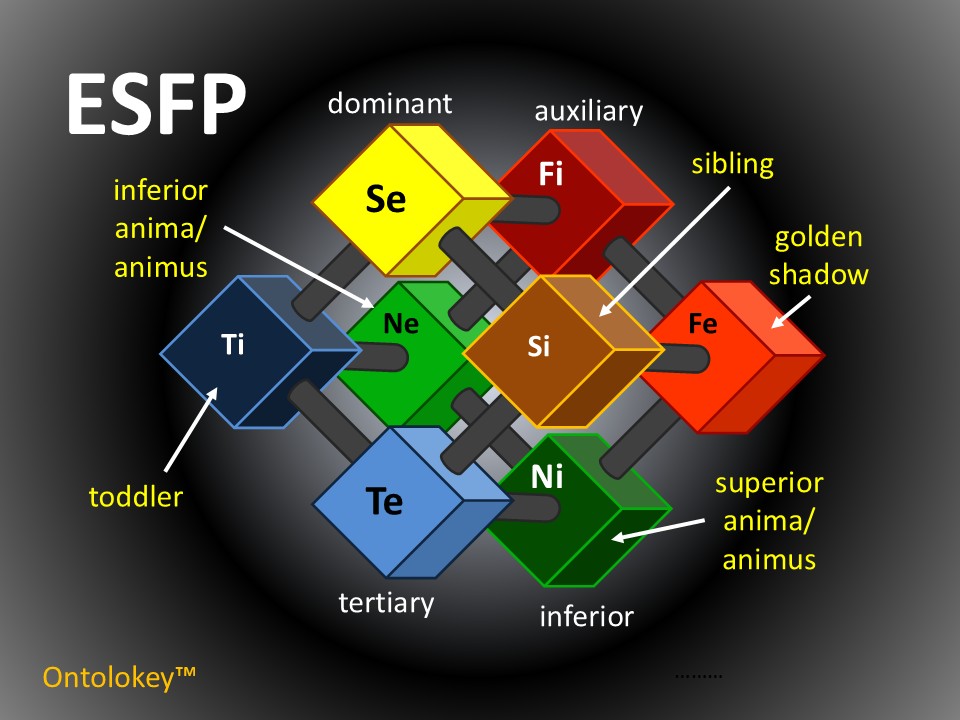
The Seduction of Reality
Among all personality structures, few are as profoundly misunderstood as the ESFP. Popular descriptions often portray this type as charismatic, spontaneous, adventurous, energetic, socially gifted, and deeply engaged with life. While these descriptions contain elements of truth, they frequently remain trapped at the surface level of observation. They describe what the ESFP looks like when functioning well, when psychologically balanced, and when life cooperates with the individual’s natural orientation toward experience. They rarely explore what happens when the same psychological mechanisms become exaggerated, defensive, compulsive, or unconscious. Yet every personality carries within itself the seeds of its own shadow, and nowhere is this more evident than in the ESFP.
The defining psychological characteristic of this personality is not merely sociability, pleasure-seeking, or enthusiasm. At a much deeper level, the ESFP is a personality organized around direct engagement with reality. Reality is not approached through abstraction, detached reflection, ideological systems, or theoretical frameworks. It is approached through contact. Life must be touched, tasted, experienced, conquered, felt, entered, and inhabited. The ESFP does not merely want to know that something exists; the ESFP wants to encounter it. Existence becomes meaningful through participation rather than contemplation. While many personalities construct internal models of reality and then interact with life through those models, the ESFP often reverses this process. Experience comes first. Meaning comes later, if it comes at all.
This orientation grants extraordinary strengths. The healthy ESFP possesses a vividness that many other personalities secretly envy. Such individuals often appear more alive than those around them. They can adapt quickly to changing circumstances, respond instinctively to opportunities, and maintain a connection to the concrete realities of existence that more abstract personalities frequently lose. They often possess a remarkable capacity for practical action. While others are still discussing possibilities, the ESFP may already be moving. While others remain trapped in endless analysis, the ESFP may already be testing reality directly. There is courage in this orientation. There is vitality in it. There is even wisdom in it, because reality often teaches lessons that theories cannot.
However, every psychological gift creates a corresponding vulnerability. The very strength that allows the ESFP to immerse themselves in life can gradually become an addiction to external stimulation. What begins as healthy engagement can slowly transform into dependence. The individual becomes increasingly unable to tolerate psychological stillness. Silence begins to feel threatening. Reflection feels unnecessary. Introspection feels unproductive. The inner world becomes neglected because the outer world continually offers fresh stimulation. At first this neglect appears harmless. After all, life seems to be working. The person remains active, attractive, successful, and engaged. Yet beneath the surface, an invisible imbalance begins to form.
The central danger emerges when experience ceases to be a means of growth and becomes an escape from self-confrontation. This distinction is crucial. Healthy experience expands consciousness. Unhealthy experience distracts consciousness. The difference is often difficult to detect because the external behavior may look identical. In both cases the person travels, socializes, pursues goals, seeks excitement, enters relationships, explores opportunities, and remains active. Yet psychologically these behaviors can serve entirely different purposes. In one case they enrich life. In the other they function as defenses against the anxiety that emerges whenever the individual is left alone with unresolved inner realities.
The shadow side of the ESFP therefore does not begin with recklessness, impulsivity, aggression, or excess. Those are later manifestations. The shadow begins much earlier with a subtle but growing alienation from the inner world. Because direct experience is so rewarding, self-reflection may appear unnecessary. Because action solves many practical problems, contemplation may seem like a waste of time. Because immediate reality feels more trustworthy than abstract interpretation, psychological complexity may be dismissed altogether. The individual increasingly identifies with what is visible, tangible, and immediate, while everything hidden, symbolic, emotional, or unconscious is pushed into the background.
Yet the unconscious never disappears simply because it is ignored. It accumulates. It waits. It compensates.
This is one of the great psychological paradoxes governing the ESFP shadow. The more intensely consciousness focuses on external reality, the more powerful unconscious forces become. Because these forces are not consciously examined, they begin operating indirectly. They emerge through irrational fears, sudden obsessions, emotional overreactions, jealousy, suspicion, compulsive desires, and unexpected behavioral contradictions. The individual who prides themselves on being practical may suddenly become consumed by irrational assumptions. The person who appears grounded in reality may become vulnerable to strange anxieties. The individual who seems fearless may discover hidden insecurities that erupt under pressure with surprising intensity.
What makes this process particularly dangerous is that the ESFP often possesses enough confidence and forcefulness to remain unaware of it for years. Many personalities receive immediate feedback when they become psychologically imbalanced. The ESFP frequently does not. Their social skills, adaptability, charisma, and action-orientation can continue generating external rewards long after inner development has stalled. This creates a situation in which external success masks internal fragmentation. The person continues moving forward while simultaneously becoming more disconnected from deeper layers of the psyche.
Over time, the pursuit of stimulation can become increasingly demanding. Ordinary experiences no longer produce the same psychological intensity. More excitement becomes necessary. More novelty becomes necessary. More conquest becomes necessary. More risk becomes necessary. The individual may not consciously realize that this escalation is occurring. They simply experience a growing restlessness. What once satisfied them now feels insufficient. What once felt exciting now feels ordinary. Life becomes an endless search for the next experience capable of recreating a feeling of aliveness that is gradually slipping away.
At this stage the personality enters dangerous territory. The pursuit of experience begins to dominate the pursuit of meaning. Pleasure becomes disconnected from fulfillment. Intensity becomes confused with depth. Movement becomes confused with growth. Activity becomes confused with purpose. Because the ESFP naturally trusts direct experience, these distinctions are not always easy to recognize. The individual may sincerely believe they are living fully when in reality they are running from an encounter with themselves.
The deepest irony is that the ESFP’s greatest fear often remains hidden even from the ESFP. On the surface, fear appears to concern boredom, restriction, powerlessness, missed opportunities, or loss of freedom. At a deeper level, however, the hidden fear is frequently psychological emptiness. If all external stimulation disappeared, what would remain? If the excitement stopped, what unresolved conflicts would emerge? If the individual could no longer distract themselves through action, what truths would demand recognition?
These questions mark the entrance to the shadow.
The shadow is not evil. It is not moral failure. It is not pathology. It is the collection of psychological realities that consciousness refuses to acknowledge. For the ESFP, this often means confronting everything that cannot be solved through action alone. Vulnerability. Existential anxiety. Dependency. Shame. Emotional wounds. Contradictory desires. Unexamined motivations. The awareness of mortality. The limits of pleasure. The limits of power. The limits of control. These realities belong to every human being, but they often appear particularly threatening to a personality structure built upon active engagement with life.
The tragedy of the undeveloped ESFP is not that they live too intensely. The tragedy is that they may spend years pursuing intensity while remaining strangers to themselves. The tragedy is that they can become masters of experience while remaining novices of self-knowledge. The tragedy is that they may conquer the external world while leaving vast territories of the inner world unexplored. When this happens, the shadow does not disappear. It grows stronger. It gathers energy in the darkness. Eventually it demands recognition, often through crisis, conflict, loss, addiction, relational collapse, or profound existential dissatisfaction.
Every authentic psychological transformation begins at precisely this point. The journey into the shadow starts when the ESFP recognizes that experience alone cannot answer every question life asks. There are dimensions of existence that require not action but reflection, not conquest but understanding, not stimulation but consciousness. Only then can the personality move beyond the pursuit of experience and begin the far more difficult task of discovering what kind of person is having those experiences in the first place.
The Tyranny of Impulse and the Will to Dominate Reality
One of the most misunderstood aspects of the ESFP shadow concerns the nature of impulse. In superficial descriptions, impulsiveness is often portrayed as little more than spontaneity, adventurousness, or a preference for living in the moment. Such portrayals contain a fragment of truth, but they conceal a much deeper psychological reality. Impulse is not merely a tendency toward action. At its deepest level, impulse represents a particular relationship between consciousness and desire. It reveals how an individual manages tension, frustration, uncertainty, and internal conflict. In the healthy ESFP, impulse functions as vitality. In the shadow-dominated ESFP, impulse becomes compulsion. The difference between these two states is not visible from the outside. Both individuals may appear energetic, decisive, and action-oriented. Yet internally, one acts from freedom while the other acts from necessity.
The healthy ESFP experiences desire as information. A desire emerges, is acknowledged, evaluated, and then either acted upon or consciously restrained. The shadow ESFP experiences desire differently. Desire begins to acquire authority. It ceases to be one psychological voice among many and gradually becomes the dominant voice within the personality. The individual increasingly feels that wanting something is sufficient justification for pursuing it. Frustration becomes difficult to tolerate because frustration is experienced not merely as disappointment but as an attack on psychological equilibrium itself. The capacity to remain in tension without immediate discharge weakens. Consequently, action becomes less a deliberate choice and more a mechanism of emotional regulation.
This dynamic explains why certain shadow manifestations appear repeatedly in descriptions of sensation-dominant personalities across psychological literature. What emerges is not merely thrill-seeking but a profound intolerance of internal pressure. The individual develops an unconscious need to resolve emotional tension immediately. If attraction arises, it must be pursued. If anger arises, it demands expression. If boredom appears, stimulation must be found. If frustration develops, reality itself becomes the enemy. The capacity to remain psychologically still in the presence of unresolved emotions gradually deteriorates. Life becomes organized around discharge rather than understanding.
The consequences of this process become particularly visible in the domain of power. Power is often misunderstood as a political or social phenomenon. Psychologically, power is much more fundamental. Power concerns the ability to impose one’s will upon reality. Every personality seeks power in some form, but different personalities pursue it through different means. Some seek power through knowledge. Some seek power through morality. Some seek power through social influence. The shadow ESFP frequently seeks power through direct impact. There is a desire to influence situations immediately, visibly, and concretely. The individual wishes to feel that reality responds to their presence.
In its healthy form, this creates remarkable leadership abilities. Such individuals are often decisive in crises. They can mobilize people. They can take action when others freeze. They possess courage that many admire. Yet every strength contains the possibility of distortion. When psychological development stagnates, the desire for influence can gradually become a need for control. The individual begins to experience resistance as a personal challenge. Other people’s boundaries become obstacles rather than realities deserving respect. Disagreement becomes opposition. Independence becomes disloyalty. Autonomy in others begins to feel threatening because it limits the individual’s ability to shape circumstances according to personal desires.
At this stage the shadow begins revealing one of its darker dimensions. Many ESFPs possess an extraordinary ability to read immediate social realities. They often notice weakness, hesitation, insecurity, attraction, fear, and desire in others long before these states become verbally expressed. In a psychologically mature individual this ability generates empathy and responsiveness. In an immature individual it can become a tool of manipulation. The person learns, often unconsciously, how to push emotional buttons, how to provoke reactions, how to create dependency, and how to maintain influence over interpersonal dynamics. Because these behaviors arise naturally rather than strategically, the individual may sincerely believe they are simply being authentic while simultaneously exercising considerable psychological power over others.
This tendency becomes especially visible in intimate relationships. The shadow ESFP often craves intensity more than stability. Stability may initially feel comforting, but over time it can produce a sense of emotional suffocation. Intensity, by contrast, creates psychological aliveness. Consequently, relationships may become arenas in which emotional intensity is constantly generated, amplified, and maintained. Conflict can become strangely attractive because conflict produces stimulation. Jealousy can become attractive because jealousy intensifies emotional experience. Dramatic reconciliations can become attractive because they temporarily restore feelings of connection and passion. The individual may unconsciously create the very instability they consciously claim to dislike.
One of the most troubling aspects of this pattern is that it often coexists with genuine affection. The shadow ESFP is rarely the cold manipulator imagined by simplistic moral narratives. More often, they sincerely love the people around them. They may be generous, protective, affectionate, and deeply loyal in many situations. Yet when powerful emotional currents emerge, another side of the personality appears. The desire to possess can temporarily overwhelm the desire to love. The need to win can temporarily overwhelm the need to understand. The urge to dominate reality can temporarily overwhelm respect for reality itself. Consequently, relationships become characterized by cycles of devotion and control, warmth and aggression, generosity and possessiveness.
The psychological roots of possessiveness deserve particular attention because they reveal an important truth about the ESFP shadow. Possessiveness is rarely caused by strength. It is usually caused by fear. Beneath the confident exterior often lies a profound anxiety regarding loss. The individual may fear losing status, losing attraction, losing influence, losing freedom, losing emotional significance, or losing the people who provide psychological grounding. Because these fears remain largely unconscious, they are not experienced as vulnerability. Instead, they emerge as controlling behavior. The person attempts to secure externally what feels uncertain internally. The tighter the grip becomes, however, the more instability is created. What begins as a strategy for preventing abandonment frequently becomes the very cause of it.
The accumulation of anger represents another crucial aspect of the shadow. Contrary to stereotypes, the darker ESFP is not always explosively emotional. In fact, many learn to suppress frustration for extended periods. They tolerate irritation, disappointment, disrespect, and resentment far longer than observers realize. The problem is not the presence of anger itself but the manner in which anger is processed. Rather than being consciously examined and integrated, it accumulates. It gathers psychological weight. Small grievances merge with larger ones. Old injuries combine with new frustrations. Eventually a threshold is crossed and the emotional system demands release.
When this release occurs, it often surprises everyone involved, including the ESFP. The intensity of the reaction appears disproportionate because the visible trigger represents only a fraction of the accumulated emotional burden. What seems like an explosion over a minor issue is often the eruption of months or years of unresolved tension. During these moments, the individual’s capacity for perspective narrows dramatically. Nuance disappears. Complexity disappears. There remains only the emotional reality of the present moment. The world becomes divided into allies and enemies, loyalty and betrayal, respect and disrespect, victory and defeat.
This narrowing of consciousness reveals something profound about the shadow itself. The shadow does not make people irrational in the conventional sense. Rather, it reduces psychological complexity. The individual becomes temporarily incapable of holding multiple truths simultaneously. Ambiguity becomes intolerable. Contradictions become unbearable. Emotional certainty replaces reflective understanding. This is why highly intelligent individuals can behave in remarkably primitive ways when overwhelmed by shadow material. Intelligence remains intact, but consciousness contracts.
Perhaps nowhere is this more evident than in the ESFP’s relationship with pride. Pride is often one of the hidden engines driving this personality structure. Healthy pride manifests as confidence, self-respect, and personal dignity. Shadow pride manifests differently. It creates an inability to tolerate humiliation, weakness, dependency, or vulnerability. The individual becomes psychologically invested in appearing strong at all times. Admitting mistakes becomes difficult. Acknowledging emotional wounds becomes difficult. Accepting limitations becomes difficult. As a result, enormous amounts of psychological energy are devoted to defending an identity that appears invulnerable.
Yet the human psyche cannot sustain such defenses indefinitely. Eventually reality intervenes. Relationships fail. Bodies age. Opportunities disappear. Betrayals occur. Illness arrives. Mortality becomes impossible to ignore. The individual encounters situations that cannot be conquered through force of personality, social skill, attractiveness, or determination. It is precisely at these moments that the deepest shadow emerges. The question is no longer whether the person can dominate reality. The question becomes whether they can surrender to reality without feeling annihilated by it.
This confrontation marks a decisive turning point in psychological development. The immature ESFP experiences limitation as humiliation. The mature ESFP experiences limitation as initiation. One responds with rage, denial, blame, or reckless compensation. The other begins the painful process of self-examination. This transition is extraordinarily difficult because it requires abandoning the illusion that strength alone can solve every problem. It requires recognizing that some aspects of existence cannot be mastered through action. They must be understood, endured, and integrated.
The deepest shadow of the ESFP therefore does not consist merely of impulsiveness, aggression, possessiveness, or domination. These are symptoms. The true shadow lies in the unconscious belief that reality must always bend before desire. As long as this belief remains unexamined, the individual remains trapped in an endless struggle with life itself. Every obstacle becomes a personal insult. Every limitation becomes a battle. Every disappointment becomes evidence that something has gone wrong. Genuine maturity begins when the ESFP realizes that reality was never meant to obey desire completely. Reality exists partly to challenge desire, refine it, and ultimately transform it.
Only when this truth is accepted does power cease to be domination and become something far more profound: self-mastery. The individual who once sought control over the external world gradually discovers the far more difficult task of governing the forces within. It is there, in that invisible territory, that the real battle of the ESFP shadow is fought.
Hedonism, Addiction, Sexuality, Obsession, and the Hunger That Can Never Be Satisfied
Every personality has a preferred method for escaping psychological suffering. Some escape into ideas. Some disappear into duty. Some seek refuge in intellectual systems, spiritual doctrines, or emotional dependency. The shadow ESFP, however, often seeks refuge in experience itself. This distinction is of enormous importance because experience possesses a unique advantage over other forms of escape: it feels real. Unlike fantasy, ideology, or abstraction, sensory experience appears undeniably concrete. It engages the body. It stimulates the nervous system. It produces immediate consequences. Because of this, the ESFP can spend years believing they are fully engaged with life while simultaneously using life itself as a distraction from deeper psychological realities.
This dynamic forms the foundation of the shadow’s relationship with hedonism. Hedonism is frequently misunderstood as simple pleasure-seeking, but psychologically it represents something far more complex. Genuine pleasure is not inherently destructive. Pleasure is a natural component of a healthy life. Hedonism becomes pathological when pleasure ceases to enrich existence and instead becomes a mechanism for avoiding existence. The difference may appear subtle, yet it marks the dividing line between vitality and addiction. In one case, pleasure serves life. In the other, life becomes organized around the pursuit of pleasure.
The ESFP is particularly vulnerable to this trap because of the extraordinary immediacy with which they experience reality. Experiences are not merely observed; they are absorbed. Music is felt physically. Attraction is experienced viscerally. Excitement floods the nervous system with intensity. Success generates powerful emotional rewards. Adventure produces genuine exhilaration. These capacities contribute significantly to the ESFP’s charm and vitality. Yet they also create a psychological environment in which external stimulation can become intoxicating. The individual begins to rely on experience not simply for enjoyment but for emotional regulation. Gradually, stimulation transforms from a preference into a necessity.
At first the process appears harmless. The person enjoys social events, romantic encounters, travel, excitement, competition, and novelty. Friends admire their enthusiasm. Others envy their courage. Life appears full and vibrant. Yet beneath this surface a subtle shift often occurs. The threshold for satisfaction begins rising. Experiences that once produced excitement become ordinary. What once felt extraordinary becomes expected. The nervous system adapts. Consequently, more stimulation becomes necessary to achieve the same psychological effect. The individual does not consciously choose this escalation. Rather, they experience it as growing restlessness. Life begins to feel flat unless something intense is happening.
This is one of the central tragedies of sensation-based addiction. The problem is not the pleasure itself. The problem is adaptation. Human consciousness quickly adjusts to repeated rewards. What initially feels extraordinary eventually becomes normal. The individual then seeks greater intensity to recover the original feeling. Unfortunately, the original feeling cannot be recovered because it was never produced solely by the experience itself. It was produced by novelty. Novelty, however, is inherently temporary. Thus begins an endless pursuit of experiences that promise fulfillment but can only provide temporary stimulation.
The shadow ESFP often experiences this process as a vague but persistent hunger. It is not merely a desire for pleasure. It is a desire for psychological fullness. The individual senses an absence somewhere within themselves and unconsciously attempts to fill it through external means. More experiences. More adventures. More achievements. More attention. More admiration. More excitement. More intimacy. More conquest. Yet every fulfillment eventually fades, leaving behind the same fundamental emptiness. The hunger returns because the source of the hunger was never external to begin with.
Sexuality frequently becomes one of the most powerful arenas in which this dynamic unfolds. Few human experiences combine intensity, excitement, validation, novelty, emotional connection, and sensory pleasure as effectively as sexuality. Consequently, sexuality can become psychologically overloaded with meanings far beyond physical attraction. The shadow ESFP may unconsciously use sexual experience to regulate self-esteem, combat loneliness, escape existential anxiety, confirm desirability, establish power, or create temporary feelings of significance. The relationship itself becomes secondary to the psychological function it serves.
This does not mean that all ESFPs become promiscuous. Such stereotypes are simplistic and often inaccurate. The deeper issue concerns psychological dependency rather than behavioral frequency. One individual may have many partners. Another may remain within a single long-term relationship. Both can experience the same underlying dynamic if their emotional stability becomes excessively dependent upon romantic intensity. The defining feature is not behavior but psychological necessity. When intimacy becomes required to maintain a coherent sense of self, relationships begin carrying burdens they were never designed to bear.
Under these conditions attraction itself often becomes distorted. The individual may mistake intensity for compatibility. They may become attracted to people who generate powerful emotional reactions regardless of whether those relationships are healthy. Calm affection can feel boring. Stability can feel lifeless. Predictability can feel suffocating. Consequently, relationships characterized by volatility, uncertainty, and emotional extremes may appear more exciting than relationships characterized by trust and consistency. The individual unconsciously confuses emotional turbulence with passion because both produce heightened psychological stimulation.
The shadow side of seduction emerges from this same mechanism. The ability to attract others often becomes a source of profound psychological reinforcement. Attention confirms desirability. Desire confirms value. Influence confirms power. The individual discovers that attraction grants access to emotional rewards that temporarily soothe deeper insecurities. Yet because these rewards remain external, they never produce lasting stability. The result is a cycle in which validation becomes increasingly necessary while simultaneously becoming less satisfying. What initially feels empowering gradually becomes exhausting. The person must continually recreate conditions that provide reassurance because the reassurance itself never penetrates deeply enough to resolve the underlying insecurity.
Obsession represents another manifestation of this dynamic. Many observers imagine obsession as a characteristic of highly introverted or emotionally dependent personalities. In reality, the shadow ESFP can become intensely obsessive, particularly when confronted with uncertainty. Because direct engagement with reality is psychologically central to this personality, situations that cannot be controlled or resolved often become extraordinarily disturbing. Unanswered questions create tension. Ambiguous relationships create tension. Uncertain outcomes create tension. The individual may become fixated on obtaining closure, certainty, or resolution because uncertainty itself feels psychologically intolerable.
This tendency becomes especially dangerous when combined with jealousy. Jealousy is fundamentally an imagination-driven emotion. It emerges when the mind attempts to fill gaps in knowledge with hypothetical scenarios. For a personality strongly oriented toward concrete reality, this process can be profoundly destabilizing. The individual becomes trapped between what they know and what they fear. Because certainty cannot be obtained, imagination begins generating possibilities. These possibilities often become emotionally real long before they are objectively verified. Suspicion grows. Possessiveness grows. Anxiety grows. The individual may become consumed by narratives that exist primarily within their own psyche.
The relationship between addiction and obsession reveals one of the deepest truths about the ESFP shadow. Contrary to appearances, the shadow is not primarily driven by pleasure. It is driven by relief. Pleasure is simply the vehicle through which relief is obtained. The addicted person does not necessarily seek ecstasy. More often, they seek temporary freedom from discomfort. The same principle applies psychologically. The shadow ESFP may not pursue stimulation because stimulation is extraordinarily enjoyable. They may pursue stimulation because stillness has become unbearable. Silence allows unresolved emotions to surface. Reflection allows hidden fears to emerge. Solitude reveals psychological realities that activity keeps temporarily concealed.
This explains why periods of inactivity often provoke surprising discomfort in deeply unbalanced individuals. Without external stimulation, internal material begins rising toward consciousness. Old regrets emerge. Existential questions emerge. Relationship wounds emerge. Feelings of inadequacy emerge. Mortality emerges. The individual suddenly encounters dimensions of themselves that have been avoided for years. Consequently, there is a powerful temptation to escape back into movement. Another trip. Another romance. Another goal. Another crisis. Another distraction. Anything except direct confrontation with the inner void.
Yet the void itself is frequently misunderstood. Most people assume the void represents emptiness. Psychologically, it often represents the opposite. The void is not empty. It is crowded. It contains grief that has never been processed, fears that have never been acknowledged, desires that have never been examined, and contradictions that have never been reconciled. The reason it feels empty is because consciousness has never entered it. The darkness appears vacant only because it remains unexplored.
The mature ESFP eventually encounters a difficult realization. No experience, regardless of intensity, can permanently satisfy a hunger rooted in the soul. No amount of pleasure can resolve existential uncertainty. No amount of admiration can create self-worth. No amount of conquest can eliminate vulnerability. No amount of stimulation can substitute for self-knowledge. These truths often arrive painfully because they challenge the very strategy the individual has used to navigate life. Yet they also open the door to genuine transformation.
The transition from hedonism to depth does not require abandoning pleasure. It requires changing one’s relationship with pleasure. Experience ceases to function as an escape and becomes what it was always meant to be: an expression of life rather than a substitute for it. Sexuality becomes connection rather than validation. Adventure becomes growth rather than distraction. Pleasure becomes enrichment rather than anesthesia. Intensity becomes a gift rather than a necessity.
Only then does the endless hunger begin to lose its power. The individual discovers that the craving was never truly for excitement. The craving was for wholeness. Excitement merely provided temporary glimpses of the aliveness that wholeness naturally produces. Once this distinction is understood, the shadow loses one of its most powerful weapons. The person no longer chases stimulation in the hope that it will finally complete them. Instead, they begin the far more difficult task of becoming complete enough that stimulation is no longer required to feel alive.
This marks one of the most important turning points in the development of the ESFP. The individual who once sought salvation through experience gradually learns that experience can enrich life but cannot define it. The hunger that once appeared insatiable begins revealing its true nature. It was never a hunger for more life. It was a hunger for a deeper relationship with life itself.
Narcissism, Pride, Image, Social Dominance, and the Fear of Insignificance
Among the many shadow manifestations that can emerge within the ESFP personality, few are as difficult to discuss honestly as narcissism. The difficulty arises because the term itself has become so distorted by popular culture that it often functions more as an insult than as a psychological concept. In reality, narcissism exists on a spectrum that encompasses every human being. Every person requires a certain degree of self-investment in order to function. Every individual seeks recognition, validation, and a sense of personal significance. The question is not whether narcissistic needs exist. The question is how consciously those needs are understood and how desperately they must be fed. It is precisely at this point that one encounters one of the deepest and most hidden dimensions of the ESFP shadow.
The healthy ESFP often possesses a natural charisma that requires little effort to express. Such individuals frequently command attention without consciously seeking it. Their vitality, emotional expressiveness, confidence, and capacity to engage directly with people create an immediate social presence. Others often experience them as energetic, attractive, persuasive, and difficult to ignore. Yet every social advantage carries a psychological cost. When admiration repeatedly accompanies one’s presence, admiration can gradually become incorporated into the structure of identity itself. The individual begins to derive not merely pleasure but psychological stability from the responses they evoke in others. What begins as a gift slowly transforms into a dependency.
This process rarely occurs consciously. Most shadow dynamics develop precisely because they remain hidden from awareness. The individual simply notices that being admired feels good, being desired feels good, being influential feels good, and being noticed feels good. There is nothing pathological about this initially. Human beings are social creatures, and recognition serves important developmental functions. Problems emerge only when external recognition becomes the primary source of internal value. The personality gradually becomes organized around maintaining an image capable of generating the desired responses. The self becomes increasingly dependent upon reflection in the eyes of others.
The distinction between identity and image becomes critically important here. Identity refers to what a person actually is. Image refers to how that person is perceived. In psychologically mature individuals, image remains secondary to identity. The person values reputation but does not depend upon it for psychological survival. In the shadow-dominated ESFP, however, image can slowly replace identity as the center of gravity. The individual begins investing enormous energy into maintaining attractiveness, influence, relevance, desirability, status, or social power. Life becomes less about being and more about appearing. The tragedy is that this transition often occurs so gradually that it remains invisible to the person experiencing it.
The deeper one investigates this phenomenon, the more one discovers that image management is rarely motivated by vanity alone. Beneath vanity often lies anxiety. The individual fears becoming invisible. They fear becoming irrelevant. They fear becoming ordinary. They fear losing the qualities that once distinguished them from others. These fears are not necessarily conscious. They may appear only indirectly through compulsive self-presentation, excessive competitiveness, status-seeking behavior, or relentless efforts to remain desirable. Yet beneath all such behaviors lies a simple psychological question: if admiration disappeared tomorrow, who would I be?
This question is profoundly threatening because it exposes a vulnerability that many shadow ESFPs spend years avoiding. Much of their confidence may be authentic, but some portion of it is often contingent upon feedback from the environment. As long as the environment provides sufficient reinforcement, psychological equilibrium remains intact. Problems arise when reality inevitably withdraws some of that reinforcement. Aging occurs. Social hierarchies change. New competitors emerge. Relationships end. Physical attractiveness evolves. Public attention shifts elsewhere. The individual discovers that many of the external foundations supporting their self-image are less permanent than previously imagined.
At this point the shadow often reacts with remarkable intensity. One common response is inflation. Rather than confronting insecurity directly, the personality expands. The individual becomes more boastful, more dominant, more demanding of attention, and more invested in proving superiority. To outside observers this may appear like confidence, but psychologically it often represents the opposite. Genuine confidence requires no constant demonstration. Inflated confidence, by contrast, must continually reaffirm itself because it is defending against doubt. The louder the proclamation of superiority becomes, the more likely it is that insecurity exists somewhere beneath the surface.
The relationship between pride and humiliation reveals this dynamic with particular clarity. Pride itself is not inherently destructive. Healthy pride forms the basis of dignity, self-respect, and personal responsibility. Without pride, individuals become vulnerable to exploitation and self-neglect. The shadow problem emerges when pride becomes fused with identity. In such cases criticism is no longer experienced as information. It is experienced as an existential threat. Failure is no longer a temporary setback. It becomes evidence of inadequacy. Disagreement is no longer interpreted as a difference of perspective. It becomes disrespect. Consequently, ordinary social friction acquires disproportionate emotional significance.
One frequently observes this mechanism in situations involving public embarrassment. Many personalities dislike humiliation, but the shadow ESFP often experiences it with unusual intensity. Because social presence occupies such a central role within the personality structure, damage to public image can feel psychologically devastating. The individual may react with rage, denial, retaliation, or dramatic efforts to restore status. Observers sometimes interpret these reactions as arrogance, yet arrogance is only part of the story. Beneath the reaction often lies a wounded sense of self struggling to preserve coherence in the face of perceived degradation.
The fear of insignificance constitutes perhaps the deepest layer of this entire structure. Most people fear failure. Many fear rejection. The shadow ESFP often fears something even more fundamental: becoming unimportant. This fear rarely appears directly because it is psychologically painful to acknowledge. Instead, it manifests through endless activity, social prominence, achievement, seduction, competition, influence, and visibility. The individual unconsciously attempts to prove their significance through external evidence. If enough people admire them, they matter. If enough people desire them, they matter. If enough people recognize them, they matter. The problem, of course, is that significance established externally remains permanently vulnerable to external change.
This vulnerability frequently generates subtle forms of social dominance. The shadow ESFP may not consciously seek control over others, yet they often seek control over how they are perceived by others. These motivations overlap more than many realize. If one’s sense of self depends heavily upon admiration, then influencing perceptions becomes psychologically important. The individual learns how to charm, persuade, impress, entertain, provoke, seduce, intimidate, or inspire. Such abilities are not necessarily manipulative in themselves. They become problematic only when they are used primarily to secure validation rather than foster genuine connection.
Over time this dynamic can create a peculiar loneliness. The person may be surrounded by friends, admirers, romantic partners, colleagues, and social opportunities while simultaneously feeling profoundly unseen. This occurs because people are often responding to the image rather than the individual behind it. The more successful the image becomes, the greater the danger. Others admire the confidence, attractiveness, charisma, strength, or influence they perceive, while the individual’s hidden insecurities remain concealed. Consequently, the very qualities that generate social success may also prevent authentic intimacy. People cannot deeply know what they never see.
This loneliness often becomes especially apparent during periods of crisis. When loss, failure, illness, aging, or disappointment strips away external sources of validation, the individual is forced into an encounter with parts of themselves that have remained underdeveloped. The question is no longer whether they can attract admiration. The question becomes whether they can tolerate themselves without admiration. The issue is no longer whether they can dominate social environments. The issue becomes whether they can remain psychologically whole when they are no longer the center of attention.
Many never consciously confront this challenge. Instead, they continue chasing increasingly fragile forms of validation. They become addicted to visibility, addicted to desirability, addicted to relevance. Yet every addiction follows the same psychological law. What is sought externally can never permanently satisfy an internal need. No amount of admiration can create intrinsic worth. No amount of status can produce authentic self-respect. No amount of attention can eliminate existential insecurity. The attempt to achieve these goals through external means merely postpones the inevitable confrontation with oneself.
The mature ESFP eventually arrives at a radically different understanding of significance. Significance ceases to be something granted by the crowd and becomes something discovered internally. The individual realizes that value does not increase because others recognize it. Nor does value disappear when recognition fades. This realization is psychologically revolutionary because it liberates the person from dependence upon perpetual performance. They no longer need to prove their existence through visibility. They no longer need to secure identity through admiration. They no longer need to dominate social reality in order to feel real.
Paradoxically, it is only after this transformation that true charisma emerges. The immature form of charisma seeks attention. The mature form no longer requires it. The immature personality enters every room asking, consciously or unconsciously, “How important am I here?” The mature personality enters asking, “What is needed here?” One orientation revolves around self-confirmation. The other revolves around reality itself. The difference may appear subtle, yet it marks the boundary between narcissism and genuine presence.
Ultimately, the deepest shadow of the ESFP is not arrogance, vanity, pride, or even narcissism. Those are merely surface expressions. The deepest shadow is the hidden fear that without admiration there may be nothing of value underneath. The great psychological task of development is therefore not learning how to attract more recognition. It is discovering that one’s worth was never dependent upon recognition in the first place. Only then can the personality become truly free. Only then can influence exist without domination, confidence without inflation, pride without defensiveness, and charisma without psychological dependency.
At that moment, the individual no longer seeks significance from the world. They bring significance into the world through the depth of their being. That transformation marks the beginning of genuine psychological maturity and the first real victory over the shadow.
The Inferior Inner World — Why the ESFP Runs from Reflection, Meaning, and Existential Anxiety
Every personality develops through a process of specialization. Consciousness cannot master every dimension of existence equally, and therefore it inevitably favors certain ways of perceiving and responding to reality while neglecting others. What is developed becomes conscious competence. What is neglected remains partially unconscious. Over time, this asymmetry creates the characteristic strengths and weaknesses associated with every personality structure. The greatest strengths emerge from the dominant mode of adaptation. The deepest shadows emerge from what consciousness leaves behind. In the case of the ESFP, few neglected territories are more significant than the realm of abstraction, symbolism, long-range meaning, and existential reflection. It is here, within this underdeveloped inner landscape, that some of the most profound psychological conflicts of the personality quietly reside.
To understand this dynamic, one must first appreciate the extraordinary effectiveness of the ESFP’s primary orientation toward life. Direct engagement with reality works. Action produces results. Experience generates knowledge. Immediate feedback provides reliable information. The external world offers concrete evidence that can be observed, tested, and verified. Compared to this vivid reality, the world of symbols, theories, existential questions, and psychological abstractions often appears frustratingly vague. Why spend hours contemplating meaning when life can be lived directly? Why analyze endlessly when experience itself provides answers? Why become trapped in internal speculation when reality stands immediately available for exploration?
At first glance these questions appear entirely reasonable. In many situations they are reasonable. Excessive introspection can become paralysis. Endless analysis can become avoidance. Obsessive self-examination can detach people from life itself. The ESFP frequently recognizes these dangers with remarkable clarity. However, every truth becomes dangerous when elevated into an absolute principle. The belief that life should primarily be experienced rather than examined eventually encounters limitations. Human beings are not merely creatures of action. They are also creatures of meaning. They do not merely inhabit reality. They interpret reality. When interpretation remains neglected for too long, psychological consequences begin accumulating beneath conscious awareness.
One of the great paradoxes of the ESFP personality is that beneath the apparent preference for concrete reality often exists a powerful but underdeveloped hunger for meaning. This hunger rarely announces itself directly. It emerges indirectly through restlessness, dissatisfaction, existential boredom, recurring questions about purpose, and a vague sense that something essential remains missing despite external success. The individual may possess relationships, achievements, pleasures, experiences, and opportunities while simultaneously feeling haunted by an undefined absence. Because this absence cannot be touched, measured, purchased, seduced, or conquered, it often remains difficult to understand.
The shadow develops precisely within this confusion. The ESFP frequently assumes that dissatisfaction indicates a lack of experience rather than a lack of meaning. Consequently, the solution appears obvious. More experiences are pursued. New goals are established. New relationships emerge. New adventures begin. New forms of stimulation are explored. Yet after each achievement, the same quiet dissatisfaction gradually returns. The problem persists because the source of the problem has been misidentified. Meaning deficits cannot be resolved through increased stimulation. Existential hunger cannot be satisfied through sensory abundance. The psyche continues demanding something fundamentally different.
This demand often appears most clearly during periods of stillness. The shadow ESFP frequently experiences an uneasy relationship with prolonged inactivity. Activity itself is rarely the issue. The deeper issue concerns what becomes visible when activity stops. During movement, attention remains focused outward. During stillness, attention inevitably begins turning inward. Thoughts emerge that have been postponed. Questions emerge that have been avoided. Contradictions emerge that have remained hidden beneath daily engagement. The individual suddenly encounters dimensions of reality that cannot be solved through action. Instead of external obstacles, there are internal mysteries.
For many ESFPs, this encounter produces a subtle but persistent discomfort. Reflection often feels less rewarding than action because reflection rarely provides immediate results. The external world responds quickly to effort. The inner world does not. Psychological insight unfolds slowly. Meaning develops gradually. Self-knowledge often emerges through prolonged confrontation with ambiguity. Such processes require patience, uncertainty, and tolerance for complexity. These qualities do not naturally align with a personality structure oriented toward direct engagement and immediate feedback. Consequently, the individual may unconsciously avoid precisely the activities necessary for deeper psychological development.
The consequences of this avoidance become increasingly visible with age. During youth and early adulthood, vitality itself can conceal many existential problems. The future appears expansive. Possibilities seem endless. The abundance of opportunities creates the impression that fulfillment remains just beyond the next experience. Yet life inevitably introduces limitations. Time passes. Choices become irreversible. Mortality becomes more difficult to ignore. The individual begins realizing that existence is finite. At this point questions that once seemed optional suddenly become unavoidable. What has all this activity meant? What remains when excitement fades? What has been built beneath the experiences themselves?
These questions often trigger profound existential anxiety. Existential anxiety differs fundamentally from ordinary fear. Ordinary fear concerns specific threats. Existential anxiety concerns existence itself. It emerges when individuals confront freedom, mortality, uncertainty, meaninglessness, isolation, and the limitations inherent in human life. Such realities cannot be defeated. They cannot be negotiated away. They cannot be escaped permanently. Every human being must eventually encounter them. The difference lies in how consciously that encounter occurs.
The shadow ESFP often attempts to manage existential anxiety through increased engagement with immediate reality. Faced with uncertainty, they seek experience. Faced with mortality, they seek vitality. Faced with meaninglessness, they seek intensity. Faced with inner emptiness, they seek stimulation. These responses are understandable because they provide temporary relief. Intense experiences generate a feeling of aliveness that temporarily suppresses existential concerns. For a brief period, the individual feels completely immersed in the present moment. Questions disappear. Doubts disappear. Anxiety disappears. Yet the relief remains temporary because the underlying questions have not been answered. They have merely been postponed.
This postponement creates a fascinating psychological phenomenon. The more intensely the individual identifies with immediate reality, the more threatening symbolic reality becomes. Symbolic reality includes everything that points beyond the visible world: myths, dreams, archetypes, spiritual questions, philosophical inquiry, unconscious motivations, existential reflection, and psychological symbolism. These dimensions often appear impractical from the perspective of the shadow ESFP. They seem detached from reality. Yet the irony is profound. Symbolic reality frequently governs behavior more powerfully than conscious intention. People do not merely act according to facts. They act according to meanings attached to those facts.
The unconscious understands this principle instinctively. Consequently, symbolic material often appears through dreams, recurring emotional patterns, irrational attractions, inexplicable fears, and persistent psychological themes. The individual may dismiss such phenomena as irrelevant, yet they continue exerting influence beneath awareness. The shadow grows stronger whenever consciousness refuses to engage with these deeper layers. What is ignored does not disappear. It simply becomes autonomous. The unconscious begins expressing itself indirectly because direct dialogue has been neglected.
One frequently observes this process in the ESFP’s relationship with long-term consequences. The personality naturally focuses on immediate realities because immediate realities feel tangible and certain. Long-range implications, however, often remain abstract. This creates a vulnerability to short-term thinking. Decisions are evaluated primarily according to present impact rather than future meaning. The individual may pursue what feels rewarding now without fully considering the symbolic significance of those choices across decades. Yet every decision contributes to a larger narrative. Human beings are constantly creating stories with their lives whether they recognize it or not.
The mature ESFP eventually discovers that meaning cannot be found through perpetual movement. Meaning emerges through integration. Experiences must be connected to one another. Events must be interpreted. Suffering must be understood. Success must be contextualized. Relationships must be examined. The individual must gradually construct a coherent understanding of who they are and why they have lived as they have. Without this process, life remains a collection of disconnected episodes rather than a meaningful whole.
This realization often marks the beginning of a profound psychological transformation. The individual who once avoided reflection begins recognizing its necessity. Solitude becomes less threatening. Silence becomes less oppressive. Ambiguity becomes more tolerable. The inner world gradually shifts from enemy to ally. What once appeared empty reveals unexpected depth. What once seemed boring reveals hidden richness. The individual discovers that introspection is not the opposite of life. It is one of life’s most important dimensions.
At the deepest level, the ESFP shadow is not afraid of meaning itself. It is afraid of what meaning might reveal. Genuine reflection has the power to expose illusions, confront self-deception, uncover hidden motives, and challenge cherished identities. It asks difficult questions. Why were certain desires pursued? What wounds fueled particular ambitions? Which relationships reflected love and which reflected dependency? Which achievements represented authentic growth and which served merely as compensation for insecurity? Such questions are psychologically disruptive because they threaten established narratives about oneself.
Yet this disruption is precisely what makes transformation possible. The individual cannot become whole while remaining identified exclusively with external reality. Wholeness requires dialogue between outer experience and inner meaning. It requires the capacity to act vigorously while also reflecting deeply. It requires engagement with life while simultaneously understanding life. The mature ESFP eventually learns that action and reflection are not opposites. They are complementary dimensions of a fully developed existence.
When this integration begins, existential anxiety itself undergoes transformation. Mortality no longer appears solely as a threat. It becomes a source of urgency and meaning. Uncertainty no longer appears solely as danger. It becomes a condition of freedom. Limitation no longer appears solely as frustration. It becomes the framework within which purpose emerges. The individual ceases fleeing from existential questions and begins living alongside them. This does not eliminate anxiety, but it changes its role. Anxiety becomes a guide rather than an enemy.
The deepest shadow of the ESFP therefore lies not in pleasure, pride, impulsiveness, or domination, although all of these may appear along the way. The deepest shadow lies in the refusal to enter the inner world. It lies in the unconscious belief that experience alone is sufficient. It lies in the attempt to outrun questions that can only be answered through reflection. Ultimately, every ESFP must face a choice. They can continue pursuing an endless succession of experiences in the hope that meaning will emerge automatically, or they can consciously enter the difficult territory of self-examination and discover the deeper significance hidden beneath experience itself.
Only through that descent into the inner world does the personality achieve genuine maturity. Only then does the individual become capable of living not merely intensely, but wisely. And only then does the deepest shadow begin to surrender its hold over the soul.
The Dark Relationship with Loyalty, Betrayal, Revenge, and Tribal Psychology
One of the most misleading assumptions about the ESFP personality is the belief that it is fundamentally carefree. Because many ESFPs appear socially fluid, emotionally expressive, adaptable, and externally relaxed, observers often assume that they move through relationships with a similar degree of psychological lightness. Yet beneath the visible spontaneity frequently exists a remarkably serious and emotionally charged relationship to loyalty. Indeed, one could argue that many of the darkest manifestations of the ESFP shadow emerge not from pleasure-seeking, impulsiveness, or vanity, but from the intense emotional significance attached to allegiance, trust, belonging, and betrayal. What appears carefree on the surface often conceals an emotional world organized around deeply personal concepts of loyalty and honor.
To understand this dimension, one must first recognize that the ESFP tends to experience relationships concretely rather than abstractly. Many individuals approach relationships through principles, ideals, shared philosophies, or intellectual compatibility. The ESFP often approaches them through lived reality. Loyalty is not measured primarily by declarations or beliefs. It is measured by actions. Who showed up when it mattered? Who remained present during adversity? Who demonstrated commitment through behavior rather than words? Because of this orientation, trust often develops through experience rather than ideology. The individual pays close attention to patterns of conduct. Actions reveal character far more reliably than promises ever can.
This creates both a strength and a vulnerability. The strength lies in the ESFP’s ability to recognize practical loyalty. They often see through empty rhetoric with remarkable accuracy. They understand that human character reveals itself most clearly through behavior under pressure. Yet the vulnerability emerges when loyalty becomes elevated from an important value into a psychological absolute. At that point, relationships cease being complex human arrangements and become moral territories. Individuals are categorized according to whether they belong within the circle of trust or outside it. Nuance begins disappearing. Ambiguity becomes increasingly difficult to tolerate.
The shadow develops when this tendency intensifies. Human beings naturally organize social reality into groups, alliances, and communities. This inclination has deep evolutionary roots. Throughout most of human history, survival depended upon cooperation within trusted groups. The distinction between ally and enemy often carried life-or-death consequences. These ancient psychological mechanisms remain active within modern consciousness. In the shadow ESFP, they can become particularly powerful because of the personality’s tendency toward direct, emotionally charged engagement with reality. Relationships are not experienced as abstract social arrangements. They are experienced as living bonds.
Consequently, betrayal often produces extraordinary psychological consequences. For some personalities, betrayal is interpreted primarily as disappointment. For others, it becomes a violation of trust. For the shadow ESFP, betrayal frequently feels like an assault upon reality itself. The individual has invested not merely affection but psychological certainty into the relationship. The trusted person occupies a defined position within the individual’s mental map of the world. When betrayal occurs, that map suddenly collapses. The problem extends beyond the specific event. The individual begins questioning the reliability of their own judgment. If this person was not who they appeared to be, what else might be false?
This helps explain the remarkable intensity with which many ESFPs react to perceived disloyalty. Outsiders often underestimate the depth of the wound because they focus on the triggering event rather than its symbolic significance. The betrayal may appear relatively minor from an objective perspective. Yet psychologically it represents something much larger. It threatens the individual’s ability to trust, belong, and navigate social reality with confidence. Consequently, emotional responses often seem disproportionate. In reality, the response is directed not only at the event itself but at the existential uncertainty created by the event.
One of the most fascinating aspects of this process is the transformation that can occur within perception itself. The individual who was once admired, protected, loved, or trusted may suddenly become reclassified within the psyche. The former ally becomes an adversary. Positive memories lose emotional weight. Negative interpretations gain prominence. Characteristics that were previously overlooked become evidence supporting a revised narrative. This shift often appears abrupt from the outside, but psychologically it reflects an attempt to restore coherence. Consciousness seeks a stable explanation for emotional injury, and therefore reconstructs reality around a new framework.
At its darkest, this process gives rise to what might be called enemy formation. Enemy formation occurs when another person ceases to exist as a complex human being and becomes instead a symbolic embodiment of threat, betrayal, disrespect, or injustice. Once this transformation occurs, emotional energy begins organizing itself around opposition. The individual becomes preoccupied with what the enemy has done, what they represent, and what response they deserve. Psychological attention narrows. Reality becomes increasingly polarized. There are those who are loyal and those who are disloyal. Those who stand with us and those who stand against us.
This tendency toward polarization reflects a broader characteristic of shadow psychology. The shadow often simplifies reality in order to manage emotional complexity. Human beings are difficult to understand because they contain contradictions. Friends disappoint us. Enemies sometimes behave nobly. Loyal people make mistakes. Good people can cause harm. Ambiguity is psychologically demanding because it requires consciousness to tolerate multiple truths simultaneously. The shadow prefers certainty. Therefore, it reduces complexity. Individuals become categories. Categories become identities. Identities become moral judgments.
The ESFP’s relationship with revenge emerges from precisely this territory. Revenge is frequently misunderstood as mere cruelty or vindictiveness. Psychologically, revenge often represents an attempt to restore violated equilibrium. The individual feels that something essential has been disturbed. Justice appears absent. The emotional system therefore seeks compensation. If pain has been inflicted, pain must be returned. If humiliation has occurred, dignity must be restored. If loyalty has been violated, consequences must follow. These impulses arise from a deeply human desire for balance.
Yet revenge contains a profound paradox. While it promises resolution, it frequently prolongs suffering instead. The individual remains psychologically connected to the very person they wish to overcome. Emotional energy continues flowing toward the source of injury. Attention remains captured by past events. The psyche becomes organized around opposition rather than growth. In extreme cases, the betrayed person becomes almost as psychologically dependent upon the betrayer as they once were during the relationship itself. Hatred preserves attachment just as effectively as love.
This paradox often remains invisible to the shadow ESFP because direct action feels inherently satisfying. Taking action creates a sense of agency. Agency reduces feelings of helplessness. Consequently, retaliation may initially appear empowering. Yet genuine healing rarely emerges through retaliation alone. Emotional wounds do not disappear simply because punishment has been administered. The deeper injury concerns meaning. Trust has been damaged. Identity has been challenged. Psychological assumptions have been shattered. These realities require understanding rather than merely action.
Another important dimension of this shadow involves territoriality. Territoriality is not limited to physical space. Human beings establish emotional territories as well. Relationships become territories. Friend groups become territories. Families become territories. Communities become territories. Within these territories, expectations of loyalty develop naturally. The shadow ESFP often experiences these boundaries intensely. Intrusions, disrespect, or challenges to the integrity of the group may provoke surprisingly powerful reactions. The individual feels responsible for protecting what belongs to them, whether that territory consists of people, relationships, values, or social structures.
At its healthiest, this tendency creates remarkable devotion. Such individuals often become fierce protectors of loved ones. They stand against injustice. They defend vulnerable people. They demonstrate courage when others remain passive. The willingness to protect what matters is one of the noblest expressions of the personality. Yet the same instinct can become destructive when unconscious. Protection transforms into possessiveness. Loyalty transforms into conformity. Group identity transforms into tribalism. The distinction between defending values and defending ego gradually disappears.
Tribal psychology represents one of the oldest forces operating within the human mind. Every tribe creates belonging by establishing boundaries. The existence of “us” often implies the existence of “them.” The shadow ESFP can become particularly susceptible to this dynamic because of the emotional intensity with which group affiliations are experienced. Once a person is accepted into the tribe, extraordinary loyalty may follow. Once a person is excluded from the tribe, however, reconciliation can become exceedingly difficult. The emotional system remembers. Injuries remain vivid. Violations of trust continue carrying psychological weight long after the external conflict has ended.
This emotional memory deserves special attention because it frequently distinguishes temporary anger from enduring resentment. Anger is immediate. Resentment is accumulated anger preserved across time. The shadow ESFP often possesses a stronger capacity for emotional memory than outsiders realize. The personality may forgive many small offenses while quietly remembering each one. Over months or years, these memories accumulate. A narrative develops. The individual becomes increasingly convinced that a particular person or situation represents a recurring threat. Eventually the emotional burden becomes too great to ignore, and a dramatic rupture occurs.
What makes this pattern particularly tragic is that it often coexists with genuine generosity. The same person capable of profound resentment may also be capable of profound loyalty. The same individual who struggles to forgive betrayal may demonstrate extraordinary devotion toward those they trust. This duality reveals an important truth about the shadow. The shadow is rarely the opposite of one’s strengths. More often, it is the distortion of those strengths. Loyalty becomes tribalism. Protection becomes control. Courage becomes aggression. Conviction becomes rigidity.
The mature ESFP eventually discovers that loyalty itself must evolve. Immature loyalty divides the world into friends and enemies. Mature loyalty remains committed to people while acknowledging their complexity. Immature loyalty demands perfection. Mature loyalty accepts imperfection. Immature loyalty seeks certainty. Mature loyalty tolerates ambiguity. Most importantly, mature loyalty recognizes that betrayal, while painful, does not justify the permanent reduction of another human being into a symbol of evil.
This realization requires immense psychological development because it demands the integration of conflicting truths. One must acknowledge genuine harm without becoming consumed by hatred. One must establish boundaries without surrendering to vengeance. One must remember injuries without allowing those injuries to define the future. Such tasks are extraordinarily difficult because they require consciousness to resist the simplifying tendencies of the shadow.
Ultimately, the deepest danger within this dimension of the ESFP shadow is not anger, revenge, or even betrayal itself. The deepest danger is the temptation to organize one’s identity around conflict. When that occurs, enemies become psychologically necessary. Opposition becomes a source of meaning. Life narrows into a struggle between loyalty and betrayal. Growth becomes impossible because consciousness remains trapped within old wounds.
The path toward maturity begins when the individual recognizes that loyalty is not measured by how fiercely one hates enemies. Loyalty is measured by how deeply one remains connected to truth. Truth demands complexity. Truth demands perspective. Truth demands the courage to see human beings as they are rather than as emotional narratives portray them. Only then can loyalty become something greater than tribal attachment. It becomes wisdom. And only then does the shadow lose one of its most seductive forms of power.
The Collapse of the Hero — Midlife Crisis, Aging, Mortality, and the Destruction of the ESFP False Self
Every personality constructs a story about itself. This story is not necessarily false, but neither is it entirely true. It is a psychological narrative that allows the individual to navigate reality with a coherent sense of identity. Throughout youth and early adulthood, this narrative often functions effectively because life itself appears to support it. Strength seems permanent. Possibilities appear endless. Time feels abundant. The future exists as an open horizon rather than a narrowing corridor. Under such conditions, the ESFP frequently develops a powerful identification with vitality itself. Life is movement. Life is experience. Life is possibility. To exist is to engage, to pursue, to conquer, to attract, to influence, and to participate. The individual becomes the protagonist of an unfolding adventure whose conclusion remains comfortably distant.
For many years this orientation appears entirely justified. The world rewards vitality. Opportunities emerge. Relationships form. Experiences accumulate. The individual discovers talents, develops confidence, and learns that action often produces results. The external world responds positively to energy, charisma, courage, adaptability, and social presence. Gradually, these qualities become incorporated into identity. The person begins to believe not merely that they possess these attributes but that they are these attributes. The distinction appears insignificant at first, yet it eventually becomes one of the most important psychological distinctions a human being can encounter.
The danger emerges because all externally expressed strengths remain subject to time. Beauty changes. Physical power changes. Social influence changes. Cultural relevance changes. Even psychological traits that appear stable eventually encounter limitations imposed by age, circumstance, illness, loss, and mortality. Yet the shadow ESFP often resists this reality more fiercely than many other personality structures because so much of their identity has been built through active engagement with the visible world. They have learned to trust what can be experienced directly. Unfortunately, aging eventually becomes one of the most direct experiences imaginable.
The first signs often appear subtly. Energy recovers more slowly. Opportunities become more selective. Younger generations begin occupying social spaces that once felt naturally accessible. Certain ambitions lose their emotional intensity. The future no longer appears infinite. None of these developments are catastrophic in themselves. In fact, they are entirely normal. Yet psychologically they carry profound implications because they challenge an unconscious assumption upon which the shadow has long depended: the belief that life will always provide another opportunity to become who one imagines oneself to be.
This assumption governs far more behavior than most individuals realize. Much of human motivation depends upon the existence of an imagined future. The individual believes there is still time to achieve, still time to change, still time to experience, still time to correct mistakes, still time to become complete. During youth, such beliefs are often reasonable. During midlife, however, reality introduces uncomfortable arithmetic. Certain paths are no longer available. Certain opportunities have vanished permanently. Certain choices have produced irreversible consequences. The person begins recognizing that existence is not merely a process of gaining possibilities but also a process of losing them.
For the shadow ESFP, this realization frequently triggers a crisis that extends far beyond aging itself. What collapses is not merely a collection of external opportunities. What collapses is a particular image of the self. The individual suddenly discovers that the identity they have spent decades cultivating may have depended heavily upon conditions that can no longer be guaranteed. If attractiveness diminishes, who am I? If influence declines, who am I? If adventure becomes less accessible, who am I? If vitality changes, who am I? Beneath each question lies a deeper one: what remains when the performance ends?
This moment represents one of the most psychologically significant thresholds in adult development. Many individuals experience it as a midlife crisis, although the term is often misunderstood. Popular culture portrays midlife crises as impulsive purchases, romantic affairs, reckless behavior, or desperate attempts to reclaim youth. Such behaviors may occur, but they are symptoms rather than causes. The true crisis is existential. The individual encounters evidence that the identity they have relied upon is incomplete. The false self begins to crack.
The concept of the false self requires careful examination because it is frequently misunderstood. The false self is not simply dishonesty. Nor is it deliberate deception. Rather, it is the collection of roles, adaptations, defenses, and social identities that consciousness mistakes for its entire reality. Every person possesses a false self to some degree. The problem arises only when the false self becomes so dominant that deeper dimensions of identity remain neglected. In the ESFP, the false self often organizes itself around vitality, attractiveness, competence, confidence, social significance, and experiential richness. These qualities may all be genuine. Yet they do not constitute the entirety of the person.
Life eventually exposes this limitation. Sometimes the exposure arrives gradually through aging. Sometimes it arrives suddenly through illness, divorce, financial collapse, betrayal, public failure, or loss. Regardless of its form, the effect remains similar. The individual discovers that many aspects of identity previously considered permanent are actually conditional. What was once taken for granted becomes uncertain. The foundations of self-definition begin shifting beneath conscious awareness.
The shadow’s initial response is usually resistance. Human beings rarely surrender cherished identities willingly. Consequently, many ESFPs attempt to preserve the old narrative through increased effort. They pursue greater excitement. They seek stronger validation. They intensify social engagement. They double down on previously successful strategies. From a psychological perspective, these behaviors often represent attempts to negotiate with reality. The unconscious message is simple: perhaps if I try hard enough, I can maintain the identity I have always known.
Yet reality does not negotiate indefinitely. Time continues moving. Mortality continues approaching. The body continues changing. The external world continues evolving. Eventually, resistance becomes exhausting. The individual confronts a painful truth: the old self cannot be preserved forever. At this point, development faces a fork in the road. One path leads toward bitterness, denial, resentment, and psychological stagnation. The other leads toward transformation.
Transformation begins with grief.
This fact is rarely acknowledged because modern culture remains deeply uncomfortable with grief. Grief is often associated exclusively with death, yet psychologically grief accompanies every significant transition. Whenever an identity dissolves, grief emerges. Whenever a possibility disappears, grief emerges. Whenever a cherished image of oneself proves incomplete, grief emerges. The individual must mourn not only lost opportunities but also lost illusions. Such mourning can be profoundly painful because it requires surrendering narratives that once provided meaning and stability.
The shadow ESFP frequently struggles with this stage because grief cannot be conquered through action. It cannot be solved. It cannot be outperformed. It cannot be distracted away permanently. It demands presence rather than movement. The individual must remain psychologically present with disappointment, regret, vulnerability, and uncertainty. This requirement directly contradicts many of the habitual strategies that previously governed adaptation. Yet precisely because it cannot be avoided, grief becomes transformative.
Through grief, consciousness gradually withdraws its investment from the false self. The individual begins recognizing that identity cannot depend exclusively upon youth, success, attractiveness, influence, or experience. These realities may enrich life, but they cannot sustain the soul indefinitely. Something deeper must emerge. The person must discover dimensions of selfhood that remain meaningful even when external circumstances change dramatically.
This process often initiates a profound reevaluation of values. Experiences that once seemed essential lose their urgency. Sources of validation that once appeared indispensable lose their authority. The individual begins asking fundamentally different questions. Instead of asking, “What can I achieve?” they ask, “What truly matters?” Instead of asking, “How can I remain significant?” they ask, “What kind of life has genuine meaning?” Instead of asking, “How can I preserve my identity?” they ask, “Who am I beneath my identity?”
These questions mark the beginning of psychological maturity. They signal a movement away from performance and toward authenticity. The individual gradually discovers that worth does not depend upon maintaining a particular image. Meaning does not depend upon constant excitement. Purpose does not depend upon perpetual achievement. The self proves larger than the roles it has occupied. What once appeared threatening now becomes liberating.
Mortality itself plays a crucial role in this transformation. Few realities challenge the shadow more directly than death. Death represents the ultimate limitation. It cannot be controlled, negotiated, seduced, dominated, or escaped. For a personality strongly identified with vitality and engagement, mortality initially appears as the great enemy. Yet psychological development often reveals a surprising truth. Mortality is not merely a limitation imposed upon life. It is one of the primary sources of life’s significance.
Without limitation, choices would carry little weight. Without endings, beginnings would lose importance. Without mortality, urgency would disappear. The awareness that time is finite forces consciousness to distinguish between what is meaningful and what is merely distracting. Mortality strips away illusions of infinite possibility and demands commitment to reality. It asks a simple but devastating question: given that life is limited, what deserves your attention?
The mature ESFP eventually learns to live differently because of this realization. Experiences remain valuable, but they no longer function as substitutes for meaning. Relationships deepen because they are no longer treated primarily as sources of validation. Success becomes less important than integrity. Visibility becomes less important than authenticity. The individual ceases measuring life solely by intensity and begins measuring it by depth.
This transformation represents the symbolic death of the false self. What dies is not vitality but identification with vitality. What dies is not confidence but dependence upon confidence. What dies is not charisma but the need for charisma to sustain identity. The individual emerges from the crisis fundamentally altered. The external personality may appear similar, yet the psychological center of gravity has shifted. Life is no longer organized around proving significance. It is organized around embodying significance.
Ultimately, the collapse of the hero is not a tragedy. It only appears tragic from the perspective of the false self. In reality, it represents initiation. The heroic image must die because it cannot carry the individual into the second half of life. Something wiser must emerge. Something deeper must emerge. Something capable of facing mortality without denial, limitation without bitterness, and uncertainty without panic.
The shadow resists this transformation with all its strength because it experiences dissolution as annihilation. Yet what actually dissolves is illusion. What remains is the individual themselves—stripped of unnecessary identifications, stripped of borrowed significance, stripped of the compulsive need to prove their worth. What emerges is not a diminished person but a more complete one.
And it is precisely here, at the point where the false self collapses and mortality becomes undeniable, that the ESFP encounters the deepest possibility hidden within the shadow: the discovery that being alive and feeling alive are not the same thing. The first is given by existence. The second emerges from consciousness. Only when the false self dies can the individual finally learn the difference.
Individuation, Wisdom, and the Redemption of the Shadow
After examining the darker dimensions of the ESFP personality, it would be easy to arrive at an incomplete conclusion. One might assume that the shadow represents a collection of defects that must be eliminated, suppressed, or overcome. Such an interpretation would fundamentally misunderstand the nature of psychological development. The shadow is not merely a repository of weakness. It is also a repository of unrealized potential. Every distortion explored throughout this manuscript originates from a quality that, in its healthy form, possesses immense value. Impulsiveness emerges from vitality. Possessiveness emerges from devotion. Pride emerges from dignity. Sensation-seeking emerges from aliveness. Tribal loyalty emerges from commitment. Even the hunger for admiration often originates in a legitimate desire to matter. The task of development is therefore not the destruction of these forces but their transformation.
This distinction is essential because many individuals attempt psychological growth through self-rejection. They discover troubling aspects of their personality and immediately begin constructing moral campaigns against themselves. They attempt to become less emotional, less intense, less passionate, less ambitious, less assertive, less alive. Such strategies rarely succeed because they attack the symptoms while ignoring the source. The shadow cannot be redeemed through self-hatred. The parts of the psyche that create problems are often the same parts that contain vitality, courage, creativity, and strength. What is required is not elimination but integration.
Integration begins when the individual abandons the fantasy of perfection. This fantasy often remains hidden within the shadow itself. The immature personality imagines that maturity consists of becoming invulnerable, completely rational, entirely self-controlled, or morally flawless. Yet human beings are not machines. They remain creatures of instinct, desire, contradiction, emotion, and uncertainty. Psychological wholeness does not mean transcending these realities. It means developing a conscious relationship with them. The mature ESFP does not cease experiencing temptation, pride, jealousy, anger, fear, or longing. What changes is the relationship to these experiences. They no longer dominate consciousness from the shadows because they have been brought into awareness.
One of the first signs of genuine integration is the transformation of action itself. Earlier in life, action often functions as escape. The individual moves constantly because stillness feels threatening. Experiences are pursued because experience distracts from self-confrontation. Goals are pursued because achievement temporarily silences insecurity. The integrated ESFP acts differently. Action remains central to life, but it no longer serves as anesthesia. Instead, action becomes expression. The individual acts not because they are fleeing themselves but because they have become increasingly capable of inhabiting themselves. The difference is profound. Outwardly, both individuals may appear equally active. Inwardly, however, one is escaping while the other is creating.
This transformation fundamentally alters the relationship with desire. In the shadow state, desire possesses a compulsive quality. The individual feels driven by urges that appear urgent and unquestionable. Every attraction demands pursuit. Every impulse demands expression. Every frustration demands resolution. The mature ESFP gradually learns that desire contains information but not authority. A feeling may be powerful without being wise. An impulse may be intense without being necessary. The individual develops the capacity to experience desire fully without immediately obeying it. This simple ability creates enormous psychological freedom because it breaks the automatic link between wanting and acting.
The integration of aggression represents another crucial milestone. Throughout the shadow, aggression often appears in distorted forms. It emerges as domination, revenge, possessiveness, intimidation, territoriality, or compulsive competitiveness. Yet aggression itself is not inherently negative. Psychologically, aggression refers to the capacity to assert oneself, establish boundaries, protect values, and confront reality directly. Without aggression, individuals become passive and vulnerable to exploitation. The mature ESFP learns how to transform raw aggression into conscious strength. Energy that was once invested in controlling others becomes invested in mastering oneself. The need to dominate gradually gives way to the ability to stand firmly within one’s own convictions.
Perhaps nowhere is transformation more visible than in the realm of relationships. Earlier chapters explored the tendency to seek validation, intensity, possession, and emotional certainty through interpersonal connections. These tendencies often create cycles of dependency and disappointment because no relationship can permanently provide what the individual refuses to cultivate internally. As development progresses, relationships begin serving a different function. Instead of compensating for inner deficits, they become opportunities for genuine encounter. The individual no longer approaches others primarily as sources of stimulation, affirmation, or security. Instead, they become increasingly interested in understanding another human being as they truly are.
This shift produces a remarkable change in the quality of love itself. Immature love often seeks possession. It asks, consciously or unconsciously, how another person can satisfy personal needs. Mature love seeks participation. It asks how two individuals can grow together while remaining psychologically distinct. The integrated ESFP becomes capable of a depth of devotion that many people never witness because the compulsive need for control gradually dissolves. Loyalty remains, but it is no longer fused with ownership. Passion remains, but it is no longer dependent upon instability. Intensity remains, but it is no longer confused with intimacy.
The relationship with pleasure undergoes a similar transformation. Earlier we explored how pleasure can become a substitute for meaning. The integrated ESFP eventually discovers that pleasure functions best when it occupies its proper place within a larger framework of values. Experiences become richer precisely because they no longer carry impossible psychological burdens. A beautiful moment is allowed to be beautiful without needing to justify existence. A romantic connection is allowed to be meaningful without needing to rescue the individual from loneliness. Success is allowed to be satisfying without becoming the sole foundation of self-worth. Pleasure ceases to be salvation and becomes enjoyment.
One of the most important developments involves the gradual awakening of the inner world. Throughout much of life, the ESFP naturally trusts external reality more than internal reflection. Yet psychological maturity requires a dialogue between both domains. The integrated individual no longer views introspection as a threat to vitality. They recognize that understanding deepens experience rather than diminishing it. Reflection ceases to feel like withdrawal from life and becomes another mode of participating in life. The individual discovers that meaning does not compete with experience. Meaning enriches experience by connecting isolated events into a coherent narrative.
This integration frequently produces an unexpected relationship with solitude. Earlier in life, solitude may have felt empty, boring, or emotionally uncomfortable. Without external stimulation, unresolved material surfaced into awareness. As self-knowledge deepens, however, solitude gradually loses its threatening quality. The individual becomes capable of remaining alone without feeling abandoned. Silence becomes less oppressive. Reflection becomes less anxiety-provoking. The inner world reveals itself as a source of depth rather than a source of danger. This transformation represents one of the clearest signs that the shadow is losing its dominance.
A particularly profound change occurs in the individual’s relationship with significance. Earlier chapters examined how admiration, attention, and visibility can become psychological necessities. The shadow often believes that significance must be proven externally. The integrated ESFP discovers something radically different. Significance is not achieved through constant demonstration. It emerges naturally when a person lives in alignment with their deepest values. External recognition may still be appreciated, but it is no longer required for psychological survival. The individual no longer asks, “How can I convince others that I matter?” Instead, they ask, “How can I contribute meaningfully to the reality I inhabit?”
This shift transforms leadership as well. The immature ESFP often seeks influence because influence confirms identity. The mature ESFP seeks influence because influence creates opportunities for service. Leadership ceases to be a mechanism for validation and becomes a form of responsibility. The individual remains decisive, energetic, and capable of mobilizing others, but the psychological motivation changes fundamentally. Attention is directed toward reality rather than toward ego. As a result, influence often becomes more effective precisely because it is less self-centered.
The encounter with mortality discussed in the previous chapter also undergoes transformation. Initially, mortality appears as a threat to everything the shadow values. It threatens youth, opportunity, status, vitality, and possibility. Yet the integrated ESFP eventually discovers that mortality contains wisdom. The awareness of finitude clarifies priorities. It strips away distractions. It reveals which pursuits are meaningful and which merely consume time. The individual begins living with greater intentionality because they recognize that life is not infinite. Mortality ceases to function solely as an enemy and becomes a teacher.
At the deepest level, the redemption of the shadow requires reconciliation with reality itself. Earlier stages of development often involve an unconscious struggle against limitation. The individual wishes life would conform more completely to desire. Pain is resisted. Uncertainty is resisted. Aging is resisted. Failure is resisted. The mature ESFP gradually understands that reality is not an opponent. Reality is the medium through which existence unfolds. Limitations are not punishments. They are conditions. Mortality is not an error. It is part of the structure of life. Once this understanding emerges, enormous amounts of psychological energy become available because consciousness no longer wastes itself fighting unavoidable truths.
The result is wisdom. Wisdom differs from intelligence, knowledge, talent, and experience. A person may possess all of those qualities while remaining psychologically immature. Wisdom emerges when experience has been integrated into understanding. It arises when suffering has been transformed into insight rather than bitterness. It develops when the individual learns to recognize recurring patterns within themselves and responds consciously rather than automatically. The integrated ESFP becomes wise not because they abandon their nature but because they finally understand it.
This wisdom possesses a unique quality. Unlike more detached forms of psychological insight, ESFP wisdom remains deeply embodied. It does not retreat from life. It engages life fully while simultaneously understanding life’s limitations. The individual remains passionate, energetic, emotionally expressive, and capable of profound enjoyment. Yet these qualities are now grounded in self-awareness. Vitality is no longer compensation for emptiness. It becomes an expression of wholeness. Confidence is no longer a defense against insecurity. It becomes trust in one’s ability to face reality honestly.
Ultimately, the redemption of the shadow reveals a truth that was hidden from the beginning. The deepest problem of the shadow was never excess pleasure, excessive pride, excessive desire, excessive loyalty, or excessive intensity. These were merely symptoms. The true problem was unconsciousness. The individual was living through forces they did not fully understand. As awareness grows, those same forces become sources of strength. The energy once invested in self-deception becomes available for creativity, love, courage, and meaningful action.
The integrated ESFP therefore represents far more than a socially charismatic personality. At the highest level of development, this individual becomes a rare combination of vitality and depth, passion and wisdom, strength and humility. They remain intensely engaged with reality, yet they are no longer imprisoned by it. They embrace experience without becoming addicted to it. They love deeply without seeking possession. They lead without needing domination. They enjoy pleasure without worshiping it. They acknowledge mortality without surrendering to despair.
This is the final paradox of the ESFP journey. The individual spends much of life searching for aliveness through the external world, only to discover that genuine aliveness emerges from consciousness itself. Once this realization takes root, the shadow ceases to function as an adversary. It becomes a teacher. Its distortions reveal hidden truths. Its wounds reveal neglected dimensions of the soul. Its conflicts reveal opportunities for growth.
And when those lessons are finally integrated, the personality does not become less itself. It becomes more itself than ever before.
The ESFP and the Encounter with the Soul
Every psychological journey eventually arrives at a point where the original questions lose their power. The individual who once asked how to become successful begins asking how to become authentic. The person who once sought admiration begins seeking meaning. The personality that once measured life through experience begins measuring life through understanding. This transition marks one of the great turning points of human development because it signals the gradual emergence of a deeper center of gravity within the psyche. The outer life does not disappear. Ambition does not disappear. Relationships do not disappear. Pleasure does not disappear. Rather, these realities cease to occupy the throne. Something older, quieter, and more profound begins demanding recognition. Throughout history, human beings have given many names to this dimension of existence. Some have called it the Self. Some have called it conscience. Some have called it spirit. Some have called it the soul. Whatever terminology one prefers, the underlying reality remains remarkably similar. There comes a moment when life ceases to ask what one wants from reality and begins asking what reality wants from oneself.
For the ESFP, this encounter is often particularly dramatic because so much of the personality’s natural development is oriented toward participation in life. The individual learns early how to engage, how to respond, how to adapt, how to seize opportunities, and how to generate momentum. Such capacities are genuine gifts. They allow the person to inhabit existence with a vividness that many others struggle to achieve. Yet every gift conceals a temptation. The temptation here is to become so immersed in the movement of life that one never pauses long enough to ask why one is moving in the first place. It is possible to live intensely while remaining disconnected from one’s deepest nature. It is possible to accumulate experiences while remaining estranged from oneself. It is possible to spend decades mastering reality while remaining a stranger to the soul.
This estrangement rarely appears dramatic during the first half of life. In fact, it often goes unnoticed precisely because external reality provides constant reinforcement. New opportunities arise. New relationships emerge. New ambitions present themselves. Every fresh experience creates the impression that fulfillment lies somewhere ahead. The horizon continually recedes. The individual remains occupied by the pursuit itself. Yet beneath this movement another process unfolds silently. The psyche keeps a record. Every neglected grief remains present. Every compromised value remains present. Every abandoned dream remains present. Every unexplored dimension of personality remains present. Nothing disappears simply because consciousness turns away from it. The soul possesses extraordinary patience. It waits.
One of the most important truths about psychological development is that the soul does not communicate through the same language as the ego. The ego prefers clarity, objectives, measurable outcomes, and visible results. The soul communicates through longing, dissatisfaction, dreams, intuition, recurring patterns, and subtle feelings that something essential remains unfinished. Consequently, many ESFPs spend years misunderstanding the source of their restlessness. They assume they require more excitement when they actually require more meaning. They assume they need a new experience when they actually need a new understanding. They assume they need to move forward when they actually need to descend inward. Because the soul speaks indirectly, its messages are easily confused with ordinary desires.
This confusion becomes especially pronounced whenever the individual encounters periods of disappointment. Earlier chapters explored the shadow’s tendency to seek relief through stimulation, validation, conquest, and activity. Such strategies often function effectively for a time. Yet eventually reality introduces experiences that cannot be solved through increased engagement. Loss arrives. Aging arrives. Failure arrives. Mortality arrives. The individual discovers situations in which no amount of effort can restore what has disappeared. At first these moments appear purely destructive. The personality experiences them as interruptions of life. Yet from a deeper perspective, they often represent invitations. Life is forcing attention toward dimensions of existence that were previously ignored.
The soul frequently enters consciousness through suffering for a simple reason: suffering disrupts automatic living. When everything proceeds according to plan, there is little incentive to question one’s assumptions. Success allows unconscious patterns to continue operating undisturbed. Crisis interrupts that process. The individual suddenly finds themselves face-to-face with realities that cannot be avoided. In these moments, the old strategies reveal their limitations. The pursuit of pleasure no longer resolves the problem. The pursuit of admiration no longer resolves the problem. The pursuit of power no longer resolves the problem. The individual discovers that certain questions can only be answered through transformation rather than achievement.
Many people resist this realization because it requires surrendering cherished illusions. One of the most persistent illusions within the ESFP shadow is the belief that enough experience will eventually produce completion. The individual imagines a future point at which the hunger will finally disappear. One more success. One more relationship. One more adventure. One more achievement. One more victory. Yet psychological hunger rarely operates according to such logic. The hunger persists because it is directed toward something fundamentally different. The soul does not seek accumulation. It seeks integration. It is not asking for more experiences. It is asking for a deeper relationship with the experiences that have already occurred.
This distinction changes everything. The individual begins realizing that meaning is not hidden somewhere in the future waiting to be discovered. Meaning emerges through reflection upon lived reality. Experiences become meaningful when they are interpreted, integrated, and connected to a larger narrative. Suffering becomes meaningful when it contributes to wisdom. Relationships become meaningful when they foster growth rather than dependency. Even failure becomes meaningful when it reveals truths that success concealed. The soul is not interested in quantity. It is interested in depth.
Depth requires a capacity that the shadow often avoids: vulnerability. Vulnerability represents one of the most misunderstood concepts in modern psychology. Many people equate vulnerability with weakness, emotional exposure, or dependence. In reality, vulnerability refers to openness toward reality. It is the willingness to encounter life without excessive defenses. It is the courage to acknowledge uncertainty, limitation, grief, fear, and longing without immediately attempting to eliminate them. For the ESFP, vulnerability often feels particularly threatening because it cannot be controlled through action. One cannot conquer vulnerability. One can only enter it consciously.
Yet precisely because vulnerability cannot be conquered, it becomes one of the primary gateways to the soul. The individual begins recognizing emotions that were previously avoided. Old wounds receive attention. Hidden fears become conscious. Long-suppressed desires emerge from the unconscious. The person gradually develops a relationship with dimensions of themselves that were excluded from the original identity structure. What once appeared threatening now reveals itself as essential. The psyche becomes larger, more complex, and more human.
As this process unfolds, another transformation occurs. The individual’s relationship with reality becomes increasingly symbolic. Earlier in life, events were often evaluated primarily according to immediate consequences. Did this experience feel good? Did this goal succeed? Did this relationship provide satisfaction? Did this opportunity produce results? While such questions remain important, they no longer capture the entire picture. The mature individual begins asking different questions. What does this event reveal about my life? What pattern keeps repeating itself? What lesson is attempting to emerge from this difficulty? What aspect of myself is seeking development through this situation? Reality becomes more than a collection of external occurrences. It becomes a dialogue between the individual and existence itself.
This dialogue eventually reveals one of the deepest truths hidden beneath the ESFP shadow. The individual was never truly searching for stimulation, admiration, conquest, or even pleasure. Those pursuits were symbolic expressions of a deeper longing. At its core, the longing was always spiritual in nature. Not necessarily religious, but spiritual in the broadest psychological sense. The soul was seeking connection to something larger than the ego. It was seeking participation in a meaningful existence. Every pursuit of intensity represented a distorted attempt to recover a sense of aliveness that naturally emerges when one feels connected to life at a profound level.
Once this truth becomes conscious, many of the shadow’s compulsions begin losing their grip. The individual no longer expects experiences to provide salvation. They no longer demand that relationships eliminate loneliness. They no longer require success to establish worth. They no longer require admiration to confirm significance. These desires may remain, but they no longer function as psychological necessities. The center of gravity shifts inward. Identity becomes rooted in being rather than performance.
This shift produces a remarkable paradox. The person often becomes more alive precisely because they stop chasing aliveness. Earlier in life, vitality was pursued indirectly through endless activity. Now vitality emerges spontaneously from psychological integration. The individual experiences a deeper appreciation for ordinary existence. Small moments acquire significance. Relationships acquire depth. Experiences acquire richness. Nothing external has necessarily changed, yet everything feels different because consciousness itself has changed.
At this stage, the distinction between the ego and the soul becomes increasingly clear. The ego asks, “How can I get more from life?” The soul asks, “How can I become more fully alive within life?” The ego seeks possession. The soul seeks participation. The ego seeks certainty. The soul tolerates mystery. The ego seeks control. The soul seeks understanding. Neither dimension is inherently wrong, but genuine maturity requires that the soul gradually assume leadership. Otherwise, life remains trapped within endless cycles of acquisition that never produce fulfillment.
The fully developed ESFP therefore represents something far richer than conventional personality descriptions suggest. At the beginning of life, this individual often appears as a force of vitality moving outward into the world. At the end of the developmental journey, they become something rarer: a person who unites vitality with wisdom. They remain engaged with reality, yet they are no longer enslaved by it. They remain passionate, yet they are no longer consumed by passion. They remain strong, yet they no longer fear vulnerability. They remain alive, yet they no longer depend upon constant stimulation to feel alive.
Such individuals possess a unique form of psychological presence. They do not withdraw from life, nor do they drown within it. They stand in relationship to it. They have learned how to enjoy pleasure without worshiping pleasure, how to love without possessing, how to lead without dominating, how to act without escaping, and how to embrace existence without denying mortality. The shadow has not disappeared. No human being becomes shadowless. Rather, the shadow has become conscious. Its energies have been integrated into a larger and more balanced personality.
This is the final lesson hidden within the ESFP journey. The deepest shadow was never the desire for pleasure, power, admiration, intensity, or experience. The deepest shadow was forgetting the soul while pursuing these things. The tragedy was never excess life. The tragedy was unconscious life. The redemption arrives when consciousness returns. The individual recognizes that all external pursuits were ultimately pointing toward an internal destination.
The encounter with the soul is therefore not an escape from reality. It is the deepest possible encounter with reality. It is the moment when the individual finally understands that the purpose of life was never merely to accumulate experiences but to be transformed by them. The world was never the destination. It was the path. The shadow was never merely an obstacle. It was a guide. And the self that emerges from that journey is not the self that began it. It is deeper, wiser, humbler, and more complete.
That is the final gift hidden within the ESFP’s deepest shadow side: the discovery that the greatest adventure was never in the external world at all. It was the journey toward the soul.


Leave a Reply