• Subject and Object in Consciousness

    Introverted people tend to focus primarily on their inner experiences, thoughts, and feelings — what Carl Jung calls the “subjective factor.” This means that their conscious attention is directed more inward than outward. As a result, they often undervalue the external world around them, which Jung refers to as the “objective factor.”

    In other words, introverts place more importance on their own personal perceptions and interpretations than on what is happening “out there.” This is the opposite of the extroverted attitude, where external facts and social realities tend to dominate one’s awareness, sometimes excessively so. Whereas extroverts might overlook their inner world, introverts may overlook or minimize the reality of the outside world.

    This imbalance means that introverts may not give the external world the recognition it deserves. They might see objects, people, and situations as less significant or less relevant than their own inner experiences. This can create a situation where the subjective perspective is so strong that it overshadows the actual external reality.

    The Conflict Between the Ego and the Object

    As the introverted person focuses more on their inner world, their sense of self—what Jung calls the “ego”—starts to claim too much importance. The ego is the conscious “I,” the part of the personality that feels like the center of experience and control.

    When the ego takes this dominant role, it tends to set itself up in opposition to the outside world (the “object”). This means the introvert’s ego tries to control, dismiss, or distance itself from external reality, thinking it can somehow manage or overcome it by sheer will or inner focus.

    However, the outside world is vast, complex, and powerful. It cannot be easily controlled or ignored. The object is “real” and has a strong influence on a person’s life—sometimes much stronger than the ego is willing to admit. Unlike the ego, which is limited, vulnerable, and small, the outside world exists independently and exerts real pressure on us.

    If the introverted person’s entire self—what Jung calls the “Self,” which includes both conscious and unconscious parts—stood in relation to the world, this relationship would be balanced. The Self is a larger, more whole concept than the ego alone, and it can relate to the world realistically.

    But when only the ego faces the world, an imbalance occurs. The ego’s claim to full control and importance creates an internal tension, because it cannot truly master the outside world. This tension forms the basis for many unconscious reactions and inner conflicts in introverted people.

    The Unconscious Compensation

    Because the ego of the introvert insists on its importance and tries to maintain control, the unconscious part of the mind reacts to balance things out. This is what Jung calls “compensation.” In simple terms, when the conscious mind tries too hard to control or deny something, the unconscious pushes back by increasing the influence of what was denied—in this case, the outside world (the object).

    So, even though the introverted person consciously tries to be independent and in control, their unconscious mind actually strengthens the pull and impact of external reality. This influence often happens without the person realizing it because it operates below the level of conscious awareness.

    This hidden pressure makes the external world feel overwhelming and unavoidable, no matter how much the ego tries to resist or separate from it. The stronger the ego’s effort to assert its superiority or independence, the stronger the unconscious influence of the object becomes.

    This unconscious compensation creates an ongoing inner struggle: the ego wants to stay “on top” and free, but the outside world keeps forcing itself in, creating stress and inner tension. The person may feel caught between wanting to control everything internally and being forced to face realities they would rather ignore or suppress.

    The Breakdown of the Ego’s Control

    Because the ego’s relationship with the outside world is weak and unstable, it tries to control or dominate what it cannot truly manage. But wanting to “master” or “rule” the external reality is not the same as genuinely adapting to it.

    This poor relationship creates a gap between the ego and the world. Instead of understanding and cooperating with reality, the ego often tries to push it away, ignore it, or force it into submission. But this effort fails because the outside world simply does not yield to such attempts.

    As a result, the unconscious mind creates a kind of compensatory connection to the outside world, even though the ego consciously rejects or minimizes it. This unconscious relationship is strong and unavoidable; it appears in the conscious mind as a deep, compelling attachment to things, people, or situations.

    In other words, despite the ego’s attempts to maintain freedom and independence, it remains bound to the external reality by invisible ties. The more the ego struggles to free itself, the stronger these ties seem to become, because the unconscious ensures the person cannot simply ignore or escape the influence of the outside world.

    This paradox often causes frustration, inner conflict, and confusion for the introverted person, as their conscious attitude clashes with the deeper forces shaping their experience.

    The Paradox of Freedom and Dependence

    The more the introverted ego tries to secure its freedom, independence, and superiority, the more it ironically becomes trapped by the very things it wants to escape.

    For example, the desire for mental freedom often clashes with real-life limitations. Financial needs can force a person into dependence on jobs or others, even if they mentally value independence. Social pressures and fear of judgment make free action difficult, as the introvert might hesitate or withdraw to avoid criticism.

    Similarly, moral or intellectual superiority, which the ego might claim proudly, can be undermined by personal relationships that are complicated or unsatisfying. The urge to be a “ruler” or leader, strong in the ego’s mind, may transform into a deep craving just to be accepted or loved—showing how fragile and vulnerable this desire really is.

    This paradox highlights the introvert’s inner dilemma: seeking freedom but ending up in subtle chains. The ego tries to create a world where it is independent and in control, but the unconscious and external realities repeatedly reveal its limits and dependencies.

    This struggle is often painful and exhausting. It can lead to feelings of helplessness, frustration, and confusion, as the person tries to balance the wish for autonomy with the unavoidable ties to the world around them.

    The Unconscious Reality Check

    The unconscious mind plays a crucial role in managing the introvert’s relationship to the external world. Its job is to balance out the conscious ego’s illusions of control and superiority.

    While the ego tries to convince itself that it is in charge and that the outside world is less important, the unconscious reveals the true scale and power of that outside world. The object—the external reality—appears in the unconscious as something huge, sometimes even frightening.

    This “reality check” from the unconscious shatters the ego’s fantasy of control. No matter how much the ego tries to downplay or dismiss the outside world, the unconscious reminds the person that the world is real and powerful.

    As a result, the ego often reacts by trying even harder to distance itself from the outside world or to control it. This leads to a vicious cycle: the ego denies reality, the unconscious brings it back forcefully, and the ego defends itself with more denial and control attempts.

    This constant push and pull creates tension and stress inside the introverted person. They feel caught between wanting to live in their own inner world and being pulled back to face the overwhelming demands of external reality.

    The Defensive System of the Ego

    Because the ego feels threatened by the overwhelming power of the outside world, it builds up a system of defenses to protect itself. These defenses are mental strategies and behaviors designed to preserve the ego’s illusion of control and superiority.

    For example, the introverted person might create strict personal boundaries, avoid situations that challenge their worldview, or surround themselves with routines and habits that make the world feel more predictable and manageable.

    These defenses also include denying or minimizing external facts that contradict their inner beliefs. By doing this, the ego tries to maintain a stable, comforting image of itself as strong and independent.

    However, this defensive system is like a fragile fortress. It requires constant effort to keep it standing and to avoid the reality that threatens to break through.

    At the same time, the ego struggles with contradictory desires: it wants to be free and independent but also fears rejection or failure. This leads to behaviors that can seem defensive, hesitant, or even self-sabotaging.

    Ultimately, these defenses separate the introverted person even more from the outside world. They spend a lot of energy protecting themselves but often feel exhausted and frustrated because their efforts don’t resolve the deeper conflict.

    Psychological Consequences — Sensitivity and Exhaustion

    The ongoing inner conflict between the ego and the external world takes a heavy toll on the introverted person’s psychological well-being.

    One typical outcome is a condition Jung called psychasthenia. This isn’t just a fancy word — it describes a state characterized by two main features: an extreme sensitivity to internal and external stimuli, and a chronic sense of exhaustion or mental fatigue.

    Because the introvert is so attuned to their inner world and deeply affected by the unconscious pressure of the outside world, they experience emotions and impressions very intensely. Even small things can feel overwhelming or threatening.

    At the same time, the constant effort to maintain control, defend the ego, and resist the power of the external world drains their energy. This creates a cycle where heightened sensitivity leads to stress, and stress leads to even greater exhaustion.

    Psychasthenia can cause feelings of anxiety, self-doubt, and difficulty concentrating. The introvert may find themselves easily overwhelmed by social interactions, work demands, or emotional challenges.

    This delicate balance means introverted individuals often need substantial inner work and self-care to maintain stability. Without it, their tendency toward fatigue and nervous exhaustion can become debilitating.

    Fear of External Influence

    One of the deeper effects of the introverted ego’s weak conscious relationship with the outside world is a strong, often unconscious fear of being influenced or controlled by others.

    Because the introvert’s conscious mind tries to keep the external world at a distance, they develop a kind of anxiety about powerful emotions and impressions coming from other people or situations. This fear isn’t always obvious; it often operates beneath awareness, but it shapes behavior strongly.

    Introverts may feel hesitant or reluctant to express their own opinions or assert themselves, worried that doing so might expose them to the emotional power of others or lead to being overwhelmed by outside forces.

    This fear can cause introverts to withdraw, avoid confrontation, or suppress their own feelings. They may be deeply sensitive to moods, judgments, or attitudes around them, feeling vulnerable to being influenced in ways they don’t want.

    Jung suggests that the introvert’s unconscious mind perceives these outside influences as not just normal interactions, but as potent, almost magical forces—forces that threaten the ego’s fragile sense of independence.

    This creates a difficult dynamic: the introvert wants to protect their inner world, but the constant fear of external influence limits their ability to engage openly with the world and express their authentic self.

    The Primitive Quality of Object Relations in the Unconscious

    Because the conscious connection to the outside world is weak or suppressed in introverts, the unconscious mind takes over and colors this relationship with more basic, primal qualities.

    Jung describes these qualities as “infantile” or “archaic,” meaning they come from very early, undeveloped parts of the psyche that are less rational and more emotional or instinctive.

    In practical terms, this means the introvert’s unconscious perceives objects—people, situations, or things—as if they possess magical or mysterious powers. The relationship is no longer balanced or realistic but charged with emotions like fear, suspicion, or fascination.

    For example, new or unfamiliar people might seem threatening or dangerous, as if they could suddenly cause harm or disrupt the introvert’s inner balance. On the other hand, familiar objects or people feel “attached” to the introvert’s psyche by invisible threads, creating a strong, sometimes limiting bond.

    Any change or disturbance to these familiar objects can feel very unsettling or even dangerous, as if it breaks a delicate magical connection.

    This primitive style of relating to the world is similar to how children or very early human societies might have experienced their environment: full of awe, fear, and magical thinking.

    For the introvert, this means the world is often experienced through a filter of deep emotional reactions, rather than clear, objective understanding.

    The Ideal of an Isolated Inner World and Its Symbolism

    Because of the intense fear of the outside world and its overwhelming influence, introverted individuals often develop a strong desire for a kind of “safe haven” — an inner world or “island” where only what they allow can move or change.

    This idealized inner space is a place of control and predictability. It allows the introvert to avoid the dangers and uncertainties of the external world, creating a feeling of safety and stability.

    However, this isolation can also limit growth and connection with others. The introvert’s retreat to this inner island can become a barrier to experiencing life fully or adapting to change.

    Carl Jung notes that this psychological state is well illustrated in the novel Auch Einer by F. Th. Vischen, which captures the essence of the introverted psyche and its struggle with the world.

    Beyond the personal level, this theme also touches on the collective unconscious—a deeper layer of the human psyche shared by all people—which holds symbols and archetypes that shape our experience of these inner conflicts.

    In sum, the introverted type’s withdrawal into their inner world is both a protective mechanism and a potential source of limitation, reflecting a complex dance between self-preservation and the need for connection.

    The Collective Unconscious and Broader Symbolism

    Jung mentions that behind the personal experiences and struggles of the introverted individual lies a deeper layer of the psyche: the collective unconscious. This is a shared reservoir of memories, images, and symbols inherited by all humans.

    While the earlier sections focus on the personal unconscious and the individual’s conflicts with the outside world, the collective unconscious connects these experiences to universal themes found across cultures and history.

    The symbols and archetypes from the collective unconscious influence how the introverted person experiences their fears, desires, and defenses. For example, the magical and archaic qualities attributed to objects in the unconscious reflect ancient human ways of relating to the world.

    This means that the introvert’s struggles are not just personal quirks, but part of a broader human condition—universal patterns that shape how people relate to themselves and to reality.

    Understanding this helps to place the introverted type in a larger context, where personal challenges are connected to timeless psychological processes shared by humanity.

  • Within Ontolokey, the eight Judging types—INTJ, ENTJ, INFJ, ENFJ, ISTJ, ISFJ, ESTJ, and ESFJ—are interpreted as complex psychological structures shaped by distinct function archetypes. These include the Dominant and Auxiliary functions, but also deeper roles such as the Anima or Animus, Toddler, Golden Shadow, Persona, Blindspot, Royal Archetype, and Sibling Function. These roles interact in a dynamic inner world, where each function carries its own energetic quality—extraverted (light tones) or introverted (dark tones), in accordance with the Ontolokey color-coded cube.


    INTJ

    INTJs lead with introverted Intuition (Ni), supported by extraverted Thinking (Te). Their Anima is introverted Sensing (Si), pulling them toward tangible inner impressions and past realities. The Toddler is extraverted Feeling (Fe), often surfacing awkwardly in social situations. Their Golden Shadow is introverted Thinking (Ti), a hidden reservoir of analytical elegance. They appear outwardly as ESTJs, while their Blindspot is introverted Feeling (Fi)—emotionally difficult to access. Their aspirational Royal Archetype is the ESFP, and their Sibling Function is extraverted Intuition (Ne).

    ENTJ

    ENTJs operate primarily through extraverted Thinking (Te), with introverted Intuition (Ni) as the internal guide. Their Anima is extraverted Feeling (Fe), which fuels their desire for relational success and approval. The Toddler is introverted Sensing (Si), which can make them resistant to new methods. Their Golden Shadow is extraverted Intuition (Ne), offering creative potential. They wear a Persona similar to the INFJ and are blind to extraverted Sensing (Se). Their Royal Archetype is the ISFP, and the Sibling Function is introverted Thinking (Ti).

    INFJ

    INFJs are led by introverted Intuition (Ni), empowered by extraverted Feeling (Fe). The Anima is introverted Sensing (Si), drawing them to personal memory and inner tradition. The Toddler is extraverted Thinking (Te), often experienced as blunt or harsh. Their Golden Shadow is introverted Feeling (Fi), a wellspring of emotional truth. The Persona resembles the ESFJ, while the Blindspot is introverted Thinking (Ti), which may be underdeveloped. Their Royal Archetype is the ESTP, and the Sibling Function is extraverted Intuition (Ne).

    ENFJ

    ENFJs are driven by extraverted Feeling (Fe), with introverted Intuition (Ni) as their inner compass. Their Anima is extraverted Thinking (Te), manifesting as goal-orientation and structure. The Toddler is introverted Sensing (Si), which may emerge as nostalgia or rigidity. The Golden Shadow is extraverted Intuition (Ne), which provides creative expansion. Outwardly, they wear the Persona of the INTJ. The Blindspot is extraverted Sensing (Se), while their Royal Archetype is the ISTP. Their Sibling Function is introverted Feeling (Fi).

    ISTJ

    The ISTJ leads with introverted Sensing (Si), supported by extraverted Thinking (Te). Their Anima is introverted Intuition (Ni), often hidden in long-term vision or insight. The Toddler is extraverted Feeling (Fe), which can feel forced or artificial. Their Golden Shadow is introverted Thinking (Ti), representing quiet intellectual depth. They present themselves like ENTJs, though their Blindspot is introverted Feeling (Fi). Their Royal Archetype is the ENFP, and the Sibling Function aligns with extraverted Sensing (Se).

    ISFJ

    ISFJs are grounded in introverted Sensing (Si) and guided outwardly by extraverted Feeling (Fe). Their Anima is introverted Intuition (Ni), which gives them flashes of meaning and depth. The Toddler is extraverted Thinking (Te), seen in structured behavior under pressure. The Golden Shadow is introverted Feeling (Fi), a deeply moral inner compass. They appear socially as ENFJs, but their Blindspot is introverted Thinking (Ti). Their Royal Archetype is the ENTP, and the Sibling Function is extraverted Sensing (Se).

    ESTJ

    ESTJs are built on extraverted Thinking (Te), with introverted Sensing (Si) as their support. Their Anima is extraverted Feeling (Fe), which drives their leadership in social systems. The Toddler is introverted Intuition (Ni), often ignored or misunderstood. Their Golden Shadow is extraverted Sensing (Se), giving them untapped physical engagement. They act with the Persona of ISFJs, but are blind to extraverted Intuition (Ne). Their Royal Archetype is the INFP, and the Sibling Function is introverted Thinking (Ti).

    ESFJ

    ESFJs rely on extraverted Feeling (Fe) and are grounded by introverted Sensing (Si). Their Anima is extraverted Thinking (Te), contributing to organizational skill and clarity. The Toddler is introverted Intuition (Ni), often dismissed or misused. Their Golden Shadow is extraverted Sensing (Se), which holds their playful or expressive side. They resemble ISTJs outwardly, yet extraverted Intuition (Ne) is their Blindspot. The Royal Archetype is the INTP, and their Sibling Function is introverted Feeling (Fi).

  • In the Ontolokey framework, the eight MBTI Perceiving types (INTP, ENTP, INFP, ENFP, ISTP, ISFP, ESTP, ESFP) are described through a deep psychological lens based on eight core internal archetypes: the Dominant Function, Auxiliary Function, Anima or Animus, Toddler, Golden Shadow, Persona, Blindspot, Royal Archetype, and the Sibling Function. Each function’s energy flow is also reflected in its orientation—extraverted (light colors) or introverted (dark colors).


    INTP

    The INTP is led by introverted Thinking (Ti), supported by extraverted Intuition (Ne). The Anima is introverted Feeling (Fi), often experienced deeply but unconsciously. The Toddler is extraverted Sensing (Se), manifesting in impulsive or sensory-seeking behavior. The Golden Shadow is introverted Intuition (Ni), offering hidden insight. Outwardly, the INTP presents a Persona similar to the ENFP. The Blindspot lies in introverted Sensing (Si), and the Royal Archetype—the aspirational psychological goal—is the ESFJ. The Sibling Function is extraverted Thinking (Te).

    ENTP

    The ENTP’s Dominant Function is extraverted Intuition (Ne), with introverted Thinking (Ti) as its Auxiliary. The Anima is extraverted Sensing (Se), craving physical and external stimulation. The Toddler is introverted Feeling (Fi), which can appear emotionally reactive or naive. The Golden Shadow is extraverted Thinking (Te), a potential for strategic mastery. The Persona resembles the ISTP—technical and independent. The Blindspot is extraverted Feeling (Fe), and the Royal Archetype is the ISFJ. The Sibling Function is introverted Intuition (Ni).

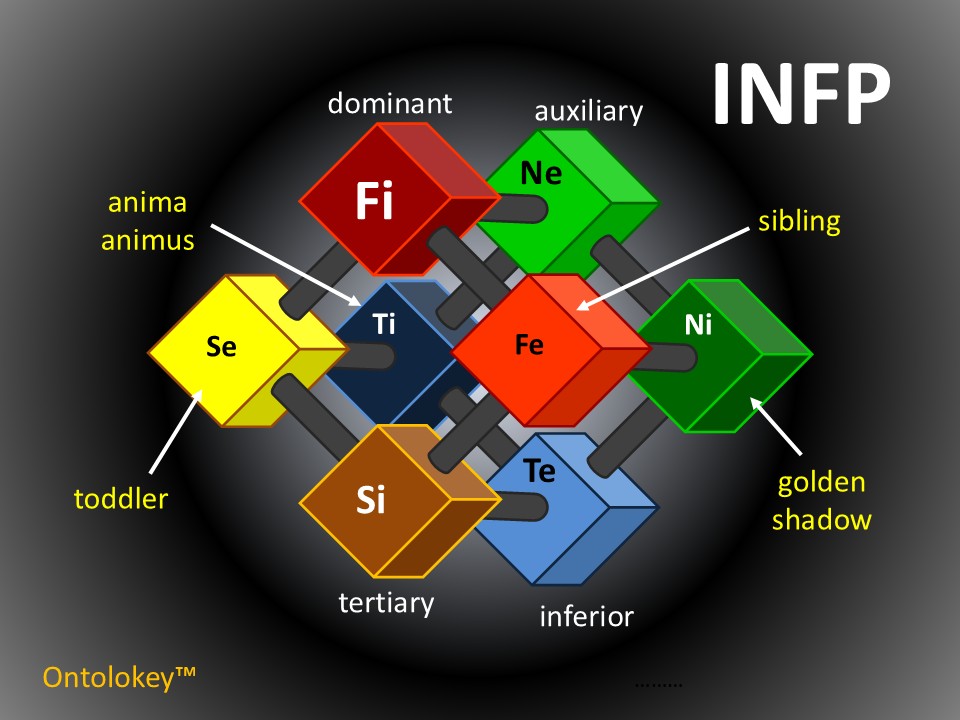
    INFP

    INFPs lead with introverted Feeling (Fi), complemented by extraverted Intuition (Ne). Their Anima is introverted Thinking (Ti), quietly forming inner logic. The Toddler, extraverted Sensing (Se), may surface in moments of impulsive action. Their Golden Shadow is introverted Intuition (Ni), offering hidden depth. The Persona resembles the ENTP—curious and outwardly expressive. The Blindspot lies in introverted Sensing (Si), and the Royal Archetype is the ESTJ. The Sibling Function is extraverted Feeling (Fe).

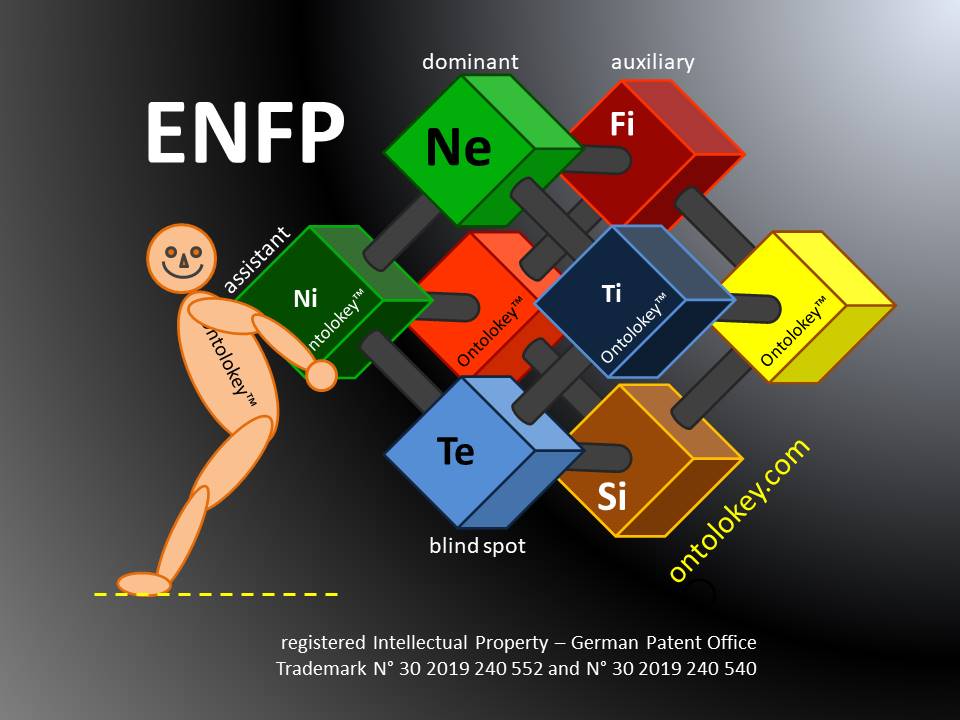
    ENFP

    ENFPs are guided by extraverted Intuition (Ne), with introverted Feeling (Fi) as their internal compass. The Anima is extraverted Sensing (Se), drawing them toward vivid experience. The Toddler, introverted Thinking (Ti), can manifest as inner criticism or intellectual over-analysis. The Golden Shadow, extraverted Feeling (Fe), holds their untapped capacity for social leadership. The Persona resembles the ISFP—artistic and emotionally grounded. Their Blindspot is extraverted Thinking (Te), while the Royal Archetype is the ISTJ. The Sibling Function is introverted Intuition (Ni).

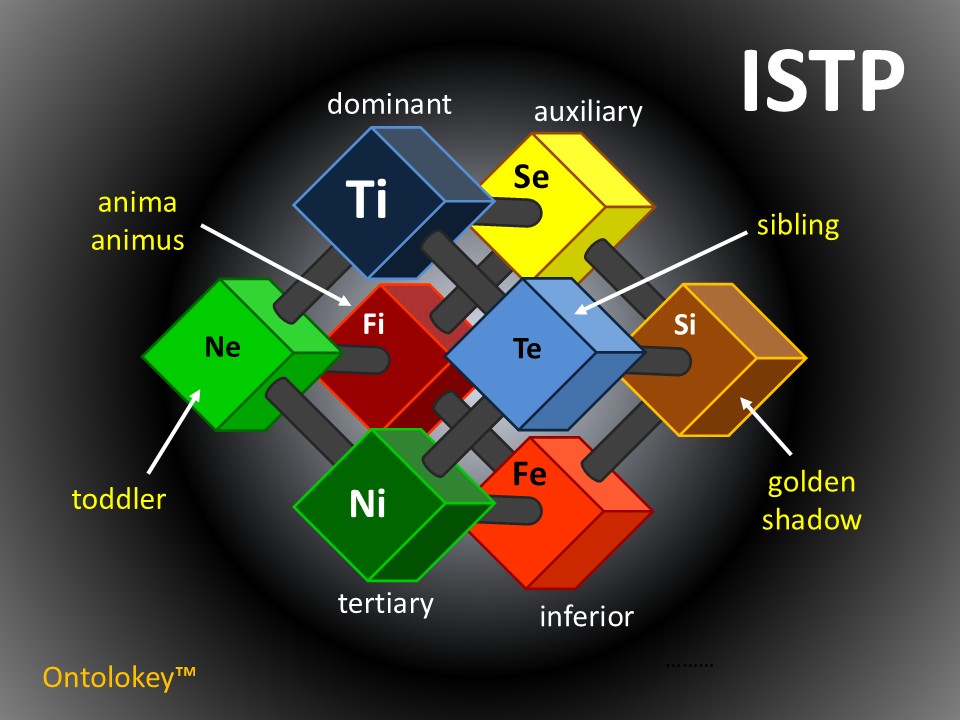
    ISTP

    The ISTP is structured around introverted Thinking (Ti), supported by extraverted Sensing (Se). Their Anima is introverted Feeling (Fi), expressing deep, often hidden values. The Toddler is extraverted Intuition (Ne), which may appear as scattered or chaotic thinking. The Golden Shadow is introverted Sensing (Si), related to tradition and physical memory. The Persona appears as an ESFP—charismatic and action-driven. The Blindspot is introverted Intuition (Ni), and the Royal Archetype is the ENFJ. The Sibling Function is extraverted Thinking (Te).

    ISFP

    ISFPs lead with introverted Feeling (Fi), and are energized by extraverted Sensing (Se). Their Anima is introverted Thinking (Ti), offering a quiet analytical undercurrent. The Toddler is extraverted Intuition (Ne), often expressed in bursts of creativity or distraction. The Golden Shadow is introverted Sensing (Si), grounding their inner experiences. Outwardly, they wear an ESTP-like Persona—spontaneous and present. The Blindspot is introverted Intuition (Ni), and the Royal Archetype is the ENTJ. The Sibling Function is extraverted Feeling (Fe).

    ESTP

    The ESTP operates through extraverted Sensing (Se), backed by introverted Thinking (Ti). Their Anima is extraverted Intuition (Ne), fueling adaptability and future-seeking. The Toddler is introverted Feeling (Fi), which may erupt in emotional confusion or withdrawal. The Golden Shadow is extraverted Thinking (Te), a resource for structure and control. The Persona mimics the INTP—rational, distant, and intellectually focused. The Blindspot is extraverted Feeling (Fe), and the Royal Archetype is the INFJ. The Sibling Function is introverted Sensing (Si).

    ESFP

    ESFPs are driven by extraverted Sensing (Se), with introverted Feeling (Fi) anchoring their value system. The Anima is extraverted Intuition (Ne), pointing to exploration and open-mindedness. The Toddler is introverted Thinking (Ti), which may complicate decisions or inner reasoning. The Golden Shadow is extraverted Feeling (Fe), showing latent potential for leadership and harmony. The Persona is that of the INFP—reserved and intellectually curious. The Blindspot is extraverted Thinking (Te), and the Royal Archetype is the INTJ. The Sibling Function is introverted Sensing (Si).

  • The ESFP – often seen as a vibrant, expressive, and pleasure-seeking personality – is far more multidimensional when viewed through Ontolokey, the ontological instrument that maps not only the conscious psyche but also the deep, hidden architecture of the self. Let’s take a journey into the ESFP’s full psychological profile, including the Anima, Toddler, Shadow, Persona, Blindspot, and Royal archetype.


    🧠 Dominant Function – Extraverted Sensing (Se)

    At the core of the ESFP is a heightened awareness of the present moment. This function brings a powerful attunement to sensory data, aesthetics, physical experiences, and immediate action. ESFPs are drawn to real-life engagement – they want to touch, taste, see, and feel the world in high definition. They respond quickly, often with joy and enthusiasm, and thrive in active, spontaneous environments.


    💖 Anima – Extraverted Intuition (Ne)

    The Anima represents the unconscious ideal – the soul’s quiet voice. For the ESFP, this is Ne, which drives a deep and often hidden fascination with possibilities, alternative realities, symbols, and meanings beneath the surface.

    While their dominant Se is grounded in the here-and-now, Ne draws the ESFP toward unseen connections and imaginative expansion. This pull toward “what could be” often shows up in creative impulses, visionary excitement, or spontaneous ideation – but the ESFP may not always understand where this curiosity comes from. It’s the inner muse whispering in the background.


    🧒 Toddler – Introverted Thinking (Ti)

    The Toddler, or child function, reflects immature but active cognitive behavior. For the ESFP, this is Ti – introverted logic, internal analysis, and detached reasoning. As a toddler, Ti tends to appear in scattered moments of intellectual curiosity or overly simplistic rationalizations.

    Under stress or emotional overload, ESFPs may retreat into unrefined logic or overthink decisions in inconsistent ways. It’s not their strength – but it’s a part of their psychological ecosystem, developing slowly over time.


    🪞 Shadow (Golden Shadow) – Extraverted Feeling (Fe)

    The Shadow, often unacknowledged or even denied, is the inverse of the auxiliary function. In the case of the ESFP (whose auxiliary is Fi), the shadow is Fe – extraverted feeling: social harmony, group ethics, emotional diplomacy.

    ESFPs may resist group norms or find social obligations overwhelming. However, the Golden Shadow invites them to integrate this suppressed function. When they do, they become more attuned to collective emotional needs and can become inspiring social connectors – balancing personal authenticity with communal sensitivity.


    🎭 Persona – INFP (Fi + Ne)

    The Persona is the adaptive mask we wear to navigate external expectations – and in Ontolokey, it is constructed from the auxiliary function oriented toward the Anima.

    For the ESFP, this is INFP: a quiet, introspective, imaginative personality that appears when the ESFP needs to shield their inner values or adapt to situations requiring deep reflection. Though the ESFP is normally expressive and action-oriented, in unfamiliar or sensitive environments they may appear as dreamy, poetic, and emotionally reserved – qualities borrowed from their INFP mask.

    This Persona is especially common when the ESFP is navigating vulnerable situations or emotional transitions.


    👁 Blindspot – Extraverted Thinking (Te)

    Te, the blindspot function, is often misunderstood or misused. It governs strategic planning, execution, and external efficiency – areas where ESFPs can feel overwhelmed or disinterested. They may resist rigid structures or formal hierarchies and struggle with sustained organization.

    When stressed, ESFPs might attempt to assert control through poor planning or reactive logic. The blindspot doesn’t imply total absence – rather, it’s an area lacking conscious strength and balance.


    👫 Sibling Function – Introverted Sensing (Si)

    Si, as the sibling to dominant Se, brings quiet contrast. Where Se seeks newness, Si stores detailed memories and physical routines. It gives the ESFP a subtle link to tradition or bodily familiarity, often reflected in comfort-seeking habits, sentimental attachments, or sensory memory. It’s not dominant, but supportive.


    👑 The Royal Archetype – INTJ (Ni + Te)

    In Ontolokey, the King or Queen represents the inferior function pair – the fully individuated ideal that feels both intimidating and aspirational.

    For the ESFP, this is the INTJ: introverted intuition paired with strategic thinking. This archetype symbolizes vision, discipline, and long-range planning – qualities that feel far from the ESFP’s natural way of being, yet are deeply respected.

    The path of individuation leads the ESFP to integrate their Ni and Te functions – becoming more future-focused, goal-driven, and deliberate. Though this transformation can feel distant or frightening, it is the crown jewel of their personal growth journey.


    🌿 Final Reflection

    The ESFP is not simply an entertainer or thrill-seeker. Through Ontolokey, we see a rich internal world filled with imagination (Ne), emotional depth (Fi), and a hidden call toward vision and mastery (Ni–Te). Each function – from the Toddler to the Shadow to the Royal – reveals how complex and profound the ESFP psyche truly is.

    By acknowledging and integrating all aspects of the self, the ESFP embarks on a path of conscious evolution – not away from their natural joy, but into the fullness of their soul.

  • The ISFP personality type—driven by Introverted Feeling (Fi) and supported by Extraverted Sensing (Se)—is a profoundly authentic and emotionally guided type. But what truly sets Ontolokey apart is the way it maps not only the conscious aspects of personality but also the rich and hidden structure of the subconscious. Using the Ontolokey model, we can identify key inner archetypes that silently shape the behavior and inner life of the ISFP: the Anima, the Toddler, the Shadow, the Persona, the Blindspot, and the Queen/Kingship.


    💖 The Anima: Ti – Introverted Thinking

    The Anima is the subconscious motivator, not feared like the inferior function, but longed for—mysterious, soulful, and powerful. For the ISFP, this is Introverted Thinking (Ti). Though the ISFP does not naturally operate in a cold, analytical framework, their deep motivation is often about making logical inner sense of the world. Their actions and emotions may seem impulsive on the outside, but at their core, there’s a desire for internal precision, consistency, and truth. This often leads to the quiet search for clarity, order, and authenticity—not only emotionally but conceptually.


    🧒 The Toddler: Ne – Extraverted Intuition

    The Toddler represents a childlike function connected to the auxiliary function in attitude but opposite in process. The ISFP’s auxiliary function is Extraverted Sensing (Se), so the Toddler becomes Extraverted Intuition (Ne).

    This explains the ISFP’s playful curiosity about possibilities, symbols, and abstract ideas—though undeveloped and immature, this function may manifest in sudden ideational bursts, unexpected imagination, or even difficulty committing, as the Toddler is not fully under conscious control. The ISFP might, at times, dart from one inspiration to the next or entertain magical thinking—revealing this untrained, intuitive toddler within.


    🪞 The Shadow: Si – Introverted Sensing

    The Shadow is the opposite orientation of the auxiliary function. Since the ISFP relies on extraverted sensing, their introverted sensing (Si) lies in the shadow.

    This shadow often shows up as a disconnection from routines, systems, tradition, or personal history. ISFPs may rebel against memory-based, conservative, or safety-first behaviors. They might even neglect physical stability, time management, or rules when Si is rejected or misunderstood. It’s not uncommon for ISFPs to feel tension around things like bureaucracy, hierarchy, or the expectation to “do it like it’s always been done.”


    🎭 The Persona: ESTP

    In Ontolokey, the Persona is the external mask we use to adapt when the situation demands. It is built by directing the auxiliary function toward the Anima. For the ISFP (Se + Ti), this creates an ESTP-like Persona.

    When needed, ISFPs can present themselves as energetic, action-oriented, and highly pragmatic. They might appear tough, street-smart, or charming—ready to engage in real-world challenges. This persona may emerge in professional settings or high-pressure situations, especially when authenticity alone doesn’t suffice.


    👁 The Blindspot: Ni – Introverted Intuition

    The Blindspot, or Tertiary Function, shares the same introverted attitude as the dominant function (Fi), but it is often neglected or distorted. For ISFPs, this is Introverted Intuition (Ni).

    The ISFP may struggle with long-term vision or with connecting seemingly unrelated patterns into a cohesive whole. Though flashes of profound insight may occur, Ni is not consciously honed. When overused or misapplied, it might lead to paranoia, irrational fear of what’s to come, or spiritual confusion. Yet, when integrated healthily, it can offer a deep well of meaning beneath their emotional decisions.


    👑 The Queen/King Function: ENTJ (Te + Ni)

    The royal archetype in Ontolokey represents the ultimate potential: the integration of the inferior function (Extraverted Thinking, Te) and the tertiary function (Ni). This creates an idealized identity the ISFP both respects and fears—in this case, an ENTJ-like figure.

    This “inner royalty” is powerful, decisive, organized, and focused on long-term execution. To the ISFP, this may feel both distant and alluring. It represents mastery over structure, leadership, and vision, and it’s often accompanied by both admiration and reluctance. The ISFP may secretly aspire to this commanding version of themselves, yet feel overwhelmed by the idea of fully embodying such ambition.


    🧩 Ontolokey’s Unique Insight

    Unlike traditional typology, Ontolokey emphasizes not only which functions are present, but how they are internally organized—across both conscious and subconscious planes. The ISFP, through this model, is not merely a gentle, artistic soul. They are a deeply layered psyche: driven by feeling, challenged by logic, pulled by intuition, and tested by structure.

    By understanding the Toddler, Shadow, Anima, and the Royal Self, the ISFP can move toward true self-awareness and individuation—a journey of integration, acceptance, and ultimately, wholeness.

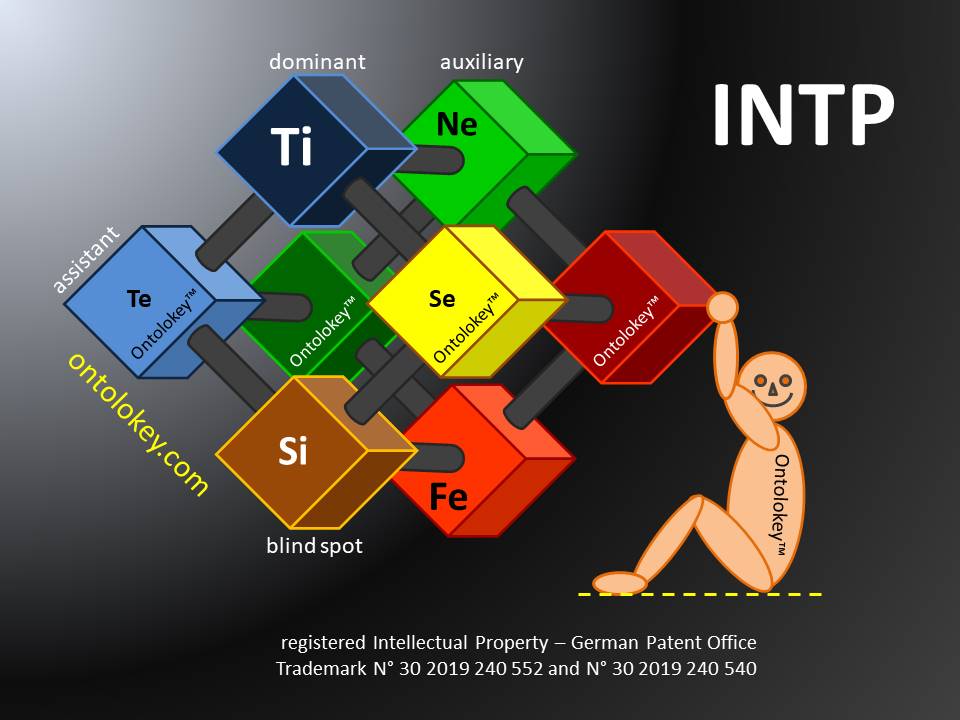
  • In the Ontolokey model, the INTP is far more than a detached intellectual or theoretical wanderer. Rather, this personality is shaped by a rich and often hidden interplay between logic, unconscious emotional drives, and a subtle longing to connect. Unlike many typological models, Ontolokey does not merely describe observable behavior—it maps out the inner architecture of psychological forces and their archetypal roles.

    The Dominant Function: Introverted Thinking (Ti)

    At the core of the INTP lies Introverted Thinking (Ti), a function that processes internal logical structures with deep precision. INTPs live in a world of frameworks, systems, and definitions. They don’t just analyze—they construct mental blueprints for understanding how things work. However, this intense rationality tends to suppress or ignore the emotional realm, especially when emotions appear irrational or disruptive to mental clarity.

    The Anima: Introverted Feeling (Fi)

    What makes Ontolokey unique is the recognition of the Anima as a crucial, unconscious influence in personality. For the INTP, this Anima is Introverted Feeling (Fi)—a deeply personal emotional compass. While it operates beneath conscious awareness, Fi guides the INTP’s choices, attachments, and sense of meaning.

    This Fi-based Anima is not to be confused with the inferior function (Extraverted Feeling, or Fe). Fe is typically experienced as uncomfortable or even threatening—associated with social obligations and emotional expectations from the outside world. By contrast, Fi is longed for, idealized, and often projected onto people, ideas, or causes. It may express itself in subtle ways, such as unexplained sadness, deep ethical convictions, or a private longing for authentic emotional resonance. INTPs often have no idea why they are moved to tears in solitude, or why a moral intuition overrides logic at crucial moments—yet these experiences stem from the influence of the Anima.

    The Auxiliary Function and the Persona: Extraverted Intuition (Ne)

    The INTP’s auxiliary function is Extraverted Intuition (Ne), a function that explores possibilities, connections, and patterns in the external world. It drives curiosity, verbal expression, and conceptual play. This function also forms the basis of the INTP’s Persona—the outer mask they wear when engaging with the world.

    In Ontolokey, the Persona is a socially adaptive construct that emerges when needed, especially for introverts. For the INTP, the Persona resembles an ENFP—someone who is spontaneous, excitable, and constantly searching for novelty and meaning. While this persona may appear vibrant and communicative, it does not reflect the INTP’s true nature. Rather, it allows them to interact with the world without revealing their core identity.

    The Blindspot: Introverted Sensing (Si)

    The tertiary function is described in Ontolokey as the Blindspot—a fallback mechanism that often activates when the auxiliary function is inactive. For the INTP, this function is Introverted Sensing (Si), which deals with bodily awareness, memory, routine, and familiarity.

    While INTPs may appear aloof or disconnected from the physical world, they are often quietly attached to sensory comforts. They might enjoy massage, warm environments, or other tactile experiences that ground them in the present. The INTP may not organize their life around routine, but they can become emotionally attached to personal rituals or nostalgic memories. This bodily connection is not often expressed openly but plays a surprisingly significant role in their psychological balance.

    The Toddler Function: Extraverted Sensing (Se)

    As a less developed and largely unconscious function, Extraverted Sensing (Se) represents what Ontolokey calls the Toddler—an impulsive, naive part of the psyche that responds instinctively to external stimuli. Se is underdeveloped in the INTP, which may result in difficulty managing sensory input, physical demands, or material priorities.

    When triggered, Se can manifest as impulsive behavior, such as sudden spending, risk-taking, or overstimulation. Conversely, the INTP might reject sensory engagement altogether, neglecting physical health or avoiding high-energy environments. The Toddler behaves like a child—sometimes charming and curious, but often clumsy and reactive.

    The Inferior Function (The Queen): Extraverted Feeling (Fe)

    In Ontolokey, the inferior function is elevated to the role of The Queen (or King)—an archetype representing a powerful yet distant ideal. For the INTP, this is Extraverted Feeling (Fe), the function responsible for social harmony, emotional attunement, and shared values.

    Fe is not just weak—it is psychologically intimidating. The INTP often perceives society, community, and emotional obligation as overwhelming or threatening. They may isolate themselves or develop a persona that masks their social discomfort. And yet, deep down, the INTP desires connection. They wish to be accepted, to belong, to feel emotionally sovereign in the world. The Queen function embodies this noble longing—it represents who they could become if they mastered the function they most fear.

    Unlike the Anima, which is internal and privately revered, the Queen is external and aspirational. The INTP respects Fe, but keeps it at a distance.

    The Shadow: Introverted Intuition (Ni)

    In the Ontolokey system, the Shadow is the dark inverse of the auxiliary function. While the INTP uses Ne to generate many possibilities and ideas, their shadow—Introverted Intuition (Ni)—focuses narrowly on singular insights and long-term outcomes. Ni appears in moments of stress or transformation, often as existential dread, obsessive foresight, or rigid inner visions.

    When integrated, Ni can become a powerful supplement to Ti, helping the INTP not only analyze but also synthesize truths over time. When unintegrated, however, it leads to distorted predictions, fatalism, or intellectual paralysis.


    Summary of the INTP in Ontolokey

    The INTP, according to Ontolokey, is a personality of profound internal contradiction and quiet depth. At once rational and emotionally driven, they rely on logic while being unconsciously pulled by deep values and subtle longings. They seek knowledge, truth, and understanding—but they are also shaped by hidden emotional forces that they rarely articulate.

    • Their dominant Ti gives them structure and intellectual power.
    • Their Anima Fi gives them soul, heart, and private conviction.
    • Their auxiliary Ne gives them energy to explore and connect ideas.
    • Their Persona (ENFP) helps them engage socially when needed.
    • Their Si Blindspot offers comfort, nostalgia, and physical grounding.
    • Their Se Toddler introduces sensory impulsiveness and unpredictability.
    • Their Fe Queen calls them toward human connection and emotional leadership.
    • Their Ni Shadow tests their clarity with singular visions and insights.

    Understanding the INTP through Ontolokey reveals a psyche that is not simply analytical, but poetic—torn between the world of systems and the longing for something real, meaningful, and whole.

  • In the depth psychology of Carl Gustav Jung, the journey of individuation—the process of becoming one’s true self—culminates in an encounter with the inferior function. This function, often feared, ignored, or misunderstood, represents not our weakness, but our crown.

    In the Ontolokey system, this archetype is known as the King or Queen—the Royal Function. It is the psychological ideal we are destined to grow into. And like any royal title, it must be earned through courage, integration, and deep inner work.


    👑 What Is the Royal Function?

    • The Royal Function is the inferior (4th) function of your type—your least developed, most unconscious cognitive process.
    • The Royal Auxiliary is your tertiary (3rd) function.
    • Together, they form the complete psychological type of your inner Queen or King.

    Examples:

    • An INTP has a Queen with the type ESFJ (Fe-Si).
    • An ENTP meets their royal archetype in the form of an ISFJ.
    • An ENTJ faces an ISFP King or Queen.
    • An INTJ finds the sovereign within in the shape of an ESFP.

    😨 Why the Royal Function Feels So Far Away

    The Royal Function is intimidating because it represents a part of us that we don’t fully understand—or even trust. It is:

    • Emotionally charged (often linked to childhood shame or rejection),
    • Socially distant (because it’s not naturally expressed),
    • Psychologically exalted (because we unconsciously admire its strength).

    Take the INTP, for example. Their inferior function is Extraverted Feeling (Fe)—the domain of emotional harmony, social grace, and interpersonal connection. To the INTP, society feels like a powerful Queen—impressive, commanding, and frightening. They feel like a commoner in the court, unworthy of wearing the crown.

    And yet… there is a secret wish:
    To one day be crowned by the Queen, or better yet—to become the Queen.


    🛤️ The Path to Inner Royalty

    Before we can embody the Royal Function, we must first integrate the Shadow—particularly the Golden Shadow Function, which reveals our unconscious imbalances.

    Only then can we turn inward to face the ultimate challenge:
    To master our inferior function not by becoming it, but by respecting it, learning from it, and building a relationship with it.

    This is the final stage of individuation—not perfection, but psychological sovereignty.


    🔑 Ontolokey: Mapping the Road to the Crown

    Ontolokey allows us to visualize the full structure of the psyche—including the Royal Function. Through the turning of the key, users can:

    • See their unconscious fears and aspirations,
    • Understand their psychological destiny,
    • And begin the transformation from servant of the King to King themselves.

    It’s not a shortcut. It’s a map.

    And every map begins with the courage to look in the mirror—and see not only who you are, but who you’re meant to become.

  • In Jungian psychology, the Persona is the mask we wear—the version of ourselves shaped to meet the expectations of the outside world. But in the Ontolokey system, this concept is refined into something more precise and measurable: a distinct personality configuration derived from our auxiliary function and oriented toward the Anima.

    It is not who we are at the core—but who we sometimes become in order to function in society.


    🧩 How the Persona Is Formed

    Ontolokey defines the Persona as follows:

    • It is based entirely on the auxiliary function.
    • It is aligned with the Anima functionally.
    • It mirrors the opposite attitude of the core personality.
    • It emerges only when needed—as a flexible, adaptive mask.

    Examples:

    • An INTP (Introverted Thinking + Extraverted Intuition) has an ENFP Persona. In social settings, they may appear highly creative, enthusiastic, and exploratory—traits more typical of an ENFP than their introspective core.
    • An ISFP (Introverted Feeling + Extraverted Sensing) has an ESTP Persona—pragmatic, quick to act, and visually engaged.
    • An ENTP with Introverted Thinking (Ti) as an auxiliary may adopt an ISTP Persona, leading them to appear like a subject-matter expert obsessed with mastering systems and tools.
    • An ENFJ with a dominant Extraverted Feeling (Fe) may rarely lean into their INTJ Persona, even though it suggests deep, intuitive insight. Why? Because extraverted personalities tend to distrust introverted functions, just as introverts sometimes mask themselves with extraverted behavior.

    🎭 The Mask That Misleads

    This masking function is so convincing that it often causes confusion—even among those deeply familiar with personality theory:

    • An INTP may easily be mistaken for an ENFP because of their restless nature and visible love for exploration, fueled by Extraverted Intuition.
    • The Persona does not override the core self but serves as a tool to survive or thrive in specific contexts: professional roles, relationships, social appearances, or creative performance.

    Introverts tend to use the Persona more frequently, since it allows them to simulate extraverted behavior in a world that often demands outward expression. Extraverts, by contrast, are more likely to neglect or even resist their Persona—especially when it invites them into unfamiliar, introverted terrain.


    🧠 A Tool for Adaptation, Not Deception

    The Persona is not a lie—it is a functional expression of our auxiliary support system. Through Ontolokey’s framework, this expression becomes visible and understandable:

    • It helps us track how and when we shift masks.
    • It explains why others perceive us in ways that don’t always match our inner truth.
    • It fosters empathy—both for ourselves and for the adaptive strategies others employ.

    The Persona is our social strategy, our bridge between the Self and the World.


    🔑 Ontolokey: Making the Mask Conscious

    In the Ontolokey tool, the Persona can be observed by turning the key to align the auxiliary function with the Anima’s orientation. This visualization allows us to see the Persona not as an abstract concept, but as a real, usable mechanism in our psychological structure.

    Rather than fearing the mask, Ontolokey invites us to master it.

    Because transformation starts when we understand not only who we are—but who we become when the world is watching.

  • Deep within the subconscious mind lives a forgotten voice—naive, emotional, reactive, and strangely powerful. This voice belongs to the Toddler Archetype, a lesser-known yet deeply influential aspect of our psyche, brought into light by the Ontolokey system.

    Just as the Anima relates to our dominant function, the Toddler mirrors and complements the auxiliary function—but in a way that is often immature, underdeveloped, and easily overlooked.


    🧠 The Toddler’s Structure in Ontolokey

    Here’s how the pattern works:

    • The Toddler shares the same attitude (introverted or extraverted) as the auxiliary function.
    • It is functionally opposite to the auxiliary function:
      • Thinking ↔ Feeling
      • Intuition ↔ Sensing

    Examples:

    • An Extraverted Intuition (Ne) auxiliary has a Extraverted Sensing (Se) Toddler.
    • An Introverted Feeling (Fi) auxiliary has an Introverted Thinking (Ti) Toddler.
    • An Extraverted Feeling (Fe) auxiliary has an Extraverted Thinking (Te) Toddler.

    This inner child operates beneath awareness, expressing itself in unexpected ways. Though not “evil” or intentionally destructive, it lacks maturity and discipline—and often hijacks our behavior under stress or fatigue.


    ⚠️ When the Toddler Takes Over

    Since the Toddler represents a function we do not fully master, it shows up in unconscious, emotionally reactive, or even careless behavior.

    • If your Toddler is Extraverted Sensing (Se), you may struggle with managing money, materialism, or impulsivity. Wealth accumulation might seem pointless, even boring.
    • If your Toddler is Introverted Feeling (Fi), you may become insensitive to others’ emotions. You may dismiss feelings as irrelevant or even annoying.
    • A Toddler in Introverted Intuition (Ni) might create unrealistic fears or obsessive theories with no grounding in reality.

    The Toddler doesn’t aim to sabotage. It simply doesn’t know better. Like a child, it needs to be seen, nurtured—and, when appropriate, gently corrected.


    🛠️ How Ontolokey Helps Us See the Inner Child

    Through its unique 3D key system, Ontolokey allows users to visualize the full architecture of their psyche, including unconscious archetypes like the Toddler.

    Rather than pathologizing our flaws, Ontolokey invites us to meet these parts with compassion. By recognizing the Toddler, we gain insight into:

    • Why we regress under stress
    • Where our blind spots lie
    • Which areas of growth remain emotionally “underage”

    This isn’t about perfection. It’s about wholeness.


    🌱 Growing the Toddler Within

    The path to inner maturity doesn’t involve silencing the Toddler—it involves listening to it, guiding it, and giving it space to grow. When we understand this archetype, we stop reacting—and start evolving.

    Because even the most sophisticated personality needs to take care of its inner child.

  • In the psychological framework of Carl Gustav Jung, the Anima (or Animus) represents far more than a gendered inner figure—it is the soul, the emotional compass, and the unconscious motivator behind much of our behavior. Within the Ontolokey system, this concept gains a powerful new form: one that is visual, interactive, and grounded in the structure of personality itself.


    🔍 The Hidden Mirror Behind the Dominant Function

    In Ontolokey, the Anima follows a distinct pattern:

    • It has the same attitude (introverted or extraverted) as the dominant function.
    • Yet, it is the opposite in function family:
      • Thinking ↔ Feeling
      • Sensing ↔ Intuition

    This means, for example:

    • A dominant Introverted Thinking (Ti) type has an Introverted Feeling (Fi) Anima.
    • A dominant Introverted Sensing (Si) type carries an Introverted Intuition (Ni) Anima.
    • A dominant Extraverted Feeling (Fe) type holds an Extraverted Thinking (Te) Anima.

    This functional opposite is not just a theoretical element—it is the very soul mirror, an inner force shaping our deepest desires, our projections, and our emotional responses.


    🌌 The Anima as Unconscious Motivation

    The Anima lies dormant in the unconscious, often influencing our behavior without our awareness. It’s the hidden motivator, the why behind the what—especially when our actions seem to contradict our rational self-image.

    Take the Introverted Thinker (Ti-dominant) for example. Rational, precise, and internal. Yet beneath that logical surface lies an Introverted Feeling Anima, silently steering the individual toward meaning, authenticity—and ultimately, true love.

    This love, however, is not always consciously directed. Instead, it is often projected outward—onto another person, a fantasy, or a relationship ideal. One doesn’t recognize this need as an inner dynamic, but sees it “out there,” in someone else.


    🌀 The Platonic Echo: Searching for the Lost Half

    This phenomenon was described powerfully in Plato’s Symposium. There, humans were once spherical beings—complete, unified. But Zeus split them in two, condemning us to wander the earth in search of our lost half.

    In the Ontolokey interpretation, this “lost half” is nothing external. It is the Anima, the internal soul-part we’ve disowned and projected. The journey is not to find someone else—but to reclaim the anima within.

    By understanding your Anima through Ontolokey, you don’t just interpret your emotional patterns—you begin the individuation process. You integrate what was once unconscious and foreign. You become whole.


    🗝️ Ontolokey: Making the Invisible Visible

    Through its revolutionary 3D key mechanism, Ontolokey reveals this dynamic visually and intuitively. Users can not only identify their personality type but also see how the Anima relates to their dominant function. For the first time, such deeply rooted psychological content is made both accessible and experiential.

    By recognizing the Anima not as a weakness or flaw, but as a sacred inner force, we gain the opportunity to deepen our relationships, heal projections, and align our actions with our hidden truths.


    ❤️ Integration Begins Within

    When we stop searching for our soul in someone else, and instead turn inward with clarity and compassion, the Anima transforms from a shadowy ghost into a guiding light.

    Let Ontolokey be your companion on this journey toward wholeness.