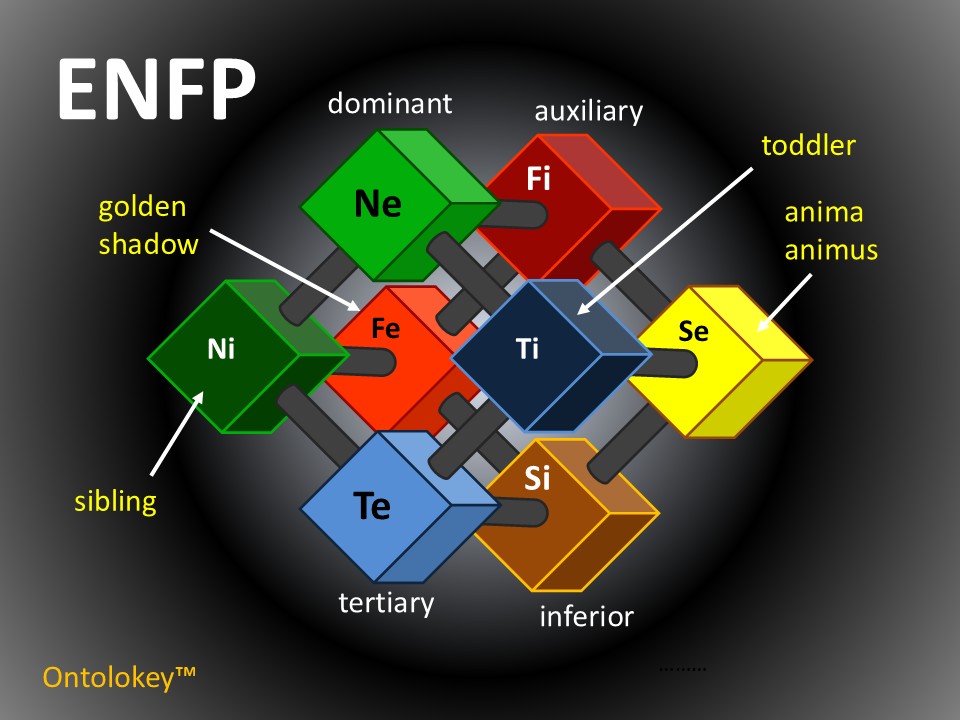
With the help of Ontolokey the 16 personality types according to C.G.Jung can be shown three-dimensionally just by turning the cube into the desired position.
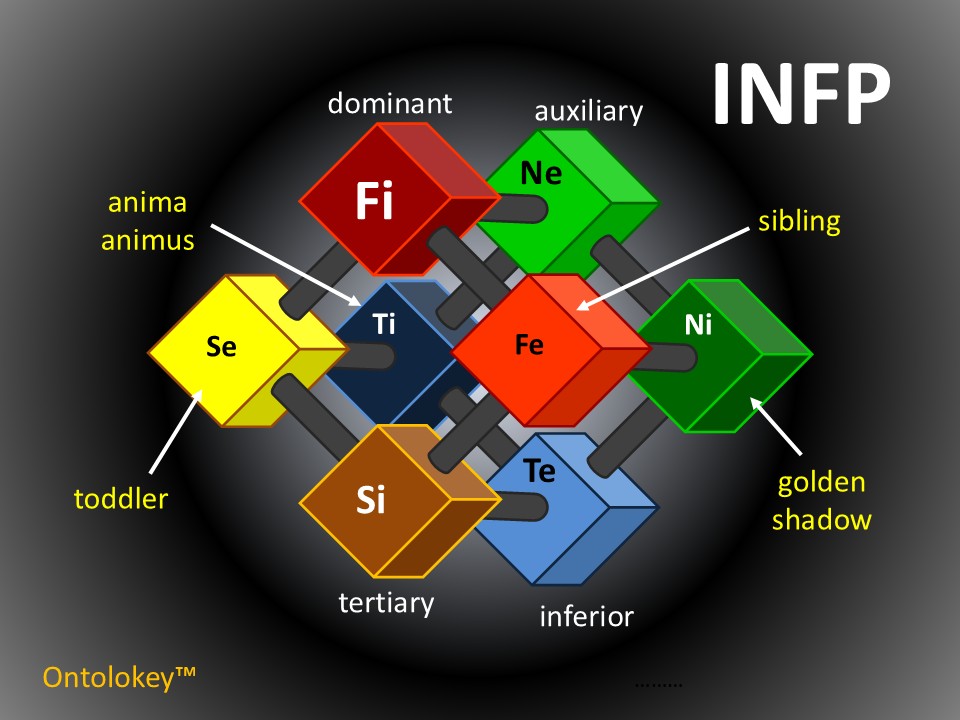
Introduction Those who know an INFP—or are one themselves—often sense a deep, quiet intensity beneath the surface. These individuals are idealists: guided by strong values, rich emotions, and a complex inner world. Creative, empathetic, and often lost in thought, they can seem elusive or hard to grasp. But behind their quiet nature lies a deep well of conviction and imagination.
The Ontolokey model offers a new, dynamic way to understand this personality type. Unlike traditional frameworks that focus on four main traits, Ontolokey explores all eight psychological forces at play—both conscious and unconscious. Using a colorful 3D cube with adjustable sliders, it illustrates not just which traits are dominant, but how they interact and influence one another throughout life’s development.
1. A World Within
INFPs are introverts by nature. They recharge through solitude, reflection, and emotional processing—not through external stimulation. Their thoughts and feelings run deep, and they often need time alone to make sense of them. This isn’t shyness—it’s depth. Their inner world is where they find meaning and direction.
2. A Moral Compass at the Core
At the heart of the INFP personality lies a powerful sense of personal values. Right and wrong are not defined by social norms or group consensus—but by an internal sense of authenticity. This moral compass guides their decisions, sometimes making compromise difficult. They would rather be true to themselves than go along with something that doesn’t “feel right.”
3. The Challenge of Social Dynamics
While INFPs are deeply empathetic, they often struggle with social expectations. They may feel overwhelmed in groups or drained by the pressure to fit in. They long for genuine connection, but not at the expense of their inner truth. As they mature, many learn to engage socially without betraying themselves—creating space for deep, honest relationships.
4. The Power of Imagination
One of the INFP’s great strengths is their creative and intuitive mind. They see patterns others miss, generate original ideas, and explore endless possibilities. This visionary thinking fuels innovation—but it can also become a trap if it leads to overthinking or indecision. The real challenge is grounding those ideas into action.
5. A Hidden Blind Spot – Presence in the Moment
Living in the present, enjoying physical sensations, or responding spontaneously to the world can be difficult for INFPs. They often live in their heads or hearts, forgetting the here and now. Yet learning to be present—through movement, nature, or mindfulness—brings vitality and grounding to their idealistic spirit.
6. Turning Dreams into Action
Organization, planning, and execution may feel unnatural to INFPs. They might resist systems or structures that seem impersonal. But embracing this challenge can transform their lives. When they learn to apply discipline and structure to their ideals, they become powerful changemakers—not just dreamers, but doers.
7. A Philosophical Soul Within
Beneath the surface, INFPs often carry an inner voice that seeks understanding and intellectual clarity. They reflect deeply—on themselves, on others, on life’s mysteries. Though this part of them may remain quiet, it adds profound depth and contributes to their thoughtful, wise presence.
8. Emotion and Memory – A Gentle Anchor
INFPs form strong emotional bonds with their past. Certain places, songs, or rituals carry deep personal meaning. This connection to memory offers comfort—but it can also hold them back. When embraced consciously, it becomes a source of strength, not nostalgia.
9. The Golden Shadow – A Hidden Visionary
Within every INFP lies a hidden capacity for vision, insight, and intuitive depth. They may project these gifts onto others—admiring charismatic leaders or spiritual thinkers—without realizing they possess similar qualities themselves. Integrating this “golden shadow” unlocks their potential as quiet visionaries and soulful guides.
10. Growth Through Balance
The INFP’s journey is not linear. It involves emotional complexity, inner conflict, and the slow integration of hidden parts of the self. Ontolokey teaches that wholeness is not about becoming someone else—but about harmonizing all aspects of who we already are. Feelings, thoughts, imagination, and presence—all must come into balance.
Conclusion
INFPs are quiet revolutionaries—shaping the world not through force, but through depth and meaning. The Ontolokey model offers a rich, multi-dimensional view of this personality: not as a fixed type, but as an evolving system. It reminds us that every person holds vast inner resources—many of them unseen. And it is in the integration of these hidden forces that real transformation begins.
In embracing this journey, the INFP does not simply observe life—but learns to shape it with quiet courage and inner light.
Die ISFP-Persönlichkeit ist geprägt von einer tiefen inneren Authentizität: Sie lebt nicht für Anerkennung oder äußere Bestätigung, sondern für ein Leben, das mit ihren eigenen Werten in Einklang steht. Entscheidungen werden nach einem inneren Kompass getroffen – einem Gefühl, das klar signalisiert, was gut und wahr ist, unabhängig externer Erwartungen. Dieses von innen gelenkte Empfinden verleiht der ISFP eine spürbare Integrität und eine ruhige, innere Stabilität.
Gleichzeitig ist die äußere Wahrnehmung durch eine ausgeprägte Sensibilität für die sinnliche Umwelt gekennzeichnet: Formen, Farben, Geräusche, Düfte und Texturen werden bewusst erlebt und wertgeschätzt. ISFPs nehmen Details wahr, die anderen entgehen, und reagieren eher durch Handlung als durch Worte. Sie lernen bevorzugt durch unmittelbare Erfahrung und Praxis – nicht durch abstrakte Theorien – und empfinden kreative Ausdrucksformen oft als direkten Zugang zu ihrer inneren Welt.
Neugierig öffnet die ISFP-Persönlichkeit sich mit leichter Zurückhaltung für neue Erfahrungen und Perspektiven. Diese Offenheit ist fühlbar, aber nicht dominant – sie erlaubt neue Ideen und Inspirationen, ohne das vertraute Gefühlssystem zu destabilisieren. Daraus entsteht eine subtile Balance zwischen dem Wunsch nach Stabilität und dem Bedürfnis nach innerer Entwicklung.
Wenn es um das soziale Umfeld geht, tritt eine Art „emotionale Schwesterrolle“ in Erscheinung: Diese äußere Form des Gefühls wirkt wie eine Brücke zwischen innerer Wahrnehmung und sozialen Beziehungen. Sie schafft Verbindung, ohne die Individualität aufzugeben. In vertrauten Beziehungen reagieren ISFPs sehr feinfühlig und empathisch – sie schenken Wärme, ohne aufdringlich zu sein.
Unterschätzt oder gar gemieden wird die Neigung zu effizienter Planung und konsequenter Umsetzung im äußeren Leben – häufig ein schwaches Bedürfnis. Doch wer diese Fähigkeit entwickelt, kann aus seinen tiefen inneren Werten heraus konkret handeln: finanziell planen, Projekte strukturieren oder kreative Visionen sinnvoll realisieren.
Still und oft unbemerkt arbeiten im Untergrund weitere Seiten der Persönlichkeit: Intuition, Erinnerung, rationales Denken. Das intuitive Verstehen, das ohne Worte entsteht, wird manchmal durch visuelle Bilder oder symbolische Eindrücke aktiviert – etwa in Momenten der Ruhe oder Meditation. Viele ISFPs finden in Yoga, Achtsamkeit oder Ritualen einen Zugang zu dieser intuitiven Tiefe – ohne dass sie darüber sprechen müssen. Die Praxis selbst wird zur symbolischen Sprache ihrer Seele.
Auch körperliche Erinnerungen und Sinneserfahrungen spielen eine subtile Rolle: das vertraute Gefühl eines Ortes, ein Duft aus der Kindheit, körperliche Rituale. Solche Eindrücke nähren das Gefühl von Zugehörigkeit, selbst wenn sie meist unbewusst bleiben. Ihre Integration bringt emotionale Sicherheit und mehr Erdung im Alltag.
Rationales Denken und genaue Analyse – obwohl eher im Hintergrund – sind vorhanden und ermöglichen der ISFP, auch in komplizierteren Situationen durchdacht zu handeln. Es ist die Fähigkeit, über Emotionen hinaus etwas zu erkennen, zu strukturieren und gedanklich zu klären. Ruhig und bedacht, nicht dogmatisch und selten laut.
In ihrer Gesamtheit bildet sich ein komplexes psychisches Netz: ein innerer Kern aus tiefem Gefühlen und integren Werten; getragen von sinnlicher Gegenwartsfreude, leichter Neugier und sozial-emotionaler Verbindung. Verborgene Potenziale bergen Stabilität, Inspiration und Klarheit.
Ontolokey visualisiert dieses Gefüge: Der innere Wertedruck steht im Zentrum, sichtbar verbunden mit den Faktoren Sinneseindruck, Intuition und sozialem Resonanzgefühl. Am Rand wirken noch nicht vollständig sichtbare Fähigkeiten – Planung, Intuition, Erinnerung. Die Schieber im Modell zeigen, wie eng oder weit diese funktionalen Anteile im Leben integriert sind.
Die psychologische Entwicklungsvision zielt auf eine Persönlichkeitsform, die Wertorientierung, Sinnesbewusstsein und emotionale Verbindung mit strukturiertem Handeln und Führungskraft verbindet – ein Schritt Richtung ENTJ: ein Mensch, der inneren Prinzipien konkrete Wirkung verleiht, empathisch führt und visionär handelt.
Die ISFP-Persönlichkeit ist damit weit mehr als ein stiller Beobachter oder Künstler. Sie ist eine Persönlichkeit in Bewegung: zutiefst authentisch, sinnlich verankert, offen für Inspiration – und fähig, wenn sie reift, ihre Werte bewusst und wirksam in die Welt zu bringen. Ihr innerer Dreifuß – Werte, Sinneserleben, Neugier – unterstützt die Kopf-Funktion: das authentische, fühlende Selbst. Im Schatten liegen Ressourcen für Wachstum: intuitive Tiefe, materielle Erinnerung, rationale Klarheit. Die Integration dieser Anteile markiert den Weg zur Ganzheit – emotional, spirituell und intellektuell.
Die ISFP‑Persönlichkeit ist gekennzeichnet durch eine sanfte, aber kraftvolle innere Welt, die von der dominanten Funktion introvertiertes Fühlen (Fi) geprägt wird. Diese Funktion bildet das Zentrum ihrer Identität – ein innerer Kompass, der aus tiefen Werten, Authentizität und persönlicher Integrität entsteht. ISFPs spüren instinktiv, was sich „richtig anfühlt“, und treffen Entscheidungen in Einklang mit ihrem inneren Maßstab. Sie streben nicht nach Anerkennung, sondern nach Echtheit – nach einem Leben, das im Einklang mit ihrem wahren Selbst steht.
Ihre Wahrnehmung der Welt ist unmittelbar und lebendig – durch extravertiertes Empfinden (Se) erleben sie die Sinnlichkeit des Augenblicks: Farben, Formen, Klänge, Texturen. Diese Funktion hält sie geerdet, verankert im Jetzt und im Körper. Sie sind oft starke Beobachter, die in der Gegenwart denken und handeln. Se verleiht ihrer Kreativität Ausdruck, sei es in Kunst, Handwerk oder Naturverbundenheit – eine physische Sprache, die direkt mit der Seele kommuniziert.
Zwischen Fi und Se bewegt sich die extravertierte Intuition (Ne) als Toddler‑Funktion, die erste Spur von Neugier in die Welt legt: sie öffnet sie für Möglichkeiten, Muster und Inspiration außerhalb der unmittelbaren Sinneswahrnehmung. Ohne Ne wäre Stimmung oft eindimensional – Ne öffnet Fenster zu anderen Perspektiven, sanft und spielerisch, ein Hauch neuer Ideen oder ungewohnter Wege.
Das emotionale Umfeld wird über die Sibling-Funktion extravertiertes Fühlen (Fe) ergänzt. Fe tritt wie eine unterstützende Schwester an die Seite von Fi und schafft Berührung zur emotionalen Welt anderer. Sie vermittelt Harmonie, Fürsorge, soziale Resonanz – nicht als zentraler Zugang zur Welt, sondern als Brücke, die intime Grenzen respektiert und dennoch Verbindung ermöglicht.
Doch hinter diesem bewussten Geflecht lauern auch unbewusste Kräfte. Die inferiore Funktion extravertiertes Denken (Te) wirkt wie ein König, der Macht aus der Außenwelt beansprucht: Planung, Effizienz, Struktur. Für viele ISFPs erscheint Te fremd oder sogar bedrohlich – ein Anspruch, dem sie sich widerstrebend unterwerfen, weil das persönliche Gefühlssystem stärker wiegt als äußere Machbarkeit. Doch wenn Te entwickelt wird, kann es eine solide Grundlage bilden, um die eigene Kunst, die Werte oder die Lebensvision in die Welt zu bringen.
Tief verborgen, im Unbewussten, wirkt introvertierte Intuition (Ni) als der Blind Spot oder die tertiäre Funktion: sie bringt leise Signale, innere Bilder oder intuitive Eingebungen, die nicht analytisch gedacht, sondern gespürt werden. In dieser Funktion öffnen sich für ISFPs oft Räume der stillen Spiritualität: Yoga, Meditation, Achtsamkeitsrituale oder kreative Rituale werden zu Plattformen, auf denen das schwer fassbare Ni Gestalt annehmen kann. Manche ISFPs betreiben Yoga‑Studios oder tägliche spirituelle Praktiken – nicht aus religiöser Konzeption, sondern durch gelebte Sinnsuche, die sich in Bewegung und Stille ausdrückt.
Ebenso leise, aber kraftvoll ist introvertierte Empfindung (Si) als goldener Schatten: sie speichert körperliche Erinnerungen, Rituale, Traditionen – jene vertrauten Rhythmen, die der Seele Halt geben. Obwohl Si selten bewusst gelebt wird, kann seine Integration ISFPs stabilisieren, indem sie ihnen Zugang zu tiefer emotionaler Gewissheit, gelebter Erinnerung und körperlicher Authentizität ermöglicht.
Als Ganzes formen diese acht Funktionen ein lebendiges Netzwerk: Fi im Zentrum, getragen von Se, Ne und Fe, während Te, Ni und Si leise, oft unterschätzt, Räume der Entwicklung und Bewusstwerdung öffnen. Die Ontolokey‑Slider visualisieren, wie nahe oder fern die Persönlichkeitsanteile zueinander stehen – wo Integration gelingt und wo Schatten noch wirken.
In der Entwicklungsvision führt diese Integration zur ENTJ‑Persönlichkeit als „königlichem Typ“: einem Menschen, der persönliche Werte in strukturierte Handlung umsetzt, Emotion mit Effizienz verbindet und intuitive Visionen in konkrete Veränderung übersetzt. ENTJ fungiert hier symbolisch als Reifeform, in der ISFPs ihre intime Wertwelt, ihre sinnliche Erfahrung und ihr intuitives Fühlen mit Stabilität, Führung und strategischem Denken verschmelzen.
Die ISFP‑Persönlichkeit ist damit keine einfache Muse oder Träumerin. Sie ist ein authentischer Ausdruck, der aus innerer Tiefe schöpft, im Jetzt lebt, Zukunft ahnt und sein Potenzial eines Tages zielgerichtet nutzen kann. Fi ist ihr Kopf; Se, Ne, Fe sind die lebendigen Beine ihres Dreifußes. Ni, Si, Te bleiben Schattenfunktionen – unvollständig, aber nicht unentwickelt. Und wenn diese Schatten integriert werden, beginnt ihr Weg zu wahrer Ganzheit – emotional, intellektuell und intuitiv.
Jung classifies both Extraverted Thinking (Te) and Extraverted Feeling (Fe) types as “rational” or “judging” types. This doesn’t mean they are always logical or objective, but rather that their behavior is guided primarily by deliberate, conscious judgment.
Their lives are heavily influenced by their rational functions — either logic (Te) or socially attuned values (Fe) — which they use to shape choices, organize behavior, and interact with the world. They strive for order, control, and consistency based on what is collectively considered reasonable or appropriate.
However, Jung warns that this perspective is subjective. While a person may experience their own behavior as rational and goal-directed, an outsider (especially one guided by intuition or perception) may perceive randomness, contradiction, or even irrationality. That’s because unconscious influences often leak through, leading to behavior that seems inconsistent with the person’s stated intentions.
Jung insists on basing his classification on how the individual consciously experiences themselves, not on how they appear to others. This is a critical distinction in analytical psychology: a person’s self-understanding forms a more solid psychological ground than a detached external diagnosis. He criticizes psychoanalysts like Freud and Adler for imposing their own interpretations on the unconscious without giving the individual’s self-awareness sufficient weight.
2. The Role of Judgment and Suppressed Perception
For rational types, life is shaped by reason and planning. They strive to eliminate randomness, impulsiveness, or anything they deem “irrational.” But this creates a tradeoff: perception functions (sensing and intuition) become secondary or even suppressed.
For Te types, feeling becomes inferior.
For Fe types, thinking is minimized.
In both, perception (sensing and intuition) is pushed to the background and may become underdeveloped.
This repression leads to a paradox: the more rational the conscious mind, the more chaotic and primitive the unconscious may become. These unconscious contents are not just neglected—they can erupt unexpectedly, causing seemingly irrational behavior driven by childlike impulses, compulsions, or overwhelming impressions. The individual might not even understand why they acted a certain way.
From the outside, this makes it possible to mistake rational types for irrational ones, especially if one pays more attention to what happens to them (their unconscious slips) than what they intend or choose.
3. The Shadow Side of Rationality
Because rational types base their decisions on collectively accepted standards, they often repress their subjective reasoning. This inner voice — their personal sense of meaning or individual insight — is neglected in favor of what “makes sense” or “fits” with societal norms.
Over time, this repression gives rise to unconscious disturbances:
Primitive sensations: compulsive indulgence or sensory excess.
Distorted intuitions: irrational suspicions, paranoia, or misread social signals.
These manifestations are often emotionally intense, yet disconnected from conscious understanding.
Ironically, what they’ve tried to avoid — disorder, unpredictability, irrationality — ends up bubbling up from the unconscious. Thus, even a deeply rational person may find their life swayed by unexpected compulsions, strange coincidences, or emotional reactions they cannot explain.
Jung calls the types dominated by perception — Se and Ne — “irrational”. This isn’t a judgment on intelligence or value. It simply means that their behavior is guided not by structured reasoning, but by what they perceive in the moment.
They live according to what is actually happening, not what they “should” do. Their choices are spontaneous, experiential, and grounded in the immediate present. While this makes them flexible, adaptable, and responsive, it also means their judging functions (thinking and feeling) are often underdeveloped and operate unconsciously.
5. The Nature of Irrational Decision-Making
Although these types don’t consciously analyze or weigh decisions like rational types do, judgment still exists in them — it’s just hidden. It might surface in odd ways: they may make snap decisions that seem cold or unusually calculating, or suddenly favor one person or idea without clear reasoning. These behaviors can seem either childishly naïve or unexpectedly ruthless.
To rational observers, irrational types may seem unprincipled or erratic, as if they have no clear internal compass. But the reverse is also true: irrational types may find rational people lifeless, rigid, or stifling — like they’re trying to cage life in artificial rules.
Each side misunderstands the other. Rational types see irrational types as chaotic. Irrational types see rational types as controlling. In truth, both are valid, but they prioritize very different psychological values.
6. How Rational and Irrational Types Relate (or Don’t)
Jung uses the concept of rapport — a psychological connection or mutual understanding — to explore how people of different types relate. Rational types seek rapport through shared principles or conscious agreement. They feel connected when they can explain, discuss, or agree on values.
Irrational types, by contrast, connect through shared experiences, mutual perceptions, or unspoken resonance. Their relationships are often situational: as long as the shared experience lasts, the bond is felt deeply. Once the experience passes, the connection may vanish — not due to disloyalty, but simply because the experience no longer exists.
This can be profoundly unsettling to rational types, who expect consistency. To irrational types, however, this situational bond is perfectly authentic and even more human than abstract agreements or promises.
The result: both sides often feel misunderstood. One believes the other is unreliable or irrational; the other believes their counterpart is rigid or lifeless.
7. Projection and Miscommunication
Most human relationships involve some level of projection: we assume others think or feel as we do. When people of different types interact, this can lead to deep misunderstandings:
The rational type assumes the other shares their judgments and values.
The irrational type senses an emotional or experiential connection the rational type isn’t aware of.
Eventually, these projections break down, often painfully, because the psychological foundation wasn’t actually shared.
According to Jung, modern Western culture tends to favor the extraverted rational model — structured, socially approved, and outwardly consistent. Introversion and irrational modes of relating are tolerated but considered exceptions.
Conclusion
Jung’s analysis of psychological types isn’t about labeling people as “logical” or “emotional”, “good” or “bad”. It’s about understanding the deep, often invisible structure behind how people relate to the world — whether through judgment or perception, logic or feeling, planning or spontaneity.
Rational types (Te/Fe): Value order, clarity, shared norms, and reason.
Irrational types (Se/Ne): Value experience, immediacy, and openness to what life presents.
Each type has strengths — and each has blind spots. True psychological understanding means not just recognizing your own type, but learning to relate to those who live and think in a profoundly different way.
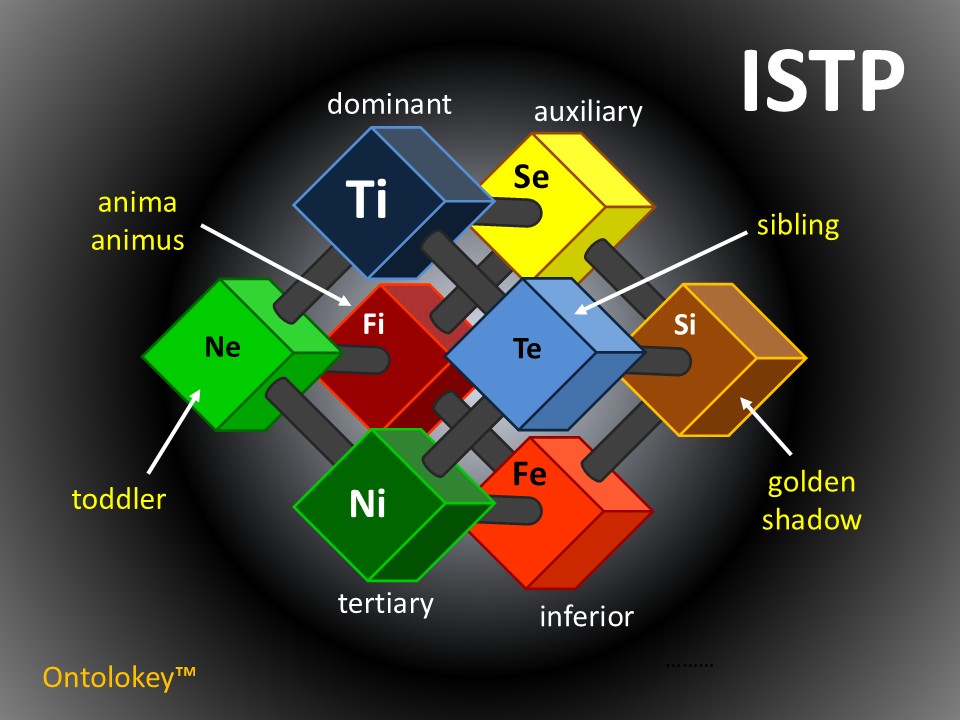
The ISTP personality reveals a quiet intensity—a mind that thinks deeply and a heart that quietly observes emotions at arm’s length. At its core lies Introverted Thinking (Ti), an inner workshop where logic is king. Everything is dissected, tested, refined—this intellectual sanctuary offers independence and precision, where ideas become internal models built on clarity rather than convention. Those who live within it seldom voice their internal reasoning, but rather act it out, guided by internal consistency and refined judgement.
Supporting this internal terrain is Extraverted Thinking (Te), the Sibling function. It bridges Ti’s internal logic with external action—planning, structuring, executing. Te demands efficiency and order in the outer world. Though often seen as a secondary, organizing counterpart, it’s deeply needed for manifesting internal insights into practical outcomes. In Ontolokey terms, the slider between Ti and Te typically balances around where the sense of internal clarity meets external performance and reliability.
The Toddler function for ISTP in this framework is Extraverted Intuition (Ne)—an unexpected turn, but a lively one. Ne introduces novelty, possibilities, and divergent thinking. Though it’s less consciously accessible for ISTPs, it nonetheless sparks curiosity, helping them explore alternatives and envision creative solutions—especially in moments of experimentation or problem‑solving that resist conventional logic.
Meanwhile Extraverted Sensing (Se), often described in function‑stack theory as auxiliary for ISTPs, is in Ontolokey the function that grounds the individual in the physical world. It connects the ISTP to movement, sensation, immediacy—whether mastering a physical skill, handling machinery, or perceiving detail at lightning speed in high‑pressure situations. Se is the anchor when Ti drifts too far into abstraction.
Yet none of these four conscious or semi‑conscious functions operate in isolation. Ontolokey insists: all eight psychological functions matter. So we turn to the hidden depths.
The inferior function is Extraverted Feeling (Fe)—a majestic but terrifying force. In the ISTP psyche, Fe represents emotional resonance, group harmony, and connection. It is the unwelcome monarch that Ti reveres yet fears. It acts as a measuring stick against societal expectations. Under stress, it bubbles to the surface—sometimes in bursts of emotion or desperate attempts at empathy—revealing how deeply the ISTP craves belonging, even if in quiet denial.
Beneath surface thought lies Introverted Feeling (Fi), the Anima or Animus. It is an inner mirror—an unconscious well of values, authenticity, and emotional truth. Though rarely articulated, Fi shapes the ISTP’s longing for real intimacy and meaning. It may stir unseen, prompting deep but silent resonance at the sight of honesty or betrayal. It’s not dramatic, but it touches the soul.
At the same time, Introverted Intuition (Ni), the Ontolokey Blindspot or tertiary, acts in subtle, uncanny ways. Ni offers flashes of insight—a gut feeling, a pattern recognized before fully understood. It’s quiet, rarely trusted, often dismissed; yet under pressure, it surfaces as foresight, or an inexplicable hunch that turns out right.
Though rarely trusted, Ni sometimes emerges through subtle, non-verbal forms—such as a pull toward introspection, symbolism, or even spiritual disciplines. Many ISTPs, perhaps unexpectedly, find grounding and quiet clarity in practices like yoga, martial arts, or meditation. These rituals allow them to tune into inner patterns and intuitive rhythms of the body and mind without needing to explain them. It’s not uncommon to find ISTPs who run yoga schools or quietly devote themselves to spiritual traditions—not out of dogma, but through lived, experiential understanding. In these moments, the blind spot begins to illuminate, gently balancing action with insight.
Finally, the golden shadow of the ISTP is Introverted Sensing (Si). It represents memory, bodily awareness, tradition, continuity. In traditional typology Si plays a minor or shadow role, but here it holds hidden strength—it grounds the ISTP’s memory and lived experience in a body, in rituals, in sensation. Though often overlooked, Si is the quiet voice reminding them of past patterns, physical comfort, and embodied presence.
Taken together, these eight functions form a dynamic psychological ecosystem. Ti governs inner logic. Te and Ne connect thought to structure and possibility. Se sustains presence. Fe challenges emotional engagement. Fi offers emotional authenticity. Ni hints at unseen meaning. Si roots experience in time and sensation. Ontolokey’s sliders track this interplay, showing where balance lies or where shadow looms.
According to the developmental arc, full integration of Fe and Si paves the way toward transformation—toward a “royal personality type” in Ontolokey’s framing, the ENFJ. This archetype symbolizes social leadership, emotional maturity, and a deeply engaged presence in the world—something toward which the ISTP can grow by integrating these initially neglected functions.
In essence, the ISTP in this framework is more than a solo thinker or hands‑on problem solver. They are explorers of logic who must learn to embrace feeling, sensation, intuition, and memory to become whole. They are silent climbers of an internal landscape whose summit lies in integrating every facet—the rational and the sensitive, the immediate and the intuitive, the internal modeler and the external human being.
A journey into the mind, the soul, and the quiet brilliance of the inner world
The INTP personality is one of quiet complexity, rich in thought and delicate in feeling. These individuals are often perceived as aloof or distracted, when in truth, their minds are intensely active, constantly shaping inner frameworks of understanding. They are philosophers of the self and the world, architects of logic, and tireless seekers of inner coherence. What they desire is not merely knowledge, but truth — truth that aligns with the intricate systems they build within their inner world. This private, internal landscape is governed by introverted thinking, a function that filters reality through a meticulous, often perfectionist lens. Every idea must be understood from the inside out, and every belief must withstand rigorous internal scrutiny.
Unlike personalities that define themselves in relation to others, the INTP lives in a world of internal principles. Thoughts are dissected, reshaped, deconstructed and reassembled with surgical precision. This interior logic is what provides them with stability in a world that often feels chaotic or illogical. Their emotional responses may seem subdued, but this is not due to a lack of depth — it is, in fact, a result of their deeply felt need for internal consistency. Authenticity, for the INTP, is not defined by spontaneous expression but by the structural soundness of what they think and believe.
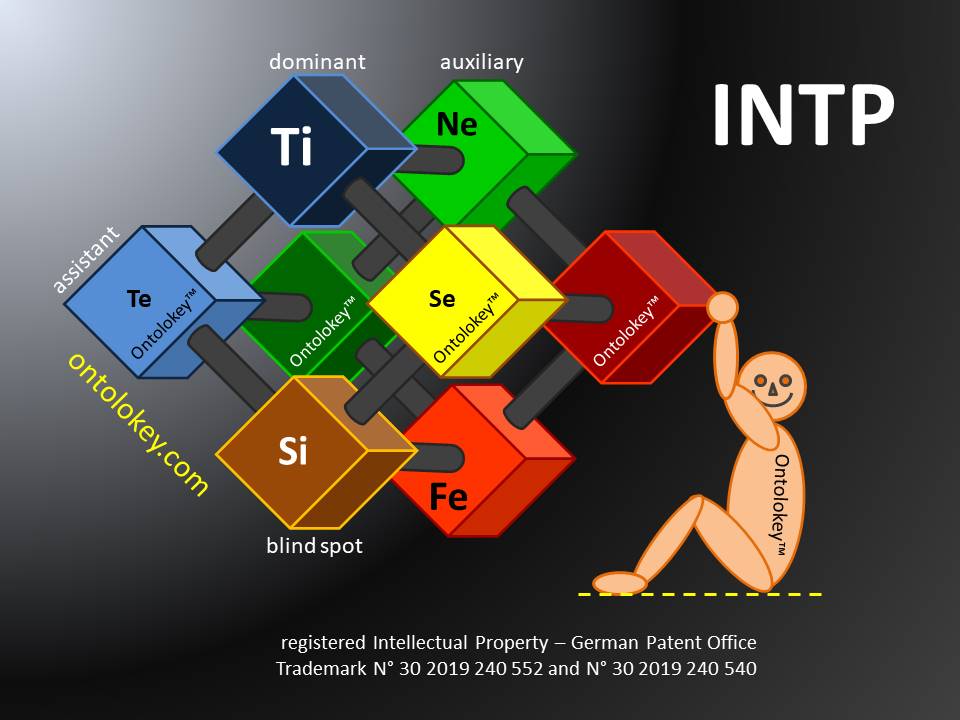
And yet, no human mind is an island. While the INTP’s inner world is their sanctuary, their development depends on how they relate to external functions and energies — those parts of the psyche that deal with action, interaction, sensation, and emotion. In the Ontolokey model, each psychological function is connected like a vertex on a cube. Between them lie movable sliders, which indicate to what extent an individual engages with the functions on either end of each edge. For an INTP, the dominant introverted thinking function connects most directly with three others: extraverted thinking, extraverted intuition, and extraverted sensing. These are not just supportive tools; they are necessary allies, often misunderstood but always essential.
Extraverted thinking, in this system, is considered the “sibling” of introverted thinking. It serves the purpose of bringing ideas into real-world form — planning, structuring, executing. Though it operates with outward efficiency and logical application, it often conflicts with the INTP’s more inward, customized logic. The relationship between these two mental energies resembles a pair of brothers: equal in strength, different in temperament, prone to rivalry yet ultimately bonded. When well-balanced, the INTP uses extraverted thinking to execute their insights effectively — perhaps managing a research project, leading a small team, or building a tool that expresses an abstract theory in tangible form. But if ignored, this function becomes a source of internal friction, a nagging reminder that ideas without action can become sterile.
Far more naturally embraced is extraverted intuition, the INTP’s auxiliary gateway to the external world. Through this function, possibilities emerge, patterns form, and previously unrelated ideas click into new constellations. It is a mental explorer, scanning the environment for novelty and potential. With it, the INTP expands their mental puzzle, adding piece by piece, revising the larger picture when a new idea challenges the previous design. This flexibility is one of their greatest strengths. They are not rigid theorists, but adaptive architects, willing to dismantle and rebuild a model when a deeper truth reveals itself. In the presence of inspiration, they can appear mentally electrified, weaving together disparate inputs into coherent insights. This intuitive stream keeps their thinking alive, mobile, and open to growth.
Less appreciated — but no less vital — is extraverted sensing, the toddler function. It ties the INTP to the immediate world: the body, the present moment, sensory data, and physical experience. While often ignored, this function is crucial for grounding. Without it, the INTP may drift too far into abstraction, losing track of time, health, or daily obligations. They may overlook the needs of their own bodies or underestimate the importance of material details. In extreme cases, this disconnect can make them vulnerable — socially, financially, or practically. But when embraced gently, even playfully, this toddler energy offers restoration: a walk in nature, a meal savored, a moment of tactile pleasure. It reminds the mind that it has a body, and that life is not only about thoughts but also about presence.
Beyond the conscious functions lie the more elusive energies — those that shape the emotional undercurrent of the INTP’s life. One of the most powerful among them is extraverted feeling, which operates as the inferior function and, in Ontolokey, takes on the archetypal role of the King or Queen. It stands in stark contrast to the INTP’s dominant thinking and is often perceived as intimidating, foreign, or even threatening. This function governs emotional harmony, social belonging, and empathy toward collective values. For the INTP, whose thinking is guided by internal logic, emotional expectations from others can feel coercive, even manipulative. Yet deep inside lies a yearning — to be understood, to belong without having to perform. The INTP may not express this openly, but their avoidance of superficial social rituals masks a deep, vulnerable desire for genuine connection.
Parallel to this lies the anima, represented by introverted feeling. This unconscious emotional core does not demand social interaction, but rather authenticity. It seeks truth in feeling as Ti seeks truth in thought. It is through the anima that the INTP longs for a kind of love that is soul-deep, unspoken, almost mythic in its purity. Because this function operates unconsciously, the INTP may not always understand the intensity of these emotions. They are not governed by logic and often rise unannounced. But they are no less real. This is the INTP’s hidden heart: tender, idealistic, quietly hoping for a kind of bond that transcends the ordinary.
Also embedded deep within the psyche is introverted sensing, a tertiary function that, in the INTP, often takes a playful or neglected form. It deals with physical memory, tradition, and routine — concepts the INTP often finds restrictive. But Si also grants comfort, personal nostalgia, and bodily awareness. When repressed, the INTP may live too much in the mind, dissociated from past and body alike. But when accepted, even slowly, this function builds internal stability and strengthens the ability to connect emotionally through shared memory and rhythm. Si also complements extraverted feeling. Together, they support the evolution toward emotional maturity, where the INTP no longer fears vulnerability but learns to live with it gracefully.
And then there is introverted intuition, the golden shadow. It is the quiet mystic within — the part of the INTP that senses meaning beyond logic. This function does not speak loudly; it whispers in symbols, images, and quiet knowing. The INTP often mistrusts this side of themselves, rejecting organized spirituality or prophetic certainty. But Ni is not a preacher; it is a poet. It offers glimpses into the soul’s myth, hints of a deeper order not captured by reason alone. To embrace this golden shadow is not to abandon logic, but to allow the soul to speak in more than one language.
Taken together, these eight functions form a psychological whole. Each plays its role, each exerts its pressure, each holds a mirror. The INTP is not just a thinker, not just a dreamer, but a personality in motion — stretching between clarity and chaos, solitude and longing, certainty and surrender. True growth comes not from perfecting the dominant function but from integrating the forgotten, the feared, and the fragile.
They are wanderers of the intellect, yes — but also pilgrims of the soul. And when they begin to embrace all parts of themselves — the rational and the emotional, the abstract and the sensory — they begin not only to understand the world, but to inhabit it fully.
Eine Reise ins Denken, Fühlen und innere Ringen eines stillen Genies
Wer einem INTP begegnet, steht oft vor einem Rätsel. Still, distanziert, gedanklich scheinbar abwesend – und doch blitzschnell im Verstand, originell im Denken und oft überraschend tief in der Seele. Es ist eine Persönlichkeit, die ihre Kraft nicht durch Lautstärke entfaltet, sondern durch Logik, Intuition und eine oft fast kindliche Neugier auf das „Warum hinter dem Warum“.
Ontolokey bietet uns einen faszinierenden Blick auf diesen Persönlichkeitstyp – nicht als statisches Etikett, sondern als lebendiges Gefüge aus acht psychologischen Funktionen, die miteinander interagieren wie die Seiten eines Würfels. Dieses Modell erlaubt, nicht nur Stärken zu beleuchten, sondern auch Unsicherheiten, unbewusste Sehnsüchte und jene leisen Schatten, die das wahre Wachstum ermöglichen.
Das Zentrum des inneren Kosmos: Introvertiertes Denken (Ti)
Im Herzen eines INTP schlägt das introvertierte Denken (Ti) – kühl, strukturiert, präzise. Es ist die Funktion, die keine Ruhe gibt, bis alles verstanden ist. Ti will nicht einfach wissen – es will begreifen. Es analysiert, dekonstruiert, ordnet und formt daraus Modelle des Verstehens, die oft weit über den Horizont anderer hinausgehen.
Aber dieses Denken geschieht leise. Nicht laut, nicht im Wettbewerb. Sondern im Inneren – in stillen Nächten, zwischen zwei Kaffees oder in einem verträumten Moment am Fenster. Ti ist der Wissenschaftler in uns, der Philosoph, der die Welt nicht nur erklären, sondern auch logisch ergründen will. Und das oft ganz für sich allein.
Die drei Kräfte im Hintergrund: Te, Ne & Se
Ontolokey verknüpft Ti mit drei weiteren Funktionen über symbolische Kanten eines Würfels, an denen bewegliche Schieber sitzen. Diese zeigen an, wie sehr eine Funktion gerade genutzt oder vernachlässigt wird.
1. Extravertiertes Denken (Te) – der Bruder im Schatten
Te ist der „Sibling“, der Bruder, der Dinge geregelt kriegt. Projektmanagement, To-do-Listen, Steuererklärung – alles, was den INTP latent nervt, aber er dennoch beherrschen muss. Wenn der Schieber hier bei etwa 40 % Te liegt, gelingt es dem INTP, auch in der Außenwelt zu funktionieren, seine Ideen zu präsentieren und Projekte zu realisieren. Doch: Zwischen Ti und Te herrscht nicht selten Geschwisterrivalität – der eine will Klarheit und Tiefe, der andere Effizienz und Resultate. Manchmal kracht’s. Aber sie brauchen einander.
2. Extravertierte Intuition (Ne) – der Pfad ins Unbekannte
Die Hilfsfunktion Ne ist wie ein Kind mit großen Augen in einem neuen Land. Sie sucht Muster, Chancen, Überraschungen. Ne fragt: „Was wäre, wenn…?“ Und während Ti eine innere Ordnung anstrebt, öffnet Ne ständig neue Türen. Für den INTP ist Ne ein Geschenk – denn ohne sie würde er in seinem Kopf bleiben. Mit Ne geht er raus – denkt weiter, spinnt Hypothesen, findet Lösungen, auf die kein anderer kommt.
3. Extravertiertes Empfinden (Se) – das notwendige Übel
Als Toddler-Funktion ist Se zuständig für das, was viele INTPs als lästig empfinden: Körper, Geld, Alltag, Hier und Jetzt. Se sorgt dafür, dass der Müll rausgebracht, das Konto ausgeglichen und der Körper nicht völlig ignoriert wird. Wird Se zu sehr vernachlässigt, verliert der INTP den Bezug zur Realität – und läuft Gefahr, ausgenutzt zu werden oder schlicht zu vergessen, dass auch die Welt da draußen ein Ort ist, der gepflegt werden will.
Der blinde Fleck: Extravertiertes Fühlen (Fe)
Und dann ist da Fe – das extravertierte Fühlen. Laut Ontolokey die inferiore Funktion, aber in Wahrheit ein stiller Riese. Für den INTP wirkt Fe wie ein riesiger Spiegel, in dem er sich nicht erkennt – und vor dem er sich manchmal fürchtet.
Fe steht für Anpassung, für soziale Wärme, für Gemeinschaft. All das erscheint dem INTP oft wie eine Bühne voller Rollen, Masken, Erwartungen. Doch tief in seinem Inneren sehnt sich auch der rationalste Denker nach Zugehörigkeit, nach dem Gefühl, nicht allein zu sein. Fe ist die „Königin“ im Inneren Königreich – gefürchtet, bewundert, aber letztlich unverzichtbar.
Die innere Seele: Die Anima (Fi)
In Ontolokey erscheint Fi – das introvertierte Fühlen – als Anima oder Animus, je nach Geschlecht. Sie wirkt wie ein Spiegel der Seele: unbewusst, archaisch, verletzlich. Der INTP ist oft überrascht von der Tiefe seiner Gefühle. Er kann tagelang rational bleiben – und dann plötzlich innerlich weinen, weil jemand seine Seele unbedacht berührt hat.
Diese Gefühle sind nicht schwach. Sie sind tief und echt. Doch sie wirken wie aus einer anderen Zeit – kindlich, rein, roh. Sie erklären auch, warum viele INTPs so nach authentischer Liebe suchen, nach Seelenverwandtschaft, nach der einen Person, die sie wirklich versteht. Fi ist das leise Vakuum, das nur mit echter Verbindung gefüllt werden kann.
Körper und Erinnerung: Introvertiertes Empfinden (Si)
Si, als tertiäre Funktion, ruht lange im Hintergrund. Es kümmert sich um Körperwahrnehmung, um sinnliche Erfahrungen – aber auch um die Vergangenheit. Für INTPs ist Si oft zweitrangig: Erinnerungen wirken blass, Rituale langweilig, Traditionen unnötig.
Doch in Wirklichkeit liegt hier ein Schlüssel zur Reifung. Denn Si verankert den INTP in seinem Körper, schenkt ihm Genuss, Erdung, Wiederholung. Ein INTP, der seinen Körper ignoriert, lebt nur halb. Einer, der ihn integriert, lebt ganz.
Der goldene Schatten: Introvertierte Intuition (Ni)
Und ganz unten, fast im Dunkeln, liegt Ni – die introvertierte Intuition. Sie ist kein Prophet, sondern eher ein Mystiker. Sie flüstert, wo andere schreien. Ni weiß Dinge, die der Verstand nicht erklären kann – sie erkennt tiefe Wahrheiten, Sinnbilder, Archetypen.
Doch der INTP hat oft Mühe, Ni zu vertrauen. Zu mystisch, zu irrational, zu „glaubensbasiert“. Und doch: In der Integration von Ni liegt eine neue Tiefe. Spiritualität muss nicht organisiert sein – sie kann im Inneren stattfinden. Ontolokey nennt Ni den goldenen Schatten – nicht, weil sie glänzt, sondern weil sie, richtig verstanden, das Unsichtbare sichtbar machen kann.
Wie sich der INTP in anderen Modellen zeigt
Andere Persönlichkeitsmodelle beschreiben den INTP als den Logiker – analytisch, ideenreich, unabhängig. Er liebt Systeme, denkt gerne „outside the box“ und diskutiert lieber über Möglichkeiten als über Emotionen. Doch er kann auch abschweifen, verheddern, sich verlieren in Theorien.
Er ist eher Einzelgänger als Mitläufer, liebt Unabhängigkeit, denkt in Langzeitprojekten – und hat einen fast kindlichen Widerstand gegen starre Routinen. Die Welt ist für ihn ein großes Puzzle. Und nur er kennt den Schlüssel, es zu lösen.
Fazit: Der INTP als Denkender Wanderer
Der INTP ist mehr als ein Denker. Er ist ein Wanderer zwischen den Welten – zwischen Logik und Intuition, zwischen Einsamkeit und Sehnsucht, zwischen Zukunftsvision und Körperlichkeit. Ontolokey zeigt uns, dass jede Funktion – ob bewusst oder unbewusst – ihren Platz hat. Dass kein Anteil unterdrückt oder ignoriert werden darf.
Am Ende ist der INTP jemand, der seine Wahrheit sucht – und bereit ist, dafür zu forschen, zu träumen, zu lieben und zu scheitern. Und das macht ihn – und sie – zu einem der faszinierendsten und tiefgründigsten Typen überhaupt.
A modern, expanded interpretation of C.G. Jung’s analytical psychology
1. Conscious and Unconscious: A Foundational Distinction
In analytical psychology, the psyche is understood as a complex system consisting of conscious and unconscious components. Consciousness includes all thoughts, perceptions, feelings, and intentions of which we are immediately aware. The unconscious, on the other hand, holds all the mental content that is repressed, forgotten, ignored, or not yet developed—ranging from instinctive drives to personal memories and collective symbols.
Jung emphasizes that these two realms operate in dynamic tension. The more consciousness leans in one direction (e.g., toward external adaptation), the more the unconscious compensates by gravitating in the opposite direction (e.g., subjective or internal content). This principle of psychic compensation is key to understanding the functioning—and dysfunction—of psychological types.
Thus, to fully grasp the “extraverted type,” we must examine not only how they consciously relate to the world but also how this orientation shapes their inner, unconscious life.
2. Core Attitude of the Extravert: Orientation Toward the Outer World
The extraverted personality type is primarily oriented toward objects—that is, toward external people, events, values, structures, and demands. Their attention, motivation, and judgment are directed outward.
This orientation is not merely social; it is existential. Extraverts derive meaning, validation, and even their sense of identity from the external environment.
Key traits of the extraverted conscious attitude:
They seek stimulation, feedback, and direction from the outside world.
They are action-driven and generally pragmatic, responding swiftly to opportunities or threats.
Their decisions are often aligned with social norms, collective values, or observable facts.
This does not mean that extraverts lack inner reflection—but their primary mode of understanding and navigating life stems from the objective conditions around them, rather than inner principles or personal intuition.
In contemporary terms, the extravert may resemble:
The entrepreneur who constantly scans the market.
The teacher who thrives on student feedback.
The politician who adapts to public opinion.
Extraversion in Jung’s system is deeper than a social preference—it is a psychic orientation, shaping perception, cognition, and values.
3. Social Conformity and Adaptability: Strength or Risk?
A defining feature of the extraverted type is their capacity for social adaptation. They align well with the roles, expectations, and hierarchies of their culture. Their moral framework often mirrors the prevailing collective standards.
In sociological terms, they are typically “normative” actors: they play the role society expects of them and do it well.
Positive aspects:
Social fluency
Career success
Realism and practical effectiveness
Risks and limits:
Over-adaptation: Extraverts may conform even to unhealthy or corrupt environments, mistaking collective norms for universal truths.
Moral relativism: Their ethical compass may shift depending on external consensus rather than internal conviction.
Resistance to innovation: Deep extraverts may avoid novelty unless it has obvious external validation.
This distinction leads Jung to an important observation: fitting in (“Einpassung”) is not the same as truly adapting (“Anpassung”) to life. The former may reflect only superficial alignment; the latter requires deeper awareness of universal psychological and spiritual truths that go beyond current cultural trends.
4. Neglect of the Subjective: When the Inner World is Forgotten
Jung warns that extraverts often pay insufficient attention to their subjective needs, especially if those needs are not immediately reflected in external demands.
Consequences of ignoring the inner world:
Physical neglect: Bodily needs like rest, nutrition, and emotional regulation may be underestimated or dismissed.
Psychological fragmentation: Vital parts of the personality—desires, fears, instincts—may be disowned.
Loss of meaning: Without inner reflection, achievements may feel hollow or directionless.
In modern psychology, this would be recognized as a disruption of interoceptive awareness (the ability to sense internal bodily and emotional states) and a weakening of self-determined motivation (autonomy).
Eventually, this inner neglect manifests in psychosomatic symptoms, burnout, anxiety disorders, or depression.
5. The Danger of Object Fixation: Becoming Lost in the World
When the extravert’s relationship to external objects (people, roles, tasks, ideals) becomes extreme, they risk psychic fusion with the world. Their identity, values, and goals become indistinguishable from the surrounding context.
Examples from Jung:
A successful businessman expands his enterprise beyond reason—out of sheer responsiveness to demand—until he collapses.
A singer becomes paralyzed by performance anxiety after being swept up in collective admiration.
Jung illustrates this dynamic with what we would today call psychosomatic defense mechanisms: unconscious psychological conflicts expressing themselves in the body. These symptoms serve as an involuntary correction: the psyche forces the individual to slow down and reorient inwardly.
In psychodynamic terms, such reactions resemble a homeostatic response of the psyche—an attempt to restore balance when conscious behavior becomes one-sided or unsustainable.
6. The Typical Neurosis: Hysteria in the Extravert
Jung associates hysteria with the extraverted type. Today, the term “hysteria” is outdated and often replaced by diagnoses such as conversion disorder, borderline traits, or histrionic personality.
A tendency toward emotional dramatization and attention-seeking behavior.
A strong desire to be noticed, admired, and affirmed by others.
High suggestibility—being easily influenced by dominant figures or group norms.
Over-identification with others’ emotions, often at the expense of personal boundaries.
Hysterical symptoms serve as both an expression and a protest: the unconscious dramatizes what the extraverted consciousness refuses to see—inner needs, unmet feelings, and unprocessed trauma.
7. The Unconscious Compensation: Rise of the Primitive Self
According to Jung’s compensatory model, the unconscious of the extraverted person becomes strongly introverted, emphasizing the subjective, emotional, and often primitive aspects of the psyche.
The more someone identifies with outer roles and suppresses inner impulses, the more those impulses become regressive—emotionally childish, irrational, and sometimes even destructive.
This is not because these impulses are inherently pathological, but because they are denied, unintegrated, and therefore distorted.
Modern parallels:
The extraverted achiever who suddenly feels lost, burnt out, or drawn to irrational desires.
The over-adapted parent who begins having vivid dreams of rebellion or escape.
The seemingly balanced executive who quietly develops compulsions, fantasies, or addictions.
The unconscious acts as a psychic counterweight, asserting unmet needs in increasingly disruptive ways if ignored for too long.
8. Breakdown and Collapse: When Compensation Fails
If the extraverted attitude becomes too extreme, and unconscious compensations are ignored, the psyche may force a collapse—either through external failure or internal breakdown.
Two forms of collapse:
Objective catastrophe: The person unconsciously sabotages their outer life by mixing in personal fantasies. For instance, turning a successful business into a misguided “artistic” project, ultimately ruining it.
Subjective collapse: Psychological exhaustion, neurosis, loss of direction, or nervous breakdown. These states emerge when the suppressed unconscious finally overwhelms the conscious ego.
In today’s terms, we might interpret this as ego depletion, burnout syndrome, or the onset of an affective disorder. Addictive behaviors, such as substance abuse, often emerge as misguided attempts to soothe the inner conflict.
9. Psychological Functions and Imbalance
Jung posits four psychological functions: thinking, feeling, sensation, and intuition. In each person, one function becomes dominant and is consciously cultivated. The remaining functions are less developed and may operate unconsciously.
In the extravert:
The dominant function is directed outward, serving external adaptation.
The inferior functions are poorly integrated and introverted, expressing themselves in unintended or uncontrolled ways.
Example:
An extraverted feeling type may be socially skilled but occasionally says things that are intellectually tactless—the result of an underdeveloped thinking function that acts without conscious regulation.
The inferior functions, tied to the unconscious, often express deeply personal or irrational content. They are ego-centric, emotionally immature, and can disrupt conscious intention—especially under stress.
10. Integration and Individuation: Toward Wholeness
Jung does not view psychological types as fixed boxes. Rather, they are starting points in the journey of individuation—the lifelong process of integrating unconscious material and becoming a psychologically whole individual.
A healthy extravert:
Engages richly with the outer world, without becoming enslaved by it.
Learns to recognize and honor inner needs, even if they feel unfamiliar or irrational.
Gradually develops the weaker functions, especially in midlife.
Only by reconciling inner and outer, subjective and objective, conscious and unconscious, can the personality evolve into a more integrated and resilient form.
Conclusion: The Gift and the Danger of Extraversion
The extraverted type offers immense value to society: action, pragmatism, connection, leadership. But when external adaptation overshadows inner truth, the psyche suffers. The unconscious will not remain silent forever.
Jung’s model serves not only as a typological framework, but also as a map for inner balance. Extraversion must be tempered with reflection, self-awareness, and a willingness to hear the subtle voice within.
Only then can extraverts live not just effectively, but authentically.
Introversion, as defined by Carl Gustav Jung, is not simply shyness or social withdrawal—it is a fundamental orientation of consciousness. While extroversion draws energy from the external world, focusing on objective facts, people, and situations, introversion is energized by the inner world: reflections, interpretations, and inner meanings.
The introverted consciousness does not deny the existence of the external world; rather, it evaluates it through an inner filter. External stimuli are not taken at face value but are subjected to internal reflection before influencing behavior. In other words, a subjective perspective mediates between perception and action. This intermediary lens acts almost like an internal editor or translator, reframing reality in terms that are psychologically significant to the individual.
This tendency has profound implications: the introvert is primarily attuned not to what is, but to what something means. In contrast to the extravert, who adapts readily to outer circumstances, the introvert’s adaptation process depends on internal resonance. The outer world becomes relevant only insofar as it aligns—or conflicts—with the inner world.
2. Subjectivity as an Epistemological Necessity
Jung is careful to defend the role of subjectivity—not as a weakness, but as a fundamental condition of human knowledge. No perception is purely objective; all perception involves a perceiving subject. We cannot access an objective world except through our subjective lenses.
This view resonates with Kantian epistemology, which holds that knowledge is always shaped by the structures of the mind. Jung extends this idea into the psychological domain: the psyche is not a passive receiver of reality, but an active interpreter. Therefore, subjectivity is not merely a personal bias but a necessary and universal dimension of consciousness.
To ignore the subjective factor is to fall into a positivist fallacy: the belief that reality can be fully captured by measurable data alone. Jung warns that such overconfidence in objectivity leads not only to an impoverished understanding of the psyche but also to emotional desensitization and authoritarian thinking—hallmarks of early 20th-century cultural and political pathology.
Thus, the introvert’s reliance on subjectivity is not narcissistic, but epistemologically valid. In fact, it reflects a deeper awareness of how knowledge works: always through a perceiving and interpreting self.
3. The “Subjective Factor” as a Psychological Constant
The subjective factor refers to the inner psychological mechanisms—cognitive, emotional, and symbolic—that shape how we perceive and respond to reality. Jung emphasizes that this subjective factor is not idiosyncratic or arbitrary. It arises from a deep structure of the psyche that is shared across cultures and generations.
This structure, which Jung later called the collective unconscious, provides the framework for certain universal perceptions, values, and instincts. It enables basic communication, cultural continuity, and stable psychological development. The subjective factor, therefore, is not simply “personal opinion,” but part of what makes human experience coherent across time and space.
In this sense, subjectivity is just as real and enduring as any objective law. Denying it would be akin to denying gravity or the laws of thermodynamics—except here, the laws are psychological rather than physical. Jung sees the subjective factor as a “second world principle,” equally essential to human experience as the external environment.
4. The Dangers of One-Sided Subjectivity
However, introversion—like any psychological orientation—can become pathological if overdeveloped or imbalanced. If the subjective lens becomes too dominant, the individual may begin to confuse internal perceptions with objective reality. This results in a “pathological subjectivization” of consciousness, where personal meaning becomes the sole criterion of truth.
In this state, the individual no longer relates to the world, but only to their internal representations of it. Feedback from others is rejected or ignored. The ego inflates, believing itself to be the center of all reality. Jung sees this not as genuine self-awareness, but as a defensive identification of the ego with the Self, a move that disconnects the person from both inner depth and outer reality.
Such a state resembles what modern psychology would call narcissistic inflation or even ego-centrism disguised as authenticity. Paradoxically, this happens most often to those who take the inner life most seriously—when they lose the capacity to question it critically.
5. The Ego and the Self: A Crucial Distinction
A core problem for the introverted type is the tendency to equate the ego with the Self. The ego is the center of conscious identity—“I think,” “I feel”—but the Self is the totality of the psyche, including unconscious elements. Dreams often illustrate this: in them, the ego may appear weak, villainous, or even absent, showing that it is only one part of the greater whole.
When the introvert mistakes their ego for the Self, they elevate their personal perspective to something universal. This leads to rigidity, dogmatism, and psychological isolation. Jung notes that this confusion is often strengthened by cultural prejudice: because introversion is already misunderstood in an extraverted world, the introvert may retreat further inward and over-identify with their internal experience.
From a Jungian developmental perspective, true individuation—the process of becoming one’s whole self—requires a careful differentiation between ego and Self. Only then can the introvert engage with both inner and outer worlds in a balanced way.
6. Archetypes: The Inner Patterns That Shape Perception
Jung introduces the concept of archetypes—universal, inherited patterns of thought and experience. These are not fixed images but dynamic forms: patterns of energy that manifest as myths, symbols, and roles (e.g., Hero, Mother, Shadow, Trickster). Archetypes influence how we interpret the world, often unconsciously.
For introverts, these patterns are especially powerful. Their psyche is oriented inward, where archetypes are most active. The introvert may unconsciously project these inner images onto the external world—interpreting events not for what they objectively are, but in terms of symbolic resonance.
For example, a simple disagreement might feel like a betrayal because it triggers the “Shadow” archetype. Or a mentor might be idealized as a wise “Sage,” regardless of their actual traits. This symbolic interpretation of life gives introverts psychological depth, but it can also cloud their objectivity if they are unaware of the archetypal layer at work.
Modern neuroscience and evolutionary psychology lend some support to this idea: pattern recognition and symbolic thinking are deeply hardwired into the human brain, helping us make sense of complexity long before formal reasoning develops.
7. Cultural Misunderstandings and the Pathologizing of Introversion
In a culture that favors extraversion—action, visibility, sociability—the introverted style is often misunderstood or pathologized. Terms like “egocentric,” “antisocial,” or “overthinking” reflect this bias. Even well-meaning psychologists may interpret introversion as a developmental delay or neurosis.
Jung sees this as a profound cultural prejudice. In fact, many introverts internalize this negativity, leading them to doubt their own perception. Others react by adopting a rigid intellectualism or retreating into abstraction, which only confirms external stereotypes.
Moreover, the introvert’s way of speaking—often abstract, generalized, or principle-driven—can alienate listeners accustomed to practical or emotional communication. The introvert may seem cold or dogmatic, when in reality they are simply expressing internal convictions shaped by archetypal experience rather than social consensus.
This misunderstanding reinforces Jung’s larger point: introversion is not a deficiency, but a different mode of consciousness, one that requires cultural and personal validation.
8. Neurotic Introversion and the Inflation of the Ego
When introversion becomes extreme—especially in neurotic individuals—the ego may become inflated by the unconscious energy of the Self. The result is a “power complex”: the ego believes it has a unique insight into truth or destiny, leading to arrogance, detachment, or even delusional thinking.
This distortion often fuels philosophical or ideological grandiosity. Jung cites Nietzsche as an example: a brilliant but often excessive thinker whose work reflects both profound insight and psychological imbalance. In such cases, the introvert does not merely live from the inner world but becomes trapped in it.
Modern clinical psychology might diagnose this as grandiose narcissism or schizotypal ideation, depending on severity. For Jung, however, the root is clear: a failure to distinguish between the symbolic authority of the unconscious and the personal ego. Healing requires re-establishing contact with the objective world—and a more humble attitude toward the inner one.
Conclusion: The Inner World as a Valid Dimension of Reality
The introverted type embodies a consciousness that prioritizes meaning over fact, depth over breadth, and essence over appearance. It is a mode of being that seeks to understand the world not by mastering it externally, but by integrating it internally.
This mode of consciousness is often underappreciated in fast-paced, data-driven societies. But Jung’s psychology reminds us: without the subjective factor—without the inner eye—there is no genuine understanding of human experience. The introvert’s path is not to escape the world, but to reveal its inner dimensions, which are just as real, and perhaps more enduring, than the outer ones.
1. Understanding Extraverted Intuition as a Cognitive Function
Extraverted Intuition (often abbreviated as Ne) is one of the eight psychological functions identified by Carl Gustav Jung in his theory of psychological types. Unlike the more familiar conscious processes like thinking or feeling, intuition operates primarily below the threshold of awareness, surfacing as images, insights, and a sense of possibility that seems to arise spontaneously.
As a perceiving function, Ne does not evaluate or judge—it simply perceives patterns, relationships, and latent potentials in the external environment. It constantly scans for what could be, rather than what is. For the extraverted intuitive type, this is not a conscious choice but a natural psychological orientation: their mind is oriented toward the unfolding potential of external stimuli.
The experience of Ne can be compared to a radar sweeping the horizon—not focusing on any one object for too long, but rapidly detecting changes, connections, and new directions. This intuitive “sight” often manifests as visionary thinking, innovative ideas, or sudden realizations that seem to leap over logical steps.
What makes this function difficult to grasp is that it works without deliberate awareness. Even the intuitive individual may be unable to explain how they “know” something—they just know it, and often correctly. This can create a kind of mystique, even for themselves.
🔍 Analogy: If introverted intuition (Ni) is like an internal telescope, focusing on singular, deep insights, then extraverted intuition is like a kaleidoscope—constantly shifting, combining elements in novel ways, generating new possibilities through external engagement.
2. Intuition vs. Sensation: A Conflict of Perception
Jung emphasizes the natural opposition between Intuition and Sensation. Where Sensation (particularly extraverted Sensing) is grounded in immediate physical experience, Ne is future-oriented and relatively detached from the concrete.
This opposition creates internal tension when Ne is dominant: the more a person is tuned into emerging possibilities, the more they tend to suppress or ignore direct sensory input. Concrete sensory details are seen as distractions—noisy, literal, and often uninspiring. Sensation drags the intuitive person back into the now, while their psyche wants to roam freely toward the not-yet-real.
Yet, in practice, intuitive insights often use sensory impressions as raw material. An intuitive may notice a small, seemingly insignificant detail—like someone’s tone of voice, a shift in lighting, or a minor inconsistency—and from this generate a rich tapestry of potential meanings or predictions. These observations are selected not for their objective strength, but because they resonate with the intuitive’s unconscious framework.
Jung notes that such individuals may mistake these intuitive selections for genuine sensations, and even speak of them as “feelings” or “sensations.” However, their orientation is not to the sensory data itself, but to its symbolic or potential value.
This confusion can create communication difficulties with sensing types, who rely on objective, measurable input. What an intuitive values is not what “is,” but what “might become.”
3. The Role of Extraverted Intuition in Adaptation and Creativity
When Ne dominates a person’s personality structure, it becomes the primary tool of psychological adaptation. Unlike types who adapt by organizing facts (Thinking types) or maintaining harmony (Feeling types), the extraverted intuitive adapts by generating options, escaping confinement, and staying mobile—mentally, emotionally, and often physically.
This makes them ideally suited for creative, pioneering, and entrepreneurial roles. They are often the first to perceive opportunities where others see nothing. In blocked or stagnating systems—whether in business, politics, or personal relationships—they often act as catalysts for change, introducing new directions or frameworks.
However, Ne-dominant individuals also risk becoming chronically unsettled, because their inner stability depends on the continuous influx of novelty. Routine, predictability, or narrow systems of meaning feel suffocating to them. They may quickly disengage from environments or people that no longer offer a sense of possibility.
Jung vividly describes how normal life situations become “prisons” to the Ne type. What begins as exciting and full of promise can, once explored, become claustrophobic. They are driven to escape—sometimes destructively—simply to re-engage with that initial feeling of openness and emergence.
This creates a paradox: the more they pursue freedom and possibilities, the harder it becomes to commit or find lasting satisfaction.
4. The Extraverted Intuitive Personality: Motivations and Behavior
People who embody this type (often associated with ENTP and ENFP) exhibit a distinct psychological profile. Their primary motivation is possibility over permanence.
They are highly responsive to emerging trends, sometimes even anticipating cultural or technological shifts before they’re widely visible.
They are natural networkers, connecting people, ideas, and systems in surprising ways.
They often experience life as a series of “turning points”, where every new opportunity feels definitive—until the next one arises.
They commit deeply and emotionally—but only to what is still unfolding. Once the outcome becomes predictable, their energy diminishes. From the outside, this can look like a lack of loyalty or depth. But internally, the intuitive feels a genuine loss of meaning.
Despite their enthusiasm, their judging functions—Thinking and Feeling—are often underdeveloped. This makes it difficult for them to evaluate or prioritize their many insights. Without this inner structure, they may leap into unwise ventures, misjudge others’ intentions, or spread themselves too thin.
⚠️ Common behaviors:
Starting many projects, finishing few
Rapid career or relationship changes
Difficulty with repetition or routine
Resisting commitment due to fear of “missing out” on something better
5. Moral Framework and Social Challenges
Because they are not primarily guided by logic or shared emotional values, extraverted intuitives often develop a personal moral code based on authenticity to their vision. Their ethical compass is oriented not toward social norms, but toward staying true to what they “see” intuitively.
This can make them appear:
Unreliable or impulsive
Disrespectful of tradition
Opportunistic or emotionally distant
But their behavior is rarely malicious. The intuitive type experiences a moral imperative to follow the vision, even when it conflicts with obligations or past choices. They value potential over consistency.
Still, this orientation can cause real harm in relationships, institutions, or communities that require stability, patience, or predictability. Their enthusiasm may inspire others to follow, only to be left behind when the intuitive moves on.
The challenge for the Ne-dominant person is to develop auxiliary judging functions (typically Introverted Feeling or Introverted Thinking) to provide grounding, discernment, and a sense of responsibility.
6. Unconscious Compensation and Psychological Risk
When the extraverted intuitive suppresses their lesser-used functions—especially Sensation, Thinking, and Feeling—these can manifest in the unconscious in distorted or neurotic forms.
According to Jung, the intuitive’s inferior function (often Sensation) can emerge as:
Somatic anxiety
Hypochondria
Obsession with bodily functions
Sudden, irrational emotional attachments
This happens because the intuitive has neglected the real, physical, and emotional content of life, focusing instead on abstract potential. Eventually, the psyche demands compensation. The more the intuitive tries to float above reality, the more forcefully the unconscious anchors them with irrational fears or compulsions.
These symptoms often take symbolic form—phantasms of sickness, misfortune, or overwhelming needs—which feel out of sync with their usual detachment. Jung even notes that Ne types may become entangled in obsessive relationships with people who evoke repressed emotional or sensory content.
Such fixations can feel deeply irrational and humiliating to the intuitive type, yet they are symptoms of the psyche trying to reintegrate neglected functions.
🧠 Therapeutic goal: Help the intuitive type reconnect with the concrete world—not by extinguishing their gift for vision, but by supporting the development of Feeling, Thinking, and Sensation in a healthy, conscious way.
7. Cultural and Social Value of the Ne Type
Despite their challenges, extraverted intuitives play a crucial cultural role. They are:
Early adopters and change-makers
Advocates for innovation and minority viewpoints
Visionaries who see beyond established paradigms
In politics, business, and social movements, they can initiate radical change when others cling to the status quo. When morally grounded, they uplift entire communities by empowering others and giving voice to the future.
Yet, to fulfill this role responsibly, they must learn inner structure—the ability to evaluate their insights, care for those affected by their actions, and stay long enough to build what they begin.
Only then can they reap the harvest of the many seeds they sow.
✅ Summary
The extraverted intuitive type is driven by a powerful, unconscious orientation toward future possibilities. They perceive hidden potentials in people, systems, and environments and are compelled to act on what others cannot yet see.
But this gift comes with the risk of instability, escapism, and emotional detachment. Without grounding in other psychological functions, the intuitive may sacrifice substance for the thrill of discovery, leaving behind unfinished projects and relationships.
Their challenge is to integrate inner judgment and grounded perception, allowing their vision to take root and bear lasting fruit.
Based on C. G. Jung’s typology and enriched with contemporary understanding
1. The Nature of Extraverted Sensing (Se) – Raw Perception of the Outer World
Extraverted Sensing (Se) is one of the eight fundamental psychological functions identified by Carl Gustav Jung in his typology of personality. As a perceiving function, it does not interpret or judge, but simply registers phenomena as they are presented by the environment. Unlike introverted sensation, which tends to filter perceptions through internal associations, Se focuses entirely on immediate, external stimuli. It deals with the here and now, capturing the vivid reality of things as they appear, not as they might mean or represent.
In a psyche dominated by Se, the self is deeply oriented toward tangible, material reality. This function operates with minimal distortion, meaning it does not seek hidden meanings or symbolic interpretations. A person using Se dominantly experiences the world as an unmediated flow of impressions, responding to colors, shapes, textures, sounds, and smells as they are, without overlaying them with theories or expectations.
This objective-oriented perception is not passive—it is highly alive and reactive. It notices novelty, intensity, contrast, and movement. Se-dominant individuals are often drawn to rich sensory experiences, whether in nature, art, food, physical activity, or interpersonal interaction. Their attention constantly scans the environment for stimuli of relevance or interest.
However, this perceptual style also means that subjective responses—such as feelings or intuitions—are suppressed or repressed. The Se type may appear indifferent to internal reflections, unaware of underlying patterns, and disconnected from symbolic or emotional meanings. This can lead to a profound imbalance when not moderated by other functions.
2. Objectivity at the Expense of Subjectivity – The Repression of Inner Experience
Jung makes an essential distinction between the objective and subjective aspects of sensation. While all perception involves a subjective component (i.e., how an individual experiences something), the extraverted sensation type consciously deactivates or denies this inner layer. In Jungian terms, the subjective function becomes inferior, existing in a repressed and unconscious state.
What this means in practice is that the Se-dominant person often struggles to access or validate personal emotional reactions, subtle intuitions, or imaginative interpretations. Instead, the psyche orients itself entirely toward what can be seen, touched, or measured. As a result, the individual becomes strongly bound to empirical reality and less able (or willing) to reflect upon its symbolic, emotional, or philosophical dimensions.
The implications for cognition and behavior are considerable. Because inner impulses are subdued, the Se-dominant person often externalizes meaning—they locate importance in what is happening around them, not within. Life becomes about what is, not what could be or what it means. Depth and inner coherence may be replaced by surface engagement and adaptation to circumstances.
Such a person may believe they are acting freely, but Jung would argue they are unconsciously enslaved to the object and to outer conditions. Without introspection, they are vulnerable to being led by circumstances, rather than directing their life from within.
3. The Vitality and Drive of Sensation – Sensory Engagement as Life Principle
When sensation becomes the dominant psychological function, it often expresses itself with a kind of vitalistic energy. Extraverted sensation is life-affirming, grounded in the body, the senses, and the pleasures of existence. It finds fulfillment in the enjoyment of good food, beautiful surroundings, sexual contact, physical movement, and artistic aesthetics.
Because Se responds directly to stimulation, those who rely on it strongly often become pleasure-seeking—though not necessarily in a hedonistic or vulgar way. At a refined level, this type may express aesthetic sensitivity and artistic taste. They may excel in fields like design, fashion, athletics, performance, hospitality, or culinary arts. Their experiences are often highly nuanced and vivid, and their appreciation for material beauty can be deeply cultivated.
However, the fundamental orientation remains the same: the external object holds the key to satisfaction. This makes Se a reactive function, vulnerable to constant shifts in the environment. In absence of stabilizing inner structures (like a strong thinking or feeling function), the Se-dominant person may live in a perpetual present, constantly drawn from one stimulus to the next.
4. Characteristics of the Extraverted Sensing Personality Type
Jung describes the Extraverted Sensing type as the most realistic of all types. Their engagement with reality is uncompromising and immediate. They gather an enormous wealth of experience through exposure to concrete situations. However, they often do not integrate these experiences into lasting insights or personal growth. Their learning tends to remain at the experiential level rather than being abstracted into principles or strategies.
They are often admired for their practical intelligence—the kind that is effective in everyday life. They tend to be excellent at adapting to real-world demands, acting swiftly and appropriately in changing environments. However, their lack of reflection can lead to poor foresight and difficulty recognizing long-term consequences.
Moral and ethical behavior, for this type, often arises not from ideology or abstract principles, but from a kind of aesthetic or natural ethic: knowing what is “right” because it feels balanced, tasteful, or fitting. They may demonstrate self-discipline and generosity, but these arise organically through their embodied experience, not from inner ideals.
In their healthy expression, Se types are energetic, likable, charming, grounded, and responsive. They can bring joy and aliveness to social settings and are often admired for their presence in the moment.
5. Pathological Development – From Enjoyment to Exploitation
When extraverted sensation is overused or becomes pathologically dominant, it can lead to a loss of internal autonomy and critical distance. The individual becomes enslaved to stimulation, requiring ever more intense or novel experiences to feel alive. Their connection to objects may become exploitative—using people or situations merely to extract pleasure or excitement.
This degeneration often leads to moral emptiness or emotional detachment. The individual might become a cold aesthete, a manipulative seducer, or an escapist thrill-seeker. The object loses its intrinsic value and becomes reduced to its utility in producing sensation. This echoes Jung’s warning about “violating” the object.
In this state, the unconscious psyche begins to rebel. Because intuition (the opposite function) has been so repressed, it resurfaces in primitive and distorted ways: through irrational fears, fantasies, obsessive thoughts, or compulsive rituals. The individual may experience phobias, chronic anxiety, or even psychosomatic symptoms.
Jung suggests that when a function is consciously rejected, it will return unconsciously with force. For the Se type, this often manifests in projections—especially in relationships. They may develop paranoid fantasies, jealousy, or spiritual confusion. Religion, in such cases, becomes superstition; reason becomes legalism; and intuition becomes suspicion or even magical thinking.
6. Neurosis and Inner Imbalance – The Cost of Unchecked Sensation
The danger of the extraverted sensation type lies in its potential to over-adapt to external reality while neglecting inner life. As long as things go well externally, the psyche remains balanced. But when challenges arise—illness, aging, loss, existential crisis—the absence of inner structure can become a serious liability.
Jung highlights that such individuals, when neurotic, are especially hard to treat using rational analysis or introspective techniques. Their inferior functions (thinking, feeling, and particularly intuition) are often so underdeveloped that they are inaccessible through normal reflection. They may deny they have internal problems at all, blaming everything on environmental factors (weather, other people, etc.).
In therapy, they may require strong emotional triggers or experiential interventions to confront their inner world. Insight alone is not sufficient. The therapist often must bypass cognition and engage directly with the person’s lived experience—through imagery, embodiment, or symbolic action.
Jung also points out a paradox: the extraverted sensation type appears to live freely, without constraint—but in truth, they are subject to the unconscious compulsions they fail to recognize. Because they do not self-limit through reflection or judgment, the unconscious eventually imposes limits through neurosis. What is not acknowledged consciously returns pathologically.
🔚 Concluding Reflection
The extraverted sensing type offers a powerful affirmation of life’s physical beauty, presence, and immediacy. But this comes at the price of inner disconnection and potential enslavement to sensation. Like all types, it must find balance through integration of the opposite function—in this case, intuition, which connects the person to future possibilities, hidden meanings, and symbolic life.
Only by acknowledging what lies within, beyond the surface of sensation, can this type avoid the loss of soul in a world of endless stimulation.