With the help of Ontolokey the 16 personality types according to C.G.Jung can be shown three-dimensionally just by turning the cube into the desired position.
Ancient myths were never mere bedtime tales whispered to lull children into sleep. They were survival maps for the human psyche — encrypted blueprints on how to become whole. Homer and Hesiod were not simply storytellers; they were cartographers of consciousness, embedding profound psychological instructions in the guise of epic poetry. If you think your favorite personality test is sophisticated, you have yet to see the depth of symbolic engineering smuggled into those verses.
Carl Gustav Jung called it individuation — the adventurous process of integrating every hidden corner of the mind until nothing within you is alien anymore. This is not therapy for the faint of heart. In mythology, individuation takes the form of the Hero’s Journey — an odyssey through monsters, trials, gods, betrayals, and revelations. The shocker? Odysseus and Perseus are, at their psychological core, the same hero running the same gauntlet of personality integration, each cut from the same rare cloth: the INTP type in modern typology, explained in depth by Ontolokey as follows.
How is individual personality development, especially the individuation process according to Carl Gustav Jung, explained or exactly described in mythologies and religions?
In these stories, the individuals in question tell a narrative about themselves—how they transform and how they achieve the wholeness of their psyche in successive stages. To emphasize that the story is about them, they portray themselves as a hero or a king. At the beginning of the tale, they are inexperienced, awkward, and faced with the need to pass a series of trials. If they succeed in these divine or mysterious tests, the story ends with their renewed coronation, enlightenment, or another expression of perfection. Notable and meaningful examples from the past include The Golden Ass by Apuleius, Parzival by Wolfram von Eschenbach, Perseus by Hesiod in Greek mythology, Odysseus by Homer, as well as the biblical account of Jesus and the philosophical enlightenment of Buddha, each portraying the process of becoming whole.
The individual stages of the individuation process appear as figures representing certain personality types. These figures, however, are in reality sub-personalities within one’s own psyche, which must be integrated step by step throughout the process.
Here, I will focus solely on two stories—the tales of Perseus and Odysseus—to explain their individuation processes. Since both heroes are clearly INTP personalities, their narratives become, from a certain point onward, essentially identical in meaning. To see this, however, one must delve deeply into psychology and understand typology in detail. In fact, both Hesiod and Homer were themselves INTP personalities who depicted their own individuation processes extensively in their works. At first glance, the stories appear different, but at a deeper level, they reveal a remarkable process of personality development. The sixteen well-known personality types are personified and named in the stories, reflecting the fact that all sixteen exist within our own psyche and must be integrated one by one.
To explain the stories of Homer and Hesiod, I will use the well-known and established Ontolokey Cube (ontolokey.com), as it provides a vivid visualization of all sixteen personality types. In the Ontolokey Cube, the personified psychological functions appear as the hero’s sub-personalities. By holding the Ontolokey Cube in hand, one can visually follow the hero’s story from a psychological perspective.
Subtypes of the INTP personality in the Odysseus myth
The Persona, as his ENFP sub-personality, draws Odysseus away for the sake of love. Here, the dominant function is the freedom-loving extraverted intuition (Ne), and the auxiliary is introverted feeling (Fi)—the love the ENFP constantly seeks. He too had fallen in love with Helen and sworn to protect her forever. Psychologically, this represents the projection of his Helen-Anima, as described by Carl Gustav Jung.
His Sibling, an ENTJ personality, appears in the form of Athena, the Greek goddess of war and justice. She initiates the individuation process, urging Odysseus to fulfill his promise. The ENTJ’s dominant extraverted thinking (Te) thus becomes the tertiary function of the ENFP sub-personality.
Odysseus’ inferior Anima is an ISFP personality. His inventive ENFP Persona devises the Trojan Horse to access his introverted feeling (Fi) function. This is a metaphor for recognizing and understanding the nature of the inferior anima projection. With the Trojan Horse, Odysseus withdraws his projection and begins integrating his inner, inferior ISFP—Jung’s so-called Mary-Anima. In real life, this often means a forced separation from the idealized person who has sometimes made life difficult. Such projections are often tied to highly toxic relationships, symbolized in the epic as the “war” over Troy. Half of the gods seem supportive, while the other half—aligned with the other person—offer fierce resistance.
Plato described the Helen-Anima in his Symposium as the “other half” after Zeus split the spherical human in two. According to Jung, the INTP’s four functions are introverted thinking (Ti), extraverted intuition (Ne), introverted sensing (Si), and extraverted feeling (Fe), whereas Helen embodies the remaining four: introverted feeling (Fi), extraverted sensing (Se), introverted intuition (Ni), and extraverted thinking (Te). In the unfolded Ontolokey Cube, the INTP’s functions form the vertical axis of the cross and the ISFP’s functions the horizontal axis of the cross, together representing all eight functions.
By recognizing this, Odysseus withdraws his projection and begins integrating the inferior ISFP. This first occurs when his ENFP Persona flips into an INFP—swapping dominant and auxiliary functions. He meets this INFP sub-personality in Circe, whose dominant Fi forces him to confront his feminine feelings, experiencing both physical and deep spiritual love.
To reach his true Mary-Anima (ISFP), Odysseus must descend into the underworld—his subconscious—where he meets the seer Teiresias, represented as his INTJ sub-personality. The INTJ’s dominant introverted intuition (Ni) is the ISFP’s tertiary function, and its auxiliary Te is the ISFP’s inferior function—both necessary to integrate the Mary-Anima.
Odysseus’ later adventures show him gradually losing his “men,” symbolizing masculinity, as he faces his feminine feelings. The Sirens confront him with Fi; Scylla and Charybdis cost him most of his male crew—like Teiresias, he is psychologically transformed into a woman.
Alignment with the Perseus myth
Here begins the story of Perseus, with Danaë (his mother) as the Mary-Anima. Odysseus’ arrival on Thrinacia, the island of Helios, parallels Perseus’ birth. Helios and Perseus represent extraverted sensing (Se), the ISFP’s auxiliary function. Calypso symbolizes Odysseus’ now fully integrated Mary-Anima, who has “given birth” to Se, symbolized by Helios.
After leaving Ogygia, Odysseus enters the realm of his Golden Shadow—his INFJ sub-personality. Perseus experiences this when Acrisius casts him and Danaë into the sea, representing immersion in the subconscious. This phase is about integrating the Golden Shadow, and the actual time spent in the subconscious is far longer than the story suggests.
After integrating the Golden Shadow, Perseus meets Dictys, and Odysseus meets Nausicaa—both ESFP sub-personalities. The ESFP’s dominant Se replaces the ISFP’s auxiliary Se, symbolizing transformation. The ESFP connects to the future ESTP sub-personality, depicted as a king (Alcinous or Polydectes).
The final integrations
The ESTP’s task is integrating the superior Sophia-Anima, which for the INTP is the ESFJ sub-personality. First, Fe must be found and integrated. The INFJ Golden Shadow transforms into the ENFJ sub-personality, represented by Queen Arete (Odysseus) or the Graeae (Perseus). Fe, as the ESTP’s tertiary function, is essential to completing the king.
Next, the ESFJ sub-personality appears—Medusa for Perseus, Penelope for Odysseus. The final function to be integrated is introverted sensing (Si), depicted as stone, petrification, or a chained woman. For Perseus, it is turning people to stone with Medusa’s gaze; for Odysseus, Penelope’s patient weaving over three years symbolizes Si’s perseverance.
Completion of the INTP’s individuation process is portrayed as the rebirth of King Odysseus, restored in strength and youth, and as Perseus freeing Andromeda and defeating the monster—symbols of overcoming every challenge along the path to wholeness.
Conclusion The Ontolokey Cube offers more than a theoretical framework—it is a living map of the psyche’s journey toward wholeness. By placing one’s own personality type at the center of the cube and tracing the interconnected sub-personalities, the abstract concept of individuation becomes a concrete, visual path. Each rotation of the cube mirrors the turning points in life; each new face reveals the functions and subtypes still waiting to be integrated. In this way, the Ontolokey Cube transforms Jung’s intricate psychological process into an accessible, hands-on experience—inviting every seeker to witness, follow, and ultimately complete their own heroic journey toward self-realization.
Exploratory Invitation For those who wish to move beyond theory and see the individuation process in action, ontolokey.com provides an interactive exploration of the Ontolokey Cube. There, the symbolic language of mythology meets a visual, hands-on tool—allowing you to map your own journey step by step and discover where you stand on the path toward psychological wholeness.
You take the test. You answer the questions. And within minutes, your “type” appears neatly on the screen: INFJ. Or ESTP. Or something else. It feels revealing… for about a day. Then you wonder: Now what?
1. The User Experience Gap
This is where many popular personality frameworks—MBTI and Socionics—fall short. They hand you a diagnosis without giving you much to do with it.
MBTI offers a four-letter label and a short personality profile.
Socionics adds depth by using all eight Jungian functions and describing intertype relations.
But from a user’s point of view, both are static. They describe you, but they don’t accompany you. It’s like receiving a detailed medical report without a treatment plan, exercises, or follow-up.
2. What Users Actually Need
From conversations in typology communities, here’s what people wish for after getting their results:
A Map, Not Just a Label
Something visual, tangible, and interactive, rather than a static PDF.
A Development Plan
Clear steps for strengthening weaker functions without neglecting strengths.
Integration of Depth Psychology
Guidance that connects type theory to Jung’s deeper work: individuation, shadow integration, and the Anima/Animus dynamic.
Framework Compatibility
A way to bring together results from MBTI, Socionics, Enneagram, and other systems into one coherent structure.
3. MBTI and Socionics: Strengths and Limits
Both systems are built on Jung’s Psychological Types (1921), but:
MBTI focuses on four preference pairs and stops at four functions.
Socionics maps all eight, but mainly for relational analysis, not personal growth.
Neither offers:
Ongoing tracking of functional development.
Interactive visualisation tools.
Built-in guidance for integrating unconscious functions.
4. Enter Ontolokey – An Upgrade, Not a Replacement
Ontolokey doesn’t try to replace MBTI or Socionics—it extends them. Think of it as a visual operating system for your psyche.
Key strengths:
Full Function Map – All eight Jungian functions placed at the cube’s corners, showing the entire psyche at once.
Dynamic Relationships – How each function interacts with its opposite, shadow, and Anima/Animus.
Data Transfer – MBTI or Socionics results can be mapped directly onto the cube.
Development Roadmap – The cube suggests practical steps for balancing your psyche.
5. User Story: From Static Report to Living Map
Meet Anna. She’s a 34-year-old project manager. She takes an MBTI test and gets INFJ. The PDF tells her she’s “empathetic, visionary, and introspective.” She feels seen—but also stuck. She wonders:
Which part of myself needs work right now?
Why do I shut down in high-pressure debates?
How do I develop the Thinking side I supposedly lack?
Step 1: Mapping INFJ onto Ontolokey
A friend shows her the Ontolokey Cube. Her cognitive stack appears as:
Conscious tripod: Ni – Fe – Te – Ne
Unconscious tripod: Se – Fi – Ti – Si
Her Persona: the EFSJ sub-personality type, to highly perform in society
Her Sibling: forming the inner ENFP sub-personality type, her creativity in bright colours
Her inferior anima/animus sub-personality type: an ISTJ
Her superior anima/animus sub-personality type: an ESTP
And some other internal sub-personality types within the INFJ personality
Here’s what this means:
Dominant (Ni) – Pattern recognition and future vision.
Auxiliary (Fe) – Harmonizing relationships.
Toddler (Te) – External logic and structure; clumsy but trainable.
Sibling (Ne) – Idea generation and possibility-seeing; supportive but underused.
Her Toddler (Te) stumbles when she needs structured planning under time pressure.
Step 3: Development Plan in 3 Dimensions
Ontolokey gives her an actionable path:
Strengthen Se: Practice photography walks, mindful cooking, or sports that demand real-time response.
Integrate Fi: Keep a weekly values journal; reflect on decisions through a personal ethics lens.
Train Te: Use small project-planning exercises with measurable outcomes.
Step 4: Long-Term Interaction
Her cube isn’t just a diagram—it’s a living map she revisits monthly:
She tracks which functions she’s exercised.
Notes patterns when shadow functions take over.
Even compares cubes with teammates for better collaboration.
Step 5: Socionics Integration
Curious, Anna later tries a Socionics test—her result: IEI (INFp). The mapping still works perfectly. Ontolokey becomes her central hub, integrating both systems.
6. Why MBTI and Socionics Should Partner with Ontolokey
Imagine if:
After your MBTI or Socionics test, your type instantly appears in a 3D cube on your phone.
The app suggests tailored exercises for each function.
You can simulate “what-if” scenarios for teamwork or relationship dynamics.
That’s not replacing MBTI or Socionics—it’s upgrading them into interactive, evolving frameworks.
Final Thought
MBTI and Socionics aren’t obsolete—they’re incomplete. For users, the missing piece is a bridge between description and development. Ontolokey provides that bridge: a way to not just know your type, but grow with it—visually, dynamically, and over time.
Because personality isn’t a label. It’s a landscape. And landscapes are meant to be explored.
This essay describes the anima of an INTJ personality according to Ontolokey in more detail in order to better clarify the terminology used in Ontolokey.
The Anima of the INTJ
The human psyche is not a monolith but a labyrinth—and for the INTJ personality type, few paths are as enigmatic and powerful as the journey of the anima. Often reduced to a vague archetype or the inferior Se function in typological charts, the anima in Jungian psychology is far more than a single psychological function. She is a dynamic, evolving presence in the unconscious that reflects the individual’s deepest emotional and spiritual maturation.
Within the INTJ’s psyche, the anima is not a static concept—she moves, transforms, matures. Her presence marks the stages of individuation: the process of becoming a whole and integrated self. Unlike simplified personality theories that define extraverted sensing (Se) as the sole expression of the anima in INTJs, Jung’s model offers a richer and more nuanced framework. The anima unfolds in four archetypal stages: Eve, Helen, Mary, and Sophia. Borrowed from myth and religion, these figures serve as psychological milestones in the unfolding of the inner feminine/masculine.
Stage One: Eve — The Archaic Beginning
Mainstream psychology often assumes that Se—extraverted sensing—is the INTJ’s sole anima expression. But according to Carl Gustav Jung, the anima develops through four distinct stages.
The journey begins with the Eve-anima, which influences the psyche during early development. She is still immature and therefore marked by archaic, childlike traits. Entirely unconscious, she remains inaccessible to the adolescent mind. At this stage, the anima is not yet extraverted but rather aligned with introverted sensing (Si).
Because the INTJ’s dominant function—introverted intuition (Ni)—is also inward-facing, their early focus naturally leans toward inner sensation rather than the still-distant outer world of Se. “Distant” here refers to its position in the slow unfolding of individuation over a lifetime.
The journey begins in adolescence with this Eve-anima—primitive, unconscious, and childlike. In the INTJ, she does not appear through Se, as some typologists claim, but rather through Si: bodily memory, inner familiarity, and instinctive resonance.
This is critical: INTJs at this stage are not reaching out to the world through Se, but turning inward into the mist of memory, instinct, and pre-verbal emotion. The Eve-anima lives in projections—accessible only through visceral bodily sensations, sudden attractions, or vague inner disturbances.
Stage Two: Helen — The Illusion of Completion
In adulthood, the second stage of the anima emerges: Helen—named after the legendary figure from Homer’s Iliad, abducted by Paris and taken to Troy. This stage manifests as a projection onto an external person, often a romantic partner or “soulmate” who seems to complete the INTJ.
Plato’s concept of the spherical being (from the Symposium) explains that Zeus once split humans in half—and each now longs for their missing other. The Helen-anima represents this idealized half, the search for lost wholeness.
According to Jung, the INTJ is made up of four primary functions: dominant introverted intuition (Ni), auxiliary extraverted thinking (Te), tertiary introverted feeling (Fi), and inferior extraverted sensing (Se). But Jungian typology includes eight functions—and the four not present in the INTJ find their mirror in the ISFJ type.
Thus, the ISFJ becomes the ideal projection screen for all the INTJ’s unconscious and undeveloped traits. The development levels of these functions can be described in Socionics as ranging from D1 (undeveloped) to D4 (fully developed). For the INTJ, Ni is at D4, Se at D1. In contrast, the ISFJ’s functions mirror this progression.
The Helen-anima therefore appears in the form of an ISFJ-like partner—someone who embodies all the traits the INTJ longs for: emotional warmth, sensory grounding, bodily presence. But does the INTJ truly love this person? – perhaps they love the projection, only? Therefore the anima must eventually be reclaimed.
Stage Three: Mary — Inner Gestation
As the INTJ matures, the Helen projection collapses. Now begins the task of integration. The anima shifts from being projected onto another to being internalized as the Mary-anima.
The name “Mary” draws from Christian mythology: her role is to “give birth” to a new function—extraverted feeling (Fe). The Mary-anima is the internalized ISFJ within the INTJ, striving toward wholeness.
Psychologically, the INTJ accesses introverted sensing (Si) through their now-developed auxiliary function, extraverted thinking (Te), which must reach D4 maturity. The first step in this phase is to strengthen Te, allowing access to the internal Si—the Mary-anima.
When Si reaches a sufficient level of development (D3 or higher), it becomes “pregnant,” symbolically mirroring the idea of the immaculate conception—an archetype found across cultures: Isis (Egypt), Maya (Buddhism), Danaë (Greece), Rhea Silvia (Rome).
For the INTJ, introverted sensing (Si)—as the Mary-anima—gives birth to extraverted feeling (Fe), which is the auxiliary function of the internal ISFJ. Only after this “birth” can the “golden shadow” be integrated—a process not discussed further in this essay.
Ontolokey refers to the Mary-anima as “inferior anima/animus”. “Interior” refers to the fact that there is a higher, more developed anima/animus, namely the Sophia-anima, which is called “superior anima/animus” in Ontolokey.
Stage Four: Sophia — The Crown of Individuation
After integrating the golden shadow (represented by ISTP dynamics in the INTJ), the final anima stage is Sophia: the embodiment of wisdom and wholeness. This is the culmination of the individuation journey.
Extraverted sensing (Se)—once the INTJ’s inferior function—now becomes conscious and integrated, personified by the Sophia-anima. Sophia is represented by the ESFP personality type: whose dominant function is Se and auxiliary is Fi. This combination matches the INTJ’s former inferior and tertiary functions. The ESFP becomes the “Queen/King” archetype in Ontolokey—a symbol of full psychological maturity.
When the INTJ reaches this stage, they are “crowned.” Like Odysseus returning to Ithaca or Christ with his crown of thorns—they are no longer just observers but sovereigns, fully present in the world.
Ontolokey refers to the Sophia anima as a “superior anima/animus” because it is the most highly evolved anima/animus achieved at the end of the individuation process.
Conclusion
To pathologize the INTJ’s inferior Se is to miss the deeper narrative. The anima is not a weakness—it is the map.
From Eve to Helen, from Mary to Sophia, the INTJ does not merely develop functions—they undergo metamorphosis. Each stage brings them closer to wholeness, to wisdom, to their true self.
The anima is not a footnote to the personality. She is the soul’s great invitation.
📖 Chapter 1: The Mythological Mind — Mapping the Psyche with ONTOLOKEY and Myth
In every person lives a story — not just the biography shaped by external events, but an inner narrative unfolding silently beneath the surface. It is a mythological journey, one that mirrors the epic tales of heroes and gods, yet plays out in the contours of our own psychology. Carl Gustav Jung called this the process of individuation: the journey toward becoming whole, by integrating the many parts of the self.
But how do we chart such a journey?
One surprisingly effective map lies at the intersection of two systems: the ONTOLOKEY personality typology and classical mythology. The first offers a framework for understanding psychological preferences — how we think, feel, perceive, and decide. The second gives us living metaphors for the drama of the inner world. Taken together, they allow us to read our lives symbolically, with each personality type reflecting not just a set of traits, but a character within the mythic theater of the self.
The Inner Cast of Characters
Imagine your psyche as a landscape populated not by a single “you,” but by many sub-personalities — each with a voice, a function, and a desire. This idea echoes Jung’s notion of the multiplicity of the Self, where consciousness is but one actor on a stage crowded with archetypes: the Anima, the Shadow, the Hero, the Wise Old Man, and many more.
To bring this into sharper focus, we turn to the ONTOLOKEY, which identifies sixteen personality types, each defined by four cognitive functions. Rather than viewing these types as static categories, we can see them as living sub-types, inner figures that surface in different contexts of our lives — sometimes developed and adult, sometimes immature and fragmented.
In this framework, the INTP personality serves as our starting point — not just a type, but the symbolic Author of this inner myth. It represents the introverted thinker, the philosopher who seeks inner truth through reflection and abstraction. Yet even the most thoughtful mind cannot individuate alone. It requires a call to action — often initiated by an opposing force.
The Individuation Journey as Myth
Like Odysseus summoned to war, or Perseus destined to slay Medusa, the individuation journey begins with disruption. A hidden function emerges — usually one that challenges the dominant ego. In our case, the INTP’s journey is catalyzed by the arrival of Te (extraverted Thinking) — the cognitive function embodied by the ENTJ personality. ENTJ becomes the “Sibbling” archetype: the rival, the challenger, the brother who forces the INTP to move beyond abstract thought into real-world confrontation.
This brotherly tension echoes mythic pairs: Cain and Abel, Set and Osiris, Jacob and Esau. The sibling is not merely an antagonist, but a spark for transformation. In myth, such pairs often represent the division of the Self — one cerebral, one action-oriented — and their conflict sets the wheel of development in motion.
In Jungian terms, this is not a war of good versus evil, but a necessary friction between different aspects of the psyche. It is through this friction that the ego is cracked open, allowing the unconscious to flood in and reshape the self.
As we progress, we will follow this symbolic journey — from the INTP’s awakening, through mythic trials of self-discovery, to the eventual integration of all sub-personalities, culminating in the ISFJ: the embodiment of peace, structure, and inner anchoring. Along the way, mythological figures such as Athene, Helena, Medusa, and Andromeda will serve as mirrors and milestones, reflecting the psychic transformations that shape the soul.
In the next chapter, we begin this odyssey — not in peace, but in conflict. For the journey toward wholeness always begins with a call to leave home.
📖 Chapter 2: The Awakening of Te — The ENTJ Brother and the Call to Action
No hero sets out on a journey without provocation. There is always a break in the pattern — a rupture, a summons, a sibling.
For the INTP, the introspective philosopher living in the quiet halls of thought, the world of ideas is home. Detached from emotional turbulence and indifferent to status or power, the INTP seeks understanding, not conquest. But as Jung taught us, the psyche is not satisfied with comfort. It demands evolution, often by forcing the ego to face its disowned functions.
Enter the ENTJ: bold, assertive, and commanding. Where the INTP reflects, the ENTJ acts. Where Ti (introverted Thinking) analyzes from within, Te (extraverted Thinking) imposes order without. ENTJ does not wait for insight to crystallize — he builds systems, takes leadership, and drives change. In the landscape of the inner myth, ENTJ is the “Sibbling Function”, a psychological brother who disrupts the INTP’s isolation and forces confrontation with the external world.
The Sibling as Catalyst
In myth, brothers are rarely just family — they are often symbolic doubles, each carrying a different fate. In the biblical story of Cain and Abel, one is favored by God, the other by his own resentment. In Egyptian mythology, Set slays Osiris, setting in motion the drama that will lead to spiritual rebirth through Horus. These stories are not about murder alone, but about necessary rupture — the breaking of unity so that a higher synthesis can emerge.
In our symbolic system, ENTJ represents this rupture. He is not the enemy of the INTP, but his active reflection — the part of the psyche that says: “It is not enough to think. You must act. You must build.”
Thus begins the journey of individuation — not as a smooth ascent, but as a confrontation with the alien within.
Athene Appears
In Greek mythology, the goddess Athene embodies Te. She is wisdom not of introspection, but of strategic implementation. It is Athene who appears to Odysseus, urging him into battle. It is she who grants him cunning, political clarity, and the courage to navigate chaos. She is not maternal, but architectural. She does not comfort; she prepares.
Likewise, in the psyche of the INTP, ENTJ arises not as a comforting guide but as a disruptive necessity. His presence demands that the quiet realm of inner thought submit to the rigor of external consequence. Suddenly, the INTP is not just observing the myth — he is inside it.
Odysseus did not seek war, but Helen was taken, and the war came to him.
The Theft of the Anima
This theft — of Helen, the soul-image — is more than politics or beauty. It is the symbolic loss of the Anima, the inner feminine that connects the ego to the unconscious. In Jungian psychology, the Anima is a bridge to feeling, intuition, and deeper wisdom. When she is projected outward — idealized, romanticized, stolen — the self becomes fragmented. The war that follows is not only fought in Troy, but within the psyche.
And so it begins.
The ENTJ sibling calls the INTP to arms. The Anima has been projected, and now must be reclaimed. The Te-function awakens in the psyche, demanding structure, strategy, and action. The philosopher must become a wanderer. The thinker must become a hero.
This is not a journey he chose — it is a journey that chose him.
📖 Chapter 3: The Anima Is Taken — Helena, Projection, and the Inner War
Every great journey begins with a loss. In the myth of Odysseus, it is the loss of Helen, whose abduction by Paris ignites the Trojan War. But on the psychological level, Helen is more than a queen or a symbol of beauty — she is the Anima: the soul-image that carries our deepest longings, intuitions, and emotional truths. When she is taken, the psyche is split. And the war that follows is not only external, but deeply internal.
The Projection of the Anima
Carl Jung taught that the Anima (in men) or Animus (in women) is a powerful archetype that mediates between the conscious ego and the unconscious mind. She appears in dreams, fantasies, and fascinations — often idealized, often misunderstood. When the ego is immature or unaware, the Anima is projected outward onto a real person: a lover, a muse, a goddess. We see in them what we cannot yet access in ourselves.
In myth, Helen is such a projection. She is perfect, luminous, otherworldly — but also passive, voiceless, caught in the will of others. She is what the INTP (our symbolic hero) cannot yet integrate: Feeling (Fi) — the capacity to feel values deeply and to ground those feelings in personal memory and embodied experience.
So long as the Anima is projected, the individual is not whole. He chases the outer image, mistaking it for his missing self. The abduction of Helen is thus not just the cause of a legendary war — it is the initiation of the Individuation Process.
The Inner Troy
Troy is not a city on a map. It is a fortress within the psyche — the place where the Anima is held captive by unconscious forces. In this framework, Paris, who takes Helen, represents the seductive but impulsive part of the self — the ENFP, driven by desire, curiosity, and chaotic potential. Paris is not evil; he is simply unintegrated. His charm masks his lack of responsibility. He acts without understanding the consequences.
To recover the Anima, the hero must confront Paris — not as an enemy, but as a part of himself.
Thus, the war begins. Not with swords and ships, but with inner conflict. The INTP must leave the world of detached thought and enter the chaos of feeling, desire, and contradiction. He must navigate a battlefield where each combatant is a function, an archetype, a piece of his own fragmented psyche.
And like all wars in myth, this one is not meant to destroy — it is meant to transform.
Kirke, Helena, and the Feminine Trial
On the journey to reclaim the Anima, the hero encounters not only Helen, but other feminine figures — each representing a stage in the maturation of feeling.
Helena: the projected, distant Anima — beautiful but inaccessible. She represents the idealized soul.
Kirke: the seductive sorceress — embodiment of the unconscious feminine’s power to enchant, deceive, and initiate. She is a test of discernment.
Danaë: the inner Anima, locked away, waiting for integration — but only accessible once the hero passes through trials of insight and humility.
Each of these figures corresponds to different stages in the INFP and ISFP sub-types — emotional depth, artistic sensibility, and inner values. They are not simply “women” in the story — they are mirrors, showing the hero who he is, and who he is not yet.
The war is underway. The Anima has been taken, but she is also calling. Not to be rescued, but to be reclaimed — not from another man, but from the illusion of separation.
In the next chapter, the hero will begin to wander — not yet returning home, but encountering the many islands of the soul. Each one holds a trial, a lesson, a sub-type. Each one is a step toward becoming whole.
📖 Chapter 4: The Island Trials — Integrating the Inner Types
After the war begins, the hero does not return home. Instead, he wanders.
In Homer’s Odyssey, Odysseus sets sail from Troy not to seek further glory, but to find his way back to Ithaca — the symbol of inner stability, of “home” in the deepest sense. Yet he is blown off course, again and again, arriving at strange islands where temptations, monsters, lovers, and riddles await. On each island, he is tested. And these trials, far from distractions, are the very path of his transformation.
Psychologically, each island represents an aspect of the self — a sub-personality or “inner type” that must be encountered, understood, and eventually integrated. Using the ONTOLOKEY framework, we can imagine these islands as living representations of the 16 personality types, each playing a role in the broader individuation process.
The journey becomes not a straight line from problem to solution, but a spiraling return to the self, made possible only by meeting — and surviving — the diversity within.
The Subtypes as Archetypal Islands
Each ONTOLOKEY type can be understood as a personified function or psychic mode, sometimes immature (the “Child”), sometimes developed (the “Adult”), and each mapped to a figure from mythology.
Let us visit some of these “islands”:
🏝 ISFP — Danaë, the Anima Awaiting
On this island, the hero meets Danaë, mother of Perseus, the divine feminine locked away from the world. She represents the ISFP type — rich in feeling (Fi) and sensing (Se), but often hidden or imprisoned. Danaë is not assertive. She waits. She holds value deep inside, untouched by strategy or analysis.
Her presence challenges the hero to listen to his inner emotional truths, to honor beauty, vulnerability, and presence — qualities the INTP hero may have long suppressed.
🏝 ESTP — Polydektes, the Toddler Tyrant
Here, the hero meets Polydektes, the arrogant king who demands Danaë for himself. He is the dark side of ESTP — impulsive, dominant, and egocentric. He lives only in the present moment and fears nothing — including consequences.
Polydektes is a warning. He shows the hero what happens when Se (extraverted Sensing) is unmoored from morality or reflection. To move forward, the hero must learn to integrate action with awareness.
🏝 INFJ — Styx, the Shadow Guide
A darker island: the river Styx, named here as the INFJ sub-type — mysterious, symbolic, powerful. This figure is not an enemy, but a shadow: a part of the self that knows more than the ego wants to admit.
Styx speaks in riddles, dreams, and visions. She draws the hero downward, into the unconscious — into intuition (Ni) and ethical depth (Fe). She is the pain of unacknowledged insight. Integration here requires surrender, not control.
🏝 ENFP — Paris, the Mask of Charm
On another shore, the hero meets Paris again — not as a thief of Helen, but as a type: the ENFP, vibrant, scattered, idealistic. Paris is charisma without commitment. He reminds the hero of his own capacity for projection, for chasing ideals rather than integrating reality.
To pass this island, the hero must balance the joy of possibility with the necessity of structure.
Integration as Relationship
These encounters are not one-time battles. The hero does not slay these figures — he relates to them, learns from them, and carries a piece of them forward. Individuation is not domination; it is relationship. It is the art of becoming many, without losing oneself.
Each function, each type, becomes a voice within — first foreign, then familiar. The INTP begins to expand: feeling, sensing, intuiting, deciding. He becomes not just a thinker, but a whole person.
And as the islands pass, he begins to understand: the journey is not about Helen, or even Ithaca. It is about becoming the kind of self who no longer seeks completion in others — because he has found it within.
In the next chapter, the hero must face that which he most fears — the unseeable truth. It awaits not on an island, but in a cave. Not a lover, not a sibling, but a monster.
📖 Chapter 5: From Leukothea to Arete — INFJ and ENFJ as the Golden Shadow Unfolded
Not all shadows are dark. Some shine so brightly that the conscious mind dares not claim them. These are the golden shadows — the aspects of our highest potential that we unconsciously disown, because to step into them would mean to become truly powerful, responsible, seen.
For the INTP, who lives primarily in the world of Ti (introverted thinking) and Ne (extraverted intuition), this golden shadow takes on the form of INFJ — the deep visionary, the silent guide, the one who sees patterns not just in ideas, but in the soul. And when fully integrated, this shadow matures and transforms into ENFJ — the radiant leader, the sovereign heart, the embodied wisdom in action.
INFJ: The Rescuer in the Depth
In Homer’s Odyssey, Odysseus is nearly drowned by Poseidon — overwhelmed by the unconscious, pulled under by forces far beyond his control. It is then that Leukothea, a sea goddess, appears and saves him. She gives him her veil — a sacred symbol — and tells him to let go of what he clings to. Only by surrendering can he survive.
Leukothea is the INFJ archetype — the quiet, intuitive force that rescues not by strength, but by insight, faith, and timing. INFJ lives in the realm of Ni (introverted intuition) and Fe (extraverted feeling) — inner knowing paired with outer harmony. She represents the first encounter with the golden shadow: the part of the INTP that knows, feels, and guides — but not yet through action.
To integrate INFJ is to accept the whisper of the soul, the irrational wisdom, the insight that defies logic. It is the turning point in the journey, where the thinker surrenders to something deeper than thought.
From Integration to Embodiment
But integration is not the end. It is the beginning of embodiment.
Once the INFJ energy has been internalized — once the INTP has surrendered, listened, and allowed himself to be transformed — a new archetype emerges: ENFJ, the inverse of INFJ, where the auxiliary and dominant functions have flipped. Now, Fe leads — feeling, not thinking, guides the psyche.
This shift is not just structural. It is spiritual.
The inner wisdom (Ni) that once whispered in private now speaks with authority. The compassion once kept hidden now organizes communities. The vision once doubted now moves others. The INTP, once abstract and unsure, steps into charisma, presence, and ethical leadership.
ENFJ: Queen Arete, Mirror of Fulfilled Potential
In the myth, this energy is personified by Queen Arete, wife of King Alcinous and ruler of the Phaeacians. When Odysseus, broken and half-naked, arrives at her court, it is Arete, not the king, who holds the power to grant him aid and restoration.
She does not lead with force — she leads with wisdom, discernment, and emotional clarity. She recognizes Odysseus not by his appearance, but by his essence. She is the ultimate mirror of the integrated self — the one who sees you not just as you are, but as you have become.
Psychologically, Arete represents the ENFJ archetype as the crown of the golden shadow — not just deep intuition, but intuition in service to others. Not just personal transformation, but collective upliftment.
To meet Arete is to be seen at your highest level of integrity.
The Golden Shadow, Fulfilled
The journey from INFJ to ENFJ is the journey from potential to power. It is the moment when the INTP no longer fears his capacity to lead, to love, to heal — but accepts it with humility and grace.
This is not ego inflation. It is self-authorization.
It is the realization that you are not here only to understand the world — but to shape it. Not just to reflect truth — but to embody it in relation to others.
Closing Image
Odysseus stands before Arete, no longer drifting, no longer hidden. She sees him — all of him. And in that gaze, he is made whole.
From the silent depths of Leukothea to the radiant throne of Arete, the golden shadow has been not conquered, but claimed.
The INTP has become more than mind. He has become presence.
📖 Chapter 6: Medusa and the Shadow — Facing the Unseeable Self
Every hero, no matter how far he travels, must one day stop running. Not from enemies or monsters — but from himself.
There comes a moment in every individuation journey when the outer trials give way to an inner reckoning. The masks fall. The projections fade. And what remains is the Shadow: the rejected, repressed, or misunderstood part of the self. It waits not on an island, but in a cave. It speaks not with words, but through fear. And it looks the hero directly in the eye.
Or rather, he dares not look directly at it — for to do so too soon would destroy him.
This is Medusa.
The Shadow as Truth in Disguise
In mythology, Medusa is the monstrous woman whose gaze turns men to stone. She was once beautiful, but was cursed — a familiar pattern in myths of the feminine. In Jungian terms, she is not simply a monster. She is the Shadow-Anima — the terrifying truth of the self, seen without distortion.
She represents what the ego cannot yet accept: unprocessed trauma, unintegrated rage, unacknowledged power. She is the truth that has been turned into a threat, because the conscious mind has refused to hold it.
In this symbolic journey, Medusa is not to be slain in hatred — but understood, even loved. Still, her gaze is deadly until the hero is ready.
Perseus and the Mirror
In the myth, Perseus defeats Medusa by using a mirror — the polished shield of Athene. He does not confront her directly. He reflects her image back to her, using awareness to face what instinct fears.
This is a profound psychological metaphor. The ego cannot face the full truth of the unconscious all at once. It must learn to see it indirectly — through dream, art, myth, projection, therapy. The mirror is symbolic consciousness: a way to look at the Shadow without being destroyed by it.
Perseus, in our system, is linked to the ISTP type — pragmatic, focused, self-reliant. Unlike the abstract INTP, ISTP acts decisively in the physical world. He brings thought into embodied action. It is this capacity — to translate insight into form — that allows the confrontation with Medusa to succeed.
The Psychological Medusa
But who is Medusa, really?
She may appear in the psyche as:
The part of you that feels too much and was shamed for it.
The memory you’ve locked away.
The power you’re afraid to claim.
The grief you haven’t faced.
The rage you’ve disowned.
To face Medusa is to risk being paralyzed by truth. But not facing her at all is to remain half-alive.
The mirror allows you to see her with compassion, not horror. Integration begins here — not with victory, but with presence.
Medusa is not destroyed. She is transformed — her head becomes a symbol of protection, worn by Athene herself. What once was feared becomes a source of wisdom.
The Turning Point
This is the great paradox of individuation: that what we most fear holds the key to our power. That the darkest image is not our enemy, but our unmet self.
Having faced Medusa, the hero is not yet whole — but he is no longer divided. He begins to walk with what was once repressed. The Shadow has become a companion, not a curse.
He can now return — not as the person he was, but as the one he is becoming.
📖 Chapter 7: The Return to Ithaca — The ISFJ and the Integration of Si
After storms, monsters, war, and wandering, the hero finally sees land. But this land is not new. It is home.
Only now does he understand what “home” truly means. Not a place, but a state of being — not a return to who he was, but the arrival at who he has become.
This is Ithaca.
And Ithaca, in our symbolic system, is embodied by the ISFJ: a personality type that holds the qualities of structure, care, memory, and quiet strength. ISFJ represents Si — Introverted Sensing — the function that roots identity in lived experience, tradition, and deep personal meaning. It is the opposite of the INTP’s airy abstraction. It is earth, flesh, ritual.
The Completion of the Circle
The journey began with INTP — the thinker lost in ideas, ungrounded, untested. Along the way, he met the fiery Te of ENTJ, the passions of the Anima, the chaos of ENFP, the precision of ISTP, the grace of INFJ, the authority of ENFJ, and the mirror of the Shadow.
Through this spiral, he was drawn out of abstraction and into life.
Now, at last, the personality stabilizes — not by rejecting thought, but by embodying it.
ISFJ is the Guardian of the Inner Temple. Just as Andromeda is chained to the rock and freed by Perseus, the ISFJ stands for the part of the psyche that was once passive but is now liberated, not through external rescue, but through internal balance. Andromeda is no longer a victim; she is the foundation.
In Christian metaphor, this is Petrus, the “rock” upon which the church is built. In psychological terms, it is the inner sanctuary — the place where memory, value, and presence converge.
The Role of Si — Memory and Embodiment
Introverted Sensing (Si) is often underestimated. It does not dazzle like Intuition or dominate like Thinking. But Si is the function that remembers. It preserves what matters. It honors the past not as nostalgia, but as root.
In individuation, Si allows us to integrate the journey. Without it, the insights remain floating, disconnected. With it, we become whole — not because we’ve mastered every function, but because we can live in our truth, day by day, breath by breath.
The ISFJ is not the hero in battle, but the hero in life. The one who holds the fire, tends the home, remembers the path. The one who lives quietly, but fully.
Individuation as Ongoing Embodiment
The return to Ithaca is not an ending. It is the beginning of a new kind of living — one that integrates thought, action, feeling, intuition, memory, and shadow into a dynamic wholeness.
The INTP who once fled the world through abstraction now walks within it, grounded, aware, connected.
He has learned:
From ENTJ: how to act.
From ENFP: how to imagine.
From ISFP: how to feel.
From ISTP: how to respond.
From INFJ: how to see.
From ENFJ: how to serve.
From ISFJ: how to be.
He has become not a different person, but a unified one — and that is the essence of individuation.
📖 Chapter 8: The Rebirth of the INTP — Entelechy and the Fully Realized Self
The journey ends where it began — but nothing is the same.
The INTP, who once lived in the high towers of thought, isolated from feeling and form, has returned. But this is no regression to old habits. It is a return transformed — a rebirth. What was once fragmented has become whole. What was once potential has become Entelechy: the full realization of inner essence.
The Final Function: Si as the Gate of Completion
In Jungian terms, the process of individuation is not complete until all eight psychological functions have been at least partially integrated. For the INTP, the last of these is Si — introverted sensing: the function most foreign to his starting point.
Si is not imaginative or speculative. It does not seek new systems. It remembers. It embodies. It roots.
On Ithaca, Odysseus reclaims this final function. He no longer wanders. He belongs. The wisdom of experience is no longer abstract — it lives in his body, his bones, his rituals, his relationships. The abstract mind becomes living memory.
And as Si is integrated, the spiral closes. The circle becomes a sphere. The psyche becomes whole.
The Return of Youth — But Transformed
Myths often speak of youth regained — not in age, but in essence. Odysseus, once worn by war and wandering, is said to shine again like a god. He bends his bow. He stands tall. He is recognized not just by others, but by himself.
This is not naïve youth, but awakened youth: Ti and Ne now infused with depth, love, structure, power, insight, presence, and memory. The original INTP framework remains — but now it is radiant, not limited.
The INTP has become like Perseus, who returns not only with the head of Medusa, but with a new identity: one who has faced fear, redeemed the feminine, and fulfilled the heroic arc — not outwardly, but inwardly.
All Eight Functions — The Inner Pantheon
The INTP, once operating with two conscious functions, has now encountered and integrated all eight:
Ti — precision of mind
Ne — pattern recognition and possibility
Si — grounded memory and continuity
Fe — empathy and social resonance
Te — external structure and execution
Fi — personal value and depth
Ni — inner vision and insight
Se — embodied immediacy and perception
These are no longer competing voices, but a symphony. The ego is no longer a ruler — it is a conductor. The self is no longer divided — it is polyphonic, fluid, and alive.
The Metaphor of the Butterfly
The Greeks had a word for soul: “psyche”, which also means butterfly. The butterfly does not simply grow wings — it dissolves into nothing in the cocoon and reforms from essence.
The INTP, at the start of this journey, was the caterpillar — filled with hunger, ideas, and instinct. Through the trials of war, sea, shadow, and grace, he entered the cocoon of transformation. And now he emerges — not as a better thinker, but as a whole being.
This is Entelechy — the final form contained within the seed of the first thought.
The New Life
Now the INTP walks the world not as an outsider, but as a mirror of the inner cosmos. He is still curious, still thoughtful — but also embodied, relational, intuitive, expressive, compassionate, and grounded.
He teaches not only what he knows, but who he is.
And most importantly: he is not done. Individuation is not an end. It is a way of being. A spiral. A flame. A dance.
Final Words
You began as a question. You have become the answer. Not the only answer — but your answer. Lived. Integrated. Whole.
So let the world call you INTP — but know, in your soul, you are no longer a type.
You are a myth made flesh. A psyche made whole. A butterfly — with memory in its wings.
In every person lives a story — not just the biography shaped by external events, but an inner narrative unfolding silently beneath the surface. It is a mythological journey, one that mirrors the epic tales of heroes and gods, yet plays out in the contours of our own psychology. Carl Gustav Jung called this the process of individuation: the journey toward becoming whole, by integrating the many parts of the self.
But how do we chart such a journey?
One surprisingly effective map lies at the intersection of two systems: the ONTOLOKEY personality typology and classical mythology. The first offers a framework for understanding psychological preferences — how we think, feel, perceive, and decide. The second gives us living metaphors for the drama of the inner world. Taken together, they allow us to read our lives symbolically, with each personality type reflecting not just a set of traits, but a character within the mythic theater of the self.
The Inner Cast of Characters
Imagine your psyche as a landscape populated not by a single “you,” but by many sub-personalities — each with a voice, a function, and a desire. This idea echoes Jung’s notion of the multiplicity of the Self, where consciousness is but one actor on a stage crowded with archetypes: the Anima, the Shadow, the Hero, the Wise Old Man, and many more.
To bring this into sharper focus, we turn to the ONTOLOKEY, which identifies sixteen personality types, each defined by four cognitive functions. Rather than viewing these types as static categories, we can see them as living sub-types, inner figures that surface in different contexts of our lives — sometimes developed and adult, sometimes immature and fragmented.
In this framework, the INTP personality serves as our starting point — not just a type, but the symbolic Author of this inner myth. It represents the introverted thinker, the philosopher who seeks inner truth through reflection and abstraction. Yet even the most thoughtful mind cannot individuate alone. It requires a call to action — often initiated by an opposing force.
The Individuation Journey as Myth
Like Odysseus summoned to war, or Perseus destined to slay Medusa, the individuation journey begins with disruption. A hidden function emerges — usually one that challenges the dominant ego. In our case, the INTP’s journey is catalysed by the arrival of Te (extraverted Thinking) — the cognitive function embodied by the ENTJ personality. ENTJ becomes the “Sibling” archetype: the rival, the challenger, the brother who forces the INTP to move beyond abstract thought into real-world confrontation.
This brotherly tension echoes mythic pairs: Kain and Abel, Set and Osiris, Jacob and Esau. The sibling is not merely an antagonist, but a spark for transformation. In myth, such pairs often represent the division of the Self — one cerebral, one action-oriented — and their conflict sets the wheel of development in motion.
In Jungian terms, this is not a war of good versus evil, but a necessary friction between different aspects of the psyche. It is through this friction that the ego is cracked open, allowing the unconscious to flood in and reshape the self.
As we progress, we will follow this symbolic journey — from the INTP’s awakening, through mythic trials of self-discovery, to the eventual integration of all sub-personalities, culminating in the ISFJ: the embodiment of peace, structure, and inner anchoring. Along the way, mythological figures such as Athene, Helena, Medusa, and Andromeda will serve as mirrors and milestones, reflecting the psychic transformations that shape the soul.
In the next chapter, we begin this odyssey — not in peace, but in conflict. For the journey toward wholeness always begins with a call to leave home.
📖 Chapter 2: The Awakening of Te — The ENTJ Brother and the Call to Action
No hero sets out on a journey without provocation. There is always a break in the pattern — a rupture, a summons, a sibling.
For the INTP, the introspective philosopher living in the quiet halls of thought, the world of ideas is home. Detached from emotional turbulence and indifferent to status or power, the INTP seeks understanding, not conquest. But as Jung taught us, the psyche is not satisfied with comfort. It demands evolution, often by forcing the ego to face its disowned functions.
Enter the ENTJ: bold, assertive, and commanding. Where the INTP reflects, the ENTJ acts. Where Ti (introverted Thinking) analyzes from within, Te (extraverted Thinking) imposes order without. ENTJ does not wait for insight to crystallize — he builds systems, takes leadership, and drives change. In the landscape of the inner myth, ENTJ is the “Sibling Function”, a psychological brother who disrupts the INTP’s isolation and forces confrontation with the external world.
The Sibling as Catalyst
In myth, brothers are rarely just family — they are often symbolic doubles, each carrying a different fate. In the biblical story of Cain and Abel, one is favored by God, the other by his own resentment. In Egyptian mythology, Set slays Osiris, setting in motion the drama that will lead to spiritual rebirth through Horus. These stories are not about murder alone, but about necessary rupture — the breaking of unity so that a higher synthesis can emerge.
In our symbolic system, ENTJ represents this rupture. He is not the enemy of the INTP, but his active reflection — the part of the psyche that says: “It is not enough to think. You must act. You must build.”
Thus begins the journey of individuation — not as a smooth ascent, but as a confrontation with the alien within.
Athene Appears
In Greek mythology, the goddess Athene embodies Te. She is wisdom not of introspection, but of strategic implementation. It is Athene who appears to Odysseus, urging him into battle. It is she who grants him cunning, political clarity, and the courage to navigate chaos. She is not maternal, but architectural. She does not comfort; she prepares.
Likewise, in the psyche of the INTP, ENTJ arises not as a comforting guide but as a disruptive necessity. His presence demands that the quiet realm of inner thought submit to the rigor of external consequence. Suddenly, the INTP is not just observing the myth — he is inside it.
Odysseus did not seek war, but Helen was taken, and the war came to him.
The Theft of the Anima
This theft — of Helen, the soul-image — is more than politics or beauty. It is the symbolic loss of the Anima, the inner feminine that connects the ego to the unconscious. In Jungian psychology, the Anima is a bridge to feeling, intuition, and deeper wisdom. When she is projected outward — idealized, romanticized, stolen — the self becomes fragmented. The war that follows is not only fought in Troy, but within the psyche.
And so it begins.
The ENTJ sibling calls the INTP to arms. The Anima has been projected, and now must be reclaimed. The Te-function awakens in the psyche, demanding structure, strategy, and action. The philosopher must become a wanderer. The thinker must become a hero.
This is not a journey he chose — it is a journey that chose him.
The Anima Is Taken — Helena, Projection, and the Inner War
Every great journey begins with a loss. In the myth of Odysseus, it is the loss of Helen, whose abduction by Paris ignites the Trojan War. But on the psychological level, Helen is more than a queen or a symbol of beauty — she is the Anima: the soul-image that carries our deepest longings, intuitions, and emotional truths. When she is taken, the psyche is split. And the war that follows is not only external, but deeply internal.
The Projection of the Anima
Carl Jung taught that the Anima (in men) or Animus (in women) is a powerful archetype that mediates between the conscious ego and the unconscious mind. She appears in dreams, fantasies, and fascinations — often idealized, often misunderstood. When the ego is immature or unaware, the Anima is projected outward onto a real person: a lover, a muse, a goddess. We see in them what we cannot yet access in ourselves.
In myth, Helen is such a projection. She is perfect, luminous, otherworldly — but also passive, voiceless, caught in the will of others. She is what the INTP (our symbolic hero) cannot yet integrate: Feeling (Fi) and Introverted Sensation (Si) — the capacity to feel values deeply and to ground those feelings in personal memory and embodied experience.
So long as the Anima is projected, the individual is not whole. He chases the outer image, mistaking it for his missing self. The abduction of Helen is thus not just the cause of a legendary war — it is the initiation of the Individuation Process.
The Inner Troy
Troy is not a city on a map. It is a fortress within the psyche — the place where the Anima is held captive by unconscious forces. In this framework, Paris, who takes Helen, represents the seductive but impulsive part of the self — the ENFP, driven by desire, curiosity, and chaotic potential. Paris is not evil; he is simply unintegrated. His charm masks his lack of responsibility. He acts without understanding the consequences.
To recover the Anima, the hero must confront Paris — not as an enemy, but as a part of himself.
Thus, the war begins. Not with swords and ships, but with inner conflict. The INTP must leave the world of detached thought and enter the chaos of feeling, desire, and contradiction. He must navigate a battlefield where each combatant is a function, an archetype, a piece of his own fragmented psyche.
And like all wars in myth, this one is not meant to destroy — it is meant to transform.
Kirke, Helena, and the Feminine Trial
On the journey to reclaim the Anima, the hero encounters not only Helen, but other feminine figures — each representing a stage in the maturation of feeling.
Helena: the projected, distant Anima — beautiful but inaccessible. She represents the idealized soul.
Kirke: the seductive sorceress — embodiment of the unconscious feminine’s power to enchant, deceive, and initiate. She is a test of discernment.
Danaë: the inner Anima, locked away, waiting for integration — but only accessible once the hero passes through trials of insight and humility.
Each of these figures corresponds to different stages in the INFP and ISFP sub-types — emotional depth, artistic sensibility, and inner values. They are not simply “women” in the story — they are mirrors, showing the hero who he is, and who he is not yet.
The war is underway. The Anima has been taken, but she is also calling. Not to be rescued, but to be reclaimed — not from another man, but from the illusion of separation.
In the next chapter, the hero will begin to wander — not yet returning home, but encountering the many islands of the soul. Each one holds a trial, a lesson, a sub-type. Each one is a step toward becoming whole.
The Island Trials — Integrating the Inner Types
After the war begins, the hero does not return home. Instead, he wanders.
In Homer’s Odyssey, Odysseus sets sail from Troy not to seek further glory, but to find his way back to Ithaca — the symbol of inner stability, of “home” in the deepest sense. Yet he is blown off course, again and again, arriving at strange islands where temptations, monsters, lovers, and riddles await. On each island, he is tested. And these trials, far from distractions, are the very path of his transformation.
Psychologically, each island represents an aspect of the self — a sub-personality or “inner type” that must be encountered, understood, and eventually integrated. Using the ONTOLOKEY framework, we can imagine these islands as living representations of the 16 personality types, each playing a role in the broader individuation process.
The journey becomes not a straight line from problem to solution, but a spiralling return to the self, made possible only by meeting — and surviving — the diversity within.
The Subtypes as Archetypal Islands
Each ONTOLOKEY type can be understood as a personified function or psychic mode, sometimes immature (the “Child”), sometimes developed (the “Adult”), and each mapped to a figure from mythology.
Let us visit some of these “islands”:
🏝 ISFP — Danaë, the Anima Awaiting
On this island, the hero meets Danaë, mother of Perseus, the divine feminine locked away from the world. She represents the ISFP type — rich in feeling (Fi) and sensing (Se), but often hidden or imprisoned. Danaë is not assertive. She waits. She holds value deep inside, untouched by strategy or analysis.
Her presence challenges the hero to listen to his inner emotional truths, to honor beauty, vulnerability, and presence — qualities the INTP hero may have long suppressed.
🏝 ESTP — Polydektes, the Toddler Tyrant
Here, the hero meets Polydektes, the arrogant king who demands Danaë for himself. He is the dark side of ESTP — impulsive, dominant, and egocentric. He lives only in the present moment and fears nothing — including consequences.
Polydektes is a warning. He shows the hero what happens when Se (extraverted Sensing) is unmoored from morality or reflection. To move forward, the hero must learn to integrate action with awareness.
🏝 INFJ — Styx, the Shadow Guide
A darker island: the river Styx, named here as the INFJ sub-type — mysterious, symbolic, powerful. This figure is not an enemy, but a shadow: a part of the self that knows more than the ego wants to admit.
Styx speaks in riddles, dreams, and visions. She draws the hero downward, into the unconscious — into intuition (Ni) and ethical depth (Fe). She is the pain of unacknowledged insight. Integration here requires surrender, not control.
🏝 ENFP — Paris, the Mask of Charm
On another shore, the hero meets Paris again — not as a thief of Helen, but as a type: the ENFP, vibrant, scattered, idealistic. Paris is charisma without commitment. He reminds the hero of his own capacity for projection, for chasing ideals rather than integrating reality.
To pass this island, the hero must balance the joy of possibility with the necessity of structure.
Integration as Relationship
These encounters are not one-time battles. The hero does not slay these figures — he relates to them, learns from them, and carries a piece of them forward. Individuation is not domination; it is relationship. It is the art of becoming many, without losing oneself.
Each function, each type, becomes a voice within — first foreign, then familiar. The INTP begins to expand: feeling, sensing, intuiting, deciding. He becomes not just a thinker, but a whole person.
And as the islands pass, he begins to understand: the journey is not about Helen, or even Ithaca. It is about becoming the kind of self who no longer seeks completion in others — because he has found it within.
In the next chapter, the hero must face that which he most fears — the unseeable truth. It awaits not on an island, but in a cave. Not a lover, not a sibling, but a monster.
We now approach Medusa.
Medusa and the Shadow — Facing the Unseeable Self
Every hero, no matter how far he travels, must one day stop running. Not from enemies or monsters — but from himself.
There comes a moment in every individuation journey when the outer trials give way to an inner reckoning. The masks fall. The projections fade. And what remains is the Shadow: the rejected, repressed, or misunderstood part of the self. It waits not on an island, but in a cave. It speaks not with words, but through fear. And it looks the hero directly in the eye.
Or rather, he dares not look directly at it — for to do so too soon would destroy him.
This is Medusa – the ENFJ Personality within the INTP
The Shadow as Truth in Disguise
In mythology, Medusa is the monstrous woman whose gaze turns men to stone. She was once beautiful, but was cursed — a familiar pattern in myths of the feminine. In Jungian terms, she is not simply a monster. She (ENFJ) is the result of the successfully integrated INFJ-Shadow — the truth of the self, seen without distortion.
She represents what the ego cannot yet accept: unacknowledged power. She is the truth that has been turned into a potential, which the conscious mind had refused to integrate.
In this symbolic journey, Medusa is not to be slain in hatred — but understood, even loved. Still, her gaze is deadly until the hero is ready.
Perseus and the Mirror
In the myth, Perseus defeats Medusa by using a mirror — the polished shield of Athene. He does not confront her directly. He reflects her image back to her, using awareness to face what instinct fears.
This is a profound psychological metaphor. The ego cannot face the full truth of the unconscious all at once. It must learn to see it indirectly — through dream, art, myth, projection, therapy. The mirror is symbolic consciousness: a way to look at the Shadow without being destroyed by it.
Perseus, in our system, is linked to the ISTP type — pragmatic, focused, self-reliant. Unlike the abstract INTP, ISTP acts decisively in the physical world. He brings thought into embodied action. It is this capacity — to translate insight into form — that allows the confrontation with Medusa to succeed.
The Psychological Medusa
But who is Medusa, really?
She may appear in the psyche as:
The part of you that feels too much and was shamed for it.
The memory you’ve locked away.
The power you’re afraid to claim.
The grief you haven’t faced.
The rage you’ve disowned.
To face Medusa is to risk being paralyzed by truth. But not facing her at all is to remain half-alive.
The mirror allows you to see her with compassion, not horror. Integration begins here — not with victory, but with presence.
Medusa is not destroyed. She is transformed — her head becomes a symbol of protection, worn by Athene herself. What once was feared becomes a source of wisdom.
The Turning Point
This is the great paradox of individuation: that what we most fear holds the key to our power. That the darkest image is not our enemy, but our unmet self.
Having faced Medusa, the hero is not yet whole — but he is no longer divided. He begins to walk with what was once repressed. The Shadow has become a companion, not a curse.
He can now return — not as the person he was, but as the one he is becoming.
In the final chapter, we arrive not at triumph, but at integration. The war has ended. The wandering slows. And at last, the hero stands at the gate of Ithaca — the ISFJ archetype, the inner home.
Penelope and the ESFJ — The Queen Who Waits
As the hero approaches the final stage of his journey, another figure steps forward — not with a sword or a trial, but with constancy.
She is Penelope, queen of Ithaca, wife of Odysseus, and guardian of the home he left behind. In the psychological myth, Penelope represents the ESFJ type: warm, structured, devoted, and relationally grounded. She is not the Shadow, not the Anima, not the Monster — she is the Heart of the System, the one who remembers who you are when you forget yourself.
Before the hero can return to his inner foundation (ISFJ), he must pass through her gates — not physically, but relationally, emotionally, and ethically.
ESFJ as the Archetype of Relational Structure
The ESFJ personality is rooted in Fe (Extraverted Feeling) and Si (Introverted Sensing) — a combination that prioritizes harmony, tradition, and social responsibility. But in myth, these qualities take on archetypal weight: Penelope doesn’t just maintain social order; she maintains the emotional and symbolic coherence of the entire journey.
She is the one who weaves and unweaves her tapestry, delaying the suitors, holding space, protecting the throne — not through power, but through ritual, memory, and loyalty.
Penelope is the soul’s relational intelligence — the part of us that maintains connection even through long separations and inner fragmentation.
The Tapestry as Symbol
Penelope’s loom is not just a clever trick — it is a psychological metaphor. The tapestry she weaves and unweaves each day represents the way the psyche holds complexity over time. She maintains the narrative thread even when the hero is lost.
This is what ESFJ does internally: it remembers the self socially, through relationships, family, and values. It keeps the emotional ecosystem intact. Without her, the hero would return to ruins.
Penelope ensures that there is something to return to — not just a place, but a meaning.
The Test of the Bed
When Odysseus finally returns, he is not immediately embraced. Penelope tests him — asking if their marriage bed can be moved. Only Odysseus knows the truth: the bed is rooted in a living olive tree; it cannot be moved without destroying its essence.
This is not a test of fact — it is a test of identity.
And the ESFJ function, psychologically, does exactly that: it tests whether your growth is authentic, whether your transformation has roots — or is just another mask.
Penelope accepts Odysseus only when he proves that he is not just returned — but truly home.
ESFJ as Emotional Threshold
In the individuation process, the Penelope moment is the moment you must re-enter your life — your relationships, responsibilities, and past — as the new self you’ve become. You are no longer the abstract seeker or the impulsive wanderer. You are whole, and now you must be known again, re-integrated into life.
But this re-integration must be earned.
Penelope (ESFJ) is not a passive endpoint. She is a threshold guardian. She asks: Can you bring your truth into your life? Can your soul be held in community? Can you love again, not as fantasy, but as integration?
Only then may you pass into the final form — ISFJ — where truth becomes structure, and memory becomes foundation.
The Inner Queen
Penelope is not “just a wife” or a supporting character. She is the sovereign of the relational world within the psyche — the part that holds together emotional integrity, loyalty, and tradition.
She teaches that individuation is not a solitary ascent into enlightenment. It is a return to responsibility, to people, to place — but this time with presence and awareness.
She is the Queen of the Self — and no hero returns home without her.
Final Words
So before the final gate opens, the soul must stop here — not to rest, but to be recognized.
Penelope does not ask, “Where have you been?” She asks, “Are you still true?”
Only when the answer is yes can the final step into wholeness — into ISFJ, into rooted being — be made.
The Return to Ithaca — The ISFJ and the Integration of Si
After storms, monsters, war, and wandering, the hero finally sees land. But this land is not new. It is home.
Only now does he understand what “home” truly means. Not a place, but a state of being — not a return to who he was, but the arrival at who he has become.
This is Ithaca.
And Ithaca, in our symbolic system, is embodied by the ISFJ: a personality type that holds the qualities of structure, care, memory, and quiet strength. ISFJ represents Si — Introverted Sensing — the function that roots identity in lived experience, tradition, and deep personal meaning. It is the opposite of the INTP’s airy abstraction. It is earth, flesh, ritual.
The Completion of the Circle
The journey began with INTP — the thinker lost in ideas, ungrounded, untested. Along the way, he met the fiery Te of ENTJ, the passions of the Anima, the chaos of ENFP, the precision of ISTP, and the mirror of the Shadow. Through this spiral, he was drawn out of abstraction and into life.
Now, at last, the personality stabilizes — not by rejecting thought, but by embodying it.
ISFJ is the Guardian of the Inner Temple. Just as Andromeda is chained to the rock and freed by Perseus, the ISFJ stands for the part of the psyche that was once passive but is now liberated, not through external rescue, but through internal balance. Andromeda is no longer a victim; she is the foundation.
In Christian metaphor, this is Petrus, the “rock” upon which the church is built. In psychological terms, it is the inner sanctuary — the place where memory, value, and presence converge.
The Role of Si — Memory and Embodiment
Introverted Sensing (Si) is often underestimated. It does not dazzle like Intuition or dominate like Thinking. But Si is the function that remembers. It preserves what matters. It honors the past not as nostalgia, but as root.
In individuation, Si allows us to integrate the journey. Without it, the insights remain floating, disconnected. With it, we become whole — not because we’ve mastered every function, but because we can live in our truth, day by day, breath by breath.
The ISFJ is not the hero in battle, but the hero in life. The one who holds the fire, tends the home, remembers the path. The one who lives quietly, but fully.
Individuation as Ongoing Embodiment
The return to Ithaca is not an ending. It is the beginning of a new kind of living — one that integrates thought, action, feeling, intuition, memory, and shadow into a dynamic wholeness.
The INTP who once fled the world through abstraction now walks within it, grounded, aware, connected.
He has learned:
From ENTJ: how to act.
From ENFP: how to imagine.
From ISFP: how to feel.
From ISTP: how to respond.
From INFJ: how to see.
From ISFJ: how to be.
He has become not a different person, but a unified one — and that is the essence of individuation.
Final Reflection
We are all heroes of our own inner myth.
The ONTOLOKEY types are not boxes, but characters. The myths are not lies, but mirrors. The journey is not linear, but spiral — ever-deepening, ever-returning.
You are not just your dominant function. You are the entire cast. And the story of your soul is still being written.
So walk your path. Face your Medusas. Remember your Ithaca.
Carl Jung once wrote, “The meeting of two personalities is like the contact of two chemical substances: if there is any reaction, both are transformed.” But what happens when these “two personalities” exist within ourselves?
In the Ontolokey Cube — a psychological model that unfolds the architecture of type-based inner sub-personalities — we can explore the rich ecosystem of distinct psychic roles that live within a single personality type. These inner figures are not mere abstractions. They have agency, voice, conflict, and transformation potential. They are our internal “cast of characters.”
This essay introduces you to some of these sub-personalities — and in particular, the one known as The Sibling.
The Sibling: Your Inner Rival and Mirror
The Sibling personality behaves like an inner brother or sister. There is an unmistakable affinity — even emotional warmth — toward this sub-personality. But just like in real life, siblings can provoke friction. They challenge us. They mirror us. And they often express our values from the opposite angle.
Psychologically, the Sibling shares your dominant function — but in the opposite attitude. If you lead with Introverted Thinking (Ti), your Sibling leads with Extraverted Thinking (Te). If your auxiliary function is Extraverted Intuition (Ne), your Sibling’s auxiliary is Introverted Intuition (Ni). In this way, the Sibling becomes a kind of parallel type that complements and contests your conscious ego.
For example:
An INTP’s Sibling is an ENTJ.
An ENFJ’s Sibling is an INFP.
An ISFP’s Sibling is an ESFJ.
This Sibling type always resides in the opposite Judging/Perceiving group (P ↔ J), even though it shares the same dominant and auxiliary functions in reversed attitudes. From the Socionics perspective, the Sibling — along with another key inner figure, the Golden Shadow — forms part of the Id Block, sitting in the Vital Ring of the psyche.
Just like real siblings, this inner figure can be both ally and rival — pushing us toward integration, balance, and maturity through tension.
The Golden Shadow: The Hidden Gift Within
Carl Jung famously warned against projecting our darker traits onto others — but he also spoke of a “golden” side of the shadow: the repressed potentials, the talents we deny, the radiance we fear to own.
In the Ontolokey framework, this Golden Shadow is more than a function — it is a personality sub-type with its own voice, energy, and trajectory. It represents the psychological function that is most natural for your Sibling — but still undeveloped in your conscious self.
Let’s take the INTP as an example. Their auxiliary function is Extraverted Intuition (Ne). The Golden Shadow, then, is the opposite-attitude version: Introverted Intuition (Ni). This Ni becomes the dominant function of the INTP’s Golden Shadow personality type — a kind of inner INFJ — paired with the INTP’s inferior function, Extraverted Feeling (Fe), in the auxiliary position.
We now have a personality structure that looks like this:
Golden Shadow type for INTP Dominant: Introverted Intuition (Ni) Auxiliary: Extraverted Feeling (Fe)
This Golden Shadow bridges the world of insight (Ni) with the emotional intelligence (Fe) the INTP typically struggles to access. It forms what Socionics calls the Id Block, connecting to the Super-Id through this archetypal bridge.
Psychologically, the Golden Shadow is a gift — but a buried one. To access it, the ego must humble itself and cross the threshold into unfamiliar terrain. Unlike the dark shadow that we disown, the Golden Shadow is often admired in others but feels unreachable in ourselves.
It is the music we long to write but don’t believe we can. It is the visionary depth we respect but rarely embody. It is the part of us we’re not sure we’re “allowed” to become.
Function vs. Personality Type
It’s crucial to make a distinction here:
The Golden Shadow as a function is just one of the eight cognitive functions.
The Golden Shadow as a personality type is a full internal structure — a sub-personality — defined by:
a dominant function (your Golden Shadow function), and
an auxiliary function (your inferior function in the main ego personality).
This structure acts as a psychological counterpoint to your dominant personality — often emerging during deep introspection, life crises, or moments of spiritual searching. It’s not your “main character” — but it might be the one with the map.
The Persona, The Anima/Animus, and The Toddler: A Psychological Drama Within
If the Sibling and the Golden Shadow are like inner rivals or distant guides, then the Persona is your mask — and the Anima or Animus your inner muse. Together, they set the stage for a profound inner transformation, one that Jung described as the individuation process — the journey toward becoming whole.
🟠 The Persona: A Composite of Strength and Seduction
In the Ontolokey model, the Persona is a sub-personality made up of:
your auxiliary function, and
your Anima/Animus function.
The auxiliary function represents the “supporting actor” of your conscious self — the one you often lean on in social or creative contexts. The Anima or Animus, by contrast, is a deeply internal figure. It often carries the emotional or imaginative opposite of your dominant function.
For example, if your dominant function is Introverted Thinking (Ti), your Anima/Animus is Introverted Feeling (Fi). It is the complementary opposite, sharing the same attitude (introvert or extravert), but a different function axis (Thinking ↔ Feeling, Sensing ↔ Intuition).
Let’s look at the INTP again. Their Persona type combines:
Extraverted Intuition (Ne) (auxiliary), and
Introverted Feeling (Fi) (Anima function).
This gives us an ENFP-like internal Persona — full of curiosity, playfulness, emotional depth, and imagination. While the INTP may not identify with this type on the surface, the Persona often takes over in interpersonal relationships, especially when attraction, art, or identity are involved.
The Persona is not false — but it is adaptive. It’s how we navigate society, charm others, or mask our deeper inner uncertainties. As Jung put it, “The Persona is that which in reality one is not, but which oneself and others think one is.”
🔵 The Anima/Animus: Soul-Mirror and Inner Other
The Anima (in men) or Animus (in women), according to Jung, is the archetype of the inner other — the unconscious image of the opposite gender, filled with potential for both projection and transformation.
In Ontolokey, the Anima/Animus is represented by:
a function opposite in kind to your dominant (Thinking ↔ Feeling, Sensing ↔ Intuition),
but sharing the same attitude (introvert or extravert).
For instance:
If your dominant function is Introverted Thinking (Ti), your Anima/Animus is Introverted Feeling (Fi).
If your dominant is Extraverted Sensing (Se), your Anima is Extraverted Intuition (Ne).
This function is often hidden, even repressed — but it holds the key to emotional integration, especially in midlife. Jung saw the Anima/Animus as a guide to the unconscious. In the Ontolokey system, it also forms a sub-personality that influences dreams, attraction, imagination, and creativity.
🟣 The Toddler: The Forgotten Limb of the Psyche
If the dominant function is the “head” of the psyche, the Toddler is one of its legs — underdeveloped, clumsy, but essential. In the Ontolokey model, the Toddler function is the auxiliary of the Anima/Animus sub-type. It’s a deeply immature part of ourselves that only becomes integrated after the Anima/Animus is acknowledged and developed.
Using the INTP example again:
Persona: ENFP (Ne + Fi)
Anima sub-type: ISFP (Fi + Se)
Toddler function: Extraverted Sensing (Se)
Se is typically one of the weakest function in the INTP’s stack — the one most likely to be ignored or even scorned. But ironically, it is this very function that holds the key to embodied vitality, spontaneity, and direct action. The Toddler is awkward, emotional, messy — but full of life.
In mythology, this process is mirrored in stories like Danaë and Perseus: the Anima (Danaë) gives birth to the Hero (Perseus) — the Toddler archetype who will one day slay inner dragons.
From Persona to Integration
In Socionics, the functions we’ve explored — dominant, auxiliary, Sibling, Golden Shadow, Anima, and Toddler — map onto the Ego, Id, Super-Id, and Super-Ego blocks. Each function belongs to a different Ring: the Mental Ring, the Vital Ring. The Ego and the Super-Ego belong to the Mental Ring, while the Id and Super-id belong to the Vital Ring. Ontolokey shares this very same knowledge and does further even visualize all these blocks, including the Mental and Vital Rings within the unfolded Ontolokey cube. It becomes herewith easy to “see” where within your personality these aspects can be found.
The Anima/Animus function and the Toddler function belong to the Super-Ego-block. The Sibling function and the Golden Shadow function belong to the id-block.
Integration is not about becoming all of these types at once. It’s about listening to their voices, recognizing their roles, and bringing them into conscious alignment. Jung called this “holding the tension of the opposites.” Ontolokey shows us how — function by function, sub-type by sub-type.
Becoming Whole: The Dance of the Inner Types
Each of us walks through life wearing a mask — our Persona — while guided by an inner compass, our dominant function. We build careers, relationships, even identities around this core. But beneath the surface, a symphony of other voices is waiting to be heard — voices that belong to a rich inner cast of characters.
In the Ontolokey model, personality is not a static “type,” but a living ecosystem: a psychological architecture of distinct sub-types, each with its own role, rhythm, and voice.
Let’s revisit these inner figures:
The Ego Personality: your primary type, shaped by your dominant and auxiliary functions. It’s the captain of your ship — but not the whole crew.
The Sibling: your psychological twin in reverse — same functions, but mirrored in attitude. A rival, a sparring partner, and often a source of inner conflict or unexpected insight.
The Golden Shadow: the function you most admire but haven’t yet owned. It calls you toward unrealized greatness — toward vision, courage, or heart.
The Persona: your adaptive, social mask. It helps you survive and perform — but when over-identified with, it can hide the deeper self.
The Anima/Animus: your soul mirror. Emotional, symbolic, often projected outward, it’s also the key to inner transformation.
The Toddler: one of the least developed function — raw, spontaneous, chaotic. But once integrated, it becomes a source of vitality and wholeness.
This isn’t just a typological model — it’s a map of inner alchemy.
Crowning the Self – The Completion of the Inner Journey
From Fragment to Sovereignty
Each sub-personality we’ve explored — from the confident Ego to the chaotic Toddler — has its place in the psychic structure. They are not accidents. They are the architecture of the Self.
Together, they form a multidimensional map of consciousness, emotion, conflict, and potential.
But this map is not just theoretical.
It has a destination.
The King or Queen: Returning to the Throne Within
At the farthest corner of the Ontolokey Cube — in the diagonal opposite of the dominant function — rests the most unconscious of all: the inferior function. Paired with the tertiary function, it forms the Super-Id Block.
These two functions, often the most emotionally charged and misunderstood, make up the final and most powerful sub-personality: The King or Queen.
This sub-type does not emerge early in life. It cannot be forced. It only awakens when:
The Golden Shadow has been embraced,
The Anima/Animus has been integrated,
The Toddler has been nurtured.
These three become the legs of what Ontolokey calls the Shadow Tripod, which supports the ascent of the inferior function into conscious rulership. Like the earlier Dominant Tripod that stabilizes our conscious dominant function, the Shadow Tripod stabilizes the deepest layers of our soul.
The Mythic Return
This moment of inner coronation is beautifully echoed in myth. After his long odyssey of war, loss, and temptation, Odysseus finally returns to Ithaca. To his home. To Penelope, his Queen. But he does not return as the same man.
He is wiser. Whole. Sovereign.
In psychological terms, the King or Queen is not about dominance. It is about integration. It is the moment when you no longer fight parts of yourself — because all voices in the inner system have been heard, honored, and brought into alignment.
This is not the crown of the ego. It is the crown of the Self.
The Cross and the Cube
In the unfolded Ontolokey Cube — rendered as a cross — the inferior and tertiary functions reside at the top beam. Symbolically, this position represents ascension.
The cross is not merely a symbol of suffering, but of transformation — the vertical path from unconscious fragmentation to conscious unity. From the lower shadow to the upper light. From exile to enthronement.
When the King or Queen finally returns to the throne, the inner kingdom is whole.
Wholeness Is Not a Fantasy
This final integration — of Ego, Shadow, Sibling, Golden Shadow, Anima, Toddler, and finally King/Queen — is not abstract. It is lived. In your choices. In your relationships. In how you hold your pain and express your joy. In how you lead your life — not from ego, but from essence.
Carl Jung called this individuation. Philosophy calls it entelechy — the actualization of your deepest nature. Myth calls it the Hero’s Return.
And Ontolokey calls it: Becoming Whole.
“The privilege of a lifetime is to become who you truly are.” — Carl Jung
Individuation: From Fragmentation to Unity
Carl Jung called the journey toward wholeness individuation — the lifelong process of integrating these sub-personalities into a cohesive self. It’s not about “fixing” yourself or becoming someone else. It’s about remembering who you already are — in full.
And that journey is not linear. Sometimes the Golden Shadow bursts forth in a dream. Sometimes the Anima appears in the form of a lover. Sometimes the Sibling challenges your beliefs, and the Toddler throws a tantrum.
But as you learn to give each of them space, voice, and form, you begin to move differently in the world. Less fragmented. Less reactive. More centered, creative, and free.
In Socionics, these functions form dynamic Blocks — Ego, Super-Ego, Id, Super-Id. In Ontolokey, they are personified — so we don’t just analyze them, we relate to them.
The Inner Hero’s Journey
Every myth is a mirror of the psyche. From Theseus in the labyrinth to Luke Skywalker facing the shadow of his father, stories echo the movement of these inner functions.
You are not just your MBTI type. You are not just your strengths. You are the entire constellation.
A camera (dominant function) rests on three legs — Auxiliary, Sibling, and Toddler. To capture the full picture, it must move — and that movement comes from the Toddler. The vision comes from the Golden Shadow. The soul enters through the Anima. And the world meets you through the Persona.
To become whole is not to suppress these parts — it is to bring them into dialogue. To build not a prison of type — but a temple of self.
“One does not become enlightened by imagining figures of light, but by making the darkness conscious.” — Carl Jung
Repetition of the last chapter:
The King/Queen Personality: Psychological Sovereignty
After the Sibling has challenged us, after the Golden Shadow has inspired us, after the Anima/Animus has seduced and transformed us, and after the Toddler has been embraced in all its mess and innocence… something begins to emerge from the depths.
Something regal.
In the Ontolokey model, this final sub-personality is known as the King or Queen — a synthesis of your inferior and tertiary functions. Together, they form the Super-Id Block, as described both in Socionics and Ontolokey. But unlike the earlier sub-types, the King/Queen is not an internal adversary or child. It is the sovereign. The one who rules when all parts have been heard, accepted, and integrated.
The Shadow Tripod: Balancing the Inferior
Imagine your inferior function — the weakest, most unconscious part of your psyche — as a camera perched on a three-legged tripod. This function is often misunderstood, ignored, or overcompensated for. And yet it represents the hidden crown of your psychological structure.
The three legs that support it are:
The Golden Shadow function,
The Tertiary function,
The Anima/Animus function.
Together, these legs form what Ontolokey calls the Shadow Tripod. It mirrors the Dominant Tripod — made up of your dominant function (head), with the auxiliary, toddler, and sibling functions — but exists on the diagonally opposite corner of the Ontolokey Cube. In this inversion, we see not opposition, but completion. The unconscious becoming conscious. The low becoming high.
Only when these three shadow legs have been consciously developed and integrated can the inferior function rise from weakness to wisdom — and the King or Queen personality take its throne.
Myth and Integration: Odysseus Returns to Ithaca
In Greek mythology, the journey to psychological sovereignty is beautifully symbolized in the story of Odysseus. After years of exile, wandering, war, and loss, he returns to Ithaca — to his kingdom, his Queen Penelope, and ultimately, to himself.
He is no longer just a warrior or a clever trickster. He is transformed — mature, tempered, whole. And in reclaiming his throne, he regains his youthful strength.
This is the essence of the King/Queen Personality: not childish dominance, but rightful sovereignty. Not control over others, but inner rulership — the ability to govern one’s instincts, emotions, and energies from a place of centered wholeness.
The Cross of Individuation
In the unfolded Ontolokey Cube, the inferior and tertiary functions are found at the top beam of the cross — the symbolic axis of integration. The entire cube, when flattened into this cruciform image, represents the path of individuation itself: a journey through tension, reversal, sacrifice, rebirth.
The whole cross depicts the Self — not as ego, but as totality.
In Aristotelian philosophy, this is called Entelechy: the realization of an inner potential into actual being. The caterpillar has become a butterfly. The exile has returned home. The fragmented psyche has become One.
“Wholeness is not achieved by cutting off a portion of one’s being, but by integration of the contraries.” — Carl Jung
When Carl Gustav Jung first proposed his theory of psychological types, he was—as Aušra Augustinavičiūtė (whom I will refer to simply as Augusta) rightly observed—very close to uncovering a deep truth about the human psyche. But Augusta, by building on Jung’s framework through her creation of Socionics, took the theory even further. Her work is a testament to the analytical power of introverted thinking (Ti): rigorous, logical, and comprehensive.
And yet, despite the brilliance of both Jung and Augusta, something was missing.
They both lacked a key cognitive capacity: the ability to visualize their theories in a spatial, image-based form. This ability, I believe, is found more often in intuitive personality types—those with either dominant introverted or extraverted intuition (Ni or Ne). These types often “see” insights in the form of internal images, patterns, or metaphors, especially when enough information has been gathered through reading, observation, and reflection.
That kind of visual insight happened to me in 2015, long before I knew about Socionics or Augusta. At the time, I was working exclusively with Jungian typology and had been certified as an MBTI practitioner in Florida, USA, back in 2012. My focus was purely on MBTI, and Socionics was unknown to me.
But then, in a lucid dream, I saw it: a cube—a perfect 3D model that represented the dynamics of the psyche. I later called it the Ontolokey Cube. This cube became my internal blueprint for understanding not only Jung’s eight psychological functions but their interplay across levels of consciousness.
Fast forward to 2025, when I finally encountered Socionics and Augusta’s work. I was blown away. Her descriptions of the psychological functions, her so-called Model A, aligned almost perfectly with the model I had visualized—down to the structure of an unfolded cube. The only thing Augusta lacked, it seemed, was the visual image itself.
And that image, the cube, makes all the difference.
The Ontolokey Cube: A Visual Architecture of the Psyche
Imagine a cube where each corner represents one of the eight Jungian functions: Thinking, Feeling, Intuition, and Sensing, each in introverted or extraverted form. But it’s not just a symbolic representation—it’s structural.
In my visualization, I saw two tripods, or three-legged stands, positioned diagonally across from each other in the cube:
The conscious tripod is built around the dominant function, supported by the auxiliary function and the other two, which I’ve termed the Sibling, and the Toddler functions.
The unconscious tripod, directly opposite in the cube, is built around the inferior function, supported by the tertiary, the Anima/Animus, and what I call the Golden Shadow.
This configuration allows the dominant function to “stand” with stability, as if it were a camera on a tripod—focused, directed, and consciously used. The unconscious tripod mirrors this structure in the shadow realm of the psyche. The “head” of the conscious tripod is the most developed one, and the “head” of the unconscious tripod is the least developed one.
This model aligns closely with what Freud described as the Ego, Super-Ego, and Id (or “Ich” in German). Augusta arrived at this insight through pure logic. I arrived at it through image. But the outcome is the same.
Beyond Humans: The Functions in Nature
If this cube model describes how the human mind processes information, could it also apply to other animals? I believe so. Elephants, octopuses, dolphins—creatures that show signs of feeling, reasoning, empathy, and memory—likely also operate through a similar structure of perception and cognition.
The key difference? Humans differentiate only one or two of the eight functions at a time. Animals, lacking this differentiation, may use all eight functions more uniformly—without ego attachment or prioritization. Their cognition may be more holistic, even if less specialized.
Unfolding the Cube: Mapping the Psyche
To truly understand how Augusta’s Socionics model describes the human mind, I had to take the cube I visualized and unfold it—just like unfolding a paper box. What I saw matched her descriptions almost perfectly. She had essentially described the logic of an unfolded cube—without ever seeing the cube itself.
This confirmed that the model wasn’t just a dream or an abstract metaphor. It was an accurate symbolic system for how our psyche organizes information—consciously and unconsciously.
Where Jung and Augusta Pointed—And Where We Might Go Next
Carl Jung gave us the blueprint. Augusta extended it into a functioning typology through Socionics. But perhaps the next step lies in visual cognition—the ability to “see” the system as a whole, like an architect seeing the entire house before a single brick is laid.
By uniting logic with vision, abstraction with structure, we may come closer to understanding the full architecture of the psyche.
Not just as thinkers. But as builders of the invisible.
Ontolokey vs. Socionics: Mapping Inner Archetypes
One of the key differences between Ontolokey and Socionics lies in the ability to visualize and track the process of individuation — Carl Gustav Jung’s concept of psychological integration.
Socionics, as developed by Augusta, brilliantly describes interpersonal information metabolism (IM). It shows how people interact, process, and communicate. But it lacks a visual-symbolic framework to explain how the individual psyche becomes whole — how we integrate our unconscious shadow, confront the Anima or Animus, and transcend the mask of the Persona.
Ontolokey, by contrast, doesn’t just treat the Jungian functions as isolated processes. It visualizes them as inner personality subtypes, each with structure and dynamic roles within the psyche. In this model, the process of integration involves not just understanding functions, but locating and differentiating them as fully-formed characters within the self.
Let’s break this down:
The Persona, for example, is not just a mask—it’s a personality construct formed from the auxiliary function (as its dominant driver) and the Anima/Animus function (as its support).
The Anima or Animus, too, becomes more than an abstract archetype. It forms an internal personality type made of the Anima/Animus function (as dominant) and the Toddler function (as auxiliary). Successful integration of this type leads to the birth of the Toddler as a fully functional, conscious process.
Opposite the Persona stands the Golden Shadow, which also manifests as a personality subtype—this one composed of the Golden Shadow function in the dominant position and the inferior function as its support.
In this model, each archetypal concept has a place, a function, and a supporting structure. This goes beyond the eight functions. It creates a living typological system where the elements of our psyche are structured as internal teams — interacting, evolving, sometimes conflicting.
This idea wasn’t present in Socionics. Augusta, working without the cube, could not visualize these inner personality configurations. Therefore, Socionics is highly effective for understanding external interaction, but limited when it comes to explaining the inner path of individuation as Jung envisioned it.
That’s where Ontolokey steps in — not as a replacement for Socionics, but as a complementary tool:
Socionics helps decode interpersonal dynamics, communication styles, and group interaction.
Ontolokey helps individuals understand their inner cast of characters, navigate their shadow, and support authentic personality development.
Whether for personal growth or team design in organizations, the visualized structure of the Ontolokey Cube offers a powerful blueprint for both inner transformation and external collaboration.
In the evolving field of psychological typology, two paradigms have emerged as deeply insightful systems: Socionics and Ontolokey. While Socionics offers a structural and interrelational model grounded in information metabolism, Ontolokey provides a symbolic, embodied, and interactive map of the psyche in the form of a cube. This essay argues that the Ontolokey Cube is merely compatible with Socionics Model A, and that it represents a three-dimensional key to unlocking the model’s full experiential potential. By superimposing Socionics’ functional logic onto Ontolokey’s dynamic, archetypal form, users gain an unprecedented way to visualize and internalize the interrelationships within the psyche.
1. Mapping the Types: Ontolokey and Socionics Alignment
The first point of convergence lies in the typology itself. Ontolokey utilizes a typological system that mirrors both the MBTI and the Socionics Model A structure. Understanding these correlations lays the groundwork for deeper integration. While MBTI and Socionics often use similar terminology, their cognitive models differ; hence, the Ontolokey Cube becomes an ideal translator between the two.
2. Socionics Model A: Structure and Depth
Socionics Model A is an elegant but complex system consisting of eight function slots, divided into the very same four blocks as Ontolokey:
Ego Block (1 & 2): Dominant (Leading) and Auxiliary (Creative)
Super-Ego Block (3 & 4): Role and PoLR (Vulnerable)
Id Block (5 & 6): Mobilizing and Suggestive
Super-Id Block (7 & 8): Inferior (Ignoring) and Tertiary (Demonstrative)
Each function varies by conscious accessibility, strength, and personal relevance. The Ego block represents strengths that are consciously used and socially expressed. Super-Ego houses obligatory but weak functions, while Super-Id represents deeply desired yet unconscious functions. The Id block is strong but unconscious, supporting the ego behind the scenes.
3. The Ontolokey Cube: Symbolic Geometry of the Psyche
Ontolokey introduces a unique spatial metaphor for personality: the Cube. Each of its eight vertices represents a psychological function arranged into two interlocked tripods: the primary tripod (Dominant head with Auxiliary, Sibling, Toddler legs) and the shadow tripod (Inferior head with Anima, Shadow, tertiary legs). The cube structure invites rotation and reflection, showing the interplay between opposing forces and hidden potentials. It maps the inner and outer aspects of personality in a way that is at once visual, conceptual, and intuitive.
4. Visualizing Model A through the Cube
To understand the power of the Ontolokey Cube in visualizing Socionics Model A, consider the example of the INTP, which corresponds to LII (INTj) in Socionics. Below is how the eight functional positions in Model A align with the Ontolokey framework:
Model A Slot
Function
Ontolokey Term
Slot 1 (Dominant)
Ti
Dominant
Slot 2 (Creative)
Ne
Auxiliary
Slot 3 (Role)
Fi
Anima
Slot 4 (PoLR-Vulnerable)
Se
Toddler
Slot 5 (Mobilizing)
Te
Sibling
Slot 6 (Suggestive)
Ni
Golden Shadow
Slot 7 (Observing-Ignoring)
Fe
Inferior
Slot 8 (Demonstrative)
Si
Tertiary
Visualizing this structure as a 3D Cube (as done in the Ontolokey system) reveals the hidden dynamics and psychological tensions that are often lost in the flat, linear presentation of Model A. In this view:
The Dominant (Ti) stands as the analytical backbone — conscious, strong, and the INTP’s main problem-solving lens.
The Auxiliary (Ne) supports exploration, idea generation, and pattern recognition.
The Anima (Fi) represents internal emotional depth that is often projected outwardly or suppressed in favor of logic — a shadowed, emerging part of identity.
The Toddler (Se) reflects sensory vulnerability and a discomfort with physical immediacy, confrontation, or spontaneity — often manifesting as emotional immaturity or avoidance in real-world action.
The Inferior (Fe) craves social harmony and emotional expression but lies buried and underdeveloped; it becomes a key point of psychological growth and desire.
The Tertiary (Si) supports internal comfort-seeking and physical self-awareness — activated under stress or maturity.
The Sibling (Te) is logically compatible with the dominant Ti but is dismissed as being “too external” or impersonal.
The Golden Shadow (Ni) operates silently, showing uncanny foresight and depth — highly capable yet undervalued, this function often arises in creative or spiritual endeavors.
By mapping these functions onto a rotating, visualizable cube, the practitioner gains a gestalt view of type — not just as a static list of functions, but as an interrelated, unfolding system of psychological energy. The Inferior (Fe) lies in shadow but craves recognition; the Golden Shadow (Ni) is proficient yet underplayed; the Toddler (Se) reveals the INTP’s tactile discomfort and financial matters aversion. These become not just diagnostic labels, but interactive geometric metaphors that make the inner life of a personality visible, rotatable, and interpretable in real time.
This dimensionality is precisely what Ontolokey adds to Socionics: an embodied, visual metaphor for functions in motion — helping both novices and experts see Model A not merely as a table of roles, but as a living psychological architecture.
5. Practical Advantages of the Ontolokey Cube for Socionics
Embodied Cognition: The cube format supports active manipulation, ideal for kinesthetic and visual learners.
Shadow Integration: Users can visually track the anima, inferior, and toddler positions to identify growth areas.
Dynamic Development: Rather than treating functions statically, the cube allows for simulated rotation, unfolding psychological depth.
Therapeutic Application: Coaches and therapists can use the cube to help clients recognize suppressed functions and unconscious drives.
Educational Clarity: Abstract concepts like demonstrative or suggestive functions become tangible, reducing the learning curve for Socionics.
6. Toward a Unified Typology Language
Socionics excels in typological precision and intertype relationships, while Ontolokey brings symbolic depth and developmental perspective. Combining them creates a unified psychological language. Socionics provides the logic; Ontolokey provides the soul.
Where Model A is a map, the Ontolokey Cube is a globe. Where Socionics gives coordinates, Ontolokey renders terrain. This multidimensional synthesis empowers users not only to classify types but to embody them.
Conclusion
The Ontolokey Cube is more than a new way to visualize typology; it is a tool for transformation. By aligning with Socionics Model A, it gives users a hands-on method to internalize, explore, and develop their cognitive architecture. The cube transforms theoretical knowledge into lived experience, enabling deeper insight, empathy, and growth. For practitioners, learners, and seekers alike, Ontolokey offers the missing dimension that Socionics has always pointed toward: the ability to not just understand the psyche, but to step inside it.
Ontolokey emphasizes dynamic unfolding, embodied interaction, and the symbolic integration of anima, golden shadow, inferior, and toddler in psychological development.
How Jung, Socionics, and one lucid dream revealed the structure of the inner world
When Carl Gustav Jung introduced his theory of psychological types, he came incredibly close to articulating a foundational truth about the human mind. Aušra Augustinavičiūtė (whom I’ll refer to as Augusta) recognized this — and took it a step further.
As the founder of Socionics, Augusta expanded Jung’s work with exceptional depth and clarity. Her logical refinement of the eight psychological functions reflects the signature style of introverted thinking (Ti): precise, analytical, and elegantly ordered.
And yet, both Jung and Augusta fell short of something crucial.
They couldn’t see their systems.
Not metaphorically — literally. They lacked the cognitive function of visual intuition: the ability to perceive abstract structures as visual-spatial images. This ability is common among intuitive types, especially those with introverted or extraverted intuition (Ni or Ne) in their ego structure. These types often “see” their ideas as patterns, blueprints, or symbolic structures long before they can fully articulate them.
That’s how the Ontolokey Cube came to me.
🌀 A Lucid Dream and a Cube
In 2015, during a lucid dream — years before I had even heard of Socionics — I visualized a structure: a cube composed of interrelated psychological functions. At that time, I had only studied MBTI and Jungian typology. I was certified as an MBTI practitioner in Florida (2012), and Socionics was completely unknown to me.
But the cube appeared with clarity. It wasn’t just a symbolic image — it was a working system. Over time, I realized it was a spatial model for understanding the entire human psyche, including both conscious and unconscious functions, in a way that neither MBTI nor Socionics had yet expressed.
In 2025, I finally encountered Socionics and Augusta’s Model A. To my astonishment, her theory aligned nearly perfectly with the cube I had already visualized. But there was one key difference: she had described the logic of the cube without ever seeing it.
🔁 The Ontolokey Cube: Two Tripods, Eight Corners
The Ontolokey Cube is more than a metaphor — it’s a visual architecture of the psyche.
Imagine a cube where each of the eight corners represents one of Jung’s psychological functions: Thinking, Feeling, Sensing, and Intuition, each in introverted or extraverted form.
Inside the cube are two opposing tripods:
The Conscious Tripod is anchored by the dominant function, supported by the auxiliary function, the Sibling, and the Toddler. These four form the conscious orientation of the psyche — like a tripod-mounted camera pointing outward.
The Unconscious Tripod mirrors this structure on the opposite corner, built around the inferior function, with support from the tertiary, the Anima/Animus, and what I call the Golden Shadow.
Each tripod consists of four psychological functions. Together, these eight form the full 3D cognitive framework.
🎭 The Persona: The Mask Between Psyche and Society
Jung’s concept of the Persona — the social mask we wear — plays a key role in the cube. It isn’t merely a metaphor for social behavior; it is a structured psychological personality subtype.
In the Ontolokey model:
The Persona is composed of the auxiliary function (as dominant) and the Anima/Animus function (as supportive). It is the part of us that adapts to society while protecting the core self.
The Anima/Animus, in turn, forms its own personality structure, composed of the Anima/Animus function (dominant) and the Toddler function (auxiliary). Its integration allows the Toddler function to be “born” into consciousness.
Opposite the Persona stands the Golden Shadow, located deep in the unconscious. It too forms a personality subtype — built from the Golden Shadow function (dominant) and the inferior function (auxiliary).
Unlike Socionics, which treats these as abstract functions or blocks, Ontolokey personifies them — turning them into internal character roles that evolve, interact, and integrate.
🧬 Individuation: Why Socionics Couldn’t Explain It
Here lies the fundamental difference between Socionics and Ontolokey:
Socionics excels at explaining interpersonal information exchange — how types interact, what kind of information they value, and how compatibility works. It’s brilliant for mapping relationships and communication.
Ontolokey, however, is designed to map the individuation process — the inner journey Jung described, in which the unconscious is made conscious and the psyche becomes whole.
Augusta did not include the Persona, Anima/Animus, Shadow, or Golden Shadow as personality subtypes. Nor could she, without a visualized model of the cube. As a result, Socionics offers no structural roadmap for the integration of the unconscious — a process central to Jungian psychology.
In contrast, Ontolokey locates these archetypal roles within the cube — with precise function pairings, directional relationships, and symbolic oppositions. It allows us to track which functions form our masks, our shadows, our internal opposites — and how they evolve over time.
🐘 Beyond Humans: Do Animals Have Cognitive Cubes?
This structure may not be unique to humans.
Elephants, dolphins, octopuses — all show signs of cognition, emotion, memory, and empathy. It’s possible they too possess a full set of psychological functions. The difference may lie in differentiation: humans tend to specialize in one or two dominant functions, while animals might operate all eight in a more undifferentiated, balanced form.
This opens up intriguing questions about universal consciousness structures — and the role of type specialization in human identity and culture.
📊 From Symbol to Tool: Team Design and Personal Growth
Because Ontolokey provides a visual framework of the psyche, it has practical applications beyond theory:
In personal development, it helps individuals locate and integrate suppressed or unconscious aspects of their psyche.
In team dynamics, it helps identify how internal archetypes influence group roles, leadership styles, and interpersonal friction.
Just as the Persona mediates between the individual and society, the Ontolokey Cube bridges the gap between inner psychology and outer function — in individuals, teams, and whole systems.
🧱 Building the Psyche from the Inside Out
Carl Jung laid the foundation. Augusta turned it into a typological system. The Ontolokey Cube adds one more dimension: visual space.
By seeing the psyche not as a list of traits, but as a dynamic structure of interdependent personalities and functions, we gain a deeper understanding of what it means to grow, to integrate, and to become whole.
Not just as thinkers.
But as builders of the invisible.
💬 About the Author
Eduardo Seufferheld is the founder of Ontolokey, a visual personality model based on Carl Jung’s eight cognitive functions. Certified as an MBTI practitioner since 2012, he later expanded his work by integrating dream-derived symbolic visualization.
Ontolokey maps not just types — but the inner structure of the psyche, offering new tools for self-awareness, individuation, and group development. You can read more at ontolokey.com or follow their essays on Medium.
📣 If this sparked something in you…
…a question, a challenge, or your own vision of the inner world — let’s connect. Leave a comment, share your model, or explore how Ontolokey might help you unfold your own cube.
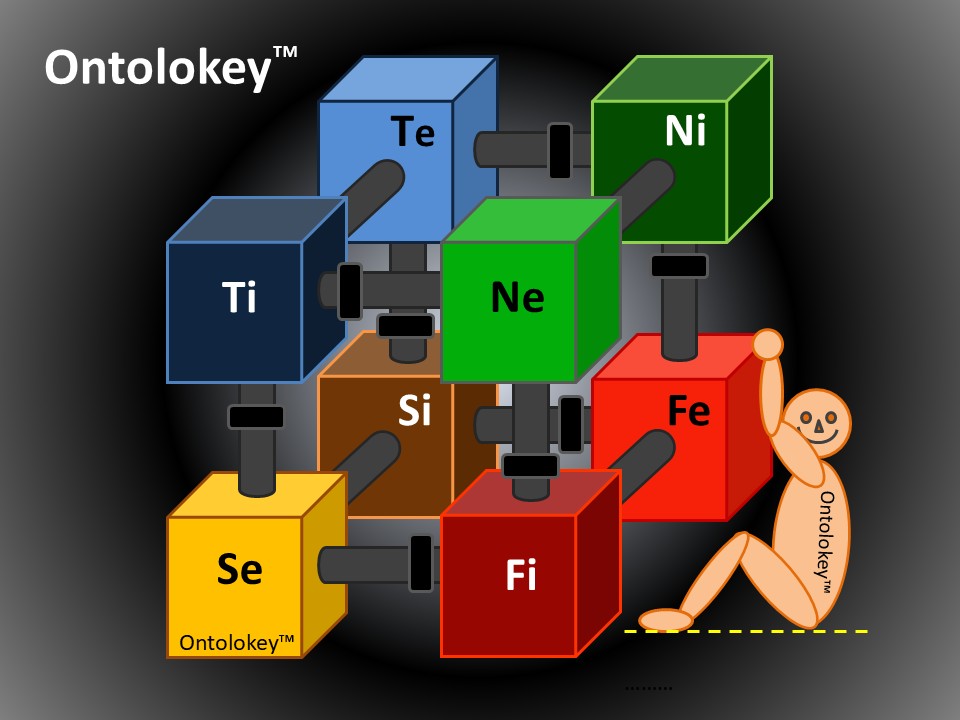
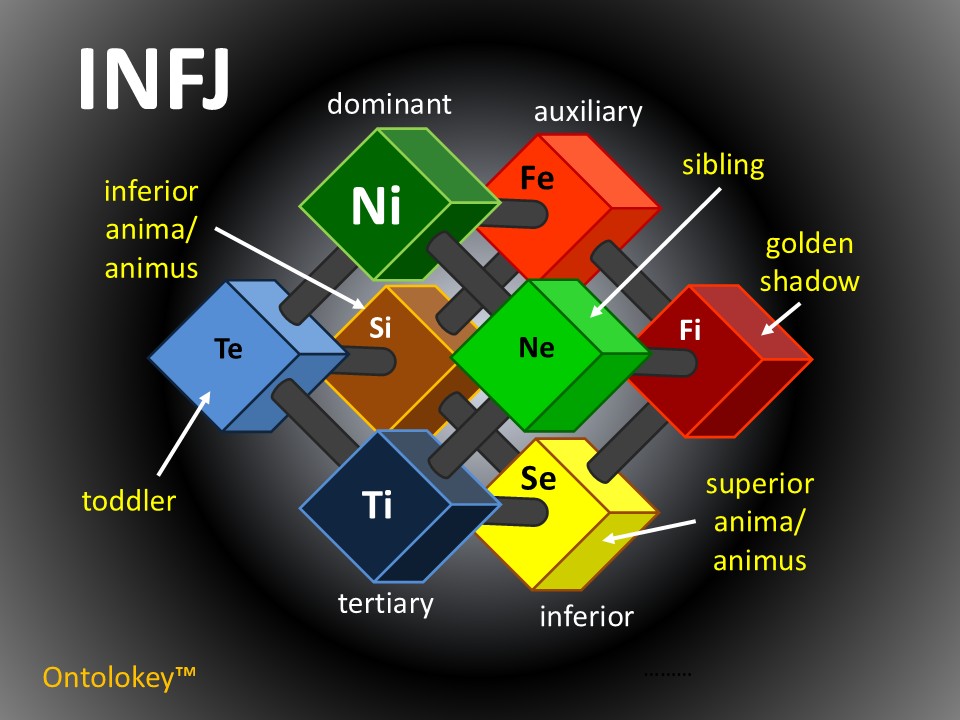



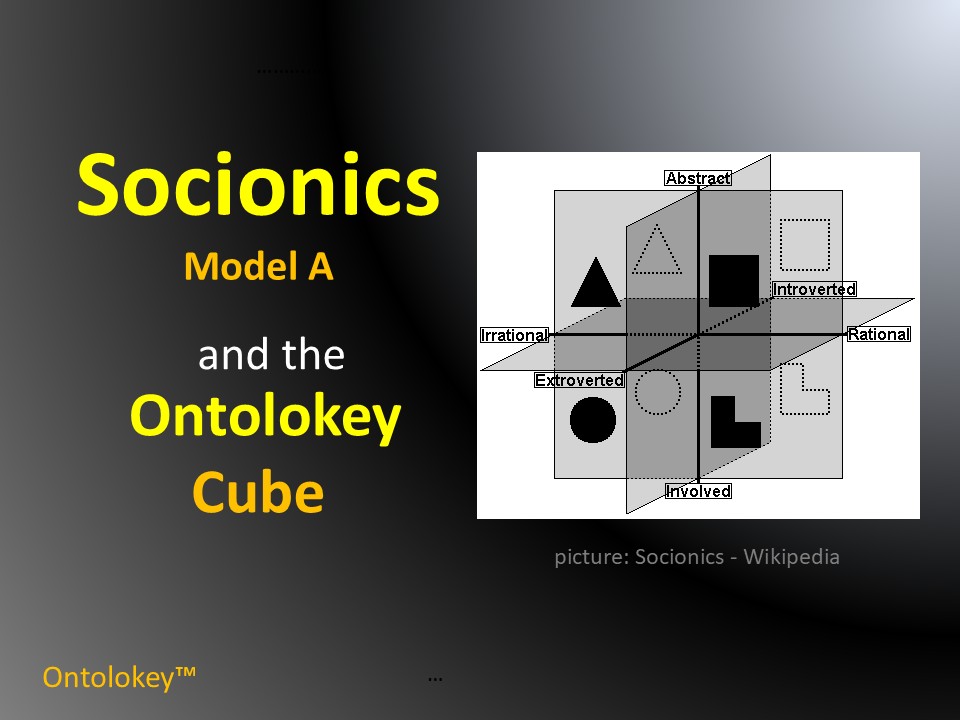
 Ontolokey