• A Comprehensive Psychological Essay


    1. Introduction: Between Structure and Soul

    The ESFJ personality type—often described as conscientious, empathetic, and relationship-driven—stands at a unique intersection of external sensitivity and internal order. Often referred to as “the caregiver” or “the consul,” the ESFJ draws psychological strength from social harmony, tangible routines, and value-based actions. But beneath the surface of social adaptability and structured empathy lies a complex psychological ecosystem governed not only by conscious preferences but also by unconscious motivations, archetypal energies, and repressed potentials.

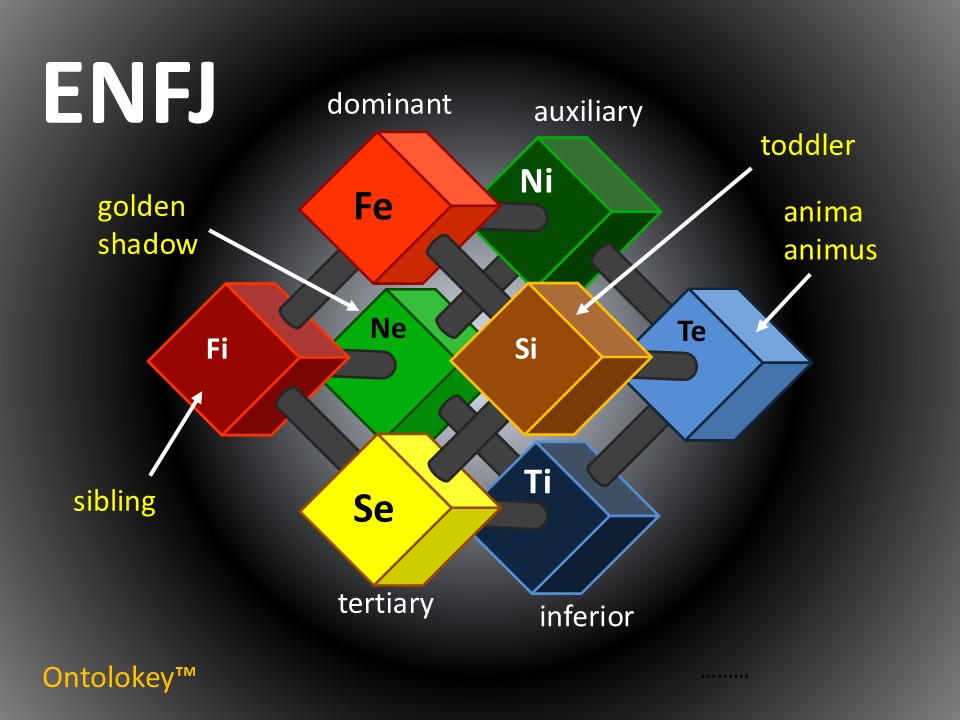
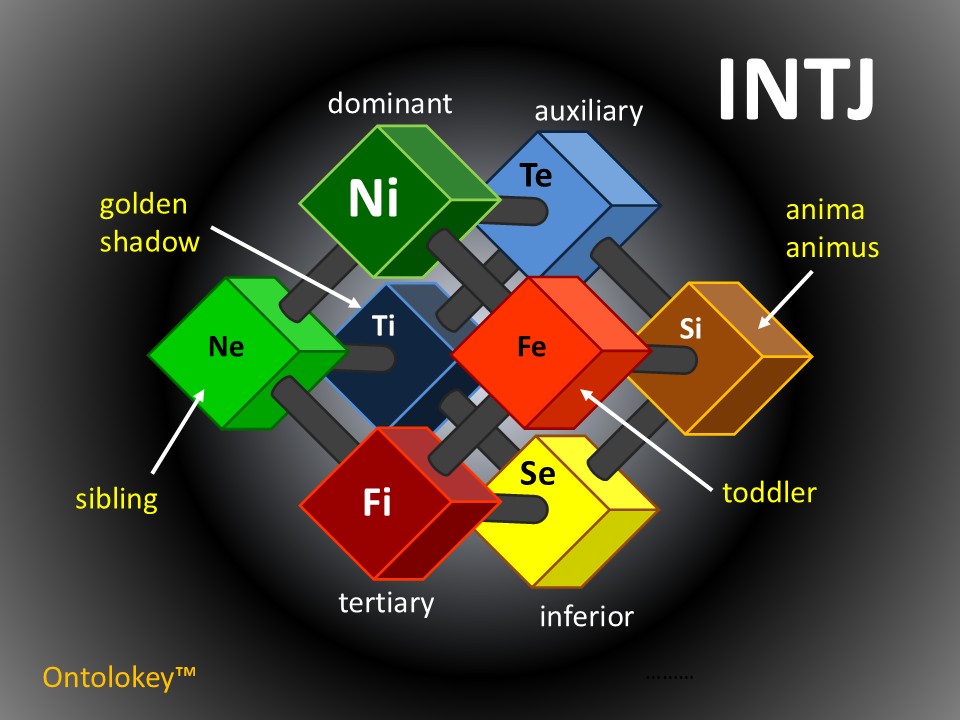
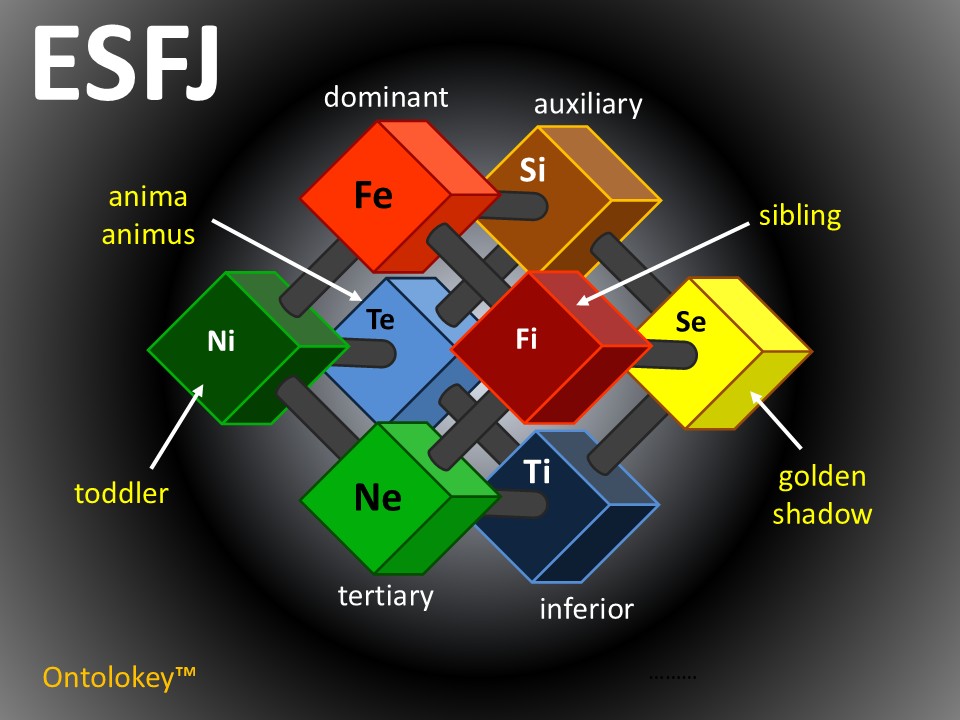
    The Ontolokey framework provides a multidimensional approach to understanding this complexity. Unlike conventional models that limit personality to four dichotomies or traits, Ontolokey visualizes all eight psychological functions—dominant, auxiliary, tertiary, inferior, as well as the less-conscious Anima/Animus, Sibling, Toddler, and Golden Shadow. These functions are dynamically interconnected through a 3D color-coded cube, with sliding mechanisms indicating the degree of functional integration. The ESFJ personality, viewed through this lens, becomes less a fixed type and more a dynamic personality structure, constantly evolving through both internal tension and external experience.


    2. General Orientation: Extraversion and Rational Structure

    The ESFJ is an extraverted rational type. This implies that their primary mode of interaction with the world is through structured judgment, rather than perception. Their judgments, however, are not based on impersonal logic (as with thinking types), but on emotional and ethical evaluations of the environment.

    As an extravert, the ESFJ draws energy from external stimuli—particularly social and relational ones. They are naturally attuned to group dynamics, community values, and emotional undercurrents. However, their rational nature means they don’t simply react to these stimuli—they evaluate, structure, and respond with purpose. Harmony is not passively maintained; it is curated and managed.

    The Ontolokey cube places this evaluative capacity—extraverted feeling (Fe)—at the forefront, supported by a trinity of interconnected yet functionally opposed orientations. The ESFJ’s psychological vitality depends on how these tensions are managed.


    3. Dominant Function: Extraverted Feeling (Fe)

    Fe governs the ESFJ’s primary interface with the world. It is the function most responsible for the type’s reputation as warm, generous, and conscientious. But Fe is far more than simple sociability. It is a highly sophisticated regulatory mechanism that seeks to align external emotional realities with internalized ethical schemas.

    Fe is concerned with interpersonal harmony, group cohesion, and shared values. It monitors social cues, modulates self-expression accordingly, and continuously negotiates between individual needs and collective expectations. In developed ESFJs, Fe operates with high attunement, often resembling emotional intelligence in action. However, Fe’s outward-directed nature may also lead to over-identification with social roles, people-pleasing behaviors, or emotional enmeshment.

    From a Jungian standpoint, Fe is a rational judging function, operating in service of what is “appropriate” or “expected” based on cultural norms. When well-integrated, Fe provides empathic structure. When inflated or unbalanced, it may manifest as moral rigidity or suppressed resentment.

    In Ontolokey’s dynamic model, Fe resides at one vertex of the cube, connected via edges to three functionally opposed support functions—each providing tension, contrast, and potential growth.


    4. The Functional Tripod (Dreifuß)

    4.1 Auxiliary Function: Introverted Sensing (Si)

    Si represents the internal stabilizing force for the ESFJ. As a perception function oriented inwardly, Si works with detailed memory, habitual frameworks, and accumulated experience. It grants the ESFJ a sense of continuity, tradition, and procedural integrity.

    Whereas Fe adapts to relational nuances in the moment, Si draws upon the past to create predictability and reliability. It answers the implicit question: “What has worked before?” and applies it to current contexts. This makes ESFJs methodical, tradition-oriented, and sometimes resistant to change.

    Psychodynamically, Si’s orientation toward order and familiarity helps to reduce anxiety in the face of Fe’s external variability. It is also the core of the ESFJ’s pragmatic stability—what gives their ethical concerns a procedural backbone. In Ontolokey’s system, the Fe-Si edge slider indicates the extent to which harmony-seeking behavior is anchored in sensory memory and traditional structure.


    4.2 Sibling Function: Introverted Feeling (Fi)

    Fi, though less conscious, is crucial for the ESFJ’s internal emotional integrity. Unlike Fe, which evaluates based on shared norms, Fi asks, “Is this right for me?” It is a deeply personal, moral compass. In the ESFJ psyche, Fi typically exists as a contrast function—often repressed but influential during internal crises or moments of deep authenticity.

    An unbalanced ESFJ may suppress Fi in favor of external approval, resulting in emotional burnout or a loss of self-definition. However, with maturity, the integration of Fi allows the ESFJ to honor their internal emotional truths even when these contradict group expectations.

    In the Ontolokey cube, the Fe-Fi axis is one of internal tension. The sliding mechanism here reveals the delicate balance between external harmony and internal authenticity—a crucial developmental task.


    4.3 Toddler Function: Introverted Intuition (Ni)

    Ni functions in the ESFJ as a nascent, childlike sense of inner vision—often subconscious, abstract, and underdeveloped. It seeks patterns, symbolic meaning, and long-term implications. But because it exists in tension with the ESFJ’s concrete, sensory focus (Si), it is often neglected or misunderstood.

    Nevertheless, Ni holds immense developmental potential. It challenges the ESFJ to look beyond the literal, to consider metaphor, archetype, and psychological symbolism. When accessed, it can manifest as uncanny insight into others’ long-term motivations or as a desire for spiritual integration. In early life, it may emerge as fantasy or idealization. With maturity, it becomes a portal to inner wisdom and intuition.

    Ni’s development is reflected in the Fe-Ni slider on the cube—often dormant in youth but pivotal for midlife individuation.


    5. Persona: The ISTJ Mask

    In the Ontolokey model, the Persona represents the functional mask adopted for social survival or ego stability—particularly under stress or social pressure. For the ESFJ, this mask often resembles the ISTJ personality, relying heavily on Si and Te (introverted sensing and extraverted thinking).

    This means that in challenging environments, the ESFJ may become overly procedural, emotionally distant, or bureaucratic. This is a defensive adaptation—an attempt to protect the vulnerable emotional core (Fe-Fi) by retreating into rigid order and impersonal systems.

    Understanding this persona is key in therapy and development: it reveals not only the ESFJ’s defensive strategies but also their potential for resilience and adaptation.


    6. The Shadow Complex: The Four Unconscious Functions

    6.1 Inferior Function: Introverted Thinking (Ti)

    Ti, the functional opposite of dominant Fe, is the most repressed and feared function in the ESFJ psyche. It values logical coherence, internal consistency, and intellectual detachment. For the Fe-dominant ESFJ, Ti represents coldness, impersonality, and internal doubt.

    However, its integration is essential. Without Ti, the ESFJ risks becoming morally reactive, logically inconsistent, or overly dependent on emotional validation. The development of Ti allows for discernment, boundary-setting, and principled decision-making unclouded by social pressure. In the cube, the Fe-Ti edge defines this dialectic of emotional ethics versus internal logic.


    6.2 Anima/Animus: Extraverted Thinking (Te)

    Te represents the archetypal soul figure—the animating spirit or unconscious inner personality. It is often projected onto leaders, systems, or individuals who embody decisive authority and strategic logic. For the ESFJ, Te is both fascinating and threatening.

    When integrated, Te grants the ESFJ clarity of purpose, executive power, and strategic objectivity. When disowned, it results in the idealization of authority and self-doubt. The Te-Ni edge in the cube reveals the potential for visionary leadership, provided that inner authority is claimed rather than projected.


    6.3 Tertiary (Blindspot): Extraverted Intuition (Ne)

    Ne is the function of possibility, divergence, and playful exploration. As a blindspot, it is often inaccessible to the ESFJ, who may find too many options disorienting. However, its development fosters cognitive flexibility, creativity, and openness to innovation. The Ne-Si dichotomy reveals the internal struggle between tradition and novelty.


    6.4 Golden Shadow: Extraverted Sensing (Se)

    Se is the embodiment of vitality, aesthetic presence, and physical immediacy. The ESFJ may idealize people who are bold, spontaneous, stylish, or physically confident. These qualities, though admired, may feel foreign.

    In Jungian psychology, the shadow is morally neutral. The golden shadow contains traits we admire but disown. Integrating Se allows the ESFJ to experience aliveness, sensuality, and immediacy—qualities essential for wholeness.


    7. The Sliders and the Dance of Integration

    Ontolokey’s 3D model includes 12 dynamic sliders between function-pairs. For the ESFJ, the most crucial sliders early in life are:

    • Fe–Si: Balancing relational harmony with procedural structure.
    • Fe–Fi: Navigating external expectations versus internal truth.
    • Fe–Ni: Incorporating intuition and symbolic foresight.

    Later development requires attention to:

    • Ti–Ne–Se: Embracing experimentation, objectivity, and spontaneity.

    Development is not about replacing one function with another, but calibrating and integrating them.


    8. Conclusion: From Type to Transformation

    The ESFJ personality, when viewed through the Ontolokey model, transforms from a stereotype of sociability to a nuanced psychological organism—one whose core impulse is to connect, harmonize, and sustain. Yet this impulse requires balance: from emotional subjectivity to logical coherence, from social roles to personal truth, from structure to spontaneity.

    Ontolokey uniquely illustrates this balance. By making all eight functions visible, and allowing for the dynamic interplay of conscious and unconscious, it provides not just a typology but a developmental roadmap. The fully individuated ESFJ becomes not merely a caretaker, but a wise integrator of emotion, tradition, logic, and insight—a whole self in a fragmented world.
  • A Rational Architect of Order and Development

    An integrative psychological essay exploring all eight cognitive functions of the ESTJ through Ontolokey and Jungian theory.


    Introduction

    The ESTJ personality type is often recognized for its pragmatic leadership, dedication to duty, and unwavering loyalty to structure and tradition. In popular typologies, this type is frequently oversimplified as a managerial or logistical archetype. However, within the Ontolokey framework—which builds upon Carl Gustav Jung’s typology while adding a dynamic, three-dimensional, eight-function model—the ESTJ emerges as a much more intricate and evolving psychological system. Ontolokey uniquely illuminates both the conscious and unconscious aspects of personality, not just through dominant and auxiliary functions, but through their interplay with shadow elements, the golden shadow, and the anima/animus.

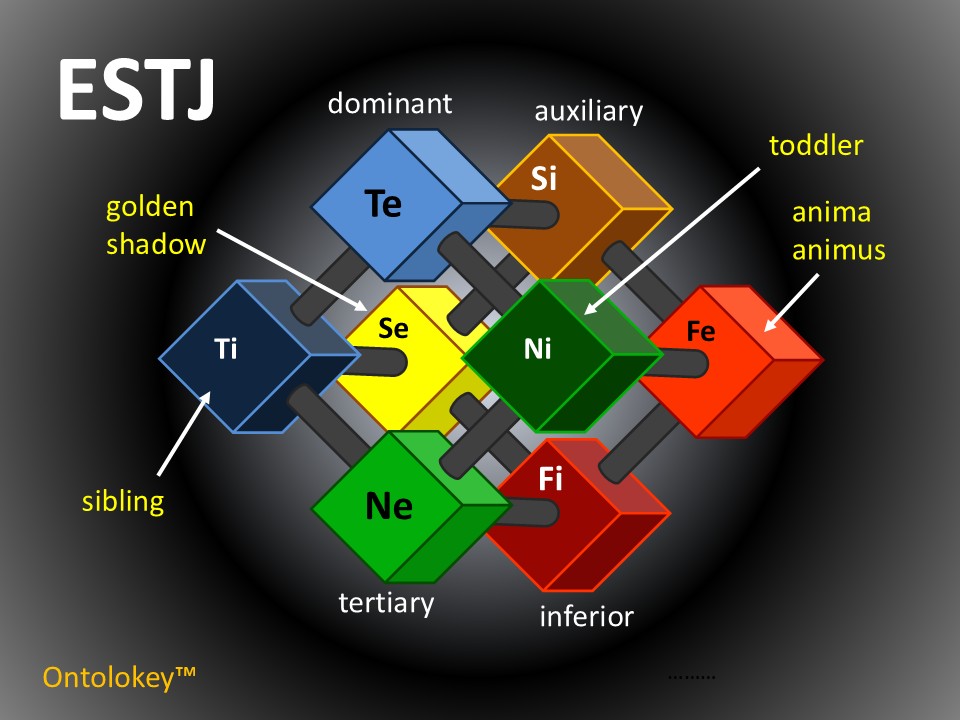
    The ESTJ is classified as an extraverted, rational type. Their dominant function, extraverted thinking (Te), is balanced and challenged by a full spectrum of cognitive functions, organized in the Ontolokey cube: three immediate structural supports (Sibling, Toddler, and Auxiliary), and four deeper unconscious components (Inferior, Tertiary, Anima, and Golden Shadow). By examining each function within this multidimensional context, we gain a fuller understanding of the ESTJ not as a static identity, but as a dynamic process of individuation and integration.


    1. Dominant Function: Extraverted Thinking (Te)

    Te governs the ESTJ’s relationship to external systems: rules, protocols, hierarchies, metrics, and cause-effect logic. It seeks to impose objective order on the environment and evaluates actions based on efficacy and utility. This function thrives in measurable outcomes and favors consistency over ambiguity. In the Ontolokey cube, Te sits at the apex of the ESTJ’s personality, connected to three other functions that inform, support, or challenge it.

    Psychologically, Te represents an external locus of rational control. In healthy development, it results in reliable, results-oriented individuals who can manage people and resources effectively. However, Te’s strength also hides a rigidity that may resist new paradigms or emotional nuance. When overemphasized, the ESTJ may fall into micromanagement, inflexibility, or utilitarian thinking at the expense of inner values and external empathy.

    Across personality theories, this dominant rational-executive trait is associated with conscientiousness, task orientation, and high social responsibility. It aligns with leadership in structured environments, particularly where performance and rules dominate—military, business, administration.


    2. Auxiliary Function: Introverted Sensing (Si)

    Introverted Sensing (Si) serves as the ESTJ’s stabilizing anchor. Where Te reaches outward, Si turns inward, drawing from memory, tradition, and past experiences. It internalizes sensory data, creating stable internal templates that guide behavior. Si is not merely about remembering; it is about referencing what is known, familiar, and proven.

    This function explains the ESTJ’s loyalty to traditions, routines, and social institutions. Si supports Te by offering a historical sense of continuity: “What has worked before is likely to work again.” This confers great reliability and duty-fulfillment, but can also lead to resistance against change or innovation.

    In Ontolokey, Si is positioned as the auxiliary leg of the Te “tripod,” connected by a dynamic slider. When balanced, this axis provides a solid, grounded pragmatism. When imbalanced, the ESTJ may lean too heavily on precedent and discount intuition or innovation.

    Si also governs the ESTJ’s Persona—a social mask often identified with ISFJ traits. In public settings, ESTJs may project nurturance, tradition, and social harmony, though their core orientation remains rational and directive. This modulation reflects their desire to maintain order through both structure and social cohesion.


    3. Sibling Function: Introverted Thinking (Ti)

    Ti introduces an internal, subjective reasoning process that differs fundamentally from Te. While Te focuses on external validity, Ti is concerned with internal logical consistency and conceptual elegance. It seeks to refine ideas down to their axiomatic core, often independent of practicality.

    As the Sibling function in the Ontolokey cube, Ti presents a valuable internal check for Te’s outward systemization. It asks: “Does this make sense logically, not just functionally?” The Te-Ti slider reflects a balance between objective performance and internal logical precision.

    If neglected, Ti becomes a shadow function: the ESTJ may dismiss introspective reasoning as inefficient or indulgent. But when integrated, it allows the ESTJ to innovate and troubleshoot with greater nuance. For instance, an ESTJ leader who develops Ti may become a strategic planner, not just a tactical executor.

    In cognitive-behavioral terms, this function adds metacognitive reflection—the ability to examine one’s own decision-making process—which enhances adaptability, critical thinking, and philosophical depth.


    4. Toddler Function: Introverted Intuition (Ni)

    Introverted Intuition is the ESTJ’s Toddler function—immature, yet full of latent potential. Ni synthesizes abstract patterns and future possibilities from minimal data. It gravitates toward singular insights, often perceived as “aha” moments. To the Te-Si dominated ESTJ, this function can feel mysterious, even uncomfortable.

    However, Ni’s emergence signals psychological growth. It challenges the ESTJ’s dependence on past precedent (Si) and immediate efficiency (Te), introducing long-term vision and symbolic awareness. Ni asks questions that Te avoids: “What is the deeper meaning? What lies beyond the horizon?”

    Ontolokey illustrates this with a Te-Ni slider. As the ESTJ matures, they begin to entertain strategic foresight. They move from enforcing existing systems to envisioning better ones. This is the point where the ESTJ transcends from a manager to a transformational leader.

    Developmentally, Ni integration requires quietude, reflection, and openness to ambiguity—qualities that don’t come naturally to the ESTJ but enrich their psychic balance.


    5. Inferior Function: Introverted Feeling (Fi)

    Fi is the ESTJ’s Inferior function—its farthest psychological point, yet also its most crucial developmental axis. Where Te seeks objective consensus, Fi evaluates experiences through deeply personal values. It asks: “Does this align with who I truly am?”

    For the ESTJ, Fi is often a source of discomfort, vulnerability, or shame. Strong Fi values may feel like obstacles to the task-oriented Te mindset. As a result, Fi is commonly repressed or projected. Yet in Jungian psychology, the inferior function is also the gateway to transformation.

    When Fi begins to emerge, the ESTJ may experience existential tension: achievements feel hollow, relationships feel transactional. If faced and integrated, Fi becomes a compass of authenticity, endowing the ESTJ with moral depth, compassion, and inner dignity.

    Psychotherapeutically, confronting Fi can surface as a mid-life crisis or sudden change in priorities. ESTJs who undertake this shadow work emerge more balanced, no longer defined solely by status or output, but by principle and meaning.


    6. Anima/Animus: Extraverted Feeling (Fe)

    According to Jung, the Anima (or Animus in women) is the personification of the unconscious opposite gender and serves as the bridge to the collective unconscious. For the ESTJ, Fe plays this archetypal role. While it lies in the unconscious, it carries significant influence.

    Fe prioritizes emotional attunement, group values, and social harmony. While it may appear that ESTJs lack this emotional intelligence, Fe actually operates in projection. They are drawn to expressive, emotionally intelligent individuals who embody qualities they struggle to access themselves.

    The ESTJ’s journey toward Fe is one of relational depth. It means shifting from controlling group dynamics (Te) to resonating with them. As Fe is gradually integrated, the ESTJ begins to feel with the group, not just act upon it. This enhances empathy, diplomacy, and charisma.

    From a psychoanalytic view, this process can resemble falling in love with one’s own capacity for relational wholeness—an inner marriage of function and feeling.


    7. Tertiary Function: Extraverted Intuition (Ne)

    Ne is the ESTJ’s tertiary function and represents a playful, exploratory openness to new ideas. It is curious, divergent, and non-linear. Unlike Te, which narrows down toward a solution, Ne expands possibilities. It brainstorms, connects dots, and sees multiple futures.

    In immature forms, Ne may express as distraction or over-optimism. But as the ESTJ individuates, Ne becomes a source of inspiration and innovation. It counters the conservative Si and procedural Te with improvisation and mental agility.

    In Ontolokey, Ne forms a dichotomous pair with Si. Their balance determines whether the ESTJ is adaptable or dogmatic. By cultivating Ne, the ESTJ learns to experiment, tolerate ambiguity, and respond to novel challenges with creativity.

    Cognitively, this can be seen as the emergence of “divergent thinking” in an otherwise convergent personality profile.


    8. Golden Shadow: Extraverted Sensing (Se)

    The Golden Shadow, according to Jung, contains undeveloped positive qualities that we unconsciously admire in others. For the ESTJ, this is Se—raw sensual experience, present-moment awareness, and aesthetic vitality.

    Se lives in the now. It embraces life through the senses—movement, color, pleasure, spontaneity. The ESTJ, preoccupied with control and planning, often represses these qualities or idolizes them in others (e.g., athletes, artists, risk-takers).

    However, when integrated, Se unlocks vitality and spontaneity. It anchors the ESTJ in the moment, fostering joy, sensuality, and groundedness. The golden shadow represents not just what we fear, but what we secretly long to reclaim.

    Through Se, the ESTJ learns that not all power is planned. Some of it must be lived, tasted, touched.


    Conclusion: Toward Individuation

    The Ontolokey model reveals that personality is not a fixed label but a dynamic system of tensions and integrations. The ESTJ, often misrepresented as a blunt executive, emerges as a complex psychological architecture, striving toward balance across eight functions.

    From the conscious strengths of Te and Si to the aspirational depths of Fi and Se, the ESTJ type contains not only the capacity to build systems but also the call to humanize them. Through the integration of shadow and anima, and the balancing of function sliders, the ESTJ becomes not merely a commander of the world, but a steward of its meaning.

    In the end, true psychological maturity lies not in dominance, but in integration. The Ontolokey cube does not just chart the ESTJ’s structure; it maps their path to wholeness.


    This essay draws upon analytical psychology, contemporary personality research, and the innovative structure of Ontolokey to provide a holistic interpretation of the ESTJ. It aims to contribute to both clinical understanding and personal insight.

  • An Archetypal Essay on Command, Consciousness, and Complexity

    An advanced psychological exploration integrating Jungian function theory, the Ontolokey model, and expanded personality research


    1. Introduction: ENTJ as Architect of the Outer World

    The ENTJ personality type has long been recognized as the quintessential executive: goal-driven, strategic, and assertively rational. Often called “The Commander,” the ENTJ is traditionally portrayed as a charismatic decision-maker with a relentless focus on results. But this archetype, as popularized in various typological systems, fails to account for the profound internal architecture and the dialectic between conscious direction and unconscious influence.

    The Ontolokey model offers a uniquely dynamic approach to understanding personality: one that integrates not only the four conscious psychological functions but also their unconscious counterparts (Anima/Animus and the Golden Shadow), and organizes them within a three-dimensional cube connected by movable sliders. This system does not merely list traits; it maps function interdependence, internal conflict, and potential for individuation.

    This essay investigates the ENTJ through the Ontolokey model, with rigorous attention to each of the eight Jungian functions in their nuanced interrelations. Supplemented with insights from broader personality theory—such as developmental psychology, cognitive science, and shadow integration—we aim to deliver a holistic and intellectually robust portrait of this powerful type.


    2. Extraversion and Rationality: Core Characteristics

    The ENTJ is both Extraverted (E) and Thinking-dominant (T), situating them in the rational quadrant of Jungian typology. Their orientation toward the external world means they process information primarily through interaction with their environment, preferring objectivity, logic, and systematization over subjective or emotional responses.

    However, unlike the commonly held notion of extraversion as social enthusiasm, the ENTJ’s extraversion is task-focused, operational, and directed. It represents a cognitive style where energy is projected outward to structure the environment in service of internal goals. The ENTJ is not interested in the outer world for its own sake, but for how it can be used, modified, or mastered.

    The rationality of the ENTJ emerges in both information processing and decision-making. They rely on deductive reasoning, cost-benefit analyses, and strategic foresight. There is a profound emphasis on efficiency, competency, and logic-based leadership. However, without balance from irrational and feeling-based functions, this rationality can ossify into rigidity or blind ambition.


    3. Dominant Function: Extraverted Thinking (Te) – Strategic Execution

    Extraverted Thinking (Te), the ENTJ’s dominant function, is the engine of command, structure, and external implementation. Te seeks objective order, relying on systems, standards, and measurable outcomes. It makes decisions based on empirical reality: what works, what delivers, what performs.

    In the Ontolokey cube, Te resides at the apex, connected via three dynamic edges to subordinate functions that counterbalance or challenge its dominance. Te forms the “camera” of the mental tripod, capturing and projecting the external world through the lens of logic and utility.

    Te is powerful, but potentially reductive. It can dismiss subjective or emotional data as irrelevant. ENTJs using Te heavily may develop a form of cognitive myopia—focusing only on what is quantifiable, while missing symbolic, relational, or long-term psychological implications. Therefore, Te must be supported by complementary functions that allow for abstract ideation and inner awareness.

    Neuroscientific correlates of Te suggest activation in the dorsolateral prefrontal cortex, involved in planning, cognitive control, and rule-based reasoning. It is the “manager” of the mind—organized, assertive, and sometimes autocratic.


    4. Auxiliary Function: Introverted Intuition (Ni) – Vision Beyond the Horizon

    Where Te sees what is, Introverted Intuition (Ni) perceives what will be. Ni, the ENTJ’s auxiliary function, offers a deep internal compass, attuned to patterns, symbolic meanings, and emergent futures. Ni provides the strategic foresight Te alone cannot offer.

    Ontolokey places Ni along one of the primary edges of the cube, showing its close functional tether to Te. The sliding scale between these functions reveals how well an ENTJ integrates their vision with their execution. A highly developed ENTJ uses Ni to map long-range trajectories, allowing them to lead not just with efficiency, but with profound purpose.

    Ni is nonlinear. It operates in symbols, insights, and sudden connections. ENTJs may not always be conscious of their Ni, but they follow its intuitive certainty with conviction. When overused or isolated from Te, Ni can lead to obsessive ideation or overconfidence in abstract frameworks.

    In archetypal terms, Ni represents the Sage—the quiet inner mystic guiding the outer ruler. ENTJs who neglect Ni become short-term tacticians; those who integrate it become visionary architects of possibility.


    5. Sibling Function: Introverted Thinking (Ti) – Internal Calibration

    Connected to Te by another axis in the cube is Introverted Thinking (Ti)—the Sibling function. Ti seeks internal logical coherence rather than external validation. Where Te asks “Does it work?”, Ti asks “Does it make sense?”

    The Te–Ti slider measures an ENTJ’s ability to refine thought with precision, to analyze frameworks and question assumptions. ENTJs with well-developed Ti become philosopher-commanders: not only efficient, but internally consistent, skeptical, and intellectually rigorous.

    However, Te and Ti can also compete. Te wants to act; Ti wants to refine. If Ti is underutilized, ENTJs may execute flawed strategies simply because they are efficient. If over-relied upon, Ti can create paralysis by analysis.

    In psychological development, enhancing Ti tempers the ENTJ’s directive nature with epistemic humility and intellectual clarity—qualities essential for long-term leadership and ethical decision-making.


    6. Toddler Function: Introverted Sensing (Si) – The Anchor of Experience

    Si, the Toddler function, reflects embodied memory, routine, and personal past. It is the domain of sensorial detail, safety, and physiological rhythm. ENTJs often neglect Si—until stress, health issues, or burnout force its acknowledgment.

    In Ontolokey, Si sits at a crucial base vertex connected to Te, symbolizing its foundational but immature status. The Te–Si slider reveals how grounded or dissociated the ENTJ is from bodily awareness and continuity of personal experience.

    Developing Si means learning self-care, honoring ritual, and valuing inner tempo over external acceleration. Without this, the ENTJ may exploit their body as a tool, ignoring signals of fatigue, illness, or emotional overload.

    In Jungian terms, Si is the child archetype: vulnerable, conservative, and rooted in continuity. ENTJs who cultivate Si develop resilience, depth of memory, and sustainable productivity.


    7. Tertiary (Blindspot): Extraverted Sensing (Se) – Impulse and Immediate Reality

    Se, the ENTJ’s tertiary or Blindspot function, governs real-time engagement with the external sensory world. It is about presence, sensation, spontaneity—qualities the ENTJ often undervalues.

    In its immature form, Se may manifest as recklessness, sensory overload, or compulsive activity. ENTJs under stress may fall into impulsive spending, aggressive behavior, or hyperstimulation as unconscious attempts to ground themselves.

    Integrated Se allows the ENTJ to be responsive, embodied, and aesthetically attuned. It enhances charisma, improves physical awareness, and reconnects the type to the tangible world they often seek only to control.

    The Ni–Se dichotomy measures the dynamic between vision and immediacy. ENTJs must learn to balance abstract foresight with the lived now—a task that requires humility and sensory openness.


    8. Inferior Function: Introverted Feeling (Fi) – The Moral Conscience

    Fi, the Inferior function, is the ENTJ’s greatest psychic challenge and deepest transformative gateway. Fi is concerned with subjective ethics, internal harmony, and authenticity—all of which can feel disorienting to a Te-dominant type.

    Fi is often projected, denied, or idealized. ENTJs may disdain emotional language or moral relativism, seeing it as inefficient or unproductive. Yet, in neglecting Fi, they risk becoming cold, utilitarian, or disconnected from human consequence.

    Developing Fi leads to profound individuation. ENTJs who explore Fi confront vulnerability, shame, and internal contradiction—but in doing so, they become ethically grounded leaders, not just tactical executors.

    Fi as Inferior is like the dragon guarding the treasure. Once faced, it grants access to moral clarity, emotional courage, and authentic leadership.


    9. Anima: Extraverted Feeling (Fe) – The Inner Social Self

    The ENTJ’s Anima, or inner soul-image, is Fe: the function of interpersonal harmony, emotional attunement, and collective feeling. Fe yearns to belong, to be understood, to create mutual resonance. It is often underdeveloped yet unconsciously idealized.

    ENTJs may admire emotionally expressive or socially fluid individuals while internally feeling awkward or disconnected. They may overcompensate with charm or become rigidly professional to avoid emotional vulnerability.

    Integrating Fe allows the ENTJ to build authentic relationships, create psychologically safe environments, and be seen as human, not just powerful. The Fe–Fi–Ni triangle in Ontolokey reflects how deep emotional intelligence can emerge from balanced introversion and feeling.


    10. Golden Shadow: Extraverted Intuition (Ne) – The Suppressed Creative

    The Golden Shadow of the ENTJ is Ne: playful ideation, possibility-thinking, and lateral exploration. Ne is the function of innovation, curiosity, and divergent thinking.

    ENTJs often repress Ne qualities, seeing them as impractical or unfocused. Yet, they deeply admire inventors, artists, or entrepreneurs who embrace uncertainty and novelty.

    When Ne is integrated, ENTJs become creative polymaths: visionary yet flexible, structured yet innovative. They unlock the capacity for adaptive intelligence and collaborative ideation.

    According to Ontolokey, ignoring the Golden Shadow leads to projection and fragmentation. Embracing it opens the door to wholeness, self-trust, and inner liberation.


    11. Ontolokey Integration: The Function Sliders and the Dynamic Self

    Ontolokey’s genius lies in its visual representation of function interplay through 12 sliders. For ENTJs, the most pivotal are:

    • Te–Ni: Execution vs. vision
    • Te–Si: External output vs. internal rhythm
    • Te–Ti: Effectiveness vs. precision

    By adjusting these sliders, we model not only preference but also developmental potential. The ENTJ’s growth path involves moving from unilateral efficiency (Te) toward multidimensional leadership, balancing intuition, ethics, sensory awareness, and creative possibility.

    This isn’t static typology. It’s a living system of self-regulation and expansion, where each function has its place and purpose.


    12. Conclusion: ENTJ as the King in the Making

    In classic archetypal terms, the ENTJ is the King—not yet crowned, but destined to rule. His journey is not just about leading others, but learning to lead himself. Ontolokey reveals this trajectory with unprecedented depth: from dominant command to integrated selfhood.

    The ENTJ’s individuation lies not in more control—but in more inclusion: of the irrational, the vulnerable, the aesthetic, and the relational. When all eight functions are consciously addressed, the ENTJ does not just lead empires—he builds civilizations of meaning.


    This essay invites readers to reimagine personality not as static typing, but as a dynamic, evolving structure of consciousness. In the ENTJ, we find the blueprint for transformational leadership—when power is tempered with soul.

  • A Comprehensive Functional Analysis Inspired by Carl Gustav Jung

    Introduction: Mapping the ENFJ as an Extraverted Rational Type in Eight Dimensions

    The ENFJ personality type is often characterized in popular psychology as empathetic, charismatic, and visionary. Yet such descriptions remain incomplete without an in-depth exploration of the intricate psychodynamic forces that constitute this type’s inner architecture. Ontolokey, a model grounded in Jungian analytical psychology, offers a multidimensional framework by which we may illuminate not only the ENFJ’s four conscious functions, but also the four unconscious ones that complete the psychological structure.

    Unlike other models that often emphasize type labels and static preferences, Ontolokey presents the psyche as a dynamic interplay of eight functions, represented as corners of a color-coded 3D cube. This cube features movable sliders along the connecting edges, visually depicting the degrees to which each function is utilized or integrated. Through this lens, the ENFJ is revealed as an extraverted rational type whose development hinges on balancing external harmony with inner authenticity, and intuitive vision with concrete presence.


    1. Dominant Function: Extraverted Feeling (Fe) – The Social Harmonizer

    At the core of the ENFJ psyche lies extraverted feeling (Fe), a function fundamentally concerned with social dynamics, interpersonal ethics, and emotional congruence. Fe evaluates the world through relational standards: What is acceptable within a group? What brings harmony or dissonance? What emotional tone is collectively appropriate?

    This function is not merely emotional, but evaluative and rational in structure. Fe seeks to optimize emotional equilibrium across systems—family units, organizations, communities. ENFJs become the emotional barometers of their environment. Their ability to read emotional cues and adapt themselves accordingly often grants them social influence, leadership, and trust.

    However, the sophistication of Fe goes beyond people-pleasing. Fe-dominant individuals may leverage their understanding of emotional landscapes to guide, persuade, or even morally compel others. In professional settings, this makes ENFJs excellent counselors, educators, negotiators, and motivational figures. The shadow side, however, may include self-effacement, emotional overextension, or manipulative harmonization in the name of peace.

    Fe is the ‘camera’ in Ontolokey’s tripod analogy, and is stabilized by three supporting legs: the auxiliary, sibling, and toddler functions. Understanding these connections is vital to grasp the full scope of the ENFJ’s psychological landscape.


    2. Auxiliary Function: Introverted Intuition (Ni) – The Visionary Compass

    Introverted intuition (Ni), the ENFJ’s auxiliary function, acts as a guiding star. While Fe engages with the present and the social, Ni delves into the abstract and the internal. It seeks patterns, symbolic meanings, and overarching narratives. For the ENFJ, Ni provides strategic foresight, often leading to an uncanny ability to anticipate events or discern others’ developmental trajectories.

    This function makes the ENFJ not just responsive, but visionary. They are drawn to systems thinking, spirituality, psychology, and other frameworks that offer unified explanations for human behavior. Ni contributes a depth of focus that balances Fe’s breadth of connectivity. It allows ENFJs to step back from the immediacy of human need and view the emotional ecosystem from a higher vantage point.

    Importantly, Ni is also what gives many ENFJs their sense of calling. They are not merely social beings—they are often mission-driven, seeking to lead others toward transformation or wholeness. Ni gives meaning to their relational investments and provides the inner map that Fe then externalizes in the world.


    3. Sibling Function: Introverted Feeling (Fi) – The Unseen Moral Core

    Though under the radar, introverted feeling (Fi) represents a vital, if often suppressed, counterpart to Fe. Fi values personal authenticity, subjective emotional truth, and individual ethical standards. In the Ontolokey cube, Fi sits adjacent to Fe, connected by a slider representing the continuum between internal and external emotional judgment.

    ENFJs often over-rely on Fe, seeking external validation and harmony at the expense of their internal moral compass. When Fi is neglected, they risk emotional codependency, loss of personal boundaries, and burnout. Conversely, when Fi is integrated, the ENFJ becomes more grounded, able to say “no,” and more emotionally honest even in the face of social disapproval.

    Fi, though quiet, serves as a source of inner truth. It helps the ENFJ distinguish between what is genuinely meaningful to them versus what is socially expected. In therapy or deep introspection, activating Fi often leads to powerful breakthroughs in self-understanding and individuation.


    4. Toddler Function: Introverted Sensing (Si) – The Ground Beneath the Feet

    The toddler function in Ontolokey refers to a function that operates in a primitive or childlike way—in this case, introverted sensing (Si). Si is concerned with past experiences, bodily awareness, safety, and routine. For ENFJs, this function is underdeveloped and thus may present as a blind spot in areas like physical self-care, memory recall, or logistical consistency.

    ENFJs may neglect basic needs, become disorganized, or feel overwhelmed by too much sensory input. Si operates like a young child: needy, vulnerable, and often ignored. Yet, the development of Si brings profound benefits. It grants stability, health awareness, and the ability to ground visionary goals in repeatable, sustainable actions.

    As the slider between Fe and Si shifts, the ENFJ moves from reactive emotionalism to embodied presence. Rituals, mindfulness practices, and somatic therapies are especially helpful in this integration.


    5. Inferior Function: Introverted Thinking (Ti) – The Architect in the Shadows

    Introverted thinking (Ti) is the ENFJ’s inferior function and thus presents the greatest long-term developmental challenge. Ti is focused on internal logical coherence, impersonal analysis, and structural clarity. Where Fe asks “What do others feel is right?”, Ti asks “Does this make objective sense?”

    Because it resides in the inferior position, Ti often emerges in moments of stress or existential questioning. The ENFJ may suddenly become hypercritical, rigid, or intellectually insecure. Yet, Ti also holds the key to individuation. When accessed healthily, it grants the ENFJ the ability to detach from social approval and assess ideas on their own logical merits.

    The integration of Ti transforms the ENFJ from a charismatic influencer to a wise, balanced leader who not only inspires but also analyzes, designs, and critiques with precision.


    6. Anima/Animus: Extraverted Thinking (Te) – The Unconscious Drive for Effectiveness

    The anima or animus in Jungian terms is the unconscious opposite-gendered aspect of the psyche. For ENFJs, this is often extraverted thinking (Te)—a function that values measurable results, objective structures, and external efficiency.

    Te may be suppressed or even projected. ENFJs might admire (or resent) people who “get things done” with no regard for emotional nuance. Yet, Te is not the enemy; it is the latent masculine principle (in women) or inner taskmaster (in men) that drives effectiveness, ambition, and impact.

    When Te is integrated, the ENFJ becomes organizationally powerful. They balance empathy with execution. This integration is particularly important in leadership roles, where the emotional vision of Fe-Ni must be grounded in the logistical clarity of Te.


    7. Tertiary Shadow Function: Extraverted Sensing (Se) – The Raw Force of Experience

    Se in the ENFJ is tertiary and unconscious, often underdeveloped or misused. It represents real-time sensory engagement: pleasure, action, risk, spontaneity. ENFJs may either underutilize Se (becoming overly cautious and idealistic), or overindulge in it during stress (impulsive spending, sensory overload).

    When Se is ignored, the ENFJ becomes disconnected from their physical reality. They may forget to eat, neglect surroundings, or appear disembodied. When embraced, Se enhances charisma, presence, and appreciation for life’s immediacy.

    Art, dance, and physical movement help cultivate this function. Se roots the visionary into the present moment.


    8. The Golden Shadow: Extraverted Intuition (Ne) – The Disowned Genius

    The golden shadow, in Jungian terms, is the positive potential we unconsciously deny. For ENFJs, this is extraverted intuition (Ne): the engine of divergent thinking, novelty, and expansive ideation. While Ni seeks one truth, Ne opens many doors.

    ENFJs may idealize spontaneous, eccentric thinkers, unaware that their own Ne is waiting to be acknowledged. This function brings humor, creativity, and the ability to improvise. Its integration softens the ENFJ’s tendency toward over-control and perfectionism.

    Creativity workshops, brainstorming, and open-ended exploration allow Ne to surface. In doing so, the ENFJ reclaims their suppressed imaginative genius.


    Conclusion: Toward Integration and Individuation

    The ENFJ, when viewed through the Ontolokey model, is revealed not as a fixed type but as a fluid constellation of psychological energies. Their growth hinges on developing neglected functions, integrating unconscious potentials, and balancing emotional harmony with personal truth and logic.

    Ontolokey’s sliders and edges allow a visual and structural approach to this journey. Through conscious effort, the ENFJ can transition from relational expert to individuated leader—a person of vision, empathy, logic, and presence. All eight functions matter, and the journey toward wholeness begins by giving each of them a seat at the table.

  • A Deep Psychological Cartography of the Introverted Intuitive Personality


    Introduction: The Paradox of Presence

    The INFJ is a paradox: outwardly reserved, yet inwardly complex; focused on others, yet profoundly self-referential; guided by a moral compass, yet attuned to abstract symbolism. Among personality typologies, few types are as rare and enigmatic. Traditional models provide a limited map of the INFJ psyche by emphasizing four conscious functions. Ontolokey, by contrast, invites us to journey through all eight psychological functions in dynamic interplay—both conscious and unconscious.

    With its innovative 3D cube, Ontolokey visualizes how the dominant function (Ni) is supported and challenged by others: the auxiliary (Fe), sibling (Ne), toddler (Te), tertiary (Ti), inferior (Se), anima (Si), and golden shadow (Fi). This essay seeks to describe the INFJ through this multidimensional psychological framework, blending insights from Jungian theory, depth psychology, and contemporary typology research—without explicitly naming alternative models.


    1. The INFJ: An Introverted, Irrational Type

    The INFJ belongs to the group of introverted and irrational types. “Irrational” here refers to Jung’s usage—where perception, not judgment, governs consciousness. INFJs prefer to perceive the world through intuition and sensation, particularly abstract, internal impressions. Their orientation is inward (introverted), meaning psychic energy flows toward the subjective world. This inward pull leads to introspection, abstraction, and an archetypal mode of experiencing reality.

    The INFJ lives primarily in the symbolic and intuitive dimension. Logical structuring and objective sensory data are filtered through the lens of inner meaning. While this enables profound insight and moral conviction, it can also result in miscommunication with a world that prioritizes tangibility and immediacy. The INFJ’s path of growth involves integrating the conscious with the unconscious—an individuation journey of wholeness.


    2. Dominant Function: Introverted Intuition (Ni)

    Introverted Intuition is the INFJ’s camera—its primary lens. It seeks depth, pattern, trajectory. Unlike extraverted intuition, which scans the surface for possibilities, Ni descends inward, distilling complex stimuli into an abstract singularity. Ni does not generate ideas through brainstorming; it produces fully formed visions, often with startling clarity. These insights are holistic and symbolic, tapping into archetypal fields of meaning.

    Psychologically, Ni operates beneath awareness. INFJs often report sudden, visceral certainties without knowing why. This “knowing without knowing how” reflects the unconscious operation of pattern recognition over time. Ni is convergent: it reduces ambiguity into insight. It also allows the INFJ to anticipate long-term outcomes and human motivations—giving them a reputation as foresighted, even prophetic.

    However, Ni’s strength is also its blind spot. It can lead to over-interpretation, rigid belief systems, or withdrawal into private worlds disconnected from sensory feedback. When not counterbalanced, Ni may fixate on abstract ideals or symbolic narratives at the expense of practical action.


    3. Auxiliary Function: Extraverted Feeling (Fe)

    Fe is the INFJ’s social bridge. As the function of interpersonal harmony, emotional attunement, and group norms, Fe enables the INFJ to adapt internal vision (Ni) into communicable form. Fe reads emotional atmospheres like a thermometer. It understands unspoken expectations and often shapes its behavior to maintain cohesion and mutual understanding.

    Psychologically, Fe is relational and responsive. It directs the INFJ’s deep concern for others’ well-being and often drives them toward service roles—therapy, education, activism. But Fe can also obscure the self, as INFJs may suppress their own needs or values to avoid dissonance or rejection.

    Because Fe is extraverted, it brings outward expression to the otherwise silent Ni. This is crucial: without Fe, the INFJ’s inner world may remain incommunicado. However, Fe must mature from compliance to authentic diplomacy; otherwise, it becomes people-pleasing or morally overextended.

    In Ontolokey, Fe is one leg of the tripod stabilizing Ni. The slider between Ni and Fe illustrates the tension between personal vision and collective empathy. Balance is key: too much Fe dilutes inner authenticity; too little results in isolation or social discord.


    4. Sibling Function: Extraverted Intuition (Ne)

    Ne is the exploratory cousin of Ni. While Ni converges, Ne diverges—gathering ideas, connections, and associations from the external world. As a sibling function in the Ontolokey cube, Ne offers creative breadth to Ni’s depth. It fuels ideation, lateral thinking, and unconventional associations.

    INFJs with developed Ne may express themselves more playfully, challenge their own paradigms, or experiment with novel solutions. Ne provides the raw material which Ni later distills. Without Ne, INFJs risk becoming ideologically rigid or stuck in visionary loops disconnected from novelty.

    The slider between Ni and Ne in the Ontolokey cube visually tracks the INFJ’s cognitive flexibility. Greater Ne integration results in resilience, humor, and adaptive creativity; less integration can lead to tunnel vision, existential monotony, or cognitive overcontrol.


    5. Toddler Function: Extraverted Thinking (Te)

    Te governs efficiency, structure, objective metrics. For INFJs, Te is underdeveloped and childlike—operating sporadically, impulsively, or reactively. As the toddler leg of the tripod, Te challenges the INFJ to externalize and implement their vision with precision.

    In early life, Te may express as perfectionism, frustration with inefficiency, or awkward attempts at organizing others. When undeveloped, INFJs may resent external systems or struggle to assert their ideas logically. Over time, however, the Te slider allows the INFJ to bring form to content—turning dreams into executable strategies.

    Te’s development marks a pivotal moment in INFJ maturation. They move from philosophical musings to real-world change. In professional settings, this manifests as structured planning, metrics-driven leadership, or disciplined creative output.


    6. Inferior Function: Extraverted Sensing (Se)

    Se is the INFJ’s least conscious function—and its greatest growth potential. It governs sensory perception, presence, spontaneity, and physical engagement. INFJs, governed by intuition and internal affect, often disregard or feel overwhelmed by the immediate environment.

    This disconnection can result in physical neglect, aesthetic numbness, or psychosomatic stress. INFJs may also experience episodes of compulsive indulgence when Se breaks through—uncharacteristic shopping sprees, impulsive experiences, or sensory cravings.

    However, Se is not the enemy. Its integration allows the INFJ to reconnect with the body, nature, art, and sensuality. Grounding practices—like yoga, dance, or culinary creativity—help INFJs anchor vision in tangible beauty. The inferior function does not demand dominance, only acknowledgment.


    7. Anima/Animus: Introverted Sensing (Si)

    Si is the INFJ’s anima: the internalized archetype of self that mediates access to the unconscious. Si stores personal memory, somatic experience, and tradition. For INFJs, the anima-Si reveals a yearning for continuity, ritual, and inner sanctuary.

    Though not actively used, Si shapes the INFJ’s emotional landscape. It explains their nostalgia, their clinging to meaningful symbols, and their intuitive sense of “rightness” based on past feeling-states. Si can also provoke overattachment to specific relationships or routines that once provided comfort.

    In Jungian terms, the anima is not immature—it is archaic. Its voice is childlike but profound. Through Si, INFJs access timeless truths, embodied knowledge, and the comfort of remembered wholeness.


    8. Tertiary Function (Blindspot): Introverted Thinking (Ti)

    Ti is the INFJ’s hidden analyst. It desires logical consistency, elegant systems, and internal coherence. Often overshadowed by Fe’s social attunement, Ti operates as a quiet inner critic—or, when undeveloped, as a reactive pedant.

    The Ti–Fe polarity is essential for INFJs. Fe absorbs external values; Ti questions them. Without Ti, INFJs may adopt social norms uncritically. But with Ti, they begin to examine ethical systems, refine arguments, and defend personal principles with precision.

    Ti’s emergence is a major psychological achievement. It tempers Fe’s need for approval, fortifies Ni’s insights with logic, and enables INFJs to differentiate their true beliefs from those borrowed from the collective.


    9. The Golden Shadow: Introverted Feeling (Fi)

    Fi is the INFJ’s golden shadow—the disowned light. While Fe seeks external harmony, Fi guards internal truth. It embodies authenticity, boundary-setting, and raw emotional honesty. INFJs often admire people with strong Fi traits—yet struggle to claim them.

    Why? Because Fi stands for inner sovereignty. It says: “This is my truth, even if no one understands.” INFJs, conditioned to be accommodating, may find this terrifying. And yet, their growth demands it. Fi integration means self-respect, resilience, and emotional autonomy.

    The golden shadow is not darkness—it is brilliance unclaimed. INFJs project Fi onto others until they learn to embody it. When they do, they become not only kind but clear, not only wise but real.


    10. The Ontolokey Sliders: Dynamic Integration

    Ontolokey’s 12 sliders track the balance between polar functions. For the INFJ, key developmental sliders include:

    • Ni–Fe: Vision vs. empathy.
    • Ni–Ne: Depth vs. breadth.
    • Ni–Te: Insight vs. execution.
    • Fe–Fi: Adaptation vs. authenticity.
    • Fe–Si: Harmony vs. tradition.

    Rather than static traits, the INFJ psyche is a moving constellation. Each slider represents an axis of growth. Psychological maturity involves conscious recalibration, not fixed preference.


    11. Conclusion: Toward Individuation

    The INFJ’s journey is alchemical. From archetypal vision (Ni) to embodied reality (Se), from social harmony (Fe) to personal truth (Fi), from unconscious memory (Si) to rational analysis (Ti)—each function is a chamber in the psyche’s temple.

    Ontolokey’s model shows: no function is disposable. Each has a role, a wound, and a gift. When all are honored, the INFJ becomes not only a visionary, but a whole human—rooted, radiant, and real.

    In wholeness lies transformation. In integration lies freedom. And in the INFJ’s silent depth lies the blueprint for a more soulful humanity.

  • Introduction: The Quiet Power of the Irrational Introvert

    The ISFJ personality type, often labeled as the “Defender” or “Protector,” is widely recognized for its care, loyalty, and sense of duty. Yet, this image—though accurate on the surface—barely scratches the depth of the ISFJ’s inner world. Through the lens of the Ontolokey model, we enter a three-dimensional, psychologically nuanced framework that reveals not only the four conscious functions but also the unconscious underpinnings of personality. Unlike typologies that reduce the psyche to behavior or surface traits, Ontolokey integrates all eight Jungian functions and maps their dynamic interplay through a rotating cube with twelve adjustable sliders—each representing the weighted use between two connected functions.

    As an introverted and irrational type, the ISFJ is shaped by a mode of cognition that is deeply experiential and inwardly oriented. “Irrational,” in the Jungian context, refers not to a lack of reason but to a preference for perception (sensation and intuition) over judgment (thinking and feeling). The ISFJ does not merely analyze or act—they absorb, feel, and remember. Their psychological center is anchored in the introverted sensation function (Si), a mode of consciousness that preserves impressions, routines, and emotional memory with almost archetypal significance. But the full complexity of the ISFJ is only understood when we explore the nuanced interaction of all eight functions: conscious, subconscious, and unconscious.


    I. Dominant Function: Introverted Sensing (Si)

    Introverted Sensing is the bedrock of the ISFJ psyche. It serves as the dominant function, situated at a vertex of the Ontolokey cube. Si does not merely catalog sensory input—it internalizes it into a rich mosaic of subjective experience. Every smell, every tone of voice, every nuance in facial expression is cataloged and compared to a vast internal database built over time. This gives the ISFJ an exceptional sense of continuity and tradition, and a deep sensitivity to the emotional atmosphere of their surroundings.

    Psychologically, Si is linked with long-term memory consolidation and emotional attachment to the familiar. This function fosters loyalty and conscientiousness, but also an aversion to unpredictability and novelty. In therapeutic settings, individuals with dominant Si often describe a preference for routines and a deep-seated anxiety when their internal order is disrupted.

    The power of Si is its ability to ground experience in context. While other functions seek abstraction or spontaneity, Si asks: “How does this compare to what I already know and trust?” This conservative epistemology can manifest as dependability or rigidity depending on the function’s development and the balance with its counterparts.

    In psychoanalytic terms, Si reflects a regressive function of the ego—a movement toward inner stability and preservation. It resonates with the archetype of the Mother: nurturing, conserving, and protective.


    II. Auxiliary Function: Extraverted Feeling (Fe)

    Fe serves as the ISFJ’s bridge to the external world. It is the second function in their stack, connected via one of the Ontolokey cube’s edges. This extraverted function is relational, social, and harmonizing. Through Fe, the ISFJ scans the emotional field for cues—what is needed, what is valued, what is appropriate.

    Fe is not simply about being kind or empathetic. It is about attunement to collective emotional norms. ISFJs often internalize external expectations, trying to embody the ideal role in each context—whether as parent, colleague, or friend. Their emotional responses are finely calibrated, not merely to individual needs, but to the implicit rules of the group. This makes them excellent mediators and caretakers, but also vulnerable to emotional burnout or enmeshment.

    Fe, as a Persona function (drawing from Jung’s concept of the social mask), gives the ISFJ an outward appearance of ENFJ energy. This is why ISFJs often come across as socially fluent despite being introverts—they’re not energized by interaction, but they are deeply skilled at making others feel understood.

    However, overuse of Fe may suppress the individual’s inner emotional compass, leading to over-compliance or difficulty asserting personal boundaries. Only through the integration of the tertiary and shadow functions can Fe become a tool of genuine expression rather than a mask.


    III. Sibling Function: Extraverted Sensing (Se)

    In Ontolokey’s cube geometry, Se acts as a “sibling” to Si—sharing an edge and thus forming one leg of the ISFJ’s functional tripod. Where Si is retrospective, Se is immediate. It engages with the environment in real-time: noticing movement, color, texture, and change.

    Though underutilized in ISFJs, Se is not absent. It often manifests in a subtle but refined aesthetic sense: a love for tactile beauty, home decoration, craftsmanship, or culinary experiences. When Se is underdeveloped, however, the ISFJ may struggle with spontaneity or become overwhelmed by sensory overload.

    In psychodynamic terms, Se represents the repressed capacity for spontaneity, risk-taking, and direct confrontation. Its development enables the ISFJ to be present rather than always referencing the past. Without this integration, Si can become neurotic—trapped in cycles of rumination and perfectionism.

    Therapeutic strategies aimed at enhancing mindfulness or body awareness often help ISFJs access Se more fully, grounding their sensing function in the present moment.


    IV. Toddler Function: Extraverted Thinking (Te)

    Te, the “toddler” of the functional quartet, is in early psychological development for the ISFJ. It represents structure, efficiency, and measurable outcome. Whereas Fe seeks harmony, Te seeks optimization. In ISFJs, Te is often immature—used reactively rather than strategically.

    This function may emerge under stress, especially in organizational or crisis situations. The ISFJ might suddenly become directive or rigid, clinging to checklists or external systems of order. This is a compensatory maneuver: when Si’s familiarity is disrupted and Fe’s harmony breaks down, Te rushes in to impose external control.

    The healthy development of Te involves learning to assert boundaries, delegate tasks, and evaluate data without becoming authoritarian or dismissive. Ontolokey’s sliding edge between Si and Te symbolizes the developmental bridge between comfort and assertive agency.

    Psychoeducation and cognitive restructuring therapies can be powerful tools in helping ISFJs refine this function—giving them the confidence to lead when necessary without abandoning their core values.


    V. Inferior Function: Extraverted Intuition (Ne)

    Ne is the ISFJ’s blind spot and greatest psychological challenge. Where Si clings to familiarity, Ne bursts open possibilities. It generates ideas, speculates, innovates. For the ISFJ, Ne often appears as anxiety, confusion, or chaos—the mind spinning out of control.

    Yet Ne is also the gateway to creativity, play, and reinvention. When developed, it allows ISFJs to step out of fixed patterns and entertain new perspectives. They begin to question assumptions, imagine future scenarios, and embrace uncertainty.

    Ne’s position as the inferior function makes it a reservoir of untapped potential. In Jungian individuation, the confrontation with the inferior function is a rite of passage—an initiation into psychological wholeness. It is through Ne that the ISFJ confronts the limits of control and opens to the numinous, the emergent, the transcendent.


    VI. Anima: Introverted Intuition (Ni)

    The Anima or Animus is the gateway to the unconscious. For the ISFJ, this inner figure is expressed through Introverted Intuition—Ni. This function doesn’t operate through logic or sensation but through symbolic insight. It perceives inner truth, archetypal patterns, and synchronistic meaning.

    Ni often emerges in dreams, art, or sudden insight. It is the inner oracle, the mythopoetic compass. In ISFJs, Ni may be underrecognized or misunderstood. They may feel drawn to mysticism, existential literature, or long-term pattern recognition without knowing why.

    Jung saw the Anima as the soul’s image—simultaneously guide and seductress. Developing Ni means honoring this inner figure: creating space for silence, contemplation, and symbolic exploration. Meditation, dream analysis, and depth psychological work can foster this integration.


    VII. Tertiary Function: Introverted Thinking (Ti)

    Ti represents internal logic, conceptual precision, and analytical clarity. As the counterpart to Fe, it is often undeveloped in the ISFJ. This can manifest as difficulty articulating personal beliefs or structuring abstract reasoning.

    Yet Ti is essential for individuation. It helps the ISFJ differentiate between authentic personal values and those absorbed from others. With Ti development, ISFJs become capable of drawing boundaries, questioning social norms, and developing intellectual autonomy.

    In therapeutic work, Ti emerges through journaling, philosophical dialogue, and structured inquiry. It supports self-definition beyond relational roles.


    VIII. The Golden Shadow: Introverted Feeling (Fi)

    Fi symbolizes the golden shadow—the reservoir of disowned virtues and passions. While Fe looks outward, Fi looks inward. It knows what feels right regardless of external approval.

    For ISFJs, Fi can be deeply threatening. It challenges their relational identity and calls them to personal truth. Yet within Fi lies moral courage, artistic authenticity, and spiritual integrity.

    Often, ISFJs project Fi onto others—admiring rebels, artists, or truth-tellers while denying those same impulses in themselves. The key to wholeness lies in reclaiming this shadow. Not in rejecting Fe, but in balancing it with an inner compass.


    Conclusion: Integration as Individuation

    The ISFJ’s journey is one of inner alchemy: from duty to authenticity, from memory to meaning, from compliance to wholeness. The Ontolokey model reveals that no function exists in isolation. Each is part of a living system, connected by movable thresholds, developmental tensions, and unconscious longings.

    Through conscious engagement with all eight functions—especially the neglected and shadowed ones—the ISFJ moves from protector to creator, from loyalist to visionary. The path is not easy, but it is profound.

    In a fragmented world, the ISFJ carries a deep gift: the capacity to remember, to feel, and to serve with heart. With full psychological integration, this gift becomes not only a personal strength—but a collective offering.

  • A Psychodynamic Essay on Order, Responsibility, and the Hidden Self

    Introduction: Structure as Inner Compass and External Order

    The ISTJ personality type is often associated with duty, precision, and responsibility. In many conventional models, this type is viewed as the backbone of societal systems—reliable, conscientious, and grounded. However, such portrayals risk reducing the ISTJ to a mere functionary of tradition. In truth, this personality reveals an intricate interplay of psychological functions—both conscious and unconscious—that shape behavior, motivation, and identity.

    Ontolokey, an innovative personality model grounded in the psychological function theory of Carl Gustav Jung, illuminates this depth by considering all eight psychological functions, not just the conscious top four. In its dynamic 3D cube, functions are connected by weighted sliders, visualizing the interplay between cognition, perception, and personal development. The ISTJ, seen through this model, emerges not as a static type but as a living system of psychological tensions and potentials.


    1. Psychological Orientation: Introversion and Irrational Perception

    ISTJs are introverted and irrational—terms that require redefinition in Jungian terms. Introversion reflects an inward orientation of energy, where attention is directed toward internal experiences, memories, and meaning-making. Irrationality, in this context, refers to a personality type that prefers perception over judgment. That is, ISTJs prioritize information intake and sensory attunement over decision-making or value assessment. They do not rush to conclusions but absorb reality carefully through subjective frameworks of experience.

    This combination creates an individual who is methodical, reflective, and highly attuned to what is real, yet prone to cautiousness when facing unpredictability. The irrational nature of the ISTJ is not chaotic—it is informed, data-rich, and subtly intuitive, despite its grounded appearance.


    2. Dominant Function: Introverted Sensing (Si) – The Archivist of Experience

    Si is a perception function that draws upon internalized sensory experiences and impressions. Unlike its extraverted counterpart, Si is not interested in novel stimuli, but rather in how current experiences correlate with established internal maps. It is about comparing, evaluating, and referencing what is known, reliable, and personally verified.

    For the ISTJ, Si becomes a psychological anchor. It preserves sensory details, emotional impressions, and routines with intense clarity—often resulting in strong memory recall and a deep sense of familiarity with established systems. The world is navigated not through improvisation, but through structured internal archives.

    Psychologically, Si also plays a protective role. It filters chaos, provides grounding, and buffers anxiety by reinforcing order. The ISTJ may thus appear emotionally restrained or inflexible, but this is a coping strategy grounded in a desire for predictable continuity.

    Neuroscientific research suggests that Si-dominant individuals may exhibit enhanced activity in brain regions responsible for episodic memory and pattern detection, supporting this heightened sensitivity to internal impressions.

    Ontolokey visually places Si at one corner of the cube, supported by three extraverted functions along its edges—each contributing to balance and challenge.


    3. Auxiliary Function: Extraverted Thinking (Te) – The Rational Executor

    Te is concerned with external structure, efficiency, and logical application. It seeks to optimize systems, standardize outcomes, and apply objective reasoning to real-world problems. In the ISTJ, Te acts as the outer face of competence—the function through which internal insights (Si) are translated into action.

    The auxiliary position of Te provides balance to the subjective tendencies of Si. It allows ISTJs to be pragmatic, structured, and highly organized. Whether leading projects, maintaining legal frameworks, or optimizing workflows, the ISTJ uses Te to construct external order out of internal familiarity.

    However, Te also presents developmental tension. It is extraverted, and thus sometimes at odds with the introverted nature of the ISTJ. When over-relied upon, it can lead to rigidity, over-control, and suppression of nuance. Over time, growth involves integrating the tertiary function (Fi) to soften this control and restore internal moral coherence.

    According to Ontolokey, the Si–Te relationship is visualized through a dynamic slider, allowing users to track the evolving balance between internal perception and external execution.


    4. Sibling Function: Extraverted Sensing (Se) – The Challenge of Immediate Presence

    Se, as the Sibling function, exists in tension with Si. Where Si looks inward, Se is immersed in the immediate external world. It processes real-time sensory input and thrives on novelty, action, and spontaneity. For the ISTJ, this function is present but underdeveloped—a source of both opportunity and stress.

    Ontolokey conceptualizes the Sibling function as a parallel tool—accessible but energetically different. Se may emerge in ISTJs during moments of crisis or experimentation, often leading to short bursts of boldness or sudden impulsive decisions. It may also manifest in a desire to physically organize, clean, or refine their environment—a hands-on attempt to control chaos.

    Psychologically, Se challenges the ISTJ to remain open to what is, not only what was. Its integration leads to greater flexibility, creativity, and grounded embodiment.


    5. Toddler Function: Extraverted Feeling (Fe) – The Underdeveloped Social Compass

    Fe governs social harmony, shared emotional dynamics, and external expressions of feeling. In the ISTJ, Fe resides in the Toddler position—immature, somewhat awkward, and easily misunderstood. This does not imply that ISTJs lack empathy, but that their emotional language is often private, grounded more in loyalty and service than in expressive warmth.

    Ontolokey treats the Toddler function as a developmental potential—its position indicates where the psyche remains vulnerable or immature. Fe in this position may lead to misjudgments in social tone, difficulty expressing care, or discomfort with emotional dependency.

    As development progresses, the slider between Si and Fe reflects an increasing emotional literacy—not necessarily in public warmth, but in deepened interpersonal ethics. The mature ISTJ learns not just to do the right thing, but to feel and express it in ways others can receive.


    6. Inferior Function: Extraverted Intuition (Ne) – The Shadow of Chaos and Creativity

    As the Inferior function, Ne represents what the ISTJ finds most alien and destabilizing. Where Si clings to structure, Ne seeks possibility, ambiguity, and spontaneous pattern recognition. It is curious, divergent, and speculative—everything that unnerves a control-oriented personality.

    Ne often surfaces under stress, producing irrational fears, worst-case scenarios, or mental chaos. However, when consciously integrated, Ne becomes the engine of innovation, allowing the ISTJ to imagine alternate futures, question assumptions, and break patterns.

    This Jungian dynamic is pivotal in Ontolokey, as the Inferior function is seen as both the source of greatest resistance and the gateway to individuation. The slider between Ne and Ti (the golden shadow) marks the bridge between scattered potential and refined insight.


    7. Anima/Animus: Introverted Intuition (Ni) – The Archetypal Soul

    Ni is the Anima of the ISTJ—a symbolic internal other that bridges consciousness and the unconscious. While not directly accessible, it influences through dreams, projections, and symbolic insights. Ni provides long-term vision, archetypal foresight, and metaphysical clarity.

    As Ni develops, the ISTJ begins to explore meaning beyond the empirical. Spirituality, myth, and inner vision may enter their world, often in the second half of life. Ni also fuels existential questioning—a deep inner pull toward purpose and philosophical reflection.

    Psychologically, this marks the ISTJ’s transition from duty-bound executor to inner seeker. The Fe–Ni slider tracks emotional maturity into soulful insight—a sign of advancing psychological complexity.


    8. Tertiary Function: Introverted Feeling (Fi) – The Moral Kernel

    Fi serves as the emotional conscience of the ISTJ. As a tertiary function, it often operates behind the scenes—providing internal assessments of right and wrong, value, and authenticity. However, its childlike position may lead to overcompensation or suppression.

    Undeveloped Fi can manifest as rigid morality, black-and-white thinking, or withdrawal from emotionally nuanced situations. When nurtured, it creates a rich ethical compass, allowing the ISTJ to move beyond external rules (Te) and act from personal conviction.

    The Fe–Fi slider in Ontolokey demonstrates the evolving interplay between social emotion and private value—a key axis for ISTJs seeking holistic authenticity.


    9. Golden Shadow: Introverted Thinking (Ti) – The Hidden Architect

    Ti is the ISTJ’s golden shadow—an unconscious reserve of analytical depth, independent logic, and intellectual creativity. Ti is self-validating and principle-driven. While Te seeks to implement external standards, Ti constructs internal systems of truth.

    ISTJs often admire clarity, intellectual depth, or philosophical thinking in others without realizing that these traits mirror their own untapped potential. The journey of integration involves moving from rule-bound cognition (Te) to self-authorized reflection (Ti).

    In shadow form, Ti may manifest as rigid skepticism, compulsive over-analysis, or devaluation of intuition. In golden form, it becomes a path to autonomy, insight, and theoretical mastery.


    10. Functional Dynamics: Ontolokey’s Twelve Sliders and Adaptive Growth

    Ontolokey’s 3D cube contains twelve bidirectional sliders, each representing a potential axis of integration. While early development revolves around the dominant tripod (Si, Te, Fe, Se), maturity is marked by fluidity across broader pairings:

    • Ti–Te: Inner logic vs. external systems
    • Ti–Ne: Internal consistency vs. generative chaos
    • Fe–Fi: Social appropriateness vs. personal value
    • Se–Si: Immediate perception vs. memory-based perception
    • Ne–Ni: Divergent possibility vs. convergent vision
    • … and others

    The model promotes not categorical typing but dynamic equilibrium. Each slider’s position reflects the psyche’s current state—and its growth edge.


    11. Individuation and Integration: The ISTJ as Archetypal Guardian and Visionary

    The mature ISTJ is no longer simply the manager, the officer, or the dutiful employee. Through integration, they become systemic thinkers, ethical leaders, intuitive planners, and soulful stewards. The journey from Te to Ti, from Si to Ni, from Fe to Fi, is not linear but spiral—each turn revealing new layers of self-understanding.

    In Jungian terms, this is the process of individuation: the gradual unification of all inner opposites. In Ontolokey, this is visualized—not abstracted. Every function is seen, measured, balanced.


    Conclusion: Beyond Type – Toward Wholeness

    Ontolokey redefines typology not as classification but as invitation to growth. In contrast to models that limit individuals to four-letter labels, it reveals the full inner architecture of personality—conscious and unconscious, strength and vulnerability, shadow and light.

    The ISTJ, in this view, is not a static guardian of tradition but a complex system in motion. Their journey is from stability to meaning, from habit to awareness, from outer responsibility to inner transformation. And in that journey, each function—no matter how buried—has its time to awaken.


    For readers, therapists, and seekers alike, this portrait of the ISTJ offers not only insight but invitation: to see structure not as the end, but as the frame through which inner life finds its full, unfolding form.

  • A Deep Psychological Analysis of the Eight Functions

    Introduction

    The INTJ personality type is often described as strategic, autonomous, and vision-driven. Yet beyond the stereotypical image of the “Mastermind” lies a profoundly complex psychological architecture. Ontolokey, a model grounded in Carl Gustav Jung’s theory of psychological types, provides a revolutionary framework for understanding the INTJ in full psychological depth. Unlike traditional typologies that focus on only four cognitive functions, Ontolokey visualizes all eight through a 3D cube with dynamic sliders that reveal the balance and tension between conscious and unconscious elements. This essay offers a thorough psychological portrait of the INTJ type, based on the Ontolokey model and enriched with complementary insights from analytical psychology and contemporary personality theories.


    1. Dominant Function: Introverted Intuition (Ni)

    “I perceive the future not as a possibility, but as a certainty in motion.”

    At the core of the INTJ personality lies Introverted Intuition (Ni), a function that operates beneath the surface of conscious thought. Unlike linear or deductive reasoning, Ni functions holistically and symbolically. It perceives patterns in seemingly unrelated events and integrates them into cohesive mental models. Ni is not merely imaginative—it is profoundly anticipatory.

    Psychologically, Ni-dominant individuals often report an internal sense of “knowing” without being able to articulate the steps by which they arrived at a conclusion. This is because Ni works on a subconscious level, feeding the conscious mind sudden insights, long-range visions, or ideological structures. These insights often appear as metaphors or images before they can be translated into language or plans.

    INTJs rely on Ni to develop personal frameworks about how the world works. Unlike extraverted types who adjust themselves to reality, the Ni-dominant INTJ builds an internal schema and expects the external world to align with it. This can be a source of genius—but also rigidity.

    In terms of psychic energy (libido in Jungian terms), Ni pulls energy inward and downward into the unconscious. This descent into the depths brings clarity and purpose but can also isolate the INTJ from sensory immediacy or emotional warmth. Without balancing mechanisms, Ni can overtake the psyche, manifesting as obsession, prophetic detachment, or even apocalyptic thinking.


    2. Auxiliary Function: Extraverted Thinking (Te)

    “Let’s systematize that vision into something actionable.”

    Te, as the INTJ’s auxiliary function, serves to extravert the insights born from Ni. Te brings structure, efficiency, and logical order to the INTJ’s vision. It ensures that ideas are not merely imagined, but implemented, refined, and measured.

    This function favors external standards of logic and productivity. It values timelines, objectives, and systems. Whereas Ni intuits what will happen, Te determines how to make it happen.

    From a developmental standpoint, Te plays a vital role in the INTJ’s engagement with the world. It is the primary channel through which INTJs interact with their environment, often giving them the appearance of cold rationality or executive decisiveness. In reality, however, Te is a servant of Ni’s vision—it does not originate meaning but gives it structure.

    When Te is overused at the expense of the tertiary Fi (introverted feeling), the INTJ can become utilitarian, dismissive of emotional nuance, or overidentified with competence. They may focus excessively on results, forgetting the ethical or human implications of their actions.

    Within the Ontolokey cube, Te is directly linked to Ni through a flexible slider. This dynamic illustrates the psychological tension between inner vision and outer execution—between what is meaningful and what is efficient. A balanced slider represents a mature INTJ who can operationalize insight without sacrificing authenticity.


    3. Sibling Function: Extraverted Intuition (Ne)

    “But what else could it be?”

    Extraverted Intuition (Ne) offers the INTJ an alternative perceptual mode—one that diverges from Ni’s convergent style. Whereas Ni narrows focus toward a singular vision, Ne broadens perception toward multiplicity, playfulness, and serendipity. It generates options, connections, and interpretations.

    In the Ontolokey model, the Ni-Ne axis represents the internal tug-of-war between certainty and curiosity, between singularity and pluralism. Ne is the INTJ’s sibling function—close in nature, but pulling in a different direction.

    Psychologically, access to Ne allows the INTJ to loosen their grip on control and explore paths not previously considered. A healthy engagement with Ne enriches creativity, prevents dogmatism, and supports innovation. However, immature or suppressed Ne can lead to restlessness, fragmented attention, or a tendency to chase distractions.

    The slider between Ni and Ne is crucial in the developmental process. INTJs who learn to balance these two intuitive styles become more open-minded and exploratory while still retaining their depth of insight.


    4. Toddler Function: Extraverted Feeling (Fe)

    “Am I attuned to the emotional atmosphere around me?”

    Fe represents the INTJ’s toddler function—a psychological component with limited maturity and conscious control. Fe manages social harmony, emotional expression, and group values. For INTJs, whose dominant mode is introverted and impersonal, Fe can feel alien or burdensome.

    Immature Fe expression often manifests as social awkwardness, insensitivity, or difficulty navigating group dynamics. INTJs may find small talk meaningless or emotional displays uncomfortable. However, when Fe is integrated through development, it fosters emotional intelligence, diplomatic awareness, and social influence.

    In the Ontolokey cube, Fe is one of the three support legs to Ni. The Ni-Fe slider reveals the degree to which the INTJ is aware of, and responsive to, the emotional needs of others. Neglecting this function can lead to miscommunication, professional friction, or emotional detachment. Cultivating it brings nuance, relatability, and interpersonal grace.


    5. Inferior Function: Extraverted Sensing (Se)

    “What is happening in the present moment?”

    Extraverted Sensing (Se) is the INTJ’s inferior function—the psychic counterweight to Ni. It focuses on the external world as it is: colors, textures, movements, and sensations. While Ni looks inward and forward, Se demands presence and immediacy.

    Because Se is deeply repressed in the INTJ, it often manifests as either a blind spot or a source of psychological turmoil. In moments of stress, the INTJ may become compulsive, thrill-seeking, or overwhelmed by sensory stimuli. Alternatively, they may deny their body’s needs, ignore aesthetic surroundings, or resist spontaneity.

    Yet paradoxically, Se is the gate to individuation. When an INTJ learns to honor their sensory awareness—through nature, physical activity, or art—they reconnect with reality, vitality, and spontaneity. The Se-Ni axis reflects the central Jungian polarity between unconscious instinct and conscious vision.


    6. Anima: Introverted Sensing (Si)

    “Where is my inner sanctuary?”

    Si, as the Anima (or Animus), represents the INTJ’s internalized soul-image—an unconscious embodiment of their emotional foundation. Si deals with internal sensations, traditions, and stored impressions. While Ni constructs the future, Si anchors the past.

    In Jungian terms, the Anima mediates between ego and unconscious, often appearing in dreams, fantasies, or projections. For the INTJ, Si may appear as a nostalgic longing for safety, continuity, or inner peace. When unrecognized, Si may provoke regression into comfort rituals or hypersensitivity to change.

    However, developing a relationship with the Anima allows the INTJ to access a richer emotional life, embodied awareness, and a sense of rootedness. It helps balance their forward momentum with reflective stillness.


    7. Tertiary Function: Introverted Feeling (Fi)

    “What do I truly believe in?”

    Fi governs internal values, ethical coherence, and emotional authenticity. As a tertiary function, Fi is not fully conscious in most INTJs—yet it is vital for integrity and personal alignment. It operates like a moral compass, quietly evaluating whether one’s actions match inner convictions.

    A neglected Fi can lead to disconnection from self or moral rigidity. An integrated Fi, however, empowers the INTJ to act with conscience, express vulnerability, and relate to others on a deeply personal level.

    Fi serves as a dichotomous counterpart to Te. Together, they define the INTJ’s axis of rationality and ethics: Te asks what works; Fi asks what matters. Ontolokey makes this tension visible, urging the INTJ toward integration.


    8. Golden Shadow: Introverted Thinking (Ti)

    “I want to understand the inner logic—just for its own sake.”

    Ti represents the INTJ’s golden shadow—the repressed but luminous potential within. Ti pursues internal logical consistency, precision, and theoretical clarity. Unlike Te, which acts outwardly, Ti analyzes inwardly.

    When Ti is not integrated, INTJs may project it onto others, idealizing those who are intellectually independent, hyper-analytical, or self-contained. They may admire this quality while denying its presence within themselves.

    By reclaiming the golden shadow, INTJs tap into a more elegant cognitive process—one that values internal alignment over external validation. The integration of Ti leads to greater autonomy, analytical subtlety, and philosophical insight.


    9. Dynamic Integration: The Role of the Sliders

    Ontolokey’s model of twelve dynamic sliders allows for a uniquely nuanced psychological map. For INTJs, the most impactful sliders in early development are:

    • Ni–Te: How effectively can insight be structured and applied?
    • Ni–Fe: How well is deep understanding communicated emotionally?
    • Ni–Ne: How flexible is the vision—can it accommodate ambiguity?

    Later in the individuation journey, additional axes come into play:

    • Ti–Te: Is logical precision aligned with practical execution?

    Each slider functions not only as a diagnostic but as a developmental guide. The goal is not to “maximize” one function, but to balance, integrate, and evolve.


    10. Conclusion: Individuation as Integration

    Ontolokey moves beyond static typologies by framing personality as a dynamic system of interacting psychic functions. The INTJ, far from being a cold strategist, is revealed as a rich psychological ecosystem—one defined by visionary perception, rational execution, internal ethics, and a profound path of individuation.

    True development arises not from amplifying strengths, but from integrating the shadow, embodying the Anima, and harmonizing all eight functions. In this light, the INTJ becomes not merely efficient or intelligent—but wise, whole, and psychologically sovereign.

  • A Dynamic Cartography of Personality

    Introduction: The ENTP – Creative Architect of Possibilities

    The ENTP personality type, often dubbed “The Visionary” or “The Inventor,” stands as one of the most enigmatic and mentally agile types within typological psychology. With their cognitive hallmark being extraverted intuition (Ne), ENTPs possess a restless desire to explore possibilities, construct abstract models, and challenge conventional wisdom. Yet beneath this vibrant exterior lies a rich psychological matrix shaped not only by conscious tendencies but also by deep unconscious patterns, shadow functions, and archetypal drives.

    The Ontolokey framework offers a groundbreaking perspective on personality by illuminating all eight Jungian functions (dominant, auxiliary, tertiary, inferior, sibling, toddler, anima/animus, and golden shadow), situating them within a dynamic 3D cube. This allows for a fluid interplay between awareness and shadow, conscious control and unconscious projection, strength and vulnerability. Through this lens, the ENTP becomes not only a creative ideator but also a psychological journeyer whose path involves integration, individuation, and psychological maturity.


    1. Fundamental Orientation: Extraversion and Irrationality

    At their psychological core, ENTPs are extraverted irrational types. In Jungian terms, “irrational” does not imply illogicality but rather refers to a personality whose dominant functions are perceiving rather than judging. That is, ENTPs lead not with critical assessment or value-based judgment, but with open perception – primarily through intuition.

    As extraverts, their psychic energy flows outward. They draw stimulation from the environment, people, concepts, and the flux of ideas. But unlike extraverted sensors, who engage with concrete, tangible information, ENTPs engage with abstract possibilities, patterns, and potential futures. This fundamental orientation leads to:

    • A tendency to initiate rather than complete
    • Difficulty with long-term consistency unless personally meaningful
    • An eagerness to explore diverse topics but often a resistance to depth unless challenged
    • Energizing effects from brainstorming, debates, and ideational play

    These traits can be easily mistaken for superficiality or flightiness; however, from the Ontolokey perspective, this is simply the natural expression of an extraverted irrational configuration – highly adaptable, improvisational, and driven by novelty.


    2. Dominant Function: Extraverted Intuition (Ne)

    Ne is the cognitive engine at the center of the ENTP’s psychological makeup. It operates through an outward search for emergent patterns and potential. Unlike introverted intuition (Ni), which aims for synthesis and convergence upon singular meaning, Ne is divergent, branching, and kaleidoscopic.

    In daily life, Ne manifests as:

    • A natural ability to connect unrelated concepts
    • Passion for innovation, design thinking, and speculative reasoning
    • Playful engagement with paradox, irony, and contradiction
    • Tendency to interrupt others not from rudeness, but from associative overflow

    Psychologically, Ne has a complex relationship to time and space. It is future-oriented but not in a linear or goal-directed way. It skips, extrapolates, and improvises. Ne resists closure, preferring open-ended structures and potentialities.

    In terms of developmental risk, unchecked Ne can lead to:

    • Chronic idea fatigue (too many ideas, not enough execution)
    • Shallow engagements (breadth without depth)
    • Difficulty with emotional or existential grounding

    In the Ontolokey model, Ne sits at the apex of the ENTP’s functional tripod and connects via sliding axes to three critical functions: Ti (auxiliary), Fi (toddler), and Ni (sibling). The tension and balance among these determine how constructive or chaotic Ne’s energy becomes.


    3. Auxiliary Function: Introverted Thinking (Ti)

    Ti provides the internal structure and logical calibration to Ne’s outward explosion. It is introverted and thus concerned with internal consistency, coherence, and subjective logical frameworks. Unlike its extraverted counterpart (Te), Ti is less concerned with efficiency or external validation and more with precision and internal truth.

    In an ENTP, well-developed Ti enables:

    • Analytical depth beneath the ideational play
    • Capacity to critique their own theories and mental models
    • Desire for intellectual integrity and conceptual elegance

    However, when underdeveloped or repressed, Ti’s absence may result in:

    • Overconfidence in half-formed ideas
    • Difficulty distinguishing intuition from logical inference
    • Tendency to manipulate logic to fit imaginative ends

    The Ne-Ti axis, when optimized, creates a cognitive powerhouse: expansive yet principled, creative yet ordered. In Ontolokey, the slider between Ne and Ti represents the ENTP’s ability to alternate between idea generation and logical refinement. Ti also serves as the psychological interface through which the ENTP adopts their social Persona, often appearing to others as cool, analytical, and detached – not unlike the ISTP archetype.


    4. Sibling Function: Introverted Intuition (Ni)

    Ni offers the ENTP access to deep symbolic understanding, foresight, and strategic insight. While Ne seeks multiplicity, Ni seeks essence. Though Ni is not a preferred function in the ENTP’s stack, its proximity to Ne in the Ontolokey cube makes it functionally adjacent.

    Ni provides counterbalance:

    • Focus versus diffusion
    • Inner vision versus outward scanning
    • Profundity versus novelty

    When sufficiently activated, Ni can refine the ENTP’s scattered ideas into meaningful trajectories. However, without conscious development, Ni can emerge as intrusive “gut feelings” or cryptic intuitions that the ENTP may distrust or misinterpret. The Ne-Ni slider allows Ontolokey users to visualize how much symbolic depth the ENTP is integrating into their visionary cognition.


    5. Toddler Function: Introverted Feeling (Fi)

    The Fi function is emotionally rich but psychologically immature in the ENTP. It governs personal values, ethics, and emotional authenticity. Unlike extraverted feeling (Fe), which adapts to social consensus, Fi is deeply individual.

    In ENTPs, Fi often appears:

    • As sudden bursts of moral passion
    • In defensive reactions when values feel violated
    • Through difficulty articulating one’s emotional core

    Ontolokey characterizes Fi in the toddler position: vulnerable, reactive, and developmentally early. Unexamined Fi can lead to internal conflicts such as:

    • Ambivalence toward personal commitments
    • Guilt over superficiality or perceived inauthenticity
    • Fear of emotional dependence or intimacy

    Yet, when nurtured, Fi becomes a critical counterweight to Ne’s cognitive detachment. The Ne-Fi slider tracks the ENTP’s development of ethical depth, self-awareness, and emotional individuation.


    6. Inferior Function: Introverted Sensing (Si)

    Si represents the ENTP’s least developed conscious function. It relates to memory, stability, attention to detail, and past experience. Where Ne thrives on novelty, Si anchors in the known.

    ENTPs typically struggle with:

    • Maintaining routines
    • Recalling specific sensory details
    • Managing structure or procedural consistency

    Yet, Si is also the gateway to inner order and long-term growth. When Si is integrated, the ENTP gains:

    • A memory palace of accumulated wisdom
    • Embodied habits that support creative freedom
    • Capacity for introspection based on past patterns

    Ontolokey visualizes this as the function diametrically opposed to Ne, and the integration of Si represents a significant milestone in personal evolution.


    7. Anima/Animus: Extraverted Sensing (Se)

    The Anima in Jungian psychology is the personified image of the soul – the unconscious feminine counterpart in men or the masculine counterpart (Animus) in women. For the ENTP, Se occupies this position.

    Se is fully present, sensually grounded, and reacts to the here and now. It emphasizes:

    • Immediate aesthetic or sensory pleasure
    • Physical risk-taking and thrill-seeking
    • Embodied spontaneity

    In the ENTP psyche, Se often appears as a projection: fascination with bold, active, or sensual individuals. It may also emerge in escapist behaviors: impulsive travel, overindulgence, or overstimulation.

    The challenge is to integrate Se without being consumed by it. This means finding balance between imagination and presence, between mind and body. Developing Se grants the ENTP access to vitality, courage, and grounded action.


    8. Tertiary Function: Extraverted Feeling (Fe)

    Fe seeks external harmony, social cohesion, and emotional resonance. For the ENTP, Fe is underdeveloped and often immature. It manifests as:

    • Attempts to win approval through charm or wit
    • Over-identification with group sentiment
    • Emotional inconsistency in relationships

    Despite its low rank, Fe is essential for social navigation. Its development allows the ENTP to:

    • Express empathy authentically
    • Collaborate with emotional intelligence
    • Balance autonomy with community

    In Ontolokey, Fe sits opposite Ti. The Ti-Fe slider indicates how much emotional intelligence complements the ENTP’s logic.


    9. The Golden Shadow: Extraverted Thinking (Te)

    The Golden Shadow represents hidden potential rather than repressed pathology. For the ENTP, Te embodies:

    • Decisiveness
    • Structural organization
    • Results-oriented leadership

    Often, ENTPs admire individuals with strong Te traits but feel disconnected from that power. They may externalize their own leadership potential through projection or envy.

    Integrating Te brings the ENTP into full agency. It enables:

    • Execution of vision
    • Strategic planning
    • Accountability

    In Ontolokey, the Ti-Te slider shows the balance between inner logic (Ti) and external efficiency (Te). Growth involves shifting from idea generation (Ne) and internal calibration (Ti) toward practical implementation (Te).


    10. Persona: ISTP as a Social Interface

    In navigating external reality, ENTPs often adopt a Persona – a psychological mask to relate to the world. In their case, the mask resembles an ISTP: cool, hands-on, and pragmatic.

    This persona serves to:

    • Withstand emotional overload
    • Gain credibility in analytical environments
    • Engage with tools, systems, or crafts in a focused manner

    While adaptive, over-identification with the ISTP persona can suppress emotional expression and long-term vision.


    11. Ontolokey Sliders: Mapping Development and Balance

    Ontolokey’s 3D model includes twelve key sliders between function pairs. These allow precise visualization of the psychological balance and areas for growth. For ENTPs, the most critical are:

    • Ne-Ti: Creativity vs. Logic
    • Ne-Fi: Ideation vs. Values
    • Ne-Ni: Expansion vs. Insight
    • Ti-Te: Internal structure vs. External execution
    • Fi-Se: Emotion vs. Sensation

    By adjusting these metaphorical sliders, the ENTP can consciously engage in self-development, aiming for functional integration rather than fragmentation.


    12. Conclusion: The ENTP as Archetype of Creative Individuation

    The Ontolokey model unveils the ENTP not as a stereotype of scattered brilliance but as a complex psychological architecture. This structure houses divergent intuitions, nascent values, buried fears, and golden potentials.

    The ENTP’s true power lies in synthesis: not in choosing between functions but in balancing them dynamically. Their journey is one of individuation – becoming whole by embracing contradiction, shadow, and emergence. In this sense, the ENTP is not only the architect of possibility but the living bridge between inspiration and realization, between thought and action, between vision and embodiment.

  • The Vital Presence of an Irrational Realist

    A psychological essay on Extraverted Sensing in its full spectrum


    1. Introduction: The ESTP – A Child of the Present

    In the dynamic landscape of human personality, few types embody immediacy, adaptability, and sensory engagement as vividly as the ESTP. Often perceived as energetic, daring, and pragmatic, this personality lives in the physical world with a readiness to act, not merely observe. While conventional typologies classify the ESTP using four-letter codes and behavioral tendencies, Ontolokey introduces a radically more integrative model. Here, the ESTP is not only described through their conscious preferences but also analyzed as an interrelated dynamic of all eight psychological functions described in the Jungian framework.

    Ontolokey’s 3D cube approach reveals a multidimensional portrait, where each psychological function occupies a vertex connected to others via flexible sliders. This allows a more nuanced, developmental perspective, recognizing the ESTP’s full psychological architecture, including unconscious drives and latent potentials. This essay aims to honor the ESTP’s rich inner dynamics, tracing the psychological scaffolding that underpins this vibrant, sensory-oriented type.


    2. Ontolokey: The 3D Cube of the Psyche

    Ontolokey conceptualizes personality as an eight-point cube. Each point represents one of the eight Jungian cognitive functions: Se, Si, Ne, Ni, Te, Ti, Fe, Fi. Unlike other typologies that focus on the four “preferred” functions, Ontolokey includes both conscious and unconscious elements in the analysis. The model includes movable sliders along each edge, which represent the fluid use and developmental stage of each functional pair.

    Of particular importance is the “tripod” (or “Dreifuß”): the dominant function (Se), the auxiliary (Ti), and two additional functions that directly support or conflict with it—the sibling (Si) and the toddler (Fi). This structure rests on a metaphorical platform, representing the individual’s conscious behavioral strategy. However, beneath this surface lies a shadow architecture of deeper psychological forces, including the inferior function (Ni), the anima (Ne), the tertiary (Fe), and the golden shadow (Te).

    Together, these twelve dynamic relationships invite a far richer and more transformative view of personality: one grounded in development, balance, and individuation.


    3. Extraverted Sensing (Se) – The Dominant Function

    Se is the cornerstone of the ESTP’s psyche. It is a function rooted in concrete reality, tuned to the sensory environment in high fidelity. For an ESTP, life is not a concept but an experience—to be seen, touched, tasted, and reacted to in real time. Se is fundamentally non-reflective: it seeks the stimulus, processes it quickly, and engages.

    ESTPs exhibit a high tolerance for chaos and rapid change. They thrive in situations requiring quick thinking, physical coordination, and real-time decision-making. Their attention is externally focused, alert to shifts in light, movement, sound, and social dynamics. They tend to be athletic, often excelling in sports, emergency response, or high-stakes negotiations.

    Yet, this immediacy can make them appear impulsive or inattentive to consequences. Se is not naturally future-oriented or reflective. Thus, without development of other functions, the ESTP may fall into a loop of overstimulation, living moment to moment without deeper anchoring.

    Neurologically, Se is associated with bottom-up processing: a cognitive style that favors incoming data over internally generated hypotheses. This supports the ESTP’s preference for action over abstraction, facts over theories, and solutions over questions.


    4. Introverted Thinking (Ti) – The Auxiliary Function

    If Se is the perceptive engine, then Ti is the internal logic filter that provides structure and coherence to the ESTP’s actions. Ti is introverted, private, and concerned with internal consistency. It asks: “Does this make sense to me?”

    While often underestimated in ESTPs, Ti grants them a remarkable ability to analyze systems, diagnose mechanical or social breakdowns, and solve problems efficiently. Unlike Te, which seeks external validation through objective measures, Ti prefers elegant internal systems—a minimalist’s logic.

    In mature ESTPs, Ti provides a strategic backbone for Se-driven improvisation. It enables them to not only act swiftly but to correct course with surgical precision. ESTPs with well-developed Ti often become engineers, tactical leaders, or system optimizers—individuals who balance spontaneity with internal rigor.

    Within Ontolokey, Ti also serves as the persona function: a mask that ESTPs often wear in professional or intellectual settings. They may adopt an INTP-like demeanor, speaking with logical detachment or philosophical curiosity, even if such expression is not their natural resting state. This persona offers legitimacy in a world that values rationalism—but it can also become an armor, obscuring emotional complexity.


    5. Introverted Sensing (Si) – The Sibling Function

    In Ontolokey, the sibling function shares a direct link with the dominant via a movable slider. Si stores impressions and compares current experiences against past templates. It is conservative, detail-focused, and context-dependent.

    In ESTPs, Si exists in tension with Se. While Se seeks novelty, Si values familiarity and stability. In stressful or overstimulating situations, the ESTP may regress into Si habits: repeating rituals, obsessing over past mistakes, or becoming uncharacteristically rigid. This regression often signals burnout.

    A mature engagement with Si enriches the ESTP with patience and historical awareness. Rather than reinventing the wheel, they learn from what has worked before. This makes their interventions not only bold but sustainable. In the Ontolokey model, movement along the Se–Si axis represents the evolution from raw spontaneity to wisdom earned through lived experience.


    6. Introverted Feeling (Fi) – The Toddler Function

    Fi is the least consciously integrated function within the ESTP’s primary tripod. It represents a nascent, childlike core of personal ethics, emotional authenticity, and value judgments.

    For many ESTPs, Fi is a blind spot. They may disregard feelings as inefficient or irrational, especially when those feelings belong to themselves. When Fi does surface, it often does so in bursts—moments of sudden loyalty, indignation, or emotional overwhelm.

    In psychological development, this toddler function is crucial. It offers a portal into the heart. ESTPs who engage Fi intentionally begin to discover what truly matters to them beyond excitement or success. They learn to recognize and name their emotions, to respect the subjective reality of others, and to make decisions aligned with deeper values.

    Failing to develop Fi leaves the ESTP vulnerable to moral disengagement or shallow relationships. Integrating it, however, infuses their dynamism with integrity.


    7. Introverted Intuition (Ni) – The Inferior Function

    Ni is the ESTP’s shadow nemesis—powerful, elusive, and often feared. It operates through deep insights, symbolic thinking, and future-oriented vision. It sees what might be, not just what is.

    As the polar opposite of Se, Ni can feel alien to the ESTP’s psyche. Under stress, ESTPs may experience intrusive thoughts, catastrophic predictions, or existential dread. This is the dark side of inferior Ni.

    Yet, Ni also holds the blueprint for transformation. When developed, it allows the ESTP to pause, reflect, and build long-term strategies. It is this function that turns the reactive daredevil into a visionary leader. In Jungian terms, integrating Ni moves the ESTP along the path of individuation—toward wholeness.


    8. Extraverted Intuition (Ne) – The Anima

    In Jungian depth psychology, the Anima (or Animus) represents the gateway to the unconscious—a bridge between ego and soul. For the ESTP, the Anima is embodied in Ne, which generates imaginative possibilities, alternative realities, and divergent thinking.

    Ne invites playfulness, curiosity, and wonder. ESTPs may find themselves secretly fascinated by philosophy, science fiction, or surreal humor—domains where Ne playfully subverts sensory logic. At times, Ne can lead to mental chaos, scattered focus, or ungrounded ideation.

    However, a developed relationship with Ne gives the ESTP wings. It softens their pragmatic edge and opens them to innovation. It also introduces a spiritual or existential dimension, offering inner renewal. In dreams, Ne often appears as an inner child—playful, mischievous, and wise.


    9. Extraverted Feeling (Fe) – The Tertiary Function

    Fe seeks interpersonal harmony and social alignment. As the ESTP’s tertiary function, it is underdeveloped and somewhat juvenile. It often manifests as charm, popularity, or people-pleasing behaviors, without true emotional depth.

    In its immature form, Fe drives the ESTP to perform likability. They may become hyper-aware of others’ reactions, adjusting their persona to maintain status or avoid conflict. This can lead to superficiality or inauthenticity.

    Yet, Fe also carries the seed of emotional intelligence. When matured, it enables the ESTP to listen deeply, respond empathically, and foster genuine connection. Alongside Fi, Fe supports the growth of relational integrity.


    10. Extraverted Thinking (Te) – The Golden Shadow

    Te represents the ESTP’s unclaimed power. It is decisive, organized, strategic—everything the Se-dominant type admires but rarely identifies with. Te projects the ideal of control: over time, resources, and outcomes.

    ESTPs often idolize Te-dominant figures: CEOs, military leaders, entrepreneurs. Yet, they may also resist structure in their own lives, viewing it as constraining.

    The golden shadow represents positive traits we admire in others but have not yet integrated. For the ESTP, claiming Te means recognizing their capacity for leadership, project management, and long-term execution. It is the key to becoming not just reactive, but effective.


    11. The Sliders: The Path to Balance

    The Ontolokey cube features 12 sliders—each representing a dynamic tension between two functions. For the ESTP, the most critical early developmental sliders are:

    • Se–Ti: sensory engagement vs. internal logic.
    • Se–Fi: action vs. authenticity.
    • Se–Si: novelty vs. tradition.

    These sliders visualize psychological growth. As one matures, the energy distribution among functions becomes more balanced. Psychological health in the ESTP is marked not by maximizing Se, but by harmonizing the entire cube.


    12. Conclusion: The Integrated ESTP

    The ESTP is often mistaken for a one-dimensional thrill-seeker. But Ontolokey reveals a complex, dynamic being whose development arcs from impulsive presence to strategic, ethical, and visionary action.

    Through integrating all eight functions—not just those on the surface—the ESTP matures into a full human being. They become not only responsive, but reflective; not only bold, but wise.

    In the fully developed ESTP, action becomes purposeful, charm becomes authentic, and possibility becomes legacy. They are no longer just actors on the world stage—they are the stage, the light, the narrative, and the vision.

    This is the promise of Ontolokey: a psychology that doesn’t box people in, but maps their becoming.