• Deep within the subconscious mind lives a forgotten voice—naive, emotional, reactive, and strangely powerful. This voice belongs to the Toddler Archetype, a lesser-known yet deeply influential aspect of our psyche, brought into light by the Ontolokey system.

    Just as the Anima relates to our dominant function, the Toddler mirrors and complements the auxiliary function—but in a way that is often immature, underdeveloped, and easily overlooked.


    🧠 The Toddler’s Structure in Ontolokey

    Here’s how the pattern works:

    • The Toddler shares the same attitude (introverted or extraverted) as the auxiliary function.
    • It is functionally opposite to the auxiliary function:
      • Thinking ↔ Feeling
      • Intuition ↔ Sensing

    Examples:

    • An Extraverted Intuition (Ne) auxiliary has a Extraverted Sensing (Se) Toddler.
    • An Introverted Feeling (Fi) auxiliary has an Introverted Thinking (Ti) Toddler.
    • An Extraverted Feeling (Fe) auxiliary has an Extraverted Thinking (Te) Toddler.

    This inner child operates beneath awareness, expressing itself in unexpected ways. Though not “evil” or intentionally destructive, it lacks maturity and discipline—and often hijacks our behavior under stress or fatigue.


    ⚠️ When the Toddler Takes Over

    Since the Toddler represents a function we do not fully master, it shows up in unconscious, emotionally reactive, or even careless behavior.

    • If your Toddler is Extraverted Sensing (Se), you may struggle with managing money, materialism, or impulsivity. Wealth accumulation might seem pointless, even boring.
    • If your Toddler is Introverted Feeling (Fi), you may become insensitive to others’ emotions. You may dismiss feelings as irrelevant or even annoying.
    • A Toddler in Introverted Intuition (Ni) might create unrealistic fears or obsessive theories with no grounding in reality.

    The Toddler doesn’t aim to sabotage. It simply doesn’t know better. Like a child, it needs to be seen, nurtured—and, when appropriate, gently corrected.


    🛠️ How Ontolokey Helps Us See the Inner Child

    Through its unique 3D key system, Ontolokey allows users to visualize the full architecture of their psyche, including unconscious archetypes like the Toddler.

    Rather than pathologizing our flaws, Ontolokey invites us to meet these parts with compassion. By recognizing the Toddler, we gain insight into:

    • Why we regress under stress
    • Where our blind spots lie
    • Which areas of growth remain emotionally “underage”

    This isn’t about perfection. It’s about wholeness.


    🌱 Growing the Toddler Within

    The path to inner maturity doesn’t involve silencing the Toddler—it involves listening to it, guiding it, and giving it space to grow. When we understand this archetype, we stop reacting—and start evolving.

    Because even the most sophisticated personality needs to take care of its inner child.

  • In the psychological framework of Carl Gustav Jung, the Anima (or Animus) represents far more than a gendered inner figure—it is the soul, the emotional compass, and the unconscious motivator behind much of our behavior. Within the Ontolokey system, this concept gains a powerful new form: one that is visual, interactive, and grounded in the structure of personality itself.


    🔍 The Hidden Mirror Behind the Dominant Function

    In Ontolokey, the Anima follows a distinct pattern:

    • It has the same attitude (introverted or extraverted) as the dominant function.
    • Yet, it is the opposite in function family:
      • Thinking ↔ Feeling
      • Sensing ↔ Intuition

    This means, for example:

    • A dominant Introverted Thinking (Ti) type has an Introverted Feeling (Fi) Anima.
    • A dominant Introverted Sensing (Si) type carries an Introverted Intuition (Ni) Anima.
    • A dominant Extraverted Feeling (Fe) type holds an Extraverted Thinking (Te) Anima.

    This functional opposite is not just a theoretical element—it is the very soul mirror, an inner force shaping our deepest desires, our projections, and our emotional responses.


    🌌 The Anima as Unconscious Motivation

    The Anima lies dormant in the unconscious, often influencing our behavior without our awareness. It’s the hidden motivator, the why behind the what—especially when our actions seem to contradict our rational self-image.

    Take the Introverted Thinker (Ti-dominant) for example. Rational, precise, and internal. Yet beneath that logical surface lies an Introverted Feeling Anima, silently steering the individual toward meaning, authenticity—and ultimately, true love.

    This love, however, is not always consciously directed. Instead, it is often projected outward—onto another person, a fantasy, or a relationship ideal. One doesn’t recognize this need as an inner dynamic, but sees it “out there,” in someone else.


    🌀 The Platonic Echo: Searching for the Lost Half

    This phenomenon was described powerfully in Plato’s Symposium. There, humans were once spherical beings—complete, unified. But Zeus split them in two, condemning us to wander the earth in search of our lost half.

    In the Ontolokey interpretation, this “lost half” is nothing external. It is the Anima, the internal soul-part we’ve disowned and projected. The journey is not to find someone else—but to reclaim the anima within.

    By understanding your Anima through Ontolokey, you don’t just interpret your emotional patterns—you begin the individuation process. You integrate what was once unconscious and foreign. You become whole.


    🗝️ Ontolokey: Making the Invisible Visible

    Through its revolutionary 3D key mechanism, Ontolokey reveals this dynamic visually and intuitively. Users can not only identify their personality type but also see how the Anima relates to their dominant function. For the first time, such deeply rooted psychological content is made both accessible and experiential.

    By recognizing the Anima not as a weakness or flaw, but as a sacred inner force, we gain the opportunity to deepen our relationships, heal projections, and align our actions with our hidden truths.


    ❤️ Integration Begins Within

    When we stop searching for our soul in someone else, and instead turn inward with clarity and compassion, the Anima transforms from a shadowy ghost into a guiding light.

    Let Ontolokey be your companion on this journey toward wholeness.

  • In the vast landscape of personality psychology, the shadow often remains just that—hidden, unconscious, and misunderstood. But what if this shadow contained the very key to our most profound growth and integration?

    Enter Ontolokey—the world’s only ontological tool capable of visualizing the complex interplay of human consciousness and the subconscious in a three-dimensional framework. More than just a typology model, Ontolokey unveils not only the 16 personality types but also their core archetypal elements: the Persona, the Opposing Shadow, the Anima or Animus, the Inner Sovereign (King or Queen), and the Self in its journey toward individuation.

    Among these, one of the most transformative yet overlooked components is the Golden Shadow Function.


    🌘 What Is the Golden Shadow?

    In Ontolokey, the Golden Shadow Function is derived from the Auxiliary Function—one of the four core functions that define a personality type—but in its opposite attitude. For example:

    • If the Auxiliary Function is Extraverted Thinking (Te), the Golden Shadow is Introverted Thinking (Ti).
    • If the Auxiliary Function is Introverted Feeling (Fi), the Golden Shadow is Extraverted Feeling (Fe).
    • And so on…

    This shadow function often represents qualities that we repress, ignore, or distort—not out of malice, but because they don’t align with our conscious self-image. But within this function lies untapped potential—a “golden” opportunity for self-awareness and balance.


    ⚖️ When the Golden Shadow Is Ignored

    The shadow becomes visible through our blind spots and our reactions:

    • A type with Extraverted Thinking (Te) in the shadow might rebel against rules and structure, disregarding legal or ethical boundaries.
    • One with Introverted Intuition (Ni) in the shadow may develop a superiority complex over spiritual or religious institutions, believing they possess “the ultimate insight.”
    • If Extraverted Feeling (Fe) is repressed, there may be a tendency toward emotional arrogance or detachment—seeing others as inferior or “overly emotional.”

    These distortions are not failures—they’re signposts. They point to what we’ve disowned, and more importantly, what we could integrate.


    🌟 Transforming the Shadow into Gold

    What happens when we acknowledge, engage, and integrate this shadow function?

    We move from rigidity to flexibility.
    From arrogance to empathy.
    From chaos to inner order.

    The Golden Shadow is not a flaw to be fixed, but a hidden strength waiting to be discovered.

    Ontolokey gives us the ability to see this process unfold—literally. With a simple turn of the Ontolokey instrument, users can visualize not only their dominant personality type but the full map of their inner architecture. For the first time, complex concepts like the shadow, the inner sovereign, and the self can be experienced intuitively and interactively.


    💡 A Call to Integration

    In a world striving for tolerance, self-knowledge, and conscious development, the Ontolokey system offers more than insight—it offers a mirror.

    By illuminating the Golden Shadow, we don’t just understand ourselves better—we expand our capacity to understand and accept others.

    Because the key to collective evolution begins with the courage to unlock our own hidden truth.

  • Ancient Myths, Modern Minds

    We tend to think of mythology as something distant—stories from ancient times, full of gods, heroes, and monsters. But what if mythology is not about the past at all?
    What if it’s a mirror of our inner world—waiting to be decoded?

    Eduardo Seufferheld’s Ontolokey model does exactly that. By combining Jungian psychology with visual metaphors and mythological figures, the Ontolokey Cube turns timeless archetypes into tools for transformation. And perhaps more importantly—it makes them usable in our modern lives, teams, and identities.


    🧠 Myth as Inner Architecture

    Each myth, whether from Greece, China, or any other tradition, contains embedded psychological patterns. Ontolokey aligns these with the eight Jungian functions:
    Introverted and Extraverted Sensing, Intuition, Thinking, and Feeling.

    Using the Ontolokey Cube, these functions become spatialized—placed in different sides of a symbolic cube that represents the full structure of a human psyche.

    Through this lens:

    • Odysseus becomes a metaphor for strategic adaptation (introverted thinking)
    • Perseus reflects courageous direct action (extraverted sensing)
    • The Eight Immortals of Taoism embody the balance of all eight functions as a spiritual goal

    Each figure shows a different path toward psychological and existential wholeness.


    🌀 The Hero’s Journey as a Map of Integration

    Joseph Campbell spoke of the Hero’s Journey as a universal structure. Ontolokey builds on this idea, mapping which parts of ourselves are being activated in the journey:

    1. Call to adventure → often triggered by suppressed intuition
    2. Trials & allies → challenge our dominant function
    3. Confronting the shadow → facing what we’ve rejected
    4. Return with wisdom → a new functional balance emerges

    These aren’t just symbolic steps—they are literal shifts in psychological orientation. The cube gives us a way to see these transitions, not just imagine them.


    🧙‍♀️ From Archetypes to Application

    Why does this matter in real life?

    Because in leadership, coaching, education, or even therapy, people don’t just need tools. They need stories that resonate with the soul. Mythological framing:

    • Inspires without preaching
    • Bypasses resistance by speaking in metaphor
    • Connects across cultures and disciplines

    In team development, myths reveal collective archetypes at play. In personal development, they help us name the “hero” (or the dragon) we’re currently facing.


    🪞 Mythology as a Reflective Technology

    Unlike typology tests that box us in, Ontolokey invites exploration. It doesn’t tell you who you are, but asks:
    “Which archetype are you currently living out? And what is trying to emerge next?”

    It’s not a static label—it’s a developmental tool. One that links mythology with modern identity in a way that is visual, flexible, and deeply meaningful.


    💬 Final Thought

    In a time of rapid change, ancient stories still speak. But we need new languages to interpret them.

    Ontolokey bridges myth and mind. It turns archetypes into allies. And most importantly—it reminds us that our lives, too, are mythological journeys in disguise.

  • Making the Invisible Visible

    Teamwork is often described as both an art and a science. But what if we’re missing a third element—a deeper structure that quietly shapes how people think, feel, and interact?

    Enter Ontolokey: a visual model created by Eduardo Seufferheld that reveals the inner architecture of personality. Rooted in Jungian typology and enriched with mythological, psychological, and cultural layers, the Ontolokey Cube offers a profound way to understand not just individuals—but team dynamics at their core.


    🧠 Eight Functions, One Team

    The Ontolokey Cube maps the psyche using eight psychological functions: introverted and extraverted versions of sensing, intuition, thinking, and feeling. While most people unconsciously favor 2–3 of these, the cube shows what remains underdeveloped—and how that affects collaboration.

    In teams, this becomes a game-changer.

    • Some teams over-rely on thinking but lack emotional attunement (feeling).
    • Others are high on intuition but miss practical execution (sensing).
    • Some communicate well outwardly (extraverted functions) but fail to reflect inwardly (introverted functions).

    Seeing this imbalance visually allows teams to shift from conflict or confusion into clarity and cohesion.


    🧩 Complementarity Over Compatibility

    Traditional team-building often focuses on similarity (“Do we get along?”). Ontolokey asks a better question:
    “How do our inner architectures complement each other?”

    It helps teams:

    • Identify blind spots in group thinking
    • Respect neurodiverse approaches to problem-solving
    • Avoid projecting personal frustrations onto colleagues
    • Recognize when someone’s behavior reflects their function, not their intent

    It turns “personality conflict” into personality complementarity.


    🔍 The Space Between: Visualizing Relationships

    One of the most intriguing aspects of the Ontolokey model is how it makes relational dynamics visible. It’s not just “what I bring”—it’s how my cube interacts with yours. The model can be used to:

    • Diagnose communication breakdowns
    • Clarify leadership dynamics
    • Uncover hidden sources of tension or synergy
    • Design more balanced project teams

    In a world of hybrid and remote collaboration, this insight is more critical than ever.


    📊 More Than a Tool—A Culture Shift

    What Ontolokey brings isn’t just insight—it invites a cultural transformation. When teams adopt a shared language for internal functions, something shifts:

    • Feedback becomes less personal, more constructive
    • Inclusion becomes not just a value, but a visible system
    • Growth becomes collective, not just individual

    It’s not just about “working better together.” It’s about thinking better together.


    💬 Final Thought

    High-performing teams aren’t made by chance. They’re made by awareness—of self, others, and the invisible structures in between.

    Ontolokey offers a revolutionary yet practical way to build that awareness.

    It’s not about changing people. It’s about understanding them—visibly.

  • In today’s fragmented world, the search for meaning is no longer a luxury—it’s a necessity. Many of us sense that we’re more than our roles, habits, or even our thoughts. But how can we make sense of the deeper layers of the self? How can we navigate the spiritual chaos that often accompanies transformation?

    Eduardo Seufferheld’s Ontolokey model offers a visionary response—an integrative framework where psychology, myth, and spiritual development meet in a visual and deeply symbolic form: the Ontolokey Cube.


    🧭 The Spiritual Map Within

    At the heart of Ontolokey lies the idea that the human psyche is composed of eight core functions—rooted in Carl Jung’s psychological types—that form a dynamic structure, often hidden from view. The cube visualizes these functions and reveals how imbalances or blind spots affect our inner world.

    In spiritual terms, each function can be seen as a gatekeeper of a deeper quality of consciousness. Intuition, feeling, thinking, and sensing—each in introverted and extraverted modes—act like compass points in our soul’s inner map. When one dominates or is denied, spiritual distress often follows.


    🧙‍♂️ Archetypes as Spiritual Guides

    Through stories like Odysseus, Perseus, or the Eight Immortals from Taoist mythology, Seufferheld doesn’t just theorize—he illustrates how timeless spiritual journeys reflect typological patterns. These myths are not relics of the past, but coded metaphors for inner integration.

    Each archetype embodies a different function of the cube, suggesting that spiritual growth is less about escaping the self—and more about including every part of it.


    ⚖️ The Inner Balance of Yin and Yang

    The cube also reflects an ancient spiritual truth: duality and integration. Many spiritual crises—such as the confusion between authentic intuition and manic thinking, or the tension between inner depth and outer activity—can be understood as energetic imbalances between functions.

    In this sense, Ontolokey becomes not just a personality tool, but a spiritual compass. It allows us to see where our soul leans, where it resists, and where it longs to be whole.


    🌿 A New Spiritual Literacy

    What if we taught people not just how to read books, but how to read themselves? What if spirituality was not a belief system, but a language we can learn and visualize?

    Ontolokey invites us into such a literacy. It encourages reflection, not escape. Awareness, not avoidance. Integration, not perfection.


    💬 Final Thought

    In a world craving depth and authenticity, the spiritual journey is not a path out of life, but deeper into it. The Ontolokey Cube reminds us that wholeness is not found in transcending our humanity—but in fully inhabiting it.

    If your path is spiritual, psychological, or somewhere in between, this model offers a beautiful mirror.

    Spiritual growth begins when we can finally see what’s always been within us.

  • From Isis to Mary, from Seed to Self – A Depth-Psychological Reflection with Ontolokey

    Across civilizations, a striking mythological pattern reappears: a sacred woman, often virgin or chosen by fate, gives birth to a divinely conceived son. From Isis to Mary, these stories are not simply legends of the past—they are archetypal maps of inner transformation, and they continue to speak to us today.

    🧬 A Universal Pattern: The Divine Mother and the Hero Son

    In the Egyptian myth, the goddess Isis conceives Horus after retrieving and reuniting the scattered pieces of Osiris. Horus is born not only to avenge his father but to restore Ma’at—the cosmic balance. His birth is a sacred reordering of chaos.

    In the Greek myth, Danae, hidden away in a bronze chamber, is visited by Zeus in the form of golden light. She gives birth to Perseus, a hero destined to face Medusa, the monstrous representation of repressed emotion and shadow. His quest is one of psychological integration.

    In Roman mythology, Rea Silvia is a vestal virgin impregnated by Mars, god of war. Her twins, Romulus and Remus, are abandoned and nurtured by a she-wolf—symbols of raw nature. Romulus, through conflict and fate, founds Rome, marking a new collective identity.

    In Buddhism, Queen Maya dreams of a white elephant, which enters her body—a dream that signals the birth of Siddhartha Gautama, the Buddha. His arrival is marked not by violence, but by detachment and introspection. He later teaches the path of liberation from suffering.

    And in Christianity, Mary conceives Jesus by the Holy Spirit. Jesus becomes the Logos, the Word made flesh—symbolizing divine love, wholeness, and the reconciliation of opposites.

    Each of these figures—Horus, Perseus, Romulus, Buddha, and Jesus—emerges from a sacred birth, representing a rebirth not only of the world, but of the self. In depth psychology, they are symbols of individuation, of a new consciousness rising from the unconscious.


    🍎 Hegel and the Tree of Human Consciousness

    Even the philosopher Georg Wilhelm Friedrich Hegel echoed this cycle in his image of the apple tree. For Hegel, the seed must first die to give rise to a tree. The tree, in turn, blossoms and produces fruit—the visible form of life. But within that fruit lies a new seed, completing the spiral.

    This metaphor mirrors the archetypal cycle of transformation:

    • The seed is the past self—limited, conditioned, and mortal.
    • The tree is the mother, the vessel of growth and expression.
    • The fruit is the hero child, the potential of a new inner being—not born of ego, but of the unconscious.

    Thus, Mary is not merely the mother of Jesus—she is the transformed self that brings forth the new seed. Jesus becomes both the fruit and the seed of a new consciousness.


    🧠 Ontolokey: A Model for Psychological Rebirth

    Through the lens of Ontolokey, this cycle of sacred birth maps onto the unconscious psychological functions of the human being. Where MBTI or Big Five stop at four functions, Ontolokey reveals all eight—including the shadow, the Anima/Animus, and the Golden Shadow.

    In every myth, the mother is not merely passive—she represents a dormant, often introverted function, waiting to be fertilized by a higher force (intuition, spirit, Logos). The child born of this union is the psychological renewal of the person: whole, balanced, and aligned.

    Just as Perseus must face Medusa (his emotional shadow) and Odysseus must reunite with Penelope (his extraverted feeling), so too must each of us descend into the unconscious, meet the mother within, and emerge transformed.


    🔁 From Myth to Self

    These myths are not fantasy. They are maps of transformation—of the ego dying, the unconscious rising, and the integrated self being born.

    Whether in ancient Egypt or modern therapy, the process is the same:

    • The divine seed enters the unknown.
    • The mother carries what the ego cannot.
    • The hero is born—not to fight the world, but to heal it from within.

  • How Taoist Myth, Jungian Psychology, and Modern Typology Align in the Pursuit of Wholeness

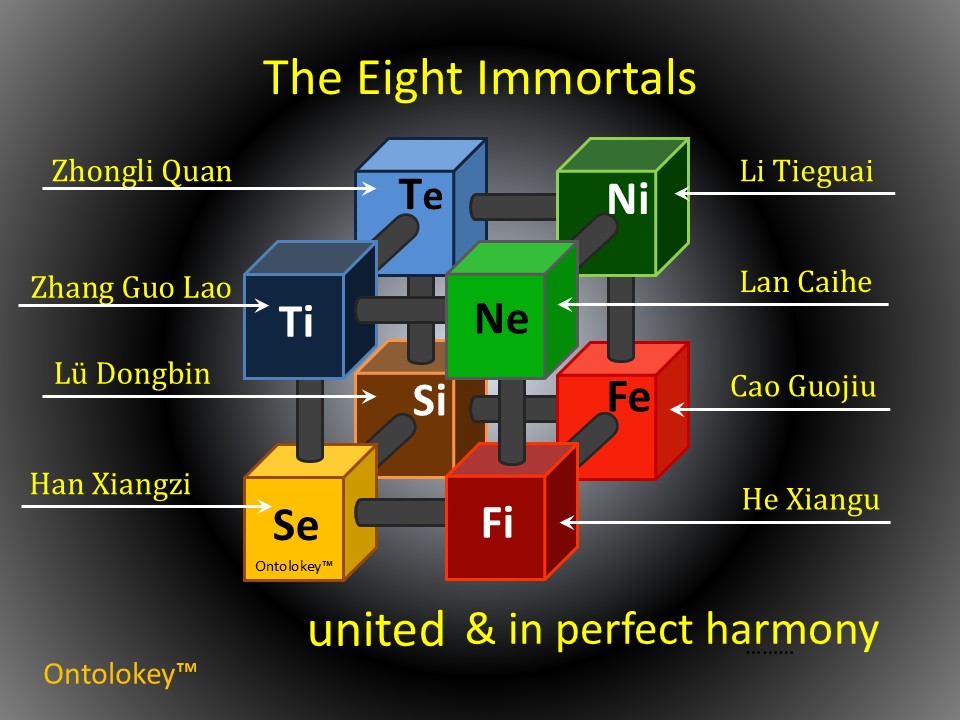
    In the Chinese tradition, the Eight Immortals (八仙 Bāxiān) are more than mythical figures. Each one represents an aspect of human virtue, spiritual development, and psychological resilience. In Taoist belief, true harmony arises when all eight Immortals work together—just as balance in the psyche is achieved when all eight psychological functions are acknowledged and integrated.

    In the Ontolokey model, based on the full eight-function framework of Carl Gustav Jung, these functions are not seen merely as traits, but as living forces within the personality. The Ontolokey Cube visualizes them as eight polar dimensions—each with its own voice, shadow, and wisdom.

    This article draws parallels between:

    • The Eight Immortals of Chinese mythology
    • The Eight Jungian functions
    • The Ontolokey Cube
    • The Yin-Yang philosophy and Taoist cosmology

    and shows how all of them describe one universal truth:
    👉 Only when all opposites are reconciled does true psychological harmony arise.


    🧩 Eight Immortals – Eight Functions

    Each Immortal mirrors one Jungian function:

    Li Tieguai (铁拐) – Ni (Introverted Intuition)

    • Symbol: iron crutch, gourd with healing medicine.
    • Attributes: protector of the sick and poor, despite his crippled body he possesses immense spiritual power.
    • Archetype: healing, compassion, strength through suffering.
    • Deep inner knowledge of transience, transformation, and the cycle of life and death.
    • A mystical thinker, often detached from the outer world, dwelling in inner visions.
    • Embodies resilience and paradoxical wisdom: through suffering (his crippled state) he gains higher insight.
    • Psychologically: highly symbolic, visionary, but somewhat estranged from everyday reality.

    Zhang Guolao (张果老) – Ti (Introverted Thinking)

    • Symbol: a white donkey, often ridden backwards.
    • Attributes: eccentric, diviner, associated with alchemy and magic.
    • Archetype: paradoxical wisdom, humor, independence.
    • An analytical, detached mind that sees through and deconstructs structures.
    • Loves paradoxes (his backward-riding donkey symbolizes “thinking against the grain”).
    • Psychologically: sharp intellect, questioning, ironic, sometimes eccentric.
    • Strives for inner logical clarity, even where the outer world appears chaotic.

    Lan Caihe (蓝采和) – Ne (Extraverted Intuition)

    • Symbol: flower basket.
    • Attributes: often depicted as androgynous, unconventional, slightly mad, patron of musicians and the poor.
    • Archetype: nonconformity, artistic freedom, joy of life.
    • Playful, creative spirit, constantly generating spontaneous new connections.
    • Symbol of freedom, nonconformity, and androgyny – a bridge between opposites.
    • Psychologically: open, experimental, unpredictable, often humorous.
    • Embodies the childlike-visionary principle that constantly sees new possibilities.

    He Xiangu (何仙姑) – Fi (Introverted Feeling)

    • Symbol: lotus flower.
    • Attributes: the only woman among the Eight; purity, healing powers, protector of women.
    • Archetype: maidenly wisdom, purity, asceticism.
    • Quiet, introverted sensitivity, oriented toward inner authenticity.
    • Embodies purity, inner self-loyalty, and paradoxical asceticism.
    • Psychologically: guided by a personal value compass, independent of outer norms.
    • Deeply reflective, empathetic, but also somewhat distant and hard to read.

    Cao Guojiu (曹国舅) – Fe (Extraverted Feeling)

    • Symbol: imperial robes, castanets or jade tablets.
    • Attributes: member of an imperial family; represents justice, order, protector of actors and performers.
    • Archetype: moral authority, social order.
    • Master of etiquette and social harmony.
    • His symbols (official garb, castanets) point to order, diplomacy, mediation.
    • Psychologically: attuned to social tensions, seeking reconciliatory solutions.
    • Embodies the collective conscience and the call for justice.

    Lu Dongbin (吕洞宾) – Si (Introverted Sensing)

    • Symbol: sword (against demons) and fly-whisk.
    • Attributes: the most famous Immortal, teacher of alchemy, known for resisting worldly temptations.
    • Archetype: enlightenment, self-discipline, spiritual guidance.
    • Embodies memory, tradition, and grounding in the physical body.
    • His role as teacher shows preservation of experience and humility.
    • Psychologically: reliable, detail-oriented, patient, with a strong sense of the past.
    • Emphasizes care and dedication, often expressed in service.

    Zhongli Quan (忠李) – Te (Extraverted Thinking)

    • Symbol: fan, with which he can revive the dead or create gold.
    • Attributes: wise elder, often portrayed as a jovial drinker, generous benefactor.
    • Archetype: alchemist, abundance, charity.
    • Represents structure and order, but also their ironic overturning (he laughs at conventions).
    • A practical organizer who gets things done.
    • Psychologically: rational, strategic, efficient – but can also be strict or mocking.
    • Symbolizes the handling of power, authority, and social order.

    Han Xiangzi (韩湘子) – Se (Extraverted Sensing)

    • Symbol: flute.
    • Attributes: musician and poet, makes flowers bloom and fruits ripen.
    • Archetype: art, harmony with nature, lightness of being.
    • Embodies sensuality, music, art, and immediacy and enjoyment.
    • Strongly lives in the present, in the sound and rhythm of life.
    • Psychologically: spontaneous, grounded, physically present, sometimes hedonistic.
    • Represents acceptance of the world as it is, here and now.

    Each figure is rich in symbolism, just like each Jungian function. None is inherently good or bad—balance emerges through cooperation.


    🌐 Taoist Harmony & the Ontolokey Cube

    Taoism teaches that harmony (道 Tao) is not reached by dominance of one side, but by the balanced interaction of oppositesYin and Yang, light and shadow, activity and receptivity.

    In Lao Tzu’s Tao Te Ching, there are allusions to what would later become the Bagua (八卦)—eight trigrams composed of broken and unbroken lines. This octagonal structure mirrors the Ontolokey Cube: eight orientations of consciousness, structured along polarities such as intuition vs sensation, feeling vs thinking, introversion vs extraversion.

    The flag of South Korea even embeds this cosmology: a Yin-Yang symbol in the center, surrounded by four of the eight trigrams, each representing a polarity of reality. It is a cosmic personality map—just like Ontolokey.


    🧠 Why This Matters for Psychology

    Most typology systems focus only on four functions—what we consciously identify with. But what about the rest? What about our shadows, blind spots, dreams, and projections?

    Ontolokey shows that only by integrating all eight functions—as if inviting all eight Immortals to the table—can a personality become whole. Imbalance leads to inner conflict, one-sidedness, even pathology.

    The Eight Immortals’ journeys reflect this process: facing fears, transforming suffering, and ultimately achieving immortality—not as escape from the world, but as psychological transcendence through integration.


    🔮 The Way Forward

    Modern psychology often looks to the West—Freud, Jung, Adler. But ancient systems like Taoism and Chinese mythology offer equally rich insights. Ontolokey provides a bridge between these worlds.

    It is time to:

    • Honor both myth and model
    • See personality as living architecture
    • And recognize that true mental health is not about control, but about inner dialogue among the eight.

    Just as the Eight Immortals are most powerful when united, so too is the self most alive when every function has a voice.

  • In contemporary psychology, ADHD is typically framed as a neurodevelopmental disorder characterized by inattention, hyperactivity, and impulsivity. But what if we viewed these traits not only pathologically—but also typologically?

    The Ontolokey model, which visualizes all eight Jungian cognitive functions, provides a powerful framework for reinterpreting psychological imbalances like ADHD in symbolic and developmental terms.

    🔄 Extraverted Intuition (Ne) and ADHD Tendencies

    Both ENFP and ENTP personality types are characterized by dominant extraverted intuition (Ne)—a function marked by curiosity, spontaneity, idea generation, and the constant pursuit of novelty. It is easy to see why some ADHD-like symptoms, such as distractibility or restlessness, may resemble an overexpression of Ne.

    ⚠️ Important disclaimer: This is not a clinical claim, but rather a typological hypothesis. ADHD is a complex condition that affects individuals across all personality types. The Ontolokey interpretation is a symbolic tool—not a substitute for diagnosis or treatment.

    From this perspective, ADHD may reflect an inner typological imbalance: an overactive dominant function (Ne) and underdeveloped or repressed supporting functions (especially introverted sensing, Si, or introverted intuition, Ni).


    🌿 The Role of Introverted Intuition (Ni) in Healing

    One unique feature of Ontolokey is its inclusion of all eight functions, including the so-called “sibling” function—the unconscious counterpart to the dominant. For both ENFPs and ENTPs, this is introverted intuition (Ni).

    Ni represents calm, internal reflection, symbolic insight, and connection to timeless patterns—very unlike the rapid-fire, chaotic nature of dominant Ne. In the Ontolokey framework, Ni is often associated with the unconscious need for stillness, solitude, and spiritual attunement.

    This leads to a therapeutic insight:

    🌲 Nature exposure, meditative practices, and symbolic reflection may help Ne-dominant individuals develop Ni—a crucial step toward balancing their inner psychological landscape.


    🔥 The Golden Shadow: Unconscious Drivers

    Ontolokey also introduces the concept of the Golden Shadow—the inverted form of the auxiliary function. For an ENTP, whose auxiliary is introverted thinking (Ti), the golden shadow becomes extraverted thinking (Te). In certain contexts, especially among male adolescents, this function may become overactivated in distorted ways, leading to aggression, defiance, or rebellious behavior.

    By contrast, ENFPs, whose auxiliary function is introverted feeling (Fi), experience their golden shadow as extraverted feeling (Fe). This can lead to withdrawal from social norms, emotional isolation, or difficulty expressing emotions in group settings—especially in female ADHD patients who feel misaligned with collective expectations.

    These projections can remain unconscious, but deeply affect self-worth, identity, and behavior. They represent the very “shadow” that Ontolokey helps bring into conscious awareness.


    ⚖️ Gender, Personality, and Emotional Response

    Typological expressions of ADHD may differ across gendered psychological development:

    • Male ENTPs may exhibit more externalized behaviors, driven by unintegrated Te (Golden Shadow), such as defiance, loudness, or impulsive aggression.
    • Female ENFPs may turn inward, manifesting emotional sensitivity, shyness, or social avoidance as their Fi function becomes overwhelmed and Fe remains repressed.

    Recognizing these tendencies does not mean pathologizing personality. Instead, it offers a roadmap for therapeutic growth and self-awareness, through careful attention to the full function stack.


    🧩 Why Ontolokey Matters

    Where conventional models like MBTI or Big Five stop at four functions, Ontolokey visualizes all eight—including the Anima/Animus, Golden Shadow, and sibling dynamics. This allows for a deep symbolic understanding of psychological imbalances, without resorting to narrow labels.

    In a world where ADHD diagnoses are rising, and children and adults alike feel misunderstood, Ontolokey offers an alternative lens—not to replace science, but to add depth, empathy, and direction.

    🧠 ADHD may not just be a disorder. It may be a call to integrate what has been ignored within.

  • A Mythological Blueprint for Individuation

    What if the myths of ancient Greece weren’t just stories, but blueprints for psychological growth? What if the journey of Perseus – from his conception to his triumph over Medusa and union with Andromeda – symbolized the deep inner path of integration for a specific personality type?

    Through the lens of Ontolokey, a visual model of Jungian typology, we uncover a profound interpretation: the story of Perseus as the individuation process of an INTP personality.


    🧠 Proitos (Ti) – The Beginning of Thought

    The journey starts with Proitos, who symbolizes Introverted Thinking (Ti) – logical, abstract, withdrawn, archetype of the INTP personality. Ti seeks internal coherence, but lacks emotional access to others. It is precise and independent, but often disconnected from shared emotional values.

    In contrast, Proitos’ brother Akrisios symbolizes Extraverted Thinking (Te) – goal-oriented, structured, externally focused. Akrisios becomes attracted to Danaë, who represents Introverted Feeling (Fi) – the quiet emotional core, deeply individual and private.

    Their union gives birth to Perseus, the potential for wholeness – a synthesis of intellect and emotion, of opposing cognitive functions.


    💛 Danaë – The Anima Within

    Danaë is more than Perseus’ mother – she also represents the Anima of Proitos (INTP). According to Jung, the Anima is the unconscious feminine aspect within a man, composed of the underdeveloped feeling functions.

    In this model, Danaë (Fi) represents the bridge to emotional depth, and ultimately to psychological balance. The INTP – strong in Ti – must open a path to Fi and Fe to mature emotionally and relationally.


    👁️ The Underworld (Ni) – Descent Before Ascent

    Before Perseus can face Medusa or meet Andromeda, he must first descend into the underworld, a symbolic space associated with Introverted Intuition (Ni) – the realm of archetypes, visions, and inner depth.

    Ni guides Perseus inward – into dreams, shadows, and symbolic truths. Only by passing through this internal realm can he prepare to confront what lies ahead: Medusa.


    🐍 Medusa (Fe) – The Extraverted Feeling Shadow

    Medusa is not just a monster – she represents the Extraverted Feeling (Fe) function, the shadow of Proitos’ Ti. As an ENFJ archetype, Medusa is persuasive, emotionally expressive, and socially attuned – everything the INTP fears losing control over.

    But the INTP cannot remain in pure Ti abstraction. To grow, he must face Fe – the function that demands awareness of others, empathy, emotional impact, and connection.

    Perseus doesn’t fight Medusa directly. He uses a mirror – the symbol of reflection and psychological distance – to integrate, not destroy, what he fears.


    🌊 Andromeda (ESFJ) – The Tertiary and Inferior Integration

    After slaying Medusa, Perseus reaches Andromeda, the true goal of his journey. She represents the ESFJ personality – the living embodiment of the tertiary function (Si) and the inferior function (Fe) of the INTP.

    This is the final stage of individuation: embracing not only the unconscious Anima and shadow (Fi and Fe), but also the underdeveloped functions that were once dismissed or feared.

    Through union with Andromeda, Perseus (the INTP Self) becomes whole. He now carries not only the sword of logic, but the heart of community and care.


    🧩 Ontolokey – A Tool for Real-World Integration

    Traditional models like MBTI, 16Personalities, or Big Five describe only the surface – the visible four functions. But the deeper work lies in the unconscious half – where the Anima/Animus, the Shadow, and the golden potential reside.

    Ontolokey visualizes all 8 psychological functions, making visible what is usually hidden. It helps people:

    • Understand their full psyche, not just their strengths.
    • Face their Medusa with tools of reflection.
    • Integrate their Andromeda to live a full, balanced life.

    🌍 From Myth to Maturity

    Perseus’ journey isn’t just his – it’s ours. Especially for those with an INTP-type structure, this path offers a powerful map:

    • Proitos (Ti): The logical base
    • Danaë (Fi): The soul within
    • Medusa (Fe): The relational shadow
    • Andromeda (ESFJ): The full integration of personality

    This myth reminds us that to become whole, we must descend before we rise, face what we fear, and unite with what completes us.With Ontolokey, we don’t just read the myth – we live it.