What if personality wasn’t just something to analyze – but something you could see, turn, and immediately understand?
Ontolokey, an innovative cube-based model, makes this possible. It brings complex personality structures into a tangible, visual form and opens new pathways for analysis, coaching, education, and self-development.
Rooted in the function typology of Carl Gustav Jung, Ontolokey integrates elements from well-known personality models such as MBTI, Socionics Model A, and the Enneagram – without being limited to a single framework.
The Foundation: Jung’s Psychological Functions
In 1921, Carl Gustav Jung outlined four core psychological functions – thinking, feeling, intuition, and sensation – each expressed in either an introverted or extraverted orientation. These eight function types continue to serve as the foundation for many modern typology systems.
Ontolokey translates these abstract concepts into a color-coded, spatial structure. Each function is represented by a specific colour and location within a cube, making it possible to instantly recognize how cognitive processes interact and which are dominant or repressed.
By rotating the cube, users can explore all 16 personality types known from MBTI or 16Personalities – including the dynamic order of their cognitive functions – in just seconds.
Beyond Typing: Archetypes and Psychological Depth
Ontolokey is much more than a quick type assessment. When the cube is unfolded, it reveals a symbolic map of the deeper layers of the psyche, inspired by Jung’s analytical psychology. This includes:
- the Ego – the conscious identity
- the Persona – our social mask
- the Anima or Animus – our unconscious inner counterpart
- the Golden Shadow – untapped potential and repressed strengths
- and the Self – the deeper center of wholeness and transformation
In this way, Ontolokey connects the surface of personality to the deeper psychological structures – offering insight not only into who we are, but who we might become.
Applications: Coaching, Education, Brands, and Teams
Ontolokey is a flexible tool that can be used across multiple fields – not only in psychology, but also in business, communication, and education:
- In coaching and psychotherapy, it provides a visual shortcut to understanding personality structures and unconscious dynamics.
- In education, it helps young people better understand themselves and others – fostering emotional intelligence, empathy, and social harmony.
- In branding and marketing, Ontolokey can be used to identify and design brand personalities based on psychological type and colour association.
- In team development, it enables better understanding of communication styles, decision-making approaches, and collaboration strategies.
Most importantly, Ontolokey is accessible to non-experts. Its color-coded and spatial format makes even deep psychological concepts easy to grasp – making it ideal for workshops, schools, and everyday conversations.
Conclusion: A Tool for Understanding and Growth
Ontolokey offers a unique way to understand personality – one that is visual, spatial, and grounded in depth psychology. It simplifies complex models without losing nuance, and opens up new ways to explore personal potential, inner conflict, and transformation.
In a time where self-awareness, empathy, and psychological well-being are more important than ever, Ontolokey provides a practical and holistic tool for understanding ourselves – and each other.It’s more than a model – it’s a key to the psyche.
The Ontolokey Cube: A Spatial Map of Mental Functions
At the core of the Ontolokey model lies a conceptual cube, with each of its eight corners representing one of Jung’s cognitive functions:
- Introverted (Ti) / Extraverted (Te)
- Introverted (Fi) / Extraverted (Fe)
- Introverted (Si) / Extraverted (Se)
- Introverted (Ni) / Extraverted (Ne)
The cube’s edges represent direct functional relationships—links between opposing functions of the same domain (e.g., Ti ↔ Te). These edges are dynamic axes, each equipped with a sliding marker that visually indicates a person’s position between the two poles.
This spatial representation allows individuals to see their functional balance, rather than relying solely on categorical type labels. Unlike the MBTI’s flat 4-letter code, Ontolokey embraces the complexity of cognition by making each person’s unique combination of preferences and tendencies visually accessible and quantifiable.
Functional Balance in Action
For example, an individual may lean more heavily toward introverted thinking (Ti), reflected by a slider positioned closer to that corner. However, the proximity of the marker to the extraverted thinking (Te) end indicates how much this function is also integrated into daily cognitive behavior. In a professional context, especially in structured environments like offices, extraverted thinking is often necessary—requiring planning, decision-making based on external logic, and execution of strategies. Even a dominant Ti user, therefore, must engage Te to function effectively in the external world.
The Sibling Function: Essential, Yet Often Ignored
One of the key contributions of Ontolokey is the concept of the Sibling Function—the non-dominant but intrinsically connected counterpart to the dominant function. For instance:
- Ti (introverted thinking) is “paired” with Te (extraverted thinking)
- Ni (introverted intuition) is paired with Ne (extraverted intuition)
- Si (introverted sensing) is paired with Se (extraverted sensing), etc.
These sibling functions form a cognitive duality. They operate on the same plane (e.g., both are thinking or both are sensing functions) but in opposite orientations—inward vs. outward. Ontolokey posits that no function operates in a vacuum. While a person may have a clear preference (e.g., 55% Ti vs. 45% Te), both are constantly and necessarily at play.
Unlike MBTI, which simplifies individuals into types and ignores sibling functions, Ontolokey recognizes that functional interplay—even among opposites—is essential for psychological adaptability and development.
In fact, the sibling function can serve as a compensatory mechanism. For instance, a Ti-dominant individual may rely more heavily on Te when working in team environments, under stress, or in situations requiring external validation of ideas.
The Tripod Structure: How Personality Stabilizes Itself
Ontolokey introduces the metaphor of the tripod to describe how a dominant function is supported and balanced by three key relationships:
- The Sibling Function (brother or sister counterpart)
- The Auxiliary Function (supportive function in a complementary domain)
- The Toddler Function (a more primitive but instinctive function)
Each of these is connected to the dominant function via a physical “leg” on the cube—represented as edges. These connections create a stable base for personality, much like how a three-legged stool can support weight even if one leg is slightly weaker.
Cognitive Load Distribution
The tripod metaphor emphasizes the reality that our conscious behavior is influenced not only by dominant or auxiliary functions but also by less conscious or situationally active functions, such as the Toddler. This function, although less developed, often plays a role in emotional responses, gut decisions, and habits, particularly under stress or in early development stages.
In Jungian terms, this reflects the complexity of the psyche, where the ego (dominant function) is continually interacting with both conscious and unconscious counterparts. Ontolokey makes this interaction explicit and measurable.
Visual Percentages: A Fluid View of Personality
In contrast to static type labels, Ontolokey introduces a percentage-based visualization to indicate how much each function is engaged in a person’s real-life cognitive behavior.
Three sliders measure the degree of influence from:
- Dominant ↔ Auxiliary
- Dominant ↔ Sibling
- Dominant ↔ Toddler
This approach acknowledges that personality is not a fixed construct but a fluid, context-dependent spectrum. For example:
- A person may show 70% preference for Ni over Ne, but when brainstorming with others, the Ne aspect might temporarily dominate.
- Under stress, a person may fall back on their Toddler function—e.g., a highly analytical Ti user suddenly relying on Se (extraverted sensing) to seek pleasure, escape, or immediate feedback.
This trifold percentage visualization aligns with findings in cognitive neuroscience, where mental functions are shown to operate in networks rather than isolated regions or types. Ontolokey, in this way, models personality more like a dynamic system, rather than a mechanical list of traits.
Ontolokey vs. MBTI: Key Theoretical Differences
While MBTI has been widely adopted and is useful for introducing people to Jungian typology, it has significant structural limitations:
| Feature | Ontolokey | MBTI |
| Number of functions | 8 (full function stack) | 4 (dominant, auxiliary, tertiary, inferior) |
| Spatial model | 3D cube with real-time dynamics | Flat letter-code (e.g., INTP, ESFJ) |
| Sibling/Toddler functions | Fully included and visualized | Ignored or undeveloped |
| Functional interactions | Emphasizes interplay and blending | Focuses on static preference |
| Relation to Jung’s theory | Closer to Jung’s original function model | More interpretive and simplified |
MBTI offers a valuable introduction to typology, but it lacks the granularity and depth needed for long-term self-development, coaching, or therapeutic use. Ontolokey restores this by returning to Jung’s function-based, dynamic psyche, while also making it visually accessible.
Practical Applications: Work, Growth, and Relationships
The Ontolokey model is particularly valuable in real-world applications:
- In work environments, recognizing one’s functional balance helps in team roles, decision-making, and task allocation. A Ti-dominant person aware of their Te usage can navigate external processes more effectively.
- In personal development, users can track which functions are overused or underdeveloped and deliberately work to engage their Toddler or Sibling functions more consciously.
- In relationships, the model facilitates empathy and communication, especially when people operate from different dominant functions but share supportive or sibling connections.
By visualizing the cognitive profile in full 3D—rather than boxing it into types—Ontolokey encourages ongoing self-awareness, growth, and adaptation.
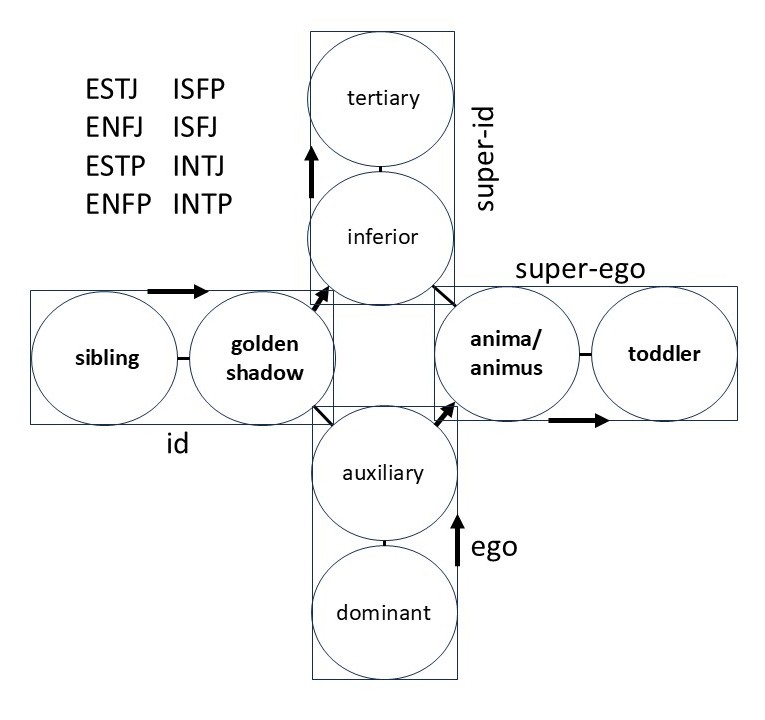
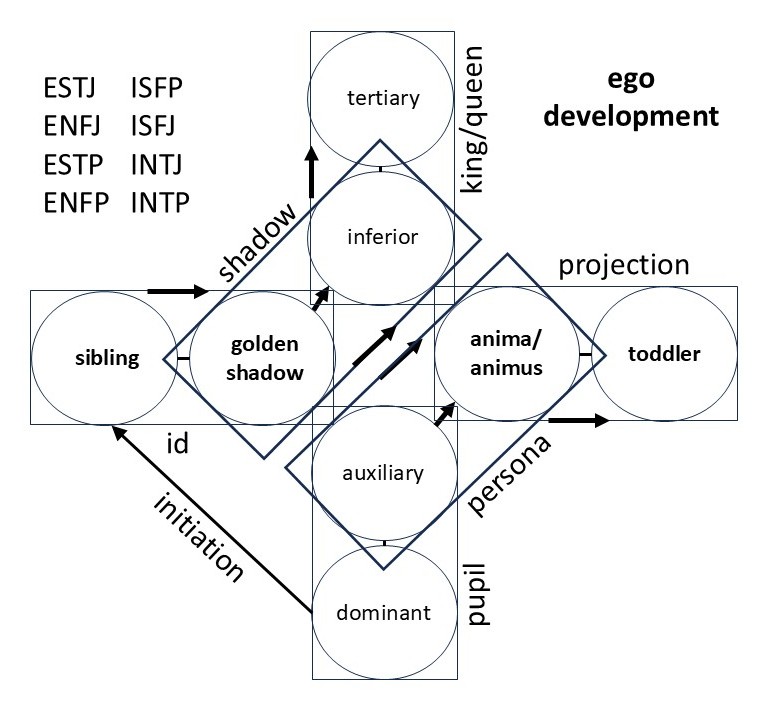
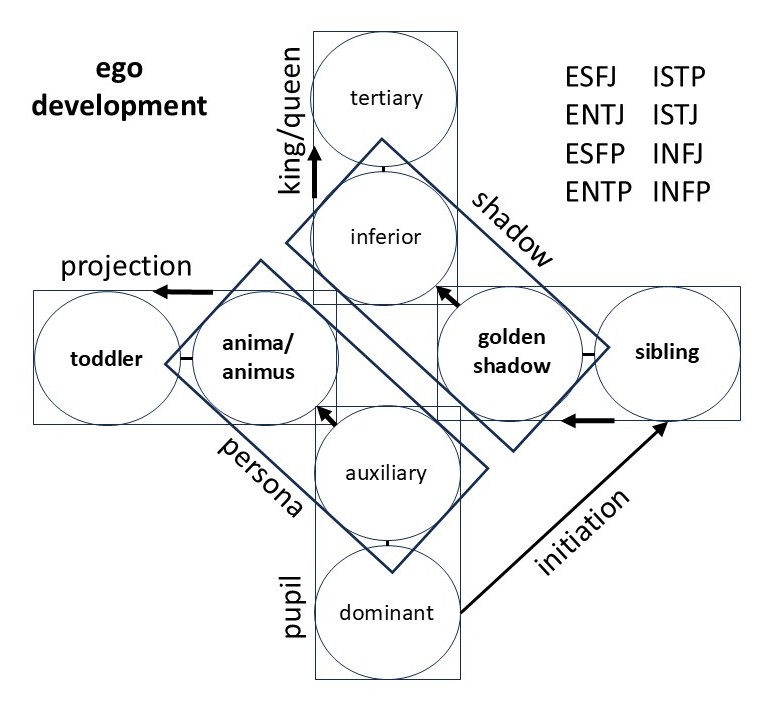
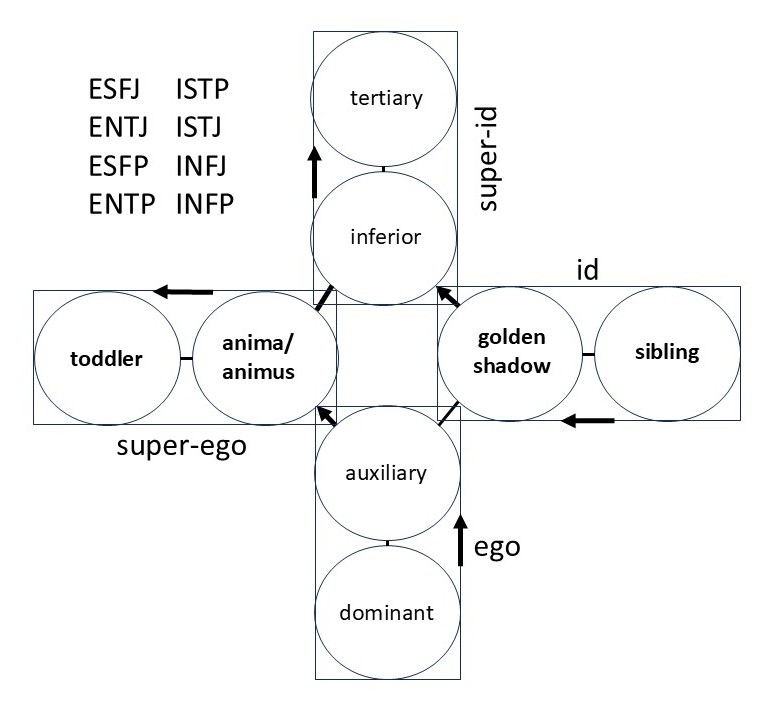
After you have turned the Ontolokey cube to the desired personality type, you can start unwinding the cube. The unwinding starts at the dominant function, goes via the auxiliary function to the two parallel functions Anima/Animus and Golden Shadow. From the Golden Shadow, a horizontal arm of the cross is folded out for the sibling function. From the Anima Animus, the other horizontal arm of the cross is folded out for the toddler function. From the two parallel psychological functions of the anima and the golden shadow, it goes further up to the inferior function and then to the tertiary function. Depending on your personality type, the toddler function is either on the right or on the left side of the cross and the sibling function is correspondingly on the other. This is illustrated by the following graphics.

Conclusion: A Modern Model for a Complex Mind
The Ontolokey model offers a modernized, more psychologically sophisticated way to understand personality. It acknowledges the multidimensional nature of cognition, honors Jung’s full functional theory, and provides users with practical tools for reflection, growth, and real-life application.
In a world that demands flexibility, collaboration, and internal coherence, understanding not just who you are, but how you operate, is more important than ever.
 Ontolokey
Leave a comment