A Modern Key of Knowledge for an Age of Psychological Confusion
In the Gospel of Luke, there is a short but striking passage in which Jesus says:
“Woe unto you lawyers! For ye have taken away the key of knowledge.”
(Luke 11:52)
This “key of knowledge” has fascinated philosophers, psychologists, and spiritual seekers for centuries. What is this key? Who lost it? And, most importantly—how do we find it again?
The answer, at least in part, lies within ourselves.
The ancient Greeks understood this deeply. At the entrance of the Temple of Apollo at Delphi, a single phrase was carved into stone:
“Know Thyself.”
This was not merely a philosophical motto. It was a map—a guide to inner truth, resilience, and clarity.
Today, in a world drowning in information yet starving for wisdom, we need such a key more than ever. A tool that helps us interpret our inner architecture, understand our motivations, and reclaim a sense of wholeness.
This is where the Ontolokey Cube enters the story.
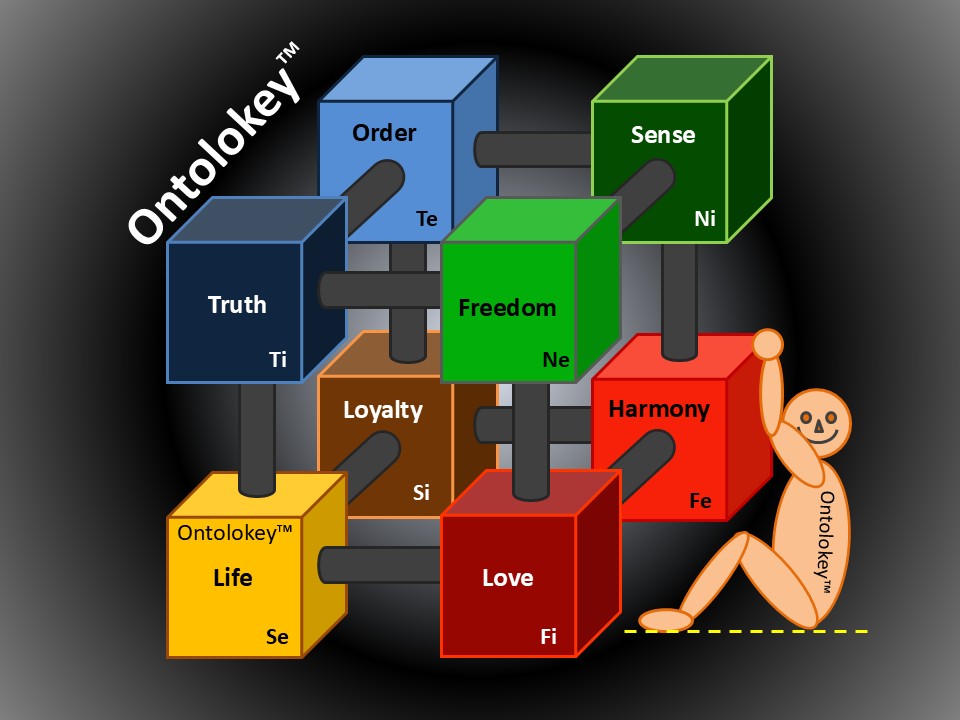
The Ontolokey Cube is not a commercial product, nor a personality test, nor a psychological gimmick. It is a symbolic instrument for inner exploration, built on the foundation of the eight psychological functions described by Carl Gustav Jung, combined with eight essential human values that give those functions emotional and existential meaning.
This article aims to introduce the Ontolokey Cube as a modern Key of Knowledge—a way for individuals to rediscover themselves, reconnect with their purpose, and reawaken the timeless wisdom hidden in their own consciousness.
Part 1 — The Crisis of Self in the Modern World
We live in an age of unprecedented technological advancement, yet psychological distress has never been higher. Anxiety, burnout, lostness, and identity confusion are rampant. People no longer know who they are, what they value, or what direction their lives should take.
Despite endless information, people feel internally empty.
Despite millions of online identities, people feel unseen.
Despite constant connectivity, people feel isolated.
Why?
Because the inner compass has been lost.
Modern society teaches us how to optimize, but not how to understand ourselves. How to perform, but not how to reflect. How to consume, but not how to listen to the inner voice that whispers truth.
Many search for meaning in external benchmarks—wealth, recognition, success—but these often leave the soul hungry.
We do not need more data.
We need a framework of meaning.
A way to decode the structure of our own consciousness.
A way to reclaim the “key of knowledge.”
The Ontolokey Cube proposes such a framework.
Part 2 — Jung’s Eight Functions as the Architecture of Inner Life
Before introducing the Cube, we must first ground ourselves in the eight fundamental psychological functions described by Carl Gustav Jung. These functions form the operating system of the human psyche.
They can be divided into:
- Thinking (Ti, Te)
- Feeling (Fi, Fe)
- Intuition (Ni, Ne)
- Sensing (Si, Se)
Each with introverted and extraverted variants.
However, Jung’s system is often misunderstood as cold, technical, or purely diagnostic. The truth is the opposite: his functions describe the depth of human experience.
To make them more accessible, the Ontolokey Cube pairs each function with a symbolic value—a word that expresses its inner essence not intellectually, but emotionally and spiritually.
These value-words are not clichés; they are condensed forms of lived human experience, archetypal energies that shape our personality and behavior.
Let’s explore each of them.
Part 3 — The Eight Functions and Their Eight Archetypal Values
Below is the Ontolokey pairing of each function with its symbolic value.
1. Ti — Truth
Introverted Thinking
Ti seeks internal coherence, clarity, and conceptual purity. It removes noise to uncover what is logically authentic. Its symbolic value Truth represents the search for intellectual honesty and the courage to question assumptions.
2. Te — Order
Extraverted Thinking
Te organizes the outer world. It builds systems, structures, and methods. Its symbolic value Order reflects the human need for alignment, direction, and purposeful action.
3. Fi — Love
Introverted Feeling
Fi navigates the inner realm of values, ethics, and emotional authenticity. Its symbolic value Love is not romantic but existential—the love that arises from being true to one’s heart.
4. Fe — Harmony
Extraverted Feeling
Fe attunes to social dynamics, emotional climates, and relational balance. Its symbolic value Harmony expresses its longing for mutual understanding and shared emotional resonance.
5. Ne — Freedom
Extraverted Intuition
Ne perceives possibilities, patterns, and emerging potential. Its symbolic value Freedom captures the spirit of exploration, creativity, and openness to the unknown.
6. Ni — Meaning
Introverted Intuition
Ni descends into the depths of vision, foresight, and inner symbolism. Its symbolic value Sense (Meaning) represents the quest for inner purpose and existential insight. It sees the hidden trajectory of things.
7. Se — Life
Extraverted Sensing
Se immerses itself in concrete reality—color, sensation, vitality, presence. Its symbolic value Life honors the immediacy and intensity of direct experience.
8. Si — Loyalty
Introverted Sensing
Si preserves memory, tradition, and inner continuity. Its symbolic value Treue (Loyalty) reflects its role as guardian of what is familiar, stable, and time-tested.
Part 4 — Introducing the Ontolokey Cube
Imagine taking these eight functions and their eight values and arranging them into a coherent three-dimensional structure.
That structure is the Ontolokey Cube.
What is the Ontolokey Cube?
- It is a symbolic model of the human psyche.
- It is a map that combines psychological function with existential value.
- It is a tool for self-reflection and self-realization.
- It is a modern interpretation of the ancient Key of Knowledge.
Why a Cube?
The cube is one of the most stable shapes in geometry. Philosophically, it represents:
- structure,
- balance,
- completeness,
- and the integration of opposites.
Each face of the cube corresponds to a pair of psychological opposites:
- Thinking vs. Feeling
- Intuition vs. Sensing
- Introversion vs. Extraversion
But the Cube is more than a diagram. It is a way of seeing yourself from multiple perspectives at once.
How the Values Bring the Cube to Life
Without symbolic values, psychological functions can feel abstract.
But when paired with values, they become alive, human, recognizable, and meaningful.
For example:
- Ti becomes not simply “logical analysis,” but Truth.
- Fi becomes not merely “subjective feeling,” but Love.
- Ni becomes not “internal intuition,” but Meaning.
- Se becomes Life itself.
This is why the Cube resonates so strongly with people, regardless of their cultural or psychological background:
it speaks the language of human essence.
Part 5 — The Ontolokey Cube as a Modern Key of Knowledge
Now we return to Luke 11:52.
What is the Key of Knowledge?
Historically, interpreters have seen it as:
- wisdom,
- insight,
- moral integrity,
- or the ability to interpret spiritual truth.
But in psychological terms, the Key of Knowledge is simply this:
The ability to interpret your own consciousness.
This is what the Ontolokey Cube provides.
It helps individuals understand:
- How they think
- How they feel
- How they see possibilities
- How they connect to meaning
- How they ground themselves in reality
- How they relate to others
- How they preserve personal continuity
- How they interact with the world
And through understanding these eight aspects, a person learns:
Who they really are.
This makes the Ontolokey Cube a modern manifestation of an ancient ideal—
the ideal of the Delphic maxim, carved at the entrance to the Temple of Apollo at Delphi:
“Know Thyself.”
When we understand ourselves, we understand others.
When we understand our motives, we gain freedom.
When we interpret our inner architecture, we grow in wisdom.
Self-knowledge is not narcissism.
It is liberation.
Part 6 — How to Use the Ontolokey Cube for Self-Discovery
The Cube invites introspection through three steps.
Step 1 — Identify Your Core Function
Your psyche always has a center of gravity, a function that feels most natural.
It might be:
- Ti (Truth)
- Fi (Love)
- Ne (Freedom)
- Si (Loyalty)
- or any of the others.
Knowing your dominant function reveals your natural way of engaging the world.
Step 2 — Understand Your Value Orientation
Each function’s value word reveals:
- What motivates you
- What you seek
- What you protect
- What you fear losing
For example:
- A Ti-dominant person seeks Truth and fears internal inconsistency.
- An Fi-dominant person seeks Love and fears emotional betrayal.
- A Ne-dominant person seeks Freedom and fears restriction.
- A Ni-dominant person seeks Meaning and fears purposelessness.
When you know your value orientation, you can see why you behave as you do.
Step 3 — Integrate the Whole Cube
The final step is the most transformative:
seeing all eight functions and values as parts of you, not labels.
The Cube helps you:
- balance strengths and weaknesses
- understand emotional triggers
- recognize blind spots
- appreciate how others operate
- develop compassion
- grow into psychological wholeness
It is not about being a “type.”
It is about becoming a balanced and integrated human being.
Part 7 — Why the Ontolokey Cube Matters Today
In a fragmented, polarized world, the Cube offers:
1. A language of understanding
Instead of reducing people to stereotypes, the Cube reveals the complexity and dignity of each person’s inner architecture.
2. A bridge between psychology and spirituality
It connects Jungian cognitive structure with ancient wisdom—
from the Bible to Greek philosophy.
3. A tool for personal growth
Self-knowledge is not optional—it is the foundation of mental clarity, emotional resilience, and social harmony.
4. A path to inner unity
The Cube teaches that:
- We are not broken.
- We are not random.
- We are not chaotic.
We are structured, meaningful beings with an inherent inner geometry.
5. A rediscovery of the Key of Knowledge
When you understand the Cube, the ancient teaching becomes alive:
“Know Thyself.”
You no longer wait for authority figures to tell you who you are.
You decode your own psyche.
You reclaim the Key of Knowledge that Luke 11:52 mourns as lost.
Part 8 — Conclusion: A Call to Rediscovery
The Ontolokey Cube is not an invention of psychological theory—it is a rediscovery of something ancient, something human, something essential.
It brings together:
- the eight Jungian functions,
- the eight archetypal values,
- the biblical Key of Knowledge,
- the Delphic command of self-understanding,
- and the modern need for psychological clarity.
It is a symbolic tool, a reflective mirror, and a philosophical companion on the path of self-discovery.
In a world filled with noise, the Cube invites silence.
In a world obsessed with performance, the Cube invites authenticity.
In a world ruled by confusion, the Cube invites meaning.
And in a world that has forgotten the wisdom of the ancients, the Cube whispers:
“Know Thyself.”
When you do, the Key of Knowledge returns to your hand—
not as a religious artifact nor a philosophical abstraction,
but as a living, breathing truth residing within your own consciousness.
 Ontolokey
Leave a comment