There are people who believe in God, and there are those who believe in religion. I have always believed in God, although neither leaning into religion nor into institutionalized doctrine. Baptized, confirmed, and later having left the church in my youth—not out of rebellion, but out of a quiet, early recognition that the institutions claiming to speak in God’s name often had little to do with what I felt to be truly divine.
My spiritual journey did not lead me to adopt another religion. Instead, it led me to what I might call an animistic perspective: the belief that all things—truly everything—are alive in some sense, and that the balance of nature is more sacred than any holy text. Perhaps this is why I have spent so much of my life examining the religions of the world. Often, an outsider sees more clearly than one who is immersed in a system too deeply to notice it.
The Burden of Christian History
Engaging with Christianity historically can be disquieting. The violence, the injustice, and the suffering inflicted in its name are staggering: the forced conversions of indigenous peoples, inquisitions, witch hunts, crusades, countless wars, and innumerable lives lost under banners of faith. The First and Second World Wars were fought primarily by Christians against fellow Christians, but also against Islamic nations. Adolf Hitler, orchestrating the genocide of six million Jews, found fertile ground in centuries of Christian anti-Semitism—rooted in religious mythologies that blamed Jews for the death of Jesus, whose image still hangs on countless crosses across Europe.
Western atrocities extend beyond war. Colonization, slavery, and economic exploitation were often conducted under the guise of moral and religious righteousness. Today, global financial systems—built on centuries of exploitation—remain intertwined with the legacy of Western Christendom. The moral ideals of Christianity frequently stand in stark contrast to its historical and contemporary actions. Drug cartels in Latin America, for example, carry crucifixes while committing acts of extreme violence—a grotesque caricature of a religion that promised redemption and compassion. These contradictions are not just historical footnotes; they are lived realities that continue to shape the world.
The Muslim World: Honor, Knowledge, and Humanity
And then there are the Muslims, often portrayed in the West as “the other”: uneducated, barbaric, or violent. These are simplifications, stereotypes reinforced by fear, ignorance, and selective reporting. In reality, the Arab world has contributed enormously to human knowledge. Between the 8th and 15th centuries in Andalusia, Arab scholars, alongside Christian thinkers, laid the foundations of modern mathematics, astronomy, medicine, and philosophy. Algebra, advances in optics, early forms of hospitals, and encyclopedic works of philosophy and science emerged in a flourishing Arab-Islamic civilization.
I remember walking through the old streets of Granada, Spain, feeling the echoes of this golden age. The Alhambra’s intricate geometric patterns and the wisdom preserved in its libraries reminded me that the Middle East was, for centuries, a cradle of human knowledge. While Europe was emerging from the Dark Ages, Baghdad and Cordoba were centers of learning, hosting libraries with hundreds of thousands of manuscripts. Medical knowledge from the Middle East saved countless lives in Europe centuries later.
In Iran, I visited the University of Tehran and spoke with young women who were not only academically brilliant but also ambitious, articulate, and confident. These were women shaping the future of science, engineering, and literature—a far cry from Western stereotypes of oppressed Muslim women. Social norms in public may differ, but inside families, in classrooms, and in workplaces, women exercise considerable influence, creativity, and authority.
My first journey into the deserts of Saudi Arabia at twenty-eight was transformative. The stillness, the vast horizon, the raw unbroken world—it was humbling. The desert confronts you with yourself: no distractions, no noise, no excuses. The people I met in the Middle East displayed a form of human dignity often missing in the West. Honor was lived, not spoken of. A handshake could carry more weight than a signed contract. Hospitality was not transactional—it was sacred. Conversations, sometimes lasting hours, addressed conflict openly, honestly, and respectfully.
Historical Comparisons: West vs. East
To understand prejudice, one must understand history. While Europe pursued expansion, conquest, and exploitation, the Middle East often prioritized knowledge preservation, cultural flourishing, and urban civilization. Consider the contrast:
- Governance: European nations in the medieval period were fragmented and often dominated by feudal lords; Arab caliphates, conversely, maintained sophisticated bureaucracies and legal systems that ensured relative stability and intellectual patronage.
- Science and Knowledge: The Library of Alexandria may have been ancient, but its intellectual tradition lived on in Arab scholars, who preserved Greek, Roman, and Indian knowledge while innovating in mathematics, astronomy, and medicine. Meanwhile, Western Europe would experience centuries of relative scientific stagnation until the Renaissance.
- Cultural Integration: Cities like Cordoba and Baghdad fostered co-existence of Christians, Jews, and Muslims, producing art, philosophy, and scholarship that influenced Europe’s own intellectual awakening. European colonization often led to cultural erasure, not integration.
Understanding these historical trajectories challenges the simplistic narrative that the West has always been the bastion of civilization, while the East has been backward or primitive.
Contrasting Personal Experiences
Traveling extensively has shown me that Western friendliness often carries a subtle caution or strategy. In Mexico, where I lived for over a decade, “gringos” are sometimes outwitted—not out of malice, but as a learned survival tactic. In Israel, openness coexists with directness, calculation, and competition. Friendliness often masks ulterior motives or self-interest.
By contrast, my experiences in Muslim countries rarely included such duplicity. Disagreements were addressed directly. Hospitality was genuine. Integrity was expected and returned in kind. Social rituals, hierarchies, and etiquette signaled respect and mutual recognition. The contrast is not a claim of superiority but of lived reality: the heart often matters more than appearances.
I recall one evening in Riyadh, sitting with colleagues after a long day of negotiations. We shared tea, dates, and conversation well past sunset. A minor misunderstanding in the office had arisen earlier, but instead of whispers or hidden agendas, we addressed it openly. By the end of the night, respect had been restored, and relationships strengthened. In Mexico or Israel, similar disputes might have lingered, festering beneath the surface, only to erupt later with resentment or competition. This was a small moment, but it encapsulated a larger cultural truth: honor and transparency mattered more than appearances.
Cultural Constructs and Relativism
What these experiences reveal is that all societies construct their own moral and social realities. The Christian worldview shaped Western geopolitics, economics, and social structures; the Muslim worldview shaped Arab civilization and its historical resilience. Neither is inherently superior or inferior—they are different. Other worldviews, from Confucianism and Taoism in China, to Hinduism and Buddhism in India, demonstrate the astonishing diversity of human thought.
To live among other cultures is to confront one’s own assumptions. The West often judges the East, yet frequently ignores its own contradictions. The history of violence, exploitation, and moral compromise in Europe and the Americas is rarely acknowledged in casual discourse about Islam or the Middle East. Empathy requires reflection, humility, and the willingness to look in the mirror before casting judgment.
The Modern Media and Political Lens
Western media often amplifies fear of Muslims, framing Islam as inherently violent or oppressive. Headlines emphasize terrorism, conflict, or “backward” practices while ignoring the ordinary lives of millions: families, students, entrepreneurs, and community leaders contributing positively to society. This selective coverage reinforces stereotypes and fuels Islamophobia in politics, schools, and social discourse.
Politically, policies such as travel bans, immigration restrictions, and profiling are often justified under the guise of security but stem from broader cultural biases. Western countries rarely interrogate their own historical responsibility in Middle Eastern instability: colonial partitioning, support for dictators, or economic exploitation. Instead, public narratives frequently cast the Muslim world as the “problem,” erasing nuance, context, and history.
During my time in Tehran, I met young activists who spoke with passion about social reform, education, and environmental initiatives. Their stories were rarely covered in Western outlets. Similarly, ordinary citizens in Saudi Arabia, Jordan, and Egypt navigate daily life with dignity, humor, and resilience. Ignoring these realities contributes to a one-dimensional worldview, making mutual understanding more difficult.
Reflections on Experience, Truth, and Generalization
This essay is personal, subjective, and fragmentary. It is a mosaic of experiences, observations, and reflections. Christianity is not merely a story of conquest and oppression, nor is Islam a monolith of tradition or rigidity. The West is capable of both loyalty and betrayal, generosity and exploitation. Likewise, the East contains both justice and corruption, hospitality and hierarchy. Recognizing these complexities fosters understanding and counters simplistic narratives of “us versus them.”
Living in the Middle East taught me lessons that no book or lecture could impart: the profound weight of honor, the significance of genuine human connection, the grace of openness. I learned that culture is not merely a backdrop—it is lived, felt, and enacted. It shapes how people behave, how they relate, and how they confront life’s challenges. To dismiss it is to misunderstand the people themselves.
Conclusion: Empathy as a Path Forward
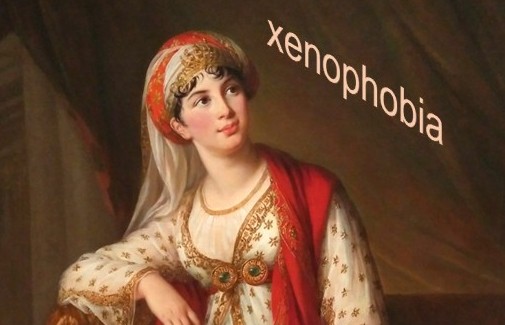
Combating xenophobia and Islamophobia begins with introspection. Western societies must confront their histories of violence, exploitation, and moral contradiction. Seeing the world through the eyes of others—the stranger—allows us to recognize shared humanity, despite differences in belief, custom, or worldview.
Before judging what we do not understand, we must examine our own actions, our own cultures, and the shadows we have left across history. Hospitality, honor, and integrity are not bound to geography or faith—they are human ideals, embodied differently in every society. By listening, observing, and experiencing, we dismantle prejudice, one insight at a time.
The desert of Saudi Arabia, the markets of Tehran, the courts of Andalusia, the streets of Mexico, the neighborhoods of Israel—all taught me a simple truth: no culture has a monopoly on morality, wisdom, or beauty. To live fully in the world, we must step outside our familiar narratives, confront uncomfortable truths about ourselves, and learn to see the other not as an enemy, but as a teacher, a mirror, and a fellow traveler in the shared human journey.
 Ontolokey
Leave a comment