1. Introduction — Bridging East and West: Toward an Archetypal and Operational Psychology
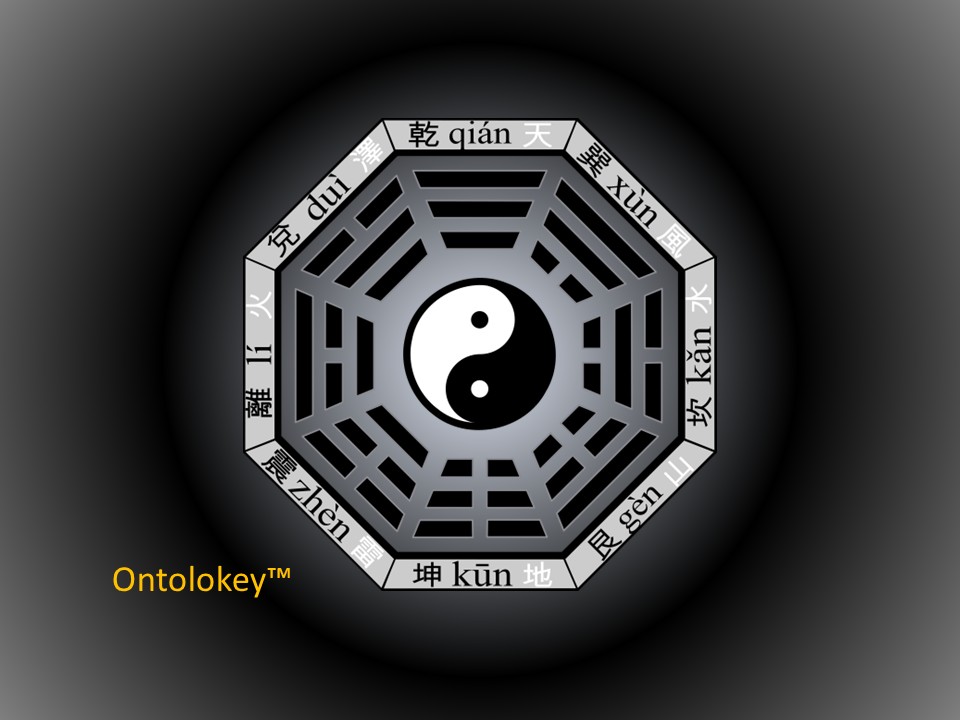
Personality theory in the twentieth and twenty-first centuries has often been narrated as a principally Western endeavor: Jung’s typology provided an archetypal grammar, Myers–Briggs rendered it practicable for institutions, and Socionics systematized Jungian functions into a formal structural model. Yet parallel intellectual traditions exist outside this familiar lineage—systems that, for millennia, have encoded human orientation, decision dynamics, and social role into symbolic schemes. Two of the most consequential of these are the Daoist Bagua (the Eight Trigrams) and the corpus of popular myth surrounding the Eight Immortals (Ba Xian). Both capture eight primary patterns of relation and action, and both do so in a language of process, complementarity, and transformation rather than of static trait lists.
This essay contends that Ontolokey — a three-dimensional, functionally-oriented framework for personality — is uniquely positioned to translate these Asian symbolic systems into an academically tractable psychology. Ontolokey’s cube (with eight vertices, paired axes, and articulated tripods of conscious and shadow functions) mirrors the formal eightfold structure of Bagua and the archetypal multiplicity embodied by the Eight Immortals. But Ontolokey does more than observe a formal similarity: by offering coordinates, manipulable dynamics, and an explicit mapping to cognitive functions, Ontolokey can convert traditionally symbolic claims into operational hypotheses, measurable variables, and testable predictions—without reducing or misrepresenting their cultural meanings.
The aims of this essay are therefore threefold:
- Descriptive Mapping. Provide a careful, historically informed reading of Bagua trigrams and the Eight Immortals as archetypal patterns, and propose systematic mappings from these archetypes into Ontolokey’s eight-function architecture (vertices, tripods, and intertype axes).
- Methodological Translation. Outline methods by which symbolic, hermeneutic content can be translated into operational constructs—psychometric anchors, behavioral markers, and dynamic indices—while preserving cultural context and interpretive nuance.
- Applications & Validation. Sketch practical implications for intercultural coaching, leadership, and clinical work, and propose empirical pathways (cross-cultural validation, longitudinal studies, and organizational trials) that allow scholars to evaluate the epistemic and predictive claims of the integrated model.
Two methodological principles guide the project. First, structural isomorphism: we begin from the proposition that resemblance in formal structure (both systems enumerate eight differentiated positions and specify oppositions and complementarities) provides a legitimate analytic opening—but resemblance alone does not prove equivalence. We therefore supplement structural parallels with semantic and functional analysis, asking not only whether positions correspond but how their psychological logics align in practice. Second, hermeneutic fidelity with empirical rigor: the translation must respect the symbolic density and cultural valences of the Bagua and the Eight Immortals while producing constructs that can be subjected to empirical scrutiny. Put differently, the essay advocates a mixed hermeneutic-empirical method: careful textual and cultural interpretation followed by operationalization and empirical testing.
To achieve these aims the essay proceeds in five substantive steps:
- Section 2 — The Bagua Revisited: a focused exegesis of each trigram’s traditional meanings, their polarities, and preliminary psychological readings that will form the basis for mapping onto Ontolokey’s vertices.
- Section 3 — The Eight Immortals as Psychological Personas: an analysis of each immortal’s mythic narrative as a developmental and functional pattern, with proposed mappings to Ontolokey tripods and shadow axes.
- Section 4 — Translational Framework: a methodological toolkit for converting symbolic archetypes into measurable constructs—covering content mapping, item generation, behavioral proxies, and digital calibration methods.
- Section 5 — Comparative Synthesis: a side-by-side comparison of Bagua/Ontolokey and Ba Xian/Ontolokey mappings, highlighting convergences, tensions, and interpretive boundaries.
- Section 6 — Applications and Research Agenda: proposals for cross-cultural validation, organizational pilots, therapeutic interventions, and ethical considerations for deploying an integrated model in practice.
Throughout, the essay will take care to avoid cultural flattening. Integration here does not mean absorption or erasure: rather, it insists that symbolic traditions contribute richly textured hypotheses to contemporary personality science and that modern modeling tools like Ontolokey can honor and translate those traditions into forms useful for research and practice. In doing so, the project seeks a double outcome: to enrich Ontolokey with centuries of archetypal insight and to offer East Asian symbolic systems new routes into systematic, empirically accountable study.
The next section turns to the Bagua itself: its lines, images, and dialectical logic—and begins the careful work of reading each trigram as a potential cognitive-functional orientation within Ontolokey’s three-dimensional field.
2. The Bagua Revisited: Eight Archetypes of Orientation
The Bagua is not only a symbolic cosmology but also an eightfold dialectical system. Its trigrams are arranged into pairs of opposites:
- Qian (☰) Heaven ↔ Kun (☷) Earth
- Zhen (☳) Thunder ↔ Xun (☴) Wind/Wood
- Kan (☵) Water ↔ Li (☲) Fire
- Gen (☶) Mountain ↔ Dui (☱) Lake/Marsh
These oppositions mirror the psychological dichotomies that structure Ontolokey’s cube:
- Te ↔ Fi
- Fe ↔ Ti
- Ne ↔ Si
- Se ↔ Ni
By aligning the Bagua opposites with these functional oppositions, we see that both systems articulate not just eight archetypes, but four fundamental polarities that generate dynamic balance.
Archetypal Polarities as Psychological Functions
When we look closely at the Bagua, we find not only eight archetypal trigrams but also a profound logic of oppositions. The ancient Daoist sages did not present these symbols in isolation; they always appear in pairs, locked in a dance of balance and tension. Heaven is always mirrored by Earth, Fire is tempered by Water, Thunder is answered by Wind, and the stillness of the Mountain is completed by the joy of the Lake.
What makes this particularly striking is how seamlessly these four cosmic polarities align with the psychological dichotomies of Ontolokey’s cube. Just as the Bagua arranges its eight orientations around four axes of contrast, Ontolokey organizes the eight cognitive functions into four oppositions: Te against Fi, Fe against Ti, Ne against Si, and Se against Ni. Both systems insist that human orientation cannot be understood in isolation, but only as the tension and dialogue between opposites.
Let us look at each of these pairings more closely.
Heaven (Qian ☰) and Earth (Kun ☷)
The trigram of Heaven represents the creative principle—expansive, directive, and authoritative. It initiates, structures, and brings forth order. In psychological terms, this resonates with Extraverted Thinking (Te), the function that establishes systems, organizes resources, and brings clarity through external frameworks.
By contrast, Earth is the receptive principle—yielding, nurturing, and adaptive. It accepts rather than imposes, values depth rather than direction. Here we find the spirit of Introverted Feeling (Fi), which grounds the individual in authentic values and relational integrity. Together, Heaven and Earth embody the polarity of system and value, structure and care.
Thunder (Zhen ☳) and Wind/Wood (Xun ☴)
Thunder is sudden, disruptive, and transformative. It shakes the ground, awakens what is dormant, and forces movement. This imagery parallels Extraverted Intuition (Ne), which shocks established patterns by generating possibilities and provoking innovation.
Wind or Wood, by contrast, is gentle but persistent. It penetrates slowly, shaping the environment over time, preserving continuity. This reflects Introverted Sensing (Si), which stabilizes life through memory, detail, and respect for tradition. Here the polarity is clear: innovation versus continuity, disruption versus preservation.
Water (Kan ☵) and Fire (Li ☲)
Water is deep, hidden, and potentially dangerous. It flows into unseen spaces, drawing one into introspection and immersion. In psychological terms, this corresponds to Introverted Thinking (Ti), which dives into abstract structures, exploring unseen logical depths.
Fire, by contrast, illuminates and communicates. It radiates outward, expressing meaning and igniting collective energy. This is the domain of Extraverted Feeling (Fe), which generates warmth, shared emotion, and the external articulation of values. Together, Water and Fire create the polarity of inner analysis versus outer expression, depth versus illumination.
Mountain (Gen ☶) and Lake/Marsh (Dui ☱)
The Mountain stands for stillness, boundary, and reflection. It is immovable, a place of meditation and foresight. This maps naturally onto Introverted Intuition (Ni), the function of inner vision, contemplative insight, and long-term foresight.
Opposite the Mountain lies the Lake, symbol of joy, play, and open interaction. The Lake reflects movement, immediacy, and sensory delight—qualities of Extraverted Sensing (Se), which grounds us in the present moment, in tangible action, and in the vibrancy of life itself. This polarity captures the tension between vision and presence, stillness and movement.
Structural Resonance
Once we see these mappings, the structural resonance between Bagua and Ontolokey becomes undeniable. Both systems—one born from Daoist cosmology, the other from modern typology—speak in the same geometry of opposites. The Bagua offers a cosmic-poetic language; Ontolokey translates the same dynamics into a psychological-scientific framework. The cube of Ontolokey does not invent new dichotomies but reveals that the architecture of the psyche has been mirrored in human culture for millennia.
Thus, when we set the Bagua alongside Ontolokey, we do not see two incompatible traditions but one underlying structure expressed in different tongues: the language of symbol, and the language of science.
3. The Eight Immortals as Psychological Archetypes
Where the Bagua offers the structural grammar of opposites, the Eight Immortals provide a more intimate, narrative lens: vivid personalities, moral tensions, and embodied archetypes that dramatize the psychological functions of the Ontolokey Cube. Each Immortal exemplifies a distinct cognitive orientation, showing how abstract functional polarities can live within human stories, with virtues, flaws, and dynamic potentials.
Crucially, the Ontolokey Cube distinguishes between Dichotomies—opposite corners representing absolute psychological polarities—and Axes, which run along the cube’s edges, indicating dynamic but non-oppositional relations. This distinction preserves the cube’s geometric and functional integrity while allowing rich narrative interpretation.
Li Tieguai – The Visionary (Ni)
Li Tieguai, often pictured as a beggar carrying a gourd, embodies Introverted Intuition (Ni). His strength lies in perceiving hidden patterns, anticipating the unseen currents of life, and moving through depth with discernment. In the cube, he faces Han Xiangzi (Se) along the Ni–Se Dichotomy, illustrating the tension between inward vision and outward engagement. Li Tieguai reminds us that foresight and introspection are most meaningful when balanced by awareness of the tangible world.
Han Xiangzi – The Artist (Se)
Han Xiangzi, the flutist who can animate nature itself, radiates Extraverted Sensing (Se). Where Li Tieguai retreats into inner vision, Han Xiangzi immerses himself in immediate experience, attuned to rhythm, color, and life in motion. Together, they dramatize one of the Ontolokey Cube’s clearest polarities: vision versus presence, intuition versus perception, inward depth versus outward immediacy.
Zhang Guolao – The Sage Trickster (Ti)
Zhang Guolao rides backward on his donkey, delighting in paradox and eccentricity. As an embodiment of Introverted Thinking (Ti), he questions conventions, unravels hidden structures, and finds logic in unexpected places. His polar opposite, Cao Guojiu (Fe), reminds us that analysis must be tempered by relational awareness. Zhang shows that wisdom often arrives wrapped in playfulness and that intellectual rigor gains meaning through social resonance.
Cao Guojiu – The Noble Arbiter (Fe)
Cao Guojiu, the dignified court official, personifies Extraverted Feeling (Fe). He governs relationships, etiquette, and harmony in the world around him. His function opposes Zhang Guolao’s detached reasoning, creating the classic Ti–Fe Dichotomy: the interplay of internal logic and external social attunement. Cao’s example demonstrates that leadership and moral order depend as much on empathy and coordination as on abstract insight.
He Xiangu – The Nurturer (Fi)
He Xiangu, carrying a lotus of immortality, embodies Introverted Feeling (Fi). Her strength lies in values, authenticity, and the cultivation of personal integrity. Her opposite, Zhongli Quan (Te), brings the outer structure, systematization, and practical execution. This Fi–Te Dichotomy illustrates the delicate balance between inner moral compass and external efficacy—reminding us that compassion is most powerful when supported by capable action.
Zhongli Quan – The Alchemist (Te)
Zhongli Quan wields a fan that revives life, symbolizing Extraverted Thinking (Te): the capacity to organize, implement, and shape reality. Opposed to He Xiangu’s inner values, he exemplifies how structured action channels purpose and empowers transformation. Together, they dramatize the dance of principle and practice, heart and method.
Lan Caihe – The Eternal Youth (Ne)
Lan Caihe, playful and androgynous, wanders singing with flowers. They exemplify Extraverted Intuition (Ne), the faculty of exploration, spontaneity, and imaginative possibility. Opposed to Lu Dongbin (Si), they dramatize the tension between novelty and tradition. Lan Caihe reminds us that creativity flourishes when boundaries exist to give direction to inspiration.
Lu Dongbin – The Contemplative Sage (Si)
Lu Dongbin, the alchemist of inner transformation, embodies Introverted Sensing (Si). He preserves tradition, cultivates discipline, and anchors insight in experience. His dichotomous opposition with Lan Caihe’s Ne highlights the balance between innovation and stability. Lu Dongbin teaches that foresight and mastery grow from attentive engagement with the past and the body’s accumulated wisdom.
3.9 Synthesizing Dichotomies and Dynamics
The Eight Immortals, arranged in Ontolokey’s structure, reveal four essential dichotomies:
- Ni ↔ Se: Li Tieguai ↔ Han Xiangzi
- Ti ↔ Fe: Zhang Guolao ↔ Cao Guojiu
- Fi ↔ Te: He Xiangu ↔ Zhongli Quan
- Ne ↔ Si: Lan Caihe ↔ Lu Dongbin
Each dichotomy represents a tension between complementary human capacities: vision and presence, analysis and empathy, values and action, innovation and tradition. Beyond the dichotomies, the edges of the cube connect functions dynamically, creating axes along which energy flows, skills develop, and growth occurs. In this way, myth, structure, and psychology converge: the Immortals bring to life the abstract geometry of the Ontolokey Cube, transforming it into a living, narratively rich model of personality.
4. Integrating Bagua and the Eight Immortals within the Ontolokey Cube
The Bagua and the Eight Immortals may seem, at first glance, like two unrelated traditions—one abstract and structural, the other mythical and personal. Yet within the Ontolokey Cube, their logics converge. The Bagua offers the skeleton of opposites: Heaven and Earth, Water and Fire, Thunder and Wind, Mountain and Lake. The Eight Immortals, by contrast, give these opposites flesh and character, illustrating how the polarities of nature live in the psyche and the stories we tell.
4.1 Structural Mapping
Each pair of Bagua opposites resonates with a functional dichotomy of Ontolokey.
- Qian (Heaven ☰) ↔ Kun (Earth ☷): This mirrors the Ni ↔ Se polarity, where expansive vision is grounded in tangible presence. Li Tieguai (Ni) and Han Xiangzi (Se) animate this tension: the seer of hidden patterns versus the artist of the here-and-now.
- Kan (Water ☵) ↔ Li (Fire ☲): Water and fire dramatize the Ti ↔ Fe axis: detached analysis versus social warmth. Zhang Guolao, eccentric logician, stands opposite Cao Guojiu, the dignified arbiter.
- Zhen (Thunder ☳) ↔ Xun (Wind/Wood ☴): Thunder’s sudden force and wind’s subtle diffusion echo the Te ↔ Fi polarity: external structuring power versus internal moral compass. Zhongli Quan (Te) and He Xiangu (Fi) embody this balance.
- Gen (Mountain ☶) ↔ Dui (Lake ☱): The stillness of the mountain and the openness of the lake align with Si ↔ Ne: memory and tradition versus spontaneity and exploration. Lu Dongbin anchors this pole (Si), while Lan Caihe embodies playful renewal (Ne).
Through this mapping, Bagua becomes not only a cosmological diagram but also a psychological framework that fits seamlessly into Ontolokey’s architecture.
4.2 Archetypes in Dynamic Balance
The Immortals dramatize what the Bagua abstracts. Water and fire as symbols may suggest balance, but Zhang Guolao’s trickster-logician and Cao Guojiu’s noble arbiter make us feel the lived experience of Ti and Fe in human form. Likewise, Qian and Kun may stand for Heaven and Earth, but Li Tieguai’s visionary wandering and Han Xiangzi’s artistic presence show us how these cosmic poles shape personality.
This integration highlights a crucial point: Ontolokey is not a system of isolated functions, but a living matrix of tensions and harmonies. Just as yin and yang interpenetrate within the Bagua, so too do the Immortals interact in stories, teaching us that every function reaches its fullest potential only when balanced by its opposite.
4.3 Toward a Cross-Cultural Synthesis
By aligning Bagua opposites with the Eight Immortals inside the Ontolokey Cube, we create a bridge between Eastern cosmology and Western psychology. The Bagua provides a universal grammar of dualities, while the Immortals provide narrative case studies of these dualities in action. Together, they reveal that personality typology is not limited by culture—it is a shared human endeavor, expressed in myths, diagrams, and psychologies across civilizations.
In this synthesis, Ontolokey achieves its ambition: not merely to refine an existing typology, but to serve as a unifying framework where traditions of East and West can converse, complement, and illuminate one another.
5. Psychological Applications of the Bagua–Immortals Integration
The union of the Bagua’s structural opposites with the Eight Immortals’ archetypal narratives does more than enrich Ontolokey conceptually—it provides a toolkit for applied psychology. By embedding Eastern wisdom traditions into a rigorous typological framework, Ontolokey allows practitioners to draw upon a broader symbolic repertoire when addressing human development, conflict resolution, and leadership challenges.
5.1 Therapy and Personal Growth
In psychotherapy, clients often struggle to recognize and integrate the shadow side of their functional preferences. A person dominated by extraverted thinking (Te), for instance, may undervalue the inner compass of feeling (Fi). The Bagua offers a cosmic language for framing this struggle: thunder must always be balanced by wind, structure by compassion. The Eight Immortals provide mythic narratives clients can identify with—He Xiangu, for example, offers a gentle image of Fi’s nurturing dimension, making it easier for someone with a Te-dominant psyche to appreciate and develop this polarity.
This dual lens transforms therapy from a purely clinical endeavor into a culturally resonant journey, where myth and structure guide self-discovery.
5.2 Leadership in Complexity
Leaders frequently lean too heavily on a single mode of cognition: some privilege data and efficiency (Te), others intuition and vision (Ni). Ontolokey, enriched by Bagua opposites, reframes effective leadership as the art of dynamic balance. A leader who can channel both the Mountain’s stillness (Si) and the Lake’s openness (Ne), or both the Fire’s warmth (Fe) and the Water’s clarity (Ti), becomes resilient in the face of complexity.
The Immortals offer role models here as well: Zhongli Quan as the strategic organizer, Lu Dongbin as the patient mentor, Lan Caihe as the playful innovator. By drawing upon these archetypes, leadership coaching can move beyond abstract competencies to embodied narratives that inspire transformation.
5.3 Education and Cross-Cultural Learning
In education, Ontolokey’s synthesis bridges cultural gaps. Western students trained in MBTI or Socionics can learn about Bagua and the Immortals as parallel expressions of the same psychological truths, deepening cultural empathy. Eastern students may find their own traditions honored and validated, seeing in Ontolokey not a foreign imposition but a cross-cultural dialogue that situates their heritage within a global framework.
By weaving these symbolic languages into pedagogy, teachers empower students to understand themselves not just through categories but through living metaphors—the thunder and the wind, the sage and the trickster—that resonate across cultures.
5.4 The Ontolokey Advantage
What makes Ontolokey unique is its ability to translate myth into method. Bagua opposites ensure structural rigor; the Eight Immortals supply narrative depth. Together, they offer therapists, leaders, and educators tools that are not only analytical, but also imaginative and humanly accessible. This balance between precision and poetry is what enables Ontolokey to thrive as a modern, academically credible, and globally relevant system of personality typology.
6. Symbolic Resonance and Cross-Cultural Bridges
If Section 5 revealed how Ontolokey can be applied in practice, Section 6 turns toward a deeper question: why do myths, symbols, and traditions matter at all in personality psychology? At first glance, they may appear merely decorative—colorful cultural layers draped over a rigorous typological structure. But in reality, they serve a far greater function: they resonate with human imagination and allow people to see themselves reflected in patterns that transcend time, culture, and geography.
6.1 Myths as Cognitive Gateways
When an individual encounters a symbol like the Bagua, or hears the story of Lü Dongbin’s immortal patience, something powerful occurs. The abstract framework of cognitive dichotomies—Te vs. Fi, Ni vs. Se—suddenly acquires flesh and story. The person recognizes that their inner struggles are not unique, but part of a universal narrative that has been told for centuries.
This recognition can serve as a gateway. Someone rooted in Taoist traditions may first connect with Ontolokey through the familiar imagery of the Bagua. Yet as they begin to see how the same structural opposites reappear in Socionics or MBTI, their worldview expands. The symbolic language thus acts as a bridge, inviting them to explore beyond their cultural home ground.
6.2 Rituals as Embodied Integration
Symbols are not only cognitive but also embodied through ritual. In Taoist practice, rituals involving the Bagua or the Eight Immortals are not intellectual exercises—they are lived performances, shaping how communities understand harmony, balance, and identity.
Ontolokey can channel this same principle into psychology. Therapeutic exercises, leadership training, or educational workshops that use symbolic enactment (for example, inviting participants to “step into” the role of an Immortal) allow insights to move from the abstract mind into the lived body. In this way, ritual practices inform modern psychodynamics by grounding abstract opposites in concrete, experiential learning.
6.3 Discovering Common Humanity
The deeper message here is profoundly simple: we are all more alike than different. Whether one starts with the Bagua, with MBTI, or with Socionics, the patterns of cognition and personality remain strikingly similar. The Taoist sees the dance of Heaven and Earth; the Socionist sees the polarity of logic and ethics; the Ontolokey framework reveals these as different dialects of the same universal grammar of mind.
By situating Ontolokey as a cross-cultural translation device, we dissolve the illusion that East and West are speaking different psychological languages. Instead, we recognize that all traditions, from Taoist cosmology to Western typology, are attempts to map the same fundamental dynamics of human nature.
6.4 From Curiosity to Dialogue
The result is not just intellectual enrichment but also dialogical transformation. A Taoist practitioner, curious about Ontolokey’s integration of Bagua, may become open to Socionics. A Western psychologist, intrigued by Socionics, may discover new layers of meaning through the Immortals’ archetypes. In this way, cultural entry points do not create boundaries—they create pathways.
Ontolokey thus does not merely classify personality. It stimulates a global dialogue about what it means to be human, showing us that across centuries and continents, we have always been telling variations of the same story.
7. Ontolokey as a Universal Anthropology of Mind
Ontolokey, at its core, is more than a typology. It is a universal anthropology—a way of understanding human beings that bridges not only disciplines but civilizations. While psychology frames these dynamics as cognitive functions and philosophy considers them epistemic categories, anthropology adds another dimension: it shows us how every culture, across time and geography, has rediscovered the same underlying patterns of the human psyche.
7.1 Recurrent Patterns Across Civilizations
The Eight Trigrams of the Bagua in Taoism, the Four Humors of Hippocratic medicine, the Enneagram of Sufi mysticism, the Jungian functions, and the Socionic dichotomies—these are not isolated cultural artifacts. They are parallel inventions, attempts to describe what every society encounters when reflecting on the variability of human character.
What is remarkable is not that they differ in imagery—trigrams, fluids, numbers, or cubes—but that they converge in structure. Each system recognizes polarity, balance, and transformation as the irreducible grammar of the psyche. Ontolokey crystallizes this insight by providing a geometric model that integrates them all, revealing the same cognitive opposites that Taoists expressed in yin and yang, or that medieval scholars saw in the four temperaments.
7.2 Universality Beyond Culture
From an anthropological standpoint, this universality is not surprising. The human nervous system, the evolutionary pressures of survival, and the social needs of cooperation and differentiation are constants across all populations. What differs are the symbolic codes through which these constants are articulated.
- In China, the Bagua codes cognition in trigrams of broken and unbroken lines.
- In Europe, scholastic thought expressed it through the dialectic of reason and faith.
- In modern psychology, MBTI and Socionics articulate them as functions and dichotomies.
Ontolokey reveals these not as separate inventions but as translations of the same human universals.
7.3 Anthropology of Archetypes
The Eight Immortals themselves illustrate a timeless anthropological principle: every society personifies psychological functions through archetypal figures. Whether gods, heroes, saints, or tricksters, these figures serve to embody abstract cognitive dynamics in narratives that are easier to remember and pass down.
In Taoist myth, Lü Dongbin becomes the seeker of truth (Ti); in Greek myth, Hermes plays the same role of intuition and mediation; in Christian tradition, saints often embody care, patience, or judgment, paralleling Fi, Si, or Te. Anthropology shows us that behind cultural variety lies the same archetypal skeleton—the same Ontolokey cube, disguised in different symbolic costumes.
7.4 Toward a Global Psychology
By framing Ontolokey as an anthropology of mind, we recognize its potential not only as a clinical or organizational tool but as a cross-cultural language. It enables a Buddhist monk, a Western academic, and a corporate leader to all speak about personality in a way that respects cultural differences but also acknowledges shared humanity.
In this sense, Ontolokey is less an invention than a rediscovery. It affirms that human beings, since the dawn of civilization, have always intuited the same patterns—whether through ritual, myth, philosophy, or science. By aligning these perspectives, Ontolokey offers a bridge between psychology and anthropology, between East and West, and between the ancient and the modern.
8. Practical Relevance of Anthropological Universality
If Ontolokey demonstrates that personality structures are universal across cultures, the immediate question becomes: so what? What difference does this recognition make in real life? The answer lies in its ability to transform intercultural understanding. By uncovering the common grammar of human cognition, Ontolokey does not merely describe personality; it provides a tool for dialogue—between East and West, tradition and modernity, science and spirituality.
8.1 Intercultural Dialogue and Global Leadership
In international contexts, conflicts often arise not from fundamental differences in human needs, but from the cultural codes through which those needs are expressed. For example:
- A Western executive may prioritize direct, logical communication (Te–Ti orientation).
- An East Asian counterpart may prefer contextual harmony and relational balance (Fe–Fi orientation).
Without a shared framework, these differences can appear irreconcilable. Ontolokey, however, reveals that these are not alien modes of being but complementary expressions of universal dichotomies. Leaders trained in this framework can see beyond surface-level differences and negotiate with an awareness of the underlying unity of human cognitive structures.
8.2 Diplomacy and Conflict Resolution
Diplomacy often fails when parties assume cultural uniqueness means cognitive incompatibility. Yet, by framing negotiation styles, value systems, and communication preferences as different instantiations of the same Ontolokey dimensions, mediators can highlight common ground. A Taoist leader invoking Bagua and a Western diplomat referencing rational-legal frameworks are, in essence, navigating the same cube—just from different symbolic entry points. Recognizing this can diffuse tension and establish a meta-language of trust.
8.3 Education and Cross-Cultural Psychology
In education, students from diverse backgrounds often struggle with imported models that fail to resonate with their cultural narratives. Ontolokey, however, is adaptable: it allows a Chinese student to see personality through the Bagua, a Russian student to connect it to Socionics, and an American student to map it to MBTI—while realizing that all three are reflections of the same deeper geometry. This makes Ontolokey a powerful framework for global curricula in psychology and leadership training.
8.4 Interreligious and Philosophical Dialogue
Religious and philosophical systems often emphasize their uniqueness, yet they converge on similar archetypal patterns. By translating Christian archetypes, Taoist immortals, and Buddhist bodhisattvas into the same Ontolokey framework, interfaith dialogue shifts from “which is true” to “how do they reflect the same human universals?” This reframing fosters respectful pluralism without relativism: the cube provides an objective structure, while the myths provide diverse interpretations.
8.5 Toward a Global Psychology of Unity
The practical power of Ontolokey, therefore, is not only in helping individuals understand themselves but in helping cultures understand each other. It enables us to say:
- We are not fundamentally different; we are differently symbolic.
- Our stories diverge, but our structures converge.
- What appears foreign is, at its root, familiar.
In a time when global cooperation is both fragile and necessary, this recognition can be revolutionary. Ontolokey becomes not just an academic framework but a diplomatic and cultural technology—a means of fostering unity in a divided world.
9. Ontolokey as a Future Paradigm
Up to this point, Ontolokey has been framed as an integrative system: a cube in which diverse cultural typologies find common expression. Yet the implications stretch further. Ontolokey does not simply offer a tool for personality description; it points toward a new paradigm in human sciences, one that could reshape psychology, anthropology, and even computational models of mind.
9.1 Beyond Fragmented Typologies
For decades, psychology has been marked by a proliferation of typologies: MBTI, Big Five, Enneagram, Socionics, indigenous models like Bagua, and countless others. Each carries partial truth, but none alone commands universal acceptance. Ontolokey demonstrates that these are not competing systems but different dialects of the same structural language. By unifying them, it establishes a foundation for psychology that is structurally coherent, culturally inclusive, and scientifically testable.
9.2 Anthropological Universality as Scientific Basis
Anthropology has long sought “human universals,” traits and patterns that appear across all cultures. Ontolokey provides a precise framework for this search: the cube functions as a cognitive map of universality. Rather than treating cultural differences as barriers, it translates them into variations within the same system. This is not cultural reductionism but cultural translation—each myth, each typology, each symbolic schema reveals how humanity has encoded the same archetypal oppositions in different languages.
9.3 Integration into Artificial Intelligence
As AI systems grow more sophisticated, the challenge lies in making them understand the nuances of human cognition. Current models of personality in AI (such as sentiment analysis or Big Five approximations) remain shallow and reductionist. Ontolokey, however, provides a multi-dimensional architecture that could inform more human-like models of intelligence. A machine trained to recognize the cube’s dichotomies would not only predict behavior but also appreciate the symbolic richness by which cultures interpret cognition. This is critical for AI operating in cross-cultural contexts—where misunderstanding is often more dangerous than ignorance.
9.4 Toward a Unified Science of Personality
If psychology, anthropology, and AI adopt Ontolokey as a common reference, we could move toward what Thomas Kuhn once called a paradigm shift. Instead of fragmented theories, there emerges a unified science of personality, where empirical data, cultural narratives, and computational models reinforce one another. Such a paradigm would:
- anchor itself in geometry (the cube as formal structure),
- validate itself through cross-cultural anthropology,
- extend itself into technological applications,
- and remain open to mythological and symbolic traditions as interpretive layers.
9.5 The Vision of a Global Framework
In this light, Ontolokey ceases to be merely a “new typology.” It becomes a meta-framework: a universal geometry of the psyche that is at once ancient and futuristic, rooted in human tradition yet forward-looking. Just as the periodic table unified chemistry, or the double helix unified biology, Ontolokey has the potential to unify the study of human personality across cultures, disciplines, and technologies.
This is not to suggest that it ends inquiry. Quite the opposite: Ontolokey opens new pathways. By providing a universal map, it allows each culture, discipline, and research program to locate itself, dialogue with others, and explore deeper. It is a paradigm of unity without uniformity—a structure broad enough to embrace diversity while rigorous enough to sustain academic credibility.
10. Conclusion: A Universal Geometry of the Psyche
When we look back at the journey traced in this essay, a striking image emerges: humanity, scattered across continents and centuries, has been sketching the same map of the mind. The Bagua of Taoist tradition, the myths of the Eight Immortals, the structural logic of Socionics, the intuitive categories of MBTI—all of them are mirrors of the same archetypal architecture. Ontolokey does not claim to have invented this architecture; it reveals it, distills it, and gives it a precise, three-dimensional form.
What makes Ontolokey unique is not simply its elegance as a model, but its power as a bridge. It invites dialogue where division has reigned. The Taoist philosopher, the psychologist trained in Western typologies, the anthropologist studying indigenous cosmologies, the AI researcher designing human-centered systems—all can find a place within the cube. In this sense, Ontolokey is not merely a system of classification, but a lingua franca of personality, a shared geometry in which every cultural voice can recognize itself.
And perhaps this is the deeper lesson. Personality typology, long dismissed as fragmented or pseudoscientific, can achieve academic legitimacy not by narrowing its scope, but by widening it—by demonstrating that the opposites encoded in myth, philosophy, and science are not local curiosities but universal truths of the human condition. To place Bagua and MBTI, Immortals and Socionics, side by side is not to dilute their meaning but to amplify it. Each becomes more intelligible when seen as part of a larger whole.
The challenge of our century is complexity. Globalization, technology, and cultural pluralism demand frameworks that can hold difference without dissolving into chaos. Ontolokey rises to this challenge. It shows that beneath our differences lies a shared architecture—that we are, in fact, variations on the same design. To grasp this is more than academic; it is profoundly human.
Thus Ontolokey is not an endpoint but a beginning. A beginning of a discipline in which East and West, science and myth, psychology and philosophy converge. A beginning of a dialogue that does not erase differences but situates them within a common framework. A beginning of a vision where the study of personality is not just about describing individuals, but about recognizing the universal geometry of the psyche—a geometry that has been with us since the dawn of human thought, and which Ontolokey now makes visible with clarity and precision. In this geometry, the cube is not a prison but a cosmos: a space where every culture, every symbol, every theory finds its place. Ontolokey invites us to step into this cosmos, not to lose ourselves, but to finally see ourselves—together.
 Ontolokey
Leave a comment