Explaining the ISFP Tripod Through Susanna
To illustrate the ISFP “tripod” model, let me introduce Susanna. Susanna is a 33-year-old choreographer and passionate dancer. She leads a small dance troupe in a Mexican city, training them for occasional theater performances both in Mexico and in the United States.
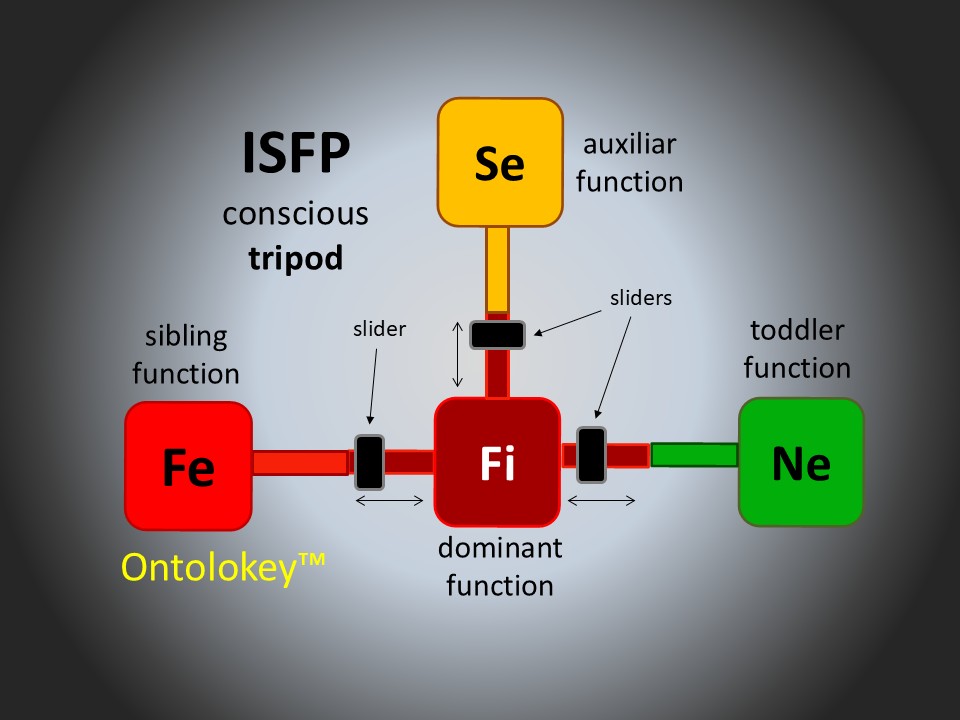
Susanna is an ISFP personality type, with Introverted Feeling (Fi) as her dominant function and Extraverted Sensing (Se) as her auxiliary function. Her Se allows her to express her deep emotions through movement, using her body as a visible form of emotional language. Since Extraverted Thinking (Te)—responsible, among other things, for rhetoric—is her inferior function within the subconscious “tripod,” she often struggles to find the right words to verbalize her feelings. As a result, she turns to nonverbal communication, using her dance as the primary outlet for her emotional world.
But Susanna is also a choreographer, and creating performances for her troupe requires a spark of creativity and innovation. This is where Extraverted Intuition (Ne) comes into play. In the conscious tripod model, she has a direct link to Ne—referred to in the Ontolokey framework as the “Toddler” function. The position of the “slider” indicates the degree to which each psychological function is being engaged.
When Susanna sits at her desk—or perhaps on her bed—planning a choreography, the slider moves closer to Extraverted Intuition (Ne), while the slider for Extraverted Sensing (Se) retreats toward her dominant Introverted Feeling (Fi). At these moments, she operates more like an INFP than her usual ISFP self, giving her creativity free rein. This shift allows her to design an innovative choreography that remains deeply faithful to her emotions. Her feelings, and her desire to express them through movement, remain at the heart of her creative process.
The third “foot” of the tripod is Extraverted Feeling (Fe), which enables Susanna to connect with society. After all, the dance performance will be presented to an audience sitting in a theater. The Fi–Fe slider shows how much she takes societal expectations into account when choreographing. She might ask herself: Will my choreography appeal to the audience? Is it morally acceptable? Can the costumes work for both Mexico and the USA, or are they too revealing? Do the movements appear too provocative?
As indicated in the Ontolokey cube, Susanna has a direct link to Fe, enabling her to adjust her choreography to meet the cultural expectations of both countries. This flexibility ensures her performances resonate with audiences and increases the likelihood of her show’s success.
The Ontolokey Tripod Model – Brief Overview
The Ontolokey model visualizes how a person’s cognitive functions work together like a tripod with three “legs” (primary areas of mental operation) and movable “sliders” that indicate moment-to-moment shifts in function use.
- Each “foot” represents a functional pathway.
- Sliders move depending on the task, mood, or environment.
- This helps explain why a person can temporarily resemble a different personality type when engaging certain skills.
Susanna and the Second Unconscious Tripod
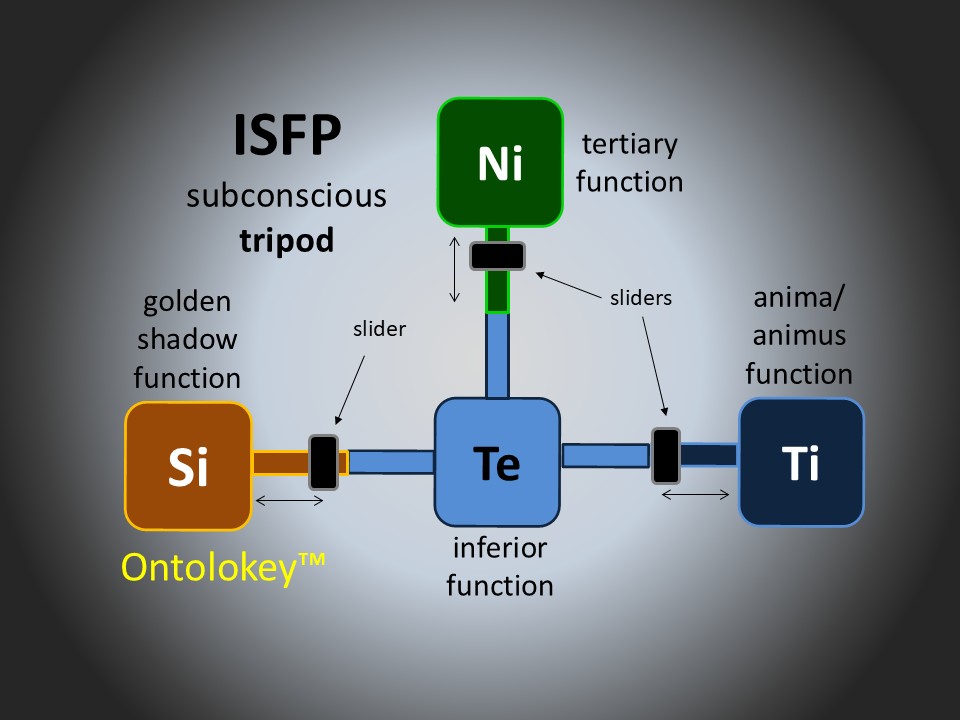
Susanna also possesses a second unconscious tripod. The “head” of this tripod is Extraverted Thinking (Te)—the inferior function of the ISFP personality type. Te is located diagonally opposite to her dominant Introverted Feeling (Fi), making it the most distant function in her cognitive landscape.
In the Ontolokey Cube model, you can imagine the dominant function as the positive pole of a magnet, and the inferior function as the negative pole. The twelve “sliders” located along the cube’s edges are naturally drawn toward the positive pole—that is, toward the dominant function. Moving these sliders away from the dominant pole toward another function requires deliberate effort. The more developed a person’s personality, the easier it becomes to move these sliders to activate and use different functions.
The Ontolokey Cube – Magnet Analogy
- Plus Pole = Dominant function (strongest, most natural mode of operation)
- Minus Pole = Inferior function (weakest, most unconscious)
- Sliders = Indicators of which functions are currently active
- Effort Required = The “distance” a slider must be moved from the dominant function
For Susanna, the Te–Ni slider sits closer to Introverted Intuition (Ni), because Ni lies nearer to her dominant Fi, and so the slider is naturally pulled in that direction. Ni gives Susanna a deep sense of faith and lived spirituality. She believes in God and prays for the success of her dance troupe. She dedicates hours to deep meditation, attending to her spiritual core. Through this practice, she gains visions and intuitive foresight regarding upcoming theater performances. She even dreams vividly about future events, unconsciously sensing potential dangers. If her intuitions are negative, she will not hesitate to cancel a show.
The Te–Ti slider lies closer to Introverted Thinking (Ti)—her Animus function. This thinking style is strategic and anticipatory. While Te often evaluates after an event has occurred, Ti operates beforehand. If Te is like Epimetheus—the one who thinks afterward—Ti is like his brother Prometheus, the one who thinks ahead. This helps Susanna pre-plan performances, considering in advance every factor that might need attention. She can map out each step of the choreography and the entire event strategically, long before it takes place.
The third “leg” of this tripod is Introverted Sensing (Si). Here too, the slider moves away from Te toward Si, because Si lies closer to her dominant Fi—a fact clearly visible in the Ontolokey Cube. Susanna uses Si to review past choreographies, sometimes borrowing elements from them. She trusts in past successes: what worked well before will likely work again. Successful performances by other artists inspire her, serving as valuable reference points. Si, is called the golden shadow of the ISFP personality, contains tremendous potential. Susanna especially treasures achievements from the distant past that triggered strong bodily sensations in her—goosebumps, a quickened heartbeat, and similar visceral reactions.
Through this example, we see how Susanna can effectively engage all eight of her psychological functions. Naturally, she will also use her inferior function (Te) after events, reflecting deeply on each performance and its outcomes.
 Ontolokey
Leave a comment