Is MBTI Obsolete – or Just in Need of an Upgrade?
You take the test. You answer the questions. And within minutes, your “type” appears neatly on the screen: INFJ. Or ESTP. Or something else.
It feels revealing… for about a day. Then you wonder: Now what?
1. The User Experience Gap
This is where many popular personality frameworks—MBTI and Socionics—fall short. They hand you a diagnosis without giving you much to do with it.
- MBTI offers a four-letter label and a short personality profile.
- Socionics adds depth by using all eight Jungian functions and describing intertype relations.
But from a user’s point of view, both are static.
They describe you, but they don’t accompany you. It’s like receiving a detailed medical report without a treatment plan, exercises, or follow-up.
2. What Users Actually Need
From conversations in typology communities, here’s what people wish for after getting their results:
- A Map, Not Just a Label
- Something visual, tangible, and interactive, rather than a static PDF.
- A Development Plan
- Clear steps for strengthening weaker functions without neglecting strengths.
- Integration of Depth Psychology
- Guidance that connects type theory to Jung’s deeper work: individuation, shadow integration, and the Anima/Animus dynamic.
- Framework Compatibility
- A way to bring together results from MBTI, Socionics, Enneagram, and other systems into one coherent structure.
3. MBTI and Socionics: Strengths and Limits
Both systems are built on Jung’s Psychological Types (1921), but:
- MBTI focuses on four preference pairs and stops at four functions.
- Socionics maps all eight, but mainly for relational analysis, not personal growth.
Neither offers:
- Ongoing tracking of functional development.
- Interactive visualisation tools.
- Built-in guidance for integrating unconscious functions.
4. Enter Ontolokey – An Upgrade, Not a Replacement
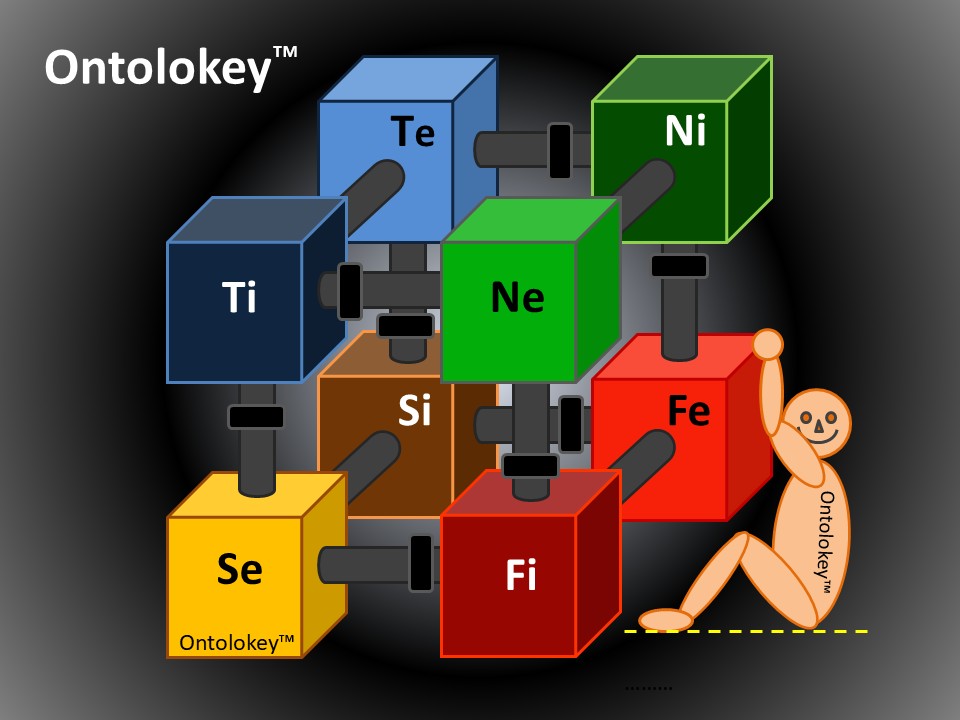
Ontolokey doesn’t try to replace MBTI or Socionics—it extends them. Think of it as a visual operating system for your psyche.
Key strengths:
- Full Function Map – All eight Jungian functions placed at the cube’s corners, showing the entire psyche at once.
- Dynamic Relationships – How each function interacts with its opposite, shadow, and Anima/Animus.
- Data Transfer – MBTI or Socionics results can be mapped directly onto the cube.
- Development Roadmap – The cube suggests practical steps for balancing your psyche.
5. User Story: From Static Report to Living Map
Meet Anna.
She’s a 34-year-old project manager. She takes an MBTI test and gets INFJ.
The PDF tells her she’s “empathetic, visionary, and introspective.” She feels seen—but also stuck.
She wonders:
- Which part of myself needs work right now?
- Why do I shut down in high-pressure debates?
- How do I develop the Thinking side I supposedly lack?
Step 1: Mapping INFJ onto Ontolokey
A friend shows her the Ontolokey Cube.
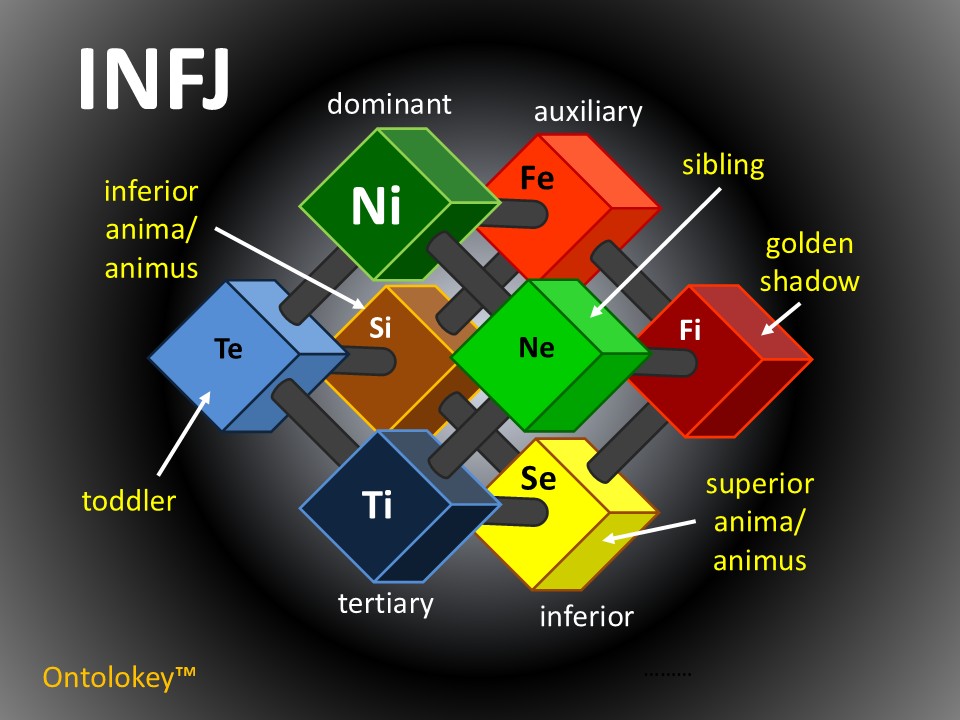
Her cognitive stack appears as:
- Conscious tripod: Ni – Fe – Te – Ne
- Unconscious tripod: Se – Fi – Ti – Si
- Her Persona: the EFSJ sub-personality type, to highly perform in society
- Her Sibling: forming the inner ENFP sub-personality type, her creativity in bright colours
- Her inferior anima/animus sub-personality type: an ISTJ
- Her superior anima/animus sub-personality type: an ESTP
- And some other internal sub-personality types within the INFJ personality
Here’s what this means:
- Dominant (Ni) – Pattern recognition and future vision.
- Auxiliary (Fe) – Harmonizing relationships.
- Toddler (Te) – External logic and structure; clumsy but trainable.
- Sibling (Ne) – Idea generation and possibility-seeing; supportive but underused.
- Inferior (Se) – Present-moment awareness; weakest conscious point.
- Inferior anima/animus (Si) – Traditions, memories and stability, emerging under stress.
- Golden Shadow (Fi) – Deep personal values and inner moral compass, often unconscious.
Step 2: Seeing the Gaps
For the first time, Anna sees her personality’s architecture:
- Her Se is directly opposite her Ni, explaining her difficulty staying present. Her superior anima/animus personality type: an ESTP
- Her inferior Anima (Si) is almost invisible in daily life—no wonder memory-based decisions feel fuzzy. Her inferior anima/animus personality type: an ISTJ
- Her Toddler (Te) stumbles when she needs structured planning under time pressure.
Step 3: Development Plan in 3 Dimensions
Ontolokey gives her an actionable path:
- Strengthen Se: Practice photography walks, mindful cooking, or sports that demand real-time response.
- Integrate Fi: Keep a weekly values journal; reflect on decisions through a personal ethics lens.
- Train Te: Use small project-planning exercises with measurable outcomes.

Step 4: Long-Term Interaction
Her cube isn’t just a diagram—it’s a living map she revisits monthly:
- She tracks which functions she’s exercised.
- Notes patterns when shadow functions take over.
- Even compares cubes with teammates for better collaboration.
Step 5: Socionics Integration
Curious, Anna later tries a Socionics test—her result: IEI (INFp).
The mapping still works perfectly. Ontolokey becomes her central hub, integrating both systems.
6. Why MBTI and Socionics Should Partner with Ontolokey
Imagine if:
- After your MBTI or Socionics test, your type instantly appears in a 3D cube on your phone.
- The app suggests tailored exercises for each function.
- You can simulate “what-if” scenarios for teamwork or relationship dynamics.
That’s not replacing MBTI or Socionics—it’s upgrading them into interactive, evolving frameworks.
Final Thought
MBTI and Socionics aren’t obsolete—they’re incomplete.
For users, the missing piece is a bridge between description and development. Ontolokey provides that bridge: a way to not just know your type, but grow with it—visually, dynamically, and over time.
Because personality isn’t a label. It’s a landscape. And landscapes are meant to be explored.
 Ontolokey
Leave a comment