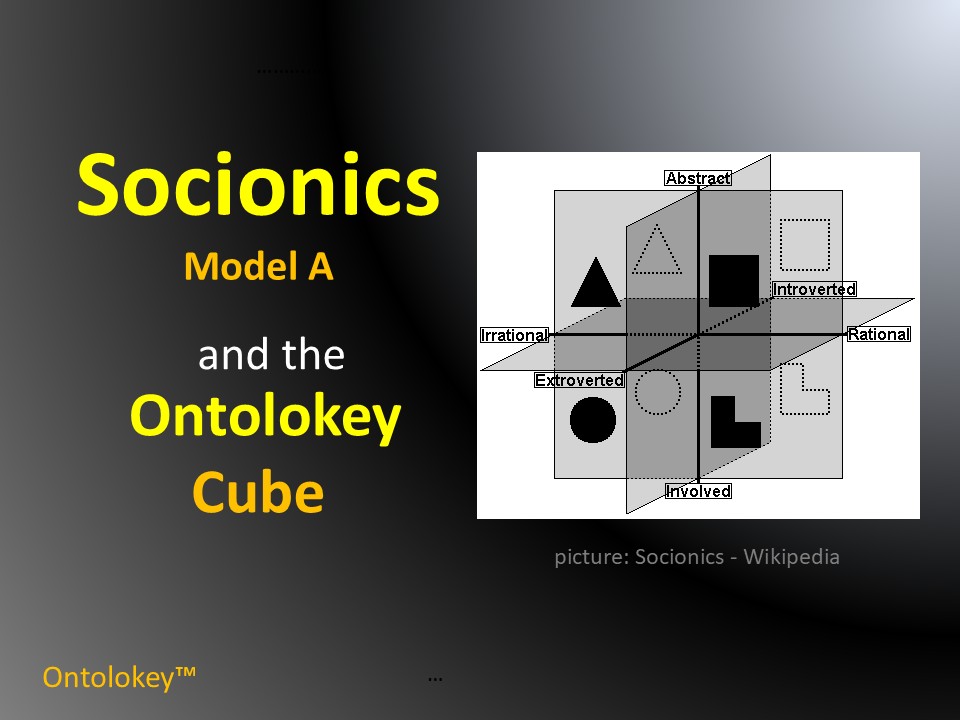
How Jung, Socionics, and one lucid dream revealed the structure of the inner world
When Carl Gustav Jung introduced his theory of psychological types, he came incredibly close to articulating a foundational truth about the human mind. Aušra Augustinavičiūtė (whom I’ll refer to as Augusta) recognized this — and took it a step further.
As the founder of Socionics, Augusta expanded Jung’s work with exceptional depth and clarity. Her logical refinement of the eight psychological functions reflects the signature style of introverted thinking (Ti): precise, analytical, and elegantly ordered.
And yet, both Jung and Augusta fell short of something crucial.
They couldn’t see their systems.
Not metaphorically — literally. They lacked the cognitive function of visual intuition: the ability to perceive abstract structures as visual-spatial images. This ability is common among intuitive types, especially those with introverted or extraverted intuition (Ni or Ne) in their ego structure. These types often “see” their ideas as patterns, blueprints, or symbolic structures long before they can fully articulate them.
That’s how the Ontolokey Cube came to me.
🌀 A Lucid Dream and a Cube
In 2015, during a lucid dream — years before I had even heard of Socionics — I visualized a structure: a cube composed of interrelated psychological functions. At that time, I had only studied MBTI and Jungian typology. I was certified as an MBTI practitioner in Florida (2012), and Socionics was completely unknown to me.
But the cube appeared with clarity. It wasn’t just a symbolic image — it was a working system. Over time, I realized it was a spatial model for understanding the entire human psyche, including both conscious and unconscious functions, in a way that neither MBTI nor Socionics had yet expressed.
In 2025, I finally encountered Socionics and Augusta’s Model A. To my astonishment, her theory aligned nearly perfectly with the cube I had already visualized. But there was one key difference: she had described the logic of the cube without ever seeing it.
🔁 The Ontolokey Cube: Two Tripods, Eight Corners
The Ontolokey Cube is more than a metaphor — it’s a visual architecture of the psyche.
Imagine a cube where each of the eight corners represents one of Jung’s psychological functions: Thinking, Feeling, Sensing, and Intuition, each in introverted or extraverted form.
Inside the cube are two opposing tripods:
- The Conscious Tripod is anchored by the dominant function, supported by the auxiliary function, the Sibling, and the Toddler. These four form the conscious orientation of the psyche — like a tripod-mounted camera pointing outward.
- The Unconscious Tripod mirrors this structure on the opposite corner, built around the inferior function, with support from the tertiary, the Anima/Animus, and what I call the Golden Shadow.
Each tripod consists of four psychological functions. Together, these eight form the full 3D cognitive framework.
🎭 The Persona: The Mask Between Psyche and Society
Jung’s concept of the Persona — the social mask we wear — plays a key role in the cube. It isn’t merely a metaphor for social behavior; it is a structured psychological personality subtype.
In the Ontolokey model:
- The Persona is composed of the auxiliary function (as dominant) and the Anima/Animus function (as supportive). It is the part of us that adapts to society while protecting the core self.
- The Anima/Animus, in turn, forms its own personality structure, composed of the Anima/Animus function (dominant) and the Toddler function (auxiliary). Its integration allows the Toddler function to be “born” into consciousness.
- Opposite the Persona stands the Golden Shadow, located deep in the unconscious. It too forms a personality subtype — built from the Golden Shadow function (dominant) and the inferior function (auxiliary).
Unlike Socionics, which treats these as abstract functions or blocks, Ontolokey personifies them — turning them into internal character roles that evolve, interact, and integrate.
🧬 Individuation: Why Socionics Couldn’t Explain It
Here lies the fundamental difference between Socionics and Ontolokey:
- Socionics excels at explaining interpersonal information exchange — how types interact, what kind of information they value, and how compatibility works. It’s brilliant for mapping relationships and communication.
- Ontolokey, however, is designed to map the individuation process — the inner journey Jung described, in which the unconscious is made conscious and the psyche becomes whole.
Augusta did not include the Persona, Anima/Animus, Shadow, or Golden Shadow as personality subtypes. Nor could she, without a visualized model of the cube. As a result, Socionics offers no structural roadmap for the integration of the unconscious — a process central to Jungian psychology.
In contrast, Ontolokey locates these archetypal roles within the cube — with precise function pairings, directional relationships, and symbolic oppositions. It allows us to track which functions form our masks, our shadows, our internal opposites — and how they evolve over time.
🐘 Beyond Humans: Do Animals Have Cognitive Cubes?
This structure may not be unique to humans.
Elephants, dolphins, octopuses — all show signs of cognition, emotion, memory, and empathy. It’s possible they too possess a full set of psychological functions. The difference may lie in differentiation: humans tend to specialize in one or two dominant functions, while animals might operate all eight in a more undifferentiated, balanced form.
This opens up intriguing questions about universal consciousness structures — and the role of type specialization in human identity and culture.
📊 From Symbol to Tool: Team Design and Personal Growth
Because Ontolokey provides a visual framework of the psyche, it has practical applications beyond theory:
- In personal development, it helps individuals locate and integrate suppressed or unconscious aspects of their psyche.
- In team dynamics, it helps identify how internal archetypes influence group roles, leadership styles, and interpersonal friction.
Just as the Persona mediates between the individual and society, the Ontolokey Cube bridges the gap between inner psychology and outer function — in individuals, teams, and whole systems.
🧱 Building the Psyche from the Inside Out
Carl Jung laid the foundation. Augusta turned it into a typological system. The Ontolokey Cube adds one more dimension: visual space.
By seeing the psyche not as a list of traits, but as a dynamic structure of interdependent personalities and functions, we gain a deeper understanding of what it means to grow, to integrate, and to become whole.
Not just as thinkers.
But as builders of the invisible.
💬 About the Author
Eduardo Seufferheld is the founder of Ontolokey, a visual personality model based on Carl Jung’s eight cognitive functions. Certified as an MBTI practitioner since 2012, he later expanded his work by integrating dream-derived symbolic visualization.
Ontolokey maps not just types — but the inner structure of the psyche, offering new tools for self-awareness, individuation, and group development. You can read more at ontolokey.com or follow their essays on Medium.
📣 If this sparked something in you…
…a question, a challenge, or your own vision of the inner world — let’s connect. Leave a comment, share your model, or explore how Ontolokey might help you unfold your own cube.
 Ontolokey
Leave a comment