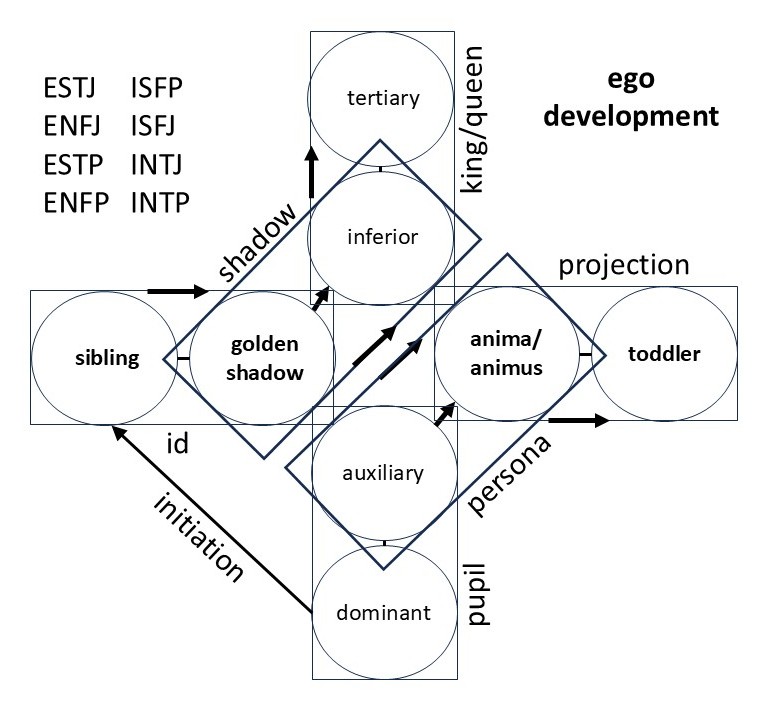
1. Dominant Function: Extraverted Intuition (Ne)
“The Trailblazer of Possibility”
ENFPs lead with Extraverted Intuition (Ne), a mental radar that constantly scans the world for ideas, connections, and untapped potential. They’re driven by a need to explore the “what ifs” in life – not necessarily to finish what they start, but to discover what could be. This makes them natural trendspotters, innovators, and creative provocateurs.
They have a remarkable instinct for reading situations and people quickly – often picking up on underlying intentions, subtle cues, or hidden opportunities before anyone else notices. It’s not uncommon for ENFPs to accurately predict how social or emotional dynamics will unfold, sometimes seeming almost psychic in their insight.
This visionary orientation gives them a unique ability to spot possibilities others overlook. Whether they’re in medicine, performance, or entrepreneurship, ENFPs excel at finding unorthodox paths forward. In fact, they’re rarely interested in the well-trodden road – unless it’s to leap ahead of everyone else and claim the win at the last minute.
They’re not just idea generators; they’re also idea testers. ENFPs treat the people around them like a kind of live feedback loop – tossing out concepts, watching reactions, and adjusting on the fly. They’re often several steps ahead in the conversation, mentally jumping between future possibilities, always looking for the next exciting breakthrough.
However, this hunger for novelty can make them restless. ENFPs are easily distracted, often abandoning projects or relationships once their curiosity is satisfied. Like a child who disassembles a toy to see how it works, they dive deep into something (or someone) and then lose interest once the mystery fades. Depth isn’t their enemy, but repetition and stagnation certainly are.
They thrive in environments where attention is a currency – where they can win people over with charm, enthusiasm, and raw originality. If others aren’t noticing them, ENFPs may grow anxious, resorting to provocations or dramatic gestures just to get back on the radar. Attention isn’t just an ego trip for them – it’s how they test their intuition of success in real time.
Their confidence in following gut instincts allows them to leap before looking. They know how to “ride the winds of opportunity” and often trust that things will work out somehow – or that they’ll land on their feet even if they don’t. Risk, to them, is often just another kind of exploration.
2. Auxiliary Function: Introverted Feeling (Fi)
“The Quiet Compass of Inner Truth”
Beneath the ENFP’s bold exterior lies a deep and private emotional world guided by Introverted Feeling (Fi). While their outer persona may be vibrant, expressive, and even provocative, their inner emotional life is subtle, complex, and deeply personal. ENFPs don’t broadcast their values – they live by them, often without explaining why.
Fi gives ENFPs a strong sense of individual ethics. They instinctively know what feels right or wrong for them – not based on external rules, but on an internal barometer of authenticity. This can make them fiercely independent in matters of morality, loyalty, or identity. If something violates their sense of personal integrity, they simply won’t go along with it, no matter how much social pressure there is.
Despite their extroverted flair, ENFPs are highly sensitive to emotional dissonance. They pick up on subtle shifts in relationships, can feel when someone’s holding back, and often mirror the mood of others. But they rarely show their full emotional range. Vulnerability, for them, is sacred – something offered carefully and only to those who’ve earned their trust.
ENFPs also struggle with being misunderstood. Because they can appear so easygoing and lighthearted on the surface, others may overlook the emotional intensity underneath. When they do open up, it’s often in indirect or artistic ways – through stories, metaphors, jokes, or ethical experiments disguised as fun. What seems like play may actually be their way of testing boundaries, loyalty, or character.
They crave emotional depth in relationships, but paradoxically, they may resist closeness if they fear being consumed or confined. Their Fi creates a strong need for autonomy. They want to be known, but not controlled; connected, but still free.
Helping others – emotionally or practically – comes naturally to ENFPs, but it can also create inner tension. They offer assistance out of genuine care, but once the responsibility becomes real, their freedom feels threatened. This can lead them to backpedal or create emotional distance after initiating connection.
When they pull away or go silent, it’s often not rejection but a quiet recalibration. Fi is slow-moving and selective. ENFPs are constantly re-evaluating: “Does this still align with who I am?” If not, they drift. Not out of cruelty, but because staying would feel like a betrayal of self.
At their best, ENFPs use Fi to champion individuality – not just their own, but everyone’s. They instinctively protect the outsider, the misunderstood, and the misjudged. Their empathy may not always come in the form of overt comfort, but rather in the space they give others to be fully themselves.
3. Anima/Animus Function: Extraverted Sensing (Se)
“The Temptation of the Moment”
For the ENFP, Extraverted Sensing (Se) lives in the shadow – seductive, risky, and often misunderstood. It represents their Anima or Animus: an alluring, mysterious force that calls them to experience life more vividly, physically, and immediately – but one that can also destabilize their intuitive nature.
Unlike their dominant Ne, which dances in the realm of ideas and possibilities, Se is about the now – direct contact with the physical world, sensory pleasure, power dynamics, and bold action. ENFPs are simultaneously drawn to and unsettled by this energy. It fascinates them, like a dangerous game they’re not sure they want to play – but can’t look away from.
This is where their flirtation with thrill, risk, and chaos often surfaces. ENFPs love to “test” ethical or social boundaries. They may create provocative situations, play tricks, or stage spontaneous experiments just to see what happens – and then feign innocence when others are shocked. It’s not always malicious; it’s curiosity, drama, and entertainment all at once. But it is their Se peeking out.
They often admire people who embody raw presence, charisma, and physical strength – people who can take decisive action without second-guessing. ENFPs may even try on this persona from time to time: the bold leader, the seductive risk-taker, the one who storms into the room and owns it. But sustaining it usually drains them. It’s play, not identity.
In relationships, this function can lead ENFPs into intense attraction toward grounded, sensory-aware individuals – especially those who seem cool, composed, or slightly dangerous. But it also makes them wary of becoming “too much” or “too impulsive.” So they dance on the edge – approaching sensual closeness, then retreating, especially when emotional stakes rise.
This dynamic gives their romantic behavior a signature ENFP flavor: playful, unpredictable, and emotionally charged, but rarely straightforward. They may talk about “just being friends,” while simultaneously crafting an atmosphere of intimacy and possibility. Their Se-shadow doesn’t want to commit to the moment – it wants to tension it, play with it, explore it without losing freedom.
This shadow function also drives their love of dramatic flair. ENFPs can slip into “performer mode,” commanding attention through voice, fashion, storytelling, or spontaneous acts. Even if their sense of aesthetic isn’t always refined, they’re often bold and expressive – a statement haircut, an eccentric outfit, a vibrant energy that leaves an impression.
Still, their Se rarely operates with discipline. It can lead to sensory overindulgence, reckless spontaneity, or a tendency to start things without thinking through consequences. While ENFPs often seem like wild free spirits, they actually don’t like losing control – they just like dancing with it.
When balanced, this function gives ENFPs confidence in the moment. It allows them to act decisively, enjoy beauty, take creative risks, and engage life with all five senses. When unbalanced, it can leave them overextended, overstimulated, or entangled in situations they didn’t quite mean to create.
In the mythic landscape of their psyche, Extraverted Sensing is the unpredictable lover, the wild fire, the impulse to leap into the experience rather than just imagine it. It’s not their home – but it’s a powerful place to visit.
4. Toddler Function: Introverted Thinking (Ti)
“The Curious Tinkerer”
Introverted Thinking (Ti) is the ENFP’s playful, sometimes clumsy child function – curious, exploratory, and often delightfully messy. It’s not how they naturally navigate the world, but it is how they try to make sense of it when intuition and emotion aren’t quite enough.
ENFPs aren’t known for clean, structured logic – but they are fascinated by ideas. Their Ti doesn’t build tidy, step-by-step systems; it pokes at concepts, breaks things apart, and asks “But what if…?” It’s less about precision and more about exploration. ENFPs often chase tangents, connect random dots, and ask seemingly off-the-wall questions – not to derail the conversation, but to expand it.
Their way of thinking can be nonlinear, intuitive, and often a bit chaotic. They may begin a sentence in one place, go on a metaphorical journey through five topics, and land somewhere entirely unexpected – and insightful. Trying to interrupt or redirect them usually only makes things worse. “Let me explain!” they insist, and suddenly we’re hearing about their cousin’s coworker’s cat to make a point about human psychology.
Because Ti is underdeveloped in ENFPs, it can lead to confusion and contradiction. They may hold multiple opposing beliefs at once, passionately defending both, depending on the context. Their arguments might seem illogical or incomplete, but they often feel true – and that’s usually good enough for them. If someone challenges their reasoning, they may get flustered, defensive, or brush it off with humor.
At the same time, ENFPs love to sound wise. They may quote their own sayings like life mottos, drop aphorisms with theatrical flair, or deliver ambiguous “deep thoughts” that seem profound even when they’re more poetic than practical. Their speech often carries the tone of logic without always delivering the structure.
Still, they can be unexpectedly sharp when it comes to analyzing people or systems they’re emotionally invested in. Their Ti might be inconsistent, but it’s not unintelligent. When they slow down and focus, they can spot inconsistencies, question assumptions, and offer insights others miss – especially when paired with their Ne’s ability to reframe ideas from unusual angles.
Where Ti really shines for ENFPs is in mental play. They love thought experiments, philosophical debates, weird hypotheticals, and mind games. Not necessarily to win the argument, but to stretch their brains and see how reality bends. Logic, to them, is a playground – not a rulebook.
That said, they often struggle to explain things simply. Asked to clarify a concept, they may either start with too much detail or get stuck on irrelevant side notes. This can frustrate both them and their audience. When ENFPs feel misunderstood, they may retreat into vagueness or give up entirely: “Never mind, you wouldn’t get it.”
Still, Ti adds a quirky, endearing edge to their personality. It gives them the confidence to “figure it out as they go,” to improvise when things don’t make sense, and to trust that they’ll land on their feet – even if their explanations are a little scrambled. At its best, ENFP-Ti is creative logic: messy, playful, and full of surprising brilliance.
5. Inferior Function: Introverted Sensing (Si)
“The Forgotten Mirror”
Introverted Sensing (Si) is the ENFP’s inferior function – the quiet, uncomfortable opposite of their adventurous spirit. Where their dominant Ne thrives on change, possibilities, and novelty, Si asks for consistency, routine, and internal reference points. To the ENFP, this often feels like a foreign language.
Si is responsible for maintaining personal stability: remembering what worked before, honoring physical limits, recognizing patterns over time, and valuing sensory continuity. But for ENFPs, this function tends to operate in extremes – either ignored completely or obsessively overcompensated. There’s rarely a healthy middle ground early in life.
For example, ENFPs might neglect structure and routine for weeks – until suddenly they plunge into an overcorrection, obsessively reorganizing their diet, exercise, or schedule with almost fanatical intensity… only to burn out quickly. Si doesn’t operate smoothly for them; it surfaces in anxious bursts, like a suppressed alarm going off too late.
They also have a complicated relationship with the past. ENFPs prefer to move forward, chasing the next experience rather than reflecting on what has already happened. But when Si does activate, it can trap them in loops of nostalgia, regret, or “what might have been.” They may replay past emotional moments obsessively – especially those tied to failure, loss of reputation, or unmet expectations.
Their physical awareness can also be off-kilter. ENFPs often ignore bodily discomfort, forget to eat, or work until they crash – not out of resilience, but because their attention simply isn’t wired to track these cues. Ironically, some ENFPs become hyper-focused on health trends, fitness regimens, or body “hacks” as a way to tame this internal blind spot. But even then, their interest tends to fade as quickly as it arose.
Aesthetically, ENFPs can have strong opinions – but they’re often quirky or inconsistent. Fashion choices may reflect mood more than logic, and interior design might feel like a chaotic mix of trends, memories, and emotional associations. When it comes to taste and physical order, they tend to follow vibes more than rules.
Si also governs memory, and for ENFPs, it often shows up as selective recall. They might remember oddly specific moments or impressions, but forget practical details. Paperwork deadlines, object placement, and procedural steps can easily slip through the cracks. Their minds are tuned to possibility, not repetition.
Because of this, ENFPs often seek out people who are strong in Si – calm, grounded, routine-oriented types who can offer structure and reliability. Deep down, they long for that kind of internal stillness, even as they run from it. Their ideal partner is someone who won’t get pulled into their whirlwind, but will instead offer an anchor when things get overwhelming.
When Si is underdeveloped, ENFPs may struggle with follow-through, consistency, and long-term self-care. But when gently supported, it becomes a quiet ally – helping them remember what matters, build sustainable habits, and bring their visionary ideas into lasting form.
In the ENFP’s psyche, Introverted Sensing is like a forgotten mirror tucked away in the attic – dusty and neglected, but still reflecting a truth they secretly need: not everything has to change to be meaningful.
6. Tertiary Function: Extraverted Thinking (Te)
“The Efficient Mask”
Extraverted Thinking (Te) is the ENFP’s tertiary function – a tool they admire, play with, and sometimes exaggerate to prove they’ve got it together. While not their natural strength, Te gives ENFPs a practical edge: the drive to get results, organize their world, and make their ideas do something.
When healthy, ENFPs use Te to bring structure to their whirlwind of ideas. It helps them set goals, hit deadlines (sometimes), and project confidence even when they’re improvising. Te is what lets them write that book, launch that project, or suddenly shift from dreamy visionary to effective doer – especially when the stakes are high and the energy is right.
But here’s the twist: ENFPs often over-identify with Te to prove competence. Deep down, they may fear being seen as unserious or flaky. So they create an image of being “on top of things” – citing certificates, quoting studies, planning big projects, or flexing about productivity techniques. They might come across as impressively organized… until the curtain lifts and you see the beautiful mess behind it.
ENFPs can be obsessed with success – not necessarily as an end goal, but as proof that their ideas have value. Te offers tangible outcomes, and outcomes validate their internal world. That’s why failure hits so hard: it doesn’t just threaten their ego, it threatens their identity. Many ENFPs are quietly terrified of being exposed as “all talk, no delivery.”
Still, they often resist traditional methods of working. Long-term planning? Tedious. Bureaucracy? Soul-crushing. Doing the same thing every day? A creative death sentence. So they find shortcuts. They’re masters of getting just enough done, just in time, to keep up appearances – and somehow, it often works.
When inspired, ENFPs can outwork almost anyone. But motivation is key. If they don’t feel it, the whole machine shuts down. That’s when procrastination, excuses, or sudden detours emerge. They may even sabotage their own momentum just to avoid the pressure of expectation.
Their relationship with authority is equally complicated. ENFPs respect competence but dislike being told what to do. If someone tries to micromanage or enforce rules without explanation, the ENFP will rebel – either outwardly or with passive resistance. On the flip side, when they are in charge, they may overcompensate, acting more commanding or rigid than they really are just to be taken seriously.
Te also gives ENFPs their occasional “tough love” mode. They enjoy motivating others, offering advice, or stepping into leadership roles – especially if it lets them champion underdogs or launch exciting initiatives. But if others don’t respond to their “wisdom” or resist their solutions, ENFPs may get frustrated: “I’m trying to help you – why won’t you let me?”
At their best, ENFPs use Te to turn inspiration into execution. They become powerful communicators, charismatic leaders, and dynamic problem-solvers. But it requires balance. When Te becomes a mask rather than a tool – a way to perform competence instead of cultivating it – burnout, self-doubt, and emotional disconnection aren’t far behind.
Te is the ENFP’s effort to ground their lightning – to bring their brilliant, spontaneous ideas into the real world. It’s not their home turf, but when used with heart, it becomes a bridge between passion and impact.
7. Sibling Function: Introverted Intuition (Ni)
“The Silent Observer”
Introverted Intuition (Ni) is the ENFP’s seventh function – distant, quiet, and often working in the background like a ghost signal. It’s not a voice they trust instinctively, but it still whispers: “Pay attention to the patterns. Something deeper is unfolding.”
Unlike their dominant Ne, which bursts with a thousand possibilities at once, Ni focuses narrowly – it filters, distills, and foresees. For the ENFP, this kind of focused foresight feels unnatural, even confining. They prefer to leave doors open rather than close them in favor of one “destined” path.
Yet, ENFPs are not blind to time or long-term consequence. In fact, Ni often shows up as low-level anxiety about missed opportunities or slow progress: “Why hasn’t this happened yet? Shouldn’t things be moving faster?” This restless tracking of time creates internal tension. Their energy says “leap!” – but Ni lingers with quiet questions like: “What if you’re chasing the wrong thing?”
This function also informs their sensitivity to pacing in relationships. ENFPs might push for closeness quickly, then back off if the tempo feels wrong – not always knowing why. It’s Ni trying to regulate connection over time, to preserve emotional mystery, and to keep partners intrigued. Too fast, and the story ends. Too slow, and interest fades. It’s a delicate dance.
Ni gives ENFPs a strange relationship with consistency. They often track the “vibe” or trajectory of things, even if they can’t explain how. For example, they might suddenly ghost a situation or person because something feels off, even if everything looks fine on the surface. This isn’t logic or ethics talking – it’s that quiet Ni warning: “This won’t end well.”
But because this function is weak and unconscious, it can also misfire. ENFPs might read too much into ambiguous signals, overthink delays, or sabotage a good thing because they misinterpret the emotional “timeline.” It’s easy for them to confuse a passing intuition with a deep insight – and once they believe they’ve seen the “truth,” it can be hard to let go of that story.
At the same time, Ni gives ENFPs occasional moments of eerie clarity. In the right mindset, they suddenly know something – a realization that’s less about logic or sensation, and more about alignment. When this happens, it feels almost sacred: like a future thread has clicked into place.
Unfortunately, these flashes are hard to summon and even harder to explain. The ENFP may try to express them through art, metaphor, or storytelling, but often feels that language is too limited for what they “just know.”
In their healthiest state, ENFPs don’t suppress Ni – they respect its quiet guidance. They learn to pause, reflect, and ask: “Is this path aligned not just with excitement, but with purpose?” It’s not about replacing their intuition of possibility – it’s about balancing it with an intuition of meaning.
Ni is the ENFP’s inner timekeeper – the sibling in the psyche who doesn’t need to speak often, but who sees through the noise. When heard and honored, it helps them stop chasing everything, and start choosing what matters most.
8. Golden Shadow: Extraverted Feeling (Fe)
“The Hidden Charisma”
Extraverted Feeling (Fe) is the ENFP’s golden shadow – a radiant potential that feels just out of reach, yet profoundly magnetic. While ENFPs lead with internal values (Fi), they often admire – and occasionally envy – the Fe ability to move fluidly within social dynamics, to read the emotional room effortlessly, and to inspire collective harmony.
Fe isn’t how ENFPs normally engage emotions. Their own feelings are deeply personal, private, and nuanced – not shaped by the group, but by authenticity. Yet, many ENFPs secretly dream of expressing emotion with the same ease and fluency that Fe-dominant types seem to embody: warm, inclusive, gracious, and emotionally in sync with everyone around them.
This desire surfaces most clearly in performance, public speaking, or social leadership. ENFPs love to charm, to uplift, to move people – and in doing so, they touch that Fe magic. They might light up a room with storytelling, mirror someone’s energy with uncanny precision, or use humor and expressiveness to draw others in. But beneath it all is often a sense of acting, not being – like they’re wearing charisma as a costume rather than channeling it from within.
Still, they’re remarkably good at it. ENFPs have a natural ability to “play to the crowd,” even if they claim not to care what people think. They watch reactions closely, adjusting tone and body language on the fly. Their emotional intelligence is real – but it’s usually used to connect one-on-one, rather than orchestrate group feelings.
When Fe emerges in the golden shadow, it may come through exaggerated enthusiasm, emotional dramatization, or theatrical warmth. ENFPs might lean into Fe when they want to influence others or protect their social image – especially in high-stakes situations where harmony matters. At these times, they seem magnetic, even radiant… but also slightly disconnected from themselves.
This disconnection can become a trap. ENFPs may start performing emotion to meet social expectations, trying to be “likable,” “charming,” or “inspiring” even when it doesn’t align with how they truly feel. Over time, this can lead to emotional burnout or confusion: “Am I being genuine, or am I just trying to be who they want me to be?”
Yet, the golden shadow is not a weakness – it’s a promise. When ENFPs integrate Fe, they don’t have to choose between authenticity and expression. They learn to lead with heart and presence, to inspire others not through performance, but through genuine alignment. Their charm becomes real, their warmth effortless, their emotional presence trustworthy.
In its highest form, Fe lets the ENFP channel their deep personal values into shared human experience. It allows them to go beyond self-expression and step into emotional leadership – guiding others through story, humor, passion, and presence.
This is the ENFP’s final frontier: to take the stage, not just as a performer, but as a beacon – someone who doesn’t just explore possibilities, but gathers people around them to bring those possibilities to life.
 Ontolokey
Leave a comment