Introduction
In the evolving field of psychological typology, two paradigms have emerged as deeply insightful yet often misunderstood systems: Socionics and Ontolokey. While Socionics offers a structural and interrelational model grounded in information metabolism, Ontolokey provides a symbolic, embodied, and interactive map of the psyche in the form of a cube. This essay argues that the Ontolokey Cube is not merely compatible with Socionics Model A, but that it represents a three-dimensional key to unlocking the model’s full experiential potential. By superimposing Socionics’ functional logic onto Ontolokey’s dynamic, archetypal form, users gain an unprecedented way to visualize and internalize the interrelationships within the psyche.
1. Mapping the Types: Ontolokey and Socionics Alignment
The first point of convergence lies in the typology itself. Ontolokey utilizes a typological system that mirrors MBTI structure, while Socionics expands this by distinguishing between the conscious and unconscious operations of each function. The following cross-reference table translates the 16 Ontolokey types into their Socionics counterparts:
| Ontolokey | Socionics TIM |
| ISTJ | SLI (ISTp) |
| ISFJ | SEI (ISFp) |
| INFJ | IEI (INFp) |
| INTJ | ILI (INTp) |
| ISTP | LSI (ISTj) |
| ISFP | ESI (ISFj) |
| INFP | EII (INFj) |
| INTP | LII (INTj) |
| ESTP | SLE (ESTp) |
| ESFP | SEE (ESFp) |
| ENFP | IEE (ENFp) |
| ENTP | ILE (ENTp) |
| ESTJ | LSE (ESTj) |
| ESFJ | ESE (ESFj) |
| ENFJ | EIE (ENFj) |
| ENTJ | LIE (ENTj) |
Understanding these correlations lays the groundwork for deeper integration. While MBTI and Socionics often use similar terminology, their cognitive models differ; hence, the Ontolokey Cube becomes an ideal translator between the two.
2. Socionics Model A: Structure and Depth
Socionics Model A is an elegant but complex system consisting of eight function slots, divided into four blocks:
- Ego Block (1 & 2): Dominant (Leading) and Auxiliary (Creative)
- Super-Ego Block (3 & 4): Vulnerable and Role (PoLR)
- Id Block (5 & 6): Suggestive (Inferior) and Mobilizing
- Super- Id Block (7 & 8): Ignoring and Demonstrative
Each function varies by conscious accessibility, strength, and personal relevance. The Ego block represents strengths that are consciously used and socially expressed. Super-Ego houses obligatory but weak functions, while Super-Id represents deeply desired yet unconscious functions. The Id block is strong but unconscious, supporting the ego behind the scenes.
3. The Ontolokey Cube: Symbolic Geometry of the Psyche
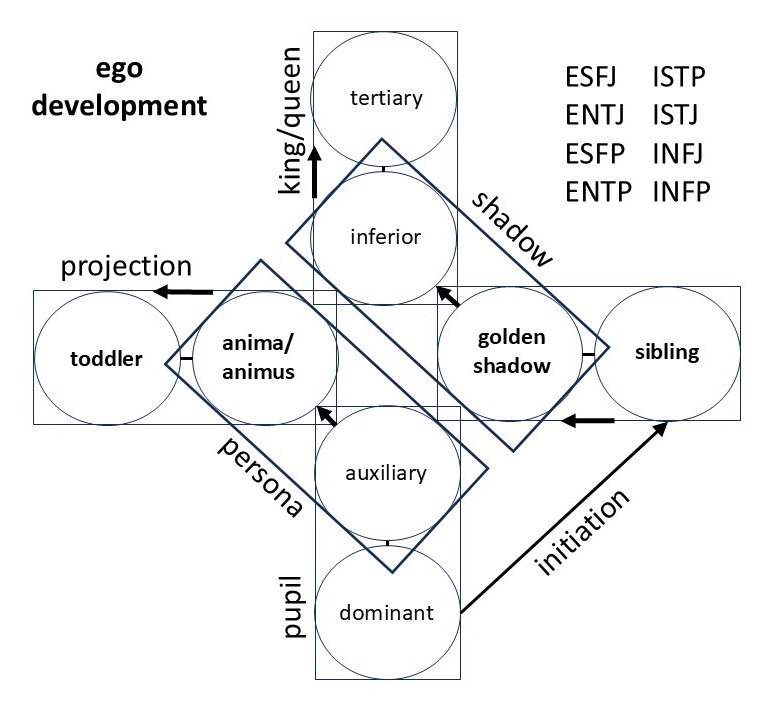
Ontolokey introduces a unique spatial metaphor for personality: the Cube. Each of its eight vertices represents a psychological function arranged into two interlocked tripods: the primary tripod (Dominant, Auxiliary, Sibling) and the shadow tripod (Anima, Toddler, Inferior). These are further enriched by archetypal roles:
- Dominant = Socionics Leading (Slot 1)
- Auxiliary = Socionics Creative (Slot 2)
- Anima = Socionics (vulnerable) Role (Slot 3)
- Toddler = Socionics PoLR (Slot 4)
- Sibling = Socionics Mobilizing (Slot 5)
- Golden Shadow = Socionics Suggestive (Slot 6)
- Inferior = Socionics Observing (Slot 7)
- Tertiary = Socionics Demonstrative (Slot 8)
The cube structure invites rotation and reflection, showing the interplay between opposing forces and hidden potentials. It maps the inner and outer aspects of personality in a way that is at once visual, conceptual, and intuitive.
4. Visualizing Model A through the Cube
To understand the power of the Ontolokey Cube in visualizing Socionics Model A, consider the example of the INTP, which corresponds to LII (INTj) in Socionics. Below is how the eight functional positions in Model A align with the Ontolokey framework:
| Model A Slot | Function | Ontolokey Term |
| Slot 1 (Dominant) | Ti | Dominant |
| Slot 2 (Creative) | Ne | Auxiliary |
| Slot 3 (Vulnerable Role) | Fi | Anima |
| Slot 4 (PoLR) | Se | Toddler |
| Slot 5 (Mobilizing) | Te | Sibling |
| Slot 6 (Suggestive) | Ni | Golden Shadow |
| Slot 7 (Ignoring / Observing) | Fe | Inferior |
| Slot 8 (Demonstrative) | Si | Tertiary |
Visualizing this structure as a 3D Cube (as done in the Ontolokey system) reveals the hidden dynamics and psychological tensions that are often lost in the flat, linear presentation of Model A. In this view:
- The Dominant (Ti) stands as the analytical backbone — conscious, strong, and the INTP’s main problem-solving lens.
- The Auxiliary (Ne) supports exploration, idea generation, and pattern recognition.
- The Anima (Fi) represents internal emotional depth that is often projected outwardly or suppressed in favor of logic — a shadowed, emerging part of identity.
- The Toddler (Se) reflects sensory vulnerability and a discomfort with physical immediacy, confrontation, or spontaneity — often manifesting as emotional immaturity or avoidance in real-world action.
- The Inferior (Fe) craves social harmony and emotional expression but lies buried and underdeveloped; it becomes a key point of psychological growth and desire.
- The Tertiary (Si) supports internal comfort-seeking and physical self-awareness — activated under stress or maturity.
- The Sibling (Te) is logically compatible with the dominant Ti but is dismissed as being “too external” or impersonal.
- The Golden Shadow (Ni) operates silently, showing uncanny foresight and depth — highly capable yet undervalued, this function often arises in creative or spiritual endeavors.
By mapping these functions onto a rotating, visualizable cube, the practitioner gains a gestalt view of type — not just as a static list of functions, but as an interrelated, unfolding system of psychological energy. The Inferior (Fe) lies in shadow but craves recognition; the Golden Shadow (Ni) is proficient yet underplayed; the Toddler (Se) reveals the INTP’s tactile discomfort and action aversion. These become not just diagnostic labels, but interactive geometric metaphors that make the inner life of a personality visible, rotatable, and interpretable in real time.
This dimensionality is precisely what Ontolokey adds to Socionics: an embodied, visual metaphor for functions in motion — helping both novices and experts see Model A not merely as a table of roles, but as a living psychological architecture.
5. Practical Advantages of the Ontolokey Cube for Socionics
- Embodied Cognition: The cube format supports active manipulation, ideal for kinesthetic and visual learners.
- Shadow Integration: Users can visually track the anima, inferior, and toddler positions to identify growth areas.
- Dynamic Development: Rather than treating functions statically, the cube allows for simulated rotation, unfolding psychological depth.
- Therapeutic Application: Coaches and therapists can use the cube to help clients recognize suppressed functions and unconscious drives.
- Educational Clarity: Abstract concepts like demonstrative or suggestive functions become tangible, reducing the learning curve for Socionics.
6. Toward a Unified Typology Language
Socionics excels in typological precision and intertype relationships, while Ontolokey brings symbolic depth and developmental perspective. Combining them creates a unified psychological language. Socionics provides the logic; Ontolokey provides the soul.
Where Model A is a map, the Ontolokey Cube is a globe. Where Socionics gives coordinates, Ontolokey renders terrain. This multidimensional synthesis empowers users not only to classify types but to embody them.
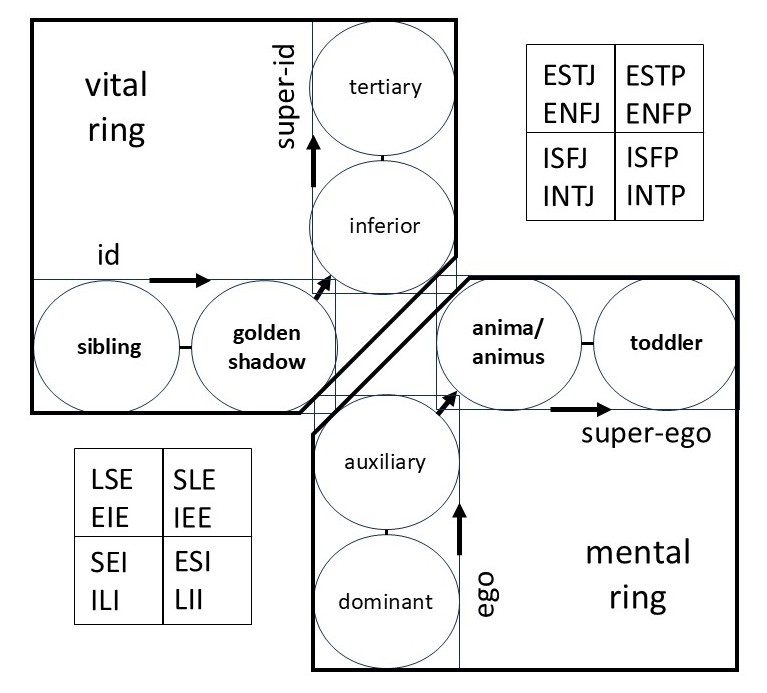
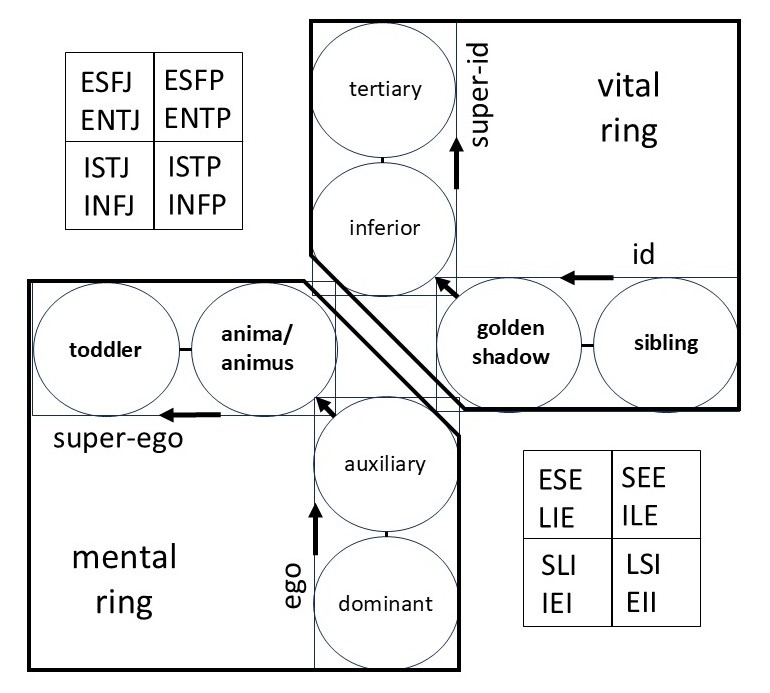
7. Mental vs. Vital Quadrants: Ontolokey and Socionics
Both systems divide functions into two rings or quadrants:
- Socionics: “mental” ring (slots 1–4) and “vital” ring (5–8)
- Ontolokey: P‑group (Ne, Se, Ti, Fi) and J‑group (Si, Ni, Fe, Te), layered spatially
Each system models dynamic energy flow:
- Mental/P‑group: dominant → auxiliary → anima → toddler
- Vital/J‑group: inferior → tertiary → sibling → golden shadow
Because both systems mirror this functional flow and pairings, Ontolokey’s cube structure ends up as a conceptual reflection of Model A in three‑dimensional space.
8. External Context: Socionics Model A and Ontolokey Foundations
Socionics Model A
Socionics Model A structures eight information‑metabolism functions into a fixed template with interrelated roles such as dominant, creative, mobilizing, etc. This model emphasizes how individuals process information and respond at both conscious (ego‑block) and unconscious (super‑id and id blocks) levels.
Ontolokey Cube
Ontolokey (Ontolokey.com) takes this Model A foundation and adds a spatial geometry: each vertex of a cube corresponds to one of the eight functions/archetypes, allowing visual mapping, rotation, and mirrored symmetry to highlight polarities and progression paths.
Ontolokey posits inner/outer axes, primary/shadow tripods, and archetypes like “Golden Shadow” that extend casual function naming into a narrative or mythic framework. It aims to make the relationships between functions intuitive via symbolic geometry.
9. Synthesis: Why the Systems Resonate So Closely
- Identical function‑role mapping: Ontolokey reassigns Socionics slots directly into spatial positions via metaphors, without altering rotational flow.
- Parallel Quadrant Divisions: Both divide mental and vital energies in complementary flows (1→4, 5→8).
- Archetypal labeling: Ontolokey uses evocative terms (e.g. Toddler, Sibling, Golden Shadow) to mirror Socionics’ super‑id/id functions.
- Dynamic symmetry: The cube enables geometric rotations, reflecting how individuals may shift energy or perspective across opposing functions and axes.
10. Implications and Insights
- The cube model supports self‑reflective visualization: one can explore how mental and vital energies interplay, how shadow functions may emerge in stress, or how the golden shadow can be activated.
- It deepens Model A literacy, offering a tangible way to grasp abstract functional dynamics.
- It bridges systems: Ontolokey is not merely an artistic reinterpretation; it is structurally isomorphic to classical Socionics Model A.
Conclusion
Ontolokey and Socionics Model A converge in their deep structural architecture. Ontolokey’s Cube is more than flair: it is a spatial metaphor for Model A’s eight slots, grouping and energy flows. By mapping personality types and function roles (Dominant, Auxiliary, Anima/Toddler, Inferior, Tertiary, Sibling, Golden Shadow), Ontolokey mirrors Socionics while adding visual and symbolic richness. Using your cross-reference table and the cube metaphor, an English‑language article like this fleshes out both systems and shows why and how they correspond so elegantly.
The Ontolokey Cube is more than a new way to visualize typology; it is a tool for transformation. By aligning with Socionics Model A, it gives users a hands-on method to internalize, explore, and develop their cognitive architecture. The cube transforms theoretical knowledge into lived experience, enabling deeper insight, empathy, and growth. For practitioners, learners, and seekers alike, Ontolokey offers the missing dimension that Socionics has always pointed toward: the ability to not just understand the psyche, but to step inside it.


 Ontolokey
Leave a comment