1. Introverted Feeling (Fi) — The Inner Compass
At the core of the INFP personality lies a powerful yet invisible force — Introverted Feeling (Fi). It’s not loud. It’s not flashy. But it’s fierce. For the INFP, Fi functions like a sacred compass, pointing always toward what feels morally right, emotionally true, and authentically “them.” This isn’t about reacting emotionally to everything; it’s about having a highly refined, deeply personal value system that quietly governs nearly every decision they make.
Living from Within
An INFP does not seek external validation to know who they are. They don’t ask, “What do others expect of me?” — they ask, “Does this resonate with my inner truth?” Their emotional world is rich, intricate, and often invisible to outsiders. Many INFPs appear reserved, even aloof at times, not because they lack depth, but because their most profound experiences occur within.
This internal life gives INFPs an unmatched sense of emotional integrity. They are deeply unwilling to violate their values — even if it costs them social approval, convenience, or career success. That’s why they’re often drawn to art, healing, activism, or mentorship: professions that allow them to express their beliefs or help others grow.
Emotional Sensitivity and the Weight of Meaning
Fi is also what makes the INFP so emotionally sensitive, not in a reactive sense, but in a profound empathic way. They don’t just notice others’ pain — they feel it. Not superficially, but as if it were happening inside them. It’s why so many INFPs are drawn to emotional caretaking roles, even informally — the friend who listens without judging, the stranger who senses when you’re hurting, the partner who makes small, gentle gestures to show love.
But this sensitivity has a price. INFPs often absorb emotional energy from the world like a sponge. They may carry around the pain of others long after an event has passed. When someone is unjustly hurt, it can keep them up at night. When someone close breaks their trust, it can shatter them from the inside out — not because of ego, but because a sacred bond has been violated.
And yet, INFPs are rarely vengeful. Fi does not seek to “win.” Instead, it seeks understanding. Forgiveness, when it comes, is quiet, sincere, and full-bodied. But it depends entirely on whether the other person recognizes the emotional impact of their actions. INFPs don’t demand apologies — they seek genuine remorse and self-awareness. Without that, the emotional door tends to stay closed.
The Unseen Moral Backbone
Though INFPs often avoid direct confrontation, their moral backbone is anything but weak. In fact, Fi is immovably strong in its quiet way. INFPs may tolerate a lot of noise, chaos, or contradiction in others — but if you cross a core boundary, they will shut the door without warning. And not out of cruelty — but out of protection. They need emotional safety the way others need food and water.
This quiet strength also makes them incredible protectors of the vulnerable. Whether it’s a bullied child, a wounded animal, or a struggling friend, INFPs will step in — often subtly, without demanding attention — to restore harmony and defend the innocent.
They are not warriors in the traditional sense. But they are guardians of emotional truth. And their armor is made of empathy, not steel.
The Cost of Being True
Fi comes with a sense of responsibility that often weighs heavy. Many INFPs spend their lives asking themselves: “Am I being authentic enough? Have I betrayed my own truth? Am I giving enough to others?” This constant emotional checking-in can make them incredibly self-aware — but also emotionally fatigued.
They may also struggle with guilt. Not the kind that comes from breaking rules, but the quiet, aching guilt of not living up to their own inner ideals. INFPs tend to be far more forgiving of others than they are of themselves. They don’t want to hurt anyone — and if they do, even by accident, they may ruminate over it for days, weeks, or even years.
This intense inner world is often invisible to others. On the outside, an INFP may appear calm, gentle, maybe even a little dreamy. But inside, a thousand ethical calculations are unfolding. They don’t act impulsively — they act when they’ve emotionally processed what feels right.
Authenticity Over Everything
The ultimate drive of Fi is authenticity — not as a performance, but as an alignment between one’s actions and one’s values. INFPs would rather be misunderstood while being true to themselves than be celebrated for something false.
They don’t fake smiles. They don’t network for gain. They don’t say things they don’t mean. This authenticity makes them magnetic in a quiet way — people feel safe around them because there’s no hidden agenda.
And yet, INFPs often feel like outsiders. They may go years without finding people who understand their depth. But when they do? Those connections are soul-deep, often lasting a lifetime.
To summarize:
Introverted Feeling is not just a “preference” for the INFP — it is their very identity. It is their voice of truth, their source of empathy, and their deepest strength. Quiet but mighty, Fi is the light they carry through the world, often unseen — but profoundly felt.
2. Extraverted Intuition (Ne) — The Pathfinder of Possibilities
If Introverted Feeling is the compass of the INFP, then Extraverted Intuition (Ne) is the wings. It’s what lifts the INFP’s inner values out into the world, giving them movement, vision, and creativity. Where Fi is rooted in internal truth, Ne is always looking outward, scanning the horizon for what could be. It’s not concerned with what is — it’s enchanted by what is possible.
A Mind in Motion
INFPs with a well-developed Ne are idea-generators by nature. Their minds work like a kaleidoscope: turning, flipping, reframing — constantly generating new connections, analogies, interpretations. Give them a single emotional moment, and they’ll find five different ways it could unfold, three symbols it reminds them of, and two life lessons embedded in it.
This is why so many INFPs are drawn to writing, art, philosophy, and storytelling. Their Ne doesn’t just entertain ideas; it transforms them. They don’t observe the world — they interpret it through an endless stream of meaning, metaphor, and potential.
This intuitive agility often makes them seem idealistic, imaginative, and visionary. Even if their demeanor is quiet, their inner world is constantly sparking with creative fire.
The “What If” Mechanism
Ne speaks in “what ifs.” What if we looked at it this way? What if this situation is actually part of something larger? What if that tiny moment mattered more than we realize?
This function allows INFPs to explore multiple perspectives simultaneously. They can empathize with people they disagree with, imagine lives they’ve never lived, and understand emotions they’ve never personally experienced. They don’t need to have been in your shoes — their Ne can walk there anyway.
This ability makes them incredible counselors, writers, artists, and innovators. Their Ne doesn’t just think outside the box — it forgets the box even exists.
Navigating with Gentle Foresight
One of the subtler gifts of Ne is the INFP’s ability to sense consequences before they happen — particularly emotional ones. It’s not a logical, step-by-step prediction. It’s more like a feeling: “If we go down this road, something painful might happen…”
This foresight leads them to be cautious in relationships. They may hold back their full emotional investment until they’ve “read the field.” They aren’t cold — they’re protective. They’ve seen enough in their minds to know how heartbreak plays out. They may preemptively soften emotional landings, anticipate hurt feelings, or sidestep confrontation — all in service of peace.
That said, this foresight also allows for small, loving miracles. An INFP might predict a child will feel left out at a party and prepare a quiet activity just for them. Or they may sense tension in a friend group and gently steer the conversation to safer ground. These small acts go unnoticed by many — but they are the INFP’s way of protecting harmony before harm can take root.
The Gift of Creative Adaptability
Ne gives the INFP incredible flexibility in thinking. Where other types might double down on one perspective, INFPs can pivot. If a belief stops making sense, they question it. If a dream starts to feel restrictive, they revise it. This inner adaptability helps them grow in deeply personal ways — even if the process is slow and nonlinear.
They may change careers multiple times, experiment with different creative mediums, or shift worldviews as they evolve. What remains constant is their internal compass (Fi); Ne simply gives them the tools to navigate new terrains.
It also explains why INFPs often struggle with rigid systems or conventional life paths. Ne wants openness, freedom, room to explore. A 9-to-5 job with no creativity may feel like slow suffocation. They don’t rebel outwardly — but inwardly, their soul starts to wilt without novelty, purpose, or room to imagine.
The Double-Edged Sword of Endless Options
The downside of Ne is that it never really stops. With so many ideas, possibilities, and interpretations swirling in their minds, INFPs can struggle with indecision. They may get overwhelmed by the sheer volume of paths they could take. They want to make the “right” choice — not just logically, but emotionally and ethically — and so they wait. And analyze. And imagine more.
This can lead to procrastination, self-doubt, or “analysis paralysis.” Sometimes, their Ne opens so many doors that they forget to walk through any of them.
But over time, mature INFPs learn to blend Ne’s openness with Fi’s inner guidance. They realize that not every path needs to be perfect — just authentic. Not every possibility needs to be explored — just the ones that feel true.
The Visionary Seed-Planter
At its best, Ne helps INFPs become visionaries. They see potential where others see problems. They believe people can grow, that relationships can heal, that even the darkest moment can have a silver thread of meaning.
They are idea-collectors, meaning-makers, future-feelers. And while they may not always know how to get where they’re going, they trust that something beautiful is waiting just around the bend — and that it’s worth walking toward.
To summarize:
Extraverted Intuition is the INFP’s open window to the world — a spark of possibility, connection, and transformation. It helps them dream, adapt, empathize, and imagine. When balanced with their deeply-held values, Ne allows the INFP to bring their inner truth into the outer world in profoundly creative and healing ways.
3. Introverted Thinking (Ti) — The Silent Analyzer in the Mirror
Introverted Thinking (Ti) is not a function most people associate with the gentle, value-driven INFP. It sits in the unconscious shadow — often unpolished, quiet, even conflicted. And yet, it plays a surprisingly important role in the INFP’s personal growth, especially as they wrestle with identity, truth, and self-understanding.
In Jungian terms, this function reflects the Anima or Animus — the inner “other” that challenges the conscious ego. For the INFP, Ti represents a part of themselves that seeks not emotional depth or moral meaning — but clarity, logic, and truth through internal analysis.
The Hidden Seeker of Coherence
While INFPs are led by feeling, their Ti quietly asks: “But does it make sense?” It doesn’t care if something is beautiful or touching. It wants precision, internal logic, consistency. Most INFPs don’t lead with this function, but when it activates — often in private, reflective moments — it brings a razor-sharp lens to their thinking.
This might emerge as a sudden need to untangle ideas: “Why do I believe this?” “Is this just an emotional story I’ve told myself?” “Does this idea contradict something I know to be true?”
In those moments, the INFP can feel like two people: the warm empath and the cool analyst. Ti doesn’t care about emotional harmony — it wants intellectual cleanliness. And when its voice gets louder, the INFP may enter deep periods of introspection, questioning not just external ideas, but the structure of their own inner world.
Quiet Intellect, Private Complexity
Ti in the INFP often remains hidden to others. While they might appear emotional, imaginative, or even idealistic on the outside, those who get closer discover something unexpected: a mind that is meticulously structured, almost surgical in its reasoning — but only when it feels safe to be revealed.
Because Ti is introverted and subtle, the INFP rarely engages in debate or “intellectual showdowns.” Instead, they analyze internally. They may spend hours — or days — working through contradictions in silence, refining their beliefs like a philosopher polishing a single sentence.
They don’t need to win arguments. They need to understand what is truly coherent. It’s not about being right — it’s about being in harmony with both their emotional truths and their intellectual ones.
The Inner Conflict: Logic vs. Feeling
One of the greatest internal tensions for INFPs comes when Fi and Ti are in conflict. Fi says, “This feels right. This aligns with who I am.” Ti counters, “But your reasoning has holes. You’re telling yourself a biased story.”
This creates emotional dissonance — a kind of self-doubt that can spiral. The INFP may feel stuck between authenticity and accuracy, between emotional loyalty and intellectual honesty. This inner tug-of-war can be draining, but it’s also essential to their evolution.
Over time, mature INFPs learn to let Ti refine Fi rather than undermine it. They begin to ask not just, “What do I value?” — but “Are my values logically consistent?” They may begin questioning spiritual beliefs, political ideals, or emotional narratives they’ve carried for years — not to discard them, but to reshape them into something truer, tighter, and more integrated.
The Self-Critic and the Inner Architect
In its shadow form, Ti can become overly harsh — like an inner critic whispering, “You don’t know enough. You’re not being rational. You’re fooling yourself.” It may show up as perfectionism in thought, a fear of sounding foolish, or a compulsion to understand everything before acting.
But in its healthy form, Ti becomes a kind of inner architect — helping the INFP build a solid internal foundation beneath their values and dreams. It says: “Let’s make this belief strong enough to stand, even under pressure.”
This process is deeply empowering. It allows the INFP to become not just emotionally authentic, but intellectually sovereign — no longer relying on external authorities to define truth.
The Philosopher Within
As they grow, many INFPs begin to embrace their Ti as a quiet philosopher within. They may read deeply, explore abstract systems (like typology itself), or question the very nature of reality. While they may never express these thoughts publicly, their inner world becomes a deeply thoughtful place — filled not just with passion, but with precision.
They may also be drawn to people who embody Ti: thinkers, inventors, or truth-seekers. At times, these relationships feel like a mirror — reflecting back a part of the INFP they both admire and fear. It is through these relationships that the Anima or Animus function comes alive, inviting them to expand who they are by integrating what they are not yet.
To summarize:
Introverted Thinking is the INFP’s hidden analyst — the philosophical voice beneath the passion. It helps them bring order to their beliefs, coherence to their worldview, and clarity to their communication. When embraced, Ti doesn’t silence the INFP’s heart — it sharpens it, giving form to their deepest truths.
4. Extraverted Sensing (Se) — The Playful Stranger
Extraverted Sensing (Se) is not a function most people would expect to find in an INFP. It lives in their unconscious — undeveloped, unpredictable, and often treated like a curious visitor. Se is all about the here and now — sensory input, physical experience, vivid detail, and immediate action. For the INFP, who lives mostly in the realms of values, ideas, and imagination, Se can feel like both a delightful surprise and a disorienting jolt.
Fleeting Moments of Presence
When Se shows up in the INFP’s life, it often does so in bursts. A sudden craving to go for a walk and feel the wind. A moment of complete absorption in music. A spontaneous urge to redecorate a room, taste something new, or dive into a sensory-rich experience like dancing or painting.
These experiences can feel almost out of character — and yet deeply nourishing. Se gives the INFP access to the joy of embodiment. It’s the function that reminds them they’re not just spirits floating through life — they have a body, and the physical world can be beautiful, exhilarating, even healing.
This is why INFPs sometimes show flashes of sensuality, adventurousness, or playfulness — seemingly out of nowhere. It’s not a core way of being, but when it arrives, it brings lightness, immediacy, and fun.
The Childlike Approach to the Physical World
Because Se is so low in their function stack, INFPs often relate to the physical world like a toddler — with wonder, but also with a lack of skill or control. They may become overwhelmed in busy environments. Loud sounds, harsh lights, messy surroundings — all can feel intrusive or draining.
They may also struggle with practical matters that require constant attention to external detail — organizing clutter, maintaining physical routines, or managing time with precision. These are not their strengths. Their attention is usually turned inward or forward — not on the small, sensory details of the now.
And yet, in their own way, they do notice beauty. Just not systematically — they notice it emotionally. The way light filters through a window. The feel of a worn book in their hands. The atmosphere of a cozy café. Se may not be dominant, but it still whispers to them in subtle, poetic ways.
Impulses, Distractions, and Overstimulation
Because Se is underdeveloped, it can also become a source of distraction — or chaos. An INFP under stress may suddenly binge-watch shows, overindulge in sweets, or scroll endlessly through their phone, seeking relief in stimulation. Not because they’re “lazy,” but because Se is trying — clumsily — to balance the overwhelming emotional or imaginative input from Fi and Ne.
In these states, the INFP may feel lost in noise. They can become overstimulated by their surroundings or disconnected from their body. Their usual inner clarity may vanish, replaced by restlessness or even guilt for having “wasted time.”
This is why healthy Se integration isn’t about becoming hyper-practical or thrill-seeking — it’s about consciously reconnecting to the body and the moment.
When Se Awakens in Creativity
Interestingly, Se often surfaces in INFPs through creative expression. Photography, dance, fashion, food, gardening — these can become portals to the sensory world in a way that still aligns with their values and imagination.
When they cook, it’s not just to eat — it’s to create an experience. When they take photos, it’s not for documentation — it’s to capture an emotion. Through creativity, the INFP accesses Se in a way that feels authentic, gentle, and emotionally meaningful.
This is how Se grows: not through discipline or control, but through play, beauty, and sensory reverence. And when nurtured, it helps ground the INFP’s dreamy nature — giving their ideals and visions a tangible form.
The Role of Se in Growth
Over time, especially in adulthood, the INFP may begin to invite Se into their life in small ways: mindfulness, movement, decluttering, intentional rituals. These don’t need to be rigid routines — in fact, they shouldn’t be. What helps most is a sensory environment that feels soothing and aligned with their values.
Se also plays a key role in embodiment. Many INFPs struggle with feeling “out of touch” with reality or their physical needs. Learning to notice tension, hunger, fatigue, or sensory pleasure is a profound form of self-care — and one of the most overlooked growth paths for this type.
To summarize:
Extraverted Sensing is the INFP’s playful, messy, sometimes overwhelming toddler function. But it’s also their access point to the joy of presence — to the taste, texture, sound, and color of life. When welcomed gently, Se becomes not a distraction, but a grounding force — a reminder that truth doesn’t live only in the heart and mind, but also in the moment.
5. Extraverted Thinking (Te) — The Reluctant Commander in the Shadows
At the bottom of the INFP’s cognitive function stack lies Extraverted Thinking (Te) — a function that deals in structure, logic, efficiency, results, and external order. It is everything the INFP instinctively avoids… and secretly craves.
Te is the INFP’s inferior function, and that makes it both a weakness and a powerful source of growth. It is the function that challenges their identity the most — the part of them that says, “Enough dreaming — what are you doing?”
The Inner Push to Do More, Be More
While INFPs are naturally guided by their values (Fi) and ideas (Ne), there’s a quiet, persistent voice inside them that wonders: “Am I doing enough? Shouldn’t I be more productive, more structured, more successful?”
That voice is Te. It measures progress not by meaning, but by output. It wants plans, systems, timelines, measurable goals. And for the INFP, this can feel suffocating — like trying to force a wildflower to grow in a spreadsheet.
But it’s not always hostile. In fact, it emerges when the INFP starts to care deeply about a cause or a dream. Suddenly, their idealism wants to become real. Their inner world starts to demand structure. And that’s where Te steps in — awkwardly, clumsily, but with purpose.
The Love-Hate Relationship with Productivity
Because Te is unconscious and underdeveloped, many INFPs have a strained relationship with productivity. They often have brilliant ideas, rich emotional insight, and creative visions — but struggle to organize them into something consistent or sustainable.
They may start ten projects and finish none. Or they may get stuck in a spiral of self-doubt: “If I can’t do this perfectly, why bother?”
They’re often allergic to strict schedules, corporate hierarchies, and hard metrics — not because they’re lazy, but because these systems feel soulless. They want their efforts to mean something — and Te’s impersonal logic can feel cold in comparison.
Yet ironically, many INFPs deeply admire people who are efficient, articulate, and commanding. They long for just enough Te to bring order to their chaos — without losing their soul.
The Danger of Te Overdrive
Under stress — especially when feeling unheard or ineffective — an INFP might “flip” into Te in a harsh, unbalanced way. This is often called a “grip” state. In these moments, they may suddenly become blunt, critical, impatient, or obsessed with control.
They might lash out at others’ inefficiency, demand immediate results, or turn their perfectionism inward: “Why can’t I get it together?”
This is not true Te mastery — it’s an emotional outburst driven by frustration and fear.
But if they learn to recognize this state, it becomes a powerful mirror. The Te-grip reveals what they really want: to feel effective, empowered, and in control of their direction.
The Journey Toward Empowered Structure
As they mature, INFPs often begin to embrace Te — not as a ruler, but as a tool. They realize that discipline doesn’t have to kill creativity. In fact, gentle structure can give their visions a foundation to thrive.
They start learning systems that support — rather than suppress — their values. They may begin using simple planners, setting soft deadlines, or building sustainable habits. The key is autonomy: they must feel like they chose the structure, not that it was imposed.
When Te is integrated, the INFP becomes a visionary builder. No longer just a dreamer, they begin to actualize their ideas. They start writing the book instead of just thinking about it. Launching the initiative instead of just envisioning it. They don’t abandon their inner world — they translate it.
Te as the Voice of Empowered Expression
At its best, Te helps the INFP express their inner truth in ways that impact the world. It lends their ideals clarity and power. It helps them say, “This is what I believe — and here’s how I will make it real.”
It also helps them communicate with confidence. Where Fi can be hesitant to assert itself, Te provides structure and strength. The INFP learns to make requests clearly, set boundaries, organize projects, and navigate the external world without apology.
This is the final form of Te-integration: not dominance, but alignment. Te becomes the INFP’s sword — not to fight others, but to cut through fear and self-doubt, carving a path for their ideals to walk in the world.
To summarize:
Extraverted Thinking is the INFP’s reluctant commander — often resisted, sometimes feared, but ultimately essential. When integrated with self-compassion, Te gives the INFP the power to bring their inner world to life: not just to feel deeply, but to build meaning in a world that needs it.
6. Introverted Sensing (Si) — The Quiet Keeper of the Inner Archive
Introverted Sensing (Si) is often overshadowed by the INFP’s dominant idealism and intuition. Yet this tertiary function plays a subtle but essential role in grounding their identity. It is Si that holds onto experiences, safeguards memories, and maintains a quiet inner continuity — even when the outer world is constantly changing.
Unlike Ne, which reaches outward for novelty, Si turns inward toward familiarity. It honors patterns, protects the past, and builds internal consistency over time. In the INFP, this manifests as a quiet loyalty to their personal history — a deep emotional bond to the stories, people, and places that have shaped who they are.
Memory as Meaning
INFPs don’t just remember — they relive. Their Si doesn’t store data like a machine; it preserves emotional impressions. A childhood bedroom, the smell of a loved one’s sweater, the sound of a rainy morning — these aren’t just memories. They’re felt experiences, sometimes resurfacing with such intensity that it’s as if no time has passed.
This emotional memory gives INFPs their signature depth. They feel things not just in the moment, but across time. The past is never truly “gone” for them — it’s alive, layered, and sacred. They may carry old notebooks, letters, playlists, or objects with great sentimental value. Not out of nostalgia, but because these things anchor their evolving identity to something real.
The Comfort of the Known
Though INFPs are often perceived as spontaneous, they secretly find great comfort in routines, rituals, and familiar settings — as long as those routines are self-chosen and emotionally resonant.
A favorite tea every morning. The same playlist on long walks. A specific spot at the café. These small sensory rituals create a private rhythm that soothes the INFP’s often chaotic inner landscape.
Si provides an anchor. It reminds the INFP, “You’ve been here before. You know how to survive this.” In times of stress or change, it’s often Si that brings calm — not by solving the problem, but by offering a familiar emotional reference point from the past.
Struggles with Rigidity and Repetition
However, because Si is tertiary — and therefore less conscious — it can sometimes show up in problematic ways. INFPs may become stuck in comforting but limiting routines. They may romanticize the past to the point of resisting necessary change. Or they may hold onto emotional wounds long after they’ve ceased to serve them.
This can create a quiet form of internal inertia — a sense of being emotionally anchored to the past in ways that make forward movement difficult. Si says, “This felt safe once,” even when that safety no longer exists.
For the INFP to grow, they must learn when to honor Si’s wisdom — and when to gently release it.
Si in Service of Identity
Despite its quiet role, Si contributes to one of the INFP’s greatest strengths: their unwavering sense of inner continuity. They may change externally, but their internal compass remains consistent. Even in the face of external chaos, there’s something in them that whispers, “I still know who I am.”
Si supports this by tracking patterns in their emotional and physical lives. It helps them recognize what environments nourish them, what stories repeat, what emotions echo. In this way, it works hand-in-hand with Fi — not by judging, but by recalling: “This felt right before. This helped me heal. This person brought peace.”
INFPs who learn to listen to these signals often become deeply self-aware — not just in terms of their values, but in the rhythm and pace of their inner life.
Healing Through Familiarity
Si also plays a beautiful role in emotional healing. Revisiting a meaningful place, rereading an old journal, or wearing a beloved sweater can reconnect the INFP to versions of themselves they thought they’d lost. These small, grounding experiences offer not just comfort, but integration.
Rather than chasing reinvention, the INFP finds wholeness through remembering — not as escape, but as reconciliation with all they’ve been.
To summarize:
Introverted Sensing is the INFP’s gentle archivist — holding their stories, preserving emotional truths, and offering quiet structure in a world of swirling feelings and ideas. When nurtured, Si becomes a deep well of memory, identity, and inner calm — reminding the INFP that growth is not just about change, but about continuity with the self.
7. Extraverted Feeling (Fe) — The Misunderstood Mirror
Extraverted Feeling (Fe) — the Sibling Function of the INFP — often lives at the edges of their awareness. While Fi, their dominant function, focuses on authentic personal values, Fe is concerned with social harmony, shared emotional expression, and external connection.
To the INFP, Fe can feel both familiar and foreign: it wants what they want — connection, emotional resonance — but it goes about it differently. Fe adapts to others; Fi stands its ground. Fe reads the room; Fi checks in with the soul. This creates both tension and potential in the INFP’s psyche.
The INFP’s Quiet Emotional Attunement
Even though INFPs don’t lead with Fe, they often exhibit a surprising level of emotional attunement to others. They may not track group dynamics as naturally as Fe-dominant types do (like ENFJs or ESFJs), but they deeply feel the emotional undercurrents around them — especially one-on-one.
They’re often the friend who intuitively senses when something’s wrong, who offers quiet support rather than public comfort. While Fe expresses emotion externally and seeks immediate emotional alignment, the INFP processes feelings internally — and offers empathy in a more reflective, personal way.
Fe says, “We’re all in this together.”
Fi says, “I see you — and I honor your truth, even if it’s different from mine.”
This difference in emotional expression can lead to beautiful, complementary relationships — or to subtle friction.
The Struggle for Social Belonging
Because Fe is not a conscious strength, INFPs may feel awkward or uncertain in highly social situations. They may worry about saying the wrong thing, disrupting group harmony, or failing to respond in the “appropriate” emotional way.
They might be quiet in groups not because they don’t care — but because their emotional processing takes longer. Where Fe types respond in the moment, the INFP often needs time to reflect before they can speak authentically.
This can sometimes cause INFPs to feel socially “behind,” even though their emotional depth is profound. They long for connection — but not at the cost of their authenticity. And in a world that often rewards surface-level harmony over inner truth, this can feel lonely.
Conflict with Fe Expectations
Fe is also where many INFPs experience tension with cultural or familial norms. They may feel pressure to “smile,” “be nice,” or “go along with the group” — even when it violates their inner convictions. These social expectations can feel oppressive to the INFP, who sees emotional conformity as inauthentic, even manipulative.
As a result, they may reject Fe altogether — seeing it as shallow or dishonest. But in doing so, they sometimes miss its positive power: to connect, to comfort, to communicate warmth and openness.
The challenge, then, is not to become Fe — but to make peace with it.
Learning to Express Emotion Externally
When INFPs begin to explore their Fe function — even tentatively — they often discover new ways to connect with others without betraying themselves. They learn that emotion shared doesn’t have to be emotion diluted. That it’s okay to express care out loud, to offer comfort in ways that others can see and feel.
This might look like initiating a conversation, validating someone’s feelings aloud, or participating in rituals of social support — even if those rituals feel a bit foreign. With time, the INFP learns that these small acts of outward empathy don’t erase their inner truth — they amplify it.
And when the INFP pairs their deep, reflective Fi with occasional, sincere Fe-style expression, something powerful happens: their relationships deepen. Others feel not just seen — but safe with them.
The Emergence of Social Confidence
As they grow, many INFPs become surprisingly gifted at helping groups navigate emotionally charged situations — not by dominating the space, but by holding it. They become mediators, calm listeners, and quiet encouragers. They may never crave the spotlight, but they become steady emotional anchors for others.
They also become more comfortable showing warmth visibly. Smiling, offering affection, saying “I care about you” — these no longer feel like acts of compromise, but of courageous vulnerability.
In this way, Fe becomes a bridge, not a burden — a way to translate the INFP’s private emotional truth into shared human connection.
To summarize:
Extraverted Feeling is the INFP’s social sibling — often misunderstood, sometimes avoided, but quietly present. When approached with openness rather than resistance, Fe becomes not a rival to Fi, but its complement: a gentle mirror that helps the INFP’s inner values meet the world with kindness and courage.
8. Introverted Intuition (Ni) — The Golden Shadow of Inner Knowing
Introverted Intuition (Ni), as the eighth and final function in the INFP’s cognitive stack, lives in the realm of the unconscious — and yet, its influence can be felt like a soft whisper in the background of the INFP’s inner life. Often overlooked or misunderstood, Ni represents the INFP’s golden shadow: a latent potential for visionary clarity, pattern recognition, and profound inner foresight.
Where their extraverted intuition (Ne) dances outward, leaping from idea to idea like sparks in the night sky, Ni moves inward, following a single thread toward a deeper, singular insight. It seeks essence, symbolism, and the ultimate meaning behind what is.
The Mysterious Pull Toward Something Deeper
Even though Ni is not consciously developed in most INFPs, many report a strange, intuitive knowing that occasionally rises from somewhere deeper than thought. It’s not like Ne’s quick “aha!” excitement — it’s quieter, slower, more penetrating.
It may come as a dream, a sudden realization, or a symbolic connection that lingers. A sense that there’s something more going on beneath the surface — something destined, something archetypal.
This is Ni’s voice within the INFP. Not frequent, not loud — but powerful when it breaks through.
When Ne Exhausts, Ni Emerges
INFPs typically rely on Ne to explore possibilities. It’s broad, playful, and divergent. But over time — especially in moments of deep personal transformation — Ne can begin to feel scattered or overwhelming. It’s in these moments that Ni sometimes steps forward with an unexpected gift: focus.
Where Ne asks, “What else?”
Ni asks, “What does it all point to?”
This shift can feel almost spiritual. The INFP begins to move from curious seeker to inner pilgrim, drawn toward something specific yet hard to name — a purpose, a vision, a truth that unfolds in layers. This inner call is Ni in its purest form: a felt sense of trajectory that transcends logic or even conscious value.
A Gateway to the Archetypal
Ni often reveals itself through symbolism and mythic resonance. An INFP may find themselves strangely moved by recurring images — a falling star, a lone tree, a certain song or color — without knowing why. These inner symbols carry meaning that defies language, yet stirs something ancient within them.
Carl Jung would describe this as a connection to the collective unconscious. For INFPs who engage with dreams, inner imagery, or meditative states, Ni becomes a kind of internal oracle — a compass that doesn’t show the map, but whispers the direction.
It’s not about solving problems — it’s about sensing the underlying purpose.
The Danger of Misusing Ni Energy
Because Ni is in the shadow, it can also be misunderstood or distorted. INFPs under stress may fall into overinterpretation, believing they “just know” what others think or what the future holds — but without grounding those impressions in reality.
They might fixate on an imagined outcome or become entranced by symbolic patterns that don’t truly serve them. In these moments, Ni becomes less of a guide and more of a maze.
That’s why conscious integration is key: not rejecting Ni, but approaching it with humility and balance.
The Alchemy of Integration
When INFPs begin to embrace Ni in a healthy, grounded way, they unlock a new layer of insight: the ability to see their life not just as a series of emotional experiences (Fi), or a web of ideas (Ne), but as a mythic journey — with direction, pattern, and personal destiny.
They begin to ask questions like:
- What is the deeper pattern beneath my story?
- Where is this emotional journey leading me?
- What inner image has always followed me, and what does it mean?
Ni helps the INFP listen to their life like a story unfolding in sacred time. They become more patient, more centered, more connected to a sense of deep inner vision. And this vision, when combined with Fi’s values and Ne’s creativity, becomes transformational — not only for the INFP, but for those they touch.
Ni as the Silent Future Within
Though rarely obvious, Ni is often the final step in the INFP’s individuation — the quiet arrival of a deeper knowing that was always there, waiting. It helps the INFP move from feeling to meaning, from scattered insight to quiet understanding, from wandering dreamer to visionary guide.
This is the gift of the golden shadow: not a function to dominate or master, but to befriend. To recognize that within all the complexity of emotion, imagination, and sensitivity, there exists a still point — a silent place inside the INFP that already knows.
To summarize:
Introverted Intuition is the INFP’s final, hidden function — mysterious, symbolic, and deeply spiritual. When integrated gently, it adds depth, focus, and vision to the INFP’s journey, allowing them not just to imagine the future — but to intuit their place within it.
Conclusion: The Inner Odyssey of the INFP
The INFP is not just a personality type — they are a living paradox, a quiet storm, a soul in motion. Their journey through the eight cognitive functions is less a linear path and more a spiral inward, each layer revealing new dimensions of who they are and who they are becoming.
At the heart of this journey is Introverted Feeling (Fi) — their moral compass, their sanctuary of truth. It guides them inward to a place of deep integrity, where values are not adopted but discovered. Around this core orbits the free spirit of Extraverted Intuition (Ne), ever curious, ever searching, breathing possibility into every corner of their imagination.
As they grow, the INFP begins to meet lesser-known parts of themselves: the logical detachment of Introverted Thinking (Ti), the sensory impulsiveness of Extraverted Sensing (Se), and the assertive but foreign energy of Extraverted Thinking (Te) — their inferior function. Each of these adds complexity, conflict, and eventually, growth.
They find quiet grounding in Introverted Sensing (Si) — the archivist of memory, the emotional mapmaker. They learn to dance with Extraverted Feeling (Fe), navigating the balance between personal authenticity and social connection. And at last, they encounter the mystical presence of Introverted Intuition (Ni) — a golden whisper from the unconscious, pointing toward meaning, vision, and transformation.
This functional journey is not about perfection. It is about integration. The INFP does not need to become someone else — they need only to become more fully themselves.
By acknowledging all eight functions — not as tools to be mastered, but as voices within a larger internal chorus — the INFP begins to walk their true path: not just as an idealist, but as a whole human being. Sensitive, yes — but also strong. Dreaming, yes — but also anchored. Quiet, yes — but never small.
The INFP’s odyssey is one of returning home — not to comfort, but to inner coherence. To a life lived in deep alignment with soul, imagination, and purpose.
And in that journey, they become what they were always meant to be: a living bridge between the world as it is — and the world as it could be.
The INFP and the Ontolokey Cube: A Visual Map of the Inner World
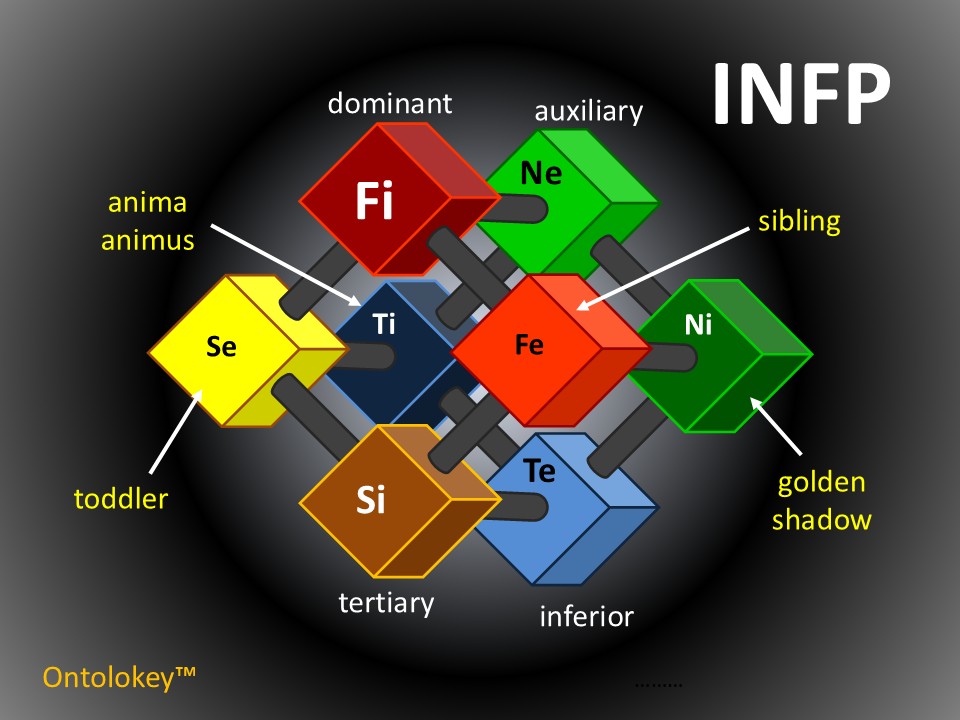
Imagine standing in front of a translucent, multidimensional cube — not just a geometric object, but a living, breathing map of your inner world. This is the Ontolokey Cube: a framework that brings Carl Jung’s eight psychological functions into a spatial and dynamic format. Each corner of the cube represents one of these eight functions, and the adjustable sliders between them show the balance, tension, or dominance between opposing traits.
For the INFP, this cube becomes a mirror. It doesn’t just reflect who they are — it reveals who they are in motion, in growth, and in essence.
Orientation Within the Cube: Where the INFP Stands
At the heart of the INFP’s position within the Ontolokey Cube is Introverted Feeling (Fi). This function anchors their identity — a deeply personal, internal sense of what’s right, authentic, and meaningful. Within the cube, this shows up as a clearly lit and stable corner. It’s where the INFP feels most at home, the center of their moral gravity.
Close to Fi is Extraverted Intuition (Ne), the function that infuses their world with imagination, creativity, and possibility. In the cube, Ne glows with dynamic energy — not overwhelming, but expansive, showing the INFP’s openness to ideas and abstract connections. The Fi–Ne axis is vibrant and dominant, highlighting the harmony between feeling deeply and imagining widely.
By contrast, the corners representing Extraverted Thinking (Te) and Extraverted Sensing (Se) appear dim or under-activated. Te, the INFP’s inferior function, is barely lit — signaling a discomfort with external systems, control, or confrontation. Se, the toddler function, remains a quiet, undeveloped space in the cube, suggesting a struggle with immediate sensory demands or external stimulation.
The INFP’s Introverted Thinking (Ti) shows up as a quieter, more subtle presence in the background — present but reserved. It offers internal structure, helping to make sense of Fi’s emotional depth in a logical way, even if the INFP doesn’t always express this logically. The Ti–Te axis is unbalanced, tilted inward.
Meanwhile, the Introverted Sensing (Si) corner holds a gentle, nostalgic glow — the echo of emotional memory. It serves as a reflective archive of past experiences, traditions, and values. Its partner, Extraverted Feeling (Fe), is visible but not dominant. Fe’s presence reveals the INFP’s desire for emotional connection, though often filtered through their own internal value system (Fi).
Finally, Introverted Intuition (Ni) — the “golden shadow” of the INFP — sits subtly in the far corner of the cube. It is not strong at first glance, but it’s the seed of depth, vision, and symbolic insight. It represents the INFP’s potential for profound inner transformation — a vision that grows silently beneath the surface.
The Movement of Sliders: A Dynamic Inner Dance
The sliders between each function in the Ontolokey Cube aren’t static. They reflect how much each function influences the INFP’s life at any given time — and how balanced (or imbalanced) certain pairs are.
The slider between Fi and Fe leans heavily toward Fi, illustrating the INFP’s tendency to prioritize personal truth over social harmony. The Ne–Ni slider is skewed toward Ne — the dominant mode of exploring life through external ideas and patterns — while Ni remains a quiet undercurrent, waiting to emerge in more reflective or visionary phases of life.
The Se–Si slider is minimal toward Se, indicating that the INFP rarely seeks stimulation in the external world. Instead, they’re more likely to revisit internal landscapes, memories, and impressions (Si). And the Ti–Te slider shows a definite inward tilt: internal logic (Ti) may guide them in subtle ways, but external execution (Te) often feels unnatural or draining.
In short, the INFP’s cube is lopsided — but not broken. It is tilted gracefully toward introspection, idealism, memory, and possibility. And in that tilt lies the beauty of their unique perception.
The Cube as a Growth Map
The Ontolokey Cube doesn’t just chart how an INFP is today — it visualizes where they can grow. Each corner represents not only a cognitive function, but also a psychological frontier. For the INFP:
- Strength lies in Fi and Ne — authenticity and vision.
- Conflict arises through Te and Se — execution and presence.
- Support is found in Si and Fe — memory and compassion.
- Potential blooms in Ni — the intuitive channel to inner truth and destiny.
This cube is not a prison. It’s a playground. By mindfully adjusting the sliders — by activating lesser-used functions over time — the INFP can evolve toward greater balance, integration, and wholeness.
They don’t need to “fix” their type. They simply need to animate their cube.
Final Reflection: The INFP Sees Themselves in the Cube
To the INFP, the Ontolokey Cube is more than a model — it’s a story told in geometry. Each corner is a character, each slider a narrative arc, each imbalance a tension to explore. And within that framework, the INFP can finally see what they’ve always felt: that their complexity is not chaos, but an elegant structure waiting to be understood.
In seeing the Cube, they begin to see themselves — not as fragmented, but as complete.
 Ontolokey
Leave a comment