A Rational Architect of Order and Development
An integrative psychological essay exploring all eight cognitive functions of the ESTJ through Ontolokey and Jungian theory.
Introduction
The ESTJ personality type is often recognized for its pragmatic leadership, dedication to duty, and unwavering loyalty to structure and tradition. In popular typologies, this type is frequently oversimplified as a managerial or logistical archetype. However, within the Ontolokey framework—which builds upon Carl Gustav Jung’s typology while adding a dynamic, three-dimensional, eight-function model—the ESTJ emerges as a much more intricate and evolving psychological system. Ontolokey uniquely illuminates both the conscious and unconscious aspects of personality, not just through dominant and auxiliary functions, but through their interplay with shadow elements, the golden shadow, and the anima/animus.
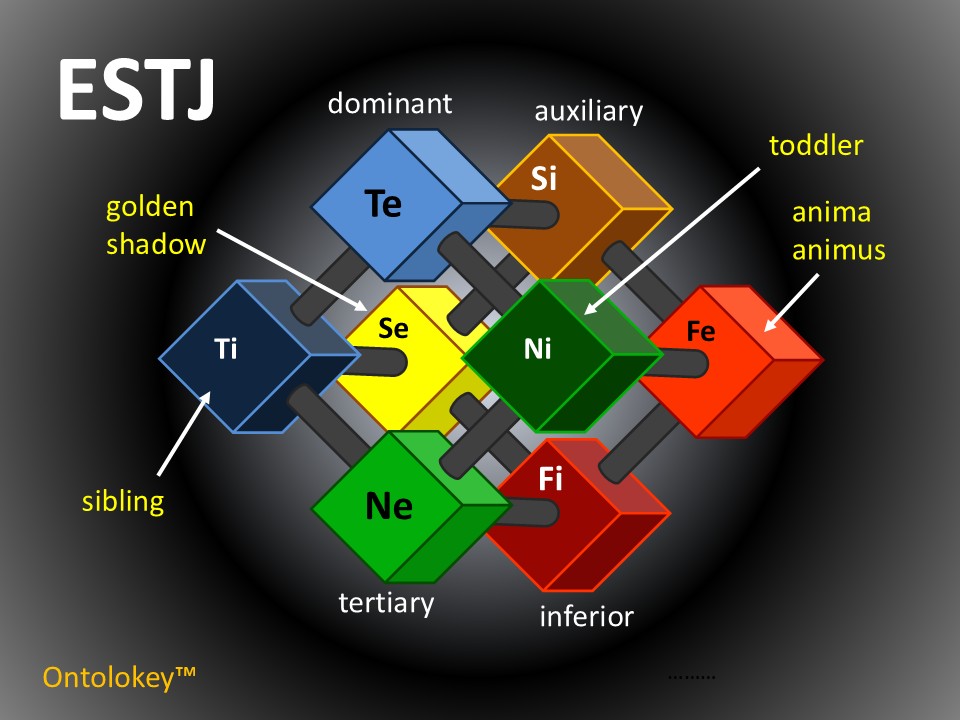
The ESTJ is classified as an extraverted, rational type. Their dominant function, extraverted thinking (Te), is balanced and challenged by a full spectrum of cognitive functions, organized in the Ontolokey cube: three immediate structural supports (Sibling, Toddler, and Auxiliary), and four deeper unconscious components (Inferior, Tertiary, Anima, and Golden Shadow). By examining each function within this multidimensional context, we gain a fuller understanding of the ESTJ not as a static identity, but as a dynamic process of individuation and integration.
1. Dominant Function: Extraverted Thinking (Te)
Te governs the ESTJ’s relationship to external systems: rules, protocols, hierarchies, metrics, and cause-effect logic. It seeks to impose objective order on the environment and evaluates actions based on efficacy and utility. This function thrives in measurable outcomes and favors consistency over ambiguity. In the Ontolokey cube, Te sits at the apex of the ESTJ’s personality, connected to three other functions that inform, support, or challenge it.
Psychologically, Te represents an external locus of rational control. In healthy development, it results in reliable, results-oriented individuals who can manage people and resources effectively. However, Te’s strength also hides a rigidity that may resist new paradigms or emotional nuance. When overemphasized, the ESTJ may fall into micromanagement, inflexibility, or utilitarian thinking at the expense of inner values and external empathy.
Across personality theories, this dominant rational-executive trait is associated with conscientiousness, task orientation, and high social responsibility. It aligns with leadership in structured environments, particularly where performance and rules dominate—military, business, administration.
2. Auxiliary Function: Introverted Sensing (Si)
Introverted Sensing (Si) serves as the ESTJ’s stabilizing anchor. Where Te reaches outward, Si turns inward, drawing from memory, tradition, and past experiences. It internalizes sensory data, creating stable internal templates that guide behavior. Si is not merely about remembering; it is about referencing what is known, familiar, and proven.
This function explains the ESTJ’s loyalty to traditions, routines, and social institutions. Si supports Te by offering a historical sense of continuity: “What has worked before is likely to work again.” This confers great reliability and duty-fulfillment, but can also lead to resistance against change or innovation.
In Ontolokey, Si is positioned as the auxiliary leg of the Te “tripod,” connected by a dynamic slider. When balanced, this axis provides a solid, grounded pragmatism. When imbalanced, the ESTJ may lean too heavily on precedent and discount intuition or innovation.
Si also governs the ESTJ’s Persona—a social mask often identified with ISFJ traits. In public settings, ESTJs may project nurturance, tradition, and social harmony, though their core orientation remains rational and directive. This modulation reflects their desire to maintain order through both structure and social cohesion.
3. Sibling Function: Introverted Thinking (Ti)
Ti introduces an internal, subjective reasoning process that differs fundamentally from Te. While Te focuses on external validity, Ti is concerned with internal logical consistency and conceptual elegance. It seeks to refine ideas down to their axiomatic core, often independent of practicality.
As the Sibling function in the Ontolokey cube, Ti presents a valuable internal check for Te’s outward systemization. It asks: “Does this make sense logically, not just functionally?” The Te-Ti slider reflects a balance between objective performance and internal logical precision.
If neglected, Ti becomes a shadow function: the ESTJ may dismiss introspective reasoning as inefficient or indulgent. But when integrated, it allows the ESTJ to innovate and troubleshoot with greater nuance. For instance, an ESTJ leader who develops Ti may become a strategic planner, not just a tactical executor.
In cognitive-behavioral terms, this function adds metacognitive reflection—the ability to examine one’s own decision-making process—which enhances adaptability, critical thinking, and philosophical depth.
4. Toddler Function: Introverted Intuition (Ni)
Introverted Intuition is the ESTJ’s Toddler function—immature, yet full of latent potential. Ni synthesizes abstract patterns and future possibilities from minimal data. It gravitates toward singular insights, often perceived as “aha” moments. To the Te-Si dominated ESTJ, this function can feel mysterious, even uncomfortable.
However, Ni’s emergence signals psychological growth. It challenges the ESTJ’s dependence on past precedent (Si) and immediate efficiency (Te), introducing long-term vision and symbolic awareness. Ni asks questions that Te avoids: “What is the deeper meaning? What lies beyond the horizon?”
Ontolokey illustrates this with a Te-Ni slider. As the ESTJ matures, they begin to entertain strategic foresight. They move from enforcing existing systems to envisioning better ones. This is the point where the ESTJ transcends from a manager to a transformational leader.
Developmentally, Ni integration requires quietude, reflection, and openness to ambiguity—qualities that don’t come naturally to the ESTJ but enrich their psychic balance.
5. Inferior Function: Introverted Feeling (Fi)
Fi is the ESTJ’s Inferior function—its farthest psychological point, yet also its most crucial developmental axis. Where Te seeks objective consensus, Fi evaluates experiences through deeply personal values. It asks: “Does this align with who I truly am?”
For the ESTJ, Fi is often a source of discomfort, vulnerability, or shame. Strong Fi values may feel like obstacles to the task-oriented Te mindset. As a result, Fi is commonly repressed or projected. Yet in Jungian psychology, the inferior function is also the gateway to transformation.
When Fi begins to emerge, the ESTJ may experience existential tension: achievements feel hollow, relationships feel transactional. If faced and integrated, Fi becomes a compass of authenticity, endowing the ESTJ with moral depth, compassion, and inner dignity.
Psychotherapeutically, confronting Fi can surface as a mid-life crisis or sudden change in priorities. ESTJs who undertake this shadow work emerge more balanced, no longer defined solely by status or output, but by principle and meaning.
6. Anima/Animus: Extraverted Feeling (Fe)
According to Jung, the Anima (or Animus in women) is the personification of the unconscious opposite gender and serves as the bridge to the collective unconscious. For the ESTJ, Fe plays this archetypal role. While it lies in the unconscious, it carries significant influence.
Fe prioritizes emotional attunement, group values, and social harmony. While it may appear that ESTJs lack this emotional intelligence, Fe actually operates in projection. They are drawn to expressive, emotionally intelligent individuals who embody qualities they struggle to access themselves.
The ESTJ’s journey toward Fe is one of relational depth. It means shifting from controlling group dynamics (Te) to resonating with them. As Fe is gradually integrated, the ESTJ begins to feel with the group, not just act upon it. This enhances empathy, diplomacy, and charisma.
From a psychoanalytic view, this process can resemble falling in love with one’s own capacity for relational wholeness—an inner marriage of function and feeling.
7. Tertiary Function: Extraverted Intuition (Ne)
Ne is the ESTJ’s tertiary function and represents a playful, exploratory openness to new ideas. It is curious, divergent, and non-linear. Unlike Te, which narrows down toward a solution, Ne expands possibilities. It brainstorms, connects dots, and sees multiple futures.
In immature forms, Ne may express as distraction or over-optimism. But as the ESTJ individuates, Ne becomes a source of inspiration and innovation. It counters the conservative Si and procedural Te with improvisation and mental agility.
In Ontolokey, Ne forms a dichotomous pair with Si. Their balance determines whether the ESTJ is adaptable or dogmatic. By cultivating Ne, the ESTJ learns to experiment, tolerate ambiguity, and respond to novel challenges with creativity.
Cognitively, this can be seen as the emergence of “divergent thinking” in an otherwise convergent personality profile.
8. Golden Shadow: Extraverted Sensing (Se)
The Golden Shadow, according to Jung, contains undeveloped positive qualities that we unconsciously admire in others. For the ESTJ, this is Se—raw sensual experience, present-moment awareness, and aesthetic vitality.
Se lives in the now. It embraces life through the senses—movement, color, pleasure, spontaneity. The ESTJ, preoccupied with control and planning, often represses these qualities or idolizes them in others (e.g., athletes, artists, risk-takers).
However, when integrated, Se unlocks vitality and spontaneity. It anchors the ESTJ in the moment, fostering joy, sensuality, and groundedness. The golden shadow represents not just what we fear, but what we secretly long to reclaim.
Through Se, the ESTJ learns that not all power is planned. Some of it must be lived, tasted, touched.
Conclusion: Toward Individuation
The Ontolokey model reveals that personality is not a fixed label but a dynamic system of tensions and integrations. The ESTJ, often misrepresented as a blunt executive, emerges as a complex psychological architecture, striving toward balance across eight functions.
From the conscious strengths of Te and Si to the aspirational depths of Fi and Se, the ESTJ type contains not only the capacity to build systems but also the call to humanize them. Through the integration of shadow and anima, and the balancing of function sliders, the ESTJ becomes not merely a commander of the world, but a steward of its meaning.
In the end, true psychological maturity lies not in dominance, but in integration. The Ontolokey cube does not just chart the ESTJ’s structure; it maps their path to wholeness.
This essay draws upon analytical psychology, contemporary personality research, and the innovative structure of Ontolokey to provide a holistic interpretation of the ESTJ. It aims to contribute to both clinical understanding and personal insight.
 Ontolokey
Leave a comment