A Comprehensive Psychological Essay
1. Introduction: Between Structure and Soul
The ESFJ personality type—often described as conscientious, empathetic, and relationship-driven—stands at a unique intersection of external sensitivity and internal order. Often referred to as “the caregiver” or “the consul,” the ESFJ draws psychological strength from social harmony, tangible routines, and value-based actions. But beneath the surface of social adaptability and structured empathy lies a complex psychological ecosystem governed not only by conscious preferences but also by unconscious motivations, archetypal energies, and repressed potentials.
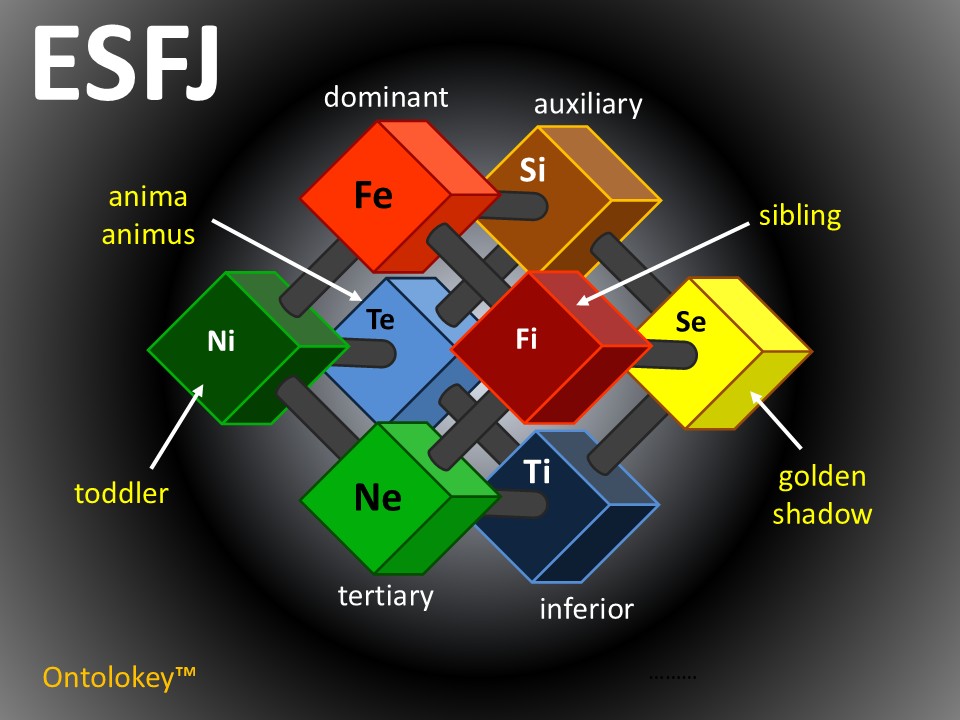
The Ontolokey framework provides a multidimensional approach to understanding this complexity. Unlike conventional models that limit personality to four dichotomies or traits, Ontolokey visualizes all eight psychological functions—dominant, auxiliary, tertiary, inferior, as well as the less-conscious Anima/Animus, Sibling, Toddler, and Golden Shadow. These functions are dynamically interconnected through a 3D color-coded cube, with sliding mechanisms indicating the degree of functional integration. The ESFJ personality, viewed through this lens, becomes less a fixed type and more a dynamic personality structure, constantly evolving through both internal tension and external experience.
2. General Orientation: Extraversion and Rational Structure
The ESFJ is an extraverted rational type. This implies that their primary mode of interaction with the world is through structured judgment, rather than perception. Their judgments, however, are not based on impersonal logic (as with thinking types), but on emotional and ethical evaluations of the environment.
As an extravert, the ESFJ draws energy from external stimuli—particularly social and relational ones. They are naturally attuned to group dynamics, community values, and emotional undercurrents. However, their rational nature means they don’t simply react to these stimuli—they evaluate, structure, and respond with purpose. Harmony is not passively maintained; it is curated and managed.
The Ontolokey cube places this evaluative capacity—extraverted feeling (Fe)—at the forefront, supported by a trinity of interconnected yet functionally opposed orientations. The ESFJ’s psychological vitality depends on how these tensions are managed.
3. Dominant Function: Extraverted Feeling (Fe)
Fe governs the ESFJ’s primary interface with the world. It is the function most responsible for the type’s reputation as warm, generous, and conscientious. But Fe is far more than simple sociability. It is a highly sophisticated regulatory mechanism that seeks to align external emotional realities with internalized ethical schemas.
Fe is concerned with interpersonal harmony, group cohesion, and shared values. It monitors social cues, modulates self-expression accordingly, and continuously negotiates between individual needs and collective expectations. In developed ESFJs, Fe operates with high attunement, often resembling emotional intelligence in action. However, Fe’s outward-directed nature may also lead to over-identification with social roles, people-pleasing behaviors, or emotional enmeshment.
From a Jungian standpoint, Fe is a rational judging function, operating in service of what is “appropriate” or “expected” based on cultural norms. When well-integrated, Fe provides empathic structure. When inflated or unbalanced, it may manifest as moral rigidity or suppressed resentment.
In Ontolokey’s dynamic model, Fe resides at one vertex of the cube, connected via edges to three functionally opposed support functions—each providing tension, contrast, and potential growth.
4. The Functional Tripod (Dreifuß)
4.1 Auxiliary Function: Introverted Sensing (Si)
Si represents the internal stabilizing force for the ESFJ. As a perception function oriented inwardly, Si works with detailed memory, habitual frameworks, and accumulated experience. It grants the ESFJ a sense of continuity, tradition, and procedural integrity.
Whereas Fe adapts to relational nuances in the moment, Si draws upon the past to create predictability and reliability. It answers the implicit question: “What has worked before?” and applies it to current contexts. This makes ESFJs methodical, tradition-oriented, and sometimes resistant to change.
Psychodynamically, Si’s orientation toward order and familiarity helps to reduce anxiety in the face of Fe’s external variability. It is also the core of the ESFJ’s pragmatic stability—what gives their ethical concerns a procedural backbone. In Ontolokey’s system, the Fe-Si edge slider indicates the extent to which harmony-seeking behavior is anchored in sensory memory and traditional structure.
4.2 Sibling Function: Introverted Feeling (Fi)
Fi, though less conscious, is crucial for the ESFJ’s internal emotional integrity. Unlike Fe, which evaluates based on shared norms, Fi asks, “Is this right for me?” It is a deeply personal, moral compass. In the ESFJ psyche, Fi typically exists as a contrast function—often repressed but influential during internal crises or moments of deep authenticity.
An unbalanced ESFJ may suppress Fi in favor of external approval, resulting in emotional burnout or a loss of self-definition. However, with maturity, the integration of Fi allows the ESFJ to honor their internal emotional truths even when these contradict group expectations.
In the Ontolokey cube, the Fe-Fi axis is one of internal tension. The sliding mechanism here reveals the delicate balance between external harmony and internal authenticity—a crucial developmental task.
4.3 Toddler Function: Introverted Intuition (Ni)
Ni functions in the ESFJ as a nascent, childlike sense of inner vision—often subconscious, abstract, and underdeveloped. It seeks patterns, symbolic meaning, and long-term implications. But because it exists in tension with the ESFJ’s concrete, sensory focus (Si), it is often neglected or misunderstood.
Nevertheless, Ni holds immense developmental potential. It challenges the ESFJ to look beyond the literal, to consider metaphor, archetype, and psychological symbolism. When accessed, it can manifest as uncanny insight into others’ long-term motivations or as a desire for spiritual integration. In early life, it may emerge as fantasy or idealization. With maturity, it becomes a portal to inner wisdom and intuition.
Ni’s development is reflected in the Fe-Ni slider on the cube—often dormant in youth but pivotal for midlife individuation.
5. Persona: The ISTJ Mask
In the Ontolokey model, the Persona represents the functional mask adopted for social survival or ego stability—particularly under stress or social pressure. For the ESFJ, this mask often resembles the ISTJ personality, relying heavily on Si and Te (introverted sensing and extraverted thinking).
This means that in challenging environments, the ESFJ may become overly procedural, emotionally distant, or bureaucratic. This is a defensive adaptation—an attempt to protect the vulnerable emotional core (Fe-Fi) by retreating into rigid order and impersonal systems.
Understanding this persona is key in therapy and development: it reveals not only the ESFJ’s defensive strategies but also their potential for resilience and adaptation.
6. The Shadow Complex: The Four Unconscious Functions
6.1 Inferior Function: Introverted Thinking (Ti)
Ti, the functional opposite of dominant Fe, is the most repressed and feared function in the ESFJ psyche. It values logical coherence, internal consistency, and intellectual detachment. For the Fe-dominant ESFJ, Ti represents coldness, impersonality, and internal doubt.
However, its integration is essential. Without Ti, the ESFJ risks becoming morally reactive, logically inconsistent, or overly dependent on emotional validation. The development of Ti allows for discernment, boundary-setting, and principled decision-making unclouded by social pressure. In the cube, the Fe-Ti edge defines this dialectic of emotional ethics versus internal logic.
6.2 Anima/Animus: Extraverted Thinking (Te)
Te represents the archetypal soul figure—the animating spirit or unconscious inner personality. It is often projected onto leaders, systems, or individuals who embody decisive authority and strategic logic. For the ESFJ, Te is both fascinating and threatening.
When integrated, Te grants the ESFJ clarity of purpose, executive power, and strategic objectivity. When disowned, it results in the idealization of authority and self-doubt. The Te-Ni edge in the cube reveals the potential for visionary leadership, provided that inner authority is claimed rather than projected.
6.3 Tertiary (Blindspot): Extraverted Intuition (Ne)
Ne is the function of possibility, divergence, and playful exploration. As a blindspot, it is often inaccessible to the ESFJ, who may find too many options disorienting. However, its development fosters cognitive flexibility, creativity, and openness to innovation. The Ne-Si dichotomy reveals the internal struggle between tradition and novelty.
6.4 Golden Shadow: Extraverted Sensing (Se)
Se is the embodiment of vitality, aesthetic presence, and physical immediacy. The ESFJ may idealize people who are bold, spontaneous, stylish, or physically confident. These qualities, though admired, may feel foreign.
In Jungian psychology, the shadow is morally neutral. The golden shadow contains traits we admire but disown. Integrating Se allows the ESFJ to experience aliveness, sensuality, and immediacy—qualities essential for wholeness.
7. The Sliders and the Dance of Integration
Ontolokey’s 3D model includes 12 dynamic sliders between function-pairs. For the ESFJ, the most crucial sliders early in life are:
- Fe–Si: Balancing relational harmony with procedural structure.
- Fe–Fi: Navigating external expectations versus internal truth.
- Fe–Ni: Incorporating intuition and symbolic foresight.
Later development requires attention to:
- Ti–Ne–Se: Embracing experimentation, objectivity, and spontaneity.
Development is not about replacing one function with another, but calibrating and integrating them.
8. Conclusion: From Type to Transformation
The ESFJ personality, when viewed through the Ontolokey model, transforms from a stereotype of sociability to a nuanced psychological organism—one whose core impulse is to connect, harmonize, and sustain. Yet this impulse requires balance: from emotional subjectivity to logical coherence, from social roles to personal truth, from structure to spontaneity.
Ontolokey uniquely illustrates this balance. By making all eight functions visible, and allowing for the dynamic interplay of conscious and unconscious, it provides not just a typology but a developmental roadmap. The fully individuated ESFJ becomes not merely a caretaker, but a wise integrator of emotion, tradition, logic, and insight—a whole self in a fragmented world.
 Ontolokey
Leave a comment