A Comprehensive Functional Analysis Inspired by Carl Gustav Jung
Introduction: Mapping the ENFJ as an Extraverted Rational Type in Eight Dimensions
The ENFJ personality type is often characterized in popular psychology as empathetic, charismatic, and visionary. Yet such descriptions remain incomplete without an in-depth exploration of the intricate psychodynamic forces that constitute this type’s inner architecture. Ontolokey, a model grounded in Jungian analytical psychology, offers a multidimensional framework by which we may illuminate not only the ENFJ’s four conscious functions, but also the four unconscious ones that complete the psychological structure.
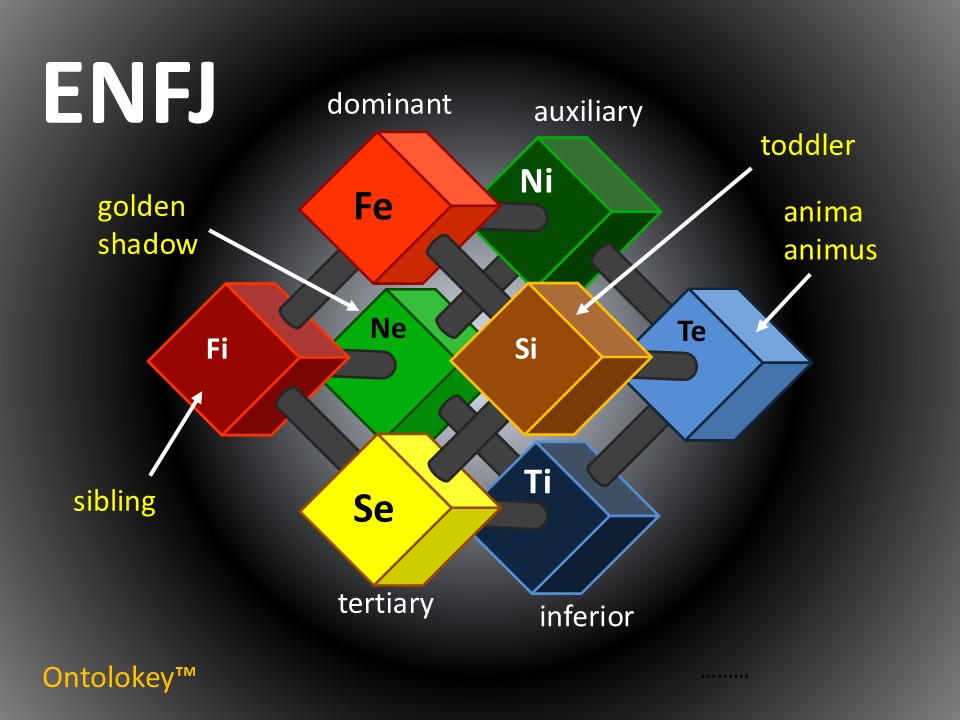
Unlike other models that often emphasize type labels and static preferences, Ontolokey presents the psyche as a dynamic interplay of eight functions, represented as corners of a color-coded 3D cube. This cube features movable sliders along the connecting edges, visually depicting the degrees to which each function is utilized or integrated. Through this lens, the ENFJ is revealed as an extraverted rational type whose development hinges on balancing external harmony with inner authenticity, and intuitive vision with concrete presence.
1. Dominant Function: Extraverted Feeling (Fe) – The Social Harmonizer
At the core of the ENFJ psyche lies extraverted feeling (Fe), a function fundamentally concerned with social dynamics, interpersonal ethics, and emotional congruence. Fe evaluates the world through relational standards: What is acceptable within a group? What brings harmony or dissonance? What emotional tone is collectively appropriate?
This function is not merely emotional, but evaluative and rational in structure. Fe seeks to optimize emotional equilibrium across systems—family units, organizations, communities. ENFJs become the emotional barometers of their environment. Their ability to read emotional cues and adapt themselves accordingly often grants them social influence, leadership, and trust.
However, the sophistication of Fe goes beyond people-pleasing. Fe-dominant individuals may leverage their understanding of emotional landscapes to guide, persuade, or even morally compel others. In professional settings, this makes ENFJs excellent counselors, educators, negotiators, and motivational figures. The shadow side, however, may include self-effacement, emotional overextension, or manipulative harmonization in the name of peace.
Fe is the ‘camera’ in Ontolokey’s tripod analogy, and is stabilized by three supporting legs: the auxiliary, sibling, and toddler functions. Understanding these connections is vital to grasp the full scope of the ENFJ’s psychological landscape.
2. Auxiliary Function: Introverted Intuition (Ni) – The Visionary Compass
Introverted intuition (Ni), the ENFJ’s auxiliary function, acts as a guiding star. While Fe engages with the present and the social, Ni delves into the abstract and the internal. It seeks patterns, symbolic meanings, and overarching narratives. For the ENFJ, Ni provides strategic foresight, often leading to an uncanny ability to anticipate events or discern others’ developmental trajectories.
This function makes the ENFJ not just responsive, but visionary. They are drawn to systems thinking, spirituality, psychology, and other frameworks that offer unified explanations for human behavior. Ni contributes a depth of focus that balances Fe’s breadth of connectivity. It allows ENFJs to step back from the immediacy of human need and view the emotional ecosystem from a higher vantage point.
Importantly, Ni is also what gives many ENFJs their sense of calling. They are not merely social beings—they are often mission-driven, seeking to lead others toward transformation or wholeness. Ni gives meaning to their relational investments and provides the inner map that Fe then externalizes in the world.
3. Sibling Function: Introverted Feeling (Fi) – The Unseen Moral Core
Though under the radar, introverted feeling (Fi) represents a vital, if often suppressed, counterpart to Fe. Fi values personal authenticity, subjective emotional truth, and individual ethical standards. In the Ontolokey cube, Fi sits adjacent to Fe, connected by a slider representing the continuum between internal and external emotional judgment.
ENFJs often over-rely on Fe, seeking external validation and harmony at the expense of their internal moral compass. When Fi is neglected, they risk emotional codependency, loss of personal boundaries, and burnout. Conversely, when Fi is integrated, the ENFJ becomes more grounded, able to say “no,” and more emotionally honest even in the face of social disapproval.
Fi, though quiet, serves as a source of inner truth. It helps the ENFJ distinguish between what is genuinely meaningful to them versus what is socially expected. In therapy or deep introspection, activating Fi often leads to powerful breakthroughs in self-understanding and individuation.
4. Toddler Function: Introverted Sensing (Si) – The Ground Beneath the Feet
The toddler function in Ontolokey refers to a function that operates in a primitive or childlike way—in this case, introverted sensing (Si). Si is concerned with past experiences, bodily awareness, safety, and routine. For ENFJs, this function is underdeveloped and thus may present as a blind spot in areas like physical self-care, memory recall, or logistical consistency.
ENFJs may neglect basic needs, become disorganized, or feel overwhelmed by too much sensory input. Si operates like a young child: needy, vulnerable, and often ignored. Yet, the development of Si brings profound benefits. It grants stability, health awareness, and the ability to ground visionary goals in repeatable, sustainable actions.
As the slider between Fe and Si shifts, the ENFJ moves from reactive emotionalism to embodied presence. Rituals, mindfulness practices, and somatic therapies are especially helpful in this integration.
5. Inferior Function: Introverted Thinking (Ti) – The Architect in the Shadows
Introverted thinking (Ti) is the ENFJ’s inferior function and thus presents the greatest long-term developmental challenge. Ti is focused on internal logical coherence, impersonal analysis, and structural clarity. Where Fe asks “What do others feel is right?”, Ti asks “Does this make objective sense?”
Because it resides in the inferior position, Ti often emerges in moments of stress or existential questioning. The ENFJ may suddenly become hypercritical, rigid, or intellectually insecure. Yet, Ti also holds the key to individuation. When accessed healthily, it grants the ENFJ the ability to detach from social approval and assess ideas on their own logical merits.
The integration of Ti transforms the ENFJ from a charismatic influencer to a wise, balanced leader who not only inspires but also analyzes, designs, and critiques with precision.
6. Anima/Animus: Extraverted Thinking (Te) – The Unconscious Drive for Effectiveness
The anima or animus in Jungian terms is the unconscious opposite-gendered aspect of the psyche. For ENFJs, this is often extraverted thinking (Te)—a function that values measurable results, objective structures, and external efficiency.
Te may be suppressed or even projected. ENFJs might admire (or resent) people who “get things done” with no regard for emotional nuance. Yet, Te is not the enemy; it is the latent masculine principle (in women) or inner taskmaster (in men) that drives effectiveness, ambition, and impact.
When Te is integrated, the ENFJ becomes organizationally powerful. They balance empathy with execution. This integration is particularly important in leadership roles, where the emotional vision of Fe-Ni must be grounded in the logistical clarity of Te.
7. Tertiary Shadow Function: Extraverted Sensing (Se) – The Raw Force of Experience
Se in the ENFJ is tertiary and unconscious, often underdeveloped or misused. It represents real-time sensory engagement: pleasure, action, risk, spontaneity. ENFJs may either underutilize Se (becoming overly cautious and idealistic), or overindulge in it during stress (impulsive spending, sensory overload).
When Se is ignored, the ENFJ becomes disconnected from their physical reality. They may forget to eat, neglect surroundings, or appear disembodied. When embraced, Se enhances charisma, presence, and appreciation for life’s immediacy.
Art, dance, and physical movement help cultivate this function. Se roots the visionary into the present moment.
8. The Golden Shadow: Extraverted Intuition (Ne) – The Disowned Genius
The golden shadow, in Jungian terms, is the positive potential we unconsciously deny. For ENFJs, this is extraverted intuition (Ne): the engine of divergent thinking, novelty, and expansive ideation. While Ni seeks one truth, Ne opens many doors.
ENFJs may idealize spontaneous, eccentric thinkers, unaware that their own Ne is waiting to be acknowledged. This function brings humor, creativity, and the ability to improvise. Its integration softens the ENFJ’s tendency toward over-control and perfectionism.
Creativity workshops, brainstorming, and open-ended exploration allow Ne to surface. In doing so, the ENFJ reclaims their suppressed imaginative genius.
Conclusion: Toward Integration and Individuation
The ENFJ, when viewed through the Ontolokey model, is revealed not as a fixed type but as a fluid constellation of psychological energies. Their growth hinges on developing neglected functions, integrating unconscious potentials, and balancing emotional harmony with personal truth and logic.
Ontolokey’s sliders and edges allow a visual and structural approach to this journey. Through conscious effort, the ENFJ can transition from relational expert to individuated leader—a person of vision, empathy, logic, and presence. All eight functions matter, and the journey toward wholeness begins by giving each of them a seat at the table.
 Ontolokey
Leave a comment