A Deep Psychological Analysis of the Eight Functions
Introduction
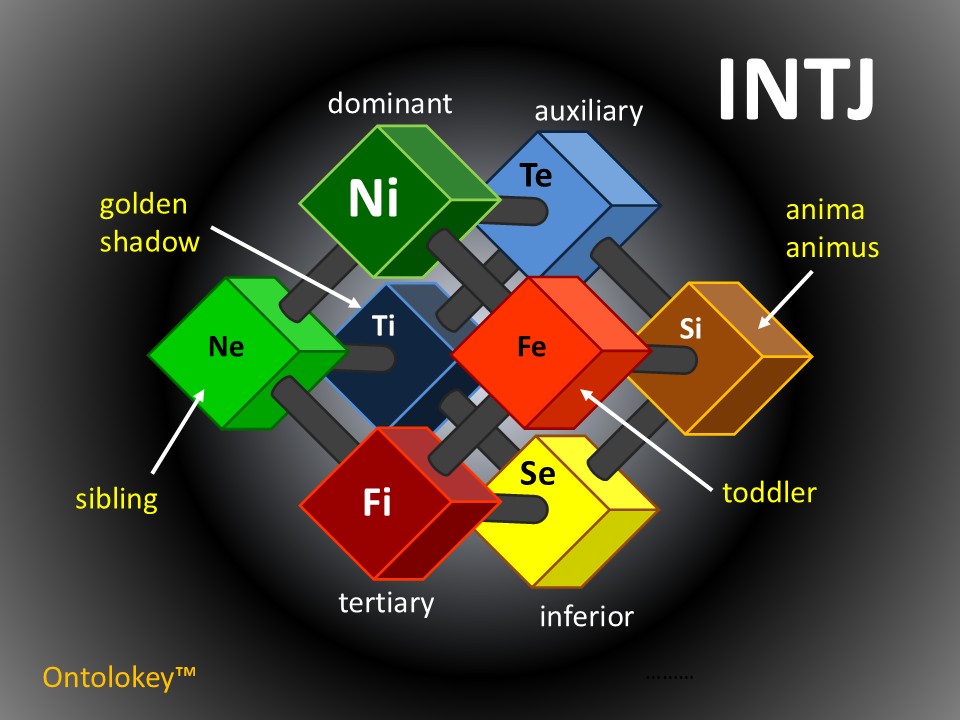
The INTJ personality type is often described as strategic, autonomous, and vision-driven. Yet beyond the stereotypical image of the “Mastermind” lies a profoundly complex psychological architecture. Ontolokey, a model grounded in Carl Gustav Jung’s theory of psychological types, provides a revolutionary framework for understanding the INTJ in full psychological depth. Unlike traditional typologies that focus on only four cognitive functions, Ontolokey visualizes all eight through a 3D cube with dynamic sliders that reveal the balance and tension between conscious and unconscious elements. This essay offers a thorough psychological portrait of the INTJ type, based on the Ontolokey model and enriched with complementary insights from analytical psychology and contemporary personality theories.
1. Dominant Function: Introverted Intuition (Ni)
“I perceive the future not as a possibility, but as a certainty in motion.”
At the core of the INTJ personality lies Introverted Intuition (Ni), a function that operates beneath the surface of conscious thought. Unlike linear or deductive reasoning, Ni functions holistically and symbolically. It perceives patterns in seemingly unrelated events and integrates them into cohesive mental models. Ni is not merely imaginative—it is profoundly anticipatory.
Psychologically, Ni-dominant individuals often report an internal sense of “knowing” without being able to articulate the steps by which they arrived at a conclusion. This is because Ni works on a subconscious level, feeding the conscious mind sudden insights, long-range visions, or ideological structures. These insights often appear as metaphors or images before they can be translated into language or plans.
INTJs rely on Ni to develop personal frameworks about how the world works. Unlike extraverted types who adjust themselves to reality, the Ni-dominant INTJ builds an internal schema and expects the external world to align with it. This can be a source of genius—but also rigidity.
In terms of psychic energy (libido in Jungian terms), Ni pulls energy inward and downward into the unconscious. This descent into the depths brings clarity and purpose but can also isolate the INTJ from sensory immediacy or emotional warmth. Without balancing mechanisms, Ni can overtake the psyche, manifesting as obsession, prophetic detachment, or even apocalyptic thinking.
2. Auxiliary Function: Extraverted Thinking (Te)
“Let’s systematize that vision into something actionable.”
Te, as the INTJ’s auxiliary function, serves to extravert the insights born from Ni. Te brings structure, efficiency, and logical order to the INTJ’s vision. It ensures that ideas are not merely imagined, but implemented, refined, and measured.
This function favors external standards of logic and productivity. It values timelines, objectives, and systems. Whereas Ni intuits what will happen, Te determines how to make it happen.
From a developmental standpoint, Te plays a vital role in the INTJ’s engagement with the world. It is the primary channel through which INTJs interact with their environment, often giving them the appearance of cold rationality or executive decisiveness. In reality, however, Te is a servant of Ni’s vision—it does not originate meaning but gives it structure.
When Te is overused at the expense of the tertiary Fi (introverted feeling), the INTJ can become utilitarian, dismissive of emotional nuance, or overidentified with competence. They may focus excessively on results, forgetting the ethical or human implications of their actions.
Within the Ontolokey cube, Te is directly linked to Ni through a flexible slider. This dynamic illustrates the psychological tension between inner vision and outer execution—between what is meaningful and what is efficient. A balanced slider represents a mature INTJ who can operationalize insight without sacrificing authenticity.
3. Sibling Function: Extraverted Intuition (Ne)
“But what else could it be?”
Extraverted Intuition (Ne) offers the INTJ an alternative perceptual mode—one that diverges from Ni’s convergent style. Whereas Ni narrows focus toward a singular vision, Ne broadens perception toward multiplicity, playfulness, and serendipity. It generates options, connections, and interpretations.
In the Ontolokey model, the Ni-Ne axis represents the internal tug-of-war between certainty and curiosity, between singularity and pluralism. Ne is the INTJ’s sibling function—close in nature, but pulling in a different direction.
Psychologically, access to Ne allows the INTJ to loosen their grip on control and explore paths not previously considered. A healthy engagement with Ne enriches creativity, prevents dogmatism, and supports innovation. However, immature or suppressed Ne can lead to restlessness, fragmented attention, or a tendency to chase distractions.
The slider between Ni and Ne is crucial in the developmental process. INTJs who learn to balance these two intuitive styles become more open-minded and exploratory while still retaining their depth of insight.
4. Toddler Function: Extraverted Feeling (Fe)
“Am I attuned to the emotional atmosphere around me?”
Fe represents the INTJ’s toddler function—a psychological component with limited maturity and conscious control. Fe manages social harmony, emotional expression, and group values. For INTJs, whose dominant mode is introverted and impersonal, Fe can feel alien or burdensome.
Immature Fe expression often manifests as social awkwardness, insensitivity, or difficulty navigating group dynamics. INTJs may find small talk meaningless or emotional displays uncomfortable. However, when Fe is integrated through development, it fosters emotional intelligence, diplomatic awareness, and social influence.
In the Ontolokey cube, Fe is one of the three support legs to Ni. The Ni-Fe slider reveals the degree to which the INTJ is aware of, and responsive to, the emotional needs of others. Neglecting this function can lead to miscommunication, professional friction, or emotional detachment. Cultivating it brings nuance, relatability, and interpersonal grace.
5. Inferior Function: Extraverted Sensing (Se)
“What is happening in the present moment?”
Extraverted Sensing (Se) is the INTJ’s inferior function—the psychic counterweight to Ni. It focuses on the external world as it is: colors, textures, movements, and sensations. While Ni looks inward and forward, Se demands presence and immediacy.
Because Se is deeply repressed in the INTJ, it often manifests as either a blind spot or a source of psychological turmoil. In moments of stress, the INTJ may become compulsive, thrill-seeking, or overwhelmed by sensory stimuli. Alternatively, they may deny their body’s needs, ignore aesthetic surroundings, or resist spontaneity.
Yet paradoxically, Se is the gate to individuation. When an INTJ learns to honor their sensory awareness—through nature, physical activity, or art—they reconnect with reality, vitality, and spontaneity. The Se-Ni axis reflects the central Jungian polarity between unconscious instinct and conscious vision.
6. Anima: Introverted Sensing (Si)
“Where is my inner sanctuary?”
Si, as the Anima (or Animus), represents the INTJ’s internalized soul-image—an unconscious embodiment of their emotional foundation. Si deals with internal sensations, traditions, and stored impressions. While Ni constructs the future, Si anchors the past.
In Jungian terms, the Anima mediates between ego and unconscious, often appearing in dreams, fantasies, or projections. For the INTJ, Si may appear as a nostalgic longing for safety, continuity, or inner peace. When unrecognized, Si may provoke regression into comfort rituals or hypersensitivity to change.
However, developing a relationship with the Anima allows the INTJ to access a richer emotional life, embodied awareness, and a sense of rootedness. It helps balance their forward momentum with reflective stillness.
7. Tertiary Function: Introverted Feeling (Fi)
“What do I truly believe in?”
Fi governs internal values, ethical coherence, and emotional authenticity. As a tertiary function, Fi is not fully conscious in most INTJs—yet it is vital for integrity and personal alignment. It operates like a moral compass, quietly evaluating whether one’s actions match inner convictions.
A neglected Fi can lead to disconnection from self or moral rigidity. An integrated Fi, however, empowers the INTJ to act with conscience, express vulnerability, and relate to others on a deeply personal level.
Fi serves as a dichotomous counterpart to Te. Together, they define the INTJ’s axis of rationality and ethics: Te asks what works; Fi asks what matters. Ontolokey makes this tension visible, urging the INTJ toward integration.
8. Golden Shadow: Introverted Thinking (Ti)
“I want to understand the inner logic—just for its own sake.”
Ti represents the INTJ’s golden shadow—the repressed but luminous potential within. Ti pursues internal logical consistency, precision, and theoretical clarity. Unlike Te, which acts outwardly, Ti analyzes inwardly.
When Ti is not integrated, INTJs may project it onto others, idealizing those who are intellectually independent, hyper-analytical, or self-contained. They may admire this quality while denying its presence within themselves.
By reclaiming the golden shadow, INTJs tap into a more elegant cognitive process—one that values internal alignment over external validation. The integration of Ti leads to greater autonomy, analytical subtlety, and philosophical insight.
9. Dynamic Integration: The Role of the Sliders
Ontolokey’s model of twelve dynamic sliders allows for a uniquely nuanced psychological map. For INTJs, the most impactful sliders in early development are:
- Ni–Te: How effectively can insight be structured and applied?
- Ni–Fe: How well is deep understanding communicated emotionally?
- Ni–Ne: How flexible is the vision—can it accommodate ambiguity?
Later in the individuation journey, additional axes come into play:
- Ti–Te: Is logical precision aligned with practical execution?
Each slider functions not only as a diagnostic but as a developmental guide. The goal is not to “maximize” one function, but to balance, integrate, and evolve.
10. Conclusion: Individuation as Integration
Ontolokey moves beyond static typologies by framing personality as a dynamic system of interacting psychic functions. The INTJ, far from being a cold strategist, is revealed as a rich psychological ecosystem—one defined by visionary perception, rational execution, internal ethics, and a profound path of individuation.
True development arises not from amplifying strengths, but from integrating the shadow, embodying the Anima, and harmonizing all eight functions. In this light, the INTJ becomes not merely efficient or intelligent—but wise, whole, and psychologically sovereign.
 Ontolokey
Leave a comment