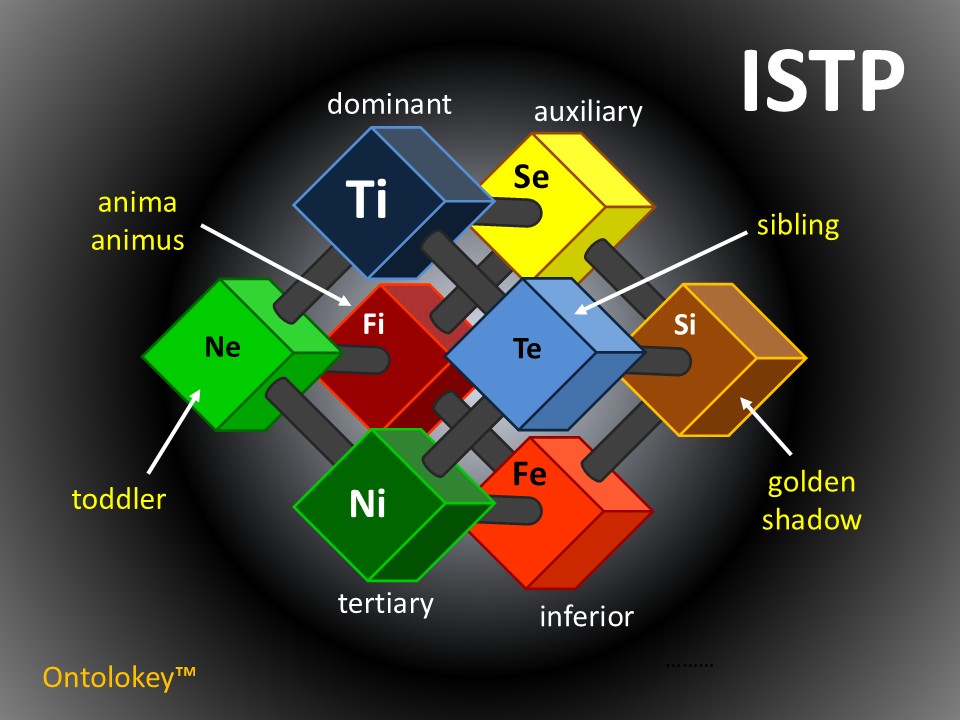
The ISTP personality reveals a quiet intensity—a mind that thinks deeply and a heart that quietly observes emotions at arm’s length. At its core lies Introverted Thinking (Ti), an inner workshop where logic is king. Everything is dissected, tested, refined—this intellectual sanctuary offers independence and precision, where ideas become internal models built on clarity rather than convention. Those who live within it seldom voice their internal reasoning, but rather act it out, guided by internal consistency and refined judgement.
Supporting this internal terrain is Extraverted Thinking (Te), the Sibling function. It bridges Ti’s internal logic with external action—planning, structuring, executing. Te demands efficiency and order in the outer world. Though often seen as a secondary, organizing counterpart, it’s deeply needed for manifesting internal insights into practical outcomes. In Ontolokey terms, the slider between Ti and Te typically balances around where the sense of internal clarity meets external performance and reliability.
The Toddler function for ISTP in this framework is Extraverted Intuition (Ne)—an unexpected turn, but a lively one. Ne introduces novelty, possibilities, and divergent thinking. Though it’s less consciously accessible for ISTPs, it nonetheless sparks curiosity, helping them explore alternatives and envision creative solutions—especially in moments of experimentation or problem‑solving that resist conventional logic.
Meanwhile Extraverted Sensing (Se), often described in function‑stack theory as auxiliary for ISTPs, is in Ontolokey the function that grounds the individual in the physical world. It connects the ISTP to movement, sensation, immediacy—whether mastering a physical skill, handling machinery, or perceiving detail at lightning speed in high‑pressure situations. Se is the anchor when Ti drifts too far into abstraction.
Yet none of these four conscious or semi‑conscious functions operate in isolation. Ontolokey insists: all eight psychological functions matter. So we turn to the hidden depths.
The inferior function is Extraverted Feeling (Fe)—a majestic but terrifying force. In the ISTP psyche, Fe represents emotional resonance, group harmony, and connection. It is the unwelcome monarch that Ti reveres yet fears. It acts as a measuring stick against societal expectations. Under stress, it bubbles to the surface—sometimes in bursts of emotion or desperate attempts at empathy—revealing how deeply the ISTP craves belonging, even if in quiet denial.
Beneath surface thought lies Introverted Feeling (Fi), the Anima or Animus. It is an inner mirror—an unconscious well of values, authenticity, and emotional truth. Though rarely articulated, Fi shapes the ISTP’s longing for real intimacy and meaning. It may stir unseen, prompting deep but silent resonance at the sight of honesty or betrayal. It’s not dramatic, but it touches the soul.
At the same time, Introverted Intuition (Ni), the Ontolokey Blindspot or tertiary, acts in subtle, uncanny ways. Ni offers flashes of insight—a gut feeling, a pattern recognized before fully understood. It’s quiet, rarely trusted, often dismissed; yet under pressure, it surfaces as foresight, or an inexplicable hunch that turns out right.
Though rarely trusted, Ni sometimes emerges through subtle, non-verbal forms—such as a pull toward introspection, symbolism, or even spiritual disciplines. Many ISTPs, perhaps unexpectedly, find grounding and quiet clarity in practices like yoga, martial arts, or meditation. These rituals allow them to tune into inner patterns and intuitive rhythms of the body and mind without needing to explain them. It’s not uncommon to find ISTPs who run yoga schools or quietly devote themselves to spiritual traditions—not out of dogma, but through lived, experiential understanding. In these moments, the blind spot begins to illuminate, gently balancing action with insight.
Finally, the golden shadow of the ISTP is Introverted Sensing (Si). It represents memory, bodily awareness, tradition, continuity. In traditional typology Si plays a minor or shadow role, but here it holds hidden strength—it grounds the ISTP’s memory and lived experience in a body, in rituals, in sensation. Though often overlooked, Si is the quiet voice reminding them of past patterns, physical comfort, and embodied presence.
Taken together, these eight functions form a dynamic psychological ecosystem. Ti governs inner logic. Te and Ne connect thought to structure and possibility. Se sustains presence. Fe challenges emotional engagement. Fi offers emotional authenticity. Ni hints at unseen meaning. Si roots experience in time and sensation. Ontolokey’s sliders track this interplay, showing where balance lies or where shadow looms.
According to the developmental arc, full integration of Fe and Si paves the way toward transformation—toward a “royal personality type” in Ontolokey’s framing, the ENFJ. This archetype symbolizes social leadership, emotional maturity, and a deeply engaged presence in the world—something toward which the ISTP can grow by integrating these initially neglected functions.
In essence, the ISTP in this framework is more than a solo thinker or hands‑on problem solver. They are explorers of logic who must learn to embrace feeling, sensation, intuition, and memory to become whole. They are silent climbers of an internal landscape whose summit lies in integrating every facet—the rational and the sensitive, the immediate and the intuitive, the internal modeler and the external human being.
 Ontolokey
Leave a comment