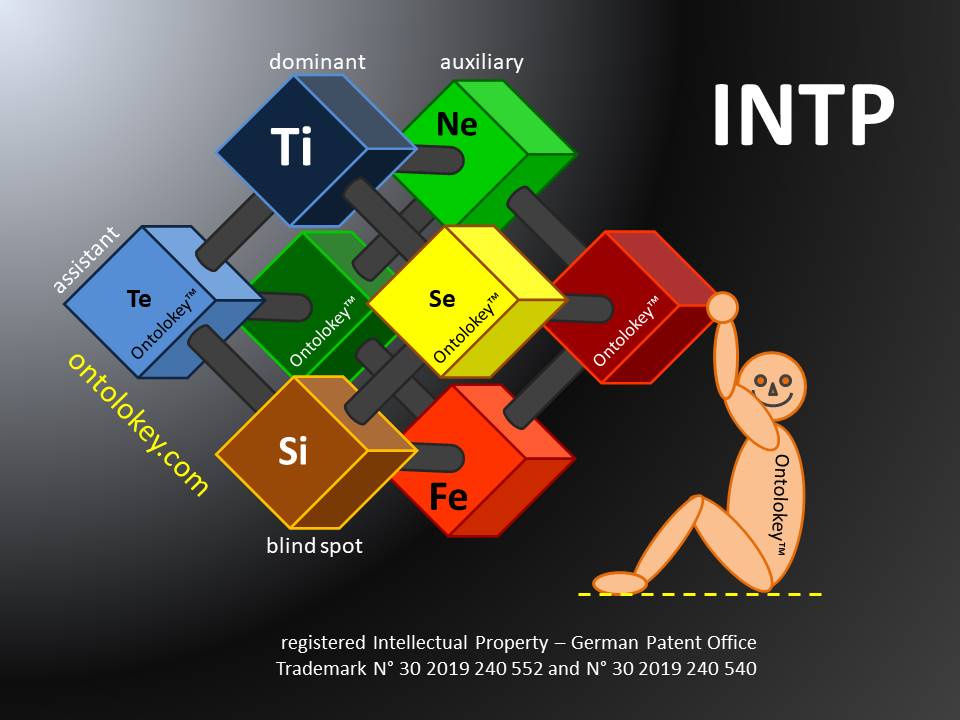
Understanding Introverted Thinking: The Core Principle
Introverted Thinking (Ti) is a cognitive function that seeks internal consistency, coherence, and clarity of thought. It is primarily subjective in orientation, not in the sense of being irrational, but in that it prioritizes the internal framework of logic over the external validation of facts.
This function does not derive its conclusions from outer experience, but rather starts from internal hypotheses, models, or symbolic images—what Jung would refer to as “archetypal contents” or “primordial images”—and attempts to refine them through mental analysis.
Key Characteristics:
- Inner Logical Framework: Ti-users build complex models of how things should work, often independent of real-world messiness.
- Detached Objectivity: Ironically, although subjective in orientation, Ti aims at objectivity within the self—”what makes sense internally must be true.”
- Reduction to Principles: It seeks to strip phenomena down to their most essential conceptual core.
📘 Think of Immanuel Kant: Instead of analyzing how we experience the world, he analyzed the conditions that make experience possible.
While this thinking can be incredibly innovative and synthetic, it risks detachment from external reality, especially when it uses the outer world only to confirm what is already internally accepted.
The Role of External Facts: Supportive, Not Foundational
Introverted thinking has a complicated relationship with empirical data. External facts are not inherently interesting unless they illustrate or support an internal idea. The thinker collects data selectively, using it to confirm or test their inner models—but never to derive those models.
This is in stark contrast to Extraverted Thinking (Te), which builds frameworks from observed regularities in the outer world.
🔬 Where Te might conduct an experiment to gather data for a hypothesis, Ti might build a hypothesis based on logical necessity and then seek data to confirm or illustrate it.
Risks of Ti:
- Confirmation Bias: Since facts are often used to validate internal models, opposing data may be downplayed or ignored.
- Detachment: If taken too far, Ti becomes self-referential—seeking internal harmony over practical usefulness.
- Symbolic Dominance: Over time, ideas may become highly abstract or even “mythological” in nature, operating more like symbolic truths than practical insights.
This function is excellent for theory-building, model construction, and philosophical analysis, but less reliable for grounded decision-making in environments where adaptive responses to facts are required.
Symbolism, Archetypes, and the Mythological Drift
One of the most striking features of introverted thinking—especially in highly developed or imbalanced individuals—is its tendency to internalize meaning symbolically. The “truth” of an idea becomes less dependent on its external applicability and more on its resonance with internal archetypes—universal, unconscious patterns deeply embedded in the human psyche (Jung’s archetypal theory).
Symbolic Thinking:
- A Ti user may see causality, time, or identity not as observable phenomena, but as symbolic systems.
- The value of a theory lies in how well it “feels” true within the internal schema, rather than how verifiable it is.
- Eventually, this symbolic world can become cut off from experience, resulting in ideas that are internally consistent but practically unusable.
⚠️ At this point, Ti becomes prone to what Jung calls “mythologizing”—a process where abstract thought morphs into symbolic narratives disconnected from empirical verification.
Psychological Risk: Overidentification with the Inner Image
When Ti is not balanced by other functions (such as Extraverted Sensation or Feeling), the individual may fall into a state where they over-identify with their inner constructs. The thinker may come to believe that if something makes internal sense, it is necessarily true or universally valid.
This leads to:
- Dogmatism: Ideas become non-negotiable.
- Alienation: Others are seen as intellectually inferior or irrelevant.
- Resistance to feedback: Since the validity of the idea is internal, criticism from the outside is dismissed or taken personally.
Over time, this process may lead to psychological inflation, where the ego fuses with the idea, believing itself to be the source of ultimate truth.
🧠 In Jungian terms, the ego becomes “possessed” by an archetype, unable to distinguish itself from the symbolic truth it represents.
When the Unconscious Responds: Archetypal Compensation
As the conscious mind contracts into a narrow inner logic, the unconscious responds by flooding the psyche with archaic, symbolic material—often in dreams, fantasies, or irrational impulses. Jung refers to this process as compensation: the psyche attempting to restore balance.
Depending on the individual’s secondary function, this may manifest as:
- Intuition: Vivid, surreal imagery (à la Alfred Kubin or Gustav Meyrink)
- Feeling: Intense, irrational emotional reactions
- Sensation: Hypersensitivity to bodily or sensory experiences
These can be both creative and destructive. If integrated, they renew the personality. If resisted, they lead to dissociation, confusion, or even psychasthenia—a state marked by mental fatigue, indecision, and obsessive doubts.
The Introverted Thinking Personality: Strengths and Pitfalls
The person dominated by Ti is typically:
- Highly independent in thought
- Detached from social conventions
- Skeptical of external authority
- More concerned with depth than breadth
While they may appear cold or aloof, they are often deeply principled and morally serious, albeit by their own standards.
Common Issues:
- Struggles with social relationships due to indifference to the emotional needs of others.
- Tends to underestimate the value of practical execution or external validation.
- Poor ability to communicate ideas effectively, especially in group or teaching settings.
- Reluctance to “sell” ideas—believing their value should be self-evident.
Paradoxically, while fiercely independent, they may become naively suggestible in personal relationships, especially when the other party seems non-threatening. This can lead to exploitation, which they often fail to notice until it’s too late.
Neurotic Outcomes: Isolation, Rigidity, and Inner Conflict
If Ti remains unbalanced over time, it can become pathological. The individual isolates themselves intellectually and emotionally. They may become:
- Hostile to critique
- Paranoid of influence
- Unable to adapt their inner truths to outer conditions
They may start to confuse their ideas with their identity, taking any disagreement as a personal attack. As they reject the world, the unconscious world pushes back, leading to internal breakdowns or compulsive behaviors.
⚠️ Jung notes that at this stage, introverted thinkers often develop “magical defenses”—rituals, intellectual rationalizations, or avoidance behaviors to fend off external intrusion.
Psychological Integration: The Path to Wholeness
Despite these dangers, introverted thinking can be immensely creative and powerful, especially when it maintains a dynamic relationship with other functions. The key is integration:
- Pairing Ti with Extraverted Sensing grounds abstract thought in lived reality.
- Balancing it with Feeling introduces empathy and ethical consideration.
- Allowing Intuition to inform ideas helps Ti transcend mere technical logic toward vision.
Jungian psychology emphasizes that no function can dominate forever without imbalance. Ti must eventually give way to other psychic processes—just as thinking cannot grasp the fullness of life alone.
💡 The matured introverted thinker learns not only to pursue truth, but also to communicate, embody, and share it.
Summary Table: Ti in Balance vs. Ti in Excess
| Trait | Healthy Ti | Unbalanced Ti |
| Source of logic | Internal consistency | Archetypal possession |
| Use of facts | As illustrations | Ignored or twisted |
| Relationship to others | Detached but respectful | Cold, dismissive, or avoidant |
| Creative output | Theories, systems, insights | Isolated myths or impractical visions |
| Risk behavior | Constructive introversion | Neurotic isolation, rigid dogma |
| Ideal development | Integration with feeling/sensation | Dominance of inner logic alone |
 Ontolokey
Leave a comment