
How Taoist Myth, Jungian Psychology, and Modern Typology Align in the Pursuit of Wholeness
In the Chinese tradition, the Eight Immortals (八仙 Bāxiān) are more than mythical figures. Each one represents an aspect of human virtue, spiritual development, and psychological resilience. In Taoist belief, true harmony arises when all eight Immortals work together—just as balance in the psyche is achieved when all eight psychological functions are acknowledged and integrated.
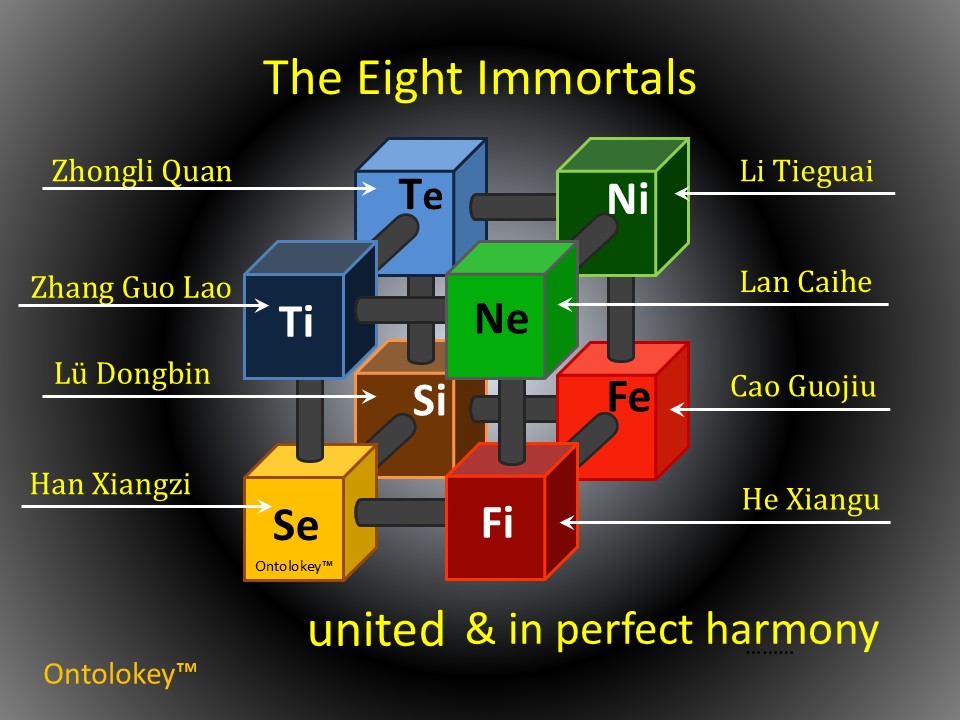
In the Ontolokey model, based on the full eight-function framework of Carl Gustav Jung, these functions are not seen merely as traits, but as living forces within the personality. The Ontolokey Cube visualizes them as eight polar dimensions—each with its own voice, shadow, and wisdom.
This article draws parallels between:
- The Eight Immortals of Chinese mythology
- The Eight Jungian functions
- The Ontolokey Cube
- The Yin-Yang philosophy and Taoist cosmology
and shows how all of them describe one universal truth:
👉 Only when all opposites are reconciled does true psychological harmony arise.
🧩 Eight Immortals – Eight Functions
Each Immortal mirrors one Jungian function:
Li Tieguai (李铁拐) – Ni (Introverted Intuition)
- Symbol: iron crutch, gourd with healing medicine.
- Attributes: protector of the sick and poor, despite his crippled body he possesses immense spiritual power.
- Archetype: healing, compassion, strength through suffering.
- Deep inner knowledge of transience, transformation, and the cycle of life and death.
- A mystical thinker, often detached from the outer world, dwelling in inner visions.
- Embodies resilience and paradoxical wisdom: through suffering (his crippled state) he gains higher insight.
- Psychologically: highly symbolic, visionary, but somewhat estranged from everyday reality.
Zhang Guolao (张果老) – Ti (Introverted Thinking)
- Symbol: a white donkey, often ridden backwards.
- Attributes: eccentric, diviner, associated with alchemy and magic.
- Archetype: paradoxical wisdom, humor, independence.
- An analytical, detached mind that sees through and deconstructs structures.
- Loves paradoxes (his backward-riding donkey symbolizes “thinking against the grain”).
- Psychologically: sharp intellect, questioning, ironic, sometimes eccentric.
- Strives for inner logical clarity, even where the outer world appears chaotic.
Lan Caihe (蓝采和) – Ne (Extraverted Intuition)
- Symbol: flower basket.
- Attributes: often depicted as androgynous, unconventional, slightly mad, patron of musicians and the poor.
- Archetype: nonconformity, artistic freedom, joy of life.
- Playful, creative spirit, constantly generating spontaneous new connections.
- Symbol of freedom, nonconformity, and androgyny – a bridge between opposites.
- Psychologically: open, experimental, unpredictable, often humorous.
- Embodies the childlike-visionary principle that constantly sees new possibilities.
He Xiangu (何仙姑) – Fi (Introverted Feeling)
- Symbol: lotus flower.
- Attributes: the only woman among the Eight; purity, healing powers, protector of women.
- Archetype: maidenly wisdom, purity, asceticism.
- Quiet, introverted sensitivity, oriented toward inner authenticity.
- Embodies purity, inner self-loyalty, and paradoxical asceticism.
- Psychologically: guided by a personal value compass, independent of outer norms.
- Deeply reflective, empathetic, but also somewhat distant and hard to read.
Cao Guojiu (曹国舅) – Fe (Extraverted Feeling)
- Symbol: imperial robes, castanets or jade tablets.
- Attributes: member of an imperial family; represents justice, order, protector of actors and performers.
- Archetype: moral authority, social order.
- Master of etiquette and social harmony.
- His symbols (official garb, castanets) point to order, diplomacy, mediation.
- Psychologically: attuned to social tensions, seeking reconciliatory solutions.
- Embodies the collective conscience and the call for justice.
Lu Dongbin (吕洞宾) – Si (Introverted Sensing)
- Symbol: sword (against demons) and fly-whisk.
- Attributes: the most famous Immortal, teacher of alchemy, known for resisting worldly temptations.
- Archetype: enlightenment, self-discipline, spiritual guidance.
- Embodies memory, tradition, and grounding in the physical body.
- His role as teacher shows preservation of experience and humility.
- Psychologically: reliable, detail-oriented, patient, with a strong sense of the past.
- Emphasizes care and dedication, often expressed in service.
Zhongli Quan (忠李权) – Te (Extraverted Thinking)
- Symbol: fan, with which he can revive the dead or create gold.
- Attributes: wise elder, often portrayed as a jovial drinker, generous benefactor.
- Archetype: alchemist, abundance, charity.
- Represents structure and order, but also their ironic overturning (he laughs at conventions).
- A practical organizer who gets things done.
- Psychologically: rational, strategic, efficient – but can also be strict or mocking.
- Symbolizes the handling of power, authority, and social order.
Han Xiangzi (韩湘子) – Se (Extraverted Sensing)
- Symbol: flute.
- Attributes: musician and poet, makes flowers bloom and fruits ripen.
- Archetype: art, harmony with nature, lightness of being.
- Embodies sensuality, music, art, and immediacy and enjoyment.
- Strongly lives in the present, in the sound and rhythm of life.
- Psychologically: spontaneous, grounded, physically present, sometimes hedonistic.
- Represents acceptance of the world as it is, here and now.
Each figure is rich in symbolism, just like each Jungian function. None is inherently good or bad—balance emerges through cooperation.
🌐 Taoist Harmony & the Ontolokey Cube
Taoism teaches that harmony (道 Tao) is not reached by dominance of one side, but by the balanced interaction of opposites—Yin and Yang, light and shadow, activity and receptivity.
In Lao Tzu’s Tao Te Ching, there are allusions to what would later become the Bagua (八卦)—eight trigrams composed of broken and unbroken lines. This octagonal structure mirrors the Ontolokey Cube: eight orientations of consciousness, structured along polarities such as intuition vs sensation, feeling vs thinking, introversion vs extraversion.
The flag of South Korea even embeds this cosmology: a Yin-Yang symbol in the center, surrounded by four of the eight trigrams, each representing a polarity of reality. It is a cosmic personality map—just like Ontolokey.
🧠 Why This Matters for Psychology
Most typology systems focus only on four functions—what we consciously identify with. But what about the rest? What about our shadows, blind spots, dreams, and projections?
Ontolokey shows that only by integrating all eight functions—as if inviting all eight Immortals to the table—can a personality become whole. Imbalance leads to inner conflict, one-sidedness, even pathology.
The Eight Immortals’ journeys reflect this process: facing fears, transforming suffering, and ultimately achieving immortality—not as escape from the world, but as psychological transcendence through integration.
🔮 The Way Forward
Modern psychology often looks to the West—Freud, Jung, Adler. But ancient systems like Taoism and Chinese mythology offer equally rich insights. Ontolokey provides a bridge between these worlds.
It is time to:
- Honor both myth and model
- See personality as living architecture
- And recognize that true mental health is not about control, but about inner dialogue among the eight.
Just as the Eight Immortals are most powerful when united, so too is the self most alive when every function has a voice.

 Ontolokey
Leave a comment